What Is Marketing Investment? (what is marketing investment) A Practical Guide
Let's get one thing straight. A marketing investment isn't just about how much money you throw at ads. It's the total sum of your resources—your budget, your tech, and your people—all strategically aimed at one thing: bringing in and keeping customers profitably.
When you start thinking this way, you stop treating marketing as just another line-item expense. Instead, you see it for what it is: the engine that drives sustainable growth for your business.
Thinking Beyond Ad Spend
For far too long, marketing has been seen as a cost center. It's often the first budget to get slashed when times get tough. The conversation usually revolves around a single question: "How much are we spending on ads?" But that question misses the point entirely.
A genuine marketing investment is a complete system for building value, not just a bill you have to pay.
Imagine you're building a high-performance race car. You could have a tanker full of the most expensive, high-octane fuel, but what good is it if the car itself is a wreck? To win the race, you need a powerful engine, a sleek design, and a world-class driver behind the wheel. The fuel is just one part of the equation.
The Components of a Winning Formula
That same logic applies directly to your marketing. A winning strategy carefully balances several crucial parts, each with a specific job to do.
The Fuel (Media Spend): This is the most obvious part of your investment—the cash you put into platforms like Meta, Google, and TikTok to get in front of your audience.
The Vehicle (Creative Development): This is what actually turns heads. Your ad copy, images, and videos are the vehicle carrying your message. If your creative is weak, you're just burning fuel for no reason.
The Engine (Marketing Technology): This is the performance hardware. Your analytics, automation, and optimization tools—like SpendOwlAI—are what make sure every dollar works as hard as it possibly can.
The Driver (The Human Element): This is the expert in the driver's seat. Your marketing team or agency brings the strategic know-how to read the data, identify opportunities, and make the right calls at the right time.
Viewing your marketing through this investment lens is a major competitive advantage. It forces you to move beyond chasing vanity metrics and focus on building a sustainable system for growth, where every dollar is deployed with purpose and measured by its contribution to the bottom line.
If you skimp on any one of these areas, you create a bottleneck that holds the entire system back. A huge ad budget can be completely wasted by terrible creative, just as a brilliant team can be crippled by outdated tech. Understanding what is marketing investment in this holistic way is the first step toward turning your marketing from a cost center into your most powerful growth asset.
The Four Pillars of Modern Marketing Investment
When you start treating marketing as an investment, you stop seeing it as just another line item on a budget. You begin to see it for what it truly is: a portfolio of assets working together to drive real growth. A smart marketing investment strategy is built on four distinct but deeply connected pillars.
Understanding these pillars helps explain why simply throwing more money at ads—a very common tactic—rarely leads to better results. Real success comes from a balanced allocation across all four areas. It's like a championship-winning race team; you need a whole lot more than just fuel to get across the finish line first.
This concept map shows how these four pillars come together to form a complete marketing investment strategy.
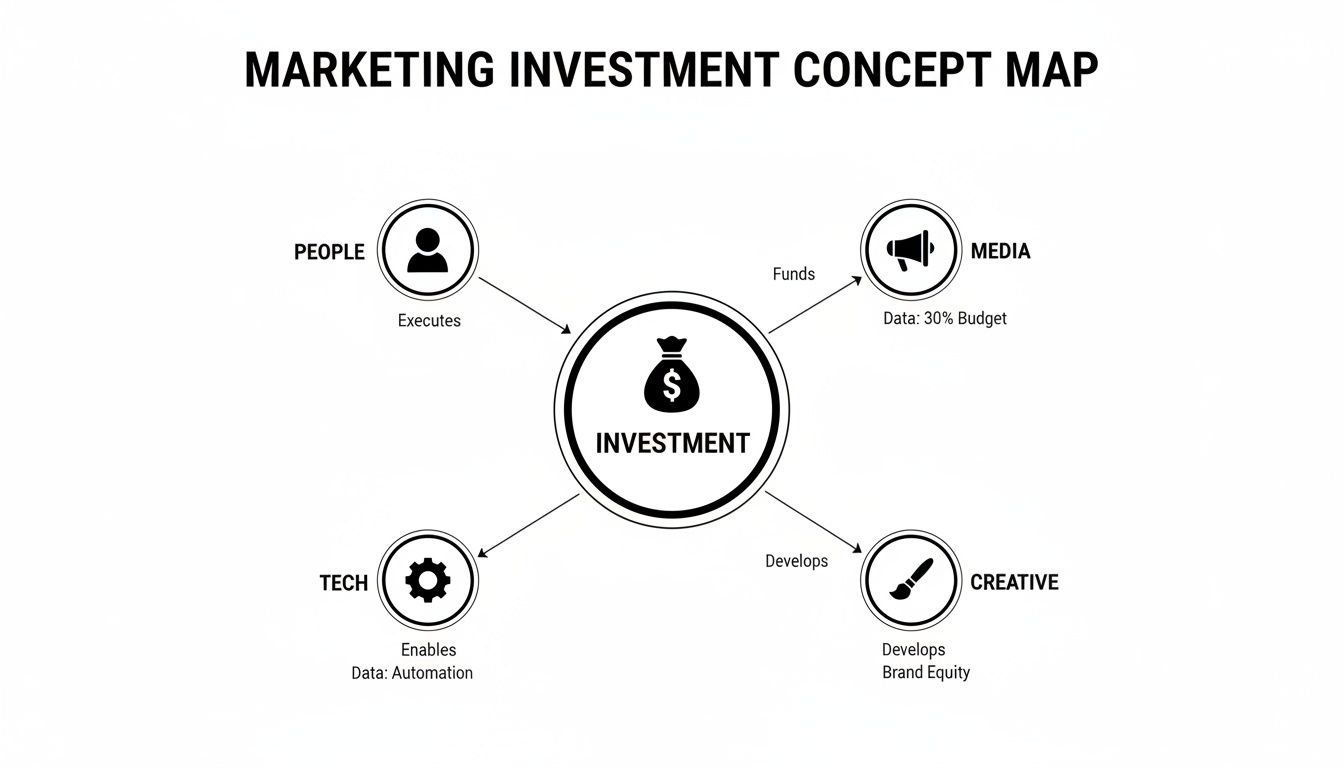
As you can see, a true investment is a blend of Media, Creative, Technology, and People. Each one plays a critical role in hitting your growth targets. Let's break down what each of these pillars looks like in practice.
Here's a quick overview of how these four components work together to form a holistic strategy.
Breaking Down the Four Pillars of Marketing Investment
Pillar | Strategic Role | Common Examples |
|---|---|---|
Media Spend | The "fuel" that gets your message in front of your audience. It provides reach and visibility. | Google Ads campaigns, Meta (Facebook/Instagram) ads, podcast sponsorships, affiliate commissions. |
Creative | The "vehicle" that carries your message. It's what captures attention and persuades customers. | Ad copy and design, video production, landing page development, branding assets, user-generated content. |
Technology | The "engine" that powers and optimizes your efforts. It provides data, automation, and efficiency. | Analytics platforms (Google Analytics), CRM software (HubSpot), ad management tools (SpendOwlAI), email marketing services. |
People | The "driver" who pilots the entire operation. This is the expertise that turns resources into results. | In-house marketing team salaries, agency fees, freelance strategist costs, training and development. |
Each pillar is essential. Neglecting one will always undermine the effectiveness of the others, no matter how much you invest elsewhere.
Media Spend: The Fuel
When most people talk about marketing spend, they’re usually thinking of media spend. This is the money you pay advertising platforms to put your message in front of your target audience. Think of it as the high-octane fuel for your marketing engine.
Without it, you have no reach and no momentum. But fuel by itself doesn't guarantee a win. Pouring millions into ads is a complete waste if the message is off or the delivery is inefficient.
This pillar includes all your paid placements, such as:
Social Media Ads: Campaigns on platforms like Meta, TikTok, and LinkedIn.
Search Engine Marketing (SEM): Bidding on keywords through Google Ads and Microsoft Advertising.
Sponsorships: Paying for brand placement in popular newsletters, podcasts, or at industry events.
Creative Development: The Vehicle
If media spend is the fuel, then your creative is the vehicle it powers. This covers every asset your audience sees, hears, and engages with—your ad visuals, your videos, the copy on your landing pages, and your overall branding.
Great creative is what grabs attention, explains your value, and ultimately convinces a potential customer to take action. A well-designed vehicle can make a small amount of fuel go an incredibly long way. On the other hand, weak creative will cause even the most generously funded campaign to sputter and stall. Underinvesting here is a classic mistake that directly sabotages the media budget.
Investing in creative isn't just about making things look pretty. It's about building a vehicle that can actually travel the distance, connect with your audience, and deliver your message in a way that truly resonates and converts.
Marketing Technology: The Engine
Your marketing technology (or martech) is the engine that makes the whole operation run efficiently. These are the software tools and platforms that empower you to measure, automate, and optimize everything you do.
Your martech stack is what gives you the data and capabilities to make smart decisions, from tracking customer journeys to managing complex campaigns at scale. Without a solid engine, you're essentially driving blind, leaking resources, and leaving your performance entirely to chance.
Recent data shows just how critical this pillar has become. A Deloitte study of nearly 1,400 marketing leaders revealed that organizations prioritizing martech investment saw an 18% greater sales lift from their marketing efforts and 7% higher overall revenue growth compared to those stuck on traditional media spend. Despite this, a staggering 61% of budgets are still dictated by rigid, top-down mandates, highlighting a huge gap between what works and what actually gets funded. You can dive deeper into these 2025 marketing investment trends on Deloitte.com.
The Human Element: The Driver
Finally, we have the human element—the skilled driver sitting behind the wheel. This pillar is all about the talent, strategic insight, and day-to-day expertise of your marketing team, agency partners, and freelance specialists. These are the people who analyze the data, spot the opportunities, and navigate the ever-changing competitive landscape.
Your team pilots the entire system. They use the engine (tech) to fine-tune the fuel (media) that powers the vehicle (creative). An expert driver can win a race even with an average car, but a novice will crash the best machine on the track. That’s why investing in top talent and continuous training isn't an "overhead cost"—it's a foundational part of your marketing investment.
How to Measure Your Marketing Investment Success
If you’re spending money on marketing but not measuring it, you're not really investing—you're just hoping for the best. To know if your investment is actually working, you have to move beyond gut feelings and get comfortable with the numbers that tell the real story.
This isn't about getting lost in spreadsheets. It's about understanding the handful of key metrics that reveal what’s working, what’s not, and where your biggest opportunities are hiding. Mastering these is how you turn marketing spend into a predictable engine for growth.

Let's break down the four most important metrics every e-commerce operator should have on their dashboard. When you see how they connect, you get a complete picture of your marketing health.
ROAS (Return on Ad Spend)
First up is Return on Ad Spend (ROAS). Think of this as your front-line, in-the-trenches metric. It gives you a quick, direct answer to the question: "For every dollar I put into ads, how many dollars in revenue came back out?"
It's a tactical metric, perfect for judging the daily performance of specific campaigns on platforms like Meta or Google.
The formula is simple:
ROAS = Total Revenue from Ads / Total Ad Spend
So, if you spend $1,000 on a Google Ads campaign and it brings in $4,000 in sales, your ROAS is 4x (or 400%). For most e-commerce brands, a 4x ROAS is a solid benchmark, but this number can shift depending on your industry and profit margins.
But here’s the catch: relying only on ROAS is a classic mistake. It only looks at your media spend and completely ignores everything else—the cost of creative, your tech stack, and your team.
ROMI (Return on Marketing Investment)
This is where Return on Marketing Investment (ROMI) comes in. ROMI zooms out from the campaign level to give you a strategic, big-picture view of your marketing's true profitability. It measures the return on your entire marketing investment, not just the ad budget.
The calculation is naturally more involved:
ROMI = (Marketing-Driven Revenue - Total Marketing Investment) / Total Marketing Investment
Let's say you brought in $50,000 in revenue last quarter. Your total marketing investment was $31,000, which included $10,000 on ads, $5,000 for creative, $1,000 for marketing software, and $15,000 in salaries. Your ROMI would be ($50,000 - $31,000) / $31,000, which equals 0.61, or a 61% return. For a closer look, you can learn more about how to properly define marketing ROI.
CAC and LTV: The Two Sides of Growth
While ROAS and ROMI are focused on revenue, two other metrics are vital for understanding profitability at the customer level: Customer Acquisition Cost and Lifetime Value.
Customer Acquisition Cost (CAC): This is the total price you pay to get one new customer. To find it, you divide all your marketing and sales costs over a set period by the number of new customers you acquired in that time. It's the "cost" side of the growth equation.
Lifetime Value (LTV): This metric forecasts the total revenue you can expect from a single customer over their entire relationship with your brand. It represents the "value" side of the equation—the total worth of that customer over time.
The relationship between these two numbers is what ultimately determines if your business is built to last. A healthy business needs its LTV to be much higher than its CAC. The gold standard is a 3:1 ratio—meaning your customers are worth at least three times what you paid to acquire them.
If your CAC is $50 but your LTV is only $45, you're losing money with every new customer, even if your daily ROAS looks great. That’s why focusing only on ROAS is like judging a new friendship by the cost of the first coffee; you're missing the long-term value completely. True success lies in balancing short-term wins with building a base of profitable, long-term customer relationships.
Building an Agile Marketing Budget for Maximum Growth
Knowing your numbers is one thing. Having the confidence to act on them is what separates fast-growing brands from the rest. The old way of doing things—setting a marketing budget once a year and sticking to it no matter what—is a surefire way to leave money on the table.
Think of your marketing budget less like a fixed expense and more like a dynamic investment portfolio. The best marketers are constantly moving capital toward the channels and campaigns that deliver the best returns.
This agile approach means ditching rigid, top-down plans. Instead, you build a framework that adapts in real-time, guided by performance signals like ROAS, CAC, and LTV. Let’s look at a few common ways to set a budget and how they fit into a modern, growth-focused strategy.
Common Budget Allocation Models
How you decide your starting budget really depends on your business stage and overall goals. None of these models are a perfect one-size-fits-all solution, but understanding the pros and cons of each helps you build a smarter, more blended approach.
Percentage-of-Revenue: This is the most straightforward method. You simply dedicate a set percentage of your company's revenue—say, 10%—to marketing. It’s easy and predictable, but it can hold you back when you need to spend aggressively to fuel a growth spurt.
Competitive Parity: With this model, you're essentially matching your budget to what your competitors are spending. It can help you maintain your "share of voice" in the market, but it’s a dangerous game. It assumes your competitors actually know what they’re doing and that their goals perfectly align with yours.
Objective-and-Task: This is by far the most strategic way to build a budget. You start with a clear business goal (like "acquire 5,000 new customers"), map out all the tasks required to hit that goal, and then add up the costs. This method directly connects every dollar you spend to a tangible business outcome.
The most effective strategy often blends these models. You might start with a percentage-of-revenue to set a baseline budget, then use the objective-and-task method to allocate those funds with precision and purpose.
Putting Agile Budgeting into Practice
The real magic happens when your budget stops being a static spreadsheet and becomes a living, breathing document.
Let's imagine a DTC brand is launching a new product with an initial monthly marketing budget of $50,000. Based on what they know about their audience and past campaigns, they create an initial channel mix.
Here’s the starting plan:
Meta (Facebook & Instagram): $25,000 (50%) to build awareness and capture early sales.
Google Ads: $15,000 (30%) to grab traffic from people actively searching for their solution.
TikTok: $10,000 (20%) to experiment with a younger audience.
After just one week, they dive into the data. Meta is doing fine, hitting a 3.5x ROAS. Google is lagging a bit at a 2.8x ROAS. But TikTok is the breakout star, delivering an incredible 5.2x ROAS with a super low CAC. This is a huge signal of product-market fit on that platform.
An agile team doesn't wait for the end-of-month report. They act now. They immediately pull $5,000 from the underperforming Google Ads budget and pump it directly into their winning TikTok campaigns. This simple move allows them to double down on what's working and maximize their overall return on investment.
This is what agility looks like in the real world. To get even more granular, you can check out our guide on using a break-even ROAS calculator to set even smarter performance targets for each channel.
It's not about throwing your plan out the window; it's about having a plan that's designed to evolve. When you monitor performance closely and empower your team to shift funds quickly, your marketing budget transforms from a constraint into your most powerful tool for growth.
How to Optimize Your Spend on the Big Ad Platforms
Knowing your numbers is one thing, but actually putting them to work on the ad platforms you live in every day? That's where the real growth happens. The best marketing investment strategies aren't just high-level theories; they’re built on smart, channel-specific decisions. You have to treat platforms like Meta, Google, and Shopify as interconnected parts of a single growth engine, not separate islands.
For DTC founders and e-commerce teams, bridging the gap between big-picture strategy and daily execution is everything. It’s where you either find efficiency or lose your shirt.
And the ad space isn’t getting any easier. Global advertising spend is on track to grow by 5.9% in 2026, but the digital slice of that pie is surging by 9.2% to grab nearly 63% of all ad budgets. Retail media, with its rich customer data, is leading the pack with an incredible 21.9% year-over-year growth. These trends, highlighted in global ad spend forecasts on dentsu.com, make one thing clear: smart marketing investment isn't just a nice-to-have, it's a matter of survival.
Taming Creative Fatigue and Saturation on Meta
On Meta’s platforms (think Facebook and Instagram), two of the biggest budget killers are creative fatigue and audience saturation. Creative fatigue is what happens when people have seen your ad so many times it just becomes background noise. Your click-through rates (CTR) sink and your costs climb.
Audience saturation is a close cousin. It happens when you’ve already reached most of the high-value people in your target audience, and every dollar you spend from that point on brings back less and less.
A huge part of optimizing your Meta spend is learning to spot these problems before they crater your performance. Don't wait for your ROAS to fall off a cliff. Instead, keep a close eye on leading indicators like a rising frequency score or a falling CTR. When you see those numbers start to move in the wrong direction, it’s your cue to roll out fresh creative or test out new audiences.
Balancing Brand vs. Non-Brand on Google Ads
Optimizing Google Ads is a constant balancing act, especially when it comes to brand and non-brand search campaigns.
Non-brand campaigns—targeting broad keywords like "running shoes"—are your engine for new customer acquisition. The catch? They almost always come with a higher Customer Acquisition Cost (CAC).
Brand campaigns, on the other hand, target your own company name. These capture people who are already looking for you, resulting in cheap, high-ROAS clicks. But they don't bring new people into your world. If you pour too much money into branded search, you can create a false sense of security with an inflated ROAS while your new customer growth stagnates. A healthy Google strategy allocates enough budget to non-brand keywords to fuel real growth while using brand campaigns to efficiently scoop up existing demand.
Using Shopify Data to Fuel Your Ad Strategy
Your Shopify store is a data goldmine, and it should be the foundation of your entire ad strategy. Stop looking at just top-line revenue and start digging into SKU-level performance. Which products have the best profit margins? Which ones do customers buy together?
Use these insights to make smarter decisions on the ad platforms:
High-Margin Products: Put your most profitable items front and center in your top-of-funnel prospecting campaigns. This maximizes your potential return right from the first click.
Best-Sellers: Feature your proven winners in retargeting ads to convince shoppers who are already on the fence.
Slow-Movers: Got inventory that isn't moving? Create a special offer or bundle and promote it to your email list or past customers to clear out stock.
When you connect your actual sales data directly to your ad creative and targeting, you create a powerful feedback loop. This ensures your marketing investment is always tied to real business results, turning platform-specific tactics into a profitable, unified growth strategy. You can dive deeper into how to optimise Facebook Ads using these very principles.
Avoiding the Million Dollar Mistakes in Marketing Spend
Knowing your metrics and setting a smart budget is half the battle. The other half? Avoiding the expensive, high-pressure mistakes that trip up even the most seasoned marketers. Real mastery over your marketing investment isn’t just about making the right moves—it’s about sidestepping the wrong ones.
In the fast-and-furious world of performance marketing, it’s dangerously easy to let emotion and reactivity hijack your budget. These slip-ups often disguise themselves as clever shortcuts but are really just fast tracks to wasted spend and stalled growth. They’re fueled by basic human psychology—fear of missing out, the thrill of a good day, the pressure to deliver—not by data.
Let's break down the most common archetypes of bad spending habits so you can spot them and stop them.
The Gut-Feeling Gambler
First up is the Gut-Feeling Gambler. This marketer runs on instinct, shifting huge chunks of budget based on what feels right. You'll see them pour thousands into a hot new channel because they have a "good feeling" or slash a campaign's budget because it doesn't "seem" to be working—all without a single glance at the data.
The problem here is a total lack of context. Gut feelings completely ignore what crucial metrics like Customer Acquisition Cost (CAC) and Lifetime Value (LTV) are telling you. A campaign might feel slow, but if it's consistently pulling in high-LTV customers at a profitable CAC, cutting its budget is a massive, self-inflicted wound.
The only cure is to build a data-first reflex. Before any big budget change, the first question out of anyone's mouth should be, "What do the numbers say?" This simple habit is what separates instinct-driven gambling from insight-driven investing.
The Reactive Scaler
Next, we have the Reactive Scaler. This person sees one good day—a sudden ROAS spike, a handful of cheap conversions—and immediately decides to triple the ad spend. They're chasing a ghost, mistaking a normal blip for a sustainable trend. It’s a classic case of chasing statistical noise.
Performance data is never a perfect, straight line. It has good days and bad days. Pouring money into a campaign after a single good day is like betting your entire bankroll on one spin of the roulette wheel. Inevitably, performance regresses back to the average, and that extra budget gets burned at a much higher cost per acquisition. You’re left with nothing but an expensive lesson.
To avoid this trap, you need to set up investment guardrails. These are your pre-defined rules for when and how to scale spend. For instance, a simple guardrail might be: "We will only increase a campaign's budget by more than 20% after it has maintained a target ROAS of 3.5x for three consecutive days."
These rules act as a circuit breaker, protecting your marketing dollars from knee-jerk reactions. They enforce the discipline needed to wait for a trend to prove itself before you commit serious money. This is exactly why tools like SpendOwlAI exist—to formalize this process by flagging premature scaling decisions and separating real trends from random noise. By building these systems, you can navigate the daily pressures with confidence and a whole lot less waste.
Frequently Asked Questions About Marketing Investment
Even after you get the hang of the core concepts, making the mental shift from treating marketing as an expense to seeing it as a strategic asset can bring up some very real questions. This is where theory meets reality for founders and marketers trying to make smarter decisions every day.
Let's tackle a few of the most common questions that pop up. Answering them will help lock in the principles of what makes a marketing investment truly work for you.
What Is the Difference Between Spend and Investment?
This is a great question because the two terms seem interchangeable, but they come from completely different mindsets.
Think of marketing spend as the simple, tactical cost of isolated activities. It's the money you pay to run a specific ad campaign or boost a post. It’s transactional.
A marketing investment, on the other hand, is the big-picture, strategic view. It includes everything—media spend, creative production, your tech stack, and even your team's salaries—all working in concert. This approach sees your marketing function as a growth engine for the business, not just another line item on a spreadsheet.
In short: Spend is what you pay. Investment is what you build. One is a temporary cost, while the other is an asset designed to generate returns long into the future.
How Much Should a Small Business Invest in Marketing?
There’s no single magic number, but there are a couple of solid frameworks to get you started. A common one is the percentage-of-revenue model. Here, you simply dedicate a set portion of your total revenue to marketing, which often falls somewhere between 7% and 12%. It’s straightforward and helps your budget scale up or down with your business's performance.
A more goal-oriented approach, however, is the objective-and-task method. This is where you work backward from a specific goal.
Define your objective: For instance, "acquire 1,000 new customers this quarter."
List the tasks needed: This might involve launching new Meta campaigns, producing a series of video ads, and bumping up your Google search budget.
Calculate the total cost: Add up the price of every task on your list. That final number is the investment you need to make.
This method is powerful because it ties every dollar directly to a business outcome, ensuring your budget is purpose-built.
Which Is a Better Metric: ROAS or ROMI?
I hear this one all the time. The answer is that you absolutely need both. They aren’t competing metrics; they’re partners that tell you different, equally important, parts of the story.
ROAS (Return on Ad Spend) is your tactical, in-the-trenches metric. It's perfect for getting quick, specific feedback on how a single campaign, ad set, or channel is performing. You'll use ROAS for daily or weekly optimizations, like deciding whether to shift budget from one ad to another.
ROMI (Return on Marketing Investment) is your strategic, 30,000-foot-view metric. It zooms out to measure the profitability of your entire marketing engine, factoring in all the costs for tech, creative, and people. You'll lean on ROMI for quarterly and annual planning to answer the big question: "Is our overall marketing strategy creating real value for the company?"
Think of it this way: ROAS tells you if an ad is working. ROMI tells you if your marketing department is working.
Tired of making marketing decisions based on gut feelings and messy data? SpendOwlAI gives you the clarity and guardrails needed to transform reactive spending into a confident, data-backed investment strategy. Stop guessing and start executing with precision. Try our free 7-day trial and see the difference for yourself.