Optimise Facebook Ads for Maximum ROAS and Performance
If you want to get serious about optimising your Facebook ads, you have to stop making reactive, gut-driven changes. The best media buyers operate with a systematic workflow. It’s a process of diagnosing performance issues before making any edits, prioritising changes based on their potential impact, and setting firm guardrails to avoid common mistakes like over-editing.
This structured approach is what turns noisy data into clear, actionable insights for stable growth.
A Modern Framework for Facebook Ad Optimisation
Relying on instinct to manage your Meta ad campaigns is a surefire way to burn through your budget and get inconsistent results. Top-tier performance teams don’t just react to a bad day; they follow a disciplined process that separates the signal from the noise.
This isn't about staring at more dashboards. It's about building a clear, defensible system for making fewer, but much better, decisions that actually drive measurable growth. The whole thing is built on a simple, powerful, three-part flow.
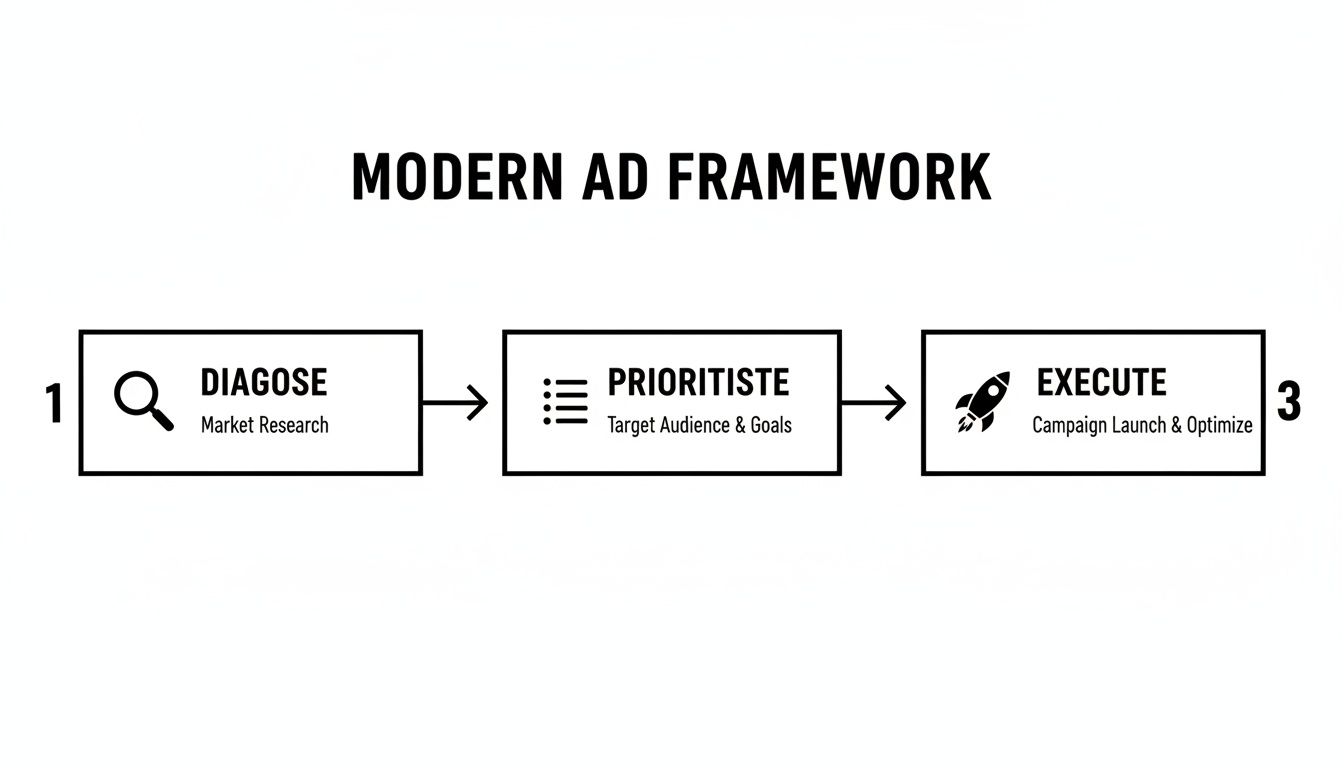
Following a process like this ensures every action you take is deliberate and backed by data. You move logically from identifying the root cause to implementing the highest-impact solution.
From Reactive Tinkering to Proactive Management
So many advertisers fall into a dangerous cycle of constant tweaking. They see a dip in Return On Ad Spend (ROAS), panic, and immediately start swapping out ad copy, changing audiences, or messing with budgets. This usually does more harm than good. It can reset Meta's learning phase over and over, muddying the data and making it impossible to know what actually worked.
A structured framework is your defense against this kind of self-sabotage. It forces you to be methodical. Instead of asking, "What should I change?" you start by asking, "What is the data telling me is broken?" This simple mental shift is the foundation of effective ad optimisation.
The goal is to build a system of confident patience, letting data guide your hand. You’ll stop chasing daily fluctuations and start focusing on meaningful trends that impact long-term profitability and scale.
The Three Pillars of Sustainable Growth
This guide will walk you through the essential components of a modern workflow for anyone serious about optimising their Facebook ads. We'll focus on building a repeatable system you can apply daily and weekly to keep your account healthy and push performance forward.
Diagnose Before Acting: First, you’ll learn to read your key performance indicators (KPIs) to find the real source of a problem. Is it creative fatigue? Audience saturation? Or something else entirely?
Prioritise for Impact: Next, you need to understand the hierarchy of edits. Not all changes are created equal. Knowing whether to focus on creative, targeting, or budget first is critical for efficiency.
Execute with Discipline: Finally, you implement changes based on clear evidence and use guardrails to avoid common blunders. This includes knowing when to scale and, just as importantly, when to sit on your hands and do nothing.
By mastering this workflow, you’ll transform from a reactive manager into a strategic operator. This system provides the clarity and confidence needed to not only fix underperforming campaigns but also to successfully scale your Facebook ads with predictable results.
Diagnosing Performance Dips Before You Act
When your Return On Ad Spend (ROAS) suddenly tanks, the gut reaction is to panic and start changing things. Don't. A drop in ROAS isn't the problem; it's just a symptom.
The biggest mistake I see advertisers make is reacting to the symptom without understanding what’s actually broken. Before you even think about touching a campaign setting, you need to put on your detective hat and figure out why performance shifted. Rushing to slash budgets or swap audiences is like trying to fix an engine without popping the hood. You might get lucky, but you'll more likely reset Meta's algorithm and make things worse.

Creative Fatigue vs. Audience Saturation
More often than not, the culprit is one of two usual suspects: creative fatigue or audience saturation. They can look similar on the surface, but a quick look at your metrics will tell you exactly which one you’re dealing with.
Creative Fatigue: This is what happens when your audience has seen your ad so many times they’ve gone blind to it. The classic sign is a declining Click-Through Rate (CTR) and a rising Cost Per Click (CPC). Your ad just isn't stopping the scroll anymore.
Audience Saturation: This means you've pretty much reached everyone in your target audience. The tell-tale sign here is Frequency. If you see your ad frequency climbing past 4 or 5 while your CTR is holding steady, you've probably tapped out that audience pool.
Knowing the difference is everything. The fix for fatigue is refreshing your creative. The fix for saturation is finding new audiences.
Stop guessing. The most effective way to optimise Facebook ads is to isolate the variable that's causing the problem by looking at the relationship between your primary and secondary metrics. This data-driven approach turns a vague problem like "low ROAS" into a specific, solvable issue.
Reading the Signals from Your Key Metrics
Think of your ad metrics as a story. Each KPI is a clue, and when you put them together, they reveal the plot. Let's say your cost per acquisition (CPA) has spiked. What's really going on?
You have to look at the supporting cast of metrics to find the source.
Is CTR down? Your ad creative is probably the issue. Time for a refresh.
Is Cost Per Mille (CPM) up? This points to more competition in the auction. Maybe a competitor just launched a big sale, or you’re targeting a high-value (and thus expensive) audience. Time to review your bidding strategy.
Is Conversion Rate (CVR) down? If people are clicking but not converting, the problem might not even be your ad. The issue could be your landing page, your offer, or a broken checkout flow.
This kind of diagnostic thinking stops you from blaming your creative when your website is the real problem. In today’s ad environment, this holistic view is non-negotiable. It's gotten so competitive that in major markets, 65% of advertisers now dedicate 30% of their budgets to retargeting, with accuracy increasingly reliant on tools like the Conversions API. To get a better sense of this landscape, it's worth checking out the latest findings on Facebook ad statistics.
To make this process easier, I've put together a quick diagnostic table. When you see a problem, find the symptom in the left column and check the primary metric to see what's likely causing it.
Common Facebook Ad Symptoms and Potential Causes
Symptom (What you see) | Primary Metric to Check | Potential Cause 1: Creative | Potential Cause 2: Audience | Potential Cause 3: Bidding/Budget |
|---|---|---|---|---|
High CPA / Low ROAS | Check all secondary metrics | CTR is low. Ad is no longer compelling or relevant. | Frequency is high. Audience is exhausted. | CPMs are rising due to auction competition. |
Low Traffic / Clicks | Click-Through Rate (CTR) | The ad's hook or visual isn't stopping the scroll. | The audience isn't a good match for the creative's message. | Your bid isn't competitive enough to win placements. |
High Ad Spend, Few Results | Cost Per Mille (CPM) | Your ad has low engagement, so Meta charges more to show it. | You're targeting a very small or high-demand audience. | Auction competition has increased, driving up costs for everyone. |
Clicks Are High, But Sales Are Low | Conversion Rate (CVR) | Ad message doesn't match the landing page offer. | You're targeting an audience that is low-intent. | N/A - This is a post-click issue. |
This table isn't exhaustive, but it covers the most common scenarios and should point you in the right direction, preventing you from making changes that don't address the root cause.
A Quick Diagnostic Checklist
Before you make a single edit, run through this mental checklist. This simple process will help you pinpoint the real issue quickly.
Check the Time Window: Are you reacting to a 24-hour blip or a 7-day trend? Never make big decisions based on short-term volatility.
Analyze Creative Metrics: How are CTR and CPC trending? This is always your first stop for diagnosing ad relevance.
Review Audience Metrics: What's your Frequency? Is it creeping up past a healthy level for your campaign objective?
Examine Auction and Bidding: Have CPMs jumped suddenly? This often points to external market factors you can't control but need to adapt to.
Evaluate Post-Click Performance: Don't forget your landing page. A drop in your website's conversion rate will kill your ROAS, even if your ads are perfect.
So, you’ve figured out what’s causing the performance dip. Now what? The biggest mistake I see advertisers make is jumping straight to the complex stuff—fiddling with bid strategies or shuffling budgets around when a simple ad swap would have done the job ten times over.
To get the best results, you need a clear pecking order for your edits. Think of it as a triage system for your ad account. You always start with the change that will deliver the biggest, fastest lift.

Priority 1: Always Start with Creative
Your ad creative is, without a doubt, the most powerful lever you can pull. It’s what grabs attention, sets the tone, and ultimately drives your Click-Through Rate (CTR) and Cost Per Click (CPC). No amount of genius-level audience targeting can save a boring, stale, or irrelevant ad.
If your data is screaming "creative fatigue"—think declining CTRs and rising CPCs—then refreshing your ads is your non-negotiable first move. And I don't mean just duplicating an old ad and tweaking the headline. You need to bring fresh concepts to the table.
Here are a few high-impact creative tests to run first:
Test a New Hook. Change the first three seconds of your video. Rewrite the main headline on your image ad. That's your one shot to stop the scroll.
Swap the Format. If you've been hammering static images, try a snappy video or a carousel. On the flip side, sometimes a clean, direct image can cut through the noise better than a flashy video.
Switch Up the Angle. Rework the core message. Instead of listing features, try leading with a specific customer pain point or a surprising benefit they hadn't considered.
Getting that initial engagement is everything. For a much deeper look at this, our guide on how to improve your click-through rate is the perfect next read. It’s a critical piece of the puzzle for lowering your costs.
Priority 2: Refine Your Audience
Only after you've addressed creative should you start looking at your audience. Why? Because a killer ad can often make a mediocre audience work, but the reverse is almost never true. The goal here is to make smart tweaks without shocking the system and forcing Meta's algorithm back to square one.
If your diagnosis was audience saturation—you're seeing a high frequency but your CTR is holding steady—it’s time to find some new people.
Try these audience refinement tactics:
Expand Your Lookalikes. If a 1% Lookalike is working but tapped out, test a broader 3% or 5% audience. You bring in new users but keep that thread of similarity to your best customers.
Explore New Interest Stacks. Build entirely new audiences. If you were targeting people who follow your competitors, try targeting users interested in complementary brands or publications.
Use Your Exclusions. Make sure you’re consistently excluding recent buyers and converters. It’s a simple check, but it’s amazing how much budget is wasted showing ads to people who already bought.
Pro tip: Resist the urge to make drastic changes to a live ad set's targeting. It's almost always better to duplicate the ad set and test the new audience there. This keeps the data and learnings from your original ad set intact.
Priority 3: Adjust Budget and Bidding Last
Think of your budget and bidding strategy as the gas pedal, not the steering wheel. These are scaling tools, not fixes for a fundamental problem. You should only be touching these after you have a winning combination of creative and audience. Trying to pump more money into a campaign with a failing ad is a recipe for disaster.
Premature or overly aggressive budget hikes are one of the fastest ways to destabilize an account. A 20% budget increase every 2-3 days is a solid rule of thumb to avoid sending the algorithm into a frantic and expensive relearning phase.
So, when is the right time to adjust your budget or bid?
When you're scaling winners. If an ad set is hitting your CPA or ROAS goals for several days straight, it’s earned a gradual budget increase.
When you need to control costs. If rising CPMs are pushing your costs up, you might consider setting a bid cap or cost cap to enforce profitability.
When you’re ready to let the machine drive. For campaigns with plenty of conversion data, shifting to Advantage+ can unlock a new level of performance by giving Meta more control.
By sticking to this hierarchy—Creative, then Audience, then Budget—you focus your energy where it actually counts. It’s a systematic approach that pulls you out of the weeds of chasing daily fluctuations and helps you build a repeatable process for real growth.
Getting Retargeting Right: From Warm Lead to Conversion
Prospecting brings people to the party, but retargeting is where you actually close the deal. These are your warm audiences—the folks who’ve browsed your site, engaged with a post, or even filled a shopping cart. When you get this part right, it can easily become the most profitable corner of your ad account.
But when you get it wrong? You'll just annoy your best potential customers and burn through your budget fast.
Effective retargeting isn't about blasting a generic ad at every person who visited your site in the last 30 days. The real goal is to guide people from a place of general awareness to a specific, timely purchase. That means getting granular and segmenting your audience based on what they actually did.
Look Beyond "All Website Visitors"
A lazy, one-size-fits-all approach is a surefire way to get ignored. Your most valuable audiences, the ones closest to converting, deserve a more thoughtful strategy. Instead of lumping everyone into one big bucket, you need to break them down by behavior.
Here are a few of the core retargeting audiences I always build first:
Cart Abandoners (Last 7 Days): These are your hottest leads, period. They were just one click away from buying. Your ads here should tackle common objections head-on—maybe it's shipping costs or just a moment of distraction. A small incentive or a reminder can often be all it takes.
High-Value Page Visitors: Someone who lingered on your pricing page or viewed a specific product three times is sending a massive signal of intent. The creative you show them should be tailored to that exact product or service category they were so interested in.
Multi-Visit Non-Converters: That person who keeps coming back to your site—maybe three or more times—but hasn't pulled the trigger yet? They're clearly interested but still have some hesitation. This is the perfect audience for trust-building content like customer testimonials, case studies, or a UGC showcase.
When you segment this way, you can finally match your message to where someone is in their journey. Your ads start feeling genuinely helpful, not just intrusive.
Don’t just retarget visitors; retarget their intent. The difference between showing a generic brand ad and an ad for the exact product they left in their cart is the difference between being ignored and making a sale.
How to Structure Your Retargeting Funnel
Once you have your segments, you need to layer them logically. The key is managing your budget and exclusions carefully to avoid showing the wrong ad to the right person. Think of it like a waterfall.
You start with your absolute highest-intent audience (like cart abandoners) and give them the most attention. Then, you work your way down to the broader, less-engaged groups, always making sure to exclude the people from the higher-intent tiers.
A Simple, Effective Funnel Structure:
Ad Set 1: Cart Abandoners (3-Day Window)
Budget: Highest Priority
Creative: Use Dynamic Product Ads to show them the exact items they left behind. It's incredibly effective.
Exclusions: Anyone who has purchased in the last 30 days.
Ad Set 2: Viewed Content / Added to Cart (14-Day Window)
Budget: Medium Priority
Creative: Carousel ads showcasing best-sellers or ads highlighting the benefits of a specific product category work well here.
Exclusions: Purchasers AND the "Cart Abandoners (3-Day)" audience.
Ad Set 3: All Website Visitors (30-Day Window)
Budget: Lowest Priority
Creative: This is where you can run brand-level ads focused on your unique value proposition or strong social proof.
Exclusions: Purchasers AND both audiences from Ad Sets 1 & 2.
This tiered setup makes sure you aren't wasting money showing a generic brand ad to someone who abandoned their cart an hour ago. It keeps your messaging laser-focused and your ad spend efficient. The power of this approach is undeniable. In fact, focused retargeting can deliver 10x better conversion rates than cold prospecting, a massive advantage for any team chasing ROAS. It's so effective that global brands now reach 2,417 users for every $10 spent on retargeting, a 5% increase year-over-year. You can dig deeper into the impact of these advertising trends to see just how much it outperforms other platforms.
Fighting Off Ad Fatigue
The biggest risk in retargeting is burning out your audience. You’re hitting a much smaller, finite group of people, which means they’ll see your ads way more often. Once your frequency starts creeping above 5 in a 7-day period, you're in the danger zone. You risk annoying people so much they start hiding your ads.
The best defense is a good offense: keep your creative fresh and use smart exclusion rules. I always have 2-3 different ad concepts ready to go for each retargeting segment. The moment I see performance start to dip or frequency tick up, I swap in a fresh ad. This simple discipline will dramatically extend the life and profitability of your retargeting campaigns.
Implementing Guardrails to Prevent Self-Sabotage
Let's be honest: one of the biggest threats to a healthy ad account isn't a competitor or a sneaky algorithm update. It's us. The well-intentioned, slightly-too-eager-to-tweak manager. In our constant drive to optimise Facebook ads, it’s incredibly easy to over-edit, constantly kicking the algorithm's learning process back to square one and making things worse.
The answer is to build a system of guardrails. Think of it as a set of non-negotiable rules and data thresholds that stop you from acting on impulse. This isn't about being lazy; it's about being disciplined. You decide what's normal and what's a real problem before you're staring at a down day, ensuring every move you make is backed by data, not panic.

Why Tiny, Frequent Edits Are So Damaging
Meta's ad algorithm is a powerful learning machine, but it's also a sensitive one. Every time you make a significant edit to an ad set—changing the targeting, swapping the creative, or even nudging the budget—you risk resetting its learning phase. When that happens, the algorithm is forced to start over, burning through your time and money to re-learn what was working.
If you’re constantly tinkering, you trap your campaigns in a state of perpetual learning. The system never gets enough consistent data to truly figure out who to show your ads to. This is exactly why a campaign that was humming along nicely can suddenly fall off a cliff after a few "harmless" adjustments. The damage isn't from one change, but from the cumulative effect of all that disruption.
The most disciplined advertisers I know have learned that often, the best action is no action at all. The goal is to let the algorithm do its job. We only step in when there's a clear, data-backed reason to do so. Patience literally pays in this game.
Setting Your Metric Thresholds
To stop yourself from self-sabotaging, you first need to define what "normal" looks like for your account and what's a genuine red flag. These numbers will be unique to your business, but you can use this framework as a starting point.
ROAS Volatility: A daily ROAS of 2.1 one day and 1.9 the next isn't a crisis; it's just Tuesday. Instead of daily swings, look at your 3-day or 7-day rolling average. A sustained drop of 20% or more over a 3-day period? Okay, now it's time to investigate. A single bad day is just noise.
Ad Frequency: For prospecting campaigns, if your frequency starts creeping past 2.5 in a 7-day window, your audience might be getting stale. For retargeting, a frequency over 5.0 in that same period is a massive warning sign of ad fatigue.
Cost Per Acquisition (CPA): Just like with ROAS, don't overreact to a daily spike. Establish your target CPA and an acceptable ceiling (say, 15% above target). Only start digging if the 3-day average CPA smashes through that ceiling.
These aren't gospel, but they are a solid place to start. The crucial part is to actually write your rules down and stick to them. Create that essential buffer between seeing the data and taking action.
The Discipline of A/B Testing
Gut feelings have absolutely no place in A/B testing. A test exists for one reason: to get a statistically significant result that proves which variable performs better. Calling a test early because one ad has a slightly lower CPA after 24 hours is a classic rookie mistake that leads you nowhere.
To run a test with discipline, you need a clear protocol.
Isolate One Variable: Test one thing at a time. Seriously. If you test a new creative and a new headline, you'll have zero clue which element actually made the difference. Test creative vs. creative, or audience vs. audience. Never both.
Define Your Success Metric: Before you even think about hitting "Publish," decide what winning looks like. Is it the lowest CPA? The highest CTR? Better ROAS? Don't move the goalposts halfway through the test just because one metric looks good.
Wait for Statistical Significance: This is the big one. Don’t declare a winner until you have enough data. A good rule of thumb is to wait for at least 1,000 impressions per variation, and ideally 50 conversions per variation. When in doubt, pop your numbers into a statistical significance calculator to confirm the result before you act.
This structured process ensures that when you finally do make a change, it’s based on solid evidence, not a hunch. By setting up these guardrails, you’re protecting your campaigns from your own best intentions, giving them the stability they need to find their groove and deliver results.
Your Daily and Weekly Optimisation Rhythm
Knowing the theory is one thing, but getting consistent results comes down to discipline. You need a repeatable routine. This is how you turn all those abstract concepts into a concrete workflow that lets you optimize your Facebook ads without getting lost in the weeds or making emotional, knee-jerk decisions.
A structured cadence for checking your account ensures you spot problems before they snowball, make smart decisions on a predictable schedule, and resist that constant temptation to tinker. This isn't about gluing yourself to Ads Manager all day. It's about being ruthlessly efficient—knowing exactly what to look for, when to look, and just as importantly, what to ignore.
Let's break this down into two simple cadences: the quick daily health check and the more thoughtful weekly deep dive.
The Five-Minute Daily Health Check
Your daily check-in is not the time for deep strategic thinking. The goal is simple: make sure nothing is on fire.
You're just looking for big, glaring anomalies that need immediate attention, not tiny performance dips. Overreacting to minor daily fluctuations is the fastest way to sabotage your own campaigns.
Here’s what your daily scan should cover:
Disapproved Ads or Account Errors: This is always stop number one. Are there any red flags from Meta? A single disapproved ad can kill an entire campaign's momentum, so you need to jump on it right away.
Sudden Spend Spikes: Glance at your total spend for the day. Is it pacing like you'd expect? If you see a massive, unexpected jump in spend without a matching lift in results, it could be a budget setting gone wrong or a weird shift in the auction.
Delivery Issues: Are your core campaigns actually spending their daily budget? If a campaign just grinds to a halt, it’s usually an audience, ad, or budget problem that needs a quick fix.
Catastrophic Performance Dips: Look at your main KPI (ROAS, CPA, whatever matters to you) for your top campaigns. Don't sweat the small dips. You're hunting for a sudden, massive drop—I'm talking 50% or more—that’s been holding for a few hours. This often points to a broken landing page link or a major tracking pixel failure.
This whole process should take you less than five minutes. If none of those alarms are blaring, your job is done. Close Ads Manager and let the algorithm do its thing.
The Weekly Strategic Deep Dive
Your weekly review is where the real optimisation happens. This is your dedicated time to zoom out, analyze the trends from the past seven days, and make informed, strategic moves for the week ahead. Seriously, block this time off in your calendar. It's that important.
This deeper analysis should follow a logical path, starting broad and then drilling down into the specifics.
Review Overall Account Performance
Kick things off by looking at your 7-day rolling averages for your core metrics. How did this week stack up against last week?
Cost Per Acquisition (CPA): Is your overall cost to land a customer trending up or down?
Return On Ad Spend (ROAS): Is your profitability holding steady, getting better, or taking a hit?
Spend and Revenue: Are you actually on track to hit your monthly targets?
This high-level view gives you the context for everything else. It tells you whether you're in a growth phase, a maintenance mode, or a troubleshooting frenzy.
Analyze Creative and Audience Performance
Next, it's time to get into the campaign-level data to see what’s working and what’s not.
Creative Fatigue Check: Sort your ads by spend over the last seven days. Are your top-spending ads looking a little tired? Watch for declining Click-Through Rates (CTR) or rising Cost Per Click (CPC). If an ad's performance has been slowly degrading, it’s time to swap in something fresh.
Audience Saturation Report: Check the Frequency metric for your key ad sets. In prospecting campaigns, a frequency creeping above 2.5 can be a sign it’s time to broaden your audience or test new interests. For retargeting, anything over 5.0 is a huge red flag that you're annoying people.
A/B Test Results: Got any tests that have finally reached statistical significance? It's time to make a call. Turn off the loser and push its budget to the winner or into a new test. Don't let inconclusive tests just run in the background, burning cash.
This structured, weekly rhythm is what turns ad management from a chaotic, reactive mess into a predictable, scalable process. It’s the single best habit you can build to drive long-term, profitable growth for your account.
For more expert insights on building effective marketing habits and strategies, the resources available on the SpendOwlAI blog offer a wealth of knowledge from seasoned operators.
This routine—a quick daily scan and a proper weekly review—strikes the perfect balance. It gives you the discipline to avoid impulsive tweaks while making sure you’re making thoughtful, data-backed decisions that consistently move the needle.
Ready to stop the guesswork and bring clarity to your daily execution? SpendOwlAI turns noisy ad data into a clear, ranked list of what to change today. Get transparent, data-backed guidance on your creatives, audiences, and budgets to save time and execute with confidence. Start your free 7-day trial today.
Article created using Outrank