How to Scale Facebook Ads: A Practical Guide (how to scale facebook ads)
Scaling your Facebook ads isn't a gamble; it's a science. The whole game is about knowing when to methodically pump more money into campaigns that are already proven winners. You're not looking for potential—you're looking for proof. This all starts with building a rock-solid foundation.
Setting the Stage: Building a Scalable Foundation
Pouring more money into a shaky campaign is like building a skyscraper on quicksand. It's just a matter of time before it all comes crashing down. Before you even think about hitting that budget increase button, you have to be brutally honest about whether your current campaigns are built on a stable, profitable base.
Honestly, rushing this part is the #1 reason scaling attempts blow up and budgets get torched.
It all begins with your creative. You can't scale off a single ad that had a good run for a day or two. You need a stable of creatives that are consistently winning. What does that mean? It means they’ve held a target Cost Per Acquisition (CPA) or Return On Ad Spend (ROAS) for at least 7-14 days straight. That's the track record that tells you an ad has legs and can likely handle more spend without its performance falling off a cliff.
Look Beyond the Ads Manager Dashboard
While in-platform ROAS and CPA are your starting point, they don't give you the full picture. True, sustainable scale comes from knowing your actual business profitability. This is where you need to get familiar with metrics like MER and LTV.
Marketing Efficiency Ratio (MER): Think of this as your "blended ROAS." You simply take your total revenue and divide it by your total ad spend across all channels. It gives you a 30,000-foot view of how marketing is impacting the bottom line, cutting through the murky attribution data you see inside any single ad platform.
Customer Lifetime Value (LTV): This is your secret weapon. When you know your LTV, you can confidently acquire customers at what might seem like a high upfront CPA. For example, if you know a new customer will spend $250 with you over the next year, paying $50 to acquire them is a no-brainer, even if their first purchase was only $35.
Without these numbers, you're flying blind. They are the financial guardrails that tell you how hard you can actually push the pedal.
Respect the Learning Phase
Finally, let's talk about one of the most overlooked prerequisites: the learning phase. Meta's algorithm needs data to do its job. Specifically, it wants to see about 50 optimization events (like a purchase) within a 7-day window to get a stable read on who your ideal customer is.
My Two Cents: Trying to scale an ad set that's still "learning" is a recipe for disaster. Making any significant edit, especially to the budget, will just reset the whole process. You’ll send the algorithm into a tailspin and burn cash with wild, unpredictable results. Patience here is non-negotiable.
Before you even consider increasing your budget, a quick health check is in order. Are your campaigns truly ready for more pressure?
Scaling Readiness Checklist
Use this simple checklist to gut-check your campaigns. Green signals mean you're good to go, but any red flags are a clear sign you need to fix the foundation before building higher.
Checklist Item | Green Signal (Ready to Scale) | Red Flag (Do Not Scale) |
|---|---|---|
Creative Performance | 2-3 ads with stable CPA/ROAS for 7+ days. | Performance is volatile or declining. |
Ad Set Status | Ad set is "Active" (exited the learning phase). | Ad set is stuck in "Learning" or "Learning Limited." |
Profitability | Current CPA is well below your target/break-even point. | CPA is at or above your break-even point. |
Frequency | Audience frequency is below 2.0 over the last 7 days. | Frequency is climbing rapidly (approaching 3.0+). |
Spend Consistency | Full daily budget is being spent consistently. | Ad set is struggling to spend its daily budget. |
Think of this as your pre-flight checklist. Once all systems are green, you're cleared for takeoff.
This is where a clear dashboard view can make all the difference, helping you monitor foundational metrics and flag risks before they become problems.
When you're tracking things like creative fatigue, budget pacing, and ROAS stability, your decisions become data-backed, not gut-driven. Purpose-built tools can help with this; for instance, the daily execution system from SpendOwlAI is designed to ensure every scaling decision is based on solid performance data, preventing you from making those premature, costly mistakes.
Once you have these pieces in place—consistent winners, a firm grasp on your real profit margins, and stable campaigns—you've built the launchpad. Now you’re ready to fire the rocket.
Choosing Your Scaling Method: Vertical vs. Horizontal
So you've found a winning campaign. Congratulations! That's half the battle. Now comes the real question: how do you scale it without setting your money on fire? This isn't about just cranking up the budget and hoping for the best. It's a strategic decision between two very different paths: going "up" with more spend (vertical) or "out" to new people (horizontal).
Getting this choice right is what separates the pros from the amateurs. One path helps you milk every drop of profit from what's working right now, while the other finds new wells to tap. Picking the wrong one can stall your growth, torch your budget, and lead to some seriously diminishing returns.
The Power of Vertical Scaling
Vertical scaling is the most straightforward approach. You’ve got an ad set that’s humming along, consistently hitting your ROAS or CPA targets after exiting the learning phase. All you do is carefully feed it more budget.
The key word here is carefully. The biggest rookie mistake I see is getting overexcited by a winner and doubling the budget overnight. That’s a great way to shock Meta's algorithm, throw the ad set right back into the learning phase, and watch your performance go haywire.
The golden rule for vertical scaling is the 20-30% rule. You only increase the budget of a proven ad set by 20-30% every 24-48 hours. This slow-and-steady approach gives the algorithm time to adjust and find more customers without resetting its progress.
Before you even think about touching that budget slider, you need to be honest with yourself. Is this campaign really ready for more spend?
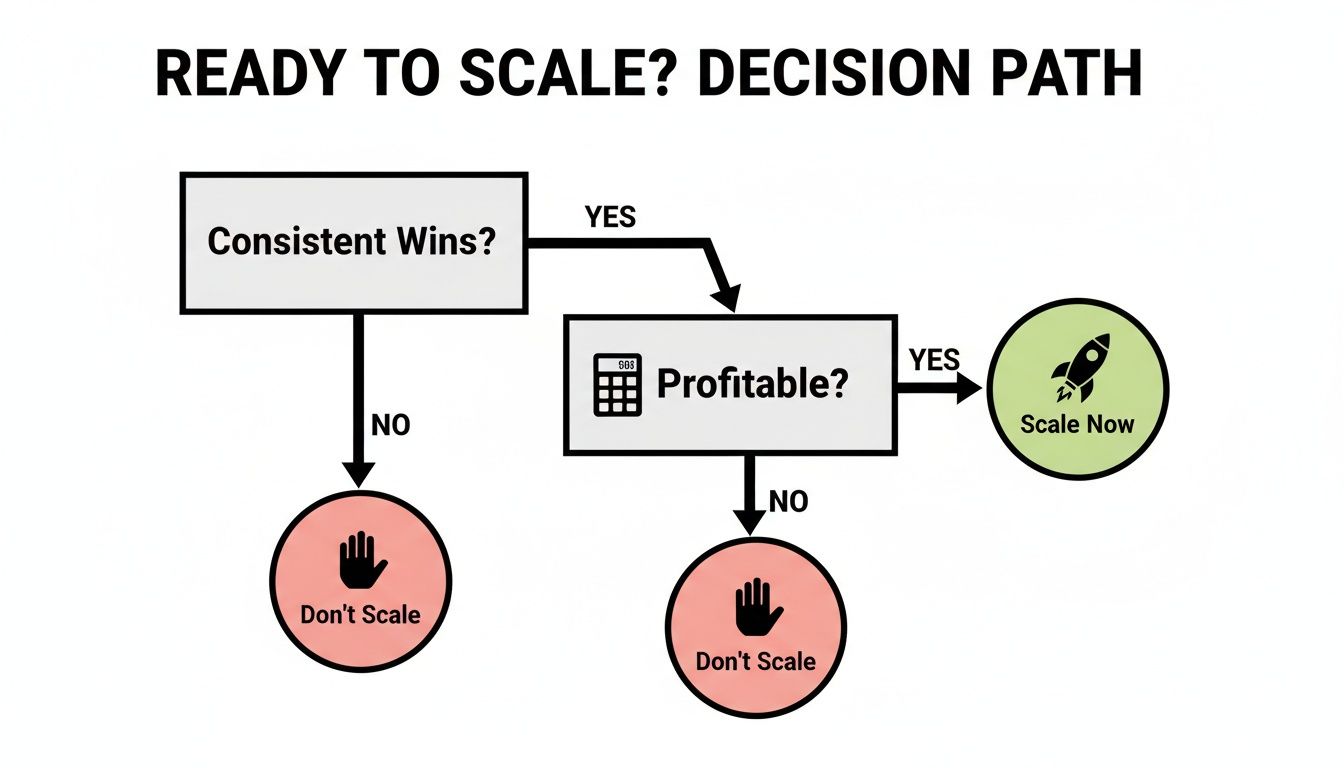
As this flowchart shows, you need both consistent wins and clear profitability before you pour more fuel on the fire. Vertical scaling is your go-to when you know you have a hit and want to squeeze as much performance as possible out of that specific ad set and audience.
Expanding Your Reach with Horizontal Scaling
Horizontal scaling is a different game entirely. Instead of putting more money behind a single ad set, you're on a mission to find new audiences. This is all about exploration—taking your proven creative and copy and seeing who else out there will bite.
Think of it like this: vertical scaling is drilling deeper into a rich oil well you’ve already found. Horizontal scaling is sending out scouting parties to find brand new places to drill.
Here are the most common ways to scale horizontally:
New Interest Targeting: Let's say you're selling high-end running shoes and your "marathon running" interest group is crushing it. You'd duplicate that ad set and test adjacent interests like "trail running," "triathlons," or even broader ones like "fitness enthusiasts."
Lookalike Audience Expansion: You can create new Lookalike Audiences from different seed lists (like a 1% Lookalike of your highest LTV customers) or simply broaden the net by testing a 3-5% Lookalike alongside your current 1%.
Broad Targeting: This has become the default strategy for most savvy media buyers, especially after iOS 14. You ditch the specific interest layers, target a huge demographic (like an entire country in a wide age range), and trust Meta's algorithm to do the heavy lifting.
Going broad is how you can scale from a modest $1,000/day to $10,000/day without your ROAS falling off a cliff. The data doesn't lie: recent analysis shows broad targeting now consistently beats lookalike audiences, delivering a 49% higher ROAS (113% vs. 76%) with a 45% lower CPM. Why? Privacy updates made lookalikes less reliable, forcing the algorithm to rely on its own massive pool of user data. We’ve even seen shopping ads get a 146% CTR surge with broad setups. You can see more on this by checking out the latest Facebook ads benchmarks, which break down these trends by industry.
When to Choose Each Method
Your campaign data and your immediate goals should dictate your next move. It's not about which method is "better," but which one is right for the current situation.
Scaling Method | When to Use It | Primary Goal |
|---|---|---|
Vertical Scaling | Your ad set has stable, profitable performance and a large enough audience to absorb more spend. | Squeeze maximum profit from a proven ad set and audience combo. |
Horizontal Scaling | Ad frequency is creeping up, or performance is starting to dip, suggesting your current audience is getting saturated. | Find new, untapped audiences to prevent ad fatigue and open up fresh revenue streams. |
In the long run, any robust scaling strategy is a dance between these two methods. You'll scale your winners vertically until they show the first signs of fatigue. Then, you'll pivot to horizontal scaling to discover new audiences. And once you find a new winning audience? You start the vertical scaling process all over again.
Mastering Your Creative Testing Engine for Scale
Pushing more budget into a winning campaign is just one piece of the puzzle. As you scale, your ads get served to more people, more often, and that's when a silent killer creeps in: ad fatigue. An ad that crushed it last week can suddenly fall off a cliff, dragging your ROAS down with it. The hard truth is you can't scale on Meta sustainably without a relentless creative testing engine.
This isn’t about just swapping out an image every now and then. It’s about building a system—a machine—that continuously feeds the algorithm fresh, high-performing ads. Think of it this way: your scaling campaigns are for making money now. Your testing campaigns are for finding what will make you money next.

Isolate Your Tests for Clean Data
The first rule of a good testing setup? Keep it separate from your main scaling campaigns. When you drop a brand-new ad into a high-spend, proven CBO campaign, Meta's algorithm will almost always favor the existing winners. This starves your new creative of the budget it needs to even get a fair shot, leaving you with useless data.
To get a clean read, you need a dedicated testing campaign. I’ve found that an Ad Set Budget Optimization (ABO) structure works best here. This setup gives you precise control, ensuring each new ad concept gets an equal slice of the budget to prove its worth.
Once a new creative stands out in this testing environment—hitting your target CPA or ROAS with some consistency—it "graduates." That's when you move this fresh winner into your main scaling campaigns to do the heavy lifting.
Different Strokes: Your Testing Methodologies
Your testing should never be random. It’s all about forming a hypothesis and then gathering data to prove or disprove it. A healthy testing strategy really boils down to two core approaches.
Iterative Testing (The A/B Test): This is where you make small, calculated tweaks to a proven winner. Think testing a different headline, a new hook in the first line of copy, a bolder call-to-action, or even just a different background color. The goal is simple: make incremental gains on what you already know works.
Conceptual Testing (The Big Swing): This is about testing entirely new angles and formats. Instead of just tweaking a headline, you're launching a completely different ad. Maybe it's a raw, user-generated-content (UGC) style video versus your polished studio creative. Or perhaps you're testing an ad focused on a completely different product benefit. This is how you find your next breakout winner.
A great rhythm to get into is running iterative tests constantly while launching those big conceptual tests every one or two weeks. This keeps your creative pipeline full of both small, reliable optimizations and potential game-changers.
Expert Insight: Your best-performing ad today has an expiration date. A structured testing process isn't just a nice-to-have when you're scaling; it's the insurance policy that protects your future returns by making sure you always have a fresh winner ready to go.
Spotting Creative Fatigue Before It Kills Your ROAS
You have to become a bit of a detective, always looking for the early warning signs of ad fatigue. Waiting until your ROAS is in the red means you’re already too late. The key is to monitor the leading indicators that tell you the audience is getting tired of seeing your ad.
Ad fatigue sneaks up fast, but getting a handle on frequency alone can save you 10-25% on CPA, which is huge when costs are rising. The data doesn't lie: when ad frequency pushes past a threshold of 3, engagement tends to dip, spiking your CPA as people start to tune you out. Authentic formats like UGC are a great countermeasure, known to drive up to 6.9x higher engagement than typical brand ads. It's also worth noting that Carousel ads can amplify wins, often yielding a 4.2x ROAS compared to just 3.1x for single images.
So, what signals should be on your radar?
Rising Frequency: If this metric creeps above 2.5-3 over a 7-day period, that's a major red flag. Your audience is seeing the ad way too often.
Declining Click-Through Rate (CTR): A steady drop in CTR is one of the earliest signs of trouble. It means the ad is losing its "thumb-stopping" power. If you see this happening, you can find some great solutions in this guide on how to improve click-through rate.
Increasing Cost Per Click (CPC): As people engage less, you start paying more for every click, which directly eats into your profit margins.
Negative Comments: Don't ignore the social proof. If you see comments like, "I see this ad every day," that's a qualitative signal that the quantitative metrics are about to take a nosedive.
Creative Fatigue Indicators and Actions
Here’s a quick cheat sheet to help you identify and act on ad fatigue before it sabotages your campaign performance.
Metric Signal | What It Means | Recommended Action |
|---|---|---|
Frequency > 2.5-3 (7-day) | Your audience is over-saturated. They've seen your ad too many times. | Rotate in a new creative from your testing campaign immediately. Consider refreshing the audience or expanding targeting. |
CTR steadily declining | The ad is losing its initial appeal and is no longer capturing attention. | Swap the creative. Test a new hook (first 3 seconds of video or headline) or a completely different visual. |
CPC consistently rising | The ad is becoming less efficient as engagement drops, costing you more for the same result. | This is a late-stage indicator. Swap the creative and analyze why it failed. Was it the angle, offer, or visual? |
Increase in negative comments | People are actively telling you they're tired of the ad. This harms brand perception. | Pause the ad immediately. Engage with the comments if appropriate, and introduce a completely new concept. |
When you spot these signs, it's time to swap in one of those shiny new winners from your testing campaign. This proactive refresh keeps your performance stable and is an absolute cornerstone of scaling on Facebook successfully.
Smart Budget Management for Sustainable Growth
Throwing more money at a winning campaign isn’t a strategy; it’s a gamble. The real difference between sustainable, long-term growth and a spectacular flameout often boils down to one thing: budget discipline. How you manage your spend during a scale is every bit as critical as the creative you run or the audiences you target.
Your worst enemy here is making reactive, emotional decisions. We’ve all been there—you see a fantastic day of performance and your first instinct is to double the budget to ride the wave. That’s a classic mistake, and it’s one of the fastest ways to derail a perfectly healthy campaign. To scale successfully, you need a methodical, data-driven approach for every single budget increase.
CBO vs. ABO: Choosing the Right Tool for the Job
Your campaign structure directly impacts how you scale your budget. The two main levers you have are Advantage Campaign Budget (CBO) and Ad Set Budget Optimization (ABO), and each has its place in a smart scaling strategy.
Advantage Campaign Budget (CBO): Think of CBO as your workhorse for scaling proven winners. You set one central budget for the entire campaign, and Meta’s algorithm automatically pushes the most spend toward your best-performing ad sets. It’s a brilliant way to maximize efficiency once you have multiple ad sets with validated creative and you trust the algorithm to find the lowest-hanging fruit.
Ad Set Budget Optimization (ABO): This gives you granular control by letting you set a specific budget for each individual ad set. ABO is absolutely essential during the testing phase for new audiences or creative angles. It ensures every ad set gets a fair shot to spend its budget and gather data, preventing one early winner from starving the others before they have a chance to prove themselves.
A battle-tested workflow is to use ABO for all your testing and validation. Once you’ve identified a few ad sets that are clear winners, you can either scale them vertically within ABO or move them into a dedicated CBO campaign to let the algorithm take the reins.
The Golden Rules of a Stable Budget Increase
The number one rule of vertical scaling is simple: don't shock the algorithm. Abrupt, massive budget changes can throw your ad set right back into the learning phase, which almost always leads to volatile performance and wasted spend. The secret is making small, deliberate adjustments over time.
Stick to the 20-30% increase rule. When you have a consistently performing ad set, only raise its budget by 20-30% every 24-48 hours. This measured approach gives the algorithm enough time to find new pockets of customers at a similar cost without completely resetting its progress.
For example, if an ad set is humming along nicely at $100 per day, your first increase should be to $120-$130. Let it run for at least a full day to stabilize before you even think about another bump. Patience here is everything.
Scaling Facebook ads is a marathon, not a sprint. Small, consistent budget increases based on stable performance will always outperform aggressive, reactive jumps that disrupt the algorithm's learning process.
Understanding Pacing and Performance Swings
It’s really important to understand how Meta actually spends your daily budget. The system doesn't spend your money in a perfect, straight line throughout the day. Instead, it paces the budget based on when it predicts the best conversion opportunities will pop up. This often means you’ll see slower spending in the morning and a rapid acceleration in the evening.
Don't panic if your performance fluctuates hour to hour. It’s completely normal. Your job is to analyze trends over a 3-4 day rolling window, not make knee-jerk decisions based on a few bad hours. Over-editing is one of the most common ways advertisers sabotage their own success. You have to let the data accumulate before making a call.
This disciplined approach is more critical than ever. Scaling demands ruthless budget discipline, especially when you look at the industry benchmarks. While the average CPC has leveled out between $0.68 and $1.38, some lead generation campaigns are seeing costs as high as $27.66—a figure that’s up 20% year-over-year.
But advertisers who scale smartly are seeing incredible returns. For instance, shopping ads have shown a massive 146% jump in CTR to 4.13%, proving that vertical scaling is highly effective when you keep the algorithm happy. You can explore more of these trends and other fascinating Facebook advertising statistics to get a better feel for the landscape.
By choosing the right budget strategy, sticking to controlled increases, and looking at performance with a long-term view, you can build a sustainable growth engine that scales predictably—without all the unnecessary drama.
Advanced Scaling Guardrails and Troubleshooting
When you start pouring real money into your campaigns, the game changes. Big wins are on the table, but so are incredibly expensive mistakes. This is where you need to move beyond basic budget bumps and start implementing some serious guardrails—a set of rules and diagnostic checks to keep your performance on track and stop problems before they spiral.
Think of it as your insurance policy against the classic scaling pitfalls. Without these systems in place, you're just flying blind, risking wasted spend, burned-out audiences, and reactive decisions that end up sabotaging your own success. The goal is to build a predictable scaling engine, even when your daily ad spend starts hitting four or five figures.
Diagnose and Eliminate Audience Overlap
One of the sneakiest profit-killers in a scaled account is audience overlap. This happens when your ad sets are targeting similar, intersecting groups of people. What's the big deal? Your own campaigns start competing against each other in the auction.
You’re literally bidding against yourself. This drives up your CPMs and makes it impossible to get a clean read on which audience is actually the better performer.
Thankfully, Meta has a tool for this. To check for overlap:
In Ads Manager, select two or more of your saved audiences.
Click the "Actions" menu and select "Show Audience Overlap."
The tool will spit out a percentage of users who exist in both audiences.
If you see an overlap of more than 20-30%, that's your cue to consolidate. Either combine the ad sets into one bigger, happier audience or use exclusions to carve out unique segments for each. This one simple fix can often bring your costs down almost immediately.
Identify and Combat Audience Saturation
Every audience, no matter how big, eventually runs out of people. Audience saturation is what happens when you’ve shown your ads to most of the active, interested users in that group. At this point, throwing more money at it just leads to diminishing returns. Your frequency skyrockets, your click-through rate nose-dives, and your cost-per-acquisition starts to climb.
The trick is to spot the warning signs before your ROAS completely tanks.
Keep a close eye on these two metrics:
Frequency: Is your 7-day frequency creeping above 2.5-3? That’s a huge red flag that people are getting sick of seeing your ad.
First Time Impression Ratio: This metric shows the percentage of daily impressions served to people seeing your ad for the very first time. If this number is steadily dropping, you're running out of fresh eyes.
When you see these leading indicators pop up, it’s not a suggestion—it's a command to take action. Trying to keep scaling vertically into a saturated audience is like trying to squeeze water from a rock. It’s time to scale horizontally by finding new audiences or rolling out fresh creative.
Monitoring these metrics helps you stay ahead of the curve, allowing you to pivot before performance falls off a cliff.
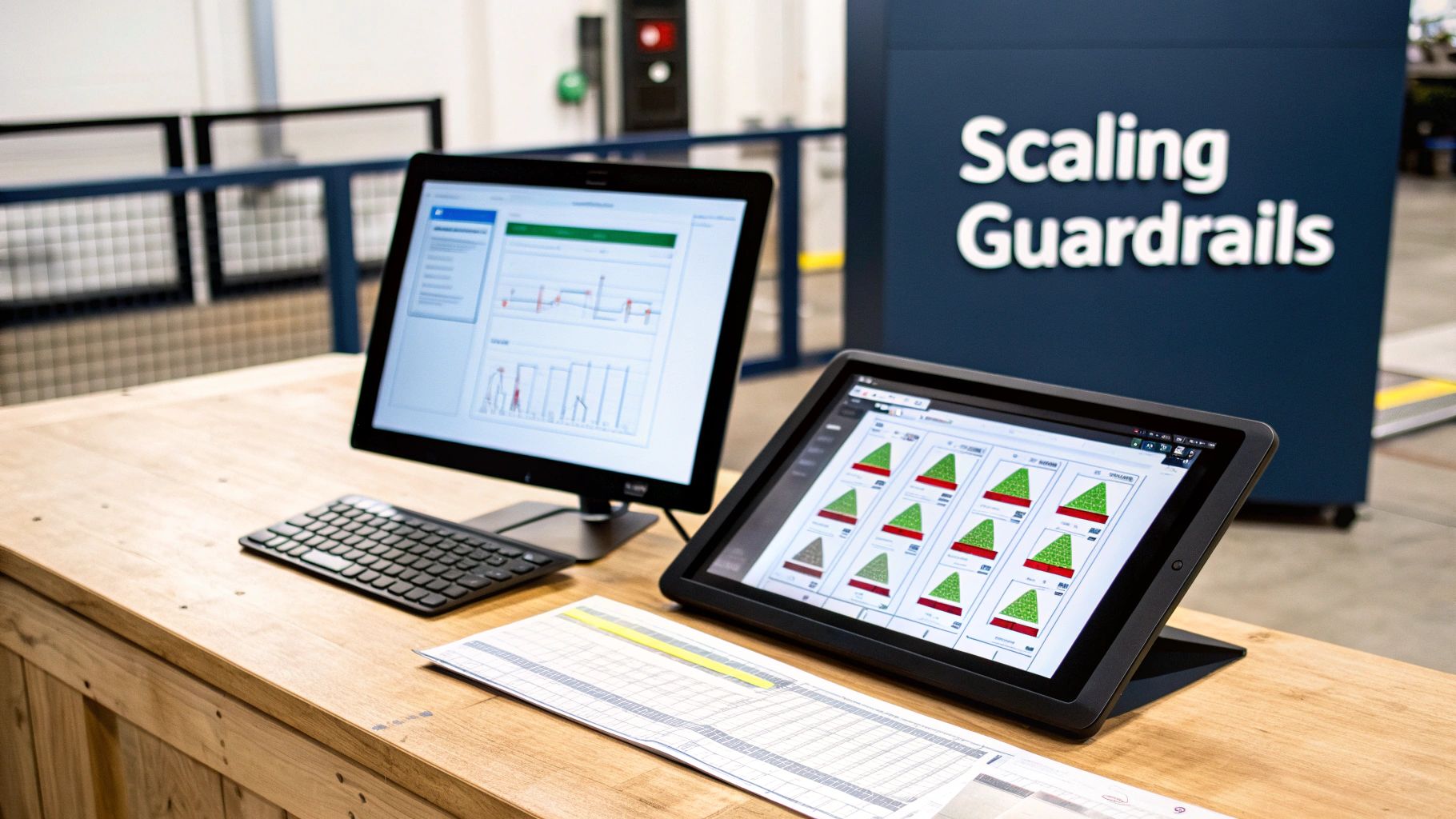
Having a dashboard that tracks things like First Time Impression Ratio next to your core KPIs gives you an at-a-glance view of audience health. You can instantly see when an audience is getting stale and needs a refresh.
Troubleshooting Performance Dips During a Scale
Look, even with the best system in the world, you'll have bad days. A campaign that was crushing it yesterday might suddenly nosedive. The difference between a pro and an amateur is having a systematic troubleshooting checklist instead of hitting the panic button.
When performance tanks, don't just start changing things randomly. Ask yourself these questions:
Did we just make a big change? If someone on your team cranked the budget, swapped all the creative, or overhauled the targeting in the last 24-48 hours, you probably sent the campaign back into the learning phase.
Is it creative fatigue? Pull up your frequency and CTR trends for the last 7-14 days. If CTR is trending down while frequency is trending up, your ads are stale. Time for a refresh.
Is something weird happening on the platform? Check Twitter, Reddit, or your favorite Slack communities. Sometimes, the entire auction gets volatile (think Black Friday week), and it has nothing to do with your specific account.
Have we hit the saturation wall? Look at that First Time Impression Ratio again. If it's in a freefall, you've likely tapped out your current audience and need to expand.
Working through this list methodically turns panic into a structured diagnosis. You can pinpoint the real problem and apply the right fix to get your scale back on track.
Burning Questions About Scaling Facebook Ads
When you're in the trenches scaling your Facebook ads, theory goes out the window. You run into specific, nagging problems that demand immediate answers. Even the most seasoned media buyers hit these walls. This section is all about tackling those common "what do I do now?" moments with straight-up, practical advice.
Getting these situations right is what separates the pros who scale profitably from the advertisers who just burn cash. Let's dig into the questions I hear most often.
How Long Should I Wait Before Scaling a New Ad Set?
This is where media buyers get tripped up. The excitement of seeing a few good results makes them jump the gun, and that's a costly mistake. Patience isn't just a virtue here; it's a core skill.
You need to hold your fire until the ad set is completely out of the "Learning Phase." That's non-negotiable. It also needs to have racked up at least 50 conversion events over a 7-day window. This is the bare minimum data Meta needs to find its footing and give you stable performance.
But don't stop there. Once it’s out of learning, watch it like a hawk. You're looking for 3-4 straight days of solid, profitable performance. If you scale before you see that stability, you'll shock the algorithm, reset the whole learning process, and send your results into a nosedive. Let the numbers tell you when it's time to go, not your gut feeling.
What’s a Better Scaling Method: CBO or ABO?
This isn't a "one is better than the other" situation. Think of them as different tools in your toolkit, each designed for a specific job. The right choice depends entirely on what you're trying to accomplish right now.
Ad Set Budget Optimization (ABO): This is your precision tool for testing. When you're trying out new audiences or creatives, ABO gives you complete control. You can assign a specific budget to each ad set, ensuring every variable gets a fair shot to prove itself without another ad set stealing its spend.
Advantage Campaign Budget (CBO): This is your powerhouse for scaling what's already working. Once you have a few winning ad sets, you put them into a CBO campaign with one shared budget. This lets Meta's algorithm do the heavy lifting, automatically shifting money to the top performers in real time. It's all about maximizing efficiency when you have proven winners.
A bulletproof workflow I've seen work time and again is to use ABO for all your testing and validation. Once you have a clear winner, you can either bump its budget up vertically in that same ABO campaign or "graduate" it to a CBO campaign with your other all-star ad sets.
The rule of thumb is simple: Use ABO for control and learning. Use CBO for efficiency and scaling.
My ROAS Dropped After I Increased the Budget. What Happened?
If I had a dollar for every time I've heard this... It’s the classic scaling headache. You have a winner, you give it more money, and suddenly your ROAS tanks. It's frustrating, but it’s almost always caused by one of a few predictable culprits. Don't panic; just put on your detective hat.
Here’s your list of likely suspects:
You Scaled Too Aggressively: This is the #1 offender. Bumping the budget by more than 20-30% at a time is like flooring the gas pedal on a cold engine. It shocks the system, and the algorithm struggles to find new pockets of customers efficiently, causing a temporary performance dip.
Ad Fatigue Sped Up: More budget means more impressions, which means your audience sees the same ad more often. Check your Frequency metric. If it’s climbing quickly (say, above a 3 or 4 in a short period), your audience is getting bored. It’s time to swap in fresh creative.
Audience Saturation: You may have simply tapped out the best part of your audience. As you spend more, Meta is forced to reach people who are further away from that "perfect customer" profile, and they are naturally less likely to convert. This will inevitably lower your ROAS.
Figure out which of these is the problem, and then you can react. You might need to dial back the budget increase, launch new ads, or start expanding horizontally into brand-new audiences. For more deep dives and strategies like these, the SpendOwlAI blog is a great resource to keep bookmarked.
At SpendOwlAI, we transform confusing ad data into a clear, prioritized to-do list. Our system tells you exactly what to change in your budgets, creatives, and audiences—ranked by impact and explained with clear reasoning—so you can make confident decisions every single day. Start your free 7-day trial and see the difference.
Article created using Outrank