How to Improve Click Through Rate An Operator's Playbook
When your click-through rate is lagging, it usually comes down to three things: your creative and copy aren't hitting the mark, your audience targeting is off, or the ad itself feels out of place. The fix is about creating headlines that stop the scroll, using visuals that connect with what your audience actually wants, and making sure the right people see your message in the first place.
Your Starting Point for Boosting CTR
Forget the generic advice and the endless dashboards. This is your practical, no-fluff guide to turning lackluster ad performance into something you can be proud of. We're going to cut through the noise and focus on what actually moves the needle on click-through rates (CTR). Think of this as your operator's playbook for getting more clicks and lowering your costs, starting right now.

The core principles are the same whether you're running paid campaigns on Meta and Google or working on owned channels like email and SEO. Your job is to close the gap between an impression and a click. A high CTR is the clearest signal that your message is resonating. It leads to better Quality Scores, lower cost-per-click (CPC), and, ultimately, a much more efficient way to get new customers.
Why CTR Is More Than a Vanity Metric
It’s easy to get lost in a sea of metrics, but CTR is a critical health indicator for any campaign. A strong CTR tells the platform algorithms that users find your ads genuinely useful, which often earns you better placement in the ad auction without having to pay a premium for it.
For an operator, a rising CTR is the first real sign you've found a winning creative or nailed your audience targeting. It’s that data point that confirms your hypothesis was right, giving you the green light to start scaling your ad spend with confidence.
This guide is all about action. We're skipping the abstract theory and diving straight into the tactical levers you can pull day-in and day-out. You’ll learn how to spot performance issues, prioritize your changes, and build a system for consistent results. If you’re looking for more deep dives into marketing performance, check out the articles on the SpendOwlAI blog.
Here’s a quick look at what we’ll break down:
Creative and Copy Frameworks: We’ll move beyond "just test more" and into a systematic way to develop ads people actually want to click.
Audience and Bidding Intelligence: You'll see how to find and engage the right users without burning your budget on people who will never convert.
Owned Channel Optimization: Learn how to apply these same CTR principles to SEO and email marketing to build a stronger, more holistic growth engine.
Testing and Measurement: We'll cover how to build a continuous improvement flywheel while avoiding those knee-jerk, reactive edits that kill campaign momentum.
This is your roadmap. Let's get started.
High-Impact Levers for Improving CTR
Before we dive deep, here’s a quick-reference table summarizing the most common issues that drag down CTR and the high-impact solutions you can implement. Think of this as your cheat sheet for quick wins.
Channel | Common CTR Blocker | High-Impact Solution |
|---|---|---|
Meta Ads | Ad fatigue; creative looks like a generic ad. | Refresh with user-generated content (UGC) or a lo-fi, native-looking video. |
Google Search | Headline isn't relevant to the search query. | Use Dynamic Keyword Insertion (DKI) and add compelling extensions (sitelinks, reviews). |
Email Marketing | Subject line is bland or uninspired. | A/B test a highly specific, curiosity-driven subject line with a clear benefit. |
Organic Search | Title tag and meta description are generic. | Rewrite to include the primary keyword, a number, and a strong call-to-action. |
This table covers the fundamentals, but mastering CTR requires a more detailed approach. In the following sections, we'll unpack the strategies behind each of these solutions.
How to Nail Your Creative and Copy for Higher Clicks
Let’s get tactical. Just "testing more creatives" is a fantastic way to burn through your budget and your team. If you want to actually move the needle on your click-through rate, you need a system for developing visuals and copy that connect with people on a psychological level. This is where you stop guessing and start building a process that works.

Think of your creative as the first handshake. If it looks and feels like a generic ad, you've already lost. The goal is to create something that feels like it belongs in their feed, whether that’s on Meta or the Google Display Network.
Crafting Headlines That Actually Stop the Scroll
I'm not exaggerating when I say your headline is 80% of the battle. If it doesn't grab someone's attention in that split second, the rest of your ad is invisible. Generic junk like "Shop Our New Collection" is a CTR killer. You have to trigger an emotion or open up a curiosity gap they just have to fill.
Here are a few frameworks I’ve seen work time and time again:
Hit the Pain Point: State the problem they're feeling right now, and tease the solution. Something like, "Tired of marketing data chaos? Get a clear action list every morning."
Get Specific with Numbers: Concrete numbers build instant credibility. Don't say "Improve your ads." Instead, try "Cut wasted ad spend by 27% in your first week." Headlines with numbers just plain work better.
Create a Curiosity Gap: Ask a question or make a bold statement that makes them wonder. For example: "This one weird tweak to our Meta ads doubled our CTR overnight."
Always write a handful of distinct headlines for every ad you run. The algorithms on Google and Meta are great at finding the winning combination, but they can't do it if you only give them one angle to work with.
The Psychology Behind High-Performing Visuals
Visuals do the immediate heavy lifting. They're what people see first. But the type of visual you use has to match the platform and what your audience expects to see there. A super-polished, cinematic video might be great for a big brand campaign, but it often feels jarring and gets ignored in a direct-response ad on Meta.
The best-performing creative I see almost never looks like an ad. It blends in, feels authentic, and gives the user a little hit of value or entertainment before it ever asks for a click. This is exactly why UGC is king right now.
Give these visual strategies a shot:
User-Generated Content (UGC): This is the gold standard for authenticity. Showing real customers using your product builds social proof and trust before they even click, which is a direct line to a better CTR.
Lo-Fi, "Shot-on-a-Phone" Video: These simple, unpolished videos often crush studio productions. They feel real and disarm the natural skepticism people have toward ads.
A Powerful Static Image: Don't sleep on a single, compelling image. Focus on a clear focal point, use colors that pop against the feed's background, and keep the text overlay to a minimum. The image should do the talking.
Writing Body Copy That Seals the Deal
Okay, the headline and visual did their job. Now the body copy has to close the loop and get them to take action. This is your chance to really sell the value and knock down any objections they might have.
The biggest mistake I see here is just listing features. Nobody cares. You need to translate those features into benefits—how does this make their life easier, better, or more interesting? Use short sentences and bullet points. Make it easy to scan.
For context, if you're battling with Google Ads performance for an e-commerce store, remember the benchmarks. The average search CTR is 3.17%, but for display, it plummets to 0.46%. Those numbers tell you that your creative and copy have to be exceptional to get noticed, especially in a competitive space like Technology where the average CPC is $3.80.
How to Spot and Beat Creative Fatigue
Creative fatigue is the silent killer of good campaigns. It's what happens when your audience sees your ad so many times they go blind to it. Your frequency metric creeps up, and your CTR starts to nosedive.
Don't wait for performance to fall off a cliff. Keep a close eye on your frequency and always have a pipeline of fresh creative ready to go. Swapping in a new headline or turning a static image into a short video can be all it takes to reset performance.
For a deeper dive, our guide on How to Identify Creative Fatigue provides a solid framework for catching this before it tanks your ROAS.
Winning with Audience and Bidding Strategies
You can have the most stunning ad creative in the world, but if it's shown to the wrong people, it's just noise. This is where your audience and bidding strategies come in—they're the engine that drives a higher click-through rate.
Shifting from a "spray and pray" approach to targeting highly relevant segments is the difference between burning cash and actually acquiring customers. It's not about randomly layering a few interests on Meta. It’s about thinking like a strategist and using data to get your ad in front of the right person at the exact moment they’re ready to act.
Precision Targeting Beyond Basic Demographics
Your best customer is more than just an age range and a location. To really move the needle on CTR, you need to build audiences based on what people do—their intent and behavior. This means digging deep into the tools that platforms like Meta and Google give you.
The best place to start is with the data you already own. Your first-party data is gold.
Customer Lists: Upload your list of past buyers. These are people who already know and trust you, making them the perfect audience for new product launches or upsell campaigns.
Website Visitors: Don't just target everyone who has visited your site. Get specific. Someone who abandoned a cart is infinitely more valuable than someone who just glanced at your homepage for three seconds.
Engagement Audiences: Build audiences of people who have liked your posts, watched your videos, or commented on your content. They've already raised their hand; a good ad can easily turn that initial interest into a click.
Once you have these core audiences locked in, use them to create powerful lookalikes. A lookalike audience built from your top 10% of customers will almost always crush one based on all website visitors.
Layering Interests Without Killing Your Reach
Here’s a classic mistake: getting way too specific with interest layering. It feels smart to target "people who like running AND hiking AND outdoor gear AND granola bars," but you can easily shrink your audience so much that the ad platform has no room to breathe or optimize.
The goal is strategic layering, not hyper-segmentation. Start with one core, high-value interest, then add just one or two related behaviors to sharpen it. Always keep an eye on your potential reach; if it drops into the low thousands, you've gone too far.
For example, instead of a dozen niche hobbies, try targeting a broad interest like "Digital Marketing" and then layering it with a behavior like "Facebook Page Admins." This gives you a relevant, motivated group that’s still large enough for the algorithm to work its magic. This kind of thoughtful targeting is a direct line to a better CTR because the ad's message will hit home.
Demystifying Bidding Strategies for Better CTR
Your bidding strategy is how you tell the ad platform what you really care about. It directly influences who sees your ad and how much the platform is willing to pay for their attention. Picking the right strategy is crucial for getting clicks from the right people.
Let's look at two common bidding strategies on Google Ads:
Bidding Strategy | What It Does | Best For | Impact on CTR |
|---|---|---|---|
Maximize Clicks | Tries to get the most possible clicks within your budget. | Driving traffic, building brand awareness, and feeding your retargeting pools. | Can dramatically increase CTR, but you risk attracting lower-intent "window shoppers." |
Target CPA (tCPA) | Aims to get you conversions at a specific cost. | E-commerce sales, lead generation, and any campaign where the final action is what counts. | Often results in a lower CTR because it's picky, prioritizing users likely to convert, not just click. |
Choosing "Maximize Clicks" is a giant lever you can pull to boost your click-through rate. But you have to watch the traffic quality like a hawk. If those clicks aren't turning into anything meaningful, you're just paying for empty volume.
A smart approach is often to start with a traffic-focused bid strategy to gather data and then, once you have enough conversion history, switch to a conversion-focused one like tCPA.
Ultimately, you need to align your bidding with your actual business goal. If you need engagement and top-of-funnel traffic, bid for clicks. If you need sales, bid for conversions and accept that your CTR might not break records. When you pair smart audience targeting with an aligned bidding strategy, you create the perfect conditions for your creative to shine.
Tapping Into Your Owned Channels: Organic and Email CTR
Paid ads are fantastic for targeted reach, but they're only one piece of the puzzle. The channels you actually own—your organic search presence and your email list—are where you build a stable, long-term foundation for growth. When you get your click-through rates dialed in here, you create a powerful flywheel that boosts brand engagement and, believe it or not, makes your paid efforts even more effective.
Think of it this way: anyone clicking your organic search result or an email link is already warm. They’re either actively looking for what you offer or they've already given you permission to be in their inbox. This is high-intent traffic, and figuring out how to get more of it is a massive operational lever.
Winning the Click on the SERP
Your spot on the search engine results page (SERP) is your digital storefront. A high ranking is great, but it’s no guarantee someone will walk in. Your title tag and meta description are your pitch, and they have to be sharp enough to pull users away from nine other options on the page.
Imagine you're running Meta Ads and Google Ads for your DTC Shopify store, but your CTRs are flatlining. That’s budget wasted on impressions that go nowhere. Historical data shows that nabbing the top organic spot can send your CTR soaring to a massive 39.8%, a huge leap from the 18.7% for second place and 10.2% for third. This isn't a fluke stat—it’s a global reality that proves the immense value of earning that #1 position.
So, how do you actually earn that click?
Don't Settle for Bland Title Tags: Go beyond just stuffing in a keyword. Add a number, a bracket, or a power word to make it pop. Instead of "Men's Running Shoes," try something like "10 Best Men's Running Shoes for 2024 [Tested]." It’s a small change, but studies have found headlines with brackets can get up to 40% more clicks.
Write Meta Descriptions That Sell: Your meta description is a direct, benefit-driven pitch. It needs to answer the user's question and give them a compelling reason to choose you. Treat it like ad copy, not a keyword receptacle.
Keep URLs Clean and Descriptive: A URL like
yourstore.com/blog/best-running-shoeslooks a lot more trustworthy thanyourstore.com/p?id=12895. It’s a subtle but important signal of relevance for both users and search engines.
Use Schema to Create Standout Results
One of the most effective ways to make your search results impossible to ignore is by using schema markup. This is a bit of code you add to your site that gives Google a clearer picture of your content, which in turn unlocks rich snippets right there on the SERP.
Schema markup is like giving Google a cheat sheet for your content. In return, it rewards you with enhanced listings that take up more space and draw the user's eye, directly leading to a higher organic CTR.
These enhanced listings can include things like:
Review Stars: Absolutely essential for e-commerce products.
FAQ Dropdowns: Answer common questions right in the search results.
Price and Availability: Show key product information at a glance.
By giving users more information upfront, you pre-qualify your traffic. The people who click through are the ones who are genuinely interested in what you’re offering.
Boosting Clicks Inside the Inbox
Once you’ve earned an email subscriber, a new battle begins: winning the click inside the inbox. The metric that really tells the story here is your click-to-open rate (CTOR), which measures how many people who opened your email actually clicked on something.
First things first, you have to get the open. A/B test your subject lines relentlessly. Try personalizing with the subscriber's name or creating a little urgency. A subject line like "Your Weekly Marketing Report" is easy to scroll past. But something like, "Alex, here are 3 trends you missed this week" feels personal and creates a curiosity gap they’ll want to close.
Inside the email itself, clarity is everything.
Stick to a Single, Clear CTA: Don't confuse subscribers with five different links. Focus on the one action you want them to take and make your call-to-action button bold and unmissable.
Use Action-Oriented Language: Ditch "Learn More." Instead, try "See the Data" or "Get My Action Plan." The copy should promise the value they'll get on the other side of the click.
Design for Mobile First: With more than half of all emails being opened on mobile, a clunky design is a CTR killer. Make sure your layout is responsive and the buttons are easy to tap with a thumb.
CTR Comparison Organic vs. Paid vs. Email
To put all this in perspective, it helps to see how click-through rates vary across channels. This isn't about one being "better" than another; it's about understanding the unique potential of each and setting realistic goals for your own efforts.
Channel | Average Industry CTR | Top Performer CTR |
|---|---|---|
Organic Search (Position 1) | ~30% | 40%+ |
Paid Search (Google Ads) | 3.17% | 10%+ |
Social (Meta Ads) | 1.32% | 5%+ |
Email Marketing | 2.6% | 7%+ |
These benchmarks show just how valuable that top organic spot is, but they also highlight the opportunity in owned channels like email, where a strong relationship can drive clicks far above industry averages.
A healthy email CTR sends a steady stream of valuable traffic your way and helps you build a much stronger relationship with your audience, turning one-time subscribers into loyal, repeat customers. For more strategies on how to measure and improve your marketing efforts, read our guide on analyzing advertising performance.
Building Your CTR Improvement Flywheel
Improving your click-through rate isn't a one-and-done project. It’s a continuous loop of testing, learning, and tweaking that builds a powerful, compounding advantage over time. This is where the real work happens—moving from simply editing campaigns to strategically operating a system that consistently gets better.
The whole point is to create a flywheel. Every test you run, whether it's a home run or a total flop, feeds you insights that make your next move smarter. We're moving beyond just swapping out creatives and hoping for the best. This is about building a disciplined rhythm: hypothesize, execute, measure, and learn. It's how you stop chasing quick, fleeting wins and start building a genuine performance engine.
Here’s a quick look at how the optimization process connects across your owned channels, from getting found in search to keeping people engaged with your emails.
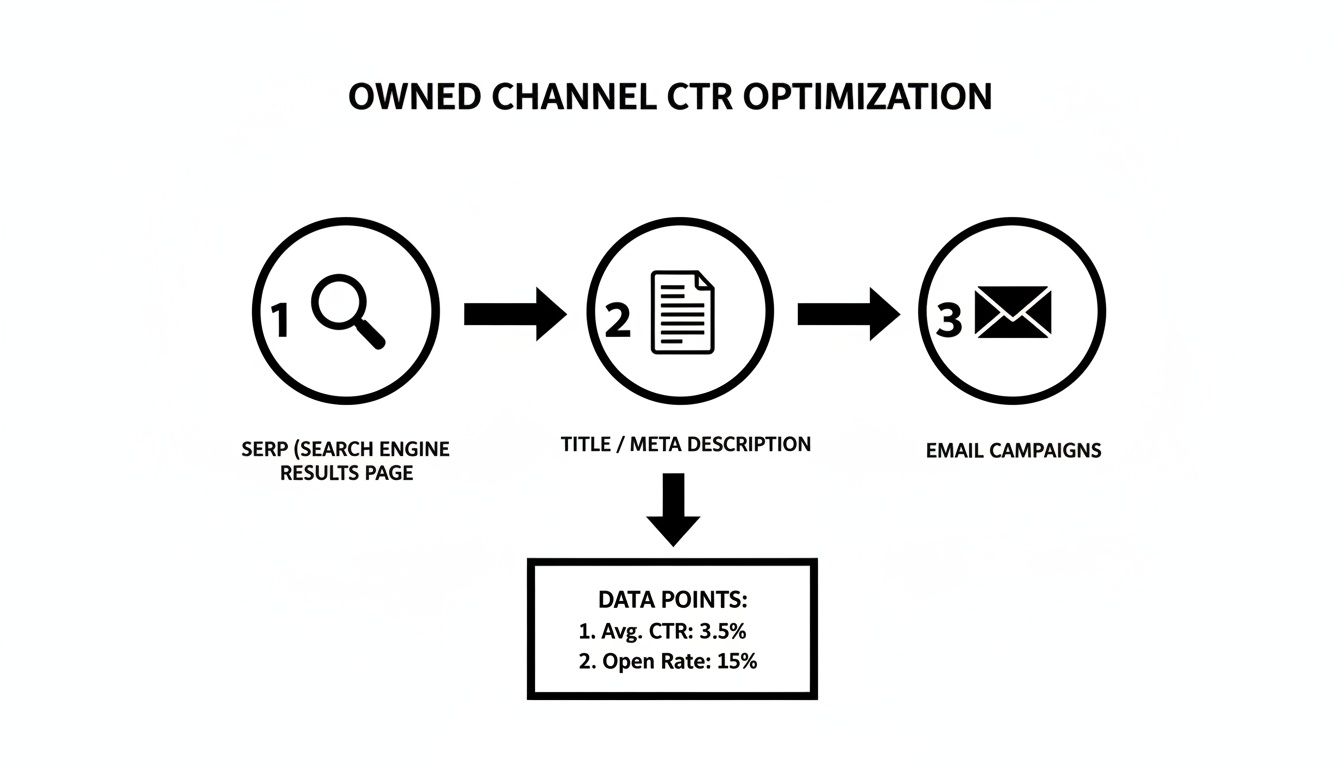
As you can see, it's all connected. A better SERP presence can lead directly to stronger email performance down the line.
Structuring A/B Tests That Actually Teach You Something
If you want to run tests that give you real answers, you have to be disciplined about isolating variables. Change your ad's headline, visual, and call-to-action all at once, and you’ll have zero idea what actually moved the needle. A proper A/B test changes only one significant element at a time. That's the only way to draw a clean conclusion.
Always start with a solid hypothesis. Don't just say, "Let's test a new image." Instead, frame it like this: "We believe using a user-generated photo will increase CTR compared to our current stock photo because it feels more authentic to our audience." This forces you to think through the why behind the test and clearly defines what a win looks like.
One of the most common mistakes I see is calling a test too early. Ad platforms need time to collect data and find the right pockets of the audience for each version. Before you declare a winner, make sure you have statistically significant results—I usually wait for at least 1,000 impressions and a healthy number of clicks.
Imagine you're running a Meta campaign for an e-commerce brand. A simple, methodical testing roadmap would look something like this:
Test 1 (Headline): Keep the creative the same, but run it with two different headlines.
Test 2 (Creative): Take the winning headline and pit two different visuals against each other (e.g., a polished graphic versus a real customer photo).
Test 3 (CTA): Once you have the winning headline/creative combo, test two different calls-to-action (like "Shop Now" vs. "Learn More").
This step-by-step approach ensures each test builds on the last, creating a new, improved "control" creative with every cycle.
Establishing Guardrails to Protect Performance
Sometimes, the smartest move is to do nothing at all. Platforms like Meta and Google have a crucial "learning phase" where the algorithm is figuring out the most effective way to deliver your ad. Every time you make a big edit, you can reset that process and tank your performance.
This is why you need guardrails—firm rules you set for yourself to prevent twitchy, emotional edits that disrupt the algorithm.
The 72-Hour Rule: My golden rule. Never make a significant change to a brand-new campaign or ad set within the first 72 hours. You have to give the platform time to find its footing.
Budget Change Limits: Try to avoid making budget adjustments of more than 20% at a time. Big, sudden shifts can shock the system and send it right back into the learning phase.
Performance Thresholds: Define what a real performance drop actually is. Is a 10% dip in CTR for one day a crisis, or just normal daily fluctuation? Set clear boundaries so you're only reacting to meaningful data, not noise.
Tools like SpendOwlAI are built for this. They can monitor performance volatility and flag when an ad set is still in that delicate learning phase, helping you avoid the temptation to over-edit. By respecting these guardrails, you give your campaigns the stability they need to reach their full potential, saving you from the constant stop-and-start cycle that wastes time and money.
Answering Your Burning CTR Questions
Even with the best playbook, you're going to run into questions in the day-to-day grind of managing campaigns. Let's tackle some of the most common ones that pop up when you're trying to push that click-through rate higher.
My goal here is to give you direct, no-fluff answers so you can make smarter decisions on the fly and stop second-guessing yourself. We’ll cover what a "good" CTR really is, how long to let a test run, and the tricky relationship between ad frequency and clicks.
What Is a Good Click-Through Rate?
This is the million-dollar question, and the only honest answer is: it depends. A "good" CTR is completely relative to the channel, your industry, and what you’re trying to accomplish. A 2% CTR on a cold-audience Meta campaign might be a home run, but that same 2% on a branded Google Search campaign would be a five-alarm fire.
So, instead of chasing some universal number, you need to focus on your own benchmarks.
Your Own History: This is your north star. What's your average CTR been for similar campaigns over the last 90 days? Your first job is to consistently beat that number. That's real progress.
Industry Averages: These are useful for a quick sanity check, but take them with a grain of salt. For instance, the average Google Ads search CTR hovers around 3.17%, but that figure gets skewed by countless variables. A lawyer and a t-shirt brand are playing completely different games.
The healthiest way to think about a "good" CTR is as a moving target. It’s less about hitting a static number and more about creating a positive upward trend over time. Your best benchmark is always your last best performance.
How Long Should I Run an A/B Test?
I see this all the time: an operator calls a test way too early. It's one of the easiest ways to shoot yourself in the foot. A new creative gets a few quick clicks, you get excited, and you're tempted to shove all your budget behind it. The problem is, you're probably acting on a statistical fluke, not a real trend.
You have to give the platforms time to work. Before you declare a winner, you need statistical significance. While fancy calculators can do the math for you, here are a few practical guardrails I always follow:
Give it at least 72 hours. Never, ever make a call on a test within the first three days. The algorithm is still figuring things out and needs that time to find the right pockets of the audience for each ad.
Get to 1,000 impressions per ad. Think of this as the absolute minimum. You need enough eyeballs on each variant for the data to mean anything. Honestly, more is always better.
Look for a clear winner. If a week has gone by and the results are still neck-and-neck, it probably means neither ad is a game-changer. Just call the test and move on to a bolder hypothesis.
Diagnosing a Sudden Drop in CTR
It’s a feeling every media buyer dreads. A campaign was cruising along, and then suddenly the CTR falls off a cliff. The first instinct is often to panic and start changing everything. Don't. Take a breath and work through the problem logically.
Your prime suspect should almost always be ad fatigue. Pop open your dashboard and check the frequency metric. If you see it creeping up—generally anything over a 3 or 4 on Meta for a prospecting audience is a red flag—it means people are sick of seeing your ad. They've started to tune it out. That's your signal to get fresh creative in there, fast.
Another common culprit is audience saturation. This is especially true if you’re targeting a smaller, niche audience. You might have simply run out of people who are going to click. The fix here is to start testing new lookalike audiences or to carefully broaden your interest targeting.
Finally, don't forget to look outside your ad account. Did a major competitor just launch a massive sale? Is it a holiday weekend? Sometimes, the dip has nothing to do with your ads and everything to do with what's happening in the real world.
Does Personalization Really Matter for Email CTR?
Absolutely. If you're also managing email, personalization is one of the biggest levers you can pull. When you see high open rates but dismal clicks, a generic, one-size-fits-all message is often the problem.
The data doesn't lie: personalized emails can drive 41% higher click-through rates compared to generic blasts. Industry averages for email CTRs tend to float between 2.3% and 4.01%, so there's a lot of room for improvement. If you're curious, you can explore more about email click-through rate benchmarks and see how you stack up.
Stop letting noisy data dictate your ad strategy. SpendOwlAI delivers a clear, prioritized action list every day, helping you make smarter edits to your Meta, Google, and Shopify campaigns. Ditch the endless dashboards and get the data-backed guidance you need to execute with confidence. Start your free 7-day trial at spendowlai.com and see the difference.
Article created using Outrank