What is attribution modeling: A Clear Guide to Marketing Attribution
Attribution modeling is really just a way to figure out which marketing efforts are actually working. Instead of throwing money at different channels and hoping for the best, it gives you a framework for assigning credit to the touchpoints a customer interacts with before they buy something.
Think of it as connecting the dots between your marketing actions and a final sale. This clarity is everything when it comes to making smart decisions about where to spend your next marketing dollar.
Understanding Your Marketing Team MVP
Let's use a sports analogy. Imagine your marketing channels are a soccer team trying to score a goal (a customer conversion). A customer might first see your brand on a Facebook ad (that's your defender making the initial play). A few days later, they might search for your product on Google and click an ad (your midfielder moving the ball up the field). Finally, they get a promo email and make a purchase (your striker scoring the goal).
So, who gets the credit? Just giving it all to the email is like saying only the striker mattered. It completely ignores the critical plays that set up the shot in the first place. That’s the exact problem attribution modeling solves. It’s your strategic game replay, letting you see how every player contributed to the win.
Why a Single Touchpoint Is Never Enough
If you only look at the last click, you're getting a dangerously narrow view of what's happening. This approach naturally overvalues the channels that are good at closing deals and completely dismisses the ones that build awareness and nurture interest along the way. That kind of bias leads to bad budget decisions, like cutting top-of-funnel campaigns that are secretly feeding your entire pipeline.
A proper attribution model gives you a much more holistic picture by spreading the credit across the entire customer journey. This helps you do three critical things:
Justify Marketing Spend: You can finally show clear evidence of how different channels are contributing to the bottom line.
Optimize Your Budget: Shift resources confidently to the channels that are proven to drive results, not just the ones that happen to be the last touchpoint.
Improve Customer Experience: By understanding the paths people take, you can make that journey smoother and more effective.
This isn't a brand-new idea. Its roots go all the way back to the 1950s with Marketing Mix Models (MMMs). But things really took off when internet usage exploded past 100 million users by 1998. The rise of cookie-based tracking made multi-touch attribution (MTA) possible, which is crucial when you realize customers interact with an average of 5-7 channels before they finally convert.
To help you get a handle on these foundational ideas, here's a quick summary of the core concepts we're discussing.
Core Concepts in Attribution Modeling at a Glance
Concept | Simple Explanation | Why It Matters for Marketers |
|---|---|---|
Attribution Modeling | The process of assigning value to each marketing touchpoint on the path to a conversion. | It helps you understand which channels are actually driving sales so you can invest your budget wisely. |
Touchpoint | Any interaction a customer has with your brand before converting (e.g., an ad, email, social post). | Identifying all touchpoints is the first step to seeing the full customer journey, not just the last step. |
Conversion Path | The sequence of all touchpoints a customer interacts with leading up to a purchase or sign-up. | Analyzing these paths reveals how customers discover and engage with your brand over time. |
Marketing ROI | A measure of the profit or revenue generated by your marketing efforts versus the cost. | Attribution modeling provides the data needed to calculate a far more accurate and channel-specific ROI. |
Understanding these terms is the key to moving beyond simple last-click reporting and into a more sophisticated and accurate way of measuring what truly works.
An effective attribution model shifts the conversation from "Which channel gets the credit?" to "How do our channels work together to drive growth?" It's about teamwork, not just a single star player.
Ultimately, getting a solid grasp on what attribution modeling is sets you up to make smarter, data-backed marketing decisions. By analyzing the entire customer journey, you get a true measure of your marketing ROI and can build a far more resilient and efficient growth strategy. For a deeper dive on this, check out our guide on how to accurately define marketing ROI.
Comparing the 6 Common Attribution Models
Think of attribution models like different camera lenses. Each one gives you a unique perspective on your customer's journey, highlighting different moments that led to a sale. Picking the right one is key because it directly impacts how you value each marketing channel and where you put your money.
To make this real, let’s follow a customer we’ll call Alex, who’s in the market for new running shoes.
Touchpoint 1 (Awareness): Alex is scrolling through Instagram and sees an ad for "Speedster Shoes." The seed is planted.
Touchpoint 2 (Consideration): A week later, Alex actively searches on Google for "best running shoes" and clicks a paid search ad for Speedster Shoes.
Touchpoint 3 (Nurturing): The next day, Alex lands on a company blog post, "How Speedster Shoes Improve Your Running Form," after clicking an organic search result.
Touchpoint 4 (Conversion): Three days later, a promotional email with a 10% discount code arrives. Alex clicks through and makes a $150 purchase.
This journey is pretty typical—a mix of social, search, and email.
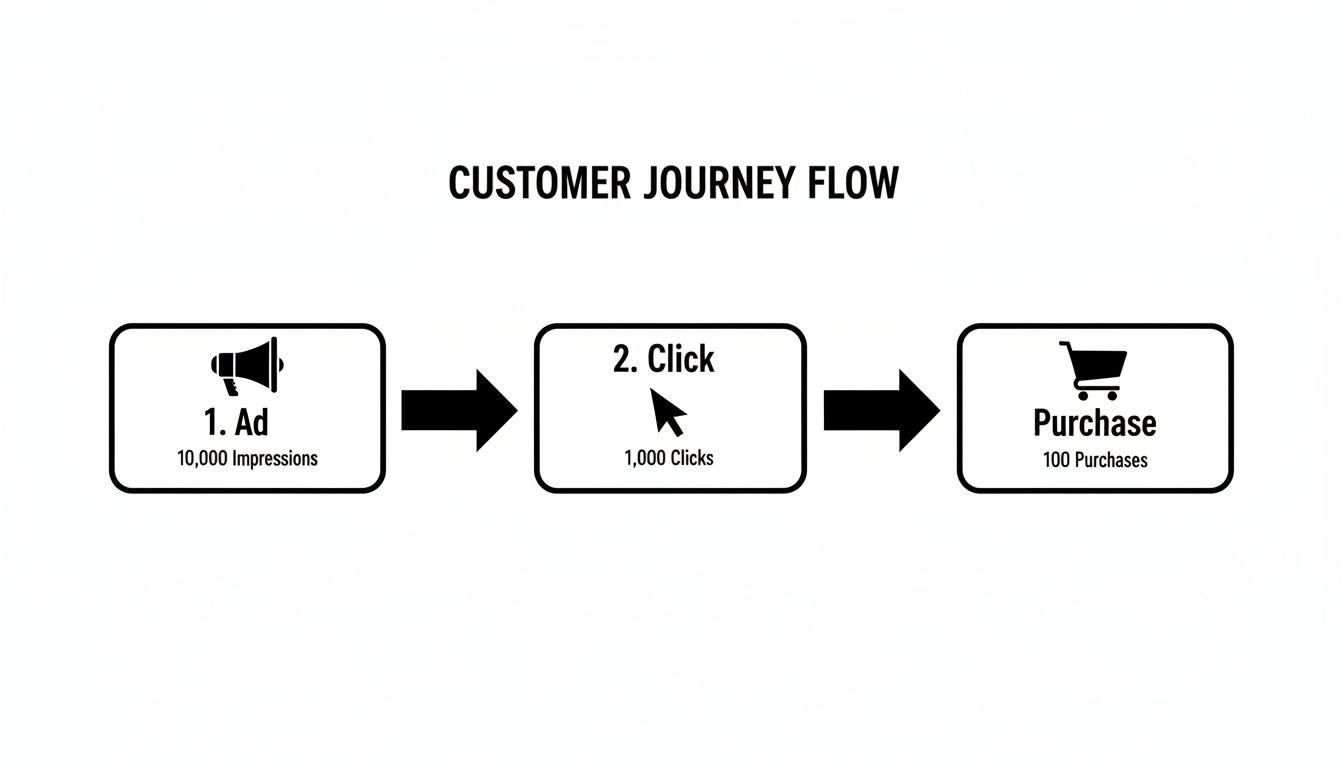
Now, let's see how different attribution models would divvy up the credit for that $150 sale.
The Single-Touch Models
These are the simplest models because they give 100% of the credit to a single event. They're straightforward but often paint a misleading picture.
1. Last-Click Attribution
This model is as simple as it sounds: the very last touchpoint before the sale gets all the glory. For Alex, the promotional email gets 100% of the credit for the $150 sale.
Pros: It's easy to track and focuses on what sealed the deal.
Cons: It completely ignores everything that came before. All the hard work of building awareness and interest gets zero credit.
This tunnel vision is why last-click, once the default for marketers, is now only used by about 12% of them. It's a flawed view. In-depth research shows that channels like organic search might actually deserve 25% of the credit, and switching away from last-click can dramatically improve your ROAS.
2. First-Click Attribution
As you might guess, this is the exact opposite of last-click. It gives 100% of the credit to the very first interaction. In Alex’s journey, the Instagram ad would get full credit.
Pros: It’s great for understanding which channels are best at kicking off the customer journey.
Cons: It completely overlooks all the crucial steps that nurtured Alex from a casual viewer into a paying customer.
The Multi-Touch Rule-Based Models
These models are a big step up, spreading the credit across multiple touchpoints using a set of fixed rules.
3. Linear Attribution
The linear model is the most democratic. It splits the credit evenly across every single touchpoint. In our example, the four interactions (Instagram Ad, Google Ad, Organic Search, Email) would each receive 25% of the credit, or $37.50.
The core idea here is simple: every interaction played an equal part in getting the customer to the finish line.
4. Time Decay Attribution
This model operates on the belief that the closer a touchpoint is to the sale, the more influential it was. The credit "decays" the further back in time you go.
For Alex’s purchase, the email would get the largest share of the credit, followed by the organic blog post, then the Google ad. The Instagram ad from over a week ago would get the smallest piece of the pie.
5. Position-Based (U-Shaped) Attribution
The position-based model is a popular hybrid. It champions the first and last touchpoints as the most important, giving 40% of the credit to each. The remaining 20% is then split among all the interactions in the middle.
First Touch (Instagram Ad): Gets 40% credit ($60).
Last Touch (Email): Gets 40% credit ($60).
Middle Touches (Google Ad & Organic Search): Each get 10% credit ($15).
This model gives a hat tip to both the channel that started the conversation and the one that closed the deal.
The Algorithmic Model
This is where things get really smart. Instead of relying on fixed rules, this model uses your own data to figure out what truly works.
6. Data-Driven Attribution (DDA)
A data-driven attribution model uses machine learning to analyze all your converting and non-converting customer paths. It crunches the numbers to determine the actual persuasive power of each touchpoint.
For Alex's journey, a DDA model might analyze thousands of similar paths and conclude the Google search ad was the real game-changer, awarding it 35% of the credit. The credit distribution is custom-built for your business and gets smarter over time. It's the most accurate model, but also the most complex to set up.
Comparison of Common Attribution Models
To help you see the differences at a glance, here’s a quick breakdown of how each model stacks up.
Attribution Model | How It Assigns Credit | Best For | Main Drawback |
|---|---|---|---|
Last-Click | 100% to the final touchpoint | Quick analysis of "closing" channels | Ignores all upper and mid-funnel efforts |
First-Click | 100% to the initial touchpoint | Measuring brand awareness and demand generation | Undervalues channels that nurture and convert |
Linear | Equally among all touchpoints | Getting a baseline, holistic view | Assumes all touchpoints are equally valuable (they aren't) |
Time Decay | More credit to recent touchpoints | Short sales cycles and promotional campaigns | Devalues early-stage awareness-building touchpoints |
Position-Based | 40% to first, 40% to last, 20% to middle | Valuing both acquisition and conversion | The 40/20/40 split is arbitrary and may not fit your business |
Data-Driven | Algorithmically based on historical data | The most accurate and nuanced performance view | Requires significant conversion data and can be a "black box" |
Each of these models tells a part of the story, but as you can see, some tell it much better than others. The right choice depends on your business goals, sales cycle, and the data you have available.
Putting Attribution Models into Practice
Understanding the theory is great, but putting it to work inside the ad platforms you use every day is what really counts. Platforms like Meta and Google Ads each have their own quirks when it comes to attribution, so getting a handle on their settings is critical to making sense of your performance data. Let's shift from the "what" to the "how."
A core piece of this puzzle is the conversion window, sometimes called an attribution window. Think of it as the timeframe after someone interacts with your ad where a conversion, like a sale, can be credited back to it. It’s the official rulebook for deciding which conversions get counted.
A very common setup is a 7-day click, 1-day view window. This tells the platform to give credit to an ad if a user clicked it within the last seven days or simply saw it (without clicking) within the last 24 hours. Changing this window directly changes the data you see, which is why sticking to a consistent setting is so important for accurate analysis.
Navigating Attribution in Meta Ads
The world of Meta attribution got a lot more complicated after Apple's iOS14 update, which put serious limits on tracking people once they leave Facebook or Instagram. Because of this, Meta now leans heavily on statistical modeling to fill in the gaps.
When you open your Meta Ads Manager, you'll find the default setting is 7-day click and 1-day view. Meta recommends this because it’s designed to capture the broader impact of your ads over a reasonable period. The crucial thing to remember here is that a good chunk of this data is now modeled, not directly observed one-for-one.
You can still customize this window to get different perspectives on your data. For example, if you only care about what’s driving immediate action, you could switch to a 1-day click window. You’ll see fewer conversions, but you’ll get a much sharper picture of direct-response performance.
The real secret with Meta is to trust the trends you see in their modeled data but not to get hung up on every single reported conversion as a directly tracked event. The platform is giving you its best educated guess on an ad's impact.
Activating Data-Driven Attribution in Google Ads
Google Ads gives you a bit more control, letting you pick from several attribution models right in your conversion settings. While you can still choose old-school models like Last-Click or Linear, Google pushes hard for users to switch to its Data-Driven Attribution (DDA) model.
Unlike the other models that follow rigid, pre-set rules, DDA is all about your own account. It uses machine learning to sift through your historical data—looking at both customers who converted and those who didn't—to figure out which touchpoints were actually the most influential. This makes it, by far, the most customized and accurate option for most advertisers.
Ready to make the switch in Google Ads? Here’s how:
Head over to Tools and Settings > Measurement > Conversions.
Click on the specific conversion action you want to update.
Find the Attribution model section in the settings.
Choose Data-Driven from the dropdown menu and hit save.
By switching to Google's DDA, you stop relying on arbitrary rules and start letting your own data tell the story of how credit should be shared. It gives you a much richer understanding of how your keywords and campaigns truly work together. Knowing the ins and outs of each platform is a huge part of choosing the right marketing attribution software to tie everything together.
Tackling Today's Attribution Headaches

The clean, linear customer paths we've used as examples are great for learning, but they aren't the real world. The modern path to purchase is messy. It's a chaotic scribble of different devices, channels, and sessions that makes connecting the dots a serious challenge.
Someone might see your Instagram ad on their phone during their morning commute, browse your site on their work laptop later, and finally make the purchase on their tablet from the couch. This cross-device journey is now the norm, not the exception.
This creates huge data gaps. If you can't tie that phone, laptop, and tablet back to the same person, your attribution model sees three separate, incomplete stories. You're trying to solve a puzzle with half the pieces missing.
The Privacy Squeeze and Widening Data Gaps
This problem got a lot harder after major privacy shifts rocked the industry. Apple’s iOS 14 update and its AppTrackingTransparency (ATT) framework was a watershed moment. It forced users to opt in to being tracked, effectively turning off a firehose of data that platforms like Meta depended on.
On top of that, the phase-out of third-party cookies in browsers like Google Chrome is closing another door for trackers. These changes create massive data gaps, making it more difficult than ever to follow a user from an ad click all the way to a sale.
To work around this, platforms now lean on modeled conversions.
Modeled conversions are essentially educated guesses. Ad platforms use aggregated and anonymized data from users who have consented to tracking to estimate the conversions from users who have not. They're a necessary fix, but they add a layer of abstraction that separates you from the raw truth.
Why You Can’t Trust a Single Platform
If you only look at the attribution report inside Google Ads or Meta Ads, you’re getting a dangerously skewed picture. Each platform’s reporting is designed to do one thing: prove its own value so you'll spend more money there.
Think of it like this:
Meta’s View: Meta knows everything that happens on Facebook and Instagram. Naturally, its model will give heavy credit to its own touchpoints because that's the data it sees best.
Google’s View: Google is the king of tracking search intent and clicks across its massive ad network. Its model will always emphasize the value of those search-related touchpoints.
Each platform is grading its own homework. When you rely on a single report, you completely miss the interplay between your channels. You can't see how a view-through of a Meta ad prompted a brand search on Google that led to a sale. For a clearer picture, it's critical to send better first-party data back to these platforms using tools like the Meta Conversions API.
A smart attribution strategy means looking at the entire ecosystem. By pulling data from multiple sources and analyzing it together, you start to see how different channels support each other to drive real growth. That unified view is the only way to navigate modern attribution and make truly informed budget decisions.
Common Attribution Mistakes and How to Avoid Them

Picking an attribution model is one thing, but actually using it to make smart decisions is where the real work begins. It’s surprisingly easy to let a sophisticated model lead you astray, causing you to misallocate budget and miss out on genuine growth. Knowing the common pitfalls is the first step to building a framework you can actually trust.
A classic mistake is choosing a model that just doesn't match how your customers buy. Imagine a company selling high-end furniture with a long, considered sales cycle. If they use a last-click model, they're completely ignoring all the blog posts, social ads, and email newsletters that introduced and nurtured that customer for weeks.
What happens next is predictable. They see "low ROI" on those top-of-funnel channels and cut their budgets. Before long, their pipeline dries up, and sales start to slide. The model wasn't broken—it was just the wrong tool for the job.
Overreacting to Daily Noise
Another trap I see teams fall into all the time is treating daily performance data as gospel. Marketing data is messy. Conversions bounce around day-to-day for reasons that have nothing to do with your campaigns. A knee-jerk reaction—like pausing a campaign after one bad day—almost always does more harm than good.
Smart teams look for trends over time. They analyze performance on a weekly, or even monthly, basis to smooth out that daily volatility. This gives you a much clearer signal of what's actually working and stops you from making panicked decisions based on random statistical noise.
Forgetting to Validate Against Reality
This is the big one: trusting a model’s output without ever checking it against real-world business results. An attribution model is just a hypothesis, not a fact. The only thing that matters is whether its recommendations actually improve your bottom line. This is the heart of effective what is attribution modeling in practice.
The most important question you can ask is: "If we shift budget based on what this model tells us, does our total revenue and profit actually increase?" If the answer is no, your model is flawed.
To sidestep these costly errors, you need a simple validation process. Before you make any major budget shifts based on your model, treat it like an experiment.
Form a Hypothesis: "Our model suggests that moving 20% of our budget from Channel A to Channel B will increase overall ROAS."
Run a Test: Actually make that budget shift and let it run long enough to get meaningful data.
Measure the Outcome: Did your total revenue and profit go up? Did your overall customer acquisition cost go down? Don't just look at the in-platform metrics for Channel B; measure the impact on the entire business.
This simple feedback loop turns attribution from a passive reporting task into an active strategic tool. By constantly testing your model’s insights against real business results, you can be confident you’re making decisions that drive real growth, not just chasing vanity metrics inside a flawed system.
Here's a rewritten version of the section, crafted to sound like an experienced human expert.
Turning Attribution Data into Daily Action
Let's be honest: the whole point of attribution modeling isn't to create a beautiful report that sits in a folder. It's about making smarter, more profitable decisions—today. All the models, data, and number-crunching are completely worthless unless they help your team take better action every single morning. This is where the rubber meets the road, turning abstract insights into real performance gains.
The big takeaway here is that attribution is a compass, not just a scoreboard. It's easy to get bogged down in endless debates about which model is "perfect" or lost in massive spreadsheets. But the real goal is to use the data to guide your next move. It needs to answer that one crucial question every performance marketer wakes up with: "What should I do today?"
From Complex Signals to Clear Guidance
This is where modern tools have really changed the game. They’re built to cut through the noise. They take all the conflicting, messy signals from platforms like Meta and Google, and boil them down into simple, direct recommendations. We've moved past just analyzing what happened and into a world of active decision support.
So, instead of just seeing that Campaign A has a higher ROAS than Campaign B, you get specific, context-aware instructions.
Smart Budget Shifts: You might get an alert that says, "Boost the budget on Campaign X by 15%." This isn't a random guess; it's backed by data showing stable performance and an audience that hasn't been tapped out yet.
Creative Fatigue Alerts: The system flags an ad that's starting to lose steam, telling you it’s time to swap in fresh creative before you start wasting money on it.
Audience Saturation Warnings: You get a heads-up when an audience is getting oversaturated, which is your cue to either test new targeting or expand your horizons.
This approach effectively turns a mountain of abstract data into a prioritized to-do list. You can finally execute with confidence, not just guesswork.
The best marketing teams I've seen don't just understand their attribution data; they have a system to act on it. They've stopped asking "What happened?" and started answering "What's next?"—every single day.
Making Daily Execution Smarter
This is exactly how a platform like SpendOwlAI works. It doesn’t just give you another dashboard to stare at. Instead, it takes all those attribution signals and churns out a ranked list of daily actions. By constantly monitoring performance and applying smart operational guardrails, it stops you from making those reactive, knee-jerk changes that often do more harm than good.
It translates the "why" behind the numbers into concrete steps, telling you to pause an underperforming ad set or scale a creative that’s clearly a winner. This flips the script on attribution, turning it from a backward-looking reporting chore into a forward-looking operational engine. When you connect your data directly to daily tasks, you start boosting ad spend efficiency, cutting waste, and ensuring your team makes consistently better decisions, day in and day out.
Still Have Questions About Attribution Modeling?
Even when you've got the basics down, putting attribution into practice always brings up a few more specific questions. Let's tackle some of the most common ones that marketers ask, so you can move forward with confidence.
How Do I Choose the Right Attribution Model?
There’s no single "best" model for everyone. The right choice really comes down to what makes sense for your specific business. Think about three things: how long it takes a customer to buy, your main marketing goals, and how many touchpoints a typical customer interacts with.
Here’s a simple way to think about it:
For short sales cycles and quick decisions: If your products are often impulse buys (like a trendy t-shirt or a new snack), what happens right before the purchase is crucial. A last-click or time-decay model works well here because it gives more weight to the final touchpoints that sealed the deal.
For long sales cycles and big decisions: When people need to do their homework before buying (think B2B software, a car, or expensive electronics), the journey is much longer. A position-based or linear model gives you a more balanced picture by crediting both the channel that first caught their attention and the one that finally got them to convert.
When you have lots of data and need precision: If you're generating a healthy amount of conversion data, you should really be looking at a data-driven model. It stops guessing and starts using your actual performance history to figure out which touchpoints are truly driving results. It's almost always the most accurate option if you have the data to support it.
How Did iOS14 Change Attribution Modeling?
Apple's iOS14 update, with its AppTrackingTransparency (ATT) framework, was a seismic shift for digital advertising. It severely limited the ability to track users as they moved between different apps and websites, which blew a huge hole in the data for platforms like Meta, which relied heavily on that information.
To adapt, ad platforms started leaning heavily on modeled conversions. Essentially, they now use aggregated, anonymous data to estimate the conversions they can no longer see directly. This new reality makes collecting your own first-party data (like email signups and customer loyalty programs) more critical than ever for piecing together a reliable view of the customer journey.
In a post-iOS14 world, having a single source of truth is non-negotiable. If you just look at what each platform reports, you're getting a fragmented and often skewed picture of what's actually working.
Can I Use Different Models for Different Channels?
Technically, you can, but you really shouldn't if you want to make smart decisions. Each platform, like Google Ads or Meta, has its own default model. Comparing Google's last-click report to Meta's 7-day click report is a classic apples-to-oranges mistake—the numbers just aren't speaking the same language.
A much better approach is to centralize your data. Pull everything into one place, whether that's a sophisticated analytics tool or even a well-organized spreadsheet. From there, you can apply a single, consistent model across all your channels. This creates that unified "source of truth" you need to compare performance fairly and decide where your next dollar should go.
Instead of getting lost in spreadsheets, SpendOwlAI translates complex attribution signals into a clear, ranked list of daily actions. It tells you exactly where to shift budget and when to refresh creatives, turning your data into confident, profitable decisions every day. Start your free 7-day trial and see for yourself.