A Guide to Marketing Attribution Software for Smarter Ad Spend
If you're pouring money into Meta and Google ads, you're probably wrestling with the same question day in and day out: which ads are actually working? Marketing attribution software is built to answer that exact question. Think of it as a detailed map connecting the dots between every dollar you spend and every sale you make. It’s the detective that uncovers the entire customer journey, not just the last click that gets all the credit.
Why Marketing Attribution Is No longer Optional
Let's be real—in today's chaotic market, customers don't travel in a straight line. They might see your ad on Instagram, search for you on Google a week later, get hit with a retargeting ad on Meta, and finally buy something from your Shopify store. Trying to make sense of this with just the data from each platform is like navigating a city with a dozen different, incomplete maps. You can see the individual streets, but you have no clue how they all connect.
This fragmented view is a recipe for wasted ad spend and missed opportunities. You might kill a top-of-funnel campaign because it looks like a dud, completely missing that it’s the essential first touchpoint for your highest-value customers. This is precisely why modern marketing attribution software has become so critical; it gives you a single, reliable source of truth.
Gaining Clarity in a Complex Market
A good attribution tool does more than just throw data at you—it provides genuine clarity. It helps you see the beautiful (and sometimes messy) synergy between your channels and how they collaborate to drive growth. For example, you can finally connect your efforts to improve click-through rates on specific ads to actual revenue down the line.
The demand for this kind of clarity is fueling explosive industry growth. The global market for this software hit an incredible USD 4.74 billion in 2024 and is on track to more than double to USD 10.10 billion by 2030. That surge tells you everything you need to know about the challenges modern marketers are facing. You can dig deeper into this trend and what it means for businesses over at Grand View Research.
Without a clear attribution strategy, marketing teams are essentially guessing where to allocate their budget. They might credit the final touchpoint for a sale while ignoring the three or four interactions that made it possible.
This lack of visibility is a major weak spot for any business trying to scale. Getting attribution right empowers you to:
Stop Wasting Money: Confidently pull budget from channels that only look busy and pour it into those that genuinely drive sales.
Optimize the Full Funnel: Finally understand which campaigns are brilliant at introducing new customers and which ones are clutch for closing deals.
Scale with Confidence: Make data-backed decisions to ramp up spending on your proven winners, knowing you're investing in what truly works.
Bottom line? Marketing attribution software isn't some luxury for massive corporations anymore. It's a fundamental tool for survival and growth. It shifts you from being a reactive marketer guessing what works to a strategic operator who understands the complete customer story, from the very first impression to the final sale.
Understanding Different Marketing Attribution Models
Choosing the right marketing attribution software really comes down to understanding the "engine" that makes it run: the attribution model. Think of a model as the rulebook that decides how credit for a sale gets handed out to all the different touchpoints a customer interacts with.
It's a lot like a soccer team scoring a goal. Who gets the credit? Is it just the player who kicked the ball into the net? What about the midfielder who made the brilliant pass that set up the shot? Or the defender who started the whole play from the back? Each answer tells a very different story about how the team won.
This is exactly what attribution models do for your marketing—they tell the story of how you're winning customers.
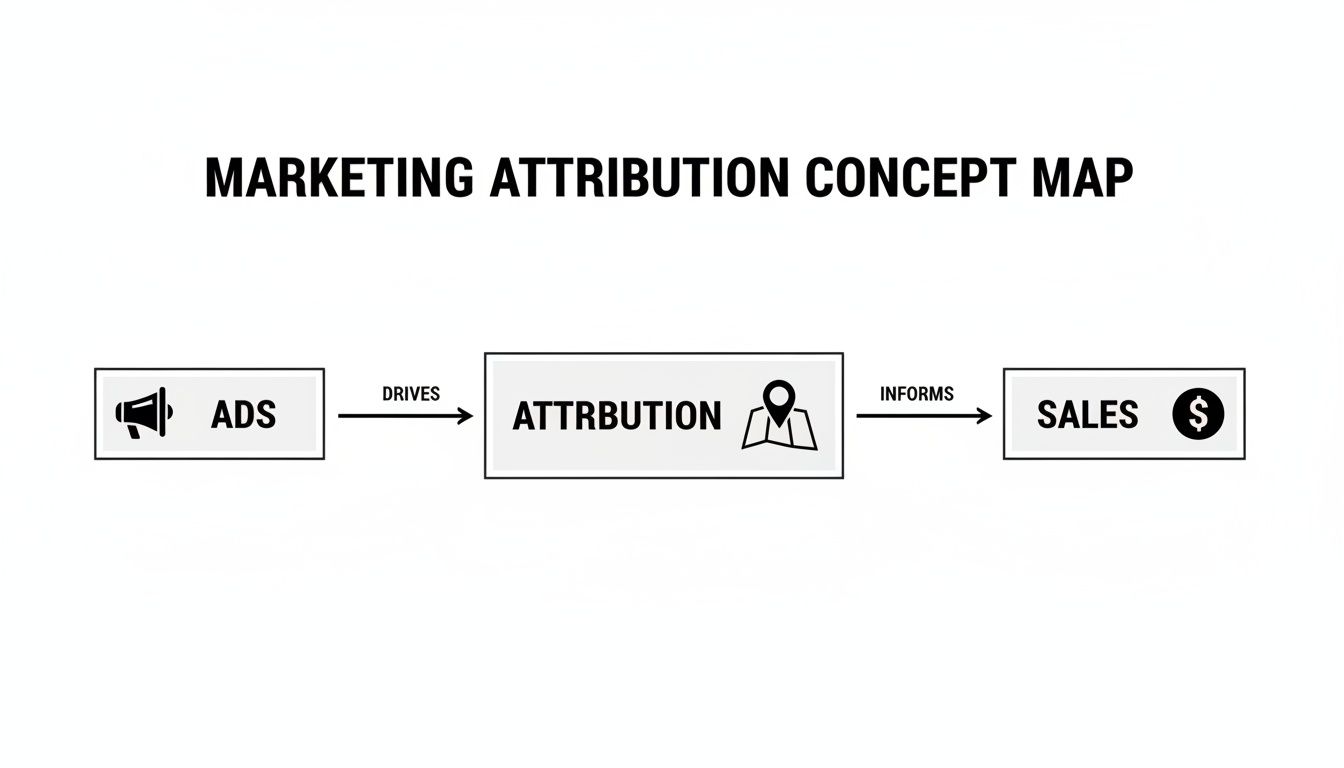
As you can see, attribution is the critical link between what you spend on ads and the revenue you generate. It turns a messy pile of ad data into a clear story that helps you make smarter decisions.
The Pitfalls Of Single-Touch Models
The simplest models are called single-touch, and as the name implies, they give 100% of the credit to just one interaction. They're easy to wrap your head around, but in today's world where customers see you everywhere, they can be dangerously misleading.
First-Touch Attribution: This model gives all the credit to the very first time a customer ever interacted with your brand. It’s great for seeing which channels are good at getting your name out there, but it completely ignores everything that happened afterward to convince them to buy.
Last-Touch Attribution: By far the most common—and often the most flawed—model. It gives all the credit to the final click before a conversion. While it tells you what closed the deal, it completely overlooks all the hard work your other channels did to nurture that customer along the way.
Relying on these is like only giving credit to the goal-scorer and concluding your defenders and midfielders are useless. It's a bad analysis that leads to even worse decisions. It’s why so many marketers are getting serious about tracking every touchpoint. For a deeper dive, check out our guide on using UTMs for Google Analytics.
Embracing A Fuller Picture With Multi-Touch Models
Customer journeys aren't a straight line anymore; they're a winding road. That’s where multi-touch attribution models come in. They spread the credit across multiple touchpoints, giving you a much more balanced and realistic view of what’s working.
Multi-touch attribution is quickly becoming the standard. Marketers are finally ditching old models like last-click, which can ignore up to 80% of the customer journey. It’s no surprise the marketing attribution software market is exploding from USD 4.35 billion in 2024 to a projected USD 17.73 billion by 2035, all because businesses need to see the entire funnel. You can read more about this market growth on Market Research Future.
Several popular multi-touch models slice up the credit in different ways:
Linear: The simplest of the bunch. It gives every single touchpoint an equal slice of the credit. It’s fair, but it also assumes a quick glance at a social media post is just as valuable as an in-depth product demo, which is rarely the case.
U-Shaped: This model recognizes that the first and last touches are often the most important. It gives 40% of the credit to the first touch, 40% to the touch that created the lead, and splits the remaining 20% among all the interactions in between.
W-Shaped: This one goes a step further by adding another key moment. It assigns 30% of the credit each to the first touch, the lead creation touch, and the opportunity creation touch. The final 10% is then divided among the remaining interactions.
These rule-based models are a massive leap forward from single-touch, but they still operate on assumptions. You're telling the model what's important, instead of letting the data speak for itself.
The Rise Of Data-Driven Attribution
This brings us to the most sophisticated approach: data-driven attribution. Instead of relying on pre-set rules, this model uses machine learning to sift through all your customer journey data—both for people who converted and those who didn't.
The algorithm figures out the actual impact of each touchpoint by calculating how much it increased the probability of a conversion.
For example, it might discover that people who watch a specific video ad early in their journey are 50% more likely to buy. A rule-based model would have given that video very little credit, but a data-driven model correctly identifies its massive influence and assigns credit accordingly.
This approach strips away the guesswork. It gives you the truest picture of what’s actually driving growth, and it’s the powerful core of any modern marketing attribution software.
Must-Have Features in Your Attribution Software

Knowing the theory behind attribution models is one thing, but putting that knowledge to work means having a tool that’s built for the job. The truth is, not all marketing attribution software is created equal. The best platforms move way beyond basic reports to offer features that solve the real, everyday problems that performance marketers and e-commerce founders face.
It’s a bit like buying a car. You know you need an engine and four wheels—that's a given. But it’s the features that make it the right car for you. Think all-wheel drive for snowy winters or a giant trunk for family road trips. Your attribution software is the same; its features have to match up with the challenges you’re trying to solve every day.
Think of this section as your practical checklist. We’re not just going to list what to look for, but explain why these features are so critical for making smarter decisions that actually grow your bottom line.
Comprehensive Cross-Channel Tracking
Your customers don’t just hang out on one platform, so your attribution tool can't afford to, either. The ability to see the complete customer journey across every single channel you use—Meta, Google, TikTok, email, organic search, you name it—is completely non-negotiable.
Without this, you’re flying blind. You might look at your dashboard and see a Google Search ad converting like crazy, but you’d completely miss the fact that a Meta prospecting campaign is doing all the heavy lifting of introducing new people to your brand in the first place.
A siloed view leads to disastrous decisions. You might cut the budget for a top-of-funnel campaign that looks like it has a low ROAS, only to watch your entire sales funnel dry up a month later. True cross-channel visibility shows you how all your marketing works together as a system, preventing these kinds of costly mistakes.
A solid marketing attribution software pulls all this data together, giving you a single source of truth. It allows you to see how your efforts to improve Google Ads performance might be driving conversions that ultimately get credited to another channel.
SKU-Level Reporting and Profitability
For any e-commerce brand, looking at overall store revenue is just scratching the surface. You need to know which specific products are flying off the shelves and, more importantly, which ones are actually making you money. This is where SKU-level reporting becomes a total game-changer.
This feature ties your ad spend directly to the sale of individual products. It finally answers those crucial questions you’ve been asking:
Which Meta campaign is actually best at selling my high-margin products?
Are my Google Shopping ads for that one specific SKU profitable once I factor in all the ad costs?
Should I pour more money into a campaign driving sales of a low-margin item, or shift that budget to promote something more profitable?
By connecting ad performance to individual SKUs, you can finally move beyond chasing revenue and start optimizing for real, actual profit. This level of detail empowers you to make smarter calls on everything from inventory management to ad creative, making sure every dollar you spend is working as hard as it possibly can.
Seamless and Deep Integrations
Your attribution tool has to talk to the other platforms that run your business, and it needs to do it flawlessly. This isn't just about pulling in data; it's about creating a smooth, automated flow of information that cuts out the manual grunt work and guarantees accuracy.
At a bare minimum, you need to look for deep integrations with these key areas:
Ad Platforms: You need direct API connections to Meta, Google Ads, TikTok, and other paid channels to pull in precise spend and campaign data.
E-commerce Platforms: A native integration with Shopify, Magento, or whatever platform you use is essential for connecting ad performance to real sales, orders, and customer information.
Analytics and CRMs: The ability to sync with tools like Google Analytics or your CRM closes the loop, giving you a complete, 360-degree view of the customer lifecycle.
A tool with weak or flimsy integrations will have you stuck in spreadsheet hell, trying to manually stitch data together. Not only is that a massive time-waster, but it’s a recipe for errors. Robust, native integrations ensure your data is reliable, current, and ready for you to act on.
Common Attribution Pitfalls and How to Avoid Them

Getting a powerful marketing attribution software up and running is a huge win, but it's no magic wand. If you're not careful, you can fall into a few common traps that completely undermine all that hard work. The real goal isn't just to gather data; it’s to turn that data into smarter, more profitable decisions.
Too many teams invest in a shiny new tool only to end up right back where they started: staring at dashboards, feeling confused, and unsure what to do next. This usually happens when the focus is on the software itself rather than on solving the real, day-to-day problems holding your marketing back.
Think of this section as your field guide to those pitfalls. By knowing what to look out for from the get-go, you can set yourself up for clarity and growth, not just another set of charts to sift through.
Pitfall 1: Data Silos and Incomplete Journeys
The most basic mistake you can make is failing to connect all the dots. If your attribution software is only looking at paid social but has no idea what’s happening in paid search, email, or organic traffic, you're trying to navigate with an incomplete map. You can't possibly understand the customer's journey if you can only see tiny fragments of the road they traveled.
This creates some seriously dangerous blind spots. You might give all the credit to a Google ad for a conversion while completely missing the three Meta ads and two email campaigns that did the real work of warming up that lead. Making budget decisions based on that fragmented view is often no better than a wild guess.
How to Avoid It:
Make Integrations Your Top Priority: Go for a tool with deep, native integrations for every platform in your stack—from ad channels like Meta and Google all the way to your Shopify store.
Create a Single Source of Truth: Your software must pull all these touchpoints together into one cohesive timeline for each customer journey. No more hopping between tabs.
Track Absolutely Everything: Be meticulous about tracking from day one. That means having solid UTM parameters for every single campaign to make sure no touchpoint gets left behind.
An attribution tool that operates in a silo isn't a solution; it's just another dashboard. The real power comes from unifying disparate data sources to reveal the full, unvarnished story of how customers interact with your brand from first touch to final sale.
Pitfall 2: Suffering From Analysis Paralysis
So, you've connected everything. Your dashboards are now overflowing with data, charts, and metrics. This feels like progress, but it often triggers a whole new problem: analysis paralysis. With so much information coming at you, it’s suddenly impossible to figure out what actually matters or which lever you should pull next.
This is where marketers get stuck in a reporting hamster wheel, trying to find a meaningful signal in all the noise. They burn hours digging through data instead of making the changes that would actually move the needle. It's the classic scenario where the tool creates more work instead of providing clear, confident direction.
How to Avoid It:
Demand Actionability: Don't settle for software that just shows you data. Look for a platform that interprets it for you and tells you what to do. Prioritize tools that give you ranked recommendations or clear, actionable insights.
Ask the Right Questions First: Before you even log in, know what you're trying to figure out. Are you trying to find your most profitable SKU? Or pinpoint your best top-of-funnel ad?
Start Small and Iterate: You don't have to optimize everything at once. Pick one campaign or channel, make an informed change based on what the data suggests, and measure the results before you move on to the next thing.
Pitfall 3: Making Knee-Jerk Reactions to Noisy Data
Not every blip on the chart is a trend. A campaign's ROAS might dip for a day because of random, unpredictable fluctuations—not because your creative suddenly stopped resonating. One of the biggest mistakes is reacting to this "noise" by immediately killing an ad or slashing its budget.
These knee-jerk changes almost always do more harm than good. They mess with the ad platform's algorithms and stop your campaigns from ever hitting their stride. True optimization is about telling the difference between random variance and a legitimate pattern that requires you to step in. This is where patience—and smarter software—can save you a world of hurt.
From Data Overload to Actionable Insights with SpendOwlAI
Let’s be honest. The big pitfalls of marketing attribution—siloed data, analysis paralysis, and knee-jerk campaign changes—all boil down to one nagging problem. Most marketing attribution software is fantastic at collecting data, but it falls flat at the most important part: telling you what to do next. You get dashboards that are a complex web of charts and metrics, creating more questions than they answer and leaving you to connect the dots yourself.
This is exactly where so many performance marketers get stuck. They invest in a powerful tool hoping for clarity but end up drowning in a sea of information. Hours are wasted trying to translate raw data into actual decisions. The goal was never to get more reports; it was to find a faster, more confident path to growth. That gap between data and action is precisely what SpendOwlAI was built to solve.
Here’s a look at the main dashboard, which throws out the complex charts in favor of a clear, prioritized to-do list.
Instead of just showing you performance metrics, the platform immediately tells you the most impactful changes you can make today, ranked by their potential to improve your results.
Moving Beyond Dashboards to Daily Actions
SpendOwlAI completely flips the script on traditional attribution. Rather than giving you a dashboard and expecting you to hunt for insights, it delivers a daily, ranked list of recommended actions. This approach is built on a simple but powerful idea: clarity comes from knowing what to do, not just from seeing what happened.
Each morning, you get a straightforward to-do list, prioritized by potential business impact. This could be a recommendation to scale a high-performing ad set, pause a creative showing signs of fatigue, or shift budget away from a saturated audience. It just cuts through the noise and turns your attribution data into a concrete plan of attack.
The real value of modern marketing attribution software isn't its ability to generate charts. It's the ability to generate confident decisions. By focusing on prioritized actions, you get to stop being a data analyst and start being a more effective operator.
This relentless focus on actionability is the perfect antidote to analysis paralysis. You no longer have to search for the signal in the noise because the system has already done the heavy lifting, pointing you straight to the opportunities that actually matter.
Combining Explainability with Protective Guardrails
One of the biggest frustrations with automated tools is their "black box" nature. They spit out a recommendation but give you no rationale, leaving you unable to understand or defend the decision. SpendOwlAI was built on the principle of explainability. Every single recommendation comes with a clear, transparent reason that you can inspect, question, and ultimately trust.
For instance, if the system suggests pausing an ad, it will show you exactly why—maybe the cost per acquisition has been creeping up for three days straight while the click-through rate has plummeted. This kind of transparency gives you the confidence to make changes, knowing each move is backed by solid data.
At the same time, the platform includes critical guardrails to prevent you from making common mistakes. These features are designed to protect your campaigns from well-intentioned but ill-timed tweaks that can hurt performance.
Preventing Over-Editing: The system keeps an eye on how often you’re making changes. If you’re editing too frequently, it will warn you that you risk disrupting the ad platform’s learning phase and destabilizing performance.
Avoiding Premature Scaling: It checks for performance volatility and saturation, stopping you from pouring budget into a campaign that isn't truly ready for it. This alone can save you a ton of wasted spend.
Context-Aware Optimization: It understands that not all metrics are created equal and avoids making blanket recommendations that ignore the bigger strategic picture.
These guardrails are a direct response to the pitfall of making reactive, noise-driven changes. They encourage a more patient and deliberate approach to optimization, making sure you only act on meaningful trends, not random daily fluctuations.
Gaining Deeper Visibility Down to the SKU
For any e-commerce brand, looking at overall campaign performance is only half the story. Real profitability is found by understanding which specific products your ads are actually selling. SpendOwlAI gives you deep SKU-level visibility, connecting your ad spend directly to individual product sales.
This granularity lets you answer the questions that truly drive your business forward:
Is my top-performing Meta campaign driving sales for my highest-margin products, or is it just moving low-profit items?
Which of my Google Ads are most effective at selling that new product line we just launched?
Should I shift budget away from campaigns promoting saturated SKUs and point it toward those with more room to grow?
This kind of view transforms your marketing attribution software from a simple reporting tool into a strategic lever for profit optimization. And with multi-account visibility, agencies and brands managing multiple storefronts can get this same level of clarity across their entire portfolio from a single interface. This cohesive view finally breaks down the data silos, ensuring every decision is made with a complete understanding of its impact on the bottom line.
Frequently Asked Questions About Marketing Attribution
Even with a solid plan, a few questions always come up when you’re bringing in new attribution software. This section covers the things we hear most often from founders, marketers, and agency partners. The idea is to give you quick, no-nonsense answers to clear up any confusion and help you get started on the right foot.
Think of this as your go-to cheat sheet. We'll nail down some of the finer points so you can choose, implement, and actually get value from your attribution platform with total confidence.
What Is the Best Attribution Model to Use?
This is the big one, and the honest answer is: it depends entirely on what you're trying to achieve. There’s no magic bullet model that works for every single business. That said, for most companies whose customers don't buy on the very first visit, a data-driven attribution model is going to give you the clearest picture.
Here’s a simple way to think about it:
To see what starts the conversation: First-touch attribution is great for figuring out which channels are introducing your brand to new people.
To see what seals the deal: Last-touch attribution shows you what gave customers that final nudge before they bought.
To get the full story: Multi-touch models (like Linear, U-Shaped, or W-Shaped) are a massive improvement, spreading the credit out across the entire journey.
For the sharpest insights: Data-driven models are the gold standard. They use smart algorithms to figure out how much each touchpoint actually contributed, taking the guesswork out of the equation.
The bottom line? The best marketing attribution software won't lock you into one view. It will let you toggle between different models so you can analyze the customer journey from every important angle.
How Long Does It Take to See Results?
This is another question that comes up all the time, and it's crucial to set realistic expectations here. You’ll start collecting data the moment your tracking is live, but seeing real, actionable patterns takes a little bit of time. The platform needs to see enough customer journeys play out to understand what’s normal for your business.
You can usually start spotting reliable trends within 30 to 90 days. This timeframe gives the software enough conversion data across your various campaigns and channels to see past the random daily fluctuations and identify what's truly working.
Seriously, patience is a virtue here. A classic mistake is to make big, knee-jerk decisions based on a few days of data. You have to give the system time to learn before you start shifting your strategy based on what it's telling you.
Is Marketing Attribution Software Difficult to Set Up?
The setup process can be all over the map. Some of the older, clunkier enterprise systems are famous for being a nightmare, often demanding a developer and a drawn-out implementation schedule. Thankfully, modern marketing attribution software built for today’s DTC brands and performance marketers is a whole different ballgame.
Look for a tool that offers:
Simple, one-click integrations: You need seamless connections to your key platforms like Shopify, Meta Ads, and Google Ads for a pain-free setup.
Automated pixel installation: The best tools offer simple scripts or apps that handle the heavy lifting of tracking for you.
Helpful onboarding: A good company will have clear documentation, video tutorials, and real human support to walk you through it.
While you'll always have to do some initial configuration, the goal of modern tools is to get you from sign-up to insights in hours, not weeks. They're designed to help you skip the technical headaches and get straight to the good stuff.
Ready to stop guessing and start making confident, data-backed decisions every day? SpendOwlAI delivers a prioritized list of actionable changes, complete with clear explanations and protective guardrails to help you optimize your ad spend without the noise. Start your free 7-day trial and see the difference.