A Playbook to Improve Google Ads Performance
Tired of that sinking feeling you get when you log into your Google Ads account, knowing you need to do something but not sure what? We've all been there—making reactive, gut-driven tweaks that feel more like gambling than a strategy, and watching the budget disappear with little to show for it.
The secret to consistently great Google Ads performance isn't a single "magic bullet" setting. It’s about building a disciplined, repeatable system for auditing your account, testing smart hypotheses, and executing changes with confidence.
From Guesswork to a Growth System
This isn't another article full of generic advice. We're handing you a practical playbook for making changes that actually move the needle. Stop staring at your dashboard, endlessly refreshing the same metrics. It's time to learn what to change, what to leave alone, and how to operate from a clear, data-backed strategy.
The Real Opportunity on the Table
The performance gap between an average Google Ads campaign and a top-tier one is staggering—and it reveals just how much room for improvement most accounts have.
Consider this: the average Search campaign CTR is about 3.17%. But the top 25% of campaigns? They hit 5.8% or higher. That’s an 83% upside if you can bridge that gap. For a business spending $50,000 a month, making that leap could almost double your click volume without spending a single dollar more. It completely changes the math on your customer acquisition costs.
The gap is even wider on the Display Network, where top performers see a 74% lift over the average. You can dig into more of the latest Google Ads benchmarks to see for yourself.
This gap doesn't exist because of luck. Top performers operate within a structured framework. They diagnose issues systematically and run controlled experiments instead of just guessing.
The goal is to replace gut feelings with a repeatable process. Instead of asking, "What should I change today?" you'll start asking, "What does the data suggest I test next?" This shift in mindset is the foundation of sustainable account growth.
What This Playbook Will Give You
We'll walk you through a clear framework for auditing your own account and spotting the highest-impact opportunities. You'll learn how to diagnose the real problems holding you back, whether it's an unstable learning phase, audience saturation, or just plain creative fatigue.
This guide is designed to help you:
Diagnose Core Issues: Pinpoint the specific problems actually wasting your ad spend.
Run Structured Experiments: Methodically test your bids, budgets, creatives, and audiences to find what works.
Execute with Confidence: Follow a simple daily and weekly checklist to stay focused on actions that matter.
By building this system, you’ll finally move from making reactive tweaks to driving proactive, data-informed decisions that create real, consistent growth.
Your Foundational Audit: Where to Find the Hidden Wins

Before you ever think about touching a bid or tweaking a budget, you need to know what’s actually going on under the hood. A real account audit isn't about ticking boxes on some generic checklist. It's a systematic deep-dive to find the exact friction points that are leaking money and holding back your results.
Without this, any attempt to improve Google Ads performance is just a shot in the dark. This initial diagnostic work is what moves you from feeling like something is off to knowing exactly what the data says is broken. It gives you a clear, prioritized roadmap so you can focus your energy where it'll make the biggest difference.
First, Assess Learning Stability to Stop Wasting Money
One of the most common mistakes I see is constant tinkering. Every time you make a big change to a campaign—messing with the bid strategy, swapping all the creative—you can throw it right back into Google's learning phase. That’s a 7-14 day period where the algorithm is just gathering data, and performance is often erratic and inefficient.
If you’re always making changes, your campaigns get trapped in this learning loop and never hit their stride. Your audit should start in the change history. Look for a pattern of nervous, reactive edits. Are you seeing daily bid adjustments or new ads being swapped in every other day? If so, you've found your first win: practice a little patience.
An account full of unstable campaigns is like a car stuck in stop-and-go traffic. You're burning a ton of fuel but not getting anywhere. Let the engine run before you try to tune it.
Pinpoint Creative Fatigue and Audience Saturation
Here's a hard truth: even your best-performing ad has a shelf life. Creative fatigue happens when your audience has seen an ad so many times it just becomes background noise. You’ll see your Click-Through Rate (CTR) and conversion rates start to slide. At the same time, audience saturation kicks in when you’ve shown your ads to most of your target audience, causing frequency to rocket up while results plummet.
Your audit needs to dig into asset-level reporting to spot these warning signs:
Sinking CTR: Pull up your rockstar ads from a month ago. Is their CTR on a steady downward trend over the last 14-30 days? That's a classic sign of fatigue. To get ahead of this, you need to know how to improve click-through rate with fresh approaches.
Skyrocketing Frequency: Check your audience segments, especially for remarketing. If you see frequency climbing while conversions are dropping, you’re just annoying the same people over and over.
Stale Conversion Rate: Sometimes, the CTR holds steady, but the conversion rate tanks. This tells you the ad is still grabbing attention, but it’s lost its power to persuade people to act.
Catching these trends early means you can refresh your creative and test new audiences before they do serious damage to your return on ad spend (ROAS).
Check Your Account's Structural Health and Hygiene
Finally, a good audit gets into the plumbing of the account. This isn't about chasing some mythical "perfect" structure, but about clearing out the obvious clogs that are hurting performance.
The first place to look is your conversion tracking. Use tools like Google's Tag Assistant to make absolutely sure your tags are firing correctly on your key pages. Bad tracking is a silent account killer—it feeds the algorithm junk data, making true optimization impossible.
Next, live in your Search Terms Report. This is a goldmine for finding all the irrelevant searches gobbling up your budget. Get aggressive with your negative keyword lists. A clean report, free of junk queries, is the hallmark of a well-run account. This simple bit of housekeeping is one of the fastest ways to improve Google Ads performance by instantly cutting waste.
Running Experiments That Actually Move The Needle

Real optimization isn’t about making random, reactive tweaks and hoping for the best. It’s built on smart, controlled experiments. Once your audit has spotlighted the big opportunities, it's time to methodically test your hypotheses. This is how you shift from just fixing problems to actively engineering growth.
The goal isn't just to A/B test a headline. It's about systematically experimenting with the four core levers of your account—bids, budgets, creatives, and audiences. This disciplined approach is the only way to generate clean, actionable insights and sustainably improve Google Ads performance.
Testing Bids And Budgets With Precision
Playing with bids and budgets can feel like walking a tightrope. A wrong move could destabilize a profitable campaign. But avoiding these tests means you're almost certainly leaving money on the table. The key is to run controlled experiments with crystal-clear goals.
When it comes to bidding, don't just set it and forget it. Pit different strategies against each other. For example, use Google's Experiments feature to run a draft campaign using a tROAS strategy against your current manual CPC setup. Give each a 50% traffic split and let it run. The winner isn't the one that looks good after three days; it's the one that proves its worth over a statistically significant period.
Budget experiments are all about smart reallocation. Let's say your audit flagged a campaign that’s hitting its ROAS target but is constantly "Limited by budget." Your hypothesis is simple: “Increasing the budget by 20% will generate more conversions at a similar ROAS.” Run that test for at least two weeks, keeping a close eye on your cost-per-acquisition (CPA) and overall return.
The most powerful experiments often come from small, targeted shifts. You don't need to overhaul your entire account. A single, well-designed test on a high-volume campaign can produce more impact than a dozen scattered changes.
A Framework For Creative And Ad Copy Experiments
Your creative is the single most powerful lever you have for grabbing attention and beating ad fatigue. Instead of just swapping out images randomly, structure your tests around specific hypotheses. Think like a scientist, testing one variable at a time.
A solid creative testing framework moves from broad to specific:
Test Big Ideas First: Start with fundamentally different angles or value propositions. For an e-commerce brand, this might mean testing a "Built to Last" message against a "Modern Luxury" one.
Isolate The Winning Hook: Once you've found a winning angle, test variations of the headline or the first three seconds of a video ad. Find the hook that stops the scroll.
Refine The Call-To-Action (CTA): With a proven angle and hook, you can now fine-tune smaller elements. Test a direct CTA like “Shop Now” against a softer one like “Learn More” to see what drives the highest-intent clicks.
This layered approach ensures you’re making meaningful progress. While the platforms are different, the principles of structured testing are universal. In fact, many insights from a disciplined creative process here can be applied elsewhere, which is a huge advantage if you're also trying to figure out how to scale Facebook Ads.
Refining And Expanding Your Audiences
Your audience targeting determines who sees your brilliant ads. Experiments here usually fall into two buckets: refining existing audiences and exploring new ones.
For refinement, you could try segmenting a remarketing list based on user behavior. For instance, create two distinct audiences: one for users who abandoned their cart and another for those who only viewed a product page. You can then test tailored ad copy for each, hypothesizing that the cart abandoners will respond better to an ad featuring a small discount.
To expand your reach, use Audience Signals in Performance Max or build Similar Audiences to find new customer profiles. A great test is to launch a separate campaign targeting a new, data-backed expansion audience. Monitor its performance closely against your core campaigns to make sure you're scaling profitably without hurting your proven segments.
To put it all in perspective, a typical Google Ads ROAS is around 3.3:1. But for a brand with a 2% conversion rate, simply lifting that to 3% can drive a massive 50% improvement in ROAS. That's often the difference between scaling a campaign and having to pause it.
High-Impact Google Ads Experiment Ideas
Not all tests are created equal. You need to focus your energy on experiments that have the potential to deliver the biggest returns. This table gives you a simple framework for prioritizing your ideas based on potential impact versus the effort required.
Experiment Area | Hypothesis Example | Primary Metric to Watch | Potential Impact |
|---|---|---|---|
Bidding Strategy | "Switching from Manual CPC to tCPA will lower our average Cost Per Lead by 15%." | Cost Per Acquisition (CPA) | High |
Budget Allocation | "Increasing the budget by 25% on our top-performing campaign will scale conversions." | Total Conversions, ROAS | High |
Ad Creative Angle | "An ad focused on 'product durability' will outperform our current 'style' messaging." | Click-Through Rate (CTR) | Medium |
Audience Expansion | "A new Similar Audience based on our 'Top 10% LTV Customers' will find new buyers." | CPA, Conversion Rate | High |
Landing Page | "A landing page with video testimonials will convert 10% better than our static page." | Conversion Rate | Medium |
Use this as a starting point. The key is to constantly form new hypotheses based on your account data and then test them in a structured way to find your next pocket of growth.
Setting Guardrails So You Don't Sabotage Your Own Account
Let's be honest. One of the biggest threats to your Google Ads performance isn't a competitor or some surprise algorithm update. It's you. It's the temptation to constantly tinker, tweak, and "optimize" based on every little daily fluctuation. This kind of over-editing is the fastest way to destabilize the algorithm, burn your budget, and drive yourself crazy.
The solution is to build a system of "guardrails." These aren't complicated scripts or automations. They're just simple, pre-defined rules you set for yourself to govern when and how you make changes. Think of them as a framework to protect your campaigns from your own best intentions, especially when things are just getting started.
Hands Off: Protect the Learning Phase
Google's algorithm needs one thing above all else: clean, consistent data. When you launch a new campaign or make a major change, it kicks off a "learning phase" that can easily last a couple of weeks. Performance will be all over the place during this time—that's normal. The system is figuring out who your best customers are.
If you jump in and start changing bids, budgets, and targeting every other day, you keep resetting that process. Your campaign gets trapped in a permanent "learning" state, never hitting its stride.
So, here’s a hard and fast rule: for the first 14 days of a new campaign, make no significant edits. Period. Your only job is to watch for show-stoppers like ad disapprovals or zero impressions. Don't react to a bad Tuesday or a low-conversion Wednesday.
Constantly editing a new campaign is like pulling a plant out of the soil every day to check on the roots. You’re killing the very thing you're trying to grow. Just let it be.
Know When to Scale (And When to Wait)
You have a great day. Or even two great days. The temptation to dump more money into that campaign is powerful. Resist it. Scaling based on a short-term spike is a classic mistake that will absolutely torch your ROAS. A real signal to scale is consistent performance over a meaningful stretch of time.
You need to establish your own data-driven rules for increasing spend. For example:
The 7-Day Rule: A campaign must hit its target CPA or ROAS for at least 7 consecutive days before you even consider raising the budget. No exceptions.
The 20% Rule: Once a campaign qualifies, only increase its budget by a maximum of 20%. Then, wait another 3-5 days to see how performance settles before touching it again.
These rules stop you from chasing a fluke and ensure you're scaling based on what's actually working, not just what you hope will work. This methodical patience is how you sustainably improve Google Ads performance for the long haul.
Filter Out the Noise with Smart Alerts
Managing a Google Ads account can feel like trying to drink from a firehose. There's just so much data, and most of it is just daily statistical noise that doesn’t mean anything. The real skill is learning to ignore the noise and act only on the true signals.
Instead of compulsively checking your dashboard ten times a day, set up automated alerts for major performance shifts. These alerts become your guardrails, tapping you on the shoulder only when something genuinely needs your attention.
Here are a few examples of alerts worth setting up:
Branded campaign Impression Share drops more than 10% in a day. (Could be a new competitor.)
Average CPC for a core campaign jumps 25% or more week-over-week. (Something's changed in the auction.)
The conversion rate plummets by 30% over a 3-day period. (Your landing page might be broken.)
By defining what a real problem looks like ahead of time, you free yourself from reacting to every minor dip. This lets you focus on actual strategy, confident that your alerts will let you know if a campaign truly goes off the rails.
Your Daily and Weekly Execution Checklist
Even the most brilliant strategy falls flat without disciplined, consistent execution. This is where the rubber meets the road—where theory ends and real results begin. If you truly want to improve Google ads performance for the long haul, you need a routine. Not a complicated, time-consuming one, but a simple, repeatable checklist that keeps you focused and in control.
This isn’t about frantically checking your account ten times a day. It’s a structured system for focusing on the handful of things that actually move the needle, catching problems before they blow up, and making decisions based on solid signals, not random noise.
Your 15-Minute Daily Stand-Up
The whole point of a daily check-in is speed and focus. You’re not here to make sweeping strategic changes; you’re just taking the account’s temperature and scanning for red flags. This should take you 15 minutes, max.
Budget Pacing Check: Are your key campaigns on track with their daily spend? A campaign that’s suddenly struggling to spend its budget, or one that’s blowing through it by noon, is often the first symptom of a bigger problem.
Critical Alerts Scan: Jump into the "Notifications" tab and look for the show-stoppers: disapproved ads, billing failures, or broken conversion tracking alerts. These are the fires you have to put out immediately.
Anomaly Spotting: Take a quick glance at your main KPIs from yesterday—CPA, ROAS, conversions. You’re not worried about minor fluctuations. You’re hunting for massive, out-of-the-ordinary swings, like a 50% drop in conversions or a 100% spike in CPA. One day’s data doesn’t mean you should change anything, but it absolutely tells you what to watch like a hawk.
This quick daily ritual prevents small issues from snowballing into expensive disasters. It keeps you connected to your account’s health without sucking you into the weeds of over-optimization.
The Weekly Deep Dive
Your weekly review is where the real work gets done. Block off a dedicated chunk of time to go deeper, analyze trends, and make informed decisions based on a full week of data.
Scour Your Search Term Reports: This is non-negotiable. Dive into the search terms for your core campaigns with one mission: find and negate irrelevant queries. This single task is one of the fastest and most effective ways to stop wasting money and boost efficiency.
Assess Creative Performance: How are your ads holding up? Sort them by impressions and look for signs of fatigue. Is the CTR on a top-performing ad starting to dip over the last 14 days? If you see a downward trend, it’s time to get a creative refresh on the calendar.
Check Experiment Results: Pop in on any active experiments. Has a variation reached statistical significance yet? Don’t be too quick to call a winner, but use this time to see what you’re learning and decide if the test needs more time to cook.
This structured weekly process ensures you're constantly refining your targeting and creative, moving the account forward one deliberate step at a time. It's the rhythm behind a disciplined management style, as this flow shows.
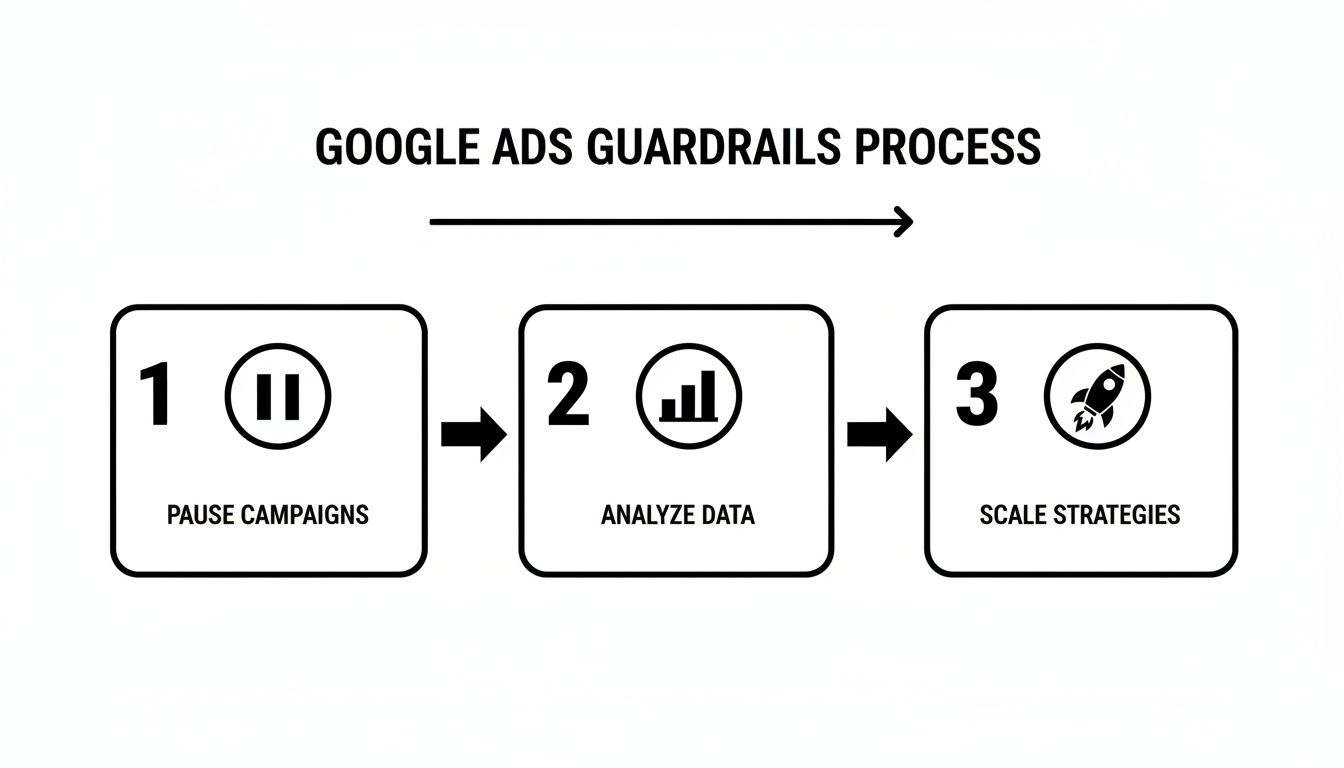
This simple flow—pause, analyze, scale—reinforces the importance of using data to guide your actions, preventing the kind of knee-jerk changes that kill performance.
A Quick Note On Budget Allocation
Your weekly deep dive is the perfect time to review your budget allocation. These days, where you spend your money is just as critical as your keyword choices. For example, recent data shows that while Search campaigns still get the lion’s share of investment at 56.2%, Performance Max is consistently pulling 13-18% of monthly spend.
Smart budget reallocation pays off. Some brands have seen their conversion rates jump over 32% month-over-month, even with rising CPCs, simply by shifting budget into proven campaigns. You can find more data like this in these 2025 Google advertising benchmarks.
Don't fall into the trap of managing your account on autopilot. This checklist isn't just a to-do list; it's a system for building discipline. Consistency is what separates the operators who get lucky from the ones who create their own luck.
A structured schedule is the backbone of disciplined account management. This cadence ensures you're covering all your bases without getting lost in the data.
Sample Google Ads Execution Cadence
Frequency | Key Tasks | Goal |
|---|---|---|
Daily (15 Mins) | Check budget pacing, review critical alerts, spot major KPI anomalies. | Firefighting & Situational Awareness |
Weekly (1-2 Hrs) | Review Search Term Reports, analyze creative performance, check experiments, re-evaluate budget allocation. | Optimization & Strategic Adjustments |
Monthly (2-4 Hrs) | Conduct a full account audit, review audience performance, analyze device/geo data, plan next month's tests. | High-Level Strategy & Planning |
By committing to a daily and weekly rhythm, you build a powerful operational habit. You stop chasing every fluctuation and start focusing your energy on the methodical, high-impact actions that compound over time to deliver killer results. This is how you move from just running ads to building a true growth engine.
Frequently Asked Questions
Even the best-laid plans run into real-world questions. When you're in the trenches managing Google Ads every day, specific challenges always pop up. Here are some of the most common ones I hear from other operators, along with my straight-to-the-point answers to help you navigate them.
How Long Should I Wait Before Changing a New Google Ads Campaign?
This is where patience becomes your most valuable tool. When you launch a new campaign, you have to fight the urge to tinker with it. Give it at least 7-14 days to get through its initial "learning phase" before you start making any big moves on bids, creative, or targeting.
The algorithm is essentially gathering intel. It needs a consistent flow of data to figure out who your ideal customer is and what makes them click. For some of the more advanced automated strategies, Google even suggests waiting for around 50 conversions over a 30-day period before things really stabilize.
Jumping in too early is a classic mistake. Every significant change can reset the learning period, trapping your campaign in a cycle where it never gets a chance to hit its stride. Use those first couple of weeks to watch for red flags—like ad disapprovals or zero impressions—but resist the temptation to overreact to a single day of bad data.
What Should I Check First If My ROAS Suddenly Drops?
Seeing your Return on Ad Spend (ROAS) take a nosedive is stressful, but don't panic. A methodical approach will almost always lead you to the root cause.
Before you look anywhere else, look at what you’ve done inside the account.
Check the Change History: This is the usual suspect. Did you or someone on your team recently adjust bids, budgets, audiences, or ads? A simple change can have a ripple effect.
Look for Technical Glitches: Is your conversion tracking still firing correctly? Are your landing pages loading properly? A broken tag is like giving the algorithm a faulty map—it's going to get lost and your performance will suffer.
If everything looks clean internally, it’s time to look at external factors.
Dive into Auction Insights: Has a new competitor shown up, or are the usual players bidding more aggressively? A sudden spike in CPC can tank your ROAS, even if your conversion rate stays the same.
Scan for Creative Fatigue: Pull up your ad-level data. Is the Click-Through Rate (CTR) on your top-performing ads starting to trend down?
Check for Audience Saturation: This is a big one for remarketing campaigns. If you see ad frequency climbing while conversions drop, you’ve probably shown your ads to the same people too many times.
By working through this checklist, you can go from reacting emotionally to diagnosing the problem with precision.
A sudden performance drop is a signal to investigate, not a signal to immediately change everything. Start with what you can control—your account's change history and technical health—before looking at external factors.
Should I Use Performance Max or Standard Campaigns?
This isn't a "one-is-better" situation. The choice between Performance Max (PMax) and standard campaigns comes down to your goals, your resources, and how much control you absolutely need. It's about picking the right tool for the job at hand.
Performance Max is built for maximum reach across all of Google's channels from one campaign. It's a fantastic option for e-commerce brands with a lot of products, as it’s incredibly good at finding pockets of customers you wouldn't have thought to target. The trade-off? You give up a lot of granular control over where your ads show up.
Standard Campaigns (like Search and Shopping) are all about precision. You can handpick keywords, set exact bids, and build out robust negative keyword lists. This makes them perfect when you need to protect your brand, target very specific high-intent search terms, or have rigid budget rules.
Honestly, most of the sharpest advertisers I know use a hybrid model. They’ll run PMax to handle broad prospecting and then use standard Search campaigns to capture those bottom-of-funnel, "ready to buy" searches where control is everything.
How Often Should I Add New Creatives to My Campaigns?
For high-volume campaigns, a good cadence is to introduce fresh creatives every 4-6 weeks. You’ll know it's time when you see core metrics like CTR and Conversion Rate start to consistently decline over a 7- to 14-day window. That’s creative fatigue setting in.
On the other hand, for lower-volume campaigns that aren't burning through audiences as fast, you can probably get away with a refresh every 2-3 months.
The key here is to not swap everything out at once. That can shock the campaign and force it back into the learning phase. A much better strategy is to add one or two new ad variations to your existing ad groups. Let them run against your current winners and see what happens. This iterative approach lets you constantly improve without causing massive performance swings. If you want more tips on testing and optimization, the SpendOwlAI blog has a ton of great, practical advice.
SpendOwlAI is a daily execution system that turns noisy ad performance into clear, explainable actions for operators. Instead of dashboards, it delivers a ranked list of what to change today—ordered by impact and paired with transparent rationale. Start your free 7-day trial and see what you should change today.