What Is a Good Click Through Rate A Marketer's Guide
Everyone wants to know what a “good” click-through rate is, but there's no single magic number. It’s a moving target that shifts based on your channel, industry, and what you’re trying to achieve with your campaign.
As a general rule of thumb, anything from 2% to 5% on search or social ads is pretty solid. But even that range can be misleading. Think of CTR as the first handshake with a potential customer—a strong one tells you your message is hitting the mark.
Defining Your CTR Benchmarks
Before you can even think about improving your CTR, you need to know where you stand. A 3% click-through rate is just a number floating in space without any context. Is that good? Terrible? The only right answer is, it depends. The first step is figuring out what a realistic target looks like for you.
At its core, CTR is just the percentage of people who saw your ad (impressions) and then actually clicked on it. The math is simple: (Total Clicks / Total Impressions) x 100. But what this metric really tells you is how well your ad creative and messaging connect with your audience.
Understanding Industry Averages
Different industries have completely different customer behaviors and buying cycles, and that has a huge impact on what a "good" CTR looks like.
Take the super-competitive world of Google Search Ads. A CTR between 3-5% is a healthy target, and the average across all industries hovers around 3.17%. But some sectors, like Dating & Personals, can see way higher engagement. On the flip side, industries like Home Goods often have lower benchmarks because the purchase journey is much longer. To see where you fall, it’s worth checking the latest 2024 performance benchmarks to see how your industry stacks up.
This gap exists because user intent is a powerful thing. Someone searching for "pizza near me" is ready to buy now. Someone researching a new sofa might browse for weeks before making a decision. Their clicking behavior will reflect that.
A high CTR is your first signal that you've achieved a strong message-to-market match. It tells platforms like Google and Meta that your ad is relevant, which they reward with better placements and lower costs.
To give you a starting point, here’s a quick look at some general benchmarks for the major ad channels. Use these as a directional guide before we get into the nitty-gritty of each platform.
Average CTR Benchmarks at a Glance
This table offers a quick reference for typical click-through rates you can expect across different digital ad channels.
Ad Channel | Average CTR Range |
|---|---|
Google Search Ads | 2% - 5% |
Google Display Ads | 0.35% - 0.60% |
Meta Ads (Facebook/Instagram) | 0.89% - 1.5% |
Remember, these are just averages. Your own performance will depend heavily on the specifics of your campaign, creative, and audience targeting.
Why Your CTR Is More Than Just a Number
It's easy to look at your Click-Through Rate as a simple formula: Clicks ÷ Impressions. But thinking of it that way is like judging a restaurant solely on how many people walk through the door. It’s a start, but it misses the entire story of why they came in.
Your CTR is a direct line of communication with ad platforms like Google and Meta. It’s the clearest signal you can send them about how well your message is landing with their users.
Think of your ad as a performer on a massive stage. Every impression is someone in the audience, and every click is a round of applause. A high CTR is a standing ovation. The louder the applause, the more the venue owner (the ad platform) wants to give you a primetime slot.
The Connection to Quality Score and Ad Relevance
This isn't just a fluffy metaphor—it's exactly how the ad algorithms are built. Both Google and Meta have systems that measure and reward ads that people actually want to see, and CTR is one of their favorite feedback signals.
Google Ads and Quality Score: In the world of Google Ads, your Expected Click-Through Rate is a huge piece of your Quality Score. A great Quality Score tells Google your ad is a fantastic match for what the user searched for. The reward? Better ad placements (hello, top of the page!) and often a lower cost-per-click (CPC).
Meta Ads and Ad Relevance: It’s a similar story over on Meta (Facebook and Instagram). Your CTR feeds directly into their Ad Relevance Diagnostics. When users click, it tells Meta’s algorithm they find your content interesting. This can earn you preferential treatment in the ad auction, which means more reach for less money.
A strong CTR creates a powerful feedback loop: your relevant ad gets more clicks, which tells the platform it's a winner, which leads to better visibility and lower costs, which helps you get even more clicks.
From Vanity Metric to ROAS Driver
Once you grasp this connection, CTR stops being a simple KPI and becomes a strategic lever for making your campaigns more efficient. When you actively work on improving your CTR, you're not just chasing a number to impress your boss. You're directly tweaking the financial engine of your ad account.
A higher CTR often leads to a lower cost per click, which in turn lowers your customer acquisition cost. That efficiency means every single dollar in your ad budget works harder, stretching further to find more potential customers.
Ultimately, a better CTR is a direct contributor to a stronger Return On Ad Spend (ROAS). By winning the click more often and more cheaply, you create more chances to turn browsers into buyers, making your entire advertising funnel more profitable. It’s all about making your ad spend smarter, not just bigger.
Setting Realistic CTR Benchmarks by Channel
Asking "what's a good click-through rate?" is a bit like asking "what's a good temperature?" without any context. The answer for swimming is very different than the answer for skiing. It's the same with advertising—an amazing CTR for one channel could be a total flop on another.
The user's mindset, the ad format, and the platform itself all create completely different expectations for performance. To build a smart, channel-specific strategy, you need to set benchmarks that reflect how people actually behave on each platform. A click on a Google Search ad is worlds apart from a click on a social media ad or a display banner. Getting this right is the first step to truly understanding how healthy your campaigns are.
This simple flow shows how a strong CTR creates a powerful advantage, leading directly to better ad placement and lower costs.
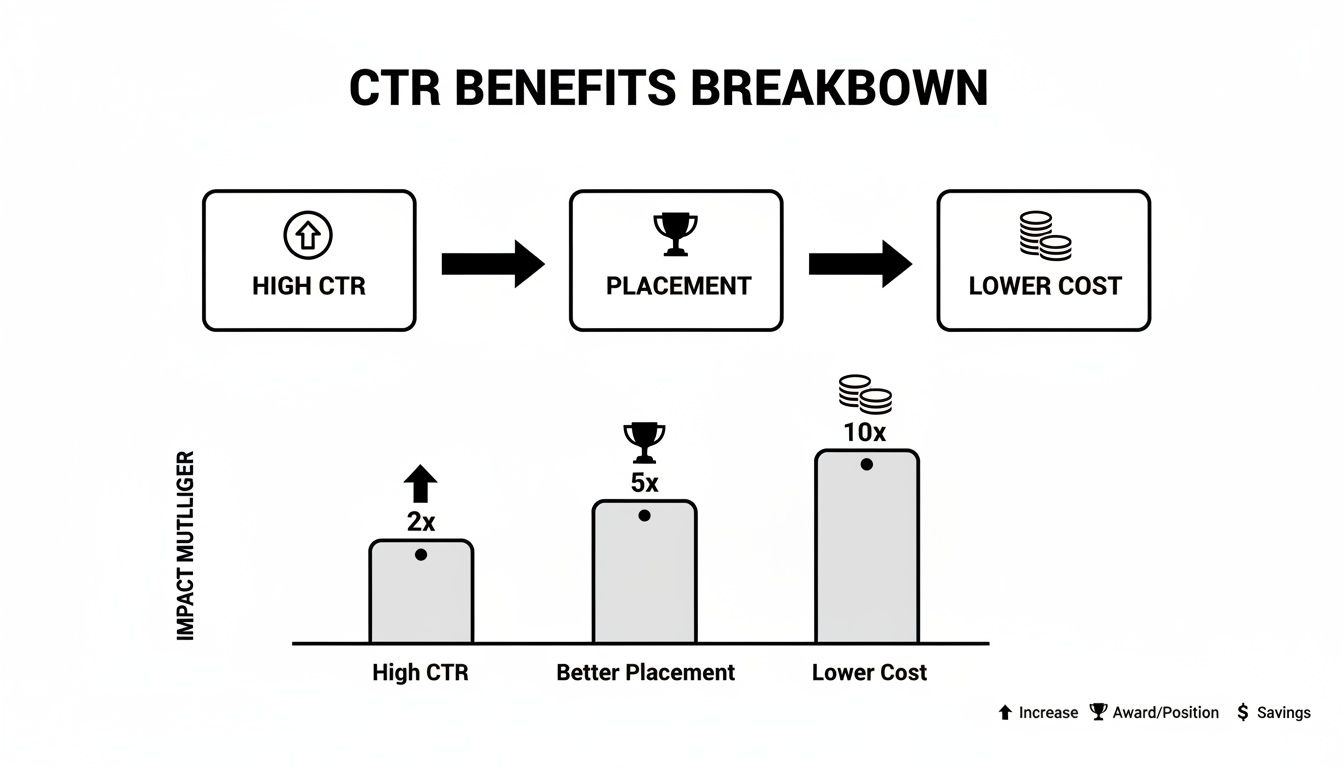
It’s a positive feedback loop. Strong performance gets rewarded, making every dollar in your ad budget work harder over time.
To put this into perspective, let's break down what a "good" CTR looks like across the major ad channels you’re likely using.
Detailed CTR Benchmarks by Ad Channel and Industry Focus
Here's a closer look at the typical CTR ranges you can expect for Search, Display, and Social ads. The table also highlights the user's mindset on each platform and gives a concrete example for e-commerce and DTC brands.
Ad Channel | Typical CTR Range | User Intent | E-commerce/DTC Industry Example |
|---|---|---|---|
Search (Google Ads) | 3% - 5% | High & Active: User is actively searching for a product, service, or solution. They want to click. | A user searching "buy vegan leather handbag" sees an ad from a sustainable fashion brand. |
Display (GDN) | 0.4% - 1% | Low & Passive: User is browsing other content (news, blogs) and sees the ad. The goal is brand awareness. | A home decor enthusiast sees a banner ad for a new line of ergonomic office chairs while reading a design blog. |
Social (Meta) | 1% - 2% | Mid & Discovery: User is scrolling for entertainment and discovers the ad. The creative must stop the scroll. | Someone interested in fitness sees a compelling video ad for a new protein powder in their Instagram feed. |
As you can see, the definition of "good" shifts dramatically based on where your ad appears. Now, let's dig into the specifics for each channel.
High Intent Search Ads
Google Search ads are where you meet customers who are actively looking for what you sell. When someone types a query into that search bar, they have a problem to solve or a product to find. This built-in intent is why a "good" CTR here is so much higher than anywhere else.
For most industries, a search ad CTR between 3% and 5% is a solid target. But don't stop there. Top-tier campaigns often push past this, hitting the 6% to 10% range, especially for branded keywords or super-specific long-tail searches. If you’re seeing a CTR below 2%, that’s a red flag—your ad copy, keywords, or offer probably aren't connecting with searchers.
Awareness-Focused Display Ads
Think of display ads as the billboards of the internet. They pop up on websites, in apps, and all over the web, targeting users based on their interests or browsing history, not an active search. Their main job is usually to build brand awareness, not to drive immediate clicks.
Because of this, the CTRs are dramatically lower. You can’t judge a display campaign by search standards. Globally, the average display ad CTR on Google is around 0.46%. If you’re a DTC founder, remember that this is a top-of-funnel play. Exceeding 0.5% to 1% is a great performance here.
A CTR of 1% on a display campaign could be a massive win. It means your creative was powerful enough to interrupt someone's browsing and get them to act.
Engagement-Driven Social Media Ads
On platforms like Meta (Facebook and Instagram), people are in discovery mode. They're scrolling through content from friends, family, and creators, so your ad needs to feel like it belongs there and is compelling enough to stop their thumb.
The intent here is passive—you’re introducing your brand to people who weren’t looking for you. For this reason, average CTRs on Meta ads usually land between 0.9% and 1.6%. But this number can swing wildly depending on your ad format and industry. For instance:
Video ads almost always grab more attention and earn higher CTRs than static images.
Carousel ads can boost clicks by letting you show off multiple products or features.
DTC brands in visual niches like fashion or home decor might see CTRs closer to 2%, while B2B services may be closer to 0.8%.
Ultimately, setting realistic goals means taking a channel-by-channel approach. For more deep-dive tactics, check out our guide on how to improve Google Ads performance.
The 4 Levers That Actually Control Your CTR
A killer click-through rate is never a fluke. It’s the result of getting a handful of critical elements to sing in harmony. When you see one ad take off while another one bombs, it’s almost always because of a breakdown in one of four key areas.
Think of these factors as a diagnostic checklist for your campaigns. Instead of blindly guessing what’s wrong, you can work through them one by one to find the weak link. Let's pull back the curtain on the four big levers that decide whether someone scrolls right past your ad or stops and clicks.
Ad Creative and Copy: The One-Two Punch
This is it—your first impression. It’s your only shot to stop the scroll. The visual part of your ad, whether it’s an image, a slick video, or a sharp graphic, has to be magnetic enough to cut through the noise of a busy feed. If your creative is weak, generic, or just looks cheap, you're dead in the water.
But a great visual is only half the battle. Your words—the headline and body text—have to connect directly with what your audience needs or wants. A stunning creative paired with vague, uninspired copy is a recipe for failure.
Imagine a DTC furniture brand. They could run an ad with a boring, static photo of a sofa. Or, they could show a video of a real family laughing and relaxing on that same sofa, with a headline that says, "Meet The Last Sofa You'll Ever Need to Buy." The second one tells a story and promises a real benefit, making it infinitely more clickable.
Your creative is the hook. It grabs their attention. But your copy is what reels them in. To get the click, you need both working together to show your audience exactly what they want.
Audience Targeting: Are You Talking to the Right People?
You could design the most beautiful, persuasive ad in history, but if it's shown to the wrong audience, your CTR will be a flat 0%. Your targeting is the bedrock of any successful campaign. It’s all about finding that perfect match between your message and the people who need to hear it.
Good targeting is so much more than just basic demographics like age and location. It means getting deep into interest-based audiences, building custom audiences from your email lists, and unleashing the power of lookalike audiences to find new people who act just like your best customers. To really nail this, you can learn more about how to optimise your Facebook Ads with smarter targeting.
Your Offer: The Reason to Click Now
Let’s be honest: why should anyone interrupt their day to click your ad? Your offer is the answer to that question. It’s the specific value you’re dangling in front of them, and it has to be compelling enough to spark curiosity or a sense of urgency.
And an "offer" doesn't just mean a discount. It can be anything that provides clear, immediate value:
A deep discount: 50% off this week only.
Exclusive access: Be the first to shop our new collection.
Valuable content: Download our free guide to [solving a problem].
A unique bundle: Get three of our bestsellers for the price of two.
If your offer is weak, confusing, or just plain boring, people have no reason to stop what they're doing.
Ad Placement: Location, Location, Location
Finally, where your ad shows up is a massive piece of the puzzle. Someone’s mindset is completely different when they’re actively searching on Google versus when they’re swiping through Instagram Stories or reading an article on a news site. An ad that crushes it in one spot can completely flop in another.
Platforms like Meta and Google give you a ton of control over this. It's on you to dig into your data, see which placements are driving the best CTR, and cut the ones that are dragging you down. An ad formatted perfectly for a mobile feed is going to look terrible as a desktop banner, which just goes to show how much placement strategy matters.
Actionable Strategies to Improve Your Click-Through Rate

Knowing your benchmarks is a great start, but turning that knowledge into clicks is what really moves the needle. Improving your CTR isn't about random guesswork or chasing the latest trend. It's about having a smart, prioritized workflow that tackles the highest-impact changes first.
Think of it as a playbook. Here's a clear, step-by-step approach to making smart, iterative improvements that will actually lift your ad performance. Let's get to work.
Prioritize Your Creative and Copy
Your ad creative—the image, video, and text—is the single most powerful lever you can pull. It's the hook that stops the scroll and earns you that crucial split-second of attention. If your creative isn't hitting the mark, no amount of technical wizardry can save your campaign.
Start by systematically testing different creative concepts. I don't mean just swapping a blue button for a red one; I mean testing fundamentally different approaches to see what truly connects with your audience.
Static Image vs. Video: Pit a polished, high-quality product shot against a short, scrappy user-generated content (UGC) video. You might be surprised how often a raw, authentic video grabs more attention than a slick studio image.
Benefit-Driven vs. Feature-Driven Copy: Stop listing what your product does and start talking about how it makes the customer's life better. "Finally get a perfect night's sleep" is infinitely more compelling than "Made with proprietary memory foam."
Test Emotional Triggers: We're all human. Use power words in your headlines that spark curiosity, urgency, or excitement. Sometimes, tiny tweaks like adding brackets (e.g., [New Release]) or a year (e.g., 2024 Edition) can make a headline feel fresh, relevant, and much more clickable.
The goal of your ad isn't just to be seen; it's to be felt. Test copy and creative that tells a story or solves a problem, and you'll give users a powerful reason to click.
Refine Your Audience Targeting
Once your creative is starting to resonate, the next place to look is your targeting. You could have the most amazing ad in the world, but if you're showing it to the wrong people, it’s going to fall flat. Getting this right means your message lands with an audience that's already primed to care.
It's time to move beyond broad, interest-based targeting and get a lot more specific with who you're talking to.
Build Custom Audiences: One of the most powerful moves you can make is uploading your customer email list. This creates a high-intent audience of people who already know and trust your brand. They're far more likely to click than a cold audience.
Leverage Lookalike Audiences: Take your best customer list and let the ad platform work its magic by creating a lookalike audience. This finds new users who share traits with your best buyers, giving you a powerful way to scale your reach without sacrificing relevance.
Analyze Placement Performance: Dig into your ad reports. Are your ads showing up in weird mobile games or on sketchy websites? If a specific placement (like the Facebook Audience Network) has tons of impressions but a CTR near zero, exclude it. Stop wasting your money.
For a deeper dive into making these kinds of improvements, our comprehensive guide on how to improve click-through rate offers even more advanced strategies.
Fine-Tune with Technical Optimizations
With strong creative and a dialed-in audience, you can now add another layer of improvement with technical adjustments. Think of these as the finishing touches—smaller tweaks that can give your ads an extra edge and capture clicks you might have otherwise missed.
For example, on platforms like Google Ads, ad extensions are basically free real estate. Adding sitelinks, callouts, or structured snippets makes your ad physically larger and more informative. This alone can often boost CTR by several percentage points because it gives people more entry points and more reasons to engage.
By methodically working through creative, then audience, and finally the technicals, you're not just hoping for better results—you're building a system for continuous improvement.
Your Top CTR Questions, Answered
Once you start digging into ad performance, you’ll inevitably run into some gray areas. It’s normal. This section is your go-to reference for tackling the most common questions that trip up even seasoned marketers.
Let's clear the air on this crucial metric.
Is a High CTR Always a Good Thing?
You'd think so, but not always. While a high CTR usually means you’re on the right track, it can sometimes be a vanity metric. For example, you could hit a 10% CTR with a clickbaity headline or some wild creative that gets clicks but doesn't really reflect what you're selling.
This is how you end up with "empty clicks." You get a ton of traffic, but these visitors are completely unqualified. They hit your landing page, realize it's not what they were promised, and bounce instantly. All you've done is drive up your ad spend without getting any closer to a sale.
A great CTR paired with a terrible conversion rate is a classic red flag. It’s a sign that your ad is writing checks your landing page can't cash. The goal isn't just to get any click; it's to get the right click from someone who might actually buy.
How Long Should an Ad Run Before I Judge Its CTR?
This is a big one. It's so tempting to check in on a new ad after a few hours and declare it a winner or a loser, but that's a classic rookie mistake. Give it some breathing room.
Ad platforms need time to figure out who to show your ad to. Performance can be all over the place in the first 48-72 hours while the algorithm does its thing.
As a rule of thumb, let a new ad run for at least 3 to 5 days before you start making serious judgments about its CTR. This gives you enough data to work with. If you’re running on a smaller budget, you might need to wait even longer to get a statistically significant number of impressions.
How Does CTR Relate to Conversion Rate?
Think of them as two parts of a whole. Your Click-Through Rate tells you how good your ad is at getting people from the platform to your website. Your Conversion Rate tells you how good your website is at turning that traffic into customers.
You need both to be healthy.
High CTR, low conversion rate? There's a mismatch. Your ad is compelling, but your landing page isn't delivering on the promise.
Low CTR, high conversion rate? Your ad isn't grabbing enough attention, but the few people who do click are a perfect fit for your offer.
Looking at them together is how you get the full story of your funnel's performance, from first impression to final sale.
Stop wasting ad spend on gut feelings. SpendOwlAI translates your complex ad data into a simple, prioritized list of daily actions to improve performance. Start your free 7-day trial and see exactly what to change today.