12 High-Impact Videos for Ecommerce to Drive Sales in 2026
In the crowded digital marketplace of 2026, static images and text descriptions are no longer enough to capture attention and drive sales. Consumers demand richer, more engaging experiences that build trust and showcase products in authentic ways. This is where videos for ecommerce become a non-negotiable part of your growth strategy. Video not only boosts conversion rates and reduces returns but also provides invaluable performance signals for advertising teams.
Effective video allows brands to tell stories, demonstrate value, and connect with audiences on an emotional level that static content simply cannot match. The key to success, however, lies in strategically choosing the right type of video for each stage of the customer journey, from initial awareness to final conversion and long-term retention. Creating a random assortment of videos won't move the needle. You need a structured approach that aligns specific video formats with clear business objectives.
In this guide, we'll break down the 12 essential video formats that every ecommerce brand needs to master for scalable growth. We move beyond generic advice to give you actionable frameworks for each one. You will find:
Practical use cases and placement ideas.
Short scripts and templates to get started quickly.
Creative best practices for high-impact results.
Measurement tips tied to advertising signals like CTR, ROAS, and creative fatigue.
This approach is designed for performance teams, founders, and Shopify operators who need to turn their video strategy into a predictable revenue driver immediately. Let’s get into the specific formats you can execute today.
1. Product Demo Videos
Product demo videos are concise, action-oriented clips (typically 60-120 seconds) that show your product in use. Their core function is to bridge the gap between seeing an item online and understanding how it feels, works, and solves a problem in real life. By demonstrating key features and benefits, these videos for ecommerce effectively answer unspoken customer questions and reduce purchase hesitation.
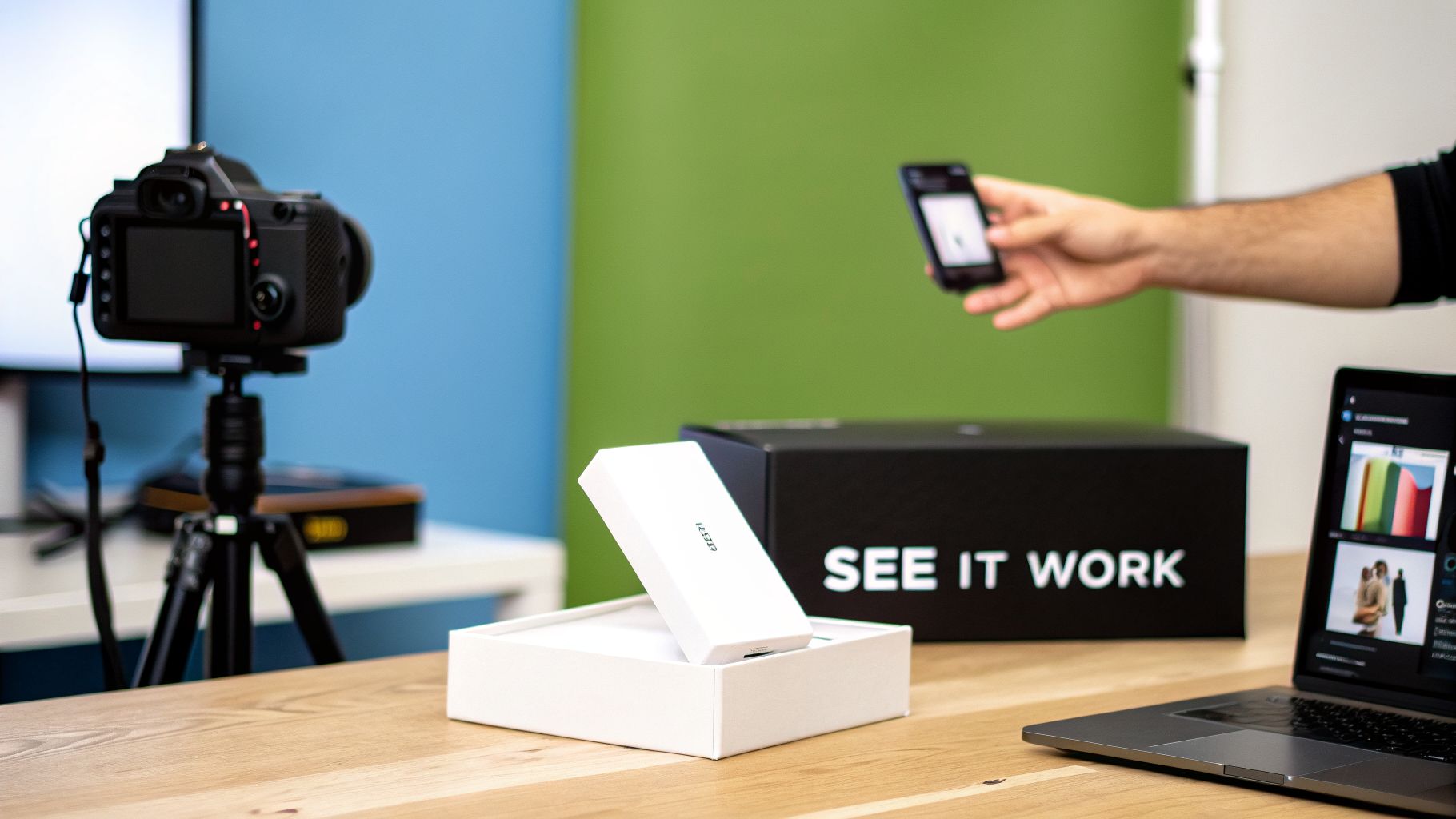
Unlike static images, a demo brings the product to life, showing its quality, ease of use, and practical application. This visual proof is exceptionally powerful on product detail pages (PDPs), where a customer is moments away from making a decision. Placing a compelling demo here can directly impact conversion rates, as seen in the strategies of brands like Dyson and GoPro, who build confidence through detailed operational walkthroughs.
Creative & Strategic Best Practices
Hook Within 3 Seconds: Start immediately with the product's most impressive feature or the problem it solves. Don't waste time on long intros.
Show, Don't Just Tell: Instead of listing features with text overlays, demonstrate them. If a blender is powerful, show it crushing ice. If a backpack is waterproof, pour water on it.
Authenticity Sells: Use real people in believable scenarios. Overly polished studio shots can feel sterile. Authentic user-generated content (UGC) or simple in-house videos often perform better on social feeds.
Optimize for Silent Viewing: A majority of social media videos are watched without sound. Use clear, bold captions or on-screen text to convey your message.
Pro Tip: For performance marketing, create different video variations that highlight specific features. A/B test these creatives against distinct audience segments to see which benefit resonates most, then monitor CTR and ROAS to swap out fatigued ads. A strong video strategy can be a key part of your overall website conversion optimization efforts.
2. Customer Testimonial & Review Videos
Customer testimonial videos are authentic clips (typically 30-90 seconds) where real buyers share their satisfaction with a product. They function as powerful social proof, building trust by replacing brand messaging with genuine customer voices. Whether it's raw user-generated content (UGC) or a professionally filmed interview, these videos for ecommerce address potential objections and validate a product's value proposition through relatable stories.

Hearing a positive review directly from a peer is often more persuasive than any polished marketing campaign. These videos are especially effective on product pages, in retargeting ads, and within email campaigns to nurture leads. Brands like Glossier and Quip have mastered this by building communities around authentic customer experiences, turning happy buyers into their most effective advocates and demonstrating that real-world results resonate deeply with prospective customers.
Creative & Strategic Best Practices
Incentivize, Don't Just Pay: Encourage customers to submit UGC by offering discounts, loyalty points, or a chance to be featured. This fosters genuine enthusiasm over transactional, paid-for praise.
Guide the Narrative: Ask customers specific questions that address common objections or highlight key benefits. For instance, ask them to recall their initial hesitation and what convinced them to buy.
Showcase Diversity: Actively seek testimonials from a wide range of customer demographics, use cases, and geolocations. This broadens your appeal and allows more prospects to see themselves in your customers.
Optimize for Social Proof: Edit videos to include the reviewer's name and location (with permission). Start with the most impactful quote to immediately capture attention on social feeds.
Pro Tip: Organize testimonials by customer segment and the specific pain point they address. Use these targeted videos in your retargeting campaigns to speak directly to different audiences. Monitor ad fatigue signals and conversion lift to rotate fresh testimonials into your ad sets, ensuring your social proof always feels current and relevant.
3. Lifestyle & Aspirational Videos
Lifestyle and aspirational videos sell a feeling, not just a product. These emotionally-driven clips position your items within a desirable aesthetic, identity, or narrative. Instead of focusing on features, their goal is to forge an emotional connection by showing how the product integrates into an ideal version of a customer's life.
This strategy helps build a brand world that customers want to be part of, transcending simple transactional relationships. Brands like Lululemon and Outdoor Voices excel at this, creating content that reflects values of wellness, community, and activity. These powerful videos for ecommerce work best at the top of the funnel to build brand awareness and create an emotional hook that drives further exploration.
Creative & Strategic Best Practices
Define the Aspiration: Before shooting, clearly define your target customer's aspirational identity. Are they a minimalist urban professional, a rugged adventurer, or a wellness advocate? Build the creative around that identity.
Focus on Story and Values: The product should feel like a natural part of the story, not the hero. The narrative should center on the lifestyle, feeling, or values your brand represents, like Everlane’s focus on ethical fashion.
Maintain Visual Consistency: Use a consistent color palette, editing style, and tone across all lifestyle content. This reinforces your brand’s identity and makes it instantly recognizable in a crowded social feed.
Pair with Other Video Types: Use lifestyle videos in top-of-funnel ads to capture attention, then retarget engaged viewers with product demos or testimonial videos to drive conversions.
Pro Tip: Test different lifestyle messaging angles with distinct audience segments. A narrative that resonates with new customers might differ from one that appeals to repeat buyers. Monitor CTR and ROAS to identify which aspirational story performs best with each audience, ensuring your creative spend is effective.
4. Unboxing & Packaging Videos
Unboxing and packaging videos capture the tactile, first-impression moment a customer receives and opens their order. More than just revealing the product, these videos for ecommerce celebrate the entire sensory experience, from the custom tissue paper to the weight of the box. They build anticipation and reinforce brand value before the customer even touches the product itself.
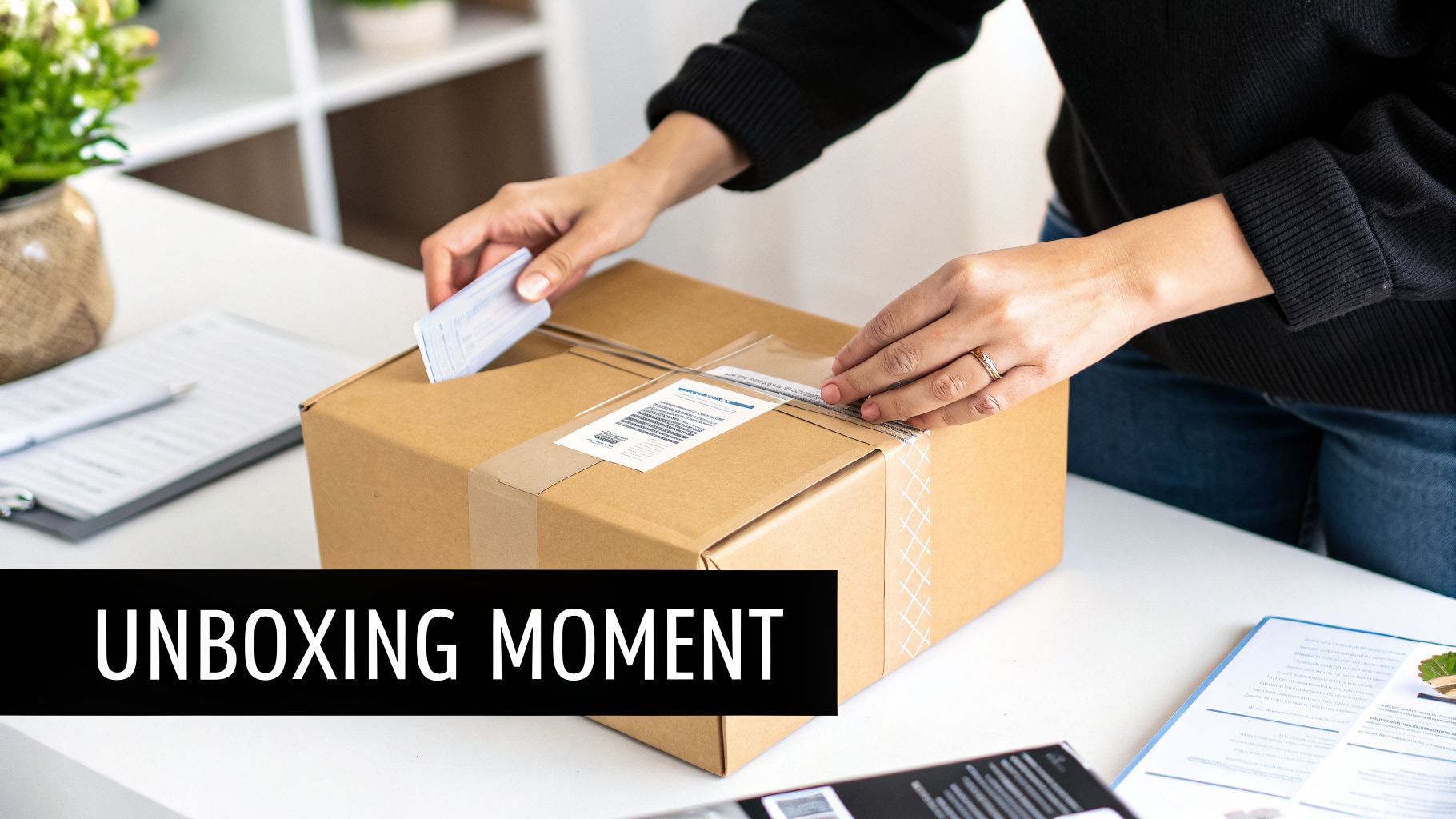
This video format transforms packaging from a simple container into a key marketing asset. By showcasing premium presentation, sustainable materials, or special inclusions, you create a shareable moment that extends your brand’s story. Brands like Glossier and Away have built cult followings around their iconic packaging, turning the unboxing into a viral, user-generated event that builds community and social proof.
Creative & Strategic Best Practices
Design for the Camera: Invest in packaging that is visually interesting. Think branded tape, custom inserts, unique textures, and a satisfying reveal.
Encourage User Content: Create a branded hashtag and incentivize customers to share their own unboxing videos. Feature the best user-generated content (UGC) on your social feeds and product pages.
Incorporate ASMR Elements: Use close-ups and high-quality audio to capture satisfying sounds, like the crinkle of paper or the crisp opening of a box. Slow, deliberate movements create a more engaging, almost therapeutic viewing experience.
Add a Surprise: Include unexpected elements like a handwritten thank-you note, a small sample, or a clever detail about your sustainable packaging. These small touches make the experience memorable.
Pro Tip: Use unboxing videos in your post-purchase email flows. Sending a video that shows another happy customer unboxing their order can build excitement and reduce buyer's remorse while the customer waits for their own package to arrive. This reinforces their decision and deepens brand loyalty.
5. How-To & Tutorial Videos
How-to and tutorial videos are educational assets that teach customers how to use, style, or maximize value from a product. Their primary goal is to move beyond the sale, positioning the brand as a helpful resource while building user confidence and product proficiency. These videos for ecommerce are especially effective for products with a learning curve or multiple applications.
By proactively answering common questions and demonstrating best practices, tutorials reduce customer support tickets and decrease the likelihood of returns caused by user error. Brands like Sephora and Olaplex use them to show specific application techniques, while Dyson creates maintenance guides. This approach adds significant value, making customers feel more capable and connected to the brand long after their purchase.
Creative & Strategic Best Practices
Focus on Common Questions: Analyze your customer support data and create tutorials that address the top 5-10 most frequent questions or issues. This ensures your content is directly solving real problems.
Use Relatable Presenters: Feature team members, customers, or micro-influencers instead of highly polished actors. Authenticity and relatability make the information feel more accessible and trustworthy.
Repurpose for Social: Break longer YouTube tutorials into bite-sized clips for TikTok, Instagram Reels, or YouTube Shorts. A 15-second "quick tip" video is perfect for social distribution and can drive traffic to the full tutorial.
Optimize for Search Intent: Host tutorials on YouTube and optimize titles, descriptions, and tags for "how to" style search queries. This captures high-intent, bottom-of-funnel traffic from users actively seeking solutions your product provides.
Pro Tip: Track tutorial performance as its own content category. Monitor metrics like watch time and audience retention to understand what educational content resonates most. You can also analyze which tutorials lead to repeat purchases to identify content that drives higher lifetime value (LTV).
6. Behind-the-Scenes (BTS) & Founder Story Videos
Behind-the-scenes (BTS) and founder story videos offer an authentic look at the people, processes, and values that define a brand. These videos build a powerful emotional connection by revealing the "why" and "who" behind your products, transforming a transactional relationship into one built on community and shared belief. They are a core component of many successful content strategies for videos for ecommerce.
Unlike polished ads, these videos thrive on authenticity. Whether it's a founder recounting their initial struggles or a walkthrough of your sustainable manufacturing process, this content humanizes your operation. Brands like Dollar Shave Club, with its iconic founder-led launch video, and Allbirds, which showcases its commitment to materials, use BTS to build trust and differentiate themselves in crowded markets. This storytelling is perfect for "About Us" pages, email nurture sequences, and retargeting ads aimed at audiences who have already shown interest.
Creative & Strategic Best Practices
Lead with Personality: The founder's passion is contagious. Let their authentic excitement for the mission shine through. Vulnerable moments and early challenges make the story relatable and trustworthy.
Showcase the Team: Expand beyond the founder to feature other team members. This demonstrates a healthy company culture and gives customers more people to connect with.
Align Values with Mission: Clearly connect the founder's "why" to the product's purpose. If your brand values sustainability, show the steps you take to achieve it.
Create Serialized Content: Turn BTS into a recurring series, like a weekly "day-in-the-life" or monthly process update. This gives your audience a reason to keep coming back for more.
Pro Tip: Use founder and BTS videos in your mid-funnel retargeting campaigns. After a user has visited your product page, serve them an ad that tells your brand's story. This deepens their connection and can be the final push they need to convert. Monitor engagement metrics (like video completion rate) to see which stories resonate most.
7. Comparison & Before-After Transformation Videos
Comparison and before-after videos offer powerful visual proof of your product's effectiveness. These videos for ecommerce directly showcase a change, either by comparing your product against a competitor or by revealing a "before" state and its "after" result. This format is incredibly persuasive because it validates your claims and builds customer trust through tangible evidence, making abstract benefits concrete and believable.
From skincare brands like Curology showing clear skin results to fitness apps like Peloton displaying user transformations, this video type cuts through marketing noise. By presenting a clear, often dramatic, outcome, you address a primary customer question: "Will this actually work for me?" Placing these on landing pages, social media ads, and product pages can significantly boost conviction at critical decision points.
Creative & Strategic Best Practices
Prioritize Authenticity: Use real customer results whenever possible. Genuine, unpolished transformations often feel more trustworthy than overly produced studio footage.
Set Clear Expectations: Include timeframes to show how long it took to achieve the result. For a skincare product, this might be "after 6 weeks of daily use." This manages expectations and adds credibility.
Show, Don't Just Tell: Instead of simply stating the results, display them. For a cleaning product, use a split-screen to show the "before" grime and the "after" sparkle side-by-side.
Quantify the Impact: When possible, add concrete metrics. This could be "saved 30 minutes on assembly," "lost 15 pounds in 3 months," or "reduced monthly costs by 20%." Numbers make the transformation more impactful.
Pro Tip: Test different reveal formats for your transformation stories. A/B test a side-by-side static comparison against a sequential video that shows the "before" state first, then wipes to reveal the "after." Monitor which format drives higher engagement and conversion rates, then double down on the winning creative style.
8. Short-Form Social Media Content (Reels, TikToks, Shorts)
Short-form social media content refers to vertical, fast-paced videos (typically 15-60 seconds) made for platforms like TikTok, Instagram Reels, and YouTube Shorts. These videos for ecommerce prioritize entertainment, trends, and viral potential over direct sales pitches. They use platform-native features like trending sounds and filters to gain organic reach through powerful algorithms.
Unlike product-centric ads, this format builds brand personality and community by joining cultural conversations. Brands like Duolingo use quirky, meme-style content to stay top-of-mind, while ASOS and Skims leverage trend-responsive Reels to showcase products in an authentic, timely context. The goal is less about an immediate sale and more about building a loyal audience that feels connected to the brand’s voice.
Creative & Strategic Best Practices
Act with Speed: Monitor trending sounds and formats daily. To benefit from the algorithm, aim to create and post your version of a trend within 24-48 hours.
Entertain First, Sell Second: The primary objective is shareability and engagement. Weave your product in subtly rather than making it the main focus. Think of the viral Ocean Spray TikTok; the brand was present but not pushy.
Embrace Authenticity: Partner with UGC creators and micro-influencers who are already fluent in the platform’s culture. Their content will feel more native and less like a traditional advertisement.
Post with High Frequency: These algorithms reward consistency. A posting schedule of 3-7 times per week is often the minimum to maintain momentum and gather data on what works.
Pro Tip: Use platform analytics to see which trend formats drive the highest engagement for your brand. Create multiple variations of a winning creative to test against different audiences. Monitor top-of-funnel metrics to understand how these videos build awareness, and review these insights to improve your click-through rate on subsequent retargeting ads.
9. Live Shopping & Live Stream Events
Live shopping events are real-time, interactive broadcasts where hosts present products, answer audience questions, and drive sales directly within the stream. These events merge entertainment with e-commerce, creating a dynamic, community-focused experience that thrives on urgency and direct engagement. They effectively replicate the consultative, in-person shopping experience for an online audience.
Unlike pre-recorded videos, live streams build a direct, unedited connection with viewers, allowing for spontaneous Q&A and authentic product demonstrations. This format is perfect for product launches, flash sales, or collaborative events, as seen on platforms like TikTok Shop, Amazon Live, and Instagram. Brands can create a "can't-miss" event, using limited-time offers to generate immediate sales and foster a loyal community.
Creative & Strategic Best Practices
Promote Extensively: Build anticipation by promoting your live event 3-5 days in advance across email, social media, and your website. Use countdown timers to create a sense of occasion.
Create Urgency: Feature exclusive, time-sensitive deals or limited-quantity products that are only available during the broadcast. This is a primary driver of in-stream conversions.
Engage Actively: Acknowledge viewers by name, answer their questions live, and encourage interaction through polls and comments. The host should be as much an entertainer as a salesperson.
Prepare for Objections: Pre-plan responses to common questions and potential purchase barriers. Having clear answers ready helps maintain momentum and builds trust with hesitant buyers.
Pro Tip: After the live event ends, repurpose the recording. Clip the best moments for social media ads, embed the full stream on a product page, or send the replay to your email list. Monitor metrics like peak concurrent viewers, conversion rate, and average order value to refine your strategy for future live videos for ecommerce.
10. Educational & Thought Leadership Content
Educational content positions your brand as a trusted authority by providing value that extends beyond a direct sales pitch. These videos, which can be medium or long-form, focus on teaching your audience something new, whether it's related to your product's niche, broader industry trends, or a valuable skill. By sharing expertise, you build credibility and foster a loyal community that views your brand as a go-to resource.
Unlike product-centric ads, this strategy is a long-term investment in brand equity. Think of GoPro’s filmmaking tutorials or HubSpot's marketing certification courses; they attract high-intent users by solving a problem or fulfilling a desire for knowledge. These types of videos for ecommerce are excellent for building top-of-funnel awareness and nurturing leads over time, creating a dedicated following that is more likely to convert and exhibit higher lifetime value.
Creative & Strategic Best Practices
Educate First, Sell Second: Your primary goal is to provide genuine value. Subtly weave your product into the narrative as a tool for achieving the outcome you're teaching, rather than making it the centerpiece.
Establish Credibility: Showcase your expertise through well-researched content, data, or unique methodologies. Partnering with respected industry experts can also amplify your authority.
Create Structured Learning Paths: Organize your videos into series or playlists that guide viewers from beginner to advanced topics. This encourages binge-watching and repeat engagement.
Optimize for Search: These videos thrive on platforms like YouTube. Research relevant keywords and optimize your titles, descriptions, and tags to capture long-tail search traffic from users actively seeking information.
Pro Tip: Educational content often attracts a more engaged, higher-quality audience. While initial ROAS might be lower than direct-response ads, monitor customer LTV for cohorts acquired through this content. A higher LTV can justify a longer payback period and prove the strategy's long-term profitability.
11. Influencer & Creator Collaboration Videos
Influencer and creator collaboration videos involve content made by external personalities who feature or promote your products to their established audience. These partnerships range from sponsored reviews and unboxings to full product integrations, tapping into the creator's authentic voice and community trust. This type of video for ecommerce moves beyond traditional advertising by using a credible third-party to vouch for your brand.
Unlike brand-produced ads, creator content feels native to the platform where it's posted, whether that’s a TikTok from Addison Rae or a long-form YouTube review. This authenticity is key to cutting through the noise and generating genuine interest. By leveraging the relationship a creator has with their followers, brands can gain immediate credibility and drive high-intent traffic, making these collaborations a powerful tool for customer acquisition and social proof.
Creative & Strategic Best Practices
Prioritize Audience Alignment: Focus on creators whose audience demographics and interests match your ideal customer profile. High engagement on a smaller, niche account often provides better ROI than a massive but misaligned one.
Allow Creative Freedom: Overly scripted content feels inauthentic and performs poorly. Provide a clear brief with key talking points but let the creator's unique style shine through.
Request Diverse Content Formats: Ask for a package of deliverables, such as one YouTube video, two TikToks, and three Instagram Stories. This gives you multiple assets to test across different channels.
Build Ongoing Relationships: Identify top-performing creators and establish long-term partnerships. Sustained collaborations feel more genuine to their audience and create a stronger brand association.
Pro Tip: Structure deals with a performance component. Offer a base fee plus a commission on sales tracked via a unique creator promo code or affiliate link. This incentivizes the creator to produce high-converting content and allows you to directly measure the ROAS of each partnership.
12. Retargeting & Dynamic Product Videos
Retargeting and dynamic product videos are personalized ads shown to users who have already interacted with your brand, such as by visiting your site or viewing a specific item. These highly relevant videos for ecommerce use dynamic creative optimization to automatically showcase the exact products users viewed or abandoned in their carts, making the ad feel personal and timely.
Unlike broad, top-of-funnel ads, these videos target a warm audience already familiar with your products. This precision makes them incredibly effective for recovering abandoned carts and driving conversions from high-intent shoppers. Platforms like Meta and Google use your product catalog feed to generate these videos on the fly, matching user browsing history with corresponding product media to create a powerful, personalized reminder that brings shoppers back to complete their purchase.
Creative & Strategic Best Practices
Segment Audiences: Create distinct retargeting lists for different user actions: viewed a product but didn't add to cart, added to cart but didn't buy, or past purchasers. Tailor your message to each segment's intent level.
Show the Exact Product: The magic of dynamic ads is relevance. Ensure your product feed is correctly set up so users see the exact item they were considering, reinforcing their initial interest.
Create Urgency: Nudge users toward a decision with scarcity messaging ("Only 2 left!") or a limited-time offer ("15% off for the next 24 hours"). This is especially effective for cart abandoners.
Rotate Creative Frequently: Warm audiences experience ad fatigue quickly. Refresh your video templates, copy, and offers weekly to keep your retargeting campaigns effective and prevent your audience from tuning them out.
Pro Tip: When retargeting, test different offers beyond simple discounts. A/B test variations featuring free shipping, testimonials, or social proof to see which incentive drives the best results for your audience. Continuously monitor your campaign performance to understand your true what is ROAS in digital marketing and swap out creatives as soon as they show signs of fatigue.
12 Ecommerce Video Types Compared
Video Type | 🔄 Implementation Complexity | ⚡ Resource Requirements | 📊 Expected Outcomes | 💡 Ideal Use Cases | ⭐ Key Advantages |
|---|---|---|---|---|---|
Product Demo Videos | Medium — staged filming & editing | Medium — camera, lighting, talent | High conversion uplift; fewer returns | Product pages, ads, social proofing | Clear product visualization; repurpose-friendly |
Customer Testimonial & Review Videos | Low–Medium — recruit & coordinate customers | Low — UGC; Medium if produced | Very high trust and credibility | Objection handling, product pages, ads | Strong social proof; cost-efficient |
Lifestyle & Aspirational Videos | High — cinematic storytelling | High — production, creative direction | Brand affinity and premium perception | Brand campaigns, awareness, positioning | Emotional connection; memorable branding |
Unboxing & Packaging Videos | Low — simple shoot; timing dependent | Low–Medium — packaging investment | High shareability; increased excitement | Launches, premium/eco brands, post-purchase | Trend-friendly; extends brand experience |
How-To & Tutorial Videos | Medium — requires subject expertise | Medium — experts, editing, assets | Better satisfaction, lower support volume; SEO value | Support content, evergreen product education | Evergreen value; builds authority and retention |
BTS & Founder Story Videos | Low–Medium — authentic footage preferred | Low — on-location/team access | Deeper brand loyalty; narrative differentiation | DTC, values-driven campaigns, warm audiences | Authenticity-driven trust; low production cost |
Comparison & Before-After Videos | Medium — evidence collection & editing | Medium — controlled demos, time for results | High persuasion; strong bottom-funnel conversions | Result-driven products, retargeting hesitant buyers | Visual proof; directly overcomes skepticism |
Short-Form Social Media Content | Low — fast iteration, trend-driven | Low — smartphone-grade production | High organic reach; awareness lift (lower ROAS) | Top-funnel reach, trends, community growth | Viral potential; low barrier to scale |
Live Shopping & Live Stream Events | High — real-time hosting & tech | High — hosts, streaming infrastructure | Strong engagement; urgency-driven sales | Flash sales, launches, community-driven commerce | Real-time interaction; direct conversions |
Educational & Thought Leadership Content | High — expert sourcing & production | High — research, hosts, production time | Long-term authority; attracts high-intent users | High-consideration categories, B2B, SEO-led growth | Builds credibility and long-term LTV |
Influencer & Creator Collaboration Videos | Medium — vetting & relationship mgmt | Variable — creator fees or incentives | Variable reach; high niche engagement | Niche targeting, trend amplification, social proof | Third-party credibility; access to engaged audiences |
Retargeting & Dynamic Product Videos | High — tracking & dynamic feed setup | High — pixel infra, dynamic creative ops | Highest conversion rates; lower CPA for warm audiences | Cart recovery, personalized retargeting, catalog scale | Highly measurable and personalized; revenue-attributable |
Turning Your Video Strategy into a Performance Engine
We’ve explored a dozen distinct types of videos for ecommerce, from the tactical precision of a Product Demo to the broad-stroke appeal of a Lifestyle Aspirational video. The real power, however, doesn't come from creating these videos in isolation. It emerges when you see them not as individual content pieces, but as interconnected assets within a full-funnel performance system. Your unboxing videos might capture initial top-of-funnel interest on TikTok, leading a viewer into a retargeting sequence featuring customer testimonials, and finally converting them with a dynamic product ad showcasing the exact item they viewed.
This strategic orchestration is what separates brands that simply make videos from those that build a predictable growth engine. Each video format we covered, whether it's a founder story or a live shopping event, has a specific job to do. Your task as a performance marketer or brand owner is to become the general manager of this video "team," putting the right player on the field at the right time.
From Creative Inventory to Performance Playbook
The biggest mistake brands make is treating video creation as the finish line. The true challenge lies in execution: knowing precisely when a high-performing video starts to fatigue, which audience segment is responding best to a new tutorial, or when to reallocate budget from a stale comparison video to a fresh influencer collaboration. This requires moving beyond gut feelings and vanity metrics.
Instead of getting lost in the noise of daily ad platform data, a successful approach requires clear, actionable signals. Consider these practical next steps to transition from sporadic video production to a disciplined, performance-focused strategy:
Map Your Funnel: Take the video types discussed in this article and assign each one to a specific stage of your customer journey (Awareness, Consideration, Conversion, Retention). This creates a clear blueprint for what content to serve and when. For example, Behind-the-Scenes and Educational videos are excellent for awareness, while How-To and Testimonial videos excel at consideration and conversion.
Establish a Testing Cadence: Don't just launch a video and let it run indefinitely. Implement a structured testing schedule. For every key ad set, you should have a "challenger" creative ready to test against the current "champion." This ensures you are constantly iterating and improving, rather than waiting for performance to collapse before acting.
Define Your "Why": Before scripting any new video, clearly define its primary objective and the key performance indicator (KPI) that will measure its success. Is it designed to boost Click-Through Rate (CTR) in a cold audience, or improve Return on Ad Spend (ROAS) in a retargeting campaign? This focus prevents the creation of generic content that fails to move any specific needle.
Key Insight: A winning ecommerce video strategy is not about finding one "perfect" video. It's about building a robust creative library and an intelligent system to deploy, measure, and refresh those assets based on real-time performance data.
The goal is to create a feedback loop where creative insights inform media buying, and media buying data informs the next creative brief. When your How-To video drives a high Add-to-Cart rate but low purchases, that's a signal. It tells you the video is effective at demonstrating value but there might be friction at checkout, perhaps requiring a follow-up video addressing shipping concerns or return policies. Mastering these videos for ecommerce is about listening to what the data is telling you and responding with the right content. By connecting your creative strategy to a disciplined execution system, you shift from simply producing content to building a scalable and predictable revenue driver for your brand.
Ready to turn your video assets into a predictable growth engine? SpendOwlAI analyzes your ad account 24/7 and gives you plain-English, actionable instructions on exactly how to optimize your campaigns, from budget shifts to creative fatigue alerts. Stop guessing and start scaling with data-driven clarity by visiting SpendOwlAI today.