Website Conversion Optimization: website conversion optimization for growth
Think of your website like a physical storefront. You wouldn't just unlock the doors and hope for the best, right? You'd meticulously arrange the displays, place clear signs, and make the checkout process as painless as possible. That, in a nutshell, is website conversion optimization (CRO). It's the craft of turning casual browsers into committed customers.
It’s not about finding a single magic bullet. Instead, it’s a continuous cycle of listening to your users, understanding why they leave, and making smart, data-backed changes to guide them toward a purchase.
What Is Website Conversion Optimization, Really?
At its heart, CRO is a systematic way to increase the percentage of visitors who take a specific, valuable action. We call this action a conversion.
For an e-commerce brand, the ultimate conversion is obviously a sale. But many other smaller, yet crucial, actions pave the way. Think of these as important steps along the customer's journey:
Filling out a contact form
Subscribing to your newsletter
Adding an item to the cart
Downloading an e-book
Starting a free trial
This is a critical mindset shift. Instead of just pouring more money into ads to get more traffic, CRO focuses on getting more value from the traffic you already have. You’re making every marketing dollar work harder and smarter.
Why CRO Is Such a Powerful Growth Lever
Imagine your marketing budget is water pouring into a leaky bucket. You have two choices: keep pouring more water in faster, hoping some of it stays, or you can plug the leaks. Website conversion optimization is the art of finding and patching those leaks in your customer journey.
The data shows a massive opportunity here for businesses willing to put in the work.
Conversion Rate Benchmarks by Performance Tier
This table shows the significant gap between average and top-performing websites, highlighting the potential gains from effective CRO.
Performance Tier | Average Conversion Rate |
|---|---|
Average Website | 2.35% |
Top 25% | 5.31% |
Top 10% | 11.45% |
The gap is staggering. The top 10% of websites convert at rates more than four times higher than the average site. Despite this, only about half of companies make CRO a real priority, leaving a huge competitive advantage for those who do. You can dig into more conversion rate optimization statistics to see just how big the opportunity is.
CRO is fundamentally about reducing friction. It's the practice of identifying what stops users from converting and systematically removing those barriers, one test at a time. A smoother user journey always leads to better business outcomes.
Ultimately, a solid CRO program does more than just lift sales figures. It builds a genuinely better experience for your users. A website that’s easy to navigate, loads quickly, and clearly shows its value makes visitors feel confident and understood. That satisfaction builds trust, which in turn fuels repeat business and transforms one-time buyers into loyal brand advocates.
Finding the Leaks in Your Conversion Funnel
Before you can fix what's broken, you have to find it. A smart website conversion optimization program doesn't start with guesswork; it starts with a diagnosis. You need to pinpoint the exact places where potential customers are giving up and leaving. Think of your website like a plumbing system—even a tiny, slow drip can add up to a massive amount of wasted water over time.
Your job is to put on your detective hat. To get the full story behind your conversion rates, you’ll need to combine two different kinds of clues: the numbers and the human stories behind them.
Start with the "What": Quantitative Data
Quantitative data is all about the numbers. It gives you the hard evidence of what is happening on your site and where things are going wrong. This is your high-level map, showing you the problem areas that need a much closer look.
Your go-to tool for this is probably Google Analytics or something similar. A great starting point is to identify your high-exit pages—the specific URLs where a huge chunk of your visitors decide to bail. This is almost always the first sign of a major leak in your conversion funnel.
Look for patterns by asking yourself a few key questions:
Which page has the highest bounce rate? A sky-high bounce rate on an important landing page often means there’s a serious disconnect between your ad and what people see when they land.
Where are people dropping off during checkout? If you see a mass exodus on the shipping information page, you can bet your shipping costs or delivery options are a major roadblock.
How does behavior change between mobile and desktop? If your site is struggling on mobile, you’re likely losing a huge portion of your audience to a clunky user experience.
These numbers give you the first layer of evidence you need, pointing you directly to the scene of the crime.
Uncover the "Why" with Qualitative Insights
Once you know where the leaks are, the next logical step is to figure out why they’re happening. This is where qualitative data shines. It adds the human context to your numbers, revealing the real thoughts, frustrations, and motivations driving your users' actions.
Qualitative analysis is what takes you from seeing a drop-off rate to truly understanding a user's frustration. It’s the difference between knowing a button isn't getting clicked and hearing a customer say, “I couldn’t even find the button to begin with.”
Now it’s time to pull out your more specialized detective tools to see what’s actually happening on the ground.
Essential Tools for Qualitative Diagnosis
When you combine insights from a few different tools, you get a much clearer, more three-dimensional picture of the user experience.
Heatmaps: Tools like Hotjar or Clarity generate visual maps showing exactly where users click, move their mouse, and scroll. A heatmap might show you that everyone is trying to click on a product image that isn't actually a link—a dead-simple fix that you'd never find in a spreadsheet.
Session Recordings: There’s nothing quite like watching anonymous recordings of real people using your site. You get to see exactly where they hesitate, get stuck, or even "rage-click" out of sheer frustration. It's one of the most powerful ways to build empathy and see your website through a customer’s eyes.
User Surveys and Polls: Sometimes, the easiest way to find out what's wrong is just to ask. A simple, one-question poll on a high-exit page that asks, “What’s stopping you from purchasing today?” can deliver incredibly valuable, direct feedback.
This two-pronged approach—blending hard numbers with human stories—is the bedrock of any successful CRO strategy. It moves you from making random shots in the dark to building a prioritized list of data-backed hypotheses. Of course, this all assumes you're getting the right people to your site in the first place. For a deeper dive, check out our guide on how to improve click-through rate to make sure your funnel starts strong. By putting it all together, you can confidently find and fix the problems that are actually costing you sales.
How to Prioritize Your CRO Efforts for Maximum Impact
You’ve found the leaks in your funnel and now you're staring at a laundry list of potential fixes. It’s overwhelming. So, where on earth do you start? The truth is, trying to fix everything at once is a surefire way to get nothing done. Smart website conversion optimization is all about strategic, focused action, not just being busy. You need a system.
A prioritization framework is your best friend here. Think of it as a simple scoring system that helps you rank every potential test or change. It moves you from "what do I feel like we should do?" to "what does the data say will have the biggest impact?"
Introducing The PIE Framework
One of the most practical and widely-used models is the PIE framework. It's brilliant in its simplicity. You just score each idea against three criteria: Potential, Importance, and Ease.
Give each a score from 1 to 10, then average them out for a final priority number.
Potential: How much better can this page actually get? Tinkering with a page that already converts at a high rate has low potential. But a complete overhaul of your most broken, worst-performing page? That has massive upside.
Importance: How valuable is the traffic hitting this page? A small improvement on your high-traffic checkout page is infinitely more valuable than a huge improvement on a blog post from 2017 that gets five visits a month. Focus on your money pages.
Ease: How hard is this really going to be to implement? You have to be honest about the time, money, and people needed. Changing a headline is a 10 on the ease scale. A full site redesign is probably a 1.
Once you score your list of ideas, the path forward becomes crystal clear. The highest PIE scores represent your biggest opportunities—the low-hanging fruit that will give you the most bang for your buck.
Connecting CRO to Your Ad Spend
Now, here’s where you can really level up. Your prioritization gets so much sharper when you bring your paid advertising data into the picture. Your ad campaigns are a constant feedback loop telling you exactly what messages and offers get people to click. Ignoring that data is like trying to navigate a maze with a blindfold on.
Think about it. You have an ad that's absolutely crushing it, getting tons of cheap clicks. That's a huge win, right? But if those people hit the landing page and bounce immediately, you have a massive disconnect. We call this a creative-to-page mismatch, and it’s one of the fastest ways to burn through your ad budget.
The goal is to create a seamless journey from the ad click all the way to the conversion. When the promise you make in an ad isn't kept on the landing page, you’re not just losing a sale—you’re literally paying to disappoint potential customers.
This is where ad-signal guardrails come into play. Tools like SpendOwlAI are built for this. They connect the dots between your ad performance and your website analytics, flagging those critical mismatches before they do serious damage. By seeing exactly where a top-performing Google Ad is sending traffic to a low-converting page, you've just found your #1 optimization priority. Our guide on how to improve Google Ads performance dives much deeper into this relationship.
This diagram shows how you can structure this process of identifying and plugging the leaks in your funnel.
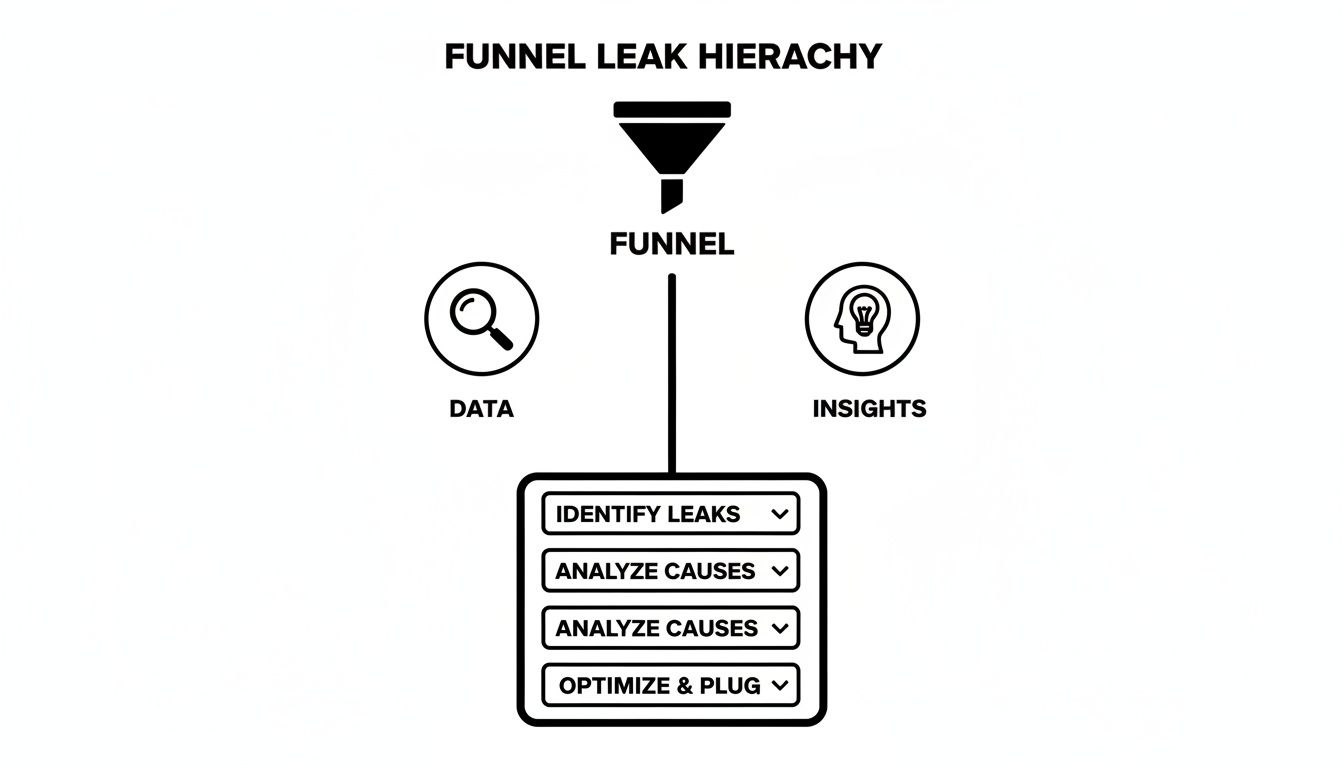
It all starts with gathering the right data and turning it into real insights you can actually act on.
When you weave your advertising signals into your CRO process, you ensure every change you make is directly tied to a business goal. You stop making changes in a vacuum and start optimizing the entire customer journey, from first impression to final sale. That holistic view is how you build a growth engine that truly scales.
Your Go-To Checklist for High-Impact Conversion Boosters

Alright, so you know where to look for problems. Now, the real question is what to do about them. Not all changes are created equal; some tweaks consistently punch way above their weight. This checklist is your starting lineup of the heavy hitters—the changes every e-commerce operator should test for effective website conversion optimization.
Think of this as your playbook. By working through these fundamentals first, you build a user experience that doesn't just feel good to your visitors but actually guides them toward becoming customers.
Sharpen Your Landing Page Essentials
Your landing pages are the first handshake, especially for anyone clicking through from a paid ad. If that first impression is confusing or it’s not obvious what to do next, you've lost them. And you paid for that click.
The number one priority here is a razor-sharp value proposition. A visitor needs to understand what you sell and why it’s for them in about three seconds. No jargon, no fluff—just the straight-up benefit they get.
Next, every single page needs a dominant, can't-miss call-to-action (CTA). Your CTA button should pop off the page with a contrasting color. And please, kill the generic "Submit." Use action-packed, specific text like "Get Your Free Quote" or "Build My Custom Kit."
Elevate the User Experience
A clunky, frustrating website is a conversion killer. Your job is to make the entire journey, from the first click to the final "thank you" page, feel completely seamless.
Start by auditing your forms. Every single field you add is a tiny piece of friction that gives someone a reason to bail. Strip your checkout and contact forms down to the bare essentials. Do you really need their phone number right now? Probably not.
And it goes without saying, but mobile is everything. A massive chunk of your traffic is on a phone, so your site had better work flawlessly on a small screen. We're talking big, tappable buttons, text that’s easy to read without zooming, and dead-simple navigation.
A slow website doesn't just annoy visitors—it actively costs you money. Even a one-second delay in page load time can cause conversion rates to plummet, making page speed one of the highest-ROI technical fixes you can make.
Getting your site speed in order is non-negotiable. Compressing your images, cleaning up your code, and using solid hosting aren't just technical chores; they're direct investments in your bottom line.
Build Unshakeable Trust with Social Proof
In e-commerce, trust is currency. People buy from brands they believe in, and the fastest way to build that belief is to show them that other people already trust you. That’s the magic of social proof.
Here’s how you put it to work:
Customer Reviews and Ratings: Get those star ratings front and center on your product pages. Honest, detailed reviews answer questions and squash doubts before a potential customer even knows they have them.
Testimonials: Pull powerful quotes from your best customers and feature them with a name and photo. It adds a human face to the praise and makes it feel real.
User-Generated Content (UGC): Actively encourage your customers to share photos and videos of them using your products. Nothing is more persuasive than seeing a real person enjoying what you sell.
The numbers here are staggering. One study found that sites featuring UGC saw a 3.2% conversion rate, which jumped to 7% when visitors simply scrolled through it. Even better, when users actually engaged with that content, their likelihood of buying doubled—a massive 102% conversion lift. You can dig into more stats on UGC's conversion impact and see just how powerful it is.
By systematically running through this checklist, you’re no longer just guessing. You’re building a structured plan where every element—from a clear CTA to a glowing customer review—works together to reduce friction, build confidence, and turn visitors into buyers.
Running Your First A/B Test Without the Headaches

It’s time to stop guessing and start knowing. Running your first A/B test can feel like a big leap, but it’s the only reliable way to prove that your changes actually improve performance. This is where website conversion optimization moves from theory to practice.
Think of an A/B test as a controlled experiment for your website. You show one version of a page (the “control”) to half your audience and a modified version (the “variant”) to the other half. By tracking which one leads to more conversions, you get a clear, data-driven answer about what works best.
Step 1: Formulate a Clear Hypothesis
Every worthwhile test begins with a solid hypothesis. This isn't just a random idea; it's a structured prediction that gives your experiment purpose. A truly great hypothesis follows a simple framework: "If I change [X], then [Y] will happen, because of [Z]."
For instance, a weak idea is: “Maybe a green button would be better.” A strong, testable hypothesis sounds like this: "If we change the 'Add to Cart' button from grey to bright orange, then the click-through rate will increase, because the new color has much higher visual contrast, grabbing the user's attention more effectively."
See the difference? This structure forces you to connect a specific change to a measurable outcome with a logical reason behind it. That clarity is what helps you learn from your results, whether the test wins or loses.
To help you get started, here is a simple template for building your own testable hypotheses.
A/B Test Hypothesis Template
Hypothesis Element | Example |
|---|---|
The Observation | Our checkout page has a 70% drop-off rate. Heatmaps show users aren't seeing the "Continue to Payment" button. |
The Proposed Change | If we change the button color from muted blue to a high-contrast green... |
The Expected Outcome | ...then we will see a 10% increase in users proceeding to the payment step... |
The Rationale | ...because the new color will stand out from the other page elements, making the primary call-to-action impossible to miss. |
Using this structure ensures every test is built on a solid foundation of observation and logic, not just a whim.
Step 2: Set Up the Experiment
With a clear hypothesis in hand, you're ready to build the test. You don't need to be a developer to get this done. User-friendly platforms like Google Optimize, VWO, or Optimizely make the technical side surprisingly straightforward.
Here’s what the setup process generally looks like:
Define Your Goal: First, decide exactly what you're measuring. Is it a button click? A form submission? A completed purchase? This will be your primary metric.
Create Your Variant: Using the tool's editor, make the single change you outlined in your hypothesis. In our example, you'd simply change the button's color on the variant.
Target Your Audience: Choose who gets to see this test. You can show it to everyone who visits the page or narrow it down to specific segments, like mobile users or visitors from a particular ad campaign.
A crucial part of a trustworthy test is reaching statistical significance. This just means you've collected enough data to be confident the result isn't a fluke. Most tools will track this for you, usually aiming for a 95% confidence level before you can declare a winner.
Step 3: Analyze and Document Your Results
Once enough people have seen your test, it's time for the big reveal. The test will either have a clear winner, or it'll be inconclusive. Here’s the key: both of these outcomes are incredibly valuable.
If your variant wins, fantastic! You’ve just found a proven way to improve your website. The next move is to roll out the winning change for 100% of your audience.
If the test is a tie or the original version wins, that’s still a success. You just saved yourself from making a change that would have done nothing—or worse, hurt conversions. This is where you dig deeper. To truly understand why a test failed, it helps to know how different users behave. Learning how to properly use UTM parameters for Google Analytics is a game-changer here, as it can reveal that a change worked for one traffic source but not another.
No matter the outcome, document everything. Keep a running log of your hypotheses, the results, and what you learned. Over time, this document becomes your single most valuable CRO asset, guiding every future experiment and building a smarter, more effective optimization program.
Avoiding the Common Mistakes That Kill CRO Programs
Even the best-laid plans for website conversion optimization can run aground. It's usually not from a lack of trying, but from a few surprisingly common mistakes that can completely halt progress. If you know what these pitfalls are ahead of time, you can build a CRO strategy that's far more resilient and successful.
One of the most frequent mistakes is trying to test way too many things at once. I get it—it’s tempting to want a complete page overhaul, changing the headline, the button color, and all the images in one big push. The problem is, when the results come back, you’re left guessing. Was it the new headline that caused the lift? Or did the new images actually tank performance while the button saved it? Good CRO is about surgical precision, not throwing spaghetti at the wall.
This ties directly into another trap: ending a test way too soon. Calling it quits after just a few days might show an exciting spike, but it's often a misleading one. You absolutely have to wait until you reach statistical significance. It’s the only way to be sure your results aren't just a product of random luck.
Ignoring Critical Performance Metrics
Beyond the visual stuff, a lot of teams completely overlook foundational issues that have a huge impact on whether people convert. Page speed is the classic example—a silent conversion killer that gets ignored in favor of flashier design tweaks. But the link between how fast your page loads and whether a user takes action is direct and unforgiving.
Think about this: for every extra second your page takes to load, conversion rates can plummet by as much as 7%. And it gets worse fast. Bounce rates can skyrocket by 32% when page load time goes from a zippy one second to a sluggish three. For any e-commerce brand, this data makes it clear: optimizing for speed isn't just a 'tech thing'—it's a fundamental part of any serious CRO program. You can dig deeper into the impact of page speed on conversions to see just how critical it is.
The most successful CRO programs are built on discipline. They resist the urge to chase shiny objects and instead focus on a methodical process of hypothesis, testing, and learning. This approach avoids the chaos of random edits and delivers consistent, reliable growth.
Failing to Revalidate and Learn
Finally, one of the biggest mistakes I see is assuming a win is a win everywhere. Just because a headline crushed it on a landing page for cold ad traffic doesn't mean it will do anything for your warm audience on a product page. Context is everything.
You should always re-test successful ideas in new environments. Every single test, whether it’s a clear winner or a total flop, teaches you something valuable about your customers. A disciplined CRO program sidesteps these common traps by staying strategic, patient, and endlessly curious about what really makes users tick.
Your Top CRO Questions, Answered
As you get started with website conversion optimization, you're bound to have some questions. Everyone does. Let's walk through some of the most common ones I hear from clients and teams to clear things up and give you the confidence to start optimizing.
What Is a Good Conversion Rate?
Ah, the million-dollar question. The honest-to-goodness answer? It completely depends on your industry, traffic source, and what you're selling. A B2B software company selling a $50,000/year platform will have a vastly different "good" conversion rate than an e-commerce store selling $20 t-shirts.
If you're looking for a general ballpark, the average website conversion rate tends to float around 2-3%. Some sectors, like finance or legal services, might see averages closer to 5% or even higher.
But here's the secret: the most important benchmark isn't some industry-wide number. It's your number, right now. The goal of CRO isn't to hit an arbitrary percentage; it's to continuously improve your own baseline. Pushing your conversion rate from 2% to 3% might sound small, but that’s a massive 50% increase in business.
How Long Should an A/B Test Run?
I get it. It’s incredibly tempting to call a test the second one version pulls ahead. But you have to resist. For your results to be trustworthy, you need to reach statistical significance—usually a 95% confidence level. This just means you have enough data to be sure the outcome wasn't a fluke.
So, how long is that? It could be a few days for a homepage that gets tons of traffic, or it might take several weeks for a less-visited page.
My rule of thumb is to always run a test for at least one full business cycle. For most businesses, that means one to two full weeks. This helps smooth out any weird fluctuations from weekends or specific days when your customer behavior might change.
Does CRO Conflict with SEO or Paid Ads?
Not at all. When done right, they're the perfect team. Think of it like a relay race:
SEO and Paid Ads run the first leg, bringing the baton (traffic) to your website.
CRO takes the baton and runs the final leg, turning that traffic into a conversion.
A well-optimized site doesn't just convert better; it also sends great signals back to the search engines. Lower bounce rates and higher engagement can actually give your SEO a nice little boost.
And for paid ads? Improving your landing page conversion rate is like pouring gasoline on a fire. It makes every single dollar you spend on ads work harder, directly cranking up your return on ad spend (ROAS). When these three work together, you get a growth flywheel that just keeps spinning faster.
Ready to stop guessing where your ad budget is leaking? SpendOwlAI connects your ad performance directly to your website analytics, pinpointing exactly where you should focus your optimization efforts for the biggest wins. Start your free 7-day trial and see what you can fix today.