Winning Bids with Software for Bid Management
Think of bid management software as an expert trading platform built specifically for your digital advertising. It steps into the chaotic, fast-paced world of ad auctions on platforms like Google and Meta and brings order, protecting your ad budget and making sure every dollar works harder.
What Is Bid Management Software

Imagine you're a stockbroker, but instead of a few dozen stocks, you have to manage thousands of tiny, fast-moving ones simultaneously. Decisions to buy or sell have to be made every single second. That’s pretty much what manual ad bidding feels like.
Every time someone searches on Google or scrolls their social feed, a real-time auction takes place to decide which ad to show. Trying to manage bids for these auctions by hand is like bringing a pocket calculator to a high-frequency trading floor. It's just not a fair fight.
This is where software for bid management comes in. It’s the purpose-built system designed for this environment. The software automates the process of setting, adjusting, and fine-tuning your ad bids to hit specific goals, whether that's getting more conversions or achieving a target Return on Ad Spend (ROAS).
The Problem It Solves
At its core, bid management software solves a huge problem: it turns the wild, unpredictable nature of ad auctions into a manageable, strategic operation. Without it, advertisers are left trying to guess how much to bid on thousands of different keywords, audiences, and ad placements. That manual approach isn't just a time-sink; it's incredibly inefficient and a recipe for costly mistakes.
These tools are built to tackle the most common headaches for advertisers:
Wasted Spend: Stop overbidding on keywords or audiences that just don't convert.
Missed Opportunities: Avoid underbidding on highly profitable segments and leaving easy money on the table.
Slow Reaction Time: Instantly adapt to market shifts and competitor moves, instead of days or weeks later.
Data Overload: Cut through the noise and make sense of massive amounts of performance data to make smart decisions.
The real job of bid management software is to shift an advertiser from reactive, gut-feel guesswork to proactive, data-driven execution. It gives you the analytical firepower to make thousands of tiny adjustments that are simply impossible for a human to handle alone.
More Than Just Automation
Good bid management software is about much more than just putting your bids on autopilot. It delivers a real strategic edge by providing deeper insights and crucial protective measures. For instance, it can spot when you're burning cash on uninterested audiences and automatically shift that budget over to your top-performing campaigns.
This strategic layer helps you find and act on profitable scaling opportunities before your competitors even know they exist. The industry gets it, which is why the global bid management software market, valued at USD 921 million in 2025, is expected to jump to USD 2,253.4 million by 2033. As ad spending grows, the efficiency these tools provide is no longer a luxury—it's essential. You can dig into these numbers and other market trends by exploring the full analysis from Data Insights Market.
Manual Bidding vs. Software at a Glance
To make the difference crystal clear, let's compare the day-to-day reality of managing bids by hand versus using a dedicated software solution.
Aspect | Manual Bid Management | Software for Bid Management |
|---|---|---|
Speed & Scale | Slow, manual adjustments on a limited number of campaigns. | Instant, automated adjustments across thousands of keywords and audiences. |
Decision-Making | Based on delayed data, historical reports, and gut feelings. | Driven by real-time data, predictive analytics, and algorithmic optimization. |
Efficiency | Extremely time-consuming, requiring hours of daily spreadsheet analysis. | Frees up hours of team time by automating routine analysis and execution. |
Budget Control | Prone to overspending and inefficient budget allocation. | Protects budget with automated rules and performance guardrails. |
Outcome | Inconsistent performance and missed growth opportunities. | Maximized ROAS and confident, scalable growth. |
As you can see, the contrast is stark. One path leads to constant firefighting and inconsistent results, while the other paves the way for efficient, scalable, and predictable growth.
What to Look For: The Must-Have Features of a Modern Bidding Platform

Alright, let's get past the marketing hype. What actually separates a genuinely useful bidding platform from a basic automation tool? It’s not just about placing bids faster. A truly modern system is designed to anticipate market shifts, protect your budget, and guide your strategy.
Forget the generic checklists. The real value is in how these features solve the day-to-day headaches that keep advertisers up at night. At the heart of it all is an intelligent engine that combines automation with AI, making thousands of tiny, correct decisions on your behalf. These are the non-negotiables you should be looking for.
AI-Powered Predictive Bidding
First up is AI-powered predictive bidding. Think of this less like automation and more like a crystal ball for ad auctions. Instead of just reacting to what happened yesterday, the software crunches massive amounts of data—time of day, user location, device, competitor patterns—to predict how a certain bid is likely to perform in a future auction.
This predictive power helps you sidestep a classic mistake: basing today's strategy on yesterday's outdated results. It lets you be proactive, putting your money on the auctions you're actually positioned to win profitably.
Automated Rules and Custom Logic
While the AI provides the predictive intelligence, automated rules are where you get to hard-code your own strategic expertise. This is how you translate your specific knowledge into hands-on actions that run 24/7 without you needing to be there.
For instance, you can set up simple "if-then" logic to manage your campaigns:
If ROAS for a campaign hits 4.5 over a three-day period, then increase its bids by 20%.
If CPC for a keyword spikes 30% above its average with zero conversions, then automatically pause it.
If a product's stock drops below 10 units, then pull back the bids on its corresponding ads.
These rules are your always-on assistant, ensuring your account sticks to the game plan and instantly capitalizes on opportunities or neutralizes threats.
Performance Guardrails and Alerts
This might be one of the most underrated features of a great platform: performance guardrails. These are the safety nets that prevent costly mistakes, whether they come from a misconfigured automation or a simple human error. They constantly scan your campaigns for strange activity and flag risks before they spiral out of control.
Think of guardrails as your co-pilot. They’ll alert you to a sudden nosedive in your click-through rate or a key campaign that inexplicably stopped spending. This stops small hiccups from quietly snowballing into huge budget drains.
The best tools don’t just automate; they protect. They add a critical layer of oversight that gives you the confidence to manage large, complex accounts. It's what turns a simple tool into a system you can truly rely on. This is where AI really shines—advertisers often report a 20-30% reduction in time spent on manual bid management, freeing them up for more strategic work. That efficiency is vital when you're fighting against the 15-20% annual CPC increases we see across major ad platforms.
Advanced Monitoring Capabilities
Finally, the most sophisticated platforms go beyond bidding to give you diagnostic tools that answer the crucial question: "Why did that happen?"
Creative Fatigue Alerts: A good system will let you know when an ad's performance is tanking simply because your audience is tired of seeing it. This gives you a heads-up to swap in fresh creative before your ROAS takes a hit.
Audience Saturation Monitoring: This feature tracks what percentage of your target audience you've reached and how frequently. It’s key for preventing you from burning money showing the same ads to the same people who have already tuned you out. You can dive deeper into this by reading our guide on using AI for smarter marketing insights.
These features elevate a platform from a simple bid-tweaking tool into a genuine strategic partner. They provide the kind of clarity that’s nearly impossible to find manually, empowering you to not only manage bids but to run a far healthier and more efficient advertising operation.
Unlocking Real Business Growth with Smart Bidding
Features and dashboards are interesting, but let's be honest—they don't pay the bills. The real point of bringing in bid management software is to drive actual business growth. It’s all about turning those technical capabilities, like AI bidding and automated rules, into real-world results like higher profits and a more effective team.
The value isn't just about making things run on autopilot; it’s about fundamentally improving how you manage your advertising. When you connect the right tools to your business goals, you start to see growth in four critical areas that directly impact your bottom line.
Maximize Your Return on Ad Spend
The most immediate win is simply getting more out of every dollar you invest. Think of smart bidding software as a tireless financial analyst for your ad budget, constantly finding and eliminating waste. It stops you from pouring money into keywords that just aren't converting and automatically shifts that budget over to your best-performing campaigns.
This constant optimization means your money is always chasing the best results. Instead of spreading your budget thin across a bunch of so-so performers, you’re consistently doubling down on the winners. This has a direct and powerful effect on your overall Return on Ad Spend (ROAS).
Of course, a deep understanding of this metric is essential for any advertiser. You can get a full breakdown in our guide on what ROAS is and how to calculate it.
Reclaim Your Team’s Valuable Time
Just think about all the hours your team loses to manual, repetitive work. Downloading reports, fighting with spreadsheets, and manually checking campaign performance—it all adds up. This is low-value work that pulls them away from what really moves the needle: strategy and creative thinking. A good bid management system automates thousands of these tiny checks every single day.
It’s not about replacing your team; it's about upgrading their toolkit. By handling the tedious data analysis, the software frees up your best people to think strategically, analyze market trends, and build better campaigns.
This shift from manual grunt work to strategic oversight is one of the most significant returns you'll get from a platform. It gives your team the breathing room to focus on what humans do best.
Scale Your Ad Budget with Confidence
Every direct-to-consumer brand knows the fear that comes with scaling. You’ve finally got a campaign that’s hitting its targets, but you're terrified to increase the budget. Will it break what’s working? Will performance fall off a cliff? This is where a system with built-in guardrails becomes a game-changer.
Take a DTC skincare brand, for example. They had a few winning ad sets on Meta but were completely stuck at a $1,000/day spend. Every single time they tried to push it higher, their ROAS would tank. After bringing in a bid management tool, they set up performance guardrails that automatically monitored their cost-per-acquisition (CPA) and ROAS in real-time.
This gave them the confidence to finally scale. The software would gently increase the budget while making sure performance stayed within their target range. If CPA started to creep up, it would automatically pull back a bit. This controlled, methodical approach allowed them to scale their spend to $5,000/day while holding their target ROAS steady—something they could never have done manually.
Make Decisions Backed by Data
Finally, the best bid management software gets rid of the guesswork. Instead of making decisions based on a gut feeling or incomplete data, your team can operate with absolute clarity. The platform’s job is to turn all that noisy performance data into clear, actionable insights.
It gives you definitive answers to critical questions, like:
Is this performance dip a real problem or just a normal market fluctuation?
Which specific ad creative is starting to show signs of fatigue?
Should I scale this campaign now, or would it be better to wait?
This data-backed guidance builds confidence, stops reactive, emotional decision-making, and creates a culture of smarter, more profitable advertising.
How to Choose the Right Bid Management Software
So, you understand what bid management software is and why it's a potential game-changer. Now for the hard part: picking the right one. This isn't just about finding a tool with the longest feature list. It's about finding a genuine partner for your advertising team.
Think of it like hiring a new senior strategist. You wouldn't just glance at their resume and say "looks good." You'd dig into how they think, how they communicate their reasoning, and how they'd actually fit into your team's day-to-day workflow. The same goes for your software. You want something that elevates your team's strategic thinking, not just another dashboard to babysit.
Start with Foundational Integrations
First things first: does it play well with others? The absolute must-have is seamless integration with the platforms where you spend your money and track your results. If a tool can't connect to your core systems, it's dead in the water.
During your evaluation, get straight to the point and ask:
Ad Platforms: Does it have deep, native integrations with Google Ads and Meta Ads? This is non-negotiable.
E-commerce Platform: Can it plug directly into your Shopify store or other e-commerce backend? This connection is crucial for pulling in product-level data like inventory and profit margins.
Analytics and Attribution: Does it sync with your analytics tools and marketing attribution software? A unified view of performance is the only way to make decisions you can trust.
If a potential tool stumbles on these basic connections, it will only create more data silos and headaches. Solid integration is the bedrock of any useful system.
Demand Transparency from the AI
A lot of bidding tools act like a "black box." The AI makes changes, the numbers go up or down, and you're left guessing why. This is a huge red flag. It robs you of the chance to learn and makes it impossible to fully trust the recommendations.
An effective AI co-pilot doesn't just act; it explains. It should provide clear, transparent reasoning for every recommendation, allowing your team to inspect, question, and ultimately understand the logic behind the strategy.
When you're getting a demo, push for clarity on this. Does the platform just show you a wall of metrics, or does it deliver an actionable to-do list with plain-language explanations? A tool that shows you its work builds operator confidence and turns every campaign adjustment into a valuable lesson.
Assess Its Ability to Scale with You
Your business isn't going to stand still, so your software shouldn't hold you back. True scalability isn't just about handling a bigger budget—it’s about growing alongside your team's needs and operational complexity.
Think about your future and consider these points:
Growing Budgets: Can the software confidently manage your spend as it climbs from $1,000/day to $10,000/day and beyond without breaking a sweat?
Agency Needs: If you're an agency, does it have a clean, efficient multi-account dashboard? Constantly logging in and out of dozens of different accounts is a massive productivity drain.
Team Collaboration: Can you set up multiple users with different roles and permissions? This is key for letting your team work together without stepping on each other's toes.
A truly scalable solution adapts to your reality, whether you're a scrappy startup founder or a multi-brand agency managing millions in ad spend.
Watch Out for Critical Red Flags
Finally, keep an eye out for warning signs that a tool might be more trouble than it's worth. Here are a few common red flags to watch for during your evaluation process.
Opaque Pricing: Steer clear of tools with complex pricing models that make it impossible to forecast your costs. You should know exactly what you're paying for.
Encouraging Constant Tweaking: The best systems promote strategic patience. A platform that nudges you to make constant, reactive changes can easily disrupt your campaigns' learning phases and hurt performance.
Lack of Guardrails: A tool without built-in safety nets is an accident waiting to happen. It should automatically alert you to risks like audience fatigue, sudden performance drops, or a campaign that's about to overspend.
Choosing the right software for bid management is a major strategic decision. This checklist will help you cut through the noise and evaluate potential platforms based on what really matters.
| Bid Management Software Evaluation Checklist |
| :--- | :--- | :--- |
| Evaluation Criteria | Key Questions to Ask | Why It Matters | | Core Integrations | Does it connect natively to Google Ads, Meta Ads, and my e-commerce platform (e.g., Shopify)? | Without deep integrations, you'll be working with incomplete data, leading to poor decisions and manual workarounds. | | AI Transparency | Can the AI explain why it's recommending a specific bid change or budget shift in plain English? | A "black box" AI robs your team of learning opportunities and makes it impossible to build trust in the system's logic. | | Scalability | Can it handle significant budget growth? Does it offer a multi-account view for agencies? Can I set user permissions? | The tool should adapt to your business growth, not hinder it. A lack of scalability creates future roadblocks. | | Safety & Guardrails | Does the software have automated alerts for risks like overspending, audience fatigue, or sudden performance drops? | Without automated guardrails, you are exposed to costly mistakes and forced to manually monitor campaigns constantly. | | Data & Reporting | Can it pull in crucial business data like profit margins and inventory? Is the reporting clear and actionable? | Generic ad metrics (like CPC or CTR) aren't enough. You need to make decisions based on real business impact and profitability. | | Pricing Model | Is the pricing simple, transparent, and predictable? Are there hidden fees or long-term contracts required? | Complicated pricing makes it difficult to calculate the tool's ROI and can lead to surprise costs as your spend increases. | | User Experience | Is the interface intuitive? Does it present a clear to-do list or just a confusing dashboard of charts? | A clunky, complicated UI creates a steep learning curve and discourages adoption, defeating the purpose of the tool. |
By focusing on deep integration, demanding transparency, planning for scale, and spotting these red flags, you’ll be in a much better position to choose a partner that becomes a true asset for growth.
The Future of Bidding Is Operator-Led
For years, the big promise of ad automation was a "set-it-and-forget-it" dream. Many bidding tools claimed they could put your campaigns on complete autopilot, but experienced marketers know the reality is often a black box. It makes decisions without any explanation, leaving the very people who know the strategy best feeling powerless and disconnected. That whole approach is getting old.
The future of software for bid management isn't about replacing the expert in the driver's seat; it's about empowering them. The best systems are ditching opaque automation and embracing a new model built on intelligent collaboration. It’s all about building trust through transparency and providing strategic guidance, not just automated actions.
Your Co-Pilot for Daily Execution
Think of this new breed of software less like a hands-off autopilot and more like a seasoned co-pilot. This is the heart of a daily execution system. Instead of just taking the controls, it sifts through the noisy, chaotic data from your ad platforms and distills it into a clear, prioritized list of things you should actually pay attention to.
Every recommendation comes with transparent reasoning you can dig into, question, and ultimately learn from. This co-pilot doesn't just tell you what to do; it shows you why. For instance, it might suggest a budget shift not simply because a campaign has a high ROAS, but because it also has stable performance, low audience saturation, and healthy creatives—the full picture you need to make a smart call.
The Power of Knowing When Not to Act
One of the biggest risks in paid advertising is over-management. We've all felt that itch to constantly tweak campaigns based on a few hours of data. This constant meddling can throw ad platforms' learning algorithms into a tailspin, causing volatile performance and what many of us have come to call self-inflicted campaign damage.
A truly intelligent system understands this. It acts as a critical guardrail, alerting you—the pilot—to real risks like editing campaigns too frequently or burning out your audience. Just as importantly, it gives you the confidence to know when the best move is to do nothing at all.
The ultimate goal of an operator-led system is to build confidence. It prevents you from reacting to noise while ensuring you act decisively when a true signal emerges, transforming gut-feel decisions into data-backed strategy.
This approach keeps the final strategic decision with you but arms you with the data and rationale to make it with conviction. It shines a light on the importance of strategic patience, a skill that separates the good advertisers from the great ones.
Bridging the Gaps in Traditional Automation
Many tools fail to deliver in three key areas, leaving agencies and brands with wasted spend, missed opportunities, and a frustrating lack of control. An operator-led system is designed to fix these exact problems.
Transparency: Old-school tools often hide their logic. A modern, operator-led system makes a point of explaining its recommendations, turning every decision into a chance to get smarter.
Guardrails: Basic automation has no safety nets. A better system actively scans for risks like scaling too quickly or creative fatigue, protecting your budget from common mistakes.
Multi-Account Visibility: Agencies know the pain of trying to get a clear, consolidated view. An operator-led platform can give you a single, unified to-do list across all client accounts, making it simple to spot priorities and manage everything at scale.
This flowchart highlights the key pillars to look for when choosing a platform, focusing on how well it integrates, how transparent it is, and whether it can grow with you.
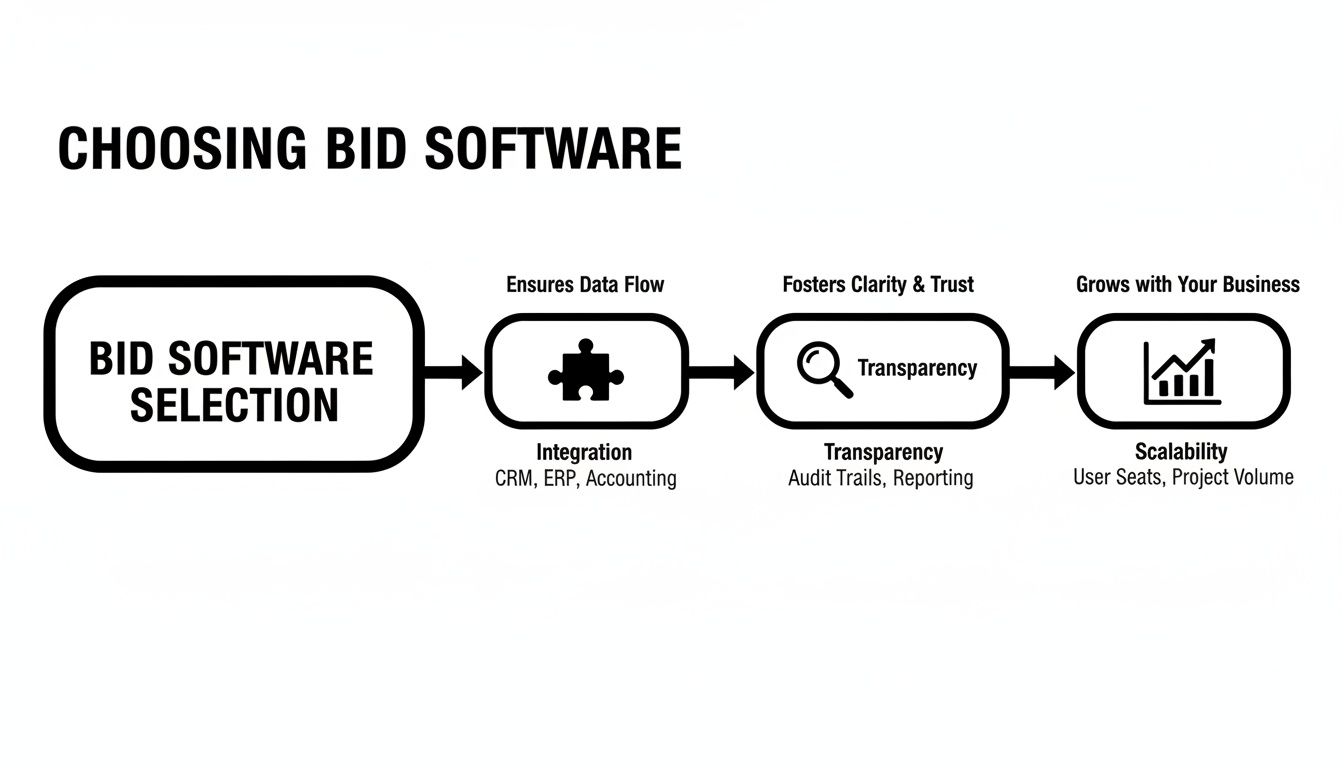
This process shows that a tool’s ability to fit into your workflow, provide clear insights, and scale with your business are the foundations of an effective operator-led strategy. By focusing on these elements, platforms like SpendOwlAI are built to empower the marketer, making sure that technology serves your strategy—not the other way around. This isn’t just a minor improvement; it's the future of managing ads effectively.
Your Next Steps to Smarter Ad Spending
So, what’s the one thing to remember after all this? It’s that effective software for bid management isn't some optional add-on for massive advertisers anymore. It's now a core part of any serious advertising playbook, crucial for protecting your budget and actually growing your business.
This is all about getting out of that chaotic, reactive cycle where you’re just putting out fires all day. The real aim is to get to a place of confident, proactive management, where your strategy is backed by solid data, not just a gut feeling. That’s how you finally stop pouring money into campaigns that go nowhere and start scaling the ones that truly deliver.
Embrace a New Approach
Making this shift means leaving the old ways of manual bidding and black-box automation behind. It’s about choosing a system that gives your team superpowers, not one that tries to replace them. An operator-led approach puts you firmly back in the driver's seat, armed with the real insights you need to make smart, profitable calls every single day. This change really comes down to three things:
Clarity Over Confusion: Imagine swapping a messy dashboard for a clean, prioritized to-do list that tells you exactly what to do next in plain English.
Guidance Over Guesswork: Get clear, data-backed recommendations that help you know when to make a move and—just as critically—when to hold back.
Confidence Over Chaos: Use automated guardrails to catch common mistakes before they happen, letting you scale your ad spend without that constant fear of performance falling off a cliff.
Ultimately, the goal is to turn your daily ad management from a constant source of stress into a streamlined, strategic advantage. It’s about building a system that saves you time, stops the waste, and lets you execute with total confidence.
Ready to see how a platform built to guide—not just automate—can completely change how you run your ads? The best way to really get a feel for this new, transparent way of working is to see it for yourself.
A platform like SpendOwlAI was built as a daily execution system for operators running ads on Google and Meta. It’s designed to give you the clear logic and protective guardrails you need to move from guesswork to confident execution. It’s your chance to see how a system built for today's marketer can help you save time and spend a whole lot smarter.
Of course. Here is the rewritten section, designed to sound completely human-written and natural, following all your specific instructions.
Frequently Asked Questions
When you're exploring bid management software, a few questions always come up. Let's tackle some of the most common ones to give you a clearer picture of how these tools really work and what they can do for you.
Can This Software Replace My Campaign Manager?
Absolutely not. Think of this software as a powerful co-pilot, not the pilot. It’s built to handle the heavy lifting—the tedious number-crunching and data analysis that a person simply can't do at scale. It flags opportunities and risks you might otherwise miss.
But a great campaign manager provides the strategy, the creative spark, and the nuanced understanding of your brand that technology just can't replicate. The goal here is to free up your manager's time so they can focus on high-level strategy and make smarter, faster decisions, not to push them out of the cockpit.
Is This Software Only for Large Companies?
That used to be the case, but not anymore. While massive enterprises obviously get a lot of value from these platforms, they’ve become essential for ambitious DTC brands and small businesses, too. The goal is always the same: stop wasting money and get a better return on your ad spend, no matter your budget.
Many modern tools now offer flexible pricing that grows with you. This makes it possible for smaller teams and growing agencies to access the same kind of competitive advantage that was once reserved for the big players.
The real value isn't about how big your budget is; it's about how smart you want to be with it. A good system makes sure every single dollar, whether it's your first or your millionth, is pulling its weight.
How Long Until I See Results?
You’ll likely notice some immediate wins. The time saved from manual reporting and the prevention of obvious budget-wasting errors can show up in the first week. It’s a huge relief.
As the system collects more data and you start acting on its insights, you can expect to see real, measurable lifts in key metrics like ROAS and CPA within 30-60 days. The key is consistency. The more you use it, the more the gains compound, helping you build a much more efficient and resilient advertising engine over time.
How Is This Different from Native Bidding Tools?
The built-in bidding tools on platforms like Google and Meta are solid, but they have a major blind spot: they only see their own world. A third-party bid management platform offers a few critical advantages they can't.
Cross-Platform View: It pulls all your performance data from Google, Meta, TikTok, and other channels into a single dashboard. For the first time, you get a true, holistic view of what’s actually working across your entire marketing mix.
Deeper Transparency: The best third-party tools don't just tell you what to do; they show you why. This layer of strategic reasoning is something you rarely get from the black-box algorithms of native platforms.
Holistic Business Strategy: These systems can connect your ad performance to real business data, like inventory levels from Shopify. This allows for much smarter decisions, like automatically pausing ads for products that are about to sell out.
Ready to stop guessing and start executing with confidence? SpendOwlAI is a daily execution system that turns noisy ad data into clear, actionable insights. See how our transparent approach can help you save time, eliminate waste, and scale with confidence. Start your free trial today.