Unlocking Growth with AI Driven Marketing Insights
Welcome to the new era of marketing. Success no longer comes from having the most data—it's about turning that data into decisive action. If you're a performance marketer or a DTC founder, you know the daily grind of sifting through a sea of noisy ad metrics, trying to figure out what actually matters. This guide is your roadmap from data overload to confident execution.
Moving from Data Overload to Decisive Action

Think of yourself as an air traffic controller. Your screens are flooded with blinking lights and alerts. Without an intelligent system to prioritize what's important, you might end up overreacting to minor turbulence while completely missing a critical engine warning. This is the reality for too many marketers today—drowning in dashboards, making reactive, wasteful edits based on metrics that bounce around for no good reason.
This is where AI-driven marketing insights step in to act as your co-pilot. Instead of just throwing more charts at you, these systems are designed to filter the signal from the noise, highlighting the few things that genuinely need your attention. They connect the dots between your ad performance and real business outcomes, taking you far beyond surface-level data.
The Shift to Proactive Strategy
The use of AI in marketing isn't just a trend anymore; it's standard practice. A staggering 94% of organizations now use it for their marketing activities. While many are still finding their footing, the value is already undeniable—42.2% of organizations report that generative AI has led to meaningful changes in their strategies. This isn't just about automation; it’s a fundamental shift toward smarter, more efficient ways to run campaigns. You can dig deeper into these trends by exploring the latest AI marketing statistics on Martech.org.
The best new tools are moving away from complex dashboards and toward something far more practical: a clear, ranked to-do list. This approach helps you act with conviction, focusing your limited time on the changes that will actually make a difference.
The goal is no longer just to analyze performance but to get clear, daily guidance. AI insights should tell you what to change, what to watch, and just as importantly, what to leave alone to keep your momentum going.
This guide will break down exactly how these insights are generated and how you can use them to build a more resilient and profitable marketing operation. It's time to stop chasing noisy metrics and start making strategic moves backed by intelligent analysis.
What AI-Driven Marketing Insights Actually Mean
Let's cut through the buzz and talk about what AI-driven marketing insights really are. This isn’t about blindly trusting a black box with your ad budget. It’s about having a system that finally explains the why behind your campaign performance, moving way beyond basic metrics like clicks and conversions.
Most marketing dashboards tell you what happened—for instance, your Return on Ad Spend (ROAS) dropped yesterday. That’s a start, but it’s not enough. An AI-driven approach digs deeper by connecting thousands of data points across your entire ecosystem, from platforms like Meta and Google all the way to your Shopify store.
Think of it like an experienced doctor. A fever (your low ROAS) is just a symptom. A great doctor doesn't just hand you a painkiller; they look at your entire history and all related symptoms to find the root cause. AI does the same thing for your marketing campaigns, giving you a complete diagnosis, not just a surface-level observation.
Connecting the Dots Humans Cannot See
A human analyst, no matter how skilled, can only juggle a handful of variables at once. An AI, on the other hand, can simultaneously monitor thousands, constantly searching for subtle patterns and relationships between metrics that are completely invisible to the naked eye.
For example, AI systems can analyze interconnected factors to build a full picture of what's going on:
Ad Fatigue: Is your click-through rate (CTR) falling while ad frequency is climbing? The AI flags this as a clear signal that your audience is tired of seeing the same creative.
Audience Saturation: By comparing your reach and delivery metrics against the total size of your target audience, the system can warn you when you're close to exhausting your pool of potential customers.
Learning Phase Stability: It keeps an eye on budget changes and performance swings to make sure you aren't accidentally resetting your campaigns or making them unstable with too many reactive edits.
By processing all this data together, the system can tell the difference between a temporary, insignificant dip and a serious underlying problem that needs your attention right away. Making that distinction is what separates good ad management from great ad management.
The Old Way vs. The New Way
To really grasp the shift, it helps to see the old and new methods side-by-side. Traditional analysis is reactive and often relies on siloed data, while an AI-powered approach is proactive and holistic.
Aspect | Manual Analysis (The Old Way) | AI-Driven Insights (The New Way) |
|---|---|---|
Data Scope | Looks at a few key metrics in isolation (e.g., ROAS, CPA). | Analyzes thousands of cross-platform metrics simultaneously. |
Focus | Identifies what happened (e.g., "Performance is down"). | Explains why it happened (e.g., "Ad fatigue is causing CPA to rise"). |
Timing | Reactive; analysis happens after a problem becomes obvious. | Proactive; flags leading indicators before they become big problems. |
Output | Raw data, charts, and dashboards requiring human interpretation. | Prioritized, actionable recommendations with clear context. |
Human Effort | Hours spent digging through data to find a potential cause. | Seconds to review a ranked list of high-impact action items. |
This table highlights the core difference: moving from being a data detective to a strategic decision-maker, guided by intelligent signals.
Separating Actionable Signals From Noise
One of the biggest headaches for any performance marketer is figuring out when to act and when to just let things run. Daily performance fluctuations are normal, but knee-jerk reactions to this "noise" can throw your campaigns out of whack and burn through your budget. AI-driven insights are designed to solve this exact problem.
An insight isn't just data; it's data with context and a recommended action. The goal is to filter out the meaningless daily volatility and surface only the trends that represent a genuine risk or opportunity.
This means you get alerted to things that actually matter—like a specific ad set showing early signs of saturation or a top-performing creative that's just starting to fatigue. It transforms a chaotic flood of data into a clear, prioritized to-do list, so you can execute with confidence instead of guesswork. By focusing only on these high-impact signals, you stop making those noise-driven edits that often do more harm than good.
How AI Turns Raw Ad Data Into Action-Oriented Steps
Understanding that AI can deliver marketing insights is one thing, but really grasping how it gets there is another. It's not magic—it's a methodical process that turns the chaotic mess of raw data from your ad platforms into a clear, prioritized to-do list for your team.
Think of it like a world-class chef. They don't just toss ingredients in a pan and hope for the best. They meticulously source the best produce, prep everything perfectly, and only then apply their skill to create a masterpiece. AI works in a surprisingly similar way.
This whole operation hinges on connecting all your different data sources, a notoriously difficult task to do by hand. Good marketing attribution software is the bedrock here, making sure the information the AI analyzes is actually accurate and complete.
The Foundational Step: Ingestion And Normalization
It all starts with data ingestion. The system plugs directly into your ad accounts and storefront—think Meta Ads, Google Ads, and Shopify—and pulls in thousands of raw data points. We’re talking about everything from impressions and clicks to conversion values and even product inventory levels.
But this raw data is a jumble. Each platform has its own way of reporting metrics, so you can't compare them directly. This is where normalization becomes essential. The AI acts as a universal translator, cleaning and standardizing all the data into a single, unified language. Now, we can finally compare apples to apples across every channel.
This first step is absolutely critical. If you feed the system messy, inconsistent data, you'll get garbage recommendations back. It's the classic "garbage in, garbage out" problem.
Identifying Patterns and Predicting Outcomes
With a clean, unified dataset, the AI’s analytical engine can finally get to work. It uses sophisticated algorithms to sift through all that information, hunting for statistically significant patterns, anomalies, and hidden connections that a person would almost certainly miss.
This is where the real insights are born. The system isn't just looking at one metric at a time; it's analyzing the intricate relationships between them.
For example, an AI might spot a few related signals for a particular ad creative:
Signal 1: Click-Through Rate (CTR) has dropped 15% in the last three days.
Signal 2: At the same time, Ad Frequency has shot up by 25%.
Signal 3: Cost Per Acquisition (CPA) is just starting to creep upward.
A sharp media buyer might catch one of these, but the AI connects all three in an instant. It immediately recognizes this trifecta as a classic sign of creative fatigue—your audience has seen the ad too many times, and it's losing its punch.
From Complex Signals To Simple Recommendations
The final, and frankly most important, step is turning these complex analytical findings into simple, actionable instructions. A great AI system doesn't just hand you a dashboard full of charts and expect you to figure it out. It gives you direct commands.
Let's say a DTC brand is trying to scale a new campaign. The AI might see that a marketer is increasing an ad set's budget too quickly, which is forcing it back into the "learning phase" and making performance erratic. Instead of just showing a volatile ROAS chart, the platform will give a clear, direct recommendation: "Hold budget on Ad Set Z for 48 hours to maintain learning stability."
For that fatigued creative we mentioned earlier, the instruction would be just as direct: "Pause Creative X due to high fatigue and declining CTR." This is how a mountain of data gets distilled into a simple, high-impact decision that lets you act with speed and confidence.
Putting AI Insights to Work in Your Campaigns
Theory is great, but let's be honest—results are what actually grow a business. This is the moment where AI-driven marketing insights stop being an abstract concept and become a must-have tool for performance marketing teams, DTC founders, and agencies. Their real strength is in solving the specific, day-to-day problems that eat up your budget and time.
Instead of just spitting out a bunch of metrics, a good AI system will frame insights as clear problem-and-solution scenarios. It replaces guesswork with direct guidance, helping you sidestep those common, costly errors like scaling a campaign too soon or applying broad optimizations that accidentally tank your best performers.
This simple flow shows how raw data gets refined into actual, concrete actions you can take.
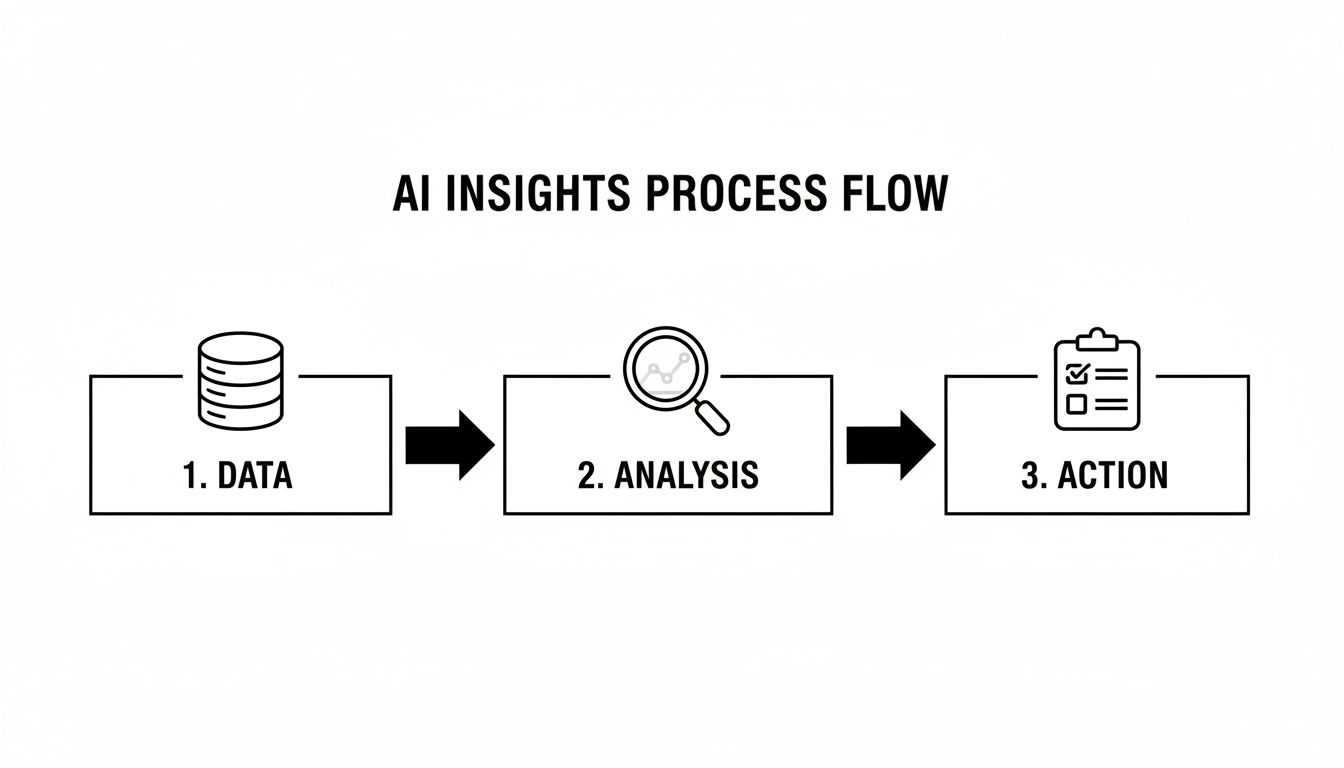
The entire process is built to cut through the noise, boiling down thousands of data points into just a handful of prioritized steps that genuinely need your attention.
Detecting Creative Fatigue Before It Drains Your Budget
One of the sneakiest profit killers is creative burnout. An ad that was crushing it last week can suddenly fall flat. Trying to track this manually across dozens, or even hundreds, of creatives is a nightmare. An AI, however, can spot the early warning signs in a heartbeat.
The Problem: You’re burning cash on a creative that your audience has started to ignore, causing your Cost Per Acquisition (CPA) to creep up for no apparent reason.
The AI Insight: The system flags a specific ad where frequency is spiking while the click-through rate (CTR) is steadily dropping. It connects these dots and diagnoses the issue as creative fatigue.
The Action: You get a straightforward recommendation to pause that creative and replace it with a fresh one. This stops the bleeding and can get your campaign performance back on track.
Avoiding Audience Saturation
Another all-too-common problem is wearing out a great audience. As you scale up, it’s easy to miss the fact that you’ve shown your ads to nearly everyone in that segment, which leads to diminishing returns.
Think of the AI as an early warning system. It keeps an eye on your reach and delivery metrics compared to your total audience size. When you're getting close to the saturation point, it gives you a heads-up.
This gives you time to expand your targeting or start testing new audiences before performance nosedives. It turns a reactive fire drill into a planned, strategic pivot.
Optimizing SKU-Level Performance
For any DTC brand, tying ad spend directly to product-level profitability is the holy grail. A campaign might look profitable on the surface, but what if it's pushing low-margin products while your most profitable SKUs are getting ignored? The right insights bring this to light.
For instance, an AI can analyze your Shopify data right alongside your ad performance to surface signals at the SKU level. It might show you that a certain ad set is driving a ton of traffic, but it’s for a product with a crazy-high return rate. An effective insight platform like SpendOwlAI connects these dots for you.
The recommendation might be to shift budget toward ads that feature higher-margin products. This kind of targeted move can seriously boost your overall profitability, not just your top-line revenue. Optimizing this connection is a huge part of improving your site’s financial health, a topic we dive into in our guide to website conversion optimization.
When you start applying AI insights to these real-world scenarios, you graduate from just managing metrics to actively shaping your business outcomes.
Here’s the rewritten section, designed to sound like an experienced human expert:
How to Use AI Insights Without Drowning in More Work
Let’s be honest—the last thing any performance marketer needs is another complicated tool to manage. The whole point of AI-driven marketing insights is to simplify your life, not add another layer of complexity. A common fear is that bringing in AI means giving up control, but it's actually the opposite. A good system gives you more command by making every single decision clear and easy to justify.
This gets us to a non-negotiable feature: explainability. You have to know the why behind every AI recommendation. If the system flags a creative to be paused, it needs to tell you it’s because of a 15% drop in CTR and a 25% spike in frequency. That kind of transparency is what builds trust and gives you the ammo you need to explain your strategy to your boss or client.
Setting Up Guardrails for Smarter Decisions
One of the most practical ways to bring AI into your workflow is by setting up smart guardrails. Think of these as your "rules of engagement" that stop you from overreacting to every little blip in the data. For example, you could set a rule that no budget gets touched unless ROAS drops by more than 20% over a three-day window.
These guardrails are built on a few core ideas:
Define Action Thresholds: Decide what a "significant" change actually looks like. This is crucial for preventing those knee-jerk edits that throw campaigns back into the learning phase.
Create a Feedback Loop: The best AI tools let you tell them if a suggestion was helpful or not. When you give it a thumbs-up, it learns. When you say a recommendation was off, it recalibrates. The system gets smarter over time.
Embrace Strategic Inaction: Sometimes, the smartest move is to do nothing at all. A truly powerful insight is one that tells you to hold steady because performance is stable, protecting your campaign's momentum.
It sounds strange, but great ad management often means doing less, not more. By focusing only on the signals that truly matter, you stop making noise-driven edits that chip away at your results.
With marketing departments leading the charge in AI adoption—a recent study found 62% of firms increased their AI budgets last year—it's more important than ever to be strategic. You can read more about the latest AI marketing stats on sopro.io. That investment has to be paired with a framework that turns raw data into real ROI, not just more alerts.
Ultimately, integrating AI-driven marketing insights properly creates a calmer, more confident workflow. It ensures every decision—from pausing an ad to holding a budget steady—is backed by solid, understandable data. This becomes especially powerful when you’re trying to make sense of complex data feeds, like the ones you get from the Meta Conversions API.
What's Next? Putting Your Data to Work
We’ve journeyed from the chaos of raw data to the clarity of confident action. Think of AI-driven marketing insights as the ultimate filter—they cut through the daily noise of fluctuating metrics, leaving you with a simple, actionable plan. The real magic isn't in adding more complexity; it's about simplifying it. It turns that overwhelming dashboard with a million blinking lights into a clear, direct flight path.
This is a fundamental shift in how you work. Instead of putting out fires, you start preventing them. It’s about getting back countless hours, stopping ad dollars from being wasted, and finally replacing those gut-feel guesses with solid, data-backed direction.
At the end of the day, it's about making fewer, better decisions. AI gives you the clarity to act on what truly matters and the confidence to ignore the rest.
This guide has walked you through the concepts, but the real test is seeing this in action with your own data, inside your own business. The next logical step is to go from reading about it to doing it. Once you experience how an AI-powered, prioritized to-do list can change your workflow, you'll see how it can fundamentally improve your campaigns and grow your business, one smart decision at a time.
Got Questions About AI Insights? We've Got Answers.
Jumping into AI-driven marketing always brings up a few questions. It's totally normal to wonder how these tools fit into your day-to-day, what they really do, and how they’re any different from the automation already built into the ad platforms.
Let's clear things up. Here are the most common questions we hear from performance marketers and DTC founders who are exploring this new way of working.
"Will AI Take My Job As A Performance Marketer?"
Absolutely not. Think of an AI insights platform as your new secret weapon, not your replacement. Its job is to handle the grunt work—the endless data crunching and pattern spotting that takes up hours of your day.
This frees you up to do what humans do best: think strategically, nail the creative, and focus on the big-picture growth of the business. The AI gives you the "what" and the "why," but you're still the expert in the driver's seat, deciding "how" and "when" to act. It makes you a more strategic marketer, not an obsolete one.
"How Is This Different From The AI In Google Or Meta Ads?"
This is a big one. While the ad platforms have powerful automation, they're essentially black boxes. They make changes but rarely explain why. And let's be honest, their main goal is to get you to spend more money on their platform.
An independent AI insights tool works for you, not for the ad platforms. It gives you an unbiased, cross-channel view of what's really happening. You get a layer of transparency and strategic control that helps you manage the platforms' own automation much more effectively.
Ultimately, it helps you make sure your budget is driving real business results, not just feeding the machine.
"How Long Until I Start Seeing Useful Insights?"
You'll be surprised how fast it is. With a modern tool, you can connect your ad accounts and e-commerce store securely in just a few minutes. There’s no lengthy onboarding or complex setup. The system starts analyzing your historical and live data right away.
In most cases, you'll see your first round of ranked, actionable insights within 24 hours. The whole point is to deliver immediate value by flagging the most urgent risks and biggest opportunities in your campaigns. You can start making smarter, data-backed decisions from day one.
Ready to stop guessing and start executing with confidence? SpendOwlAI delivers a clear, ranked to-do list for your ad accounts every day. Get your free 7-day trial and see your first insights tomorrow.