Shopify or Magento? A 2026 Guide for DTC Brands
You’re usually not choosing between platforms at a calm, academic moment.
You’re choosing after a redesign stalled, after your Meta account burned budget on the wrong products, after your team asked for one more custom fix, or after growth exposed the limits of the stack you started with. Consequently, the shopify or magento decision rarely comes down to feature checklists.
It comes down to operating model.
One platform is built to help a lean team move fast with fewer technical dependencies. The other is built to let a technical team shape commerce around the business, even when the requirements get messy. Both can work. Both can be expensive in different ways. Both can hurt ad efficiency if the catalog, feed logic, and tracking setup are handled badly.
For DTC brands, especially brands running Meta as a primary acquisition channel, the better question is simple: which system helps you get profitable products into market faster, keep data clean, and avoid turning every growth initiative into a development project?
The Crossroads Every Founder Faces
A founder usually reaches this decision right after momentum starts to show up.
Orders are coming in. The catalog is getting wider. Paid media is no longer a side experiment. Suddenly, the store isn’t just a website. It’s the operating system for merchandising, retention, tracking, product launches, and the feed that powers Meta catalog ads.
That’s when the fork appears.
One path says, “Use the platform that lets the team ship quickly, stay stable during traffic spikes, and plug into the tools growth depends on.” The other says, “Build on the platform that gives full control, even if control comes with more engineering overhead.”
That tension defines the shopify or magento debate.
I’ve seen brands choose Magento because they were worried Shopify would box them in, even though they didn’t have a strong need for deep backend customization. I’ve also seen brands choose Shopify, then discover later that their business had unusual pricing logic, multi-store complexity, or ERP requirements that would always feel awkward in a SaaS environment.
The mistake is treating this like a branding decision. It’s not. It’s a commitment to how your team will work every week.
Choose the platform that fits the team you have, not the team you imagine hiring later.
For a DTC operator, the consequences show up fast:
Launch speed matters because every delayed product drop delays revenue.
Catalog structure matters because messy product data turns into poor ad segmentation.
Developer dependence matters because every paid media fix competes with other technical work.
System stability matters because broken tracking and slow pages don’t just hurt conversion. They distort optimization.
The platform choice shapes all of that.
Two Philosophies of Ecommerce At a Glance
The cleanest way to compare them is this.
Shopify is a managed commerce system. Magento is a customizable commerce framework.
That difference sounds abstract until you live with it.

Shopify feels like moving into a polished retail space where utilities, security, and maintenance are already handled. Magento feels like buying the property and deciding how every room, system, and workflow should be built.
That’s why Shopify has spread so widely. Shopify powers over 4.82 million active stores worldwide as of 2026, has processed $1.1 trillion in cumulative GMV since its founding in 2006, and during BFCM 2025 Shopify merchants generated $14.6 billion in sales, peaking at $5.1 million per minute, according to Red Stag’s Shopify statistics roundup. The scale matters because it reflects what founders value most in practice: speed, reliability, and a large ecosystem.
If you’re also comparing channel strategy at the platform level, this take on Amazon vs Shopify for modern ecommerce growth is useful context.
Comparison table for founders and operators
Area | Shopify | Magento |
|---|---|---|
Core model | SaaS platform with managed infrastructure | Open-source or Adobe Commerce setup with heavier implementation responsibility |
Best fit | Lean DTC teams, founder-led brands, fast-moving operators | Businesses with complex requirements and technical resources |
Speed to market | Faster to launch and easier to maintain | Slower to launch when custom work is involved |
Control | Controlled environment with strong app ecosystem | Deep control over code, data structures, and business logic |
Daily operations | More marketer-friendly | More developer-reliant |
Meta catalog ad readiness | Easier to connect feeds, apps, and automation | More flexible, but usually requires more custom integration work |
Cost profile | More predictable, but app costs accumulate | Less predictable, with development and infrastructure costs driving TCO |
Scaling style | Built for hands-off operational scaling | Built for customizable scaling if your team can support it |
The philosophy gap shows up in day-to-day work
On Shopify, the platform limits some forms of freedom. That’s the trade. In return, the merchant gets a smoother baseline. Fewer infrastructure decisions. Faster app installs. Cleaner admin usability. A setup that generally favors operators and marketers over engineers.
Magento flips that trade. You get deeper system-level control, richer attribute architecture, and the ability to shape complicated commerce logic exactly the way the business needs it. But every advantage depends on technical execution.
Shopify removes many decisions. Magento gives them back to you.
Neither philosophy is better in the abstract. One is better if your growth plan depends on agility. The other is better if your business model depends on custom architecture.
Calculating Total Cost of Ownership and Time to Launch
Most brands underestimate platform cost because they look at the platform invoice instead of the operating reality.
That’s why the TCO conversation matters more than the sticker price. With shopify or magento, the biggest cost differences often sit outside the plan tier.

Shopify costs are usually visible, but they still stack up
Shopify is easier to budget because the core platform is packaged. Hosting, security, and baseline maintenance are not separate workstreams. For many brands, that predictability is the biggest financial advantage.
But “predictable” doesn’t mean “cheap.”
A typical Shopify bill usually includes:
App subscriptions for subscriptions, upsells, reviews, bundles, feed management, search, returns, and analytics
Theme customization work when the brand needs more than out-of-the-box presentation
Agency or freelancer support for redesigns, migrations, and QA
Operational compromise costs when a needed workflow exists only through a combination of apps
That last one gets ignored. If your team needs three tools and manual workarounds to produce one clean result, you’re paying with labor even if the software bill looks manageable.
Magento costs hide in implementation and maintenance
Magento often looks attractive to brands that want flexibility without platform constraints. The problem is that flexibility isn’t self-executing.
On Magento, the bill usually spreads across more categories:
Cost area | Shopify tendency | Magento tendency |
|---|---|---|
Infrastructure | Included in platform model | Requires hosting and performance planning |
Security and updates | Managed by platform | Ongoing responsibility for the merchant or agency |
Feature delivery | App install or light custom work | Extension setup, custom build, or deeper integration |
Performance tuning | Limited manual intervention | Often needs technical optimization work |
Admin usability changes | Usually limited and standardized | More configurable, but often custom |
Magento can absolutely justify that overhead. But only when the business uses the control it’s paying for.
Time to launch is a revenue variable
Founders often treat launch timing like a project management issue. It’s really a commercial issue.
Every extra week spent in custom build, QA, extension conflict resolution, or performance remediation is a week the business isn’t learning from live traffic. That matters a lot for DTC brands where paid acquisition, offer testing, bundle strategy, and retention flows all depend on fast iteration.
Practical rule: if the business wins by testing products, offers, and creative quickly, delays are not neutral. They cost you learning velocity.
This is also where performance enters the TCO discussion. Shopify’s cloud-based infrastructure delivers average page load times of 1.8 seconds versus Magento’s 2.9 seconds out-of-the-box. G2 data shows Shopify leading customer satisfaction by 12% with 4.4/5 versus 3.9/5, and ease-of-use ratings are 22% higher at 8.9 versus 7.3, according to Uptek’s Shopify vs Magento benchmark summary.
That doesn’t mean every Shopify store is faster than every Magento store. It means the default starting point is better if you don’t want to build a performance discipline in-house.
A helpful overview of the implementation trade-offs is below.
What founders usually miss in the budget model
The expensive platform is not always the one with the higher invoice.
The expensive platform is the one that turns ordinary business requests into technical work. Common examples include:
Catalog changes that require development rather than merchant admin edits
Promotional logic that can’t be activated quickly by the marketing team
Feed troubleshooting that requires technical intervention before ads can recover
Tracking fixes that get delayed because they sit in the same queue as theme and backend work
If your business has a strong technical team and unusual operational requirements, Magento may still be the cheaper long-term choice because it avoids platform constraints. If your growth depends on speed, campaign iteration, and lower engineering reliance, Shopify often wins the TCO argument even when app spend rises over time.
Customization Control and Developer Dependency
Many teams say they want customization. Far fewer teams have a clear definition of what they need.
Usually, they mean one of three things: a branded storefront, unusual merchandising logic, or operational workflows that don’t fit standard ecommerce patterns. Those are very different needs. shopify or magento should be decided accordingly.
Shopify customization is broad, but it lives inside guardrails
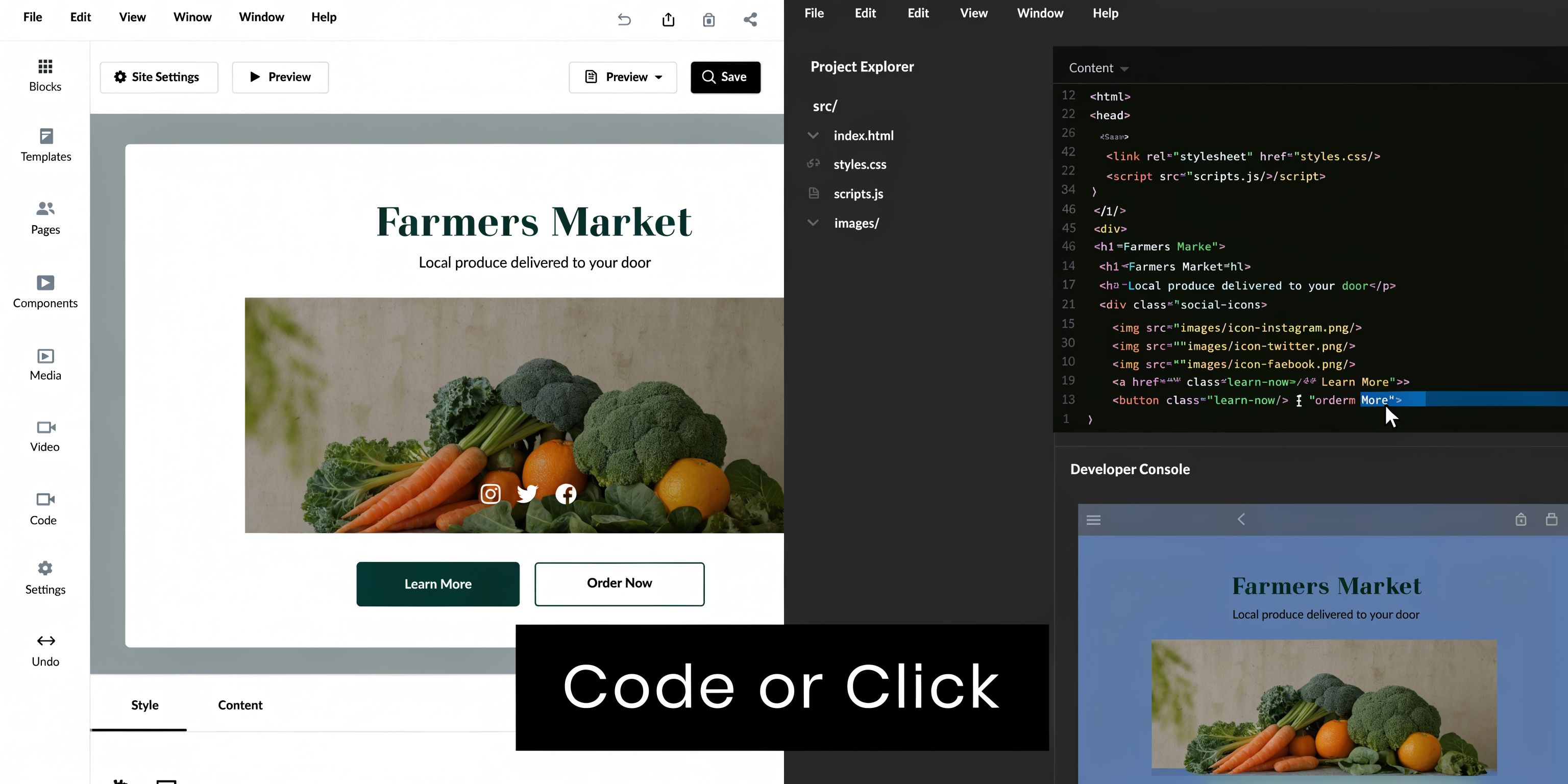
Shopify gives merchants a lot of practical flexibility through themes, apps, APIs, and platform extensions. For many DTC brands, that’s enough.
You can usually handle:
Storefront design changes through theme work and Liquid
Common commerce functions through apps
Product merchandising logic through tags, collections, metafields, and app-layer rules
External system connections through APIs and middleware
The upside is obvious. Non-technical teams can do more without opening a development sprint.
There’s also real ecosystem depth here. Shopify supports 8,000+ apps with one-click installs and built-in SEO and marketing tools, while Magento or Adobe Commerce offers multi-brand and multi-store capability for 100k+ SKUs, granular metadata, and fully configurable extensions that require developer integration, according to Elsner’s Shopify vs Magento comparison.
That summary gets to the heart of it. Shopify extends outward. Magento builds inward.
Magento customization is real control, with real dependency
Magento is the stronger option when the business has non-standard requirements that would always feel bolted onto Shopify.
Examples include:
Business need | Shopify reality | Magento reality |
|---|---|---|
Complex attribute structures | Possible, but often app-assisted | Native fit |
Multi-brand or multi-store complexity | Manageable, but less natural in complex setups | Stronger native orientation |
Highly custom checkout or backend logic | More constrained | Deeper control |
Legacy system integration | Often handled through middleware | Often handled directly in custom implementation |
If you need custom pricing rules, unusual catalog relationships, extensive B2B logic, or a backend that mirrors an existing operational model, Magento earns its keep.
Here, teams get caught. The same freedom that makes Magento powerful also creates dependency. When you own more of the stack, more of the stack needs attention.
The technical freedom to change anything also means more things can break, conflict, or drift over time.
What works in the field
For most DTC brands, Shopify’s limitations are operationally healthier than Magento’s freedom.
That’s especially true when the team is small and the business depends on frequent campaign launches, merchandising changes, new bundles, landing page tests, and quick fixes. In those environments, marketer-accessible flexibility beats theoretical control.
Magento starts to look smarter when the business already has:
In-house developers who know the platform well
A mature QA process
Complex backend workflows that are central to margin or fulfillment
A strong reason to own source-level customization
The wrong move is choosing Magento because it feels more “enterprise” when your bottleneck is not technical capability. It’s execution speed.
Activating SKU-Level Intelligence for Performance Marketing
This is the part most generic platform comparisons miss.
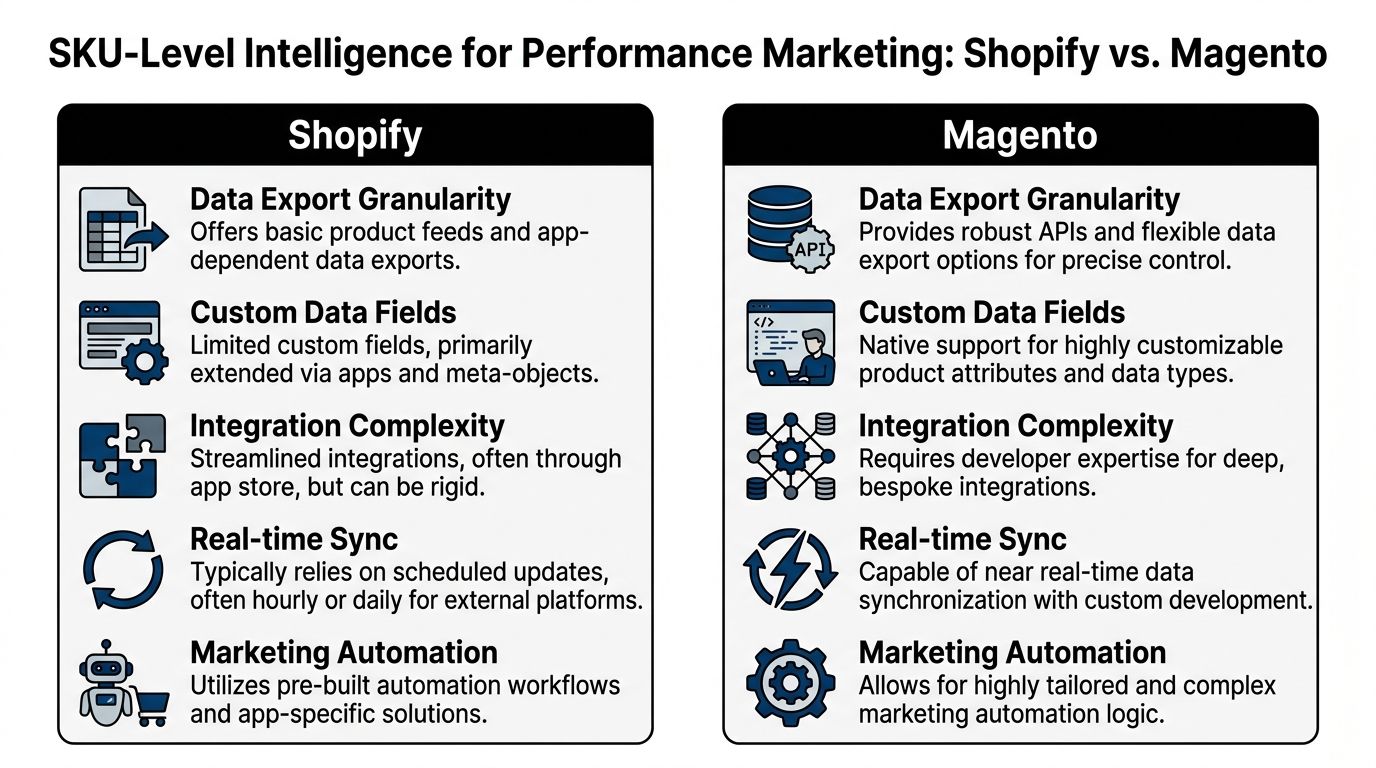
Your storefront platform doesn’t just affect merchandising and checkout. It affects whether your ad account gets usable product data, whether your catalog feed stays clean, and whether your team can separate high-margin winners from products that only look good on surface-level ROAS.
That’s where shopify or magento becomes a performance marketing decision.
Why catalog ad profitability starts with product architecture
Meta catalog ads reward clean product organization.
If your feed is a dump of every SKU, every color variant, every low-margin item, and every product with weak creative support, Meta won’t magically correct that. It will optimize inside the structure you give it. If the structure is bad, spend drifts toward cheap clicks and noisy outcomes.
For DTC brands with wider assortments, the operating question is whether the platform helps the team do all of the following without friction:
Push product data into Meta cleanly
Sync availability and changes reliably
Segment products into meaningful sets
Map margin and performance data back to SKU selection
Exclude weak products fast
Shopify tends to win for growth teams in this area.
Shopify is usually easier to operationalize for Meta
The overlooked advantage isn’t just that Shopify integrates with Meta. It’s that Shopify’s ecosystem makes ongoing feed management and product tagging easier for non-technical teams.
That matters because an often-ignored angle in Shopify vs Magento comparisons is managing catalogs with 20+ SKUs for Meta ads. Shopify’s app ecosystem enables automated profit-based product tagging and dynamic feeds, which is presented as an advantage over Magento’s developer-heavy custom builds. The same comparison notes that Shopify accounts for 28% of the top 1M ecommerce sites and that Meta integrations surged 35% year over year, as outlined by Plumrocket’s Magento vs Shopify analysis.
In practical terms, Shopify lets operators move faster on tasks like:
Creating product groups for heroes, seasonal items, new launches, and long-tail discovery
Applying custom labels that can be used in Meta Commerce Manager
Connecting apps and automation layers without rebuilding data structures
Adjusting feed logic when campaign strategy changes
If you’re trying to make catalog ads behave more like a merchandising system and less like a broad feed dump, that operational speed matters a lot. For a deeper look at the business case behind catalog optimization, this article on return on Shopify growth systems connects the dots well.
Magento can do more, but usually with more engineering
Magento’s data model can be excellent for SKU-level control. In many cases it’s richer than Shopify’s native structure.
If you have a technical team, you can shape attributes, exports, business rules, and integrations in ways that fit the business exactly. For brands with complex catalogs, that’s attractive.
The problem is not capability. It’s operational burden.
A typical DTC marketing team doesn’t just need the data model to be possible. They need it to be usable this week. If every feed adjustment, attribute mapping update, custom label change, or sync fix requires developer time, ad optimization slows down.
Good performance marketing depends on short feedback loops. Platforms that lengthen those loops create hidden media costs.
What practical SKU-level intelligence looks like
The brands that run profitable catalog ads usually stop thinking in terms of “the catalog” and start thinking in terms of product classes.
A useful operating model often includes categories like:
Heroes Products with stable conversion behavior and strong economics. These belong in broad prospecting and Advantage+ style campaign structures.
Potentials Products getting attention but not enough purchases yet. These need controlled exploration, not unlimited spend.
New launches Fresh products need forced visibility. If left to pure algorithmic selection, they often never gather enough signal.
Long tail The products that don’t deserve main-budget attention but still benefit from discovery and cross-sell exposure.
Dead products Items that keep spending and don’t justify their inclusion.
This is one place where a specialized automation layer can help. For example, SpendOwlAI connects a Shopify catalog to Meta Commerce Manager, scans product-level performance and margin data, and pushes product tiering into custom labels so catalog campaigns can rotate around heroes, potentials, new launches, long-tail products, and exclusions. That kind of workflow is much easier to operationalize in Shopify than in a custom Magento stack.
What doesn’t work
Some approaches consistently waste money no matter which platform you pick.
Dumping the whole catalog into one ad set and trusting Meta to find profitability
Tagging products manually in spreadsheets and updating them too slowly
Using revenue-only logic while ignoring margin differences across SKUs
Allowing the same product to compete across multiple audience buckets
Keeping weak products live in the feed because no one owns exclusion logic
The platform doesn’t solve strategy by itself. But it can make disciplined execution either much easier or much harder.
Architecting for Scale From First Spike to Headless Enterprise
Scaling pressure rarely arrives in a neat sequence.
A brand might get hit with a viral moment before its retention systems are mature. It might expand internationally before its catalog is fully standardized. It might decide to go headless before the team has stabilized basic on-site conversion work.
The platform needs to absorb that uneven growth.
Handling traffic spikes without a fire drill
A lot of founders say they want scale. What they want is fewer emergency meetings when demand jumps.
Shopify is strong here because the infrastructure burden is mostly abstracted away from the merchant. For DTC teams, that translates into a simpler operating reality during launches, product drops, and seasonal peaks. The team can focus on inventory, offer structure, landing pages, and paid traffic instead of server readiness.
Magento can also scale well, but not passively. It rewards teams that plan capacity, tune performance, manage caching intelligently, and treat infrastructure as part of the commerce stack. If that discipline exists, Magento can be powerful. If it doesn’t, scale exposes weaknesses quickly.
Going headless only makes sense when the business needs it
Both platforms can support headless commerce. The question is whether your business benefits enough to justify the extra complexity.
Use a simple filter:
Stay standard if your core challenge is merchandising, conversion, and paid traffic efficiency.
Consider headless if your brand needs unusual frontend experiences, content-heavy commerce, or integration with a broader digital product ecosystem.
Avoid premature architecture moves if your bottleneck is organizational, not technical.
For many DTC brands, headless is adopted too early. The result is slower deployment, more QA complexity, and more ways for analytics and feed logic to break.
Magento tends to appeal more to teams that already expect custom architecture and long-term engineering ownership. Shopify supports headless too, but the main reason most merchants choose Shopify isn’t to escape the standard stack. It’s to get more done without adding one.
Expanding internationally without multiplying chaos
International growth forces the platform decision into operations fast.
The store now has to support market-specific pricing, currency handling, merchandising differences, shipping logic, and regional campaign structure. Even when both platforms can technically support those goals, the path to getting there feels very different.
For practical planning, ask these questions:
Scaling scenario | Shopify tendency | Magento tendency |
|---|---|---|
One big launch spike | Easier for lean teams to absorb operationally | Strong if infrastructure is managed well |
Multi-market rollout | Simpler for standardized expansion | Better when markets require deeper structural customization |
Headless storefront build | Viable, but often overkill for smaller teams | Natural fit when custom architecture is expected |
Ongoing merchandising changes | Faster for operators and marketers | Stronger if dev support is continuously available |
A lot of growth-stage brands don’t need maximum architecture. They need fewer dependencies between idea and execution. If that’s your situation, keep the stack simpler for longer.
This is also where orchestration matters beyond the storefront itself. A brand that scales well usually ties together catalog management, audience segmentation, lifecycle messaging, and campaign automation. If that’s the direction you’re heading, this guide to commerce marketing automation is a useful next read.
Scale is not just traffic capacity. It’s the ability of your team to keep shipping when complexity rises.
The Final Verdict A Decision Framework for Your Business
If you want the short answer, here it is.
For most DTC brands, Shopify is the better default choice.
Not because Magento is weak. It isn’t. Magento is powerful. But most founder-led and growth-led ecommerce teams don’t lose because they lack raw platform control. They lose because too many important tasks require technical intervention, move too slowly, or break under everyday operational pressure.
Choose Shopify when speed and ad efficiency matter most
Choose Shopify if this sounds like your business:
You’re a DTC brand with a lean team
Your growth depends on Meta, Google, email, and product launches moving quickly
You need marketers and operators to make changes without filing developer tickets
Your catalog strategy depends on feeds, segmentation, and SKU-level decision-making
You want more predictable infrastructure and less operational drag
Shopify is usually the right answer when the business wins through execution speed.
That includes most brands that are still building category fit, testing bundles, iterating landing pages, expanding SKU counts, and trying to keep acquisition profitable while the team is still relatively small.
Choose Magento when your business model is structurally complex
Choose Magento if your company already operates like this:
You have dedicated technical leadership and development resources
Your commerce model includes complex backend logic or unusual integrations
Multi-brand, multi-store, or attribute-heavy catalog architecture is central to operations
You need deeper control over how the system behaves, not just how the storefront looks
You can support a platform that requires ongoing technical ownership
Magento is the right answer when the custom architecture is not optional. It should serve a specific business need, not an abstract preference for flexibility.
Use this final filter
Ask three direct questions.
Who needs to make changes every week? If the answer is marketers, merchandisers, and ecommerce operators, Shopify usually fits better.
What happens when the feed, tracking, or catalog logic needs fixing? If you can’t afford to wait on engineering, don’t choose the stack that assumes engineering.
Is customization a real requirement or an imagined future scenario? If the custom need is vague, don’t buy complexity in advance.
The best platform is the one that lets your team keep moving without losing control of margin, data quality, and launch velocity.
That’s the practical answer to shopify or magento.
If you are a fast-moving DTC brand, especially one using Meta catalog ads to scale, Shopify usually gives you the better combination of launch speed, maintainability, and marketing agility.
If you are running a complex commerce operation with the technical depth to support it, Magento can be the stronger long-term foundation.
If you run a Shopify catalog and want tighter control over which products Meta spends on, SpendOwlAI is built for that workflow. It connects Shopify with Meta Commerce Manager, applies SKU-level performance and margin logic, and pushes product tiers into catalog campaigns so teams can stop relying on broad feed dumps and manual tagging.