A Practical Guide to Commerce Marketing Automation
Imagine having an expert co-pilot for your marketing—one that instantly knows which ads to scale up, which ones to kill, and exactly when a creative is starting to go stale. That’s the core idea behind commerce marketing automation.
This isn't just another dashboard with more charts. It's a smart system that plugs directly into your ad platforms, like Meta and Google, and connects that performance data with what’s actually happening in your Shopify store. The result? A clear, prioritized list of what to do next.
What Is Commerce Marketing Automation, Really?
At its heart, commerce marketing automation is the engine that turns messy, disconnected data into clear, profitable decisions. If you're running a direct-to-consumer (DTC) brand, you know the daily grind: battling wasted ad spend, feeling buried in operational tasks, and being forced to make quick calls based on gut feelings. This is the exact problem a modern automation system is built to solve.
It goes way beyond simple email flows or social media schedulers. We're talking about a direct, two-way connection between the money you spend on ads and the sales happening on your site. This link gives the system a crystal-clear view of performance, cutting through the noise to pinpoint what’s actually driving revenue.
Shifting from Reactive to Proactive
The real magic here is moving your team from constantly reacting to problems to proactively getting ahead of them. Instead of scrambling when ROAS suddenly tanks or a key campaign fizzles out, the system helps you spot these issues before they become full-blown fires.
This proactive approach comes from automating the most tedious and time-sucking parts of managing ads. Think about tasks like:
Wrangling Data: Automatically pulling metrics from all your different ad accounts and matching them up with real-time sales data.
Analyzing Performance: Spotting statistically significant trends, dips, or spikes across all your campaigns, ad sets, and individual creatives.
Finding Opportunities: Flagging the exact ads you should scale, the new audiences worth testing, or the tired creatives that need a refresh.
Before we dive deeper, let's look at how this new approach stacks up against the old way of doing things.
Manual Ad Management vs Automated Commerce Marketing
This table breaks down the fundamental shift in how teams operate when they move from a manual workflow to an automated one.
Operational Area | Manual Approach (The Old Way) | Automated Approach (The New Way) |
|---|---|---|
Data Analysis | Manually exporting CSVs and building spreadsheets. | Real-time, unified dashboard with cross-channel data. |
Decision Making | Based on gut feelings, delayed data, and guesswork. | Driven by prioritized, data-backed recommendations. |
Budget Pacing | Daily manual checks and adjustments across campaigns. | Automated rules to scale winners and cut losers. |
Creative Testing | Slow, inconsistent, and hard to measure accurately. | Systematic detection of creative fatigue and high-performers. |
Team Focus | Buried in repetitive tasks and data entry. | Focused on high-level strategy and creative development. |
As you can see, the difference isn't just about saving time; it's about fundamentally changing where your team invests its energy—moving from low-value manual work to high-impact strategic thinking.
The Tangible Impact on Your Bottom Line
The financial upside is huge and well-documented. In the fast-moving world of e-commerce, businesses using marketing automation see an average return on investment of $5.44 for every $1 spent. That’s a massive 544% ROI that leaves manual strategies in the dust.
The data backs this up, with 80% of users reporting a jump in leads and 77% seeing more conversions. You can find more stats on this in a great breakdown of marketing automation impact from Zoko.
"True commerce marketing automation isn't about 'set it and forget it.' It's about building a system of disciplined, data-driven action that frees up your team to focus on strategy and creativity, not spreadsheets and guesswork."
Ultimately, the goal is to make smarter decisions, faster. By serving up a prioritized list of what to change, what to monitor, and—just as crucial—what to leave alone, it gives you the guardrails you need to grow sustainably. In this guide, we'll unpack its core pieces, the benefits, and how to put it to work for your own brand.
The 5 Pillars of a Modern Automation System
A powerful commerce marketing automation system isn't just one piece of software. It’s a complete engine built on five core pillars that work together. Each part has a specific job, and when they’re all in sync, they completely change how you manage and scale your advertising.
Think of it like an expert crew running a high-performance race car. Each person has a role—the driver, the pit crew, the strategist—and they all communicate perfectly to win. Your automation system operates the same way, with each pillar executing its function to drive your marketing forward, faster and more efficiently than ever before.
Understanding these components is the first step toward moving from reactive guesswork to disciplined, data-driven growth.
1. Ad Automation
First up is Ad Automation, which you can think of as the hands of your system. This is the part that does the work, executing precise, calculated actions on your ad platforms. It handles all the repetitive but critical tasks that would otherwise eat up hours of your team's day.
Ad automation is responsible for the moment-to-moment adjustments that keep your campaigns running at peak performance. This includes things like:
Bid Management: Automatically adjusting bids up or down based on real-time performance data to maximize your return on ad spend (ROAS).
Budget Allocation: Shifting your daily or lifetime budgets to the campaigns and ad sets that are actually delivering results. This ensures your money is always working its hardest.
Campaign Pacing: Keeping a close eye on your spend to make sure campaigns stay on track. No more overspending early or having to cram budget at the end of the month.
Without this pillar, even the best strategy would fall flat due to slow, manual execution.
2. Audience Orchestration
If ad automation is the hands, then Audience Orchestration is the brain. This pillar is all about strategy—making sure the right message gets in front of the right person at exactly the right time. It’s the connective tissue between your ad platforms and your customer data, allowing you to build and manage highly specific audience segments.
This is where you graduate from broad, generic targeting. Audience orchestration lets you run more sophisticated plays, like segmenting high-value customers for loyalty campaigns or building lookalike audiences from your most profitable buyers. It’s a core component that ensures your ad spend isn't just efficient, but also deeply relevant. To see how this concept works in other automated channels, check out our guide on building a drip campaign.
The map below visualizes how these pillars work together, turning raw data from ad platforms into profitable actions for your business.
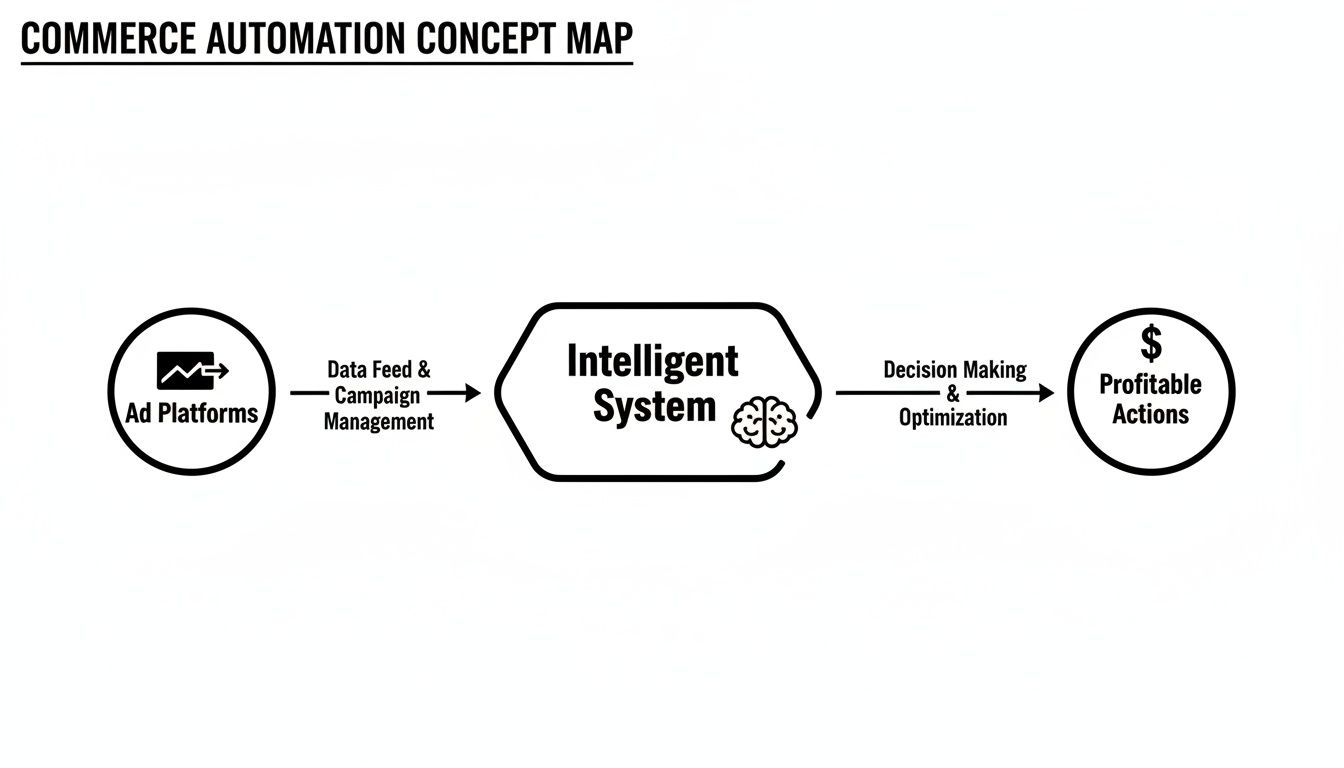
As you can see, the intelligent system is the central processor, turning simple platform signals into high-impact business decisions that drive growth.
3. Creative Fatigue Detection
Think of Creative Fatigue Detection as your system’s early warning signal. It’s like a smoke alarm that goes off when an ad's performance is starting to decline, before it completely burns out and torches your budget. In the world of commerce marketing automation, this is a non-negotiable feature.
By constantly monitoring engagement metrics like click-through rates (CTR) and conversion rates, this pillar can spot when an ad is losing its magic. This gives you a heads-up to proactively swap in fresh creative, keeping your campaign momentum strong and preventing those dreaded performance dips.
4. Dynamic Budget Rules
Dynamic Budget Rules act as your smart financial investor. This pillar automates the high-level financial decisions, shifting funds across your entire ad account to the areas with the highest potential return. It all works based on simple "if-then" conditions that you get to define.
For example, you could set a rule like: "If a campaign holds a ROAS above 4.0 for three straight days, then increase its daily budget by 20%." On the flip side, another rule could automatically cut spend on underperformers. These rules make your budget fluid, ensuring it’s always chasing the best performance without you having to constantly check in.
5. SKU-Level Signals
Finally, we have SKU-Level Signals—your connection to the ground truth. For any e-commerce brand, this might just be the most important pillar of all. It ties every dollar of ad spend directly to the sale of a specific product in your Shopify store. It finally answers the ultimate question: "Which products are my ads actually selling?"
By analyzing data at the individual stock-keeping unit (SKU) level, this pillar provides unbelievable clarity. You can see which ads drive sales for your bestsellers, which ones are helping move clearance items, and even spot when you’re wasting money advertising a product that’s about to go out of stock. This granular insight is what unlocks truly intelligent, profit-focused automation.
How Automation Drives Tangible Business Growth
Knowing what commerce marketing automation is and understanding what it can do for your bottom line are two different things. The real "why" behind this technology is refreshingly simple: it makes your business run better and earn more.
For DTC founders and marketing managers, it all comes down to three concrete outcomes. These systems are built from the ground up to improve how you find and keep customers, and that translates directly into measurable growth.
Let’s get into the three main ways this actually works.
Dramatically Reduce Wasted Ad Spend
One of the fastest ways to burn through a marketing budget is wasted ad spend. It often comes from emotional, gut-instinct decisions. We’ve all been there: panicking and killing a campaign after one bad day or getting overexcited and scaling an ad based on a temporary spike.
These knee-jerk reactions throw the platform algorithms for a loop, resetting their learning phase and costing you real money.
Commerce marketing automation acts as a disciplined, data-driven co-pilot. It puts a stop to those costly gut feelings by creating clear guardrails for your campaigns.
It keeps you steady. The system only flags performance changes that are statistically significant, so you stop reacting to random noise and start making moves that matter.
It spots trouble early. You get alerts for things like creative fatigue or audience saturation before they tank your Return on Ad Spend (ROAS).
By sticking to decisions backed by solid data, you give your campaigns the stability they need to actually optimize. This means every dollar you spend is put to its best possible use.
Reclaim Countless Hours of Operational Time
The day-to-day grind of managing ad accounts is a massive time sink. Manually pulling reports, stitching together spreadsheets, and building dashboards are low-impact tasks that can eat up a shocking amount of your team's week.
This is where automation provides its most immediate and obvious payback. The right platform simply handles all of it for you.
Instead of starting the day buried in spreadsheets, your team can log in and see a clear, prioritized list of what actually needs their attention. This frees them up for the high-impact work that truly moves the needle—like brainstorming new creative, researching untapped markets, or refining your brand’s message.
For lean teams, this shift is everything. It allows a small group to punch way above their weight, operating with the analytical power of a much larger department.
Increase Overall Business Profitability
At the end of the day, it's about making more money. Commerce marketing automation boosts profitability by helping you make smarter, faster decisions. By connecting your ad performance directly to your product-level sales data from a platform like Shopify, it gives you a crystal-clear view of what's really working.
You can confidently scale the campaigns selling your most profitable products and pull back on the ones that are just spinning their wheels.
The proof is in the numbers. The commerce marketing automation market was valued at $6.65 billion in 2024 and is expected to soar to $15.58 billion by 2030. That growth is fueled by real results. Businesses using these tools report an 80% increase in leads and a 77% jump in conversions, all while saving an estimated $130,000 in yearly operational costs. You can dig deeper into these marketing automation statistics and findings.
This isn't just about a higher ROAS. It's about building a more resilient, scalable marketing engine that turns ad spend into predictable revenue, securing a much healthier bottom line.
Building Your Automation Tech Stack

A powerful commerce marketing automation system isn't just a concept—it's a practical tech stack where different platforms talk to each other. For most DTC brands, this architecture rests on three pillars: your ad platforms, your e-commerce store, and the automation engine that sits in the middle, connecting everything.
Think of that engine as the command center. Its job is to pull in, process, and make sense of all the information flowing from your core business tools. It takes a constant flood of disconnected data points and turns them into a single source of truth for your marketing team.
Without this central hub, you're stuck with data silos. Ad performance lives in one place, sales data in another, and your team is left trying to manually stitch the story together. A proper automation stack fixes this by creating a seamless, two-way conversation between your tools.
Core Platform Integrations
For the majority of e-commerce brands, the key pieces of this stack are the tools you already use every day. The most common and effective setup involves integrating:
Meta Ads (Facebook & Instagram): This is your main source for top-of-funnel insights. The engine pulls in crucial metrics like ad spend, impressions, click-through rates (CTR), and cost per acquisition (CPA).
Google Ads: This gives you another critical stream of performance data, covering everything from search and shopping to YouTube and Performance Max. You're looking for signals like conversion rates and keyword-level performance.
Shopify: This is your ground truth. The integration pulls real business data—SKU-level sales, revenue, customer lifetime value (LTV), and inventory levels—tying your ad spend directly to what's happening in your bank account.
This trio forms the backbone of a modern commerce marketing automation stack. It ensures that every decision is backed not just by vague ad metrics, but by actual sales performance.
The Flow of Information
So, how does all this data actually move around? The process starts when the automation platform makes API calls to each source. It's constantly pinging them for fresh data, often in near real-time, to build a live, dynamic picture of your entire marketing operation.
This stream of information is then standardized and organized. The engine doesn't just collect data; it interprets it. For example, it matches a specific campaign from Meta with the exact product sales from Shopify, giving you a true, undeniable return on ad spend. To see how this data is captured securely, you can read our guide on the Meta Conversions API.
A well-built tech stack turns noise into signal. It takes thousands of individual data points from different platforms and translates them into a clear, prioritized list of actions ordered by impact.
From Data Points to Actionable Insights
This translation from raw data to real, actionable tasks is where the magic happens. The central engine analyzes the unified data to power the five pillars we talked about earlier, like spotting creative fatigue before it kills your ROAS or finding the perfect moment to scale a winning campaign's budget.
The table below gives you a clear picture of what kind of data is pulled from each platform and the specific automated actions it can trigger.
Key Data Signals from Integrated Platforms
Platform | Critical Data Signals | Automated Insight/Action Powered |
|---|---|---|
Meta Ads | Ad-level spend, CTR, frequency | Creative fatigue detection, audience saturation alerts |
Google Ads | Campaign ROAS, conversion rate | Dynamic budget rules to scale top performers |
Shopify | SKU-level sales, inventory data | Alerts to pause ads for out-of-stock products |
Ultimately, building this tech stack is about creating an intelligence layer for your business. It’s the infrastructure that lets your team finally step away from manual data-pulling and spreadsheets, and instead focus on strategic, data-backed decisions that drive profitable growth.
Monitoring KPIs That Actually Matter
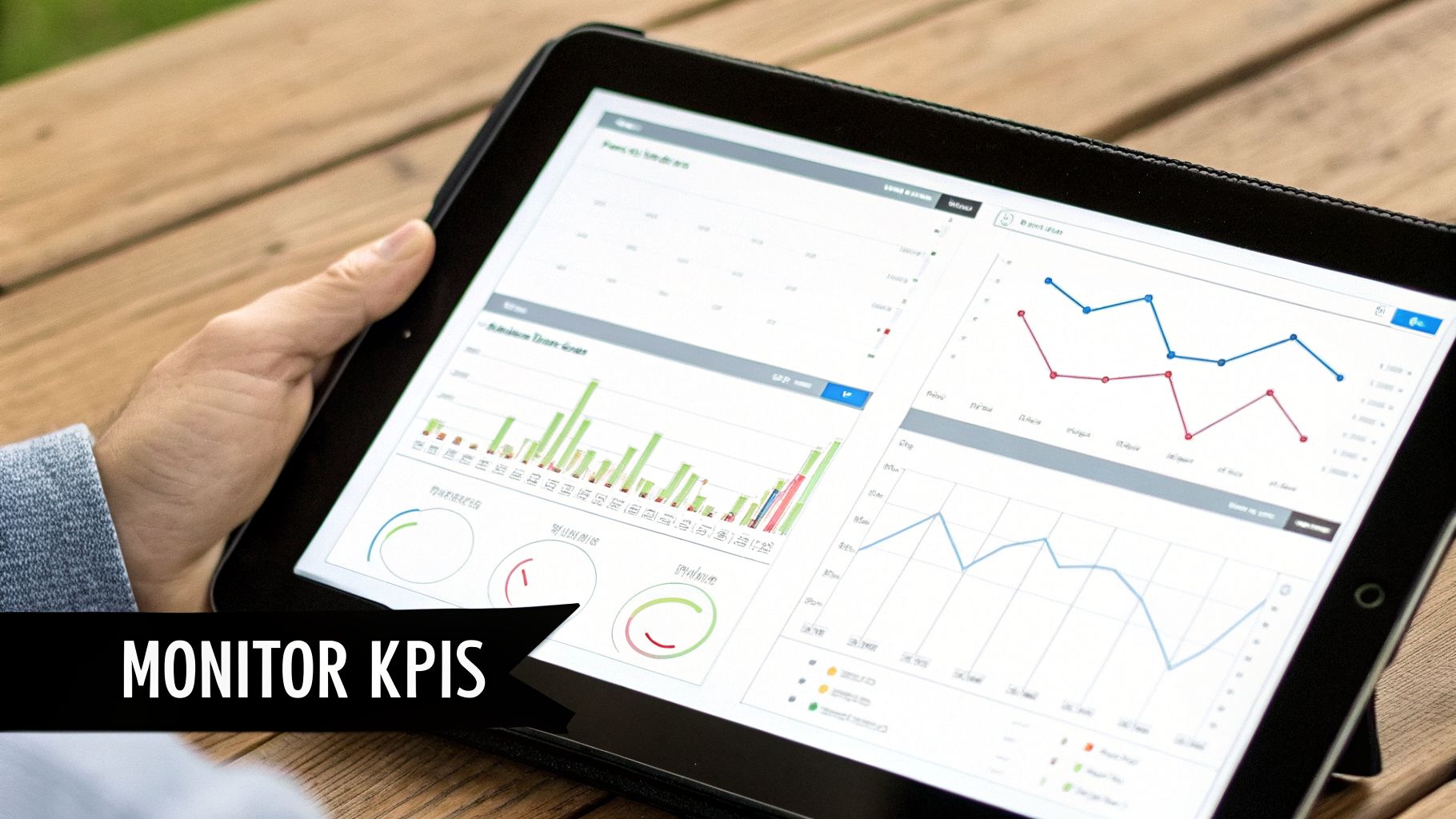
Once you let automation take the wheel, your dashboard needs a serious upgrade. Forget obsessing over daily ROAS fluctuations. The real game is understanding whether your system is learning and performing consistently.
Your new North Star metrics are learning stability, edit frequency, and performance volatility. Think of these as the engine's warning lights. They tell you if you're constantly resetting the learning phase or causing wild performance swings that kill your momentum.
Here’s what to keep on your radar:
Learning Stability: How long does it take for your ad sets to get out of that dreaded "learning" phase and start performing reliably?
Edit Frequency: How often are you or your team manually tweaking bids, budgets, and creative?
Performance Volatility: How much do your costs and conversion rates jump around day-to-day?
Delivery Consistency: Are your ads getting a steady stream of impressions, or are they sputtering and stalling?
Decoding the Signals
It helps to think about these metrics with a simple analogy. Learning stability is like a healthy, steady heartbeat. When it's high, you know the system is humming along efficiently without constant interruptions.
On the other hand, high edit frequency is like a driver who can't stop jerking the steering wheel. Every little adjustment forces the ad platform's algorithm to re-learn, costing you precious time and momentum.
Performance volatility is the weather forecast for your campaigns. Low volatility means clear skies and stable growth. High volatility signals a storm is brewing, bringing risk and unpredictable results.
Finally, delivery consistency is your engine's RPM gauge. If it's spiking erratically, your budget rules or targeting might be too aggressive, causing the system to lurch forward and then slam on the brakes.
Turning Metrics into Action
These signals aren't just for show—they tell you when to intervene and, more importantly, when to be patient. For example, a great rule of thumb is to let a campaign run untouched if its learning stability stays above 75% for at least three consecutive days.
This hands-off approach is crucial. The demand for marketing automation is soaring, with 91% of organizations reporting they need more of it. Why? Because it works. Companies see 34% average revenue growth driven by 60% higher engagement and 58% boosted loyalty. This is especially true for the 44% who are folding AI into their strategies, according to marketing automation statistics on ContactPigeon.
If you see edit frequency creeping up—say, more than two major adjustments in a week—it’s a clear sign to step back. Let the algorithm do its job. Constantly hitting the reset button just guarantees mediocre performance.
(Want to dive deeper into measurement? Check out our complete guide on marketing attribution software.)
“By monitoring learning stability and edit frequency, you give your campaigns the breathing room they need to achieve sustained growth.”
Practical Monitoring Habits
Ready to put this into practice? Here's how to build a simple, effective monitoring framework:
Set up automated alerts. Get a notification when learning stability dips below your established baseline.
Establish soft limits. Create team rules to prevent too many manual edits from resetting the learning phase.
Chart volatility with rolling averages. This smooths out daily noise and helps you spot meaningful trends.
Build a dedicated dashboard. Put all these key metrics in one place so you can see the full picture at a glance.
These habits create a system for managing your system. You’ll know exactly when to step in and when to trust the process.
Making Smarter Growth Decisions
When your new KPIs are all pointing in the right direction, it’s a sign to hold off on major changes. This is when the algorithm is truly refining your campaigns and finding those pockets of performance you couldn't find manually.
If volatility suddenly spikes, look at your budget rules first. The biggest mistake marketers make is changing too many variables at once. Isolate the problem, test a single fix, and measure the impact.
Make this a weekly ritual. A quick KPI review will shift your entire process from being reactive and chaotic to strategic and systematic. Over time, you’ll build a deep-seated confidence in your automation, knowing precisely when to act and when to let it run.
Avoiding Common Pitfalls with Smart Guardrails
Getting started with commerce marketing automation is a bit like trading in your trusty sedan for a Formula 1 car. The power and speed are exhilarating, but you can’t just floor it without knowing how to handle the machine. If you're not careful, you'll spin out on the first turn. Automation scales everything—the wins and the mistakes.
Without a solid set of rules, you can easily automate a bad decision just as fast as a good one. This is where smart guardrails come into play. Think of them not as rigid restrictions, but as the disciplined practices that keep you on the track, preventing common and expensive errors. They make sure your automation is a co-pilot for stable, long-term growth, not a recipe for chaos.
The Pitfall of Over-Editing
The single most common mistake we see marketers make is tinkering too much. Every time you manually adjust a bid, nudge a budget, or swap a creative while a campaign is learning, you're essentially hitting the reset button on the platform's algorithm. This constant meddling traps your campaigns in a never-ending "learning phase," preventing them from ever getting the traction they need to perform.
This habit is usually a gut reaction to the small, day-to-day performance dips that are nothing more than statistical noise. It’s a frustrating cycle: you try to "fix" things, which only disrupts the algorithm, leading to more inconsistent results and wasted ad spend.
The Smart Guardrail: Institute a strict "hands-off" policy during the learning phase. A great starting point is a simple rule: no manual edits for at least 72 hours after making a significant change. This gives the algorithm the clean, stable data it needs to actually learn who your best customers are and how to reach them effectively.
The Danger of Premature Scaling
Everyone gets a rush when they see a ROAS number jump. The immediate temptation is to dump more money into what feels like a winning lottery ticket. But scaling a campaign based on a short-term blip—a few good hours or one great day—is one of the quickest ways to burn through your budget.
That flash of good performance is rarely statistically significant. More often than not, it's just a random cluster of conversions, not a sustainable trend. When you scale prematurely, you almost always see efficiency plummet as you exhaust that tiny pocket of initial performance, leaving you with a higher CPA and a worse ROAS than when you started.
The Folly of Blanket Rules
Another trap is creating one-size-fits-all automation rules and applying them across your entire account. For instance, a rule that says "increase budget by 20% on any ad set with a ROAS above 3.0" might seem logical on the surface, but it's dangerously devoid of context. It treats every product, audience, and campaign objective as if they were identical.
This approach completely misses the business reality happening outside the ad platform.
Inventory Levels: What if that ad set with a sky-high ROAS is for a product with only a handful of units left in stock? Scaling it will just lead to angry customers and wasted ad spend promoting something nobody can buy.
Profit Margins: A 3.0 ROAS might be wildly profitable for a high-margin hero product, but it could be losing you money on a low-margin item. Blanket rules can't tell the difference between revenue and actual profit.
Campaign Goals: The performance metric for a top-of-funnel video view campaign is completely different from a bottom-of-funnel retargeting campaign. Applying the same ROAS target to both makes no strategic sense.
The Smart Guardrail: Build your automation rules with real business context. Instead of generic rules, connect them directly to your store's data. For example, create a rule that only scales ads for products with more than 50 units in stock. Better yet, set different ROAS or CPA targets based on specific product collections or margin tiers. This ensures your automation is making decisions that are not only algorithmically sound but also genuinely good for your bottom line. This is what separates basic automation from true commerce marketing automation.
Still Have Questions About Automation?
Diving into commerce marketing automation can feel like a big leap, and it’s totally normal to have questions. Most DTC brands I talk to have the same concerns: How hard is it to set up? Will it make my team obsolete? Is it only for the big players?
Let's clear the air and tackle these head-on.
How Long Does This Actually Take to Set Up?
You’ll be up and running way faster than you think. Forget about those nightmare IT projects that drag on for months. Modern automation platforms are built for speed.
Connecting your ad accounts (like Meta and Google) and your e-commerce store (like Shopify) honestly takes less than an hour.
Once you’re connected, the system gets to work chewing through your historical data. You’ll start seeing the first actionable insights and smart recommendations pop up within 24 to 48 hours. This isn't a "wait and see" situation; you get value almost immediately.
Will This Replace My Marketing Team?
Nope. It will supercharge them. This is probably the biggest myth out there. Think of automation not as a replacement, but as the ultimate assistant for your team—a co-pilot who handles all the tedious, soul-crushing work.
By taking over the mind-numbing tasks of pulling reports and crunching numbers, automation frees up your marketers to do what humans do best: think strategically. They can finally focus on brilliant creative, exploring new channels, and crafting a brand story that connects with people. It elevates them from spreadsheet jockeys to genuine growth drivers.
Your team’s creativity and market intuition are irreplaceable. Automation just gives them better data and more time to put those skills to work.
Is This Only for Brands with Huge Budgets?
Definitely not. While big advertisers can’t live without it, automation is arguably even more valuable for smaller, growing brands. For lean teams, efficiency isn't just a nice-to-have; it's a matter of survival.
Here’s why it’s a game-changer for smaller businesses:
Punches Above Your Weight: It gives a small team the analytical firepower of a much larger company, letting you compete on strategy, not just headcount.
Stops You from Burning Cash: It acts as a safety net, preventing common and costly mistakes like scaling a campaign too early or tweaking ads into oblivion. When every dollar matters, this is huge.
Builds a Foundation for Growth: It helps you bake in smart, disciplined processes from the start, so you're ready to scale your ad spend without everything catching fire.
At the end of the day, commerce marketing automation levels the playing field. It empowers brands of any size to run their marketing with the kind of data-driven confidence that was once reserved for the giants.
SpendOwlAI is the daily execution system that turns noisy ad data into clear, prioritized actions. Instead of dashboards, get a simple list of what to do today to save time and reduce wasted spend. Start your free 7-day trial.