A Clear Drip Campaign Definition for Modern Marketers
Ever wonder how some brands seem to send you the exact right email at the exact right time? It’s not magic; it’s a drip campaign.
Think of a drip campaign as a series of automated, pre-written messages that get sent out to customers over time. These aren't random blasts. Instead, they’re triggered by a specific action a person takes—or doesn't take—or are sent on a predetermined schedule. It’s a way of having a planned conversation that unfolds naturally, guiding someone from being a curious browser to a loyal customer.
What Is a Drip Campaign and Why Does It Matter?
Let's ditch the marketing buzzwords for a second. A drip campaign is essentially a "set it and forget it" marketing engine that works for you 24/7. It gives you the power to connect with thousands of people on an individual level, without losing that personal touch that actually builds a relationship.
For example, when someone signs up for your newsletter, what happens next? A great drip campaign kicks in immediately. They might get a warm welcome email right away. A few days later, another email could arrive highlighting your most popular products. A week after that, maybe a special discount just for them. This entire flow happens automatically, nurturing that new lead without you lifting a finger. That’s the core idea.
The Shift from Blasting to Building
For a long time, email marketing was all about the "one-off blast"—a single email sent to the entire list at once. This still has its place for big announcements, but it’s like shouting into a crowded room. A drip campaign is the complete opposite. It's a focused conversation, not a singular event.
This move away from manual, one-size-fits-all emails toward automated, personalized journeys is a massive shift. It ensures every message you send feels relevant to where that person is in their relationship with your brand.
To make this distinction crystal clear, here's a quick breakdown of how drip campaigns stack up against traditional email blasts.
Drip Campaigns vs One-Off Blasts
Attribute | Drip Campaign | One-Off Email Blast |
|---|---|---|
Timing | Sent automatically based on triggers or a schedule. | Sent manually on a specific date and time. |
Audience | Highly targeted to individuals based on their actions. | Sent to a broad segment or the entire list at once. |
Purpose | To nurture a relationship over time. | To make a single announcement or promotion. |
Content | A series of connected, contextual messages. | A single, standalone message. |
Scale | Scales personal-feeling communication effortlessly. | Becomes impersonal as the list grows. |
Simply put, one-off blasts are for announcements, while drip campaigns are for building relationships.
The Tangible Benefits of Automation
This automated, conversational style gets real results. Drip campaigns consistently outperform one-off emails because they deliver a steady stream of relevant messages that actually nurture leads. The data backs this up: drip campaigns often see open rates roughly 80% higher than single emails, and their click-through rates can be up to three times higher. You can dig deeper into how drip campaigns boost engagement with industry reports.
This performance lift is exactly why drip campaigns are a must-have for e-commerce brands and paid media teams. They create a reliable, automated system for:
Onboarding new customers and making an unforgettable first impression.
Nurturing leads who are interested but not quite ready to buy.
Recovering abandoned carts with a gentle nudge to complete their purchase.
Re-engaging subscribers who have gone quiet to win them back.
Ultimately, a well-planned drip campaign is your best tool for turning passive subscribers into enthusiastic, paying customers.
How Drip Campaigns Actually Work
To really get what a drip campaign is, you need to look under the hood. At its heart, a drip campaign runs on a simple but powerful "if-this-then-that" logic, built from three key pieces: triggers, sequences, and segmentation.
Think of a trigger as the tripwire. It’s a specific action someone takes that kicks off the whole process. This could be anything—a customer signing up for your newsletter, a shopper ditching their cart, or even someone going quiet for a while. It’s the event that says, "Okay, go time!"
Once that trigger is tripped, the sequence starts. This is your series of pre-planned messages—emails, SMS texts, or a mix—that are sent out over a set period. You're not just blasting them with content; you’re strategically delivering the right message at the right time to keep them engaged.
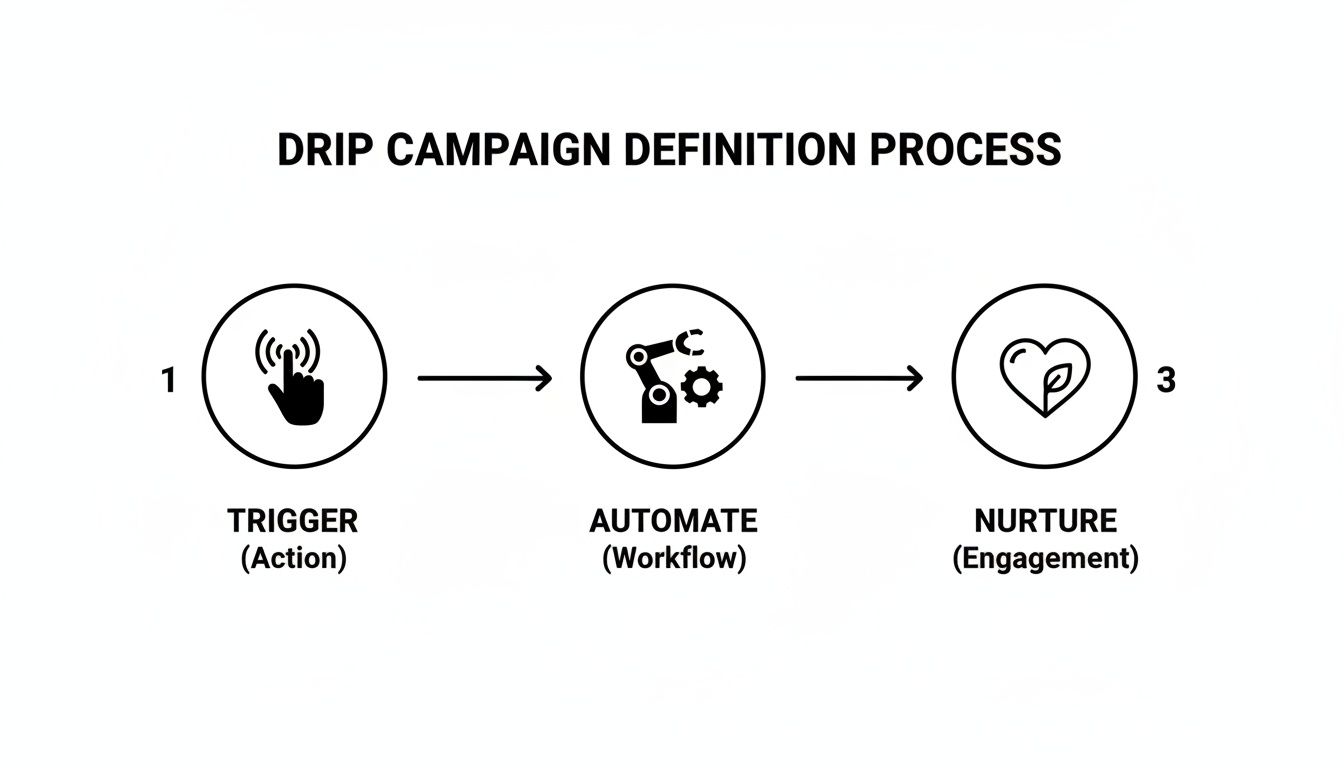
This simple flow shows how a single action can set off a powerful, automated nurturing journey that keeps your brand fresh in the customer's mind.
The Magic of Smart Segmentation
The last piece of the puzzle, and arguably the most important, is segmentation. This is where you slice your audience into smaller, more focused groups based on what they have in common. Without segmentation, you're just sending automated blasts. With it, you're starting a real conversation.
Segmentation is what lets you get personal and precise. For example, you could create segments based on:
Purchase History: Treat first-time buyers differently than you treat your VIPs who come back again and again.
Engagement Level: Send one message to the people who open every email and another to those who haven't clicked in months.
Demographics: Customize offers based on where someone lives or other profile data.
This way, a brand new subscriber gets a friendly welcome series, while a long-time loyal customer gets an exclusive reward. Different people, different conversations.
Bringing It All Together
When you combine these three—triggers, sequences, and segmentation—you get a seriously effective system. A trigger pinpoints a key moment, segmentation makes sure the message fits the person, and the sequence delivers it at the perfect time.
This is a game-changer for waking up dormant leads. Ever notice how traffic from your Meta ads seems to vanish after the first click? A well-timed re-engagement drip can bring them back. These flows can be set to trigger on inactivity—like no opens in 30 days—and send a series of tailored messages, from loyalty perks to special offers, using both email and SMS for maximum impact. You can get more ideas on how to execute these re-engagement campaigns to revive your lists.
By combining smart automation with genuine personalization, you build a system that saves you a ton of time while forging stronger, more profitable relationships with your customers. It’s a marketing machine that feels remarkably human.
Essential Drip Campaigns for E-commerce Growth
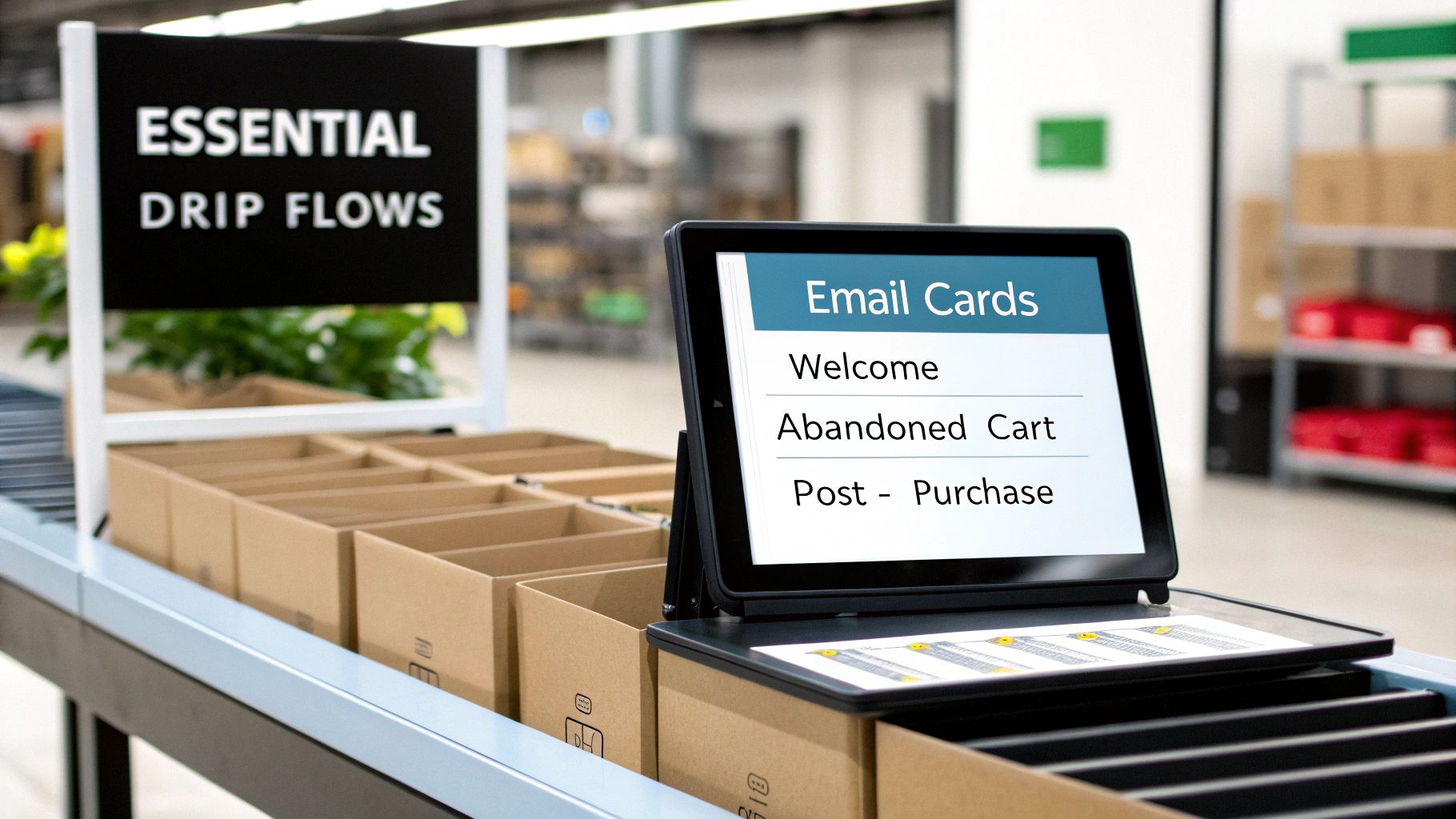
Knowing the theory is one thing, but putting drip campaigns into action is where the real growth happens. For any e-commerce brand looking to scale, a few core automated sequences are the absolute foundation of your marketing engine.
These aren't just random email blasts. Think of them as strategic, automated conversations that meet customers at crucial points in their journey—from the moment they first hear about you to long after they’ve clicked "buy."
The Welcome Series
This is your digital handshake, your first impression. A welcome series is all about bringing new subscribers into the fold, telling your brand story, and building that initial spark of excitement and trust. It’s your best shot at turning a casual signup into a loyal fan.
Trigger: Someone subscribes to your newsletter, creates an account, or drops their email in a pop-up form.
Content: The first email should be a genuine thank-you that sets the stage for what they can expect from you. The next few messages can introduce your mission, showcase your best-sellers, feature some great customer photos, and often, seal the deal with a special discount on their first purchase.
The Lead Nurturing Campaign
Let's be real: not every person who lands on your site is ready to buy on the spot. A lead nurturing drip campaign is your way of gently educating and warming up potential customers, guiding them toward a purchase without coming off as too salesy.
The real objective here is building a relationship. In fact, leads who are properly nurtured produce 47% more sales-ready buyers than those who aren't. Why? Because you're taking the time to build authority and trust.
This is all about providing value first. A skincare brand might send tips on creating the perfect morning routine; a coffee company could share different brewing guides. Once you've established that connection, you can start introducing products that genuinely solve their problems.
The Abandoned Cart Sequence
If you're going to build one drip campaign, make it this one. The abandoned cart sequence is easily one of the most profitable automations you can run. Its entire purpose is to win back sales that were just a few clicks away from being complete.
Trigger: A user who is logged in (or has entered their email at checkout) adds items to their cart but bounces before finishing the purchase.
Content: The first email, sent within an hour, is a simple, helpful reminder. The follow-ups can create a bit of urgency with a limited-time offer, tackle common objections like shipping costs, or show off stellar reviews for the exact items they left behind.
These reminders become even more effective when they're part of a bigger picture. For example, if you learn how to scale Facebook ads, you can use retargeting audiences to show those same abandoned products to shoppers on social media, creating a powerful one-two punch.
The Post-Purchase Flow
The relationship shouldn't die the second the payment goes through. A post-purchase drip is designed to boost customer satisfaction, drive repeat business, and create true brand loyalty. This is how you turn a first-time buyer into a customer for life.
This sequence can start with a simple thank-you and shipping confirmation, followed by a request for a product review a week or two later. It can also include helpful content, like tips on how to get the most out of their new purchase. Down the line, you can introduce smart cross-sells or upsells based on what they bought, making every message feel personal and relevant.
Measuring the True Impact of Your Campaigns

Running a drip campaign without tracking the right numbers is like flying blind. It's easy to get excited about high open rates and click-throughs, but those metrics are just part of the story. They show that people are paying attention, but they don't prove your campaign is actually making a difference.
To figure out if your automated sequences are truly working, you need to dig deeper. You have to focus on the key performance indicators (KPIs) that connect directly to your bottom line—the numbers that show whether your efforts are generating real revenue and building lasting value.
Key Metrics Beyond Opens and Clicks
Forget the vanity metrics for a moment. To see what's really happening, your dashboard should highlight the KPIs that reflect financial health and customer loyalty.
These are the metrics that matter most:
Conversion Rate: This is the big one. It’s the percentage of people who actually took the action you wanted them to take, whether that was making a purchase, booking a demo, or downloading an ebook. It’s the ultimate test of your campaign’s persuasion power.
Revenue Per Recipient (RPR): A simple but incredibly telling calculation. Just divide the total revenue a campaign brought in by the number of people who received it. This gives you a clear dollar value for every single person in your sequence.
Unsubscribe Rate: Think of this as a direct feedback channel. A sudden spike is a red flag—it might mean your messaging is off, your timing is wrong, or you're talking to the wrong audience. A low, steady rate, on the other hand, tells you you're delivering consistent value.
A great drip campaign isn't just about sending messages. It's about guiding customers toward a specific outcome. Tracking these deeper KPIs is the only way to know if you're hitting the mark and to prove the real return on your investment.
Connecting Drips to Business Goals
The best marketers take this a step further by connecting these campaign-level KPIs to broader business goals. After all, the real aim isn't just to make one sale today; it's to create a customer who comes back again and again. This is where Customer Lifetime Value (LTV) becomes your north star.
Start analyzing how different drip sequences—say, a welcome series versus a post-purchase follow-up—affect the LTV of the customers who receive them. You might discover that your onboarding sequence leads to a 20% higher LTV over six months, proving its value goes far beyond that initial conversion.
Of course, none of this works without solid attribution. You need to know exactly which touchpoint gets the credit for a conversion. This is where meticulous tracking comes in. For a deep dive into setting this up correctly, check out this guide on using UTMs for Google Analytics. Getting your tracking right ensures every dollar and every effort is accounted for, allowing you to fine-tune your strategy with confidence.
Optimizing Your Drips with Performance Data
A truly powerful drip campaign isn't a "set it and forget it" tool that operates in a vacuum. The best ones are wired directly into the real-time performance of your paid ad channels, turning a simple automated sequence into a responsive, intelligent growth engine.
Think about it this way: what if your Meta ad campaigns are starting to show early signs of audience fatigue? Instead of waiting for performance to completely tank, you could use that data as an immediate trigger. A subtle drop in click-through rates or a slow creep in ad costs could automatically kick off a re-engagement drip, sending a fresh offer to that specific audience to win them back before they're gone for good.
Using Performance Guardrails
This proactive strategy hinges on what we call performance guardrails. Think of them as pre-set tripwires for your key advertising metrics. When a metric crosses a threshold you've defined, it automatically signals that it's time for the right drip campaign to jump into action.
You can set up alerts for any meaningful shift in your core data points. For example:
Cost Per Acquisition (CPA): If your CPA suddenly jumps by 20%, you could trigger a drip campaign that offers a small, limited-time discount to help push those hesitant buyers over the finish line.
Return on Ad Spend (ROAS): When ROAS for a particular audience dips below your target, you could automatically pause any promotional drips and switch to a value-focused nurturing sequence to rebuild interest.
Click-Through Rate (CTR): A declining CTR is the classic sign of ad fatigue. This is the perfect moment to launch a drip sequence with completely new creative and messaging to see what resonates. For more on this, our guide explains in detail how to improve click-through rate with actionable tactics.
By integrating these guardrails, you transform a standard drip campaign definition from a standalone marketing tactic into a dynamic component of your entire acquisition strategy.
This approach lets you make smarter, data-backed decisions about when to pause, launch, or tweak a sequence. It ensures your marketing messages are constantly adapting to what the market is telling you, protecting your ad spend and squeezing every last drop of impact out of your campaigns.
Common Questions About Drip Campaigns
As you start sketching out your first automated sequences, a few questions always seem to pop up. Getting these sorted out early on really helps clarify what a drip campaign is and how to get it right.
Let's walk through some of the things marketers ask most when they're just getting started with this stuff.
What Is the Main Difference Between a Drip Campaign and a Newsletter?
The biggest difference boils down to automation versus a one-off broadcast. Think of a newsletter as a single announcement sent to your entire list at the same time. Everyone gets the same message, on the same day. It's mass communication.
A drip campaign, on the other hand, is a series of messages that trigger based on what a specific person does or when they signed up. It's all about individual timing and context. A new subscriber gets your welcome series, but a long-time customer won't. Drips are designed to follow the user's personal journey.
How Many Emails Should Be in a Drip Campaign?
Honestly, there's no magic number. It all comes back to the goal of the campaign. A simple welcome series might only need three to five emails to get the job done. But a long-term nurturing sequence for a high-value lead could easily have 10 or more messages spaced out over several months.
The best way to approach this is to map out the customer journey you're trying to create. Make sure every single message has a clear purpose and adds real value. Start with what feels logical, then let the data—engagement rates, unsubscribes—tell you whether to add or remove steps later.
For something like an abandoned cart sequence, you'll want to keep it short and sweet. Usually, two or three emails sent over a couple of days is perfect for creating that sense of urgency without being annoying.
Can I Run Drip Campaigns on Platforms Other Than Email?
Absolutely. Email is definitely where drip campaigns got their start, but the strategy itself—sending automated, sequential messages—works across a ton of different platforms.
Today's best drip strategies often mix in other channels like:
SMS Campaigns: Text messages are huge right now because their open rates are incredible. They're perfect for time-sensitive deals, shipping updates, or quick reminders.
Chatbot Sequences: You can build drip-style conversations right into a chatbot on your website or through social media. It's a great way to guide visitors through a sales funnel or answer common questions automatically.
By using multiple channels, you can connect with people on the platform they actually use most. This creates a much smoother and more effective experience for them, and better results for you.
Ready to stop guessing and start executing? SpendOwlAI turns your noisy ad data into a clear, ranked list of actions to take today. Get transparent rationale for every recommendation and data-backed guardrails to protect your ad spend. Start your free 7-day trial.