Amazon vs Shopify: Which Platform Wins for Your DTC Brand? amazon vs shopify
For any direct-to-consumer founder, the choice feels monumental. Do you tap into Amazon's massive, ready-to-buy audience for a shot at immediate sales? Or do you go all-in on building a durable brand with total control on Shopify?
This decision is more than just picking a platform; it sets the entire trajectory of your business, influencing everything from your margins to the relationship you have with your customers.
Choosing Your E-Commerce Battlefield

The Amazon vs. Shopify debate isn't about a simple pros-and-cons list. It’s a fundamental strategic fork in the road. One path drops you into a raging river of high-intent shoppers, while the other gives you the tools to build your own kingdom from scratch. Getting a handle on how their ecosystems truly differ is the first step toward a decision that actually fits your long-term vision.
It all boils down to this: Amazon is a marketplace. Think of it as renting a kiosk in the world's busiest mall. Shopify, on the other hand, is a platform—it gives you the land and the tools to build your very own flagship store. This one distinction is the source of every other difference we'll cover, from how you pay fees to how you run your ads.
Platform vs. Marketplace At a Glance
The sheer scale of this choice is clear in the numbers. Amazon absolutely dominates U.S. e-commerce with a staggering 37.6% market share. We're talking about $491 billion in annual sales from a user base of over 300 million active buyers.
Meanwhile, Shopify powers millions of independent stores and is growing at an incredible 26% year-over-year. That growth tells a story of its own—it’s the go-to for DTC brands determined to own their destiny. You can discover more e-commerce statistics and trends that paint a similar picture.
This guide is designed to get past the generic talking points and give you a real framework for making this call. Let's break down the core trade-offs.
Attribute | Amazon | Shopify |
|---|---|---|
Model | Marketplace (You're a tenant) | Platform (You're the landlord) |
Traffic | Built-in, high-intent audience | You have to generate your own traffic |
Customer Data | Amazon owns the customer relationship | You own all your customer data |
Brand Control | Very limited; you play by Amazon's rules | Complete control over branding & experience |
Fees | Variable (Referral fees, FBA, storage) | Fixed (Monthly subscription + processing) |
My goal here is to arm you with a practical understanding of what you're giving up and what you're gaining with each option. By looking closely at profitability, customer data, and brand control, you can confidently choose the path that makes the most sense for your product, your business stage, and your ultimate ambitions.
Brand Control and Customer Data: Who's Really in Charge?
When you boil it down, the Amazon vs. Shopify debate really comes down to a single, critical question for any DTC brand: control. This isn't just about picking your brand colors; it's about your fundamental ability to build a valuable asset, forge a real connection with your audience, and truly own the relationship with the people buying your products.

Think of it this way: selling on Amazon is like leasing a kiosk in the world's busiest mall. You get an unbelievable amount of foot traffic, but you're still just a tenant playing by the landlord's rules. Your products are crammed next to your fiercest competitors, and your branding gets diluted in a sea of sameness. It's nearly impossible to tell a compelling brand story.
Shopify, on the other hand, is like buying the land and building your own flagship store from the ground up. It’s your domain, your rules. You have complete freedom to craft the website design, the user experience, and the entire narrative you want to share with the world.
Your Store, Your Story
On Shopify, you are the architect of the entire customer journey. You control the experience from the first click on an ad to the moment they unbox their order.
Total Design Freedom: Use custom themes and layouts to build a unique brand identity that actually resonates with your ideal customer.
Rich Content and Storytelling: Weave your story into every corner of the site with a blog, in-depth landing pages, and video content that connects on an emotional level.
A Curated Experience: You decide how to merchandise products, what promotions to run, and how the checkout flows, all without outside interference.
Amazon, by its very nature, standardizes everything. Your "storefront" is just an Amazon-branded page, and your product listings are locked into a rigid template. The platform’s primary goal is to keep the experience consistent for Amazon's brand, not to help you build yours.
Selling on Amazon prioritizes the transaction. Selling on Shopify prioritizes the relationship. This single distinction drives every strategic decision you'll make as a founder.
The Fight for Customer Data
Beyond branding, the biggest philosophical divide is over customer data. For a modern DTC brand, this data is gold. It’s what fuels personalization, sophisticated ad campaigns, and profitable growth. In this fight, the two platforms are on opposite sides of the battlefield.
With Shopify, every piece of customer information belongs to you. You get names, email addresses, phone numbers, and a full purchase history. This direct line to your customer is an incredibly powerful asset.
This data allows you to:
Build a Community: Grow targeted email and SMS lists to nurture prospects and launch new products to an engaged audience.
Run Smarter Retargeting: Create granular custom audiences for Meta and Google Ads based on specific actions, like abandoning a cart.
Calculate Lifetime Value (LTV): Pinpoint your most valuable customer cohorts and focus your marketing budget on acquiring more people just like them.
Personalize the Shopping Experience: Leverage purchase history to recommend relevant products and serve up custom offers that bring customers back again and again.
Amazon acts as a deliberate gatekeeper. The people buying your product are Amazon's customers, not yours. The platform goes out of its way to obscure direct contact information, limiting your communication to its clunky internal messaging system, which is meant for order issues, not relationship-building.
This lack of data access is a massive handicap for your marketing. You can't add Amazon buyers to your email list, run a targeted win-back campaign, or truly understand their long-term value. Getting a clear picture of customer behavior is everything, which is why a robust marketing attribution software setup is non-negotiable for Shopify stores juggling multiple ad platforms. For Amazon sellers, that level of insight is a fantasy, forcing you to rely on Amazon's ad ecosystem and constantly pay to re-acquire the same customers.
Analyzing Platform Fees and Profit Margins
When you're comparing Amazon and Shopify, don't just look at the monthly subscription price. That's a rookie mistake. The real cost—and the real impact on your bottom line—is buried in the variable fees that chip away at your profit with every single sale. Getting this right is fundamental to building a sustainable DTC brand.
Shopify’s pricing is refreshingly predictable, which is a huge advantage when you're trying to forecast cash flow. Your costs are mostly fixed, built around a monthly plan.
Basic Shopify: Kicks off at $39/month, perfect for getting a new store off the ground.
Shopify Plan: Jumps to $105/month, adding the features you'll need as you start to grow.
Advanced Shopify: Is $399/month, built for established brands that need the lowest transaction rates to scale.
Besides the subscription, your main variable cost is payment processing. If you use Shopify Payments, you dodge extra transaction fees and just pay the standard credit card rate—usually around 2.9% + 30¢ for online sales on the Basic plan. The only real "hidden" cost comes from third-party apps, which can easily add hundreds of dollars a month for critical tools like subscription management or advanced reviews.
Amazon’s Variable Cost Structure
Amazon is a completely different beast. It’s a pure pay-to-play marketplace where your costs are almost entirely variable and tied directly to sales volume. This makes financial modeling a whole lot trickier.
The biggest fee you’ll face is the referral fee—Amazon’s commission on every sale. This usually runs between 8% and 15% of your product's total price, depending on the category. Sell a $50 product, and Amazon instantly pockets $4 to $7.50 before you see a dime.
Amazon's fee structure is designed to extract value from every transaction. Shopify's is designed to provide a predictable platform for a monthly fee. This fundamental difference dictates your entire profitability model.
And it doesn't stop there. If you use Fulfillment by Amazon (FBA)—and let's be honest, you almost have to if you want to compete—you're hit with another layer of costs:
FBA Fulfillment Fees: This is what you pay for Amazon to pick, pack, and ship your products. It’s all based on your item’s size and weight.
Monthly Storage Fees: You're renting shelf space in Amazon's warehouses, and the rates spike during the Q4 holiday rush.
Long-Term Storage Fees: If your inventory sits for too long, Amazon penalizes you with steep fees, forcing you into disciplined inventory management.
Let's quickly review the core differences that will directly affect your brand's profitability and control.
Platform Fee and Margin Impact at a Glance
Attribute | Amazon | Shopify |
|---|---|---|
Primary Cost Model | Variable, commission-based | Fixed, subscription-based |
Core Fees | 8%-15% referral fee + FBA fees | $39-$399/mo subscription + payment processing |
Customer Data | Heavily restricted; Amazon owns the customer | Full ownership of all customer data |
Brand Control | Limited; constrained by marketplace rules | Complete control over branding and experience |
Marketing | Must pay for visibility via Amazon Ads | Drive your own traffic (Meta, Google, etc.) |
This table lays bare the fundamental trade-off: Amazon offers a massive built-in audience at the cost of high variable fees and limited brand control. Shopify gives you complete ownership and better margins, but you're responsible for generating every single visitor.
A Practical Margin Comparison
Let's run the numbers with a common DTC product: a premium water bottle sold for $40. Assume your Cost of Goods Sold (COGS) is $10.
Scenario 1: Selling on Shopify
Sale Price: $40.00
COGS: -$10.00
Shopify Payments Fee (2.9% + 30¢): -$1.46
Gross Profit per Unit: $28.54
From this healthy gross profit, you cover your fixed Shopify plan, any app fees, and your own marketing budget for things like Meta and Google ads. The key takeaway is that your margin per sale is high and consistent.
Scenario 2: Selling on Amazon with FBA
Sale Price: $40.00
COGS: -$10.00
Amazon Referral Fee (15%): -$6.00
Estimated FBA Fee (fulfillment + storage): -$5.50
Gross Profit per Unit: $18.50
Here, Amazon’s fees eat up 28.75% of your revenue before you even think about the ad spend required to get noticed on the platform. Your gross profit is over $10 lower per unit compared to Shopify. For brands on tight margins, that difference is everything.
This contrast makes it crystal clear why knowing your numbers is so critical. A good break-even ROAS calculator becomes an indispensable tool, helping you figure out exactly how much you can afford to spend on ads to acquire a customer profitably on either channel. The higher margins on Shopify simply give you far more breathing room to scale your ad strategy.
Comparing Traffic and Marketing Strategies

When you get right down to it, the biggest strategic split between Amazon and Shopify is how you find your customers. One hands you a massive, built-in audience ready to buy; the other gives you a blank canvas and tells you to go find them yourself. This isn't just a small detail—it fundamentally changes how you build and run your marketing team.
Amazon is a giant "pull" ecosystem. Think of it less as a simple marketplace and more as the world's biggest product search engine. Millions of shoppers land on Amazon every day with their credit cards out, actively searching for something specific. Your job is simply to get in front of them.
Success on Amazon means mastering their closed-loop system. All your marketing efforts live and breathe right there on the platform.
Your team’s focus will narrow to a few critical areas:
Amazon SEO: Obsessively optimizing titles, bullet points, and backend keywords to show up on page one for high-value search terms.
Amazon PPC: Pouring budget into Sponsored Product and Sponsored Brand campaigns to buy your way to the top of the search results.
Review Management: Building a system to generate a steady stream of positive reviews, which is a huge lever for ranking and winning that coveted Buy Box.
Shopify: You Are the Traffic Engine
Shopify is the complete opposite—it’s a "push" platform. Launching a Shopify store is like opening a gorgeous boutique in the middle of nowhere. You own the space, but there's no foot traffic. You are 100% responsible for paving the roads that lead customers to your front door.
This model requires a totally different marketing DNA, one built around acquiring customers from external channels. A Shopify-first brand needs deep expertise in building multi-channel campaigns from the ground up.
Your marketing team’s daily grind will look something like this:
Paid Social: Spinning up, testing, and optimizing ad campaigns on platforms like Meta (Facebook and Instagram) and TikTok to create demand.
Paid Search: Bidding on keywords in Google Ads to catch users who are looking for your kind of product outside of the Amazon universe.
Content and SEO: Playing the long game by building an organic traffic machine with a blog, link building, and on-page SEO for your own domain.
Email and SMS: Nurturing the leads you generate and driving repeat sales from the customer list you actually own.
The core difference is simple but profound: On Amazon, you compete for existing demand. On Shopify, you are responsible for creating it. This single fact dictates your team structure, budget allocation, and the metrics you live by.
The Strategic Marketing Consequences
For a performance marketing manager, the implications here are massive. An Amazon-first brand lives and dies by its ability to game the platform’s algorithms. The team becomes hyper-specialized in Amazon's quirks, from crafting A+ Content to managing inventory for Prime Day. Their world is entirely self-contained.
On the other hand, a Shopify-first brand needs a team of generalists or a network of specialists who can conduct a complex, multi-touchpoint customer journey. They wrestle with cross-channel attribution, trying to figure out how a TikTok view influenced a Google search that eventually led to a sale. They are constantly analyzing ROAS across a dozen platforms, shifting budget to chase opportunities. For those deep in Meta Ads, knowing how to scale campaigns without burning cash is a make-or-break skill. You can learn more about those tactics in our guide on how to scale Facebook Ads.
This fundamental "pull" versus "push" dynamic is the heart of the Amazon vs. Shopify debate. Choosing Amazon is a bet on your ability to out-hustle competitors in a crowded, rule-heavy arena to win a slice of an enormous pie. Choosing Shopify is a bet on your ability to build a powerful, diversified marketing engine from scratch to create a pie that's all your own.
Breaking Down Fulfillment and Operations
Logistics can make or break an e-commerce brand. Seriously. How you get your product into your customers' hands is just as important as the product itself. When we look at Amazon versus Shopify, the fulfillment debate really comes down to one thing: convenience versus control.
For so many sellers, Fulfillment by Amazon (FBA) is the entire reason they’re on the platform. It’s an incredibly hands-off system. You just ship your inventory to an Amazon warehouse, and they take care of everything else—picking, packing, shipping, and even handling customer service calls about where their package is.
The single biggest carrot FBA dangles is the Amazon Prime badge. That little blue and white checkmark is a massive conversion driver, telling millions of Prime members they can get your product with the fast, free shipping they’ve come to expect. For high-volume, standardized products, FBA’s efficiency is pretty hard to beat.
But all that convenience has its price. You give up all control over the unboxing experience; your beautifully designed product will show up in a standard, brown, Amazon-branded box. On top of that, FBA has notoriously strict inventory rules and fees that can quickly add up, especially if your products don't move fast or during the Q4 holiday rush.
The Shopify Fulfillment Ecosystem
Shopify plays a completely different game. Instead of a single, rigid system, it offers a flexible ecosystem built on partnerships, putting you firmly in the driver's seat. You get total freedom to pick a logistics model that actually fits your brand and operational reality.
This flexibility is a game-changer for direct-to-consumer brands that view the post-purchase experience as a critical marketing opportunity.
Third-Party Logistics (3PLs): The most common route is partnering with a 3PL to manage your warehousing and shipping. This gives you complete creative control, from custom-branded boxes and tape to personalized inserts and thank-you notes that make for a memorable unboxing.
Shopify Fulfillment Network (SFN): Shopify’s own network tries to simplify things for its merchants. It’s a more integrated solution that still gives you far more brand control than you’d ever get with FBA.
Self-Fulfillment: If you're just starting out or dealing with highly custom products, fulfilling orders yourself offers the ultimate control. Just be mindful that it doesn't scale easily.
The core operational question is this: Is your product a commodity that wins on Amazon's speed and efficiency, or is it a branded experience where the unboxing moment is a critical customer touchpoint?
A Direct Operations Comparison
So, let's get practical. If you're an ops manager trying to decide between these two paths, here’s how they stack up.
Operational Factor | Amazon FBA | Shopify (with 3PL) |
|---|---|---|
Packaging | Standard Amazon-branded boxes only. | Fully customizable branded boxes, tape, and inserts. |
Delivery Speed | Unrivaled speed with Prime eligibility. | Varies by 3PL partner but can be competitive. |
Inventory Rules | Strict receiving requirements and penalties. | More flexible, negotiated with your 3PL partner. |
Cost Structure | Complex web of fulfillment and storage fees. | Generally simpler, often a per-pick and per-ship fee. |
Brand Experience | Completely generic and standardized. | A powerful extension of your brand identity. |
Choosing your fulfillment strategy isn't just a logistics decision; it directly shapes your brand's perception and bottom line. FBA gives you incredible power and reach, which is a fantastic fit if you're focused on volume and grabbing market share where the brand experience isn't the top priority.
On the other hand, using a 3PL with your Shopify store lets you build a premium, direct-to-consumer experience from the very first click to the final unboxing. Your choice should ultimately come down to your order volume, product complexity, and—most importantly—where you want your brand to be in the long run.
A Decision Framework for Your DTC Brand
So, which one is it? Amazon or Shopify? The truth is, there’s no single right answer. The best platform for you is the one that actually fits your business goals, your products, and where you want to be in a few years.
This isn't about a simple feature checklist. It’s about making a strategic choice. Let's dig into some practical scenarios to help you figure out which ecosystem makes the most sense for your operational reality.
Scenario-Based Recommendations
Think about where your brand is right now and what you’re ultimately trying to achieve. Are you aiming for a quick win to validate an idea, or are you in it for the long haul to build a valuable asset? Your answer to that question is everything.
Choose Amazon if your primary goal is rapid market validation. This is the path for brands that need to test the waters—fast. If you have price-competitive products that can handle Amazon's fees and you want to see if there's real demand from a massive audience ready to buy, Amazon is a fantastic tool. The built-in traffic is a huge leg up for getting that initial sales velocity.
Choose Shopify if your priority is building a defensible brand. This is the route for founders who want to own their customer relationships and control their destiny. If your game plan is all about creating a unique brand experience, collecting customer data for retargeting and email lists, and keeping your margins healthy, then Shopify gives you the foundation you need to build on.
The core decision is whether you want to rent access to an existing audience (Amazon) or invest in building an audience you own (Shopify). One is a short-term tactic for sales; the other is a long-term strategy for brand equity.
The Increasingly Popular Hybrid Strategy
For many brands that have found their footing, the answer isn’t “either/or.” It’s “both, but strategically.” The hybrid model lets you play to each platform's strengths, creating a growth engine that smooths out the weaknesses of relying on just one channel.
Here’s how the roles typically shake out in this model:
Amazon as an Acquisition Channel: Think of the marketplace as your discovery engine. You use it to find new customers, especially those who start and end their entire shopping journey on Amazon. It’s a powerful top-of-funnel play.
Shopify as a Retention Hub: This is your home base. You drive repeat purchases and build real loyalty through your branded store. With the customer data you own, you can craft personalized email and SMS campaigns, creating a better experience that brings people back to buy directly from you—where your margins are best.
This strategy uses Amazon’s incredible reach to funnel new customers toward your brand, where you can then turn them into high-LTV fans on Shopify. The flowchart below helps map out the fulfillment side of this decision, which is a huge piece of the puzzle.
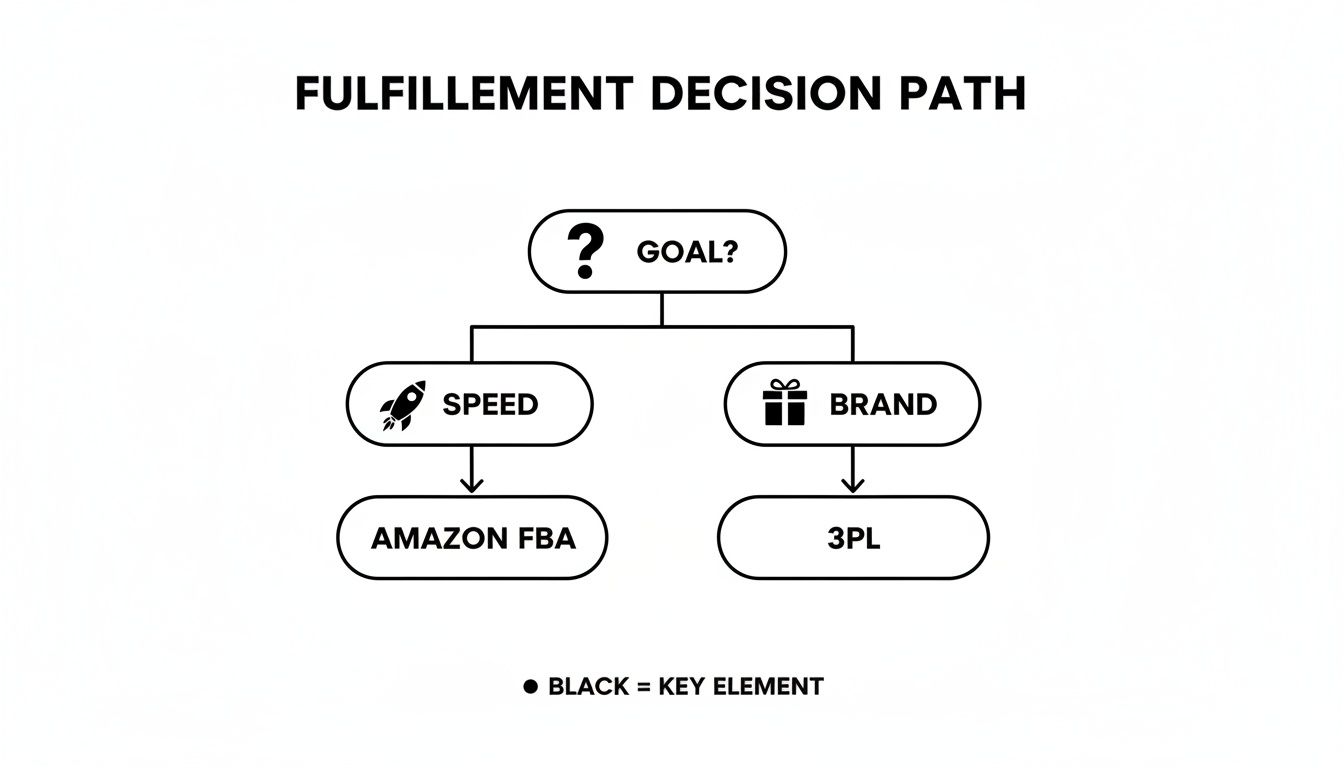
This visual really gets to the heart of the trade-off. Do you prioritize raw speed and convenience with Amazon FBA, or do you opt for a 3PL to deliver a controlled, branded experience that screams your brand, not Amazon's?
To land on the right choice, sit down with your team and hash out the answers to these questions:
What's our main objective for the next 12 months: quick sales or long-term brand building?
Can our product margins actually handle Amazon's 8-15% referral fees on top of all the FBA costs?
Do we realistically have the budget and know-how to drive our own traffic to a Shopify store?
How important is the unboxing experience and our post-purchase communication to what we’re building?
Is owning our customer data a non-negotiable for our marketing strategy down the road?
Frequently Asked Questions
After weighing all the pros and cons, you probably still have a few specific questions. Let's tackle the most common ones we hear from founders and marketers trying to make the right call between Amazon and Shopify.
Can I Use Both Amazon and Shopify?
Absolutely. In fact, many of the smartest brands do. Think of it as a "hub and spoke" model. Amazon becomes a powerful acquisition channel—a massive marketplace to get in front of new customers who've never heard of you. Your Shopify store, on the other hand, is your brand's home base for building a real community and maximizing lifetime value.
You can even connect the two operationally. Using Amazon's Multi-Channel Fulfillment (MCF), you can fulfill orders from your Shopify site using your FBA inventory. It's a great way to tap into Amazon's logistics without being entirely dependent on their marketplace.
Which Platform Is Better for Beginners?
This depends on what kind of "beginner" you are.
If you're an absolute newcomer just trying to validate a product idea and don't want to mess with marketing, Amazon is probably the faster start. You can tap into their enormous built-in audience without having to build traffic from day one. List your product, and you could see sales almost immediately—that's powerful market feedback.
But if you're a beginner who wants to build a real brand and learn the ropes of e-commerce marketing, Shopify is the better classroom. You'll own the process from the start.
Is It Cheaper to Sell on Amazon or Shopify?
Shopify’s costs are more predictable, which usually makes it cheaper in the long run, especially as you grow. You're looking at a fixed monthly subscription plus standard payment processing fees. That's it. You know exactly what your platform costs will be, making it easy to calculate your margins.
Amazon’s fees are a different beast. They are variable and they add up fast. Between referral fees (typically 8-15% of the sale price), FBA fulfillment fees, and storage fees, Amazon takes a hefty slice of every single transaction. For some products, those fees can make it nearly impossible to maintain healthy margins.
The core difference is this: with Shopify, you pay a fixed fee to rent the space. With Amazon, you pay a variable commission on every single thing you sell. For high-volume brands, that commission becomes a massive expense.
Which Platform Is Growing Faster?
Shopify's momentum is hard to ignore. In late 2024, its Gross Merchandise Volume (GMV) shot up 26% year-over-year. While Amazon is still the giant, holding 37.6% of U.S. online retail sales, its growth in the third-party marketplace is much slower, hovering around 7-9%. You can read the full research about Shopify's growth trajectory for a complete breakdown.
This isn't just a vanity metric. For marketers, Shopify's rapid growth points to a thriving ecosystem where independent brands can succeed on their own terms, free from the constraints of Amazon's walled garden and ever-increasing fees.
Ready to stop guessing and start executing with confidence? SpendOwlAI delivers a ranked list of what to change in your ad accounts today—from budgets to creatives—backed by transparent rationale. Start your free 7-day trial and turn noisy ad data into clear, impactful actions. https://spendowlai.com