Shopify and Amazon: The 2026 Multi-Channel Playbook
A lot of brands get stuck on the wrong question.
They ask whether they should sell on Shopify or Amazon, usually right after ad costs rise, repeat purchase rates flatten, or operations start breaking under SKU sprawl. The founder wants margin and brand control. The growth lead wants more volume. The ops manager wants fewer channel fires. Everyone is right, and that is why the debate drags on.
In practice, shopify and amazon are not competing decisions for most established DTC brands. They are different jobs inside the same system. Amazon is where many buyers discover products with high intent. Shopify is where the brand owns merchandising, retention, bundles, margins, and the customer relationship. The true challenge is not opening both channels. It is making them work together without wrecking inventory accuracy, fragmenting product data, or feeding ad spend into the wrong SKUs.
That is the point most guides stop too early. They compare storefront control against marketplace reach, then move on. Operators know the hard part starts after that. The hard part is SKU governance, inventory sync, order routing, catalog structure, and deciding which products deserve paid traffic based on profit, not just top-line return.
The Ecommerce Crossroads Shopify or Amazon
A familiar situation looks like this.
A skincare brand has a clean Shopify site, decent creative, and a Meta account that keeps spending into the same few products. At the same time, the team sees competitors ranking on Amazon and starts wondering if they are missing easy demand. Then the second-guessing starts. Should they move faster on Amazon? Should they pull back and focus on their store? Should they split inventory? Which channel gets the hero products?
That framing creates bad decisions because it assumes one platform has to win.
The better view is that each platform solves a different problem. Amazon gives you discovery from shoppers who already trust the marketplace and often want speed, convenience, and comparison. Shopify gives you a property you control, where merchandising logic, landing pages, bundles, retention flows, and customer data stay in your hands. If you want a useful baseline comparison before making channel decisions, this breakdown of Shopify vs. Amazon is a solid reference point.
The strongest multi-channel operators stopped treating this as an identity choice a while ago. They use Amazon to meet demand where it already exists, then build the brand system on Shopify where they can shape the customer journey.
Key takeaway: The true decision is not Shopify or Amazon. It is which platform becomes your brand’s home base, and how tightly you connect the second channel to it.
When teams miss that distinction, they usually create channel conflict. They duplicate assortments without a clear plan, let inventory drift, and run ads off incomplete feed data. When they get it right, Shopify becomes the command center and Amazon becomes a demand surface.
That is the difference between selling in two places and running one coherent business.
Platform Foundations Choosing Your Home Base
A brand usually feels the platform decision in operations before it feels it in strategy. Orders start coming in from two systems. One SKU is named one way in Shopify and another way in Amazon. Inventory lags by a few hours, then a fast-moving variant oversells. The team blames the channel, but the core problem is the home base.
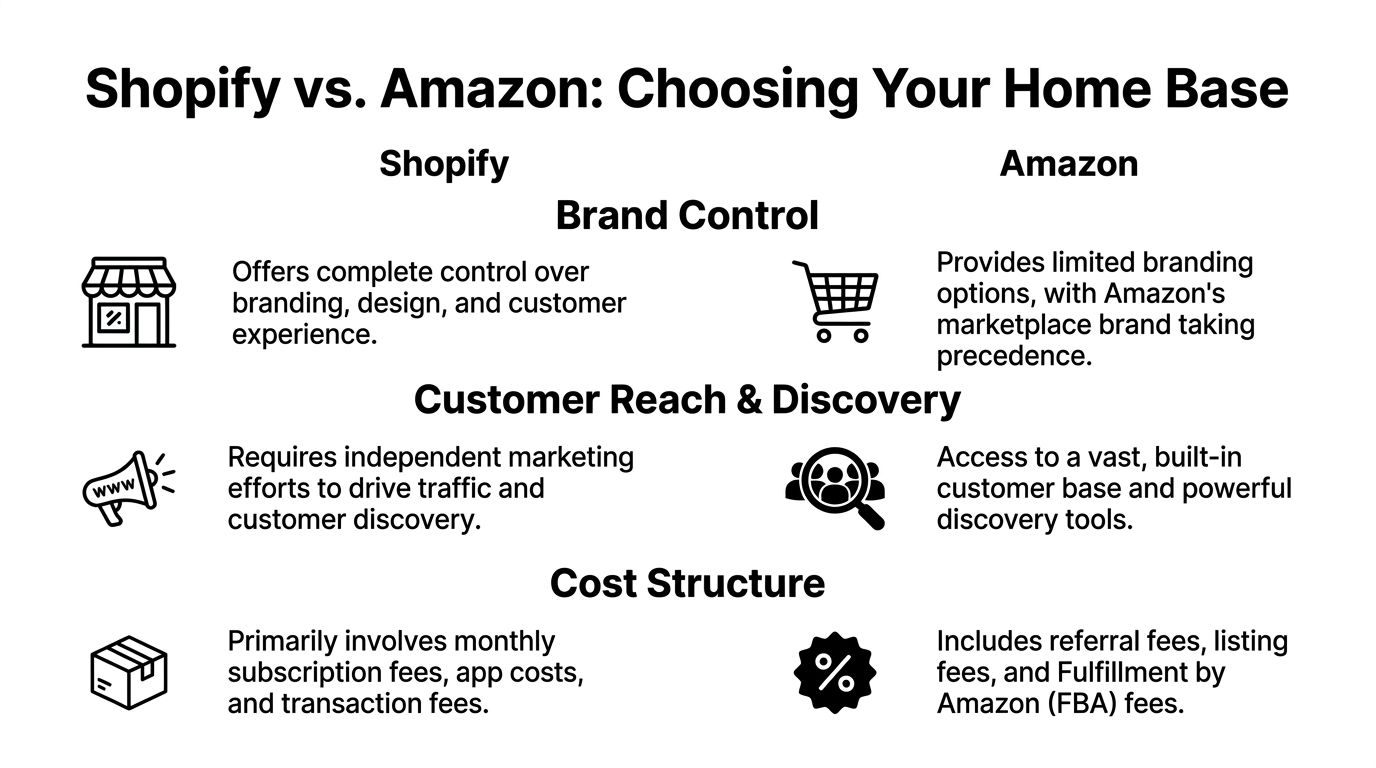
Home base means the system that holds your product truth, customer context, and merchandising logic. For a multi-channel brand, Shopify usually fits that role better. It gives your team control over collections, bundles, upsells, landing pages, retention flows, and the data needed to decide which products deserve more budget across Amazon and Meta.
Amazon still matters. It just does a different job.
Control is not a branding issue alone
Shopify gives you control over how products are presented and how customers move through the store. That matters once the catalog gets messy, especially if you sell bundles, subscriptions, replenishment items, or products that need education before purchase. Amazon can support branded content, but the buying environment still pushes comparison shopping and limits how much of the journey you shape.
That difference shows up in conversion work. Teams that improve product pages, collection structure, and cart flow usually see gains they can carry into paid media efficiency. If your storefront still functions more like a catalog than a selling system, this guide to improving ecommerce conversion performance is a good place to tighten the basics.
Discovery comes with constraints
Amazon brings demand you do not have to create from scratch. Marketplace shoppers arrive ready to compare prices, reviews, delivery promises, and listing quality. That can accelerate early sales, especially for products with clear intent and simple value propositions.
Shopify requires you to build traffic through paid social, search, email, creators, affiliates, and organic content. The upside is that you control the post-click experience and keep more of the customer relationship. That control becomes more valuable once you start optimizing campaigns by margin, repeat purchase rate, or bundle mix instead of just top-line orders.
Analysts at Marketplace Pulse have documented Amazon's scale and seller concentration for years, and the practical takeaway is straightforward. Amazon is hard to beat for product discovery. Shopify is better suited to act as the operating layer behind the business.
Cost structure changes operator behavior
The fee model shapes how teams price, advertise, and decide which SKUs deserve inventory.
Shopify costs are easier to forecast because the platform itself is usually not the largest variable expense. Your costs come from traffic, apps, creative, fulfillment, and people. Amazon adds marketplace fees, fulfillment fees if you use FBA, and competitive pressure that can force pricing decisions you would not make on your own store. That is why a product that looks healthy on blended revenue can be weak on contribution margin once Amazon fees and ad spend are fully loaded.
This also affects assortment strategy. Margin-rich bundles, subscription products, and products that benefit from education often perform better on Shopify. Commodity products, replenishment items, and products with strong review velocity often fit Amazon better.
The operational test
The right home base is the platform that can keep the business coherent when complexity shows up.
Use a simple test:
Decision factor | Shopify | Amazon |
|---|---|---|
Catalog control | Full control over naming, bundling, merchandising, and landing pages | Listing structure follows marketplace rules |
Customer data | Stronger visibility into behavior, LTV signals, and retention paths | Limited direct customer relationship |
Margin management | Easier to protect pricing architecture and bundle economics | Fees and price competition can compress margin |
Operational risk | Better as the source of truth for products and campaign feeds | Strong demand, but harder to manage as the primary system of record |
If the answer to SKU governance, inventory sync, and campaign feed accuracy lives in two places, the team will spend its week fixing exceptions instead of making decisions.
What usually works in practice
The strongest setup is boring by design. Shopify holds the master catalog. Amazon listings are mapped cleanly to that catalog. Inventory rules are centralized. Product titles, variant logic, and image standards are managed with one source of truth. Advertising pulls from the same margin and stock reality, not from channel-specific guesses.
That structure also protects your paid media. If Shopify is the intelligence hub, you can judge product performance across channels with more context. A SKU might look average on Amazon, but be highly profitable when it also drives repeat purchase on Shopify or performs well in Meta retargeting. That is the layer many platform-comparison guides miss.
Amazon operators still need channel-specific discipline, especially around listing health and the Buy Box. If your team is competing with other sellers or struggling with offer stability, this guide on how to win the Amazon Buy Box is worth reviewing.
Why Shopify usually wins the home-base role
Shopify has become the stronger command center for independent brands because it supports the work Amazon does not handle well. It stores the merchandising logic. It connects retention with acquisition. It gives ad systems cleaner product signals. It helps finance, ops, and marketing work from the same product reality.
Amazon can generate demand at scale. Shopify can organize the business around profitable demand. For a multi-channel operator, that is the distinction that matters.
The Hybrid Playbook Using Amazon for Discovery and Shopify for Loyalty
The best hybrid setups are simple on paper and demanding in practice.
Use Amazon to get discovered. Use Shopify to deepen the relationship.

That sounds obvious until you see how many brands still run both channels as separate businesses with separate logic. One team manages Amazon for volume. Another team runs Meta into Shopify. Nobody aligns assortments, promotions, or product priorities. The same SKU ends up pushed in multiple places for different reasons, and nobody can say which channel contributes to long-term value.
Amazon is your discovery shelf
Amazon still matters because buyers start there.
A useful industry observation is that many comparisons miss the profit-optimized cross-promotion angle. Amazon offers 197 million monthly customers, but it restricts data ownership, while stronger 2026 strategies use Shopify as an intelligence layer for targeted Meta catalog ads (The Robin Report). That is the essential hybrid move. You do not just “sell on both.” You use Amazon for the reach it gives you and Shopify for the data it lets you act on.
For commodity products, replenishable products, and categories where search behavior is strong, Amazon is often the first touchpoint. Shoppers arrive with intent. They compare fast. They care about delivery, reviews, price clarity, and confidence.
If you are trying to improve listing competitiveness on the marketplace side, especially on shared listings, this guide on how to win the Amazon Buy Box is worth keeping in your operating docs.
Shopify is where loyalty gets built
Shopify does the work Amazon cannot do for you well.
The platform allows you to shape collections, bundles, routine builders, landing pages, retention flows, and product education. Your first-party data then becomes useful. Buyers who interacted with a product, browsed a category, bought once, or bought on a certain cadence can be segmented and reached again in smarter ways.
That is why attribution matters. If your team cannot connect paid traffic to product-level outcomes across the journey, your channel mix gets distorted fast. For a clean framework on that side, this article on https://spendowlai.com/blog/article/marketing-attribution-software is useful.
The handoff between channels
The hybrid model works when each platform has a job:
Amazon handles first-touch discovery for products that fit marketplace demand.
Shopify handles deeper merchandising for bundles, routines, and content-heavy selling.
Paid media amplifies the owned side using Shopify data, not marketplace guesswork.
Here is a good visual explainer before going deeper into the mechanics:
Operator’s rule: Do not ask one platform to do the other platform’s job. Amazon is not your CRM. Shopify is not a marketplace shortcut.
When brands respect that separation, channel conflict drops. When they ignore it, they usually overvalue surface metrics like gross marketplace revenue and undervalue what owned data can do for repeat purchases and paid media efficiency.
Unifying Your Operations for Multi-Channel Success
Most multi-channel failures are not marketing failures first. They are systems failures.
The brand launches Amazon. Orders come in. The team assumes the connector is handling stock updates correctly. Then a variant sells on one channel, inventory lags on the other, a duplicate listing appears because one SKU was formatted differently, and customer support starts dealing with oversold items that should never have been available.

SKU governance is the first line of defense
This is the problem operators underestimate because it looks minor until it is expensive.
Precise SKU matching between Shopify and Amazon is critical. Minor discrepancies such as TSHIRT-BLK-M versus TSHIRT-BLK-M-01 cause sync failures, duplicate listings, and overselling. Evidence from integrations shows that enforcing SKU consistency prevents 20% to 30% of oversell incidents and avoids self-competition in Meta ads that can inflate CPAs by 15% to 25% for multi-channel DTC brands (Prediko).
That single point touches operations and media at the same time. A bad SKU map does not only create inventory problems. It fragments your product data, which can also break feed logic and cause the same item to appear in overlapping ad sets.
What clean SKU governance looks like
A workable SKU system is boring by design. That is good.
Use one naming convention. Keep every variant unique. Never let channel-specific edits create “almost matching” SKUs. If Amazon requires a certain structure, decide whether Amazon becomes the master format or whether your middleware maps exact equivalents without rewriting your source catalog.
The practical checklist:
Audit every variant: Size, color, pack count, and bundle component need their own unambiguous SKU.
Export and compare: Pull Shopify variant data and compare it directly against Amazon listings before sync goes live.
Lock naming rules: No extra spaces, suffixes, dashes, or channel-only edits unless your mapping layer fully supports them.
Assign ownership: One person or team approves SKU creation. Shared editing rights create drift.
Review monthly: Catalogs change. Variants get added. Old products come back. Drift starts subtly.
Tip: If your team cannot answer which system is the source of truth for SKU creation, you do not have SKU governance. You have temporary alignment.
Inventory sync is not just a connector setting
Teams often think installing an app solves inventory accuracy. It does not. The app is only as good as the rules behind it.
Inventory sync works when three conditions are true:
Operational layer | What must be true | What breaks when it is not |
|---|---|---|
Catalog structure | Variants are mapped correctly across channels | Child items fail to match, or duplicate listings appear |
Stock logic | One source of truth controls available quantity | Oversells, phantom stock, and delayed decrements |
Routing rules | Orders flow to the correct fulfillment path | Shipping delays, manual interventions, and support tickets |
Order routing needs a policy
Here, channel strategy becomes operational policy.
Some brands fulfill Amazon through FBA and Shopify through a 3PL. Others use Amazon inventory for additional channels. Others split by product type, margin profile, or shipping requirements. None of that is wrong. The mistake is letting routing happen by accident.
Decide in advance:
Which products can be fulfilled by Amazon inventory
Which products must stay in branded fulfillment
How bundles are handled
What happens when one node goes out of stock
Which exceptions trigger manual review
Without those rules, your team spends its week fixing edge cases.
Forecasting and buffers still matter
Amazon operates with 175+ global fulfillment centers and predictive placement logic, while Shopify-side operations are generally more reactive across channels (Shopify Community). That difference matters when you carry a broader catalog. Amazon is built for networked logistics. Shopify gives you flexibility, but not automatic prediction.
The practical move is not to copy Amazon’s infrastructure. It is to build enough discipline around stock buffers and sync monitoring that your smaller operation does not get blindsided.
Use a buffer stock policy. Watch sync logs. Check variant mappings when new products launch. If a parent-child relationship is inconsistent across systems, fix it before traffic starts.
The hidden ad impact of bad operations
This part gets missed often.
When inventory and SKU data are messy, ad platforms inherit that mess. Out-of-stock items stay eligible. Duplicate products split performance history. Product sets become harder to trust. Teams start making bid and budget decisions on corrupted catalog data.
That is why operational cleanup usually improves media performance even before the ad account changes. Better product data creates better exclusions, cleaner reporting, and fewer wasted impressions.
Building a Profit-Driven Advertising Engine
Monday morning usually exposes the problem. Meta says a catalog campaign is working. Amazon sales are up on a few SKUs. Shopify shows healthy top-line revenue. Then finance pulls the week and finds the budget drifted into products with thin contribution margin, stock pressure, or ugly return rates.
That is what breaks a multi-channel ad system. The account is optimizing for conversion volume while the business needs profitable orders across Shopify and Amazon together. Shopify should act as the control layer here, because it is the one place you can combine product margin, reorder behavior, merchandising logic, and inventory intent into ad decisions.
Stop rewarding vanity ROAS
ROAS by itself is a weak operator metric.
A product with a lower return on ad spend can still be the better bet if it carries healthier gross margin, lower fulfillment cost, and fewer post-purchase headaches. A product with strong headline ROAS can still be a bad place to put budget if fees, shipping, returns, or marketplace pricing pressure leave little room underneath.
That is where media buyers and operators often split. The buyer sees efficient acquisition. The operator sees contribution margin getting squeezed by channel fees, discounting, and fulfillment cost. If those views never meet at the SKU level, the ad account keeps promoting the wrong products.
A better process starts with break-even math. Set targets from contribution margin, not from a platform screenshot. If you need a clean framework, use this break-even ROAS calculator for ecommerce products.
Build product tiers around business role
Campaign structure gets easier once each SKU has a job.
Some products deserve cold traffic because they convert cleanly, hold margin, and do not create support issues. Some are better for retargeting because they need more context or a stronger offer. Some belong in retention because they attach well after the first purchase. Some should stay out of paid media until pricing, inventory, or the PDP is fixed.
A simple tiering model works well:
Heroes
These are the SKUs you trust to acquire customers. They have reliable conversion history, enough margin to absorb paid traffic, and stable availability across the channels you are pushing.
Use them in prospecting and broad catalog campaigns. Keep the list tight.
Potentials
These products have a case, but not for unrestricted scale. They may get clicks without enough conversion rate, work better as a bundle component, or depend on better creative and merchandising before they can carry acquisition spend.
Use them in controlled tests, themed collections, and narrower retargeting pools.
Drains
These SKUs burn budget without helping the business. Sometimes the issue is obvious. Weak margin, poor conversion rate, high returns. Sometimes it is operational. Feed errors, confusing variants, inconsistent pricing between Shopify and Amazon, or stock that keeps going in and out.
Remove them from active promotion until the underlying issue is fixed.
Key takeaway: Catalog advertising works best when SKU eligibility reflects margin, inventory, and channel role, not just recent click performance.
Structure media around intent and ownership
Paid media should mirror how the business grows.
Prospecting
Use prospecting to push hero products and hero assortments. Cold traffic should see the items with the clearest path to first purchase and acceptable unit economics.
If too many SKUs are eligible, platforms tend to find cheap clicks instead of durable profit. That usually means budget drifts toward visually catchy products, low-ticket items, or products that convert well but contribute very little after costs.
Retargeting
Retargeting needs tighter control than many teams give it.
Viewed product traffic, cart abandoners, and category browsers should not all receive the same products or the same urgency. Product recency matters. So does inventory reality. If a shopper engaged with a SKU that is now low in stock, repriced, or no longer worth promoting, the feed and audience logic should reflect that quickly.
Cross-sell and retention
Here, Shopify earns its place as the intelligence hub.
Amazon is strong at discovery. It is weaker as a system for building your next-best-product logic across owned channels. Shopify holds the customer record, order history, bundle behavior, and merchandising flexibility that let you decide what should be promoted after the first purchase. That makes retention and cross-sell campaigns more precise, and usually more profitable.
Control overlap before it distorts performance
Overlap creates fake complexity.
The same SKU ends up in a bestseller set, a category set, a sale set, and a broad catalog campaign. Then reporting gets muddy, budget allocation becomes harder to trust, and the platform starts competing against its own product logic.
The issue gets worse in a shopify and amazon setup. One SKU can exist with different titles, variants, or availability states across systems. If those records are not aligned, ad platforms can treat them like separate merchandising decisions even when they represent the same product. That leads to wasted spend and bad readouts.
Set an inclusion rule for every SKU. Keep it as exclusive as the catalog allows. If a product belongs in prospecting, define why. If it belongs in retention only, keep it out of cold traffic.
Make ad eligibility reflect operational reality
Profit-driven advertising depends on operational discipline.
If Amazon demand is surging on a SKU and Shopify inventory is getting tight, paid social should not keep spending as if stock is unlimited. If a bundle creates picking errors or fulfillment delays, it should not stay in broad acquisition because the top-line ROAS looked good for three days. If variant mapping is messy, fix that before pushing budget, because bad SKU logic corrupts reporting and product selection fast.
The strongest multi-channel ad accounts are not the ones with the fanciest dashboards. They are the ones where product margin, stock status, channel behavior, and merchandising rules feed directly into who gets ad spend and who does not.
Automating SKU-Level Actions with SpendOwlAI
The problem with SKU-level decision-making is not the logic. The logic is straightforward.
The problem is execution speed.
A human team can identify hero products, spot dead products, compare margin against return, and clean up product sets. But once a catalog has enough SKUs, enough traffic, and enough campaign layers, those decisions start lagging behind reality. The spreadsheet is already old by the time someone updates labels, exclusions, and product sets.

SpendOwlAI solves that specific execution gap.
It sits between Shopify and Meta as an intelligence layer. Instead of treating the product catalog as one giant feed, it reads product-level signals and turns them into actions. That means products can be tagged by performance tier, routed into the right catalog group, and excluded when they stop earning spend.
What that changes in practice
Most brands do one of two things with catalog ads.
They either avoid them because the setup across Shopify, Commerce Manager, pixel events, and CAPI feels too technical. Or they launch a broad catalog and let the platform decide what to push. In both cases, control over product selection is weak.
SpendOwlAI changes that by making product-level status operational.
Product tiers become active rules
Instead of keeping static spreadsheets of winners and losers, the platform can classify products into tiers such as Heroes, Potentials, New Launches, Long Tail, and Dead. Those tags then feed the ad structure so the right SKUs appear in the right campaign layers.
That matters because cold traffic should not be the testing ground for everything in the catalog.
Margin data is part of the decision
A product that looks efficient on surface return can still be a poor scaling candidate if margin is weak. SpendOwlAI uses Shopify margin data so the system can favor products that contribute profit rather than just top-line conversion volume.
That is the difference between optimizing for traffic and optimizing for a business.
Feed health gets monitored continuously
Catalog performance depends on infrastructure staying clean. SpendOwlAI flags feed issues, out-of-stock items, and sync errors so bad product data does not keep leaking into the ad account.
For teams running both shopify and amazon, that kind of feed discipline matters even more because catalog errors often start upstream in operations.
Why automation matters
Manual SKU management breaks first in three places:
Exclusions lag behind performance
Product overlap creeps into prospecting
Teams keep spending on products that looked good last week
Automation is useful when it removes those delays.
SpendOwlAI is not another reporting layer. It is the operating logic that keeps product sets current, rotates winners, suppresses spend on dead inventory, and helps prevent self-competition across catalog structures.
Where it fits best
The platform is most useful for Shopify brands with enough catalog complexity that product-level decisions materially affect outcomes. That usually means brands with a meaningful SKU count, active Meta spend, and clear differences in margin or reorder behavior across products.
It is especially relevant when:
A few products absorb most spend
Bundles or routines need different treatment than single-SKU offers
Cross-sell matters after first purchase
Operations and media need one version of product truth
That is where automated SKU-level actions stop being a nice-to-have and become necessary operating discipline.
Your Path to Multi-Channel Mastery
A multi-channel brand usually breaks in a familiar place. Amazon is driving orders, Shopify is carrying the brand experience, Meta is spending against a catalog that no longer matches inventory, and no one fully trusts the numbers because the same SKU is labeled three different ways across systems.
The brands that handle shopify and amazon well build around that reality. Shopify serves as the operating center. Amazon captures high-intent marketplace demand. The team keeps catalog structure, inventory sync, and order routing tight enough that ads are based on current product truth instead of yesterday's feed.
That is the part many guides skip. The true advantage is not merely selling in two places. It is using Shopify as the central intelligence hub for the rest of the stack, then pushing that product and margin data into channel decisions on Amazon and Meta. Once that connection is clean, acquisition gets sharper, suppression gets faster, and repeat purchase strategy stops fighting marketplace logic.
There is a trade-off. Amazon gives reach and conversion density, but it limits customer ownership. Shopify gives control, better retention mechanics, and cleaner first-party data, but it asks more from operations. The stronger model is to let each platform do its job, then manage them from one source of truth.
Execution is where teams feel the strain. SKU mismatch, delayed inventory updates, duplicate listings, bundle logic, channel-specific pricing, and late exclusions all hit profit before they show up in reporting. A multi-channel strategy only works when operations and media are reading from the same catalog.
Get that discipline right and advertising improves fast. Budget can shift toward products with healthy margin, stable stock, and repeat purchase potential. Weak SKUs can be suppressed before they drain spend. Prospecting, retargeting, and marketplace visibility start to work like one coordinated system instead of three disconnected accounts.
If your team runs Shopify and Meta and needs a system that turns product-level data into real catalog ad actions, SpendOwlAI is built for that job. It connects Shopify to Meta, auto-tags products by performance and margin, keeps dead SKUs out of prospecting, and helps brands move from broad catalog dumping to disciplined, profit-driven automation.