A Guide to Self Service Business Intelligence for Marketers
If you’ve ever felt like your company’s data was locked in a vault, you’re not alone. For years, getting answers required filing a ticket and waiting for a data analyst to come back with a report. Self-service business intelligence (BI) is the key to that vault. It’s a modern approach that gives non-technical people—like marketers and founders—the power to explore data and find their own answers.
Unlocking Your Data Without a Gatekeeper

The old way was painfully slow. A performance marketer asking a simple question like, "Why did our Meta ROAS drop last Tuesday?" would join a queue, creating a bottleneck that slowed down the entire team. Decisions ended up being based more on gut feelings than actual evidence, which is a risky way to manage a budget.
Self-service BI completely changes that dynamic. It provides intuitive, user-friendly tools that let the people closest to the work—the ones running the campaigns—access, filter, and visualize data on their own terms. Think of it like this: instead of asking a librarian to find a specific book for you, you get to walk the aisles yourself. You'll find what you were looking for much faster and probably stumble upon other valuable insights along the way.
The Shift From Waiting to Acting
This isn't just a minor tweak; it’s a fundamental change in how fast-moving businesses operate. The demand is surging, with the global self-service BI market valued at USD 7.99 billion in 2025 and projected to hit an incredible USD 32.97 billion by 2034. That explosive growth, detailed in this report on Fortune Business Insights, proves how essential it is for teams to have direct access to their data.
For DTC brands, this means marketers can finally connect the dots between platforms without spending hours in spreadsheets. A media buyer can instantly see how a spend increase on Google Ads is affecting sales on their Shopify store or spot creative fatigue before it completely tanks a campaign.
Self-service BI isn't about turning marketers into data scientists. It's about giving them the right tools to make smarter, faster decisions with the data they already have.
To understand the difference, let's compare the old and new models side-by-side. The table below shows how self-service BI directly addresses the daily frustrations marketing teams face.
Traditional BI vs. Self-Service BI For Marketing Teams
Aspect | Traditional BI | Self-Service BI |
|---|---|---|
Who Analyzes Data? | A dedicated data analyst or team. | The marketer, founder, or operator. |
Speed to Insight | Days or weeks, depending on the backlog. | Minutes or hours, available on-demand. |
Common Workflow | Submit a ticket, wait for a report, ask for revisions. | Log in, explore a dashboard, slice and dice data. |
Typical Questions | "Can you pull a report on Q3 ROAS by channel?" | "Why did ROAS dip yesterday? Which ad is responsible?" |
Flexibility | Rigid. Follow-up questions create more delays. | High. Explore hunches and new ideas instantly. |
Impact on Decisions | Decisions are slow and often based on outdated info. | Decisions are fast, agile, and data-driven. |
As you can see, the move to self-service is a move toward agility, empowering the people on the front lines to act with confidence.
Why This Matters for Performance Marketers
For teams managing ad spend, the benefits are immediate and tangible. Instead of getting lost in complex spreadsheets or waiting for a weekly report, self-service tools can surface critical patterns automatically. This solves some of the biggest pain points in any marketing department:
Ending the Waiting Game: When momentum is everything, waiting for an analyst kills it. Self-service BI delivers answers to urgent questions right when you need them.
Replacing Hunches with Hard Data: Big decisions about budget allocation and creative strategy should never be a guess. Now, they can be backed by real-time performance data.
Connecting the Silos: Finally, you can get a unified view that bridges the gap between your ad platforms (like Meta and Google) and your sales platform (like Shopify).
Specialized platforms like SpendOwlAI are taking this a step further. They don't just show you the data; they translate it into a prioritized list of daily actions. This transforms self-service business intelligence from an analytical exercise into a true competitive advantage, giving operators a clear path to execution every single day.
Why Self-Service BI is a Must-Have for DTC Marketers

Let’s be honest: in the world of DTC marketing, speed is everything. The biggest benefit of self-service business intelligence is that it eliminates the waiting game. When you have to wait days for an analyst to pull a report, you’re already behind. By then, the trend has passed, the opportunity is gone, or the damage is done.
Self-service tools put the power back in your hands. Instead of getting stuck in a queue for the data team, performance marketers can respond to changes in the market almost instantly. It’s the difference between watching your ROAS tank for a week versus spotting the dip on Monday morning and fixing it before lunch.
From Reactive Reports to Proactive Decisions
Picture this all-too-common scenario: a performance marketer notices ROAS has suddenly dropped on a major Meta campaign. In a traditional setup, they'd file a ticket with the analytics team and wait. And wait.
With a self-service BI tool, that same marketer can jump in and diagnose the problem themselves. Within minutes, they’re slicing and dicing the data, filtering by ad set, creative, and audience. This hands-on approach lets them pinpoint the issue—maybe one specific ad is burning out—and take action immediately. They can pause the weak creative and spin up a new test without ever needing someone else's help.
The real magic of self-service BI isn't just about seeing the numbers; it's about being able to do something about them on the spot. It closes the gap between analysis and action.
This is a fundamental shift from passively receiving reports to actively solving problems. The teams that can make fast, confident decisions are the ones that consistently win.
Building a True Data-Driven Culture
"Data-driven culture" gets thrown around a lot, but what does it actually mean? It means creating an environment where anyone on your team can find answers backed by evidence, not just opinions. Self-service analytics makes this happen by giving everyone access.
Empowered Teams: Marketers no longer have to rely on a central data person for every little question. They start building their own analytical muscle and gain a much deeper feel for the business.
More Accountability: When you can directly see the impact of your campaigns, you naturally take more ownership of the results.
Better Collaboration: Data becomes the shared language that connects marketing with other departments like merchandising and finance.
This approach encourages curiosity. It creates a team that instinctively asks questions and knows exactly where to find the answers. You can explore various data-driven marketing solutions that help instill this kind of operational independence.
Connecting Ad Spend to SKU-Level Profitability
For most Shopify store owners, understanding true, bottom-line profitability is a huge headache. Seeing your total revenue is easy, but tying ad spend back to the performance of an individual product is a whole other challenge. This is where e-commerce-focused self-service BI tools really shine.
For instance, an operator using a tool like SpendOwlAI can pull their data from Meta and Google and merge it directly with their store’s sales data. Suddenly, they have a single source of truth that can answer the most important questions:
Which specific products are actually driving profitable growth?
Is my best-selling SKU actually making me money once I factor in its ad costs?
Which ads are moving the needle for my new product line?
This SKU-level clarity is a total game-changer. It gives founders and marketers the confidence to make smarter bets on inventory, ad creative, and budgeting, ensuring every dollar they spend is pushing the business toward sustainable growth.
Key Features of an Effective Self-Service BI Tool
Let's be real: not all self-service BI platforms are built for the fast-paced, chaotic world of e-commerce marketing. While plenty of tools can spit out a pretty dashboard, an effective solution for operators needs to do a lot more. It has to be built from the ground up to solve the specific pain points marketers face every single day.
When you're looking at different options, you aren't just buying software; you're fundamentally changing how your team operates. The right features can transform self-service business intelligence from a dreaded analytical chore into a core part of your daily execution. The wrong ones will just give you another dashboard to ignore.
The market for these tools is exploding for a reason. It’s projected to climb from over USD 10.73 billion in 2025 to an incredible USD 49.84 billion by 2035. As you can see in this detailed market forecast, this growth is all about giving teams direct access to data and using AI to predict what works, cutting down on wasted ad spend.
An Intuitive Interface Designed for Marketers
First and foremost, the tool has to be intuitive. If your team needs weeks of training just to pull a simple report, it has already failed. The best platforms are designed for marketers, not data scientists, using language and workflows that actually match what you do.
This means you should be able to log in and start asking meaningful questions on day one. Complex query languages or a maze of confusing menus are major red flags. The whole point is to get answers fast, and the interface should be a shortcut, not a roadblock.
Direct and Seamless Integrations
A BI tool is only as powerful as the data it can connect to. Manually uploading CSV files every morning is a painful and error-prone relic of the past. Your solution needs direct, one-click integrations with the platforms you live in.
For any DTC or performance marketing team, these are the absolute non-negotiables:
Ad Platforms: Direct pipes into Meta and Google Ads are essential for analyzing campaign results in real time.
E-commerce Platforms: A deep integration with Shopify is critical to tie your ad spend directly to sales, products, and actual profit.
Analytics Tools: The ability to pull in data from your other tools ensures you’re looking at the complete customer journey.
These integrations are what save you countless hours of data-wrangling misery. They're the foundation for a single source of truth you can actually trust.
From Dashboards to Actionable Insights
Here’s where most BI tools fall short. They’re great at building dashboards that show you what happened. But what marketers desperately need is an execution system that tells them what to do about it.
An effective self-service BI tool doesn't just give you more data to look at. It interprets the data for you and provides a prioritized list of actions to take, turning complex analysis into a simple daily checklist.
Look for features that go beyond just charts and graphs. A platform like SpendOwlAI, for example, is designed to translate all that noisy performance data into a ranked list of recommendations. Instead of forcing you to hunt for the insights, it brings them directly to you, making it obvious what to scale, what to cut, and what to leave alone.
Built-In Guardrails and Automated Storytelling
One of the fastest ways to burn through your budget is making knee-jerk decisions based on a day or two of weird data. A top-tier self-service BI tool should act as a set of guardrails, preventing you from overreacting to statistical noise.
You want a system with capabilities like:
Creative Fatigue Detection: It should automatically flag ads that are starting to burn out well before their performance completely tanks.
Audience Saturation Monitoring: You need alerts when an audience is tapped out, so you know it's time to find new pockets of demand.
Automated Data Storytelling: The tool should explain why a metric changed in plain English, giving you the story behind the numbers.
These features help you shift from being reactive to proactive. They analyze real trends, not just daily blips, and give you the narrative to understand what's driving performance. This is especially crucial when trying to make sense of your marketing attribution software, which you can learn more about in our dedicated guide. By focusing on what truly moves the needle, you can make decisions with confidence.
How to Implement Self-Service BI in Your Marketing Workflow
Jumping into self-service BI doesn't mean you have to overhaul everything at once. The most successful rollouts I've seen don't try to boil the ocean. Instead, they start a small, manageable fire and then give it the fuel to grow. A practical, phased approach is your best bet for showing value quickly, building your team’s confidence, and creating momentum.
Think of it as a "crawl, walk, run" strategy. You start with a single, high-impact problem—something that’s causing your team a real headache right now. This focus lets you prove the concept and get buy-in without getting lost in a complex, company-wide project.
Start with Your Most Critical Business Questions
Before you even think about looking at tools, get your marketing team in a room and pinpoint your biggest blind spots. What questions do you ask over and over but struggle to answer with any real speed? For most performance marketing teams, these usually come down to daily execution and making the budget work harder.
Your list of nagging questions might look something like this:
Which specific ads are starting to fade right now?
Is our budget actually going toward our most profitable campaigns and products?
Are we about to hit audience saturation on our best-performing ad sets?
Why did our ROAS suddenly tank yesterday, and which campaign, ad set, or ad is the culprit?
Pick just one or two of these to tackle first. This gives your implementation a clear, tangible purpose. The goal shifts from a vague "let's adopt BI" to a concrete "let's fix our daily performance monitoring," which is far more motivating for everyone involved.
Select a Tool and Connect Your Data
Once you’ve identified your core problem, you can evaluate tools based on how well they actually solve it. If you're a performance marketing team, this means looking for platforms with direct, one-click integrations for the big players like Meta, Google Ads, and Shopify. The whole point is to kill the manual data grunt work.
This step should be quick. A modern self-service business intelligence platform should get you from connecting your accounts to seeing real data in minutes, not weeks.
Imagine this scenario: an agency brings on a new DTC client. Instead of spending the first week drowning in spreadsheets, they pop the client’s accounts into a tool on a 7-day trial. By day two, the platform flags two campaigns with significant wasted spend from creative fatigue. They make a targeted fix, and by the end of the week, they’ve already bumped the client's ROAS—proving their value right out of the gate.
The Core Process for Self-Service Success
This simple flow is what makes self-service BI work. It’s a three-step process that turns messy, raw data into smart, confident decisions.
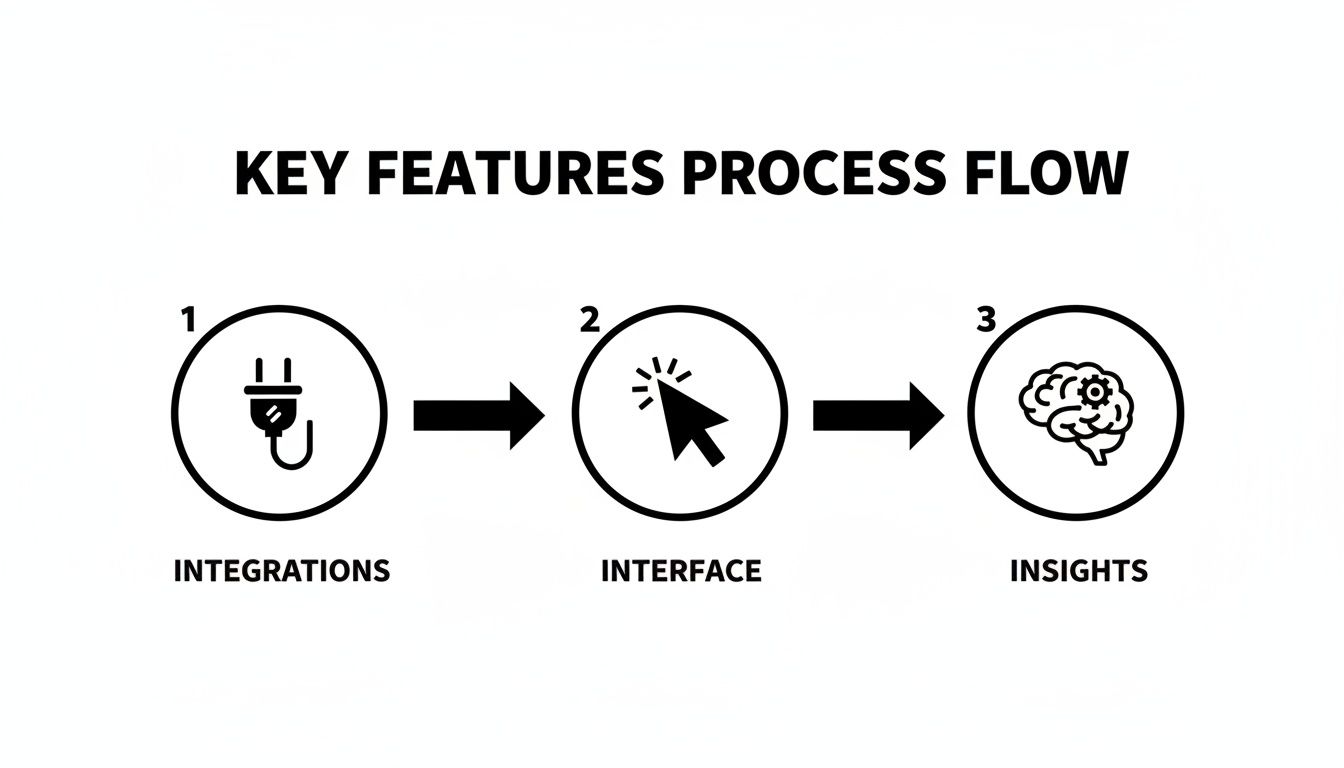
The magic happens as you move from seamless Integrations to an intuitive Interface and finally land on actionable Insights. This is what gives lean teams a serious edge.
Build Confidence and Scale Your Efforts
By starting small, you build a solid foundation of trust. Once your team sees that the tool gives them reliable data and helps them make smarter calls, they'll naturally start asking bigger questions. Your initial focus on daily performance checks can evolve into weekly strategic reviews or deep dives into SKU-level profitability. Of course, this all relies on clean data, so making sure your tracking is solid is a prerequisite; our guide on setting up UTMs for Google Analytics can help you build that solid foundation.
This approach aligns with a major shift in the industry. While huge enterprises still hold the largest market share at 61.28%, self-service BI is leveling the playing field for smaller, more agile teams. By cutting IT dependency by up to 80%, these tools allow founders and marketers to see exactly why a platform recommends a certain action, like giving more budget to a specific creative. This transparency can lead to 30-50% faster decision cycles, stopping waste from scaling too soon or making panicked, reactive changes. You can read the full business intelligence market forecast to see just how big this trend is becoming.
The "run" phase is when it all clicks. Self-service BI is no longer a special project—it's just how your team operates. It becomes the default, empowering everyone to make data-backed decisions, every single day.
Common Pitfalls to Avoid in Self-Service Analytics
Handing the keys to the data kingdom over to your marketing team sounds great in theory, but it's a move that can easily go sideways. Done wrong, self service business intelligence can create more problems than it solves, leading to confusion and distrust instead of clear, confident action.
The good news? These traps are completely avoidable if you know what to look for. It's not about just giving people access to data; it's about building a system that delivers reliable insights. Recognizing the common pitfalls is your first step to getting it right.
Overcoming Data Chaos and Mistrust
The first and most immediate danger is what I call "data chaos." I’ve seen it a hundred times: one person pulls a report and sees a 3.1x ROAS. Someone else runs their own numbers and gets 2.8x. Suddenly, the meeting isn't about strategy—it's an argument over whose spreadsheet is right. Decision-making grinds to a halt.
This mess happens when you don't have a single source of truth. When your team is manually exporting data from Meta and Google Ads and trying to stitch it together with Shopify numbers in different spreadsheets, you’re practically guaranteed to get inconsistencies. Even tiny differences in how you set an attribution window or date range can create conflicting metrics, and trust in the data evaporates.
The only way to fix this is with a system that centralizes and unifies your data automatically. You need a platform that plugs directly into all your sources—your ad accounts, your store, everything—and standardizes the information. This creates one trustworthy foundation, so everyone is looking at the same numbers and the team can get back to focusing on what to do next.
Avoiding Analysis Paralysis with Ranked Priorities
The second big pitfall is analysis paralysis. You've opened the floodgates and given your team an ocean of data, but now they're drowning. Faced with endless dashboards covered in charts and graphs, marketers freeze up, completely unsure of what actually matters or where they should even begin.
This is where a lot of traditional BI tools fail. They’re fantastic at showing you everything but terrible at telling you what to do. An effective self-service BI tool for operators can't just be a passive dashboard; it needs to be an active system that drives execution.
The real value of self-service BI isn't in seeing more data; it's in seeing the right data at the right time. The best tools cut through the noise to tell you what to focus on today.
Instead of just building dashboards, look for tools that give you a ranked priority list of actions. Rather than showing you 50 different metrics, a smart system should highlight the three most important opportunities or problems you need to address, ordered by their potential impact. This turns a mountain of overwhelming data into a clear, actionable to-do list.
Resisting the Urge to Overreact to Noise
One of the most expensive mistakes a performance marketer can make is overreacting to a single day of bad data. We’ve all felt that panic. A one-day dip in your click-through rate (CTR) might just be statistical noise, but the temptation to make a knee-jerk change is strong. Killing an ad or gutting a campaign based on a blip can do far more harm than good, especially if you reset an ad platform's learning phase.
Imagine this scenario: a marketer sees that a top ad's CTR dropped from 2% to 1.5% on a Tuesday and immediately pauses it. A more advanced BI tool, however, would have recognized this fluctuation was within the normal range and advised holding steady. It would only flag the ad if it detected a statistically significant downward trend over several days, which would point to actual creative fatigue.
This is why built-in guardrails are so crucial. You need a system that monitors for meaningful trends, not just daily blips. It prevents you from making costly over-edits and keeps your focus on changes that will genuinely move the needle. It acts as a voice of reason, giving your campaigns the time they need to gather enough data for real optimization.
The Future Is Actionable Intelligence, Not More Dashboards
Let's be honest, the age of the dashboard is over. Dashboards were a fantastic step forward for making data visible, but they’ve pretty much hit their limit. Today’s marketers aren’t drowning from a lack of data; they’re drowning in the effort it takes to figure out what all that data actually means.
The real future of self-service business intelligence isn’t about just showing you information. It's about giving you clear directions. The next generation of tools doesn't just flag that your ROAS dropped—it uses AI to tell you why it dropped and suggests exactly what to do about it. We're finally moving past asking "what happened?" and getting straight answers to "what should I do now?"
From Data Janitor to Strategic Marketer
This shift is completely redefining the role of a modern marketer. For years, smart, creative people have been stuck being data janitors. They spend countless hours exporting spreadsheets, cleaning up messy rows, and trying to Frankenstein together reports. It's frustrating work that gets in the way of what they're actually great at: thinking big and coming up with brilliant campaigns.
The next wave of BI is all about automating that analytical grunt work. Think of it like having an expert co-pilot who constantly monitors your ad accounts. Instead of you having to hunt for insights, the system brings them directly to you, complete with a simple explanation.
This is all made possible by a few key developments:
Augmented Analytics: AI automatically preps the data, spots important patterns, and generates insights on its own. This drastically cuts down the time it takes to go from raw data to a smart decision.
Natural Language Processing (NLP): You can ask questions in plain English instead of writing complicated queries. Even better, the tool can explain its findings back to you like a human would.
Predictive Analytics: By analyzing past performance, these systems can spot future trends. For example, they can warn you about creative fatigue before it completely torpedoes a campaign.
Your Daily Execution Plan Is Here
For performance marketers running ads on platforms like Meta and Google, this isn't some far-off dream—it's already happening. Tools like SpendOwlAI are built around this very idea of actionable intelligence. The entire point is to give you a simple, prioritized to-do list every morning, not another dashboard you have to spend an hour deciphering.
The future of BI is prescriptive. It won’t just tell you a campaign is underperforming; it will tell you to shift $50 from ad set A to ad set B because B has a higher conversion rate and is showing stronger signals for growth.
This is what self-service BI was always meant to be about: freeing up human potential. When smart systems handle the daily analytical grind, marketers can finally focus on high-level strategy, creative direction, and building the brand for the long haul. They can stop reacting to yesterday's numbers and start proactively shaping the future, armed with a clear plan that tells them exactly what to do to drive growth.
Frequently Asked Questions About Self-Service BI
Whenever you're thinking about changing your approach to analytics, a few questions always pop up. For DTC founders and performance marketers exploring self-service business intelligence, the concerns are usually grounded in reality: What’s the real cost? How long until we see results? And does my team have the chops to actually use it?
Let's get straight to the answers.
How Much Does Self-Service BI Cost?
The price tag for BI tools can be all over the map. You’ve got enterprise-level platforms that can run well into five figures, but there are also fantastic tools built specifically for leaner teams. For most DTC brands, the sweet spot is a Software-as-a-Service (SaaS) tool with a monthly subscription.
This model makes powerful analytics accessible. Instead of a massive upfront investment that drains your cash flow, you're looking at a predictable monthly fee. Often, these costs scale with your ad spend or the number of data sources you connect, so you only pay for what you use. Plus, many of these modern tools offer free trials so you can prove the value before you ever pull out a credit card.
How Long Does Implementation Take?
If you’re picturing a massive, multi-month IT project, you can breathe a sigh of relief. Those days are long gone, at least for modern BI tools. When a platform has direct, one-click integrations with the systems you live in—like Meta, Google Ads, and Shopify—you can be up and running in a matter of minutes.
Seriously. The process is usually dead simple:
Sign up for an account.
Grant access to your ad accounts and e-commerce store.
Let the platform pull in and organize all your historical data.
You can go grab a coffee and, by the time you're back, you'll likely have your first dashboards ready to go. The tool does all the heavy lifting—connecting, cleaning, and structuring the data—so your team can jump straight to finding insights.
What Skills Does My Team Need to Use It?
This is probably the most important question of all. The whole point of self-service BI is to take data out of the hands of a few specialists and give it to the people who can actually use it. You absolutely do not need a data scientist or SQL wizard on your payroll.
The core idea is to bring data to the people who know the business best—the marketers. A good self-service platform is designed for them, using familiar language and workflows that feel intuitive from day one.
The only prerequisite is a working knowledge of your own marketing metrics. If your team understands what ROAS, CTR, and CPA mean, they have everything they need to get started. The tool handles the complex number-crunching in the background; your team brings the business context to turn those numbers into smart decisions.
Ready to see how actionable intelligence can transform your daily workflow? SpendOwlAI gives you a prioritized execution plan, not another dashboard. Start your free 7-day trial and start making smarter decisions today.