Data-Driven Marketing Solutions for Smarter Growth
Data-driven marketing solutions are systems built to cut through the noise of ad performance and give you a clear, prioritized to-do list. They’re designed to save you from knee-jerk reactions and wasted spend by delivering daily, explainable actions with logic you can actually dig into and understand.
Move From Guesswork to Confident Decisions
Trying to manage daily ad performance can feel like steering a ship in a dense fog. One day you're up, the next you're down, and it's hard to know why. A proper data-driven marketing solution is like your ship's navigation system, charting a clear course through the uncertainty.
This means you can stop chasing those fleeting ROAS spikes that disappear as quickly as they arrive. Instead, you get:
A ranked action list that prioritizes your budgets, creatives, and audiences based on their potential impact.
Transparent explanations for why each suggested change actually matters.
Built-in guardrails that flag risks like editing your campaigns too often or letting your best creative burn out.
We saw this happen with an e-commerce brand that got a creative fatigue signal from their system. Instead of blindly pushing more budget into a campaign that was starting to fade, they paused. By following the system's priority list instead of their gut, they saw a 15% lift in ROAS by the end of the week.
Why Clarity Matters
When you have clarity, you stop wasting money. It’s that simple. Every change you make is backed by data, not just a hunch, which means your team spends less time arguing about what to tweak and more time executing on what works.
This system feels like upgrading from a sundial to a digital clock.
You can pinpoint the exact moment performance starts to shift. You also get alerts when a campaign's learning phase becomes unstable or when an audience is hitting its saturation point.
The benefits here are tangible:
Spot growth opportunities much faster.
Lower the risk of scaling a campaign too early and watching it crash.
Maintain consistent priorities, even when you're running ads on multiple platforms.
Have a clear, inspectable reason for every single recommendation.
This allows your team to pivot based on real evidence. No more "I think this will work" based on yesterday's numbers. Every edit you make has a defensible logic behind it, which builds a ton of confidence across the board.
Getting Started Today
The first step is to connect your data sources—usually Meta, Google Ads, and Shopify. You'll want to validate your first-party signals and just make sure everything is flowing correctly. From there, you can set your own guardrails for things like edit frequency, audience saturation, and budget shifts.
Unify your data from ad platforms and Shopify.
Review your ranked to-do list each day.
Inspect the rationales and approve the top three actions.
Monitor the results and tweak your thresholds over time.
You can get started in minutes with a free trial.
With SpendOwlAI, you’re not just looking at metrics; you're getting a clear roadmap. Your team saves time, cuts waste, and finally gains the confidence to move from guesswork to precise, data-backed execution.
Understanding Your Data-Driven Marketing Engine
A real data-driven marketing solution is so much more than a dashboard cluttered with charts. Think of it as a complete operating system built for taking action. It’s a lot like how a master chef runs a world-class kitchen—success isn't about one single element, but four core pillars working in perfect harmony.
First, the chef needs incredible ingredients. For marketers, these are your Data Sources. We're talking about first-party signals from your Shopify store, conversion data from Meta, and performance metrics from Google Ads. But raw, siloed data isn't useful. It all needs to be brought together and made reliable to build a solid foundation.
This is the big shift marketers are making—moving from guesswork and gut feelings to executing with total clarity.
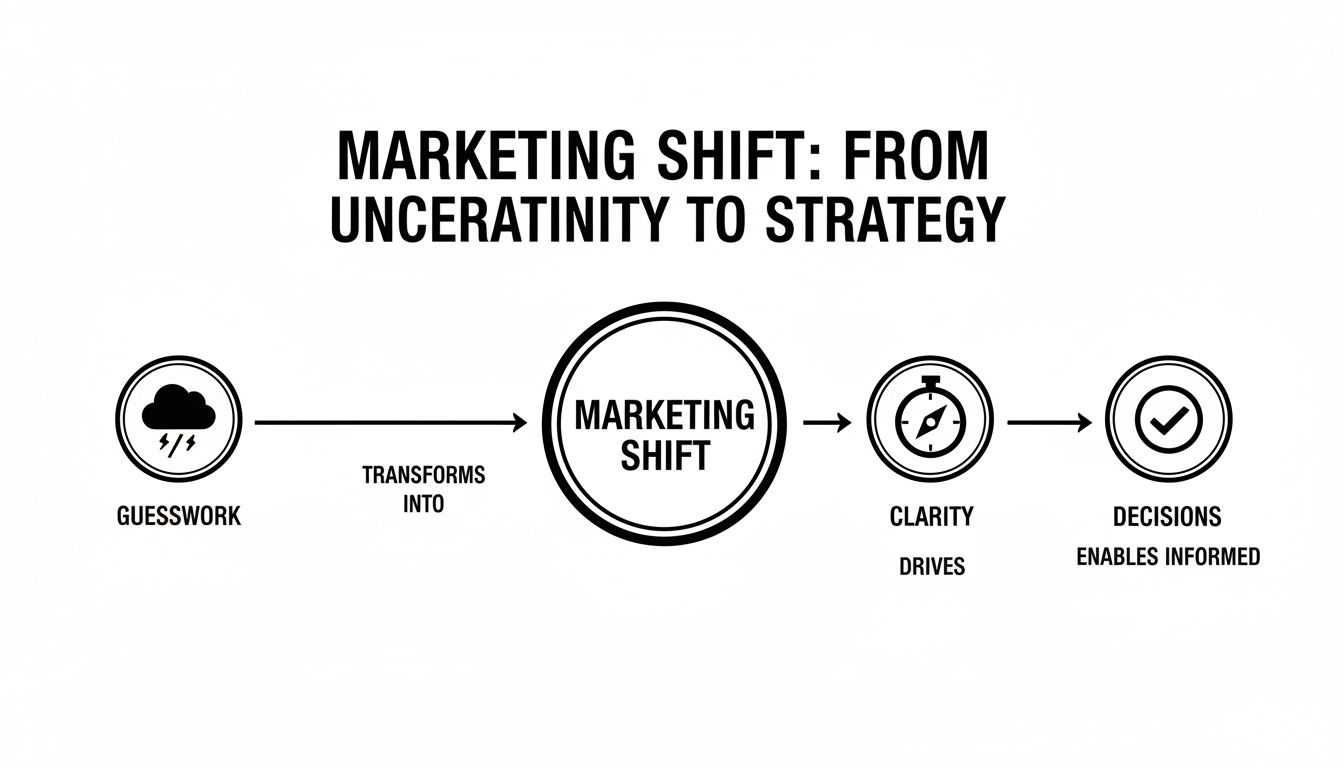
As you can see, once you integrate your data and apply smart analytics, you get the clarity you need to make the right strategic moves every time.
To truly understand how these pieces fit together, let's break down the core components of any effective data-driven solution. Each part plays a specific role in turning raw numbers into profitable actions.
Core Components of a Data-Driven Solution
A breakdown of the essential pillars of an effective data-driven marketing system and their functions for an operator.
Component | Function | Example for an E-commerce Brand |
|---|---|---|
Data Sources | The raw inputs. This is about collecting clean, unified data from all your marketing and sales channels. | Pulling sales data from Shopify, ad spend from Meta and Google, and customer behavior from your email service provider. |
Analytics | The "brains" of the operation. This engine processes the raw data to find patterns and diagnose performance. | Identifying that a recent drop in ROAS is caused by ad fatigue in your top-performing Meta campaign, not a sitewide issue. |
Activation | The to-do list. This translates analytical findings into specific, prioritized, and actionable tasks. | Generating a daily recommendation: "Pause Ad Set X due to high CPA and reallocate $500 to Ad Set Y, which has a rising CTR." |
Guardrails | The safety net. These are automated monitors that prevent common mistakes and protect your performance. | An automated alert fires when you try to edit a campaign too often, warning you that it might reset the ad platform's learning phase. |
Each component builds on the last, creating a system that not only tells you what happened but guides you on what to do next.
From Raw Data to Actionable Insights
Now, back to our chef. With the ingredients sourced, they need a proven recipe to turn them into a stunning meal. This is your Analytics engine. It's the part of the system that processes all that raw data, spots the patterns that actually matter, and tells you why your metrics are changing. This is where you find the root cause, not just the symptom. A perfect example of this in action is how sophisticated platforms use marketing attribution software to accurately credit conversions across the entire customer journey.
Once the chef has the recipe, they need to follow the cooking steps. This pillar is Activation—the part that turns insights into a clear, prioritized checklist. Instead of leaving you to interpret charts, a true solution tells you precisely what to do next. It might be adjusting a specific budget, refreshing a tired creative, or killing an underperforming ad set. This is what moves you from just looking at data to actually doing something with it.
A true execution system doesn’t just report the news; it writes the headlines for what you need to do next. It provides a transparent, inspectable rationale for every recommended action, building trust and confidence.
The Guardrails Protecting Your Performance
Finally, every great chef uses a timer to make sure nothing burns. In marketing, these are your Guardrails. Think of them as automated checks that monitor for common risks. They can stop you from editing campaigns too frequently (which can throw ad platforms into a tizzy) or alert you when audience saturation starts quietly eating into your returns. These guardrails are your safety net, preventing costly mistakes that often happen when we react emotionally to a bad sales day.
This kind of operational system isn't just a nice-to-have anymore. A staggering 87% of marketers see data as their company's most under-used asset. For e-commerce operators juggling dozens of touchpoints for every single purchase, getting daily, ranked actions with a clear "why" behind them is the only way to cut through the noise and scale effectively.
Why This All Matters to Your Business
Let's get real. Connecting high-level marketing theory to what's actually happening in your bank account is what separates the brands that thrive from those that just... exist. Using a data-driven approach isn't about chasing the latest shiny object; it’s about building a smarter, tougher, and more profitable business from the inside out.
The biggest shift? It pulls guesswork out of the equation. You stop making knee-jerk, emotional decisions because of one weird day of performance. Instead, you get the clarity to act with confidence, avoiding that classic mistake of killing a campaign right before it was about to take off or, even worse, pouring money into a flawed ad set that was never going to work.
Stop Burning Cash and Start Working Smarter
One of the most immediate wins is how much less ad spend you'll waste. When your team has a clear, prioritized to-do list every morning, they stop spinning their wheels on tasks that don't matter. Everyone’s attention shifts to the handful of actions that will actually move the needle, making sure every minute and every dollar is invested where it counts.
This is the difference between simply seeing performance metrics and truly understanding the 'why' behind them. You're no longer a passenger watching the numbers fluctuate; you're the pilot, hands firmly on the controls.
Think about it this way. Brand A is constantly chasing fleeting ROAS spikes, tweaking campaigns every few hours and resetting the ad platform's learning phase. Brand B, on the other hand, uses a data-driven system to spot creative fatigue and audience saturation ahead of time, allowing them to make fewer, more deliberate changes. Brand A is on a rollercoaster of volatile results, while Brand B builds predictable, sustainable growth.
Staying Afloat in a Crowded Digital World
This kind of operational discipline is non-negotiable in today's ad space. The global digital ad market is expected to hit a staggering $786.2 billion by 2026. For Shopify store owners and growth teams, that just means more competition and higher ad costs. Keeping a close eye on shifts in cost, delivery, and creative performance isn't just a nice-to-have anymore—it’s a survival tactic to protect your ad spend. You can dig deeper into the explosive growth in digital marketing on boomcycle.com.
At the end of the day, putting real data-driven marketing solutions in place gives your business a massive competitive edge. It builds a culture where you act with strategic patience, empowering your team with the tools to make smarter, evidence-backed decisions every single day.
Focusing On Metrics That Actually Matter

To make smart decisions, you have to look past the surface-level numbers. Chasing a daily Return on Ad Spend (ROAS) target without understanding the forces behind it is like trying to drive a car by only looking at the speedometer. Sure, you know your speed, but you have no clue if you're headed toward an open highway or a dead end.
This is where good data-driven marketing solutions really shine. They help you separate the signal from the noise by tracking two very different, but equally critical, categories of Key Performance Indicators (KPIs).
Performance Indicators: The "What"
First up are the Performance Indicators. These are the outcome-based metrics you probably already live and breathe. They tell you what happened with your marketing efforts.
Return on Ad Spend (ROAS): The classic. This shows the total revenue you brought in for every dollar you spent on ads.
Cost Per Acquisition (CPA): This tells you, on average, how much it costs to land one new customer.
Conversion Rate (CVR): This is the percentage of people who took the action you wanted them to, like completing a purchase.
These metrics are fundamental for knowing if you won or lost. But here's the catch: relying on them alone gives you "context blindness." A sudden drop in ROAS might send you into a panic, leading to frantic, counterproductive campaign edits, when the real issue is lurking somewhere deeper. If you want to get this right from the start, check out our guide on how to properly define your marketing ROI.
Health Indicators: The "Why"
The second, and often ignored, group is Health Indicators. These are the diagnostic metrics that explain why your performance is changing. Think of them as the vital signs for your marketing machine.
Relying solely on performance metrics leads to frantic, reactive decisions. Health indicators act as guardrails, protecting long-term performance and enabling sustainable, predictable growth by revealing the story behind the numbers.
Truly intelligent solutions keep a close eye on these health metrics to give you that much-needed context.
Creative Fatigue: Is your top-performing ad getting stale? Showing it too often can lead to a drop-off in results.
Audience Saturation: Have you tapped out your target audience? If you've reached most of the valuable users, your costs will start to climb.
Edit Frequency: Are you tinkering with a campaign too much? Constant changes can prevent the platform's algorithm from learning and optimizing properly.
Imagine a system flags that your CPA is creeping up. Instead of just showing you the bad news, it connects that trend to a high creative fatigue score on your main ad. The recommendation isn't a vague "fix your CPA." It's a specific, actionable insight: "Refresh the creative in Ad Set Z before performance gets worse."
This is the difference between guessing and executing with confidence.
Putting Data-Driven Solutions Into Action

Shifting to a data-driven approach isn't about flipping a switch overnight. It’s more like developing a new operational rhythm for your team. It's a practical, step-by-step process that turns abstract data into a concrete daily execution plan. This roadmap is built for the people in the trenches—from DTC founders to agency performance managers.
The journey starts by getting all your information in one place. Truly effective data-driven marketing solutions need a unified view, pulling performance metrics from ad platforms like Meta and Google and combining them with sales data straight from your e-commerce store. Getting this foundation right is critical for making sure the insights you get are actually complete and accurate.
For this whole process to work, you absolutely have to track customer touchpoints with precision. This means your tracking parameters need to be configured correctly. Taking the time to build a comprehensive UTM strategy for Google Analytics can make a world of difference in the quality of your data.
Establish Smart Guardrails
Once your data is flowing in, the next move is to set up intelligent guardrails. These are simply rules and automated monitors that decide how and when you make campaign changes. Think of them as bumpers in a bowling lane—they keep your strategy on track and out of the gutter.
These guardrails are your defense against common, yet expensive, mistakes. For example:
Edit Frequency Alerts: Get a notification if you’re tinkering with a campaign too often. Constant tweaks can reset an ad platform's learning phase and tank your performance.
Budget Shift Monitors: Set thresholds to stop knee-jerk budget changes based on a single good or bad day's results.
Creative Swap Cadence: Build a system for swapping out ad creatives based on actual fatigue signals, not just a hunch.
This kind of framework is what protects your long-term growth from getting derailed by short-term emotional reactions.
Adopt a Daily Execution Cadence
With solid guardrails in place, you can shift your focus to daily execution. This is where your dashboard stops being a sea of numbers and becomes a prioritized to-do list. Every morning, your team should see a clear, ranked list of the most impactful actions to take, along with the reasoning behind each recommendation.
The goal is to cultivate a culture of strategic restraint. True mastery isn't just knowing what to change; it's knowing what not to change.
This daily rhythm gets rid of the guesswork and gets everyone aligned on the highest-priority tasks. It ends the cycle of debating what to do next and empowers your team to execute with confidence.
And this stuff works. A global survey found that 63% of marketing professionals rated their data-driven strategies as somewhat successful, while another 32% called them very successful. You can dig into the high success rate of these data strategies on Statista. It just goes to show how a structured approach turns complex ad data into daily, actionable priorities, helping teams avoid common pitfalls and stack up consistent wins.
How to Choose the Right Solution for Your Team
Picking the right data-driven marketing solution is a huge decision, and let's be honest, not all tools are built the same. A lot of platforms out there can serve up gorgeous charts and dashboards, but they leave you completely on your own when it's time to turn those insights into action. The goal isn't just to add another shiny object to your tech stack; it's to find a true partner that actually helps your team get things done.
To cut through the noise, start with one simple question: Does this tool give me an actionable to-do list, or just more data to stare at?
A genuine execution system doesn't just report on what happened yesterday. It should hand you a clear, prioritized list of what you need to do today to move the needle, directly connecting an insight to a specific task.
Look for Transparency Not Black Boxes
Next up, you need to get a feel for how transparent the tool's recommendations are. Some automated systems work like a "black box," making changes behind the scenes without ever telling you why. This is a risky game to play. It sidelines the marketer from the decision-making loop and makes it impossible to learn from what’s working (or what isn't).
Instead, you want a solution that uses explainable AI. This means it provides a clear, inspectable reason for every single suggestion it makes. You should be able to see exactly why the system thinks you should shift your budget from one campaign to another or pause a specific creative. This transparency builds trust and transforms the tool from a mysterious automator into a reliable co-pilot that makes your whole team smarter.
The right solution shouldn't just automate tasks; it should educate your team. When you can inspect the logic behind a recommendation, you build institutional knowledge and make smarter strategic decisions over time.
Find a Fit for Your Workflow
Finally, think about who the tool was really built for. Was it designed for a data scientist who loves to spend all day swimming in complex spreadsheets? Or was it made for the hands-on operator—the founder, the performance marketer, the agency account manager—who needs to make confident decisions and execute quickly?
The best data-driven marketing solutions are designed to slot right into your daily grind without causing friction. They feel natural to use.
Your choice of tool depends heavily on your team's day-to-day reality. To help you navigate this, here’s a quick breakdown of the common solution types and who they’re best for.
Choosing Your Data-Driven Marketing Solution
Solution Type | Primary Function | Best For | Potential Drawback |
|---|---|---|---|
Business Intelligence (BI) Tools | Data visualization and reporting | Analysts and data teams who need to build custom reports and dashboards. | Requires technical expertise to set up and interpret; not inherently actionable. |
Automated "Black Box" Systems | Hands-off campaign management and optimization | Teams with very limited time or marketing expertise. | Lack of transparency and control; hard to learn or troubleshoot when things go wrong. |
Execution Systems (Co-Pilots) | Translating data into a prioritized, actionable to-do list | Hands-on operators (founders, marketers, agencies) who need to execute with confidence. | May not offer the deep, manual data exploration that a dedicated BI tool provides. |
Point Solutions (e.g., Creative Analytics) | Solving one specific problem, like creative performance | Specialists who need to go deep on a single aspect of marketing. | Creates data silos and requires stitching multiple tools together for a full picture. |
Ultimately, a solo founder needs efficiency and clarity above all else. A growing agency handling multiple accounts needs something that can scale and provide robust guardrails to prevent costly mistakes.
By zeroing in on actionable outputs, transparent logic, and a design that actually fits your workflow, you can find a solution that doesn't just report on your business—it helps you build it.
Common Questions About Data-Driven Marketing
Even with a solid plan, stepping into a new way of working always brings up questions. Let's walk through some of the most common ones I hear from operators to clear up any confusion about putting data-driven marketing solutions to work.
How Much Data Do I Need to Start?
This is a big one, and the answer is probably less than you think. You don't need a massive archive of historical data to get started. A good system can start generating value right away by plugging into the data you already have in places like Meta, Google, and Shopify.
The magic isn't in having a mountain of data; it's about the quality and speed of the insights you can pull from it. An effective solution can start finding opportunities with just a few weeks of recent campaign data, looking at current performance, creative fatigue, and audience health to help you make better decisions now.
Is This Just Another Analytics Dashboard?
Not at all. It’s easy to get them confused, but they serve fundamentally different purposes. An analytics dashboard is a reporting tool. It’s great at showing you charts and graphs of what happened in the past, but it stops there. The "so what?" is entirely on you to figure out.
A true data-driven marketing solution is a decision-making engine. It doesn't just show you the data; it interprets it for you and tells you what to do next. It turns complex analysis into a clear, prioritized action plan.
This is the key difference. It shifts your team from being passive data observers to active, confident decision-makers who have a clear path forward.
Will This Replace My Marketing Team?
Absolutely not. The whole point is to make your team better, not replace them. Think of it less like a replacement and more like an expert co-pilot for every person on your team.
It handles the tedious, number-crunching parts of the job that drain time and energy. This frees your people up to focus on what they do best: high-level strategy, creative thinking, and building the brand. By providing ranked actions and guardrails, it sharpens their judgment and gives them the confidence to execute faster and more effectively.
Ready to move from guesswork to confident execution? SpendOwlAI delivers a prioritized daily to-do list with explainable actions, helping you save time and reduce wasted ad spend. Start your free 7-day trial today.