ROI vs ROAS A Guide to True E-commerce Profitability
The real difference between ROI and ROAS boils down to this: Return on Ad Spend (ROAS) tracks the gross revenue you make for every dollar you spend on ads, while Return on Investment (ROI) calculates the actual profit you’re left with after all your business costs are paid.
Think of it this way: ROAS is a tactical metric for your ad campaigns. ROI is the strategic metric for your entire business's financial health.
Understanding The Core Difference Between ROI and ROAS
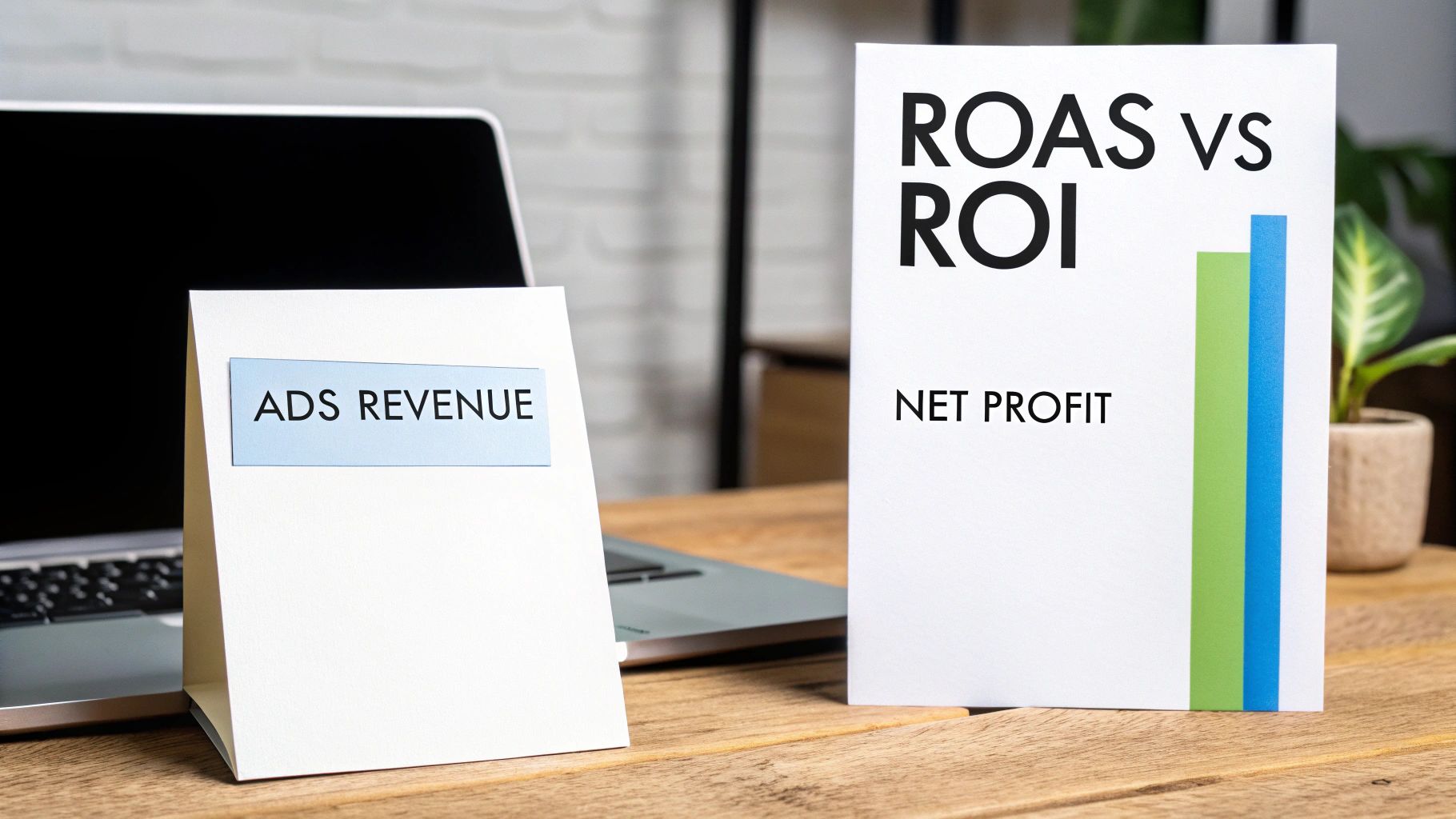
It’s a common mistake to use these terms interchangeably, but that can lead to some seriously misguided—and expensive—scaling decisions. They might seem related, but they answer two completely different questions.
ROAS asks, "Are my ads actually working to bring in revenue?" In contrast, ROI poses the much bigger question: "Is this whole marketing effort actually making us money?"
This distinction is absolutely critical. A fantastic ROAS can easily hide an unprofitable business. You might have an ad campaign pulling in impressive revenue, but if your product margins are razor-thin or your operational costs are high, you could be losing money on every single sale. It's a classic case of chasing a vanity metric that looks good on paper but hurts the bottom line.
ROI vs ROAS at a Glance
To really get a feel for the ROI vs ROAS comparison, it helps to see their attributes laid out side-by-side. Each one gives you a different perspective on performance—one is zoomed in on campaign tactics, the other is the wide-angle view of your business's profitability.
Attribute | ROAS (Return on Ad Spend) | ROI (Return on Investment) |
|---|---|---|
Primary Goal | Measures gross revenue from advertising | Measures net profit from all investments |
Strategic Focus | Tactical (Campaign efficiency) | Strategic (Overall business profitability) |
Scope | Narrow (Specific ads or campaigns) | Broad (Entire business or investment) |
Costs Considered | Only direct advertising spend | All associated costs (COGS, shipping, etc.) |
Primary Use Case | Optimizing ad creative and targeting | Evaluating long-term business viability |
This table makes it clear why ROAS is the go-to diagnostic tool for anyone in the trenches managing campaigns on platforms like Meta or Google. It tells you, quickly and directly, if your ads are hitting the mark and driving sales.
ROAS reveals if an ad is working, but ROI reveals if the business model is working. Relying only on ROAS is like judging a restaurant's success by its number of customers without checking if it's profitable.
Ultimately, though, ROI is the true measure of success. It makes you face the music by accounting for every single expense—from your Cost of Goods Sold (COGS) and shipping fees to software subscriptions and team salaries. For a deeper look at the nuances, you can explore our guide on how to properly define marketing ROI.
Without a firm grip on your ROI, you risk pouring money into campaigns that look incredible on an ad dashboard but are quietly bleeding your company dry. What feels like a win becomes a slow, costly financial loss.
How to Calculate ROI and ROAS With Real-World Numbers
It’s one thing to know the definitions, but seeing how these formulas work with real numbers is where the lightbulb really goes on. Let's move from theory to practice and walk through a realistic e-commerce scenario to see what these calculations truly reveal about ad performance.
Picture this: you run a direct-to-consumer brand selling premium coffee beans. You’ve just launched a new Google Ads campaign for your latest single-origin roast, and the numbers rolling in look great. Or do they?
Calculating Your Return on Ad Spend
First, let's nail down the ROAS. This formula is simple and direct, laser-focused on how much revenue your ad spend is generating.
ROAS Formula: Revenue from Ad Campaign / Ad Spend
Let's plug in the numbers from your coffee campaign:
Total Revenue from Google Ads: $25,000
Total Google Ads Spend: $5,000
Here's the math: $25,000 (Revenue) / $5,000 (Ad Spend) = 5
Your campaign delivered a 5x ROAS, or 500%. That means for every $1 you put into Google Ads, you got $5 back in gross revenue. On the surface, this feels like a home run—a clear signal to start scaling the budget.
This is precisely the moment the ROI vs. ROAS distinction becomes critical. A high ROAS looks like a win, but it only tells you your ads are good at making the cash register ring. It says nothing about whether your business is actually profiting from those sales.
Before you pour more money into this campaign, you have to dig deeper and calculate its true profitability: its ROI.
Calculating Your Return on Investment
Now, we shift from a tactical view to a strategic one. The ROI calculation forces you to look past the ad spend and account for every single cost tied to getting that coffee into your customer's hands.
ROI Formula: (Net Profit / Total Investment) x 100
To get your net profit, you first need to identify the total investment, which is much more than just what you paid Google.
Let’s itemize the real costs behind that $25,000 in revenue:
Ad Spend: $5,000
Cost of Goods Sold (COGS): $10,000 (The coffee beans and packaging)
Shipping & Fulfillment: $4,000
Transaction Fees (e.g., Shopify Payments): $750
Software & Overheads (prorated): $250
Now we can figure out the total investment and net profit:
Total Investment: $5,000 + $10,000 + $4,000 + $750 + $250 = $20,000
Net Profit: $25,000 (Revenue) - $20,000 (Total Investment) = $5,000
With these numbers, the ROI calculation looks quite different: ($5,000 / $20,000) x 100 = 25%
Your campaign's ROI is 25%. While still positive, it paints a much more sober picture than the flashy 500% ROAS. This is a classic trap for performance marketers: chasing a high ROAS while profits evaporate due to hidden costs.
Imagine spending $25,000 on ads to drive $100,000 in revenue—a fantastic 400% ROAS. But after you subtract $80,000 in total operational costs, your profit is only $5,000, flipping your ROI into the red and revealing a net loss. You can figure out your own profitability line in the sand by using a break-even ROAS calculator.
This example starkly illustrates how a strong ROAS can easily mask a razor-thin (or even negative) ROI. To get a true measure of financial success, you have to look beyond the ad platform dashboard.
Choosing The Right Metric for Each Marketing Goal
Great marketing strategy isn't about picking one metric and sticking to it no matter what. The real art is knowing which lens to look through at any given time, making sure your decisions match up with what you're trying to achieve at each stage of the customer journey.
Get this wrong, and you'll make costly mistakes. You might kill a brilliant awareness campaign because it's not showing immediate ROI, or you could pour money into a high-ROAS campaign that's quietly bleeding your business dry.
Aligning ROAS with Top-of-Funnel Goals
Return on Ad Spend is your go-to metric for top-of-funnel (TOFU) activities. We're talking about brand awareness campaigns, video view goals, or driving traffic to a new blog post. The main objective here isn't profit—it's getting eyeballs and making introductions.
At this stage, your mission is to capture attention. ROAS gives you a clean, direct read on how efficiently your ads are doing that job, without getting bogged down in complex profit calculations. It answers a simple but critical question: "For the money I'm spending, is this ad generating real customer interest?"
ROAS is also a rockstar for day-to-day campaign management. When you're A/B testing ad creative, headlines, or audiences, ROAS delivers fast feedback. If one ad variant has a higher ROAS than another, you have a clear winner. It allows you to iterate quickly and get more bang for your buck.
Prioritizing ROI for Bottom-of-Funnel Growth
Once a potential customer moves further down the funnel, your focus has to shift from just making sales to making profitable sales. This is where Return on Investment becomes your North Star. For any campaign designed to drive a final conversion, ROI provides the business context that ROAS simply can't.
A 4x ROAS might look fantastic on your Meta Ads dashboard. But if your profit margin is only 20%, you’re actually losing money. ROI forces you to face that reality head-on.
A positive ROI is the ultimate proof that your marketing isn't just busywork—it's building a sustainable, profitable business. It's the metric that tells you whether you can actually afford to scale.
By zeroing in on ROI for your conversion campaigns, you ensure every dollar you invest is adding directly to your bottom line. That's what long-term, healthy growth is all about.
Situational Decision Making In Practice
The right metric often depends on the specific scenario. For a new product launch, for instance, a high ROAS might be the main goal, even if it means taking an initial hit on profitability. The objective is to grab market share, create buzz, and collect customer data fast.
Here’s a simple way to think about it:
New Product Launch: Prioritize ROAS. Your goal is market penetration. You might even accept a negative ROI for a short time to win those crucial first customers.
Scaling a Mature Product: Prioritize ROI. You know your numbers and unit economics. Every marketing dollar now needs to pull its weight and contribute to profitable growth. A consistently positive ROI is your green light to spend more.
Clearing Excess Inventory: Prioritize ROAS. When you just need to liquidate stock, you can afford to sacrifice some profit margin. A high ROAS shows your ad spend is efficiently converting that inventory into cash, even if the overall ROI is slim.
This decision tree gives you a great visual for how to think beyond surface-level revenue and get to a true profit analysis.
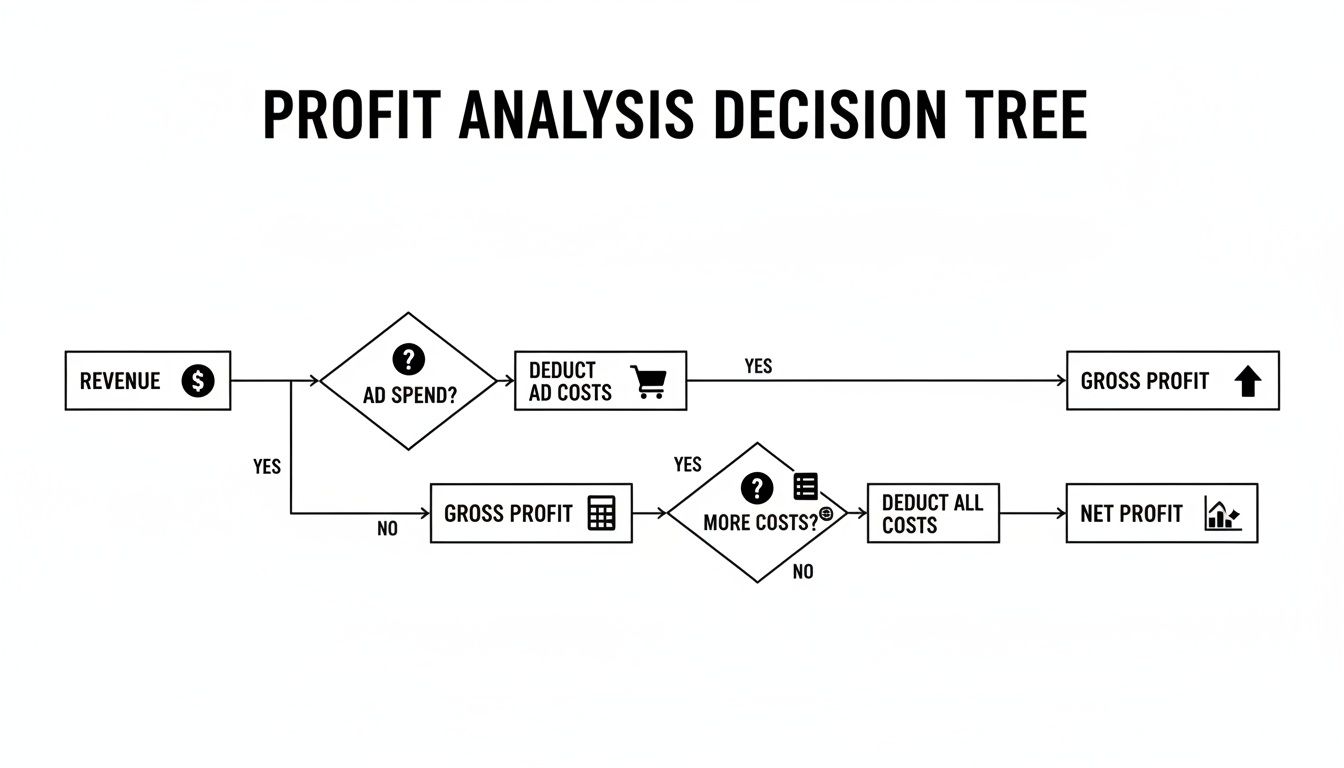
As the flowchart shows, revenue and ad spend are just the starting point. You only understand the real health of your business after you account for all the other costs. By weaving both ROI and ROAS into your daily workflow, you can make smarter, more contextual decisions that serve both your immediate goals and your long-term vision.
Avoiding the Pitfalls of a ROAS-Only Strategy
Fixating on Return on Ad Spend (ROAS) is one of the most common—and dangerous—traps in e-commerce marketing. It creates strategic blind spots that can slowly sink an otherwise healthy business. When you chase a high ROAS above everything else, you start making decisions that look fantastic on an ad platform dashboard but are quietly bleeding your company dry.
This narrow focus can lead you down a treacherous path. For example, a campaign pushing a low-margin gadget might hit a stellar 7x ROAS, making you want to scale the budget aggressively. But what if rising fulfillment costs, high return rates, and those paper-thin margins aren't factored in? You could be losing money on every single sale, essentially paying customers to take your product.
A ROAS-only mindset mistakes revenue for profit, and that mistake creates a fragile business model that can’t withstand market shifts or rising ad costs.
The Hidden Costs of a High ROAS
The real problem with a ROAS obsession is that it completely ignores total business costs and the long-term value of a customer. It's built to optimize for immediate top-line revenue, often at the expense of sustainable, profitable growth.
Let’s look at a common scenario. Imagine you're running two campaigns:
Campaign A delivers a 3x ROAS. It acquires customers who come back for repeat purchases, have a high average order value, and rarely bother with discount codes.
Campaign B boasts a 5x ROAS. It pulls in one-off bargain hunters who never return to buy at full price.
A marketer driven purely by ROAS would cut Campaign A and pour every last dollar into Campaign B. This move sacrifices a steady stream of high-value, profitable customers for a short-term revenue bump from low-value buyers. Over time, your customer base erodes, profitability tanks, and you find yourself spending more and more just to stand still.
When you optimize for ROAS, you get more revenue. When you optimize for ROI, you build a healthier, more resilient business. The ROI vs ROAS debate is really about choosing between short-term vanity and long-term viability.
This exact situation plays out every day in the fast-paced world of e-commerce advertising. A B2C brand might spend $100,000 on PPC ads to generate $250,000 in sales, showing a solid 2.5x ROAS. But as some industry analysis shows, up to 70% of ad spend waste can be traced back to these kinds of ROAS blind spots. It's a stark reminder of how often operators overestimate their ad performance. You can learn more about how ROAS blind spots impact ad spend on First Page Sage.
Shifting from Ad Efficiency to Business Impact
To break out of this cycle, performance marketers need to adopt a more holistic, profit-aware perspective. It means looking beyond the ad platform and pulling in the metrics that tell the complete financial story.
Instead of just asking, "What's my ROAS?" start asking better, more incisive questions:
What’s the actual profit margin on the products we're selling in this campaign?
What is the Customer Lifetime Value (LTV) of the audience we’re acquiring here?
Is this campaign's ROAS high enough to cover all associated costs and still turn a real profit?
This shift in thinking stops you from scaling campaigns that look successful but are quietly draining your cash reserves. It forces you to prioritize activities that directly contribute to the bottom line, building a business that doesn't just grow, but thrives.
By balancing the tactical efficiency of ROAS with the strategic wisdom of ROI, you can make smarter decisions, prevent wasted ad spend, and build a truly resilient e-commerce operation.
Connecting Ad Performance to True Profitability

Getting a handle on the ROI vs. ROAS debate is one thing, but the real challenge is building a system that ties your ad platform signals to what’s actually happening in your bank account. A high ROAS can feel great, but it often creates a false sense of security, hiding underlying issues that are quietly draining your cash.
The trick is to build a practical bridge between the tactical metrics media buyers obsess over—ROAS, CTR, CPC—and the strategic numbers that tell you if your business is healthy, like profit margins and customer lifetime value (LTV). Without that connection, you're flying blind, likely scaling campaigns that look amazing in Ads Manager but are actually losing you money.
Establishing Profitability Guardrails
The best way to protect your bottom line is to set up what I call profitability guardrails. These are basically pre-set limits that stop you from scaling campaigns that aren't contributing to net profit, no matter how fantastic their ROAS might seem.
Think of guardrails as your financial early-warning system. They automatically flag campaigns where costs are getting out of hand or the customers you're acquiring just aren't valuable enough over time. It’s about moving from reactive damage control to proactive profit protection.
To build these, you have to connect your core business data (margins, shipping costs, etc.) with your ad performance data. For example, if you know your exact SKU-level profit margin, you can calculate the absolute minimum ROAS a campaign needs to hit just to be profitable.
A profitability guardrail isn't just a number. It's a rule that forces you to ask, "Even if this campaign hits its ROAS target, is it actually making the business money?" This one question changes everything.
Of course, this means you need a rock-solid understanding of your unit economics. You have to know your all-in costs, from the Cost of Goods Sold (COGS) to fulfillment fees, before you can set meaningful guardrails that actually work.
A System for Data-Driven Decisions
Once you have your guardrails, you need a daily routine that uses them to guide your decisions. This system should be constantly checking your campaign performance against your real-world business profitability data.
Suddenly, your priorities become crystal clear. Instead of getting bogged down in every little metric fluctuation, you can focus on the tweaks that will have a real, measurable impact on your bottom line.
Here’s how it plays out in the real world:
Scenario: A Meta Ads campaign for one of your best-sellers is crushing it with a 6x ROAS.
Action without Guardrails: The gut reaction is to pump more money into it. Double the budget, let's go!
Action with Guardrails: Your system flags that this specific product has a slim 15% profit margin and costs a ton to ship. Your guardrail shows you need a 7.5x ROAS just to break even.
Data-Backed Decision: Instead of scaling a loser, you pause and figure out how to increase the Average Order Value (AOV) or cut fulfillment costs before you spend another dime.
This kind of systematic approach gives you the confidence to act decisively. Every dollar you spend is now directly tied to increasing net profit, not just chasing top-line revenue. Getting this right demands a robust understanding of your data, which is where effective marketing attribution software becomes absolutely essential for connecting the dots.
By truly connecting your ad performance to profitability, you stop treating marketing as a cost center and start treating it like the reliable growth engine it should be. It’s all about making sure every decision you make is intentionally strengthening your company's financial foundation.
Common Questions About ROI and ROAS
As you start weaving these metrics into your daily campaign management, you're bound to run into some specific questions. Working through the whole ROI vs. ROAS puzzle is an ongoing process, but getting clear on a few common sticking points will sharpen your strategy and give you more confidence in your decisions.
Let's tackle some of the most frequent questions marketers have when they're trying to get these two critical metrics to play nicely together.
What Is a Good Benchmark for ROAS and ROI?
This is probably the most common question out there, but the honest answer is: it depends. While it's tempting to look for a universal number, what’s "good" for you is completely tied to your business's unique financial health.
For ROAS, you'll often hear 4:1 thrown around as the e-commerce standard. That means you're making $4 in revenue for every $1 spent on ads. But treat that as a loose guideline. A brand with fat profit margins might be killing it at a 3:1 ROAS, while another with razor-thin margins could need an 8:1 just to stay afloat.
For ROI, anything above zero means you're in the black. A healthy, growing e-commerce business should really be aiming for an ROI somewhere between 200% and 500%. That range usually means you have enough net profit left over to reinvest in inventory, team growth, and other parts of the business.
The only benchmark that truly matters isn't some industry average—it's your own break-even point. Once you know the absolute minimum ROAS and ROI you need to turn a profit, you can set realistic targets that actually align with your business goals.
Ultimately, your targets have to come from your own profit margins and business model, not from a blog post.
Can a Campaign Have a High ROAS and Negative ROI?
Yes, absolutely. This is the classic trap that this guide is all about helping you sidestep. It’s a surprisingly common scenario where a campaign looks like a rockstar on your ad dashboard but is secretly bleeding money.
Think about it this way: you're running a campaign with a 5:1 ROAS. For every $100 in revenue, you spent $20 on ads. Looks great, right?
But once you start pulling in the other costs, the picture gets a lot clearer.
Cost of Goods Sold (COGS): $50
Shipping & Fulfillment: $20
Transaction Fees: $5
Prorated Software Costs: $5
Suddenly, your total cost to make that $100 sale isn't just the $20 ad spend; it's $100 ($20 + $50 + $20 + $5 + $5). Your net profit is zero, meaning your ROI is 0%, even with what looked like a solid ROAS. If any of those costs crept up even slightly, you'd be in the red.
How Can I Calculate ROI Without Knowing All My Costs?
Perfect, clean data is a luxury most of us don't have. But don't let that paralyze you. An estimated ROI that's directionally correct is infinitely more useful for making strategic decisions than a precise ROAS that tells you nothing about profitability.
The trick is to start with the big costs you do know and build from there.
Start with the Basics: Kick off your ROI calculation with just your ad spend and your Cost of Goods Sold (COGS). This gives you a gross profit-based ROI, which is already a huge leap forward from just looking at ROAS.
Add Major Variable Costs: Next, layer in the other big-ticket items tied directly to each sale, like shipping and payment processing fees. These are usually pretty easy to find or get a good estimate for.
Estimate Fixed Overheads: Finally, approximate your fixed costs—things like software subscriptions, rent, and salaries. You can prorate these expenses across your total sales to assign a rough per-order cost.
Even an incomplete ROI calculation gives you a much more grounded view of profitability. It helps you make smarter decisions about where to scale, something you just can't do with ROAS alone.
For growth teams, mistaking a high ROAS for true success can lead to disastrous scaling decisions. For instance, a campaign might generate $24,000 in revenue from a total investment of $4,800, yielding a fantastic 400% ROI. However, if the ad spend portion was only $1,920, the ROAS would appear to be an elite 5:1. While general benchmarks peg a good marketing ROI at 200-500%, this example shows how a healthy ROI can be masked by a seemingly average ROAS if all costs aren't considered. You can explore more about these marketing metrics on Digital Dawn.
Ready to move beyond noisy dashboards and gut-driven decisions? SpendOwlAI provides a daily execution system that translates complex ad performance into clear, prioritized actions. We connect your ad signals to profitability guardrails, helping you scale what works and cut what's wasting money—all with transparent rationale. Start your free 7-day trial and execute with confidence.