Roas vs Roi: The roas vs roi Metrics for Profitable Growth
It's easy to get tangled up in marketing acronyms, but the difference between ROAS and ROI is one you absolutely need to get right. In short, ROAS measures the gross revenue you get back from your ad spend, while ROI looks at the net profit from your entire investment.
Think of it this way: ROAS tells you if your ads are working. ROI tells you if your business is making money.
Understanding The Core Difference: ROAS vs ROI

While people often toss these terms around interchangeably, they paint two very different pictures of your company's financial health. For any e-commerce brand trying to build something that lasts, nailing this distinction is non-negotiable.
ROAS (Return on Ad Spend) is the metric for the folks in the trenches. It's a sharpshooter's tool, isolating the direct effectiveness of an ad campaign. It answers one simple question: for every dollar we put into ads, how many dollars of revenue came back out? This makes it a go-to for performance marketers making real-time tweaks.
ROI (Return on Investment), on the other hand, is the view from the C-suite. It zooms out to see the whole picture, asking a much bigger question: after we subtract all our costs—ad spend, cost of goods, salaries, shipping, software—are we actually profitable? It's the ultimate measure of whether an investment was truly worth it.
A Tale Of Two Metrics
The real danger comes from looking at just one of these metrics. A killer ROAS can easily hide deep profitability problems. It happens all the time.
For example, a brand might spend $100,000 on a Google Ads campaign and bring in $250,000 in sales. That's a 2.5x ROAS, or $2.50 back for every dollar spent. On paper, it looks like a win.
But once you calculate the ROI, that shiny number might tell a different story. After factoring in the cost of the products, shipping, and team overhead, the total profit might only be 150%, or $1.50 in profit for every dollar invested. Suddenly, the margins look a lot tighter.
This is a classic scenario that separates the pros from the amateurs. You can find more examples of how these metrics work in practice in this detailed guide from landermagic.com.
ROAS is a tactical lever for campaign managers. ROI is the strategic compass for the business. Mastering both is how you scale ad campaigns that are both efficient and truly profitable.
ROAS vs ROI At a Glance
To make the distinction crystal clear, let's put them side-by-side. This table gives you a quick snapshot of how they differ in their formulas, focus, and when you should be using them.
For a deeper dive into the nuances of calculating profitability, check out our guide on how to properly define marketing ROI.
Attribute | ROAS (Return on Ad Spend) | ROI (Return on Investment) |
|---|---|---|
Formula | Ad Revenue / Ad Cost | (Net Profit / Total Investment) x 100 |
Focus | Measures gross revenue from advertising | Measures net profit from all costs |
Scope | Tactical (Campaign-specific) | Strategic (Business-wide) |
Use Case | Optimizing ad performance, adjusting bids | Evaluating overall profitability, setting budgets |
Seeing them laid out like this makes it obvious they aren't interchangeable. ROAS keeps your ad campaigns sharp, while ROI ensures the entire business engine is running smoothly and, most importantly, profitably.
Getting the Math Right: How to Calculate ROAS and ROI
Let's get practical. Figuring out your ROAS and ROI is simple on the surface, but the real devil is in the details—specifically, which numbers you use. Each formula tells a very different story. One is about how hard your ad dollars are working, and the other is about whether your business is actually making money.
Nailing these calculations is the first real step toward making decisions with your data, not just your gut. The formulas are basic, but a common slip-up is miscalculating the costs, which can completely warp your view of a campaign's success. Let's break down the math for both.
The ROAS Calculation Formula
Return on Ad Spend gives you a direct, unfiltered look at how much gross revenue your ads are generating. It’s a fast, powerful way to gauge a campaign’s performance without getting lost in the weeds of your overall business expenses.
The formula is clean and simple: ROAS = Total Revenue from Ad Campaign / Total Cost of Ad Campaign
The result is a ratio. So, a ROAS of 4 means you’re making $4 in revenue for every $1 you spend on ads. It's a fundamental metric, and if you want to dig deeper, you can explore what ROAS means in digital marketing.
The ROI Calculation Formula
Return on Investment, on the other hand, gives you the big picture. It calculates the true profitability of your entire marketing effort by factoring in all associated costs, not just what you paid for the ads. This is your bottom-line truth.
Here’s the formula: ROI = [(Net Profit - Total Investment) / Total Investment] x 100
In this equation, "Total Investment" is the key. It includes ad spend plus everything else: the cost of the products themselves (COGS), shipping, software fees, even a portion of your team's salaries. The final number is a percentage that tells you how much actual profit you generated from the total capital you put in.
A Real-World Shopify Store Example
Let's run the numbers for a Shopify store that just launched a Meta ad campaign for a new product. This will make the ROAS vs. ROI distinction crystal clear.
After one month, here’s what the data looks like:
Ad Spend: $5,000
Total Revenue Generated from Ads: $20,000
Cost of Goods Sold (COGS): $8,000
Shipping & Fulfillment Fees: $3,000
First, let's figure out the ROAS: ROAS = $20,000 (Revenue) / $5,000 (Ad Spend) = 4
A 4x ROAS! That looks great on paper. For every dollar pumped into Meta, the store got four dollars back in sales. A performance marketer staring at this number alone would be celebrating and probably pushing to scale the budget.
But a high ROAS doesn't always mean you're profitable. Until you calculate ROI, you're flying with one eye closed. Some of the most costly business mistakes are made on the back of incomplete data like this.
Now, let's get the full story by calculating the ROI for the same campaign. We need to find our total investment and net profit first.
Total Investment: $5,000 (Ad Spend) + $8,000 (COGS) + $3,000 (Fulfillment) = $16,000
Net Profit: $20,000 (Revenue) - $16,000 (Total Investment) = $4,000
ROI: [($20,000 - $16,000) / $16,000] x 100 = 25%
The real ROI is 25%. It's still a positive return, but it paints a far more realistic picture than the flashy 4x ROAS. This is exactly why you can't rely on ROAS alone to make business decisions. ROAS is your tool for optimizing campaigns, but ROI is the ultimate judge of whether those campaigns are actually growing your bottom line.
Applying The Right Metric for Better Decisions
Knowing the formulas for ROAS and ROI is one thing. Understanding which one to use for smarter, more profitable decisions is where the real skill comes in. These two metrics serve entirely different purposes and answer fundamentally different questions. Think of one as your tactical field guide and the other as your strategic world map.
For performance marketers deep in the daily trenches of Meta Ads and Google Ads, ROAS is the essential, in-the-moment tool. It's the metric that fuels immediate actions—adjusting bids on a keyword, shifting budget to a top-performing ad set, or deciding which creative variation gets more spend. ROAS gives you the quick feedback loop you need for agile, daily optimization.
On the flip side, for e-commerce founders, strategists, and agency leaders, ROI is the North Star. It guides the high-level business decisions that shape the company’s future. ROI answers the big-picture questions: Is this entire marketing channel truly profitable? Should we increase our overall marketing budget next quarter? Is our current pricing model sustainable, given our total customer acquisition costs?
Tactical Decisions with ROAS
Let’s say you're a media buyer managing a campaign for a new line of sneakers. You spot one ad set generating a 6:1 ROAS, while others are stuck around 3:1. Using ROAS as your guide, the decision is straightforward: cautiously scale the budget for the high-performing ad set to maximize immediate revenue. This is a classic tactical move driven by campaign efficiency.
ROAS tells you how well your ad engine is running today. ROI tells you if the entire vehicle is moving in the right direction toward profitability. Using the wrong one for the job is a recipe for disaster.
This kind of reactive, data-driven approach is what makes ROAS so powerful for on-platform management. It allows operators to be nimble, capitalizing on emerging trends within the ad auction. It's all about winning the daily battles.
Strategic Decisions with ROI
Now, let's pull back and look at the bigger picture. You're the founder of that same sneaker brand. While the media buyer celebrates the 6:1 ROAS, you're looking at the ROI for the entire channel. After factoring in the cost of goods sold, shipping, and fulfillment, you realize the overall ROI for that channel is only 15%. Sure, it's profitable, but it’s a much slimmer margin than your other channels, like email marketing, which boasts a 75% ROI.
This is where strategic thinking kicks in. The ROI data forces you to ask deeper questions: Are the margins on these sneakers too low? Can we negotiate better shipping rates? Is the high ROAS coming from a low-margin "hero" product that's actually hurting our bottom line? This is how ROI protects the long-term financial health of the business.
A high ROAS can easily mask underlying unprofitability. Imagine launching a $5,000 Facebook campaign that brings in $20,000 in revenue—your ROAS is a fantastic 4:1. But after you subtract $10,000 in total costs (ads, production, salaries, shipping), your net profit is $5,000. That's a 33.33% ROI. Many businesses get fixated on the flashy ROAS number and miss the bigger cost picture, a problem that affects over a quarter of companies.
This decision tree gives you a simple mental model for when to rely on ROAS for tactical tweaks versus when to escalate to an ROI analysis for a real profitability check.
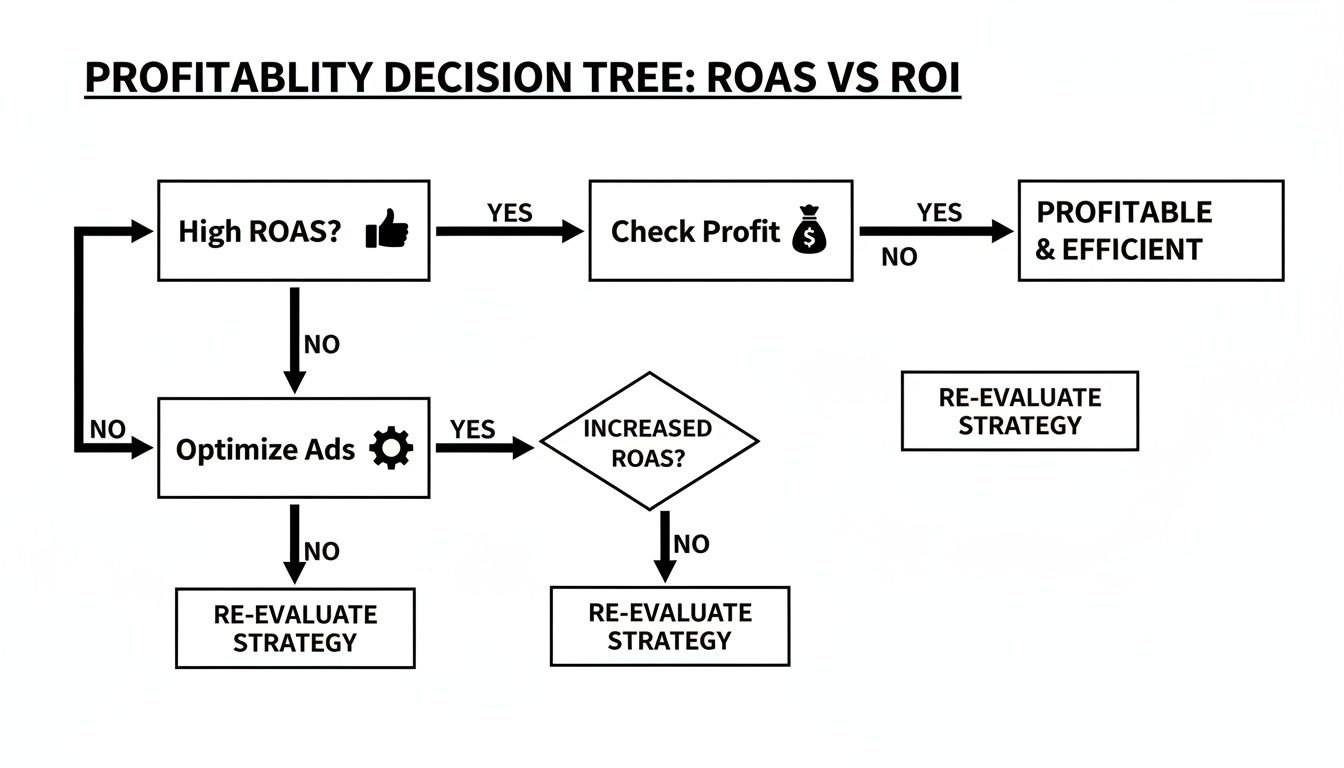
The flowchart makes a critical point clear: a high ROAS is a green light to investigate profitability with ROI, not a blind signal to crank up the ad spend.
Here's a quick framework for choosing the right metric based on the decision you need to make.
Decision Making Framework: ROAS vs. ROI
Scenario or Decision | Primary Metric to Use | Rationale |
|---|---|---|
Daily Ad Campaign Optimization | ROAS | You need a fast, direct measure of ad spend efficiency to make quick adjustments to bids, budgets, and creative. |
Evaluating Creative Performance | ROAS | Helps you compare which ad variations are generating the most revenue for every dollar spent on that ad. |
Choosing Between Marketing Channels | ROI | A full ROI analysis is required to compare the true profitability of channels with different cost structures (e.g., paid social vs. SEO). |
Setting Annual/Quarterly Budgets | ROI | High-level budget allocation should be based on which initiatives deliver the best overall return on total investment. |
Assessing Product Line Profitability | ROI | ROAS can be misleading if a product has a low margin. ROI tells you if you're actually making money on it after all costs. |
Deciding on Scaling a Business | ROI | Scaling decisions must be based on a comprehensive understanding of profitability, not just top-line revenue from ads. |
By separating their functions, you can build a much more resilient marketing operation. Your performance team can focus on hitting ROAS targets to drive efficient growth, while leadership uses ROI to ensure that growth is sustainable and actually adding to the bottom line. When used in its proper context, each metric becomes an incredibly powerful tool for building a successful business.
Common Traps That Hurt E-commerce Profitability
Knowing the difference between ROAS and ROI is one thing. Actually avoiding the common pitfalls that come from misreading these metrics is what protects your profitability. Too many brands get mesmerized by numbers that look great on a marketing dashboard but are quietly draining their bank account.
The root of most of these mistakes is the same: fixating on a single metric instead of looking at the overall health of the business. Once you learn to spot these traps, you can shift from just reacting to ad performance to building a truly strategic, resilient brand.
The Vanity ROAS Trap
This is easily the most common and dangerous mistake I see: chasing a sky-high ROAS on products with razor-thin margins. A campaign might be humming along at a 6x ROAS, and on the surface, that looks like a home run. But if the product you're pushing only has a 15% profit margin, that impressive-looking ROAS could be hiding a major loss on every sale.
Here’s how this trap springs shut:
The Lure: You spot a 6x ROAS in your ads manager and immediately crank up the budget. You think you’ve struck gold.
The Reality: Once you factor in cost of goods, shipping, and fulfillment, your total cost to get an order out the door is actually more than the revenue you brought in. You’re literally paying to give your product away.
The Solution: You absolutely must calculate your break-even ROAS for every single product or category. This number is your floor—the minimum ROAS you need to hit just to cover your costs. Anything above it is profit. Anything below is a loss.
Chasing a high ROAS without understanding your profit margins is like driving a fast car with no fuel gauge. You're moving quickly, but you have no idea how close you are to stalling out completely.
Ignoring Customer Lifetime Value
Another classic blunder is killing campaigns that have a low initial ROAS without stopping to think about their long-term value. This happens all the time with top-of-funnel customer acquisition campaigns. The goal here is to bring new people into your brand's orbit, and that first purchase might not even be profitable. Its real value is unlocked over time.
For instance, a campaign might show a 2x ROAS, which is below your break-even point. The knee-jerk reaction is to shut it down. But what if that same campaign is acquiring customers who come back to buy again and again over the next year? Its long-term ROI could be massive.
For Shopify operators, getting this right is non-negotiable. A recent analysis of DTC brands found that those who connected Customer Lifetime Value (CLTV) to their ROAS evaluations saw 15-25% better long-term ROI. They stopped prematurely cutting off promising acquisition campaigns just because the immediate return wasn't stellar. If you want to dig deeper into how top brands are managing this, check out these insights on ROAS and ROI from azariangrowthagency.com.
The Over-Optimization Panic
The final trap is getting spooked by daily ROAS swings and making impulsive, short-sighted changes. Ad platforms like Meta and Google need time to learn, and performance can be erratic during this phase. Seeing ROAS dip for a day or two sends many marketers into a panic, leading them to frantically tweak budgets, targeting, or ad creative.
This constant meddling just disrupts the algorithm's learning process and prevents the campaign from ever hitting its stride. It creates a self-inflicted cycle of instability where performance never settles, and the constant edits just drive up costs and torpedo your overall ROI.
How to avoid this:
Trust the Learning Phase: Give new campaigns enough time and money to exit the learning phase before you start making major adjustments.
Look at Trends, Not Snapshots: Judge performance based on a 7-day or 14-day window. Don't make big decisions based on just 24 hours of data.
Use Guardrails: This is exactly the kind of problem a tool like SpendOwlAI is built to solve. It monitors for volatility and flags when campaigns are being edited too frequently. It helps you tell the difference between a real performance problem and normal algorithmic fluctuations, stopping you from over-editing your way into a lower ROI.
Balancing ROAS and ROI for Sustainable Growth

Knowing the difference in the ROAS vs ROI debate is one thing, but actually using that knowledge to drive growth is another game entirely. The real challenge for any performance marketer isn't just watching two numbers on a dashboard; it's about building a solid decision-making framework. You need a system that balances the immediate wins flagged by ROAS with the long-term, big-picture profitability measured by ROI.
This is where tactical campaign tweaks and strategic business goals stop being two separate conversations and start informing each other. It’s about creating a rhythm of deliberate, data-backed actions that protect your bottom line while you scale.
Bridging Tactics and Strategy
You don't have to choose between ROAS and ROI. In a smart growth strategy, ROAS acts as your real-time tactical guide, while ROI serves as the ultimate guardrail, making sure those quick moves are actually profitable.
Think about what a good system should do during your daily ad account check-in. It should flag two very different situations:
High-ROAS Opportunity: A specific campaign is crushing it with a consistently high ROAS and stable performance. The clear recommendation? Push more budget its way. This is a classic tactical move to double down on what’s working right now.
Declining ROAS Threat: At the same time, it flags another campaign where ROAS is slowly bleeding out due to ad fatigue. It’s still technically profitable today, but the downward trend is a direct threat to your long-term ROI. The smart move isn't to kill it, but to refresh the creative and stop a future profitability problem before it starts.
This is how you bridge the gap between reacting to today's numbers and planning for a healthy next quarter.
A truly effective system doesn't just show you numbers; it tells you what to do with them. It combines the speed of ROAS with the wisdom of ROI, creating a framework for confident, profitable decisions.
A Framework for Confident Execution
Building this balance requires discipline. For performance teams running ads on Meta, Google, and Shopify, ROAS is your go-to for tactical calls, like spotting audience saturation. But it’s ROI that tells you if strong performance on a specific SKU justifies expanding an entire product line or channel. A smart system helps you navigate this by looking at ROAS in the context of other health metrics. A crucial first step is understanding your baseline, which is covered in our guide on using a break-even ROAS calculator.
Systems like SpendOwlAI create daily, ranked action lists by looking at ROAS alongside CTR, delivery stability, and even how often you’ve been editing a campaign. This prevents those reactive, knee-jerk changes that can derail long-term growth. Early users have seen real results, reporting 25% lifts in ROAS and 18% gains in ROI simply by following guardrails that stop them from chasing noise. To see how other industry leaders think about this, you can discover more insights about return on ad spend at Triple Whale.
Prioritizing Actions for Growth
In the end, it all comes down to prioritizing your actions. Not every dip in ROAS is a five-alarm fire, and not every high-ROAS campaign is ready for a massive budget injection. A structured process helps you tell the difference between normal fluctuations and genuine threats or opportunities.
Here’s a simple way to frame your focus:
Daily Focus (ROAS-Driven): Keep an eye on campaign-level performance for quick, efficient adjustments. Are my ads running smoothly? Is the immediate return looking good?
Weekly/Monthly Focus (ROI-Driven): Zoom out to review profitability at the channel and business level. Is our growth actually sustainable? Are we protecting our margins?
This dual-track approach lets your team be agile without being reckless. By connecting your daily tweaks to your strategic profitability goals, you build a powerful engine for scalable—and more importantly, sustainable—growth. It’s the difference between just spending money on ads and truly investing in your business.
Turning Metrics Into a Winning Ad Strategy
Understanding the difference between ROAS and ROI is more than just a theory lesson—it's the bedrock of a resilient and profitable ad strategy. These two metrics aren't in opposition. Think of them as essential partners that give you a complete view of your business's health, telling you what's working right now and what will keep you profitable in the long run.
ROAS is your real-time pulse check. It's the tactical, in-the-trenches feedback you need to tweak creatives, adjust audiences, and fine-tune bids. ROI, on the other hand, is the definitive health report for your entire business. It confirms whether your growth is actually padding your bottom line after every single cost is accounted for.
Your Action Plan for Profitable Growth
Getting past simple number-watching requires a clear, repeatable system. A winning strategy weaves both metrics into your decision-making, turning raw data into confident, profitable actions that build a sustainable ecommerce brand.
The real goal is to build a business where high-ROAS campaigns feed a healthy, growing ROI. This is the sweet spot where sustainable scaling happens, moving you from just reacting to numbers to strategically building an asset.
To make this happen, you need a simple, three-step action plan that connects your daily tactics to your long-term strategic goals. This approach makes sure your marketing efforts are both efficient and truly effective.
Three Steps to a Smarter Strategy
Here’s a clear framework you can put into practice today:
Set Your Profitability Floor: Before you spend another dime on ads, calculate your break-even ROAS for your most important products. This number is your non-negotiable baseline for profit and the most critical guardrail for your ad spend.
Sync Up Your Reporting: Stop looking at ROAS and ROI in separate meetings. Review ROAS daily or weekly to guide tactical campaign adjustments. Then, review ROI on a weekly or monthly basis to check on channel health and make bigger decisions about budgets and where to put your resources.
Find Your Balance with a System: Put a process in place that helps you balance short-term wins with your long-term vision. A system like SpendOwlAI delivers daily, prioritized actions that weigh immediate ROAS opportunities against potential threats to your long-term ROI, helping you avoid knee-jerk changes that cost you later.
Following this plan helps your team move beyond gut feelings and vanity metrics. You’ll start building a business engine fueled by smart, data-backed decisions that drive not just revenue, but real, sustainable profit.
ROAS vs. ROI: Your Questions Answered
Even when you’ve got the basics down, a few questions always seem to surface when you start applying ROAS and ROI to real-world campaigns. Let's tackle some of the most common ones I hear from other marketers.
What’s a Good ROAS for E-commerce?
You’ll often hear 4:1 thrown around as the "good" ROAS benchmark, meaning you get $4 back for every $1 you spend. But honestly, that number is almost meaningless without context. The only "good" ROAS is a profitable one for your business.
If you're selling high-margin luxury goods, a 3:1 ROAS might be fantastically profitable. But if you’re in a low-margin, high-volume industry, you might need a 10:1 ROAS just to keep the lights on. The first thing you absolutely must do is calculate your break-even ROAS—that’s your real starting line for what "good" looks like.
Can You Have a High ROAS but Negative ROI?
Absolutely, and it's a trap I've seen countless brands fall into. It’s surprisingly easy to get a 5:1 ROAS that looks incredible on your ads dashboard while you’re actually losing money hand over fist.
How? Because ROAS only looks at ad spend. Once you factor in the cost of the goods themselves, shipping, payment processing fees, and all the other operational costs, that "profit" can vanish. This is exactly why ROI is the ultimate gut-check. It tells you the real story of your business's financial health.
A high ROAS feels good on paper, but a positive ROI is what actually pays the bills. Don't ever confuse campaign efficiency with true profitability.
How Does Customer Lifetime Value (CLTV) Fit In?
This is where things get really interesting. Customer Lifetime Value (CLTV) can completely reframe how you look at both ROAS and ROI. You might run a customer acquisition campaign that, on its own, has a pretty dismal ROAS—maybe it doesn't even break even on that first purchase.
But if that customer sticks around and makes several more purchases over the next year, their total value skyrockets. That initial loss-leader campaign suddenly looks brilliant from a long-term ROI perspective. If you only focus on immediate ROAS, you risk shutting down campaigns that are actually planting the seeds for future growth.
How Often Should I Be Checking These Metrics?
ROAS and ROI operate on completely different clocks because they serve different needs.
Think of ROAS as your tactical, in-the-trenches metric. You should be looking at it frequently—maybe even daily—to make quick adjustments to your live campaigns. It’s perfect for tweaking bids, reallocating budgets, and swapping out creative on the fly.
ROI, however, is your strategic, big-picture metric. It's for understanding the overall health and direction of your business. Reviewing it weekly, monthly, or quarterly is much more practical. Use it to evaluate channel performance, plan future budgets, and make sure the whole ship is headed in the right direction.
Stop making decisions based on noisy data. SpendOwlAI delivers a clear, ranked list of actions to take in your ad accounts every day, balancing ROAS opportunities with ROI guardrails to ensure you scale profitably. Start your free 7-day trial at spendowlai.com and see what you should focus on tomorrow.