Mastering Return On Ad Spend to Boost Your Profits
Think of your ad budget like an investment portfolio. Every single dollar you put in needs to work hard to bring more dollars back. That’s the entire idea behind Return On Ad Spend (ROAS).
At its core, ROAS is the metric that tells you the gross revenue generated for every dollar spent on advertising. It's the ultimate compass for your marketing strategy, helping you move from just spending money to making it.
What Is Return On Ad Spend and Why It Matters
It’s easy to get distracted by vanity metrics like clicks and impressions. They might look impressive on a report, but they don't pay the bills. ROAS cuts straight through the noise and focuses on what actually grows your business: revenue.
It answers the most critical question you can ask about your advertising: "For every dollar I put into this campaign, how many dollars did I get back?"
Let's use a simple analogy. Imagine you open a lemonade stand and spend $10 on colorful signs to attract customers. Thanks to those signs, you sell $50 worth of lemonade. Your ROAS is 5x, or 5:1. You made $5 for every $1 you spent on advertising. This same principle is the foundation of profitable growth for every business, from a local boutique to a global e-commerce giant.
The Growing Challenge of ROAS
Tracking ROAS has become non-negotiable as advertising costs have gone through the roof. The nightmare scenario for any founder or marketer is pouring money into ads without seeing a clear return.
Consider this: between 2017 and 2024, global digital ad spend exploded from $243.1 billion to a staggering $740.3 billion. But more spending didn't automatically lead to better results. In fact, 2022 benchmarks showed e-commerce ROAS hovering around a mere 2.5x in competitive industries. When you factor in product costs and other fees, many brands were just barely breaking even. You can learn more about the trends in digital ad spend at Oberlo.com.
In this tough environment, having a firm grasp on your ROAS is everything. It’s what separates businesses that scale profitably from those that just burn cash.
ROAS Quick Reference Guide
To really get a handle on this, it helps to have some benchmarks. This simple table breaks down the ROAS formula and what the numbers actually mean for your bottom line.
Metric/Concept | Definition | Practical Example |
|---|---|---|
ROAS Formula | Total Revenue from Ads / Total Ad Spend | If you spend $1,000 on ads and get $4,000 in revenue, your ROAS is 4:1. |
Below 1:1 ROAS | For every $1 spent, you earn less than $1 back. | A $0.80 return on a $1 spend. You are actively losing money. |
1:1 ROAS | For every $1 spent, you earn exactly $1 back. | This is your breakeven point on ad spend alone, not accounting for other business costs. |
3:1 ROAS | For every $1 spent, you earn $3 back. | This is often seen as a solid benchmark, suggesting you're likely profitable. |
5:1+ ROAS | For every $1 spent, you earn $5 or more back. | An indicator of a highly effective and very profitable ad campaign. |
Think of this table as your go-to guide. A 3:1 ROAS is a common target, but a 1:1 ROAS isn't a total failure—it just means you broke even on your ad cost. Knowing where you stand is the first step to making smarter decisions.
How to Calculate Your True Return On Ad Spend
Ever looked at your ad platform’s dashboard and felt a surge of confidence? The revenue numbers are up, the ROAS looks great, and it feels like your campaigns are absolutely firing on all cylinders.
But here's a hard truth I've learned from years in the trenches: that "dashboard ROAS" can be a bit of an optimistic storyteller. It often paints a rosier picture than reality, hiding the real story of your profitability. To make genuinely smart budget decisions, you have to dig deeper and calculate your true return on ad spend.
This means going beyond the surface-level metrics to account for all the costs that quietly eat away at your revenue. At its core, the goal is simple: turn ad dollars into more revenue. This flow chart breaks it down to its most basic elements.
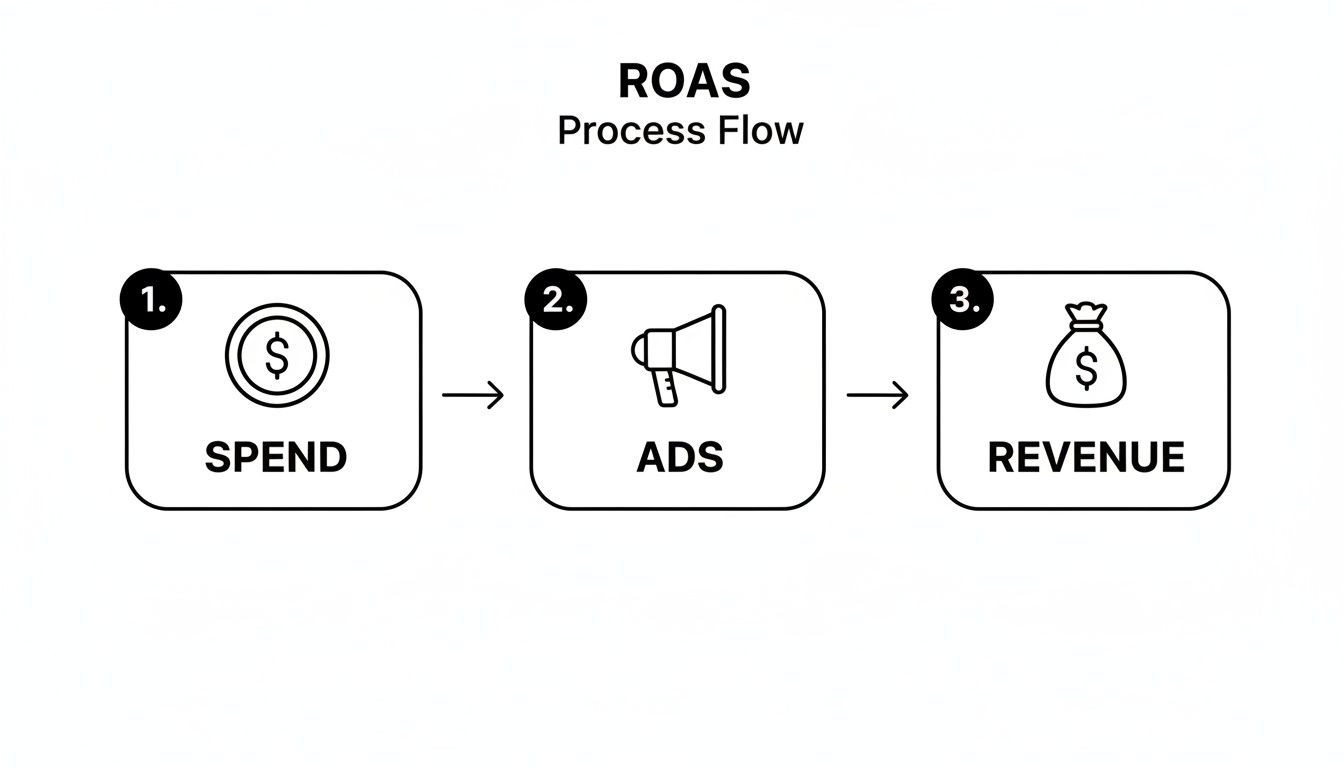
While the diagram makes it look straightforward, the real challenge is understanding what happens after the revenue comes in—specifically, all the costs you have to subtract from that final number.
The Problem With Dashboard ROAS
The ROAS you see on your Meta or Google dashboard uses a very simple formula: Total Revenue from Ads / Total Ad Spend. The problem? This calculation ignores several critical expenses that directly impact your profit margins.
To find your true, profit-driven ROAS, you must factor in all the associated costs. Think of it like this: the revenue shown in your ad account is your gross income, but what you actually take home is the net profit after all your business expenses are paid.
These costs almost always include:
Cost of Goods Sold (COGS): What you actually paid for the products you sold.
Shipping and Fulfillment Costs: The expenses to pick, pack, and ship orders to your customers.
Transaction Fees: The percentage taken by payment processors like Shopify Payments or Stripe.
Software and Agency Costs: Any retainers or platform subscriptions tied to your marketing efforts.
True profitability isn't about chasing a high ROAS; it's about staying consistently above your breakeven point after every single cost is accounted for.
Ignoring these expenses gives you a dangerously incomplete picture. A 3x ROAS on your dashboard might feel like a huge win, but if your product margins are 50%, you could actually be losing money on every sale once you factor in shipping and other fees.
Finding Your Breakeven ROAS
This brings us to one of the most important numbers in your business: your breakeven ROAS. This is the absolute minimum ROAS you must achieve to cover all your costs without losing a dime. Knowing this number is the first step toward building a truly profitable advertising strategy.
The formula is elegantly simple:
Breakeven ROAS = 1 / Profit Margin
Let's walk through a real-world example for an e-commerce store.
Product Price: You sell a fantastic widget for $100.
Cost of Goods (COGS): It costs you $30 to manufacture or purchase that widget.
Other Variable Costs: Let's say shipping, fulfillment, and payment processing fees add up to $20 per order.
Total Cost Per Sale: Your total cost is $30 (COGS) + $20 (other costs) = $50.
Profit Per Sale: Your profit is $100 (revenue) - $50 (total costs) = $50.
Profit Margin: Now, find your margin: $50 (profit) / $100 (revenue) = 50% (or 0.5).
With your profit margin in hand, you can find your breakeven ROAS:
Breakeven ROAS = 1 / 0.5 = 2x
This simple calculation reveals a powerful insight: you need to generate at least $2 in revenue for every $1 you spend on ads just to cover your costs. Anything below a 2x ROAS is a loss, while anything above it is pure profit.
This transforms ROAS from a simple vanity metric into a crucial tool for financial decision-making. For a more detailed walkthrough and some helpful tools, check out our guide on how to use a breakeven ROAS calculator.
What's a Good ROAS, Really?
Everyone seems to be chasing that magic 4:1 return on ad spend. It's held up as the gold standard, but honestly? That's a myth. A "good" ROAS is deeply personal to your business, shaped by your specific profit margins, your industry, and what you're trying to achieve at that moment.
Fixating on some universal benchmark is a strategic trap. What looks like a home run for one brand could easily bankrupt another. So, it's time to stop asking, "What's a good ROAS?" and start asking, "What's a good ROAS for my business?"
The Problem with Universal Benchmarks
Let's make this real. Imagine two e-commerce stores. One sells a coffee subscription, banking on high customer lifetime value (LTV). The other sells trendy, low-cost phone cases with razor-thin margins.
For the coffee brand, a 2:1 ROAS on a customer's first purchase could be a huge win. Why? Because they know that customer is very likely to stick around, making repeat purchases for months or even years. The initial ad spend is simply an investment in a long-term, profitable relationship.
But for the phone case brand with a tight 30% profit margin, that same 2:1 ROAS would be a disaster. After they pay for the product, shipping, and transaction fees, they'd be losing money on every single sale driven by ads. They absolutely need a 4:1 or 5:1 ROAS just to stay in the black.
A "good" ROAS is simply one that keeps you profitably above your unique breakeven point. It's not about hitting some arbitrary number—it’s about funding your growth without bleeding cash.
See? Context is everything. Your business model is what truly dictates your ROAS target.
Finding Your Starting Point with Industry Averages
While your own profitability is king, looking at industry benchmarks can give you a decent feel for the landscape. They provide a general sense of what's typical for your vertical, influenced by things like the level of competition, average order values (AOV), and how often customers come back to buy again.
Here’s a quick look at what you might see across different sectors:
Fashion & Apparel: This space often sees a lower ROAS, usually hovering around 2x to 4x. The intense competition, high return rates, and the constant need for fresh ad creative put a cap on returns.
Beauty & Cosmetics: These brands typically do better, often landing in the 3x to 5x range. High brand loyalty and repeat purchases fuel a healthier return on ad spend.
Home Goods & Furniture: This category is a mixed bag, but a 3x to 6x+ ROAS isn't uncommon. The higher AOV helps a lot, but you have to be patient with a longer sales cycle.
Remember, these are guideposts, not gospel. The ad world is getting more crowded and expensive by the day. A 2024 report on internet ad revenue really drove this home; while US ad revenue hit a staggering $259 billion, the average ROAS for e-commerce brands often struggled to stay around 2.5x. Many brands even saw their ROAS dip below 3x thanks to rising costs and ad fatigue. You can dig into the ad revenue trends in the full report for more details.
This just goes to show that even with massive spending, profit is never a given. It makes setting a realistic ROAS target more critical than ever. Start with your breakeven point, then adjust your goal based on what you need to do—whether that's maximizing profit, scaling like crazy, or just clearing out old inventory.
Actionable Strategies to Improve Return On Ad Spend

Knowing your true profitability is one thing, but actually improving it? That’s where the real work begins. Boosting your return on ad spend isn't about finding a single silver bullet. It's about making disciplined, strategic improvements across the core levers of your advertising.
Think of your ad account as a high-performance engine. To get more power and efficiency, you can't just wish for it—you have to get under the hood and tune the critical components. For us, those components are your creative, your audience, and your budget.
This section is a tactical playbook designed to help you do just that. We'll get into practical "do this, not that" examples that can drive real, immediate improvements. Let's break down how to optimize each area for a much healthier ROAS.
Master Your Creative Optimization
Your ad creative is the tip of the spear. It’s the first—and often only—thing a potential customer sees. You can have the perfect audience and a flawless budget, but a weak creative will sink your ROAS every single time.
The secret to great creative isn't just making something that looks nice; it's about relentlessly testing to see what actually connects with people. This means actively fighting ad fatigue, which is what happens when performance tanks simply because your audience is tired of seeing the same ad. In fact, one study showed that after merchants switched to smarter campaign types with auto-generated creative, they saw an 18% boost in ROAS. It’s a powerful reminder that fresh, relevant ads win.
To get started, focus your tests on these critical elements:
The Hook (First 3 Seconds): Experiment with different opening lines, visuals, or questions. For a video ad, you could pit a text-on-screen hook against a person speaking directly to the camera.
The Format: Test static images against videos. Try carousels against user-generated content (UGC). Different formats appeal to different people, and you won't know what works best until you test.
The Angle: Don't just sell the product; sell the transformation. Test a "problem/solution" angle (e.g., "Tired of dull skin?") against a "benefit-driven" one (e.g., "Get a radiant glow in 7 days").
A winning ad isn't found; it's built. Consistent, methodical testing is the only path to discovering creative that not only grabs attention but also drives profitable conversions.
Refine Your Audience Targeting
You can have the best ad in the world, but if you show it to the wrong people, you're just lighting money on fire. Refining your audience targeting is all about moving from broad assumptions to data-driven precision. The goal is to find high-intent buyers without paying a fortune to reach them.
A major pitfall here is audience saturation. This is when you've shown your ads to the most interested people in your audience so many times that performance starts to drop. The key is to spot the warning signs—like a rising Cost Per Click (CPC) and a falling Click-Through Rate (CTR)—before they drain your budget.
Here’s how to sharpen your targeting for a better return on ad spend:
Go Beyond Basic Interests: Instead of just targeting a broad interest like "skincare," create a lookalike audience from your list of top-spending customers. This uses your own first-party data to find people who look and act just like your best buyers.
Segment Your Retargeting: Don't lump all your website visitors into one giant bucket. Create separate audiences for "viewed product," "added to cart," and "initiated checkout." This allows you to tailor your message and offer based on how close they actually were to buying.
Test Broad, but Verify: Modern ad algorithms are pretty good with broad targeting, but don't just "set it and forget it." Let the algorithm explore, but keep a close eye on your cost per acquisition (CPA). If broad targeting isn't bringing in profitable customers, it’s time to narrow your focus back to more specific lookalikes or interest groups.
Implement a Smarter Budget Strategy
Your budget strategy is what dictates how your money is spent and scaled. Knee-jerk reactions—like killing an ad after one bad day or dumping money into a new winner too fast—are a surefire way to hurt your ROAS. A smart budget strategy is all about disciplined, data-backed decisions.
For example, when should you use Campaign Budget Optimization (CBO)? CBO is fantastic for letting the ad platform automatically shift your budget to the best-performing ad sets. However, if you absolutely need to guarantee spend on a specific audience (like a high-value retargeting segment), setting the budget at the ad set level gives you that control.
Here are a few practical budget rules to live by:
Scale Winning Ads Carefully: When an ad is crushing it, resist the urge to double the budget overnight. This can shock the algorithm and reset its learning phase. Instead, increase the budget by a steady 15-20% every 2-3 days to scale performance reliably.
Know When to Cut Losses: Don't let a losing ad run "just in case" it turns around. Set clear rules for yourself. For instance, if an ad has spent twice your target CPA without a single conversion, it's time to turn it off.
Balance Prospecting and Retargeting: A solid rule of thumb is an 80/20 split. This means putting 80% of your budget toward finding new customers (prospecting) and 20% toward re-engaging people who have already visited your site (retargeting).
Improving your ROAS is also directly tied to how well your ads convert visitors once they land on your site. For more on this, check out our guide on improving your website conversion optimization.
How to Diagnose and Fix Common ROAS Problems

When your return on ad spend suddenly takes a nosedive, it's easy to panic. The first instinct is often to start frantically slashing budgets, pausing campaigns, or swapping out creatives. But the best move is to take a deep breath and diagnose the problem systematically before you act.
Think of yourself as a detective arriving at a crime scene. You wouldn’t start dusting for fingerprints in the attic without first checking if the front door was forced open. In advertising, this means ruling out simple, external issues before you dive deep into the complexities of your ad campaigns. This structured approach ensures you’re making decisions based on data, not just a gut reaction.
Check for External Issues First
More often than you'd think, the root of the problem isn't even in your ad account. Performance is often at the mercy of outside factors, and checking these first can save you hours of wasted effort.
Start by running through this quick diagnostic checklist:
Website Functionality: Is your website up and running smoothly? Are there any broken links on your key landing pages? A simple bug in the checkout flow is all it takes to kill conversions and tank your ROAS.
Payment Processor Errors: Double-check that your payment gateways, like Shopify Payments or Stripe, are working correctly. If customers can't pay, it doesn't matter how great your ads are.
Seasonal Dips: Could a seasonal trend be the culprit? Performance naturally ebbs and flows around major holidays or specific times of the year. Compare your current numbers to the same period last year to see if you’re looking at a pattern or a new problem.
Identifying Campaign-Specific Symptoms
Once you've confirmed that your site and payment systems are fine, it’s time to put your campaigns under the microscope. Most ROAS issues trace back to a few usual suspects: your creative, your audience, or your tracking. Here are the most common symptoms and how to fix them.
Symptom 1: High Clicks, Low Conversions
Your ads are grabbing plenty of eyeballs and getting clicks, but that traffic just isn't translating into sales. This is a classic sign of a mismatch between your ad's promise and your landing page's delivery.
The Cure: Put yourself in your customer’s shoes and analyze the landing page experience. Does the message on the page line up with the ad they just clicked? Is it easy to find what they're looking for, with a clear call-to-action (CTA)? You might also need to re-evaluate your product-market fit or see if the price point feels right for the value you're offering in the ad.
Symptom 2: Rising Ad Costs and Declining CTR
You're watching your Cost Per Click (CPC) creep up while your Click-Through Rate (CTR) is simultaneously dropping. This is the textbook definition of creative fatigue. Your audience has seen your ad so many times it's become invisible.
The Cure: It's time for a creative refresh. Test out new ad copy, experiment with different visuals—like user-generated content versus polished studio shots—and try new video hooks. The goal here is to present your product in a fresh, engaging way that snaps your audience out of their ad blindness and boosts your return on ad spend.
Keeping ROAS healthy is only getting tougher. With global ad spend projected to blow past $1 trillion in 2026, standing out is harder than ever. The top advertisers are hitting a 5x ROAS by avoiding saturation, while others are wasting 20-30% of their budget on reactive, panic-driven tweaks. You can read more about this in the global ad spend forecast on WARC.com.
A disciplined diagnostic process is your best defense against wasting money. Don't let panic-driven edits destroy a campaign that just needs a targeted fix. Treat the symptom, not just the metric.
Symptom 3: Performance Suddenly Drops After a Great Week
Your ROAS was incredible for a few days, and then it fell off a cliff. If you check your frequency metric and see it's high (say, above 3-4 in a short span), you're almost certainly dealing with audience saturation. You've simply shown your ads to the most interested people in your audience, and now you're running on fumes.
The Cure: It’s time to find new people. Expand your targeting by building new lookalike audiences from recent purchasers or high-value customer lists. Test out some new interest-based groups, or simply broaden your targeting and let the ad platform's algorithm do the work of finding new pockets of customers for you.
Moving From Reactive Dashboards to Proactive Growth
Digging into your return on ad spend is absolutely essential, but let's be honest—it's usually a backward-looking exercise. You're staring at dashboards crammed with charts and numbers, trying to piece together a story from dozens of campaigns, ad sets, and creatives. This leads to a classic marketer's headache: drowning in data but starved for clear direction.
The old way of managing ads is a grind. It's a cycle of constant monitoring, gut-feel decisions, and that nagging fear you've missed a crucial dip or surge in performance. You're stuck in a loop of analysis paralysis, which is often broken by impulsive edits that do more harm than good. This reactive firefighting is a huge source of wasted ad spend.
A Shift to Proactive, Guided Action
But what if you could get ahead of the curve instead of just reacting to what's already happened? A new approach flips this entire dynamic. Instead of getting lost in dashboards, you could start your day with a clear, prioritized to-do list focused on one thing: improving your ROAS.
This proactive model lets technology handle the heavy lifting. It can spot problems like creative fatigue and audience saturation long before they start burning through your budget. It highlights which ads are your winners, which are starting to fade, and exactly where your next dollar will make the biggest impact—then tells you precisely what to do about it.
For example, imagine your daily "what to do" list looking like this:
The screenshot above shows a simple, ranked list of actions. You see recommendations like pausing an underperforming ad or scaling a winning one, with the specific dollar impact spelled out. This turns hours of manual analysis into a few minutes of confident decision-making. You get to act on genuine insights, not just raw data.
Building Guardrails Against Impulsive Edits
One of the sneakiest threats to a healthy ROAS is the tendency to over-edit. Constantly tinkering with campaigns based on a few hours of noisy data can throw the ad platform's learning phase out of whack and sabotage your long-term results. Proactive systems help build guardrails against this very problem.
By serving up disciplined, data-backed recommendations, these tools empower you to execute your ad strategy with conviction every single day. They tell you which changes matter most and—just as importantly—give you the confidence to leave everything else alone.
Instead of asking "What should I change?" you start your day knowing exactly what actions will protect and grow your ROAS. This shift is fundamental to scaling profitably.
This disciplined approach means you're making smart, impactful moves that consistently drive better returns. It's about replacing guesswork with clarity and confidence. Of course, the complexities of different platforms and tracking systems can make this tough, which is why having the right setup is crucial. You can dive deeper into this topic by exploring our guide to the best marketing attribution software on the market.
Return On Ad Spend: Your Questions Answered
Even when you've got a good handle on ROAS, tricky questions always pop up when you're in the weeds managing campaigns. Let's tackle some of the most common ones so you can navigate them like a pro.
How Long Should I Wait Before Measuring ROAS?
I get it—you just launched a campaign and you're dying to see the results. But checking ROAS too soon is a classic mistake. You've got to give your campaigns time to find their footing.
On platforms like Meta, this means getting through the "learning phase." This usually takes about 7 days or until the campaign racks up 50 conversion events. Performance can be all over the place initially, so wait for things to stabilize. For a reliable picture, I recommend looking at a 7 to 14-day window after that learning period. If you're selling something with a longer sales cycle, you might even need to stretch that out to 28 days to see the full story.
Why Is My ROAS Different Across Platforms?
This is a huge source of confusion, and it all comes down to one word: attribution. Ad platforms like Meta and Google Ads are pretty generous with themselves—they'll often claim credit for a sale if a user just interacted with an ad at some point. On the other hand, Google Analytics typically defaults to a last-click model, giving all the glory to the very last touchpoint before the purchase.
The truth? It’s usually somewhere in the middle. Use the ad platform data to see how your campaigns are influencing behavior, but rely on a source like Google Analytics to get a more holistic view of the entire customer journey. For the most accurate picture, you'll want to explore a multi-touch attribution model.
Can I Have a High ROAS and Still Lose Money?
Yes, you absolutely can. This is a critical trap many advertisers fall into. A "high" ROAS is meaningless unless it's higher than your breakeven point.
Think about it this way: if your business runs on a 25% profit margin, you need a 4x ROAS just to cover your costs (the math is 1 / 0.25). A 3x ROAS might look good on your dashboard, but in reality, you're losing money with every ad-driven sale. That's why figuring out your true breakeven ROAS—the one that accounts for all your costs, not just ad spend—is one of the most important things you can do.
Stop wasting time trying to decipher confusing dashboards. Start your day with a clear, prioritized to-do list designed to boost your return on ad spend. SpendOwlAI cuts through the noise from Meta and Google, telling you exactly which ads to scale, which ones to kill, and where your next big win is hiding. Get started with a free 7-day trial and start making decisions with data-backed confidence.