Smarter Reports And Analytics for Winning Ad Performance
Let's be honest: staring at a screen full of ad data isn't a strategy. For your reports and analytics to actually mean something, they have to turn that chaos of numbers into clear, confident actions. It’s the difference between just knowing your metrics and knowing what to do about them.
Beyond The Dashboard: What Reports And Analytics Really Mean
For most e-commerce store owners, the words "reports" and "analytics" conjure up images of cluttered dashboards, confusing graphs, and that nagging feeling you’re missing something important. The problem isn't a lack of data. It’s an overload of it. This leads straight to 'analysis paralysis,' where you’re so overwhelmed you can't make a decision.
The goal isn't to watch every single dial flicker.
Think of it like a pilot in a cockpit. They aren't staring at every single gauge at once. They're trained to focus on the critical instruments that tell them when a change in direction or altitude is absolutely necessary. Managing your ads well works the exact same way. It's all about filtering out the noise to spot the meaningful shifts that actually require your attention.
Shifting from Data Collection to Decisive Execution
The real power of reports and analytics is in how they guide your next move. Instead of just showing you that your Return on Ad Spend (ROAS) dropped, a truly useful system should help you understand why it dropped and what you should do about it. That's where the industry is heading.
The demand for tools that cut through the noise is undeniable. The marketing analytics market, which was valued at USD 7.12 billion in 2025, is expected to more than double to USD 14.55 billion by 2031. This massive growth is being fueled by operators on platforms like Meta and Google who need smart, scalable solutions to flag real performance issues without the old-school complexity. You can find more detail on this trend over at Mordor Intelligence.
The most effective approach reframes the goal from just collecting data to making decisive moves. It’s about having a system that gives you a ranked list of actions, not just more charts to figure out on your own.
This new way of thinking zeroes in on:
Prioritized Actions: Pinpointing the few changes that will make the biggest difference.
Meaningful Signals: Learning to tell the difference between random daily blips and genuine performance trends.
Clear Rationale: Understanding the "why" behind every recommendation, so you can act with confidence.
When you focus on execution instead of just observation, your analytics transform from a source of stress into a real competitive edge. This also means getting a handle on the complete customer journey, a topic we dive into in our guide to marketing attribution software. A system like SpendOwlAI is built on this very philosophy, giving you the guardrails and clear, ranked actions you need to stop making reactive mistakes and protect your ad budget.
The Critical Ad Metrics You Should Actually Monitor
When you open up your ad accounts, you’re hit with a wall of data. It’s easy to get lost in the numbers, but the secret to great reporting and analytics isn't tracking everything. It’s about zeroing in on the few vital signs that truly signal an opportunity or a looming problem.
To cut through the noise, I like to split these signals into two main buckets: the metrics that tell you what’s happening right now, and the ones that predict what’s going to happen next.
This simple diagram breaks down the ideal workflow: turning that messy, raw data into clear, confident actions.
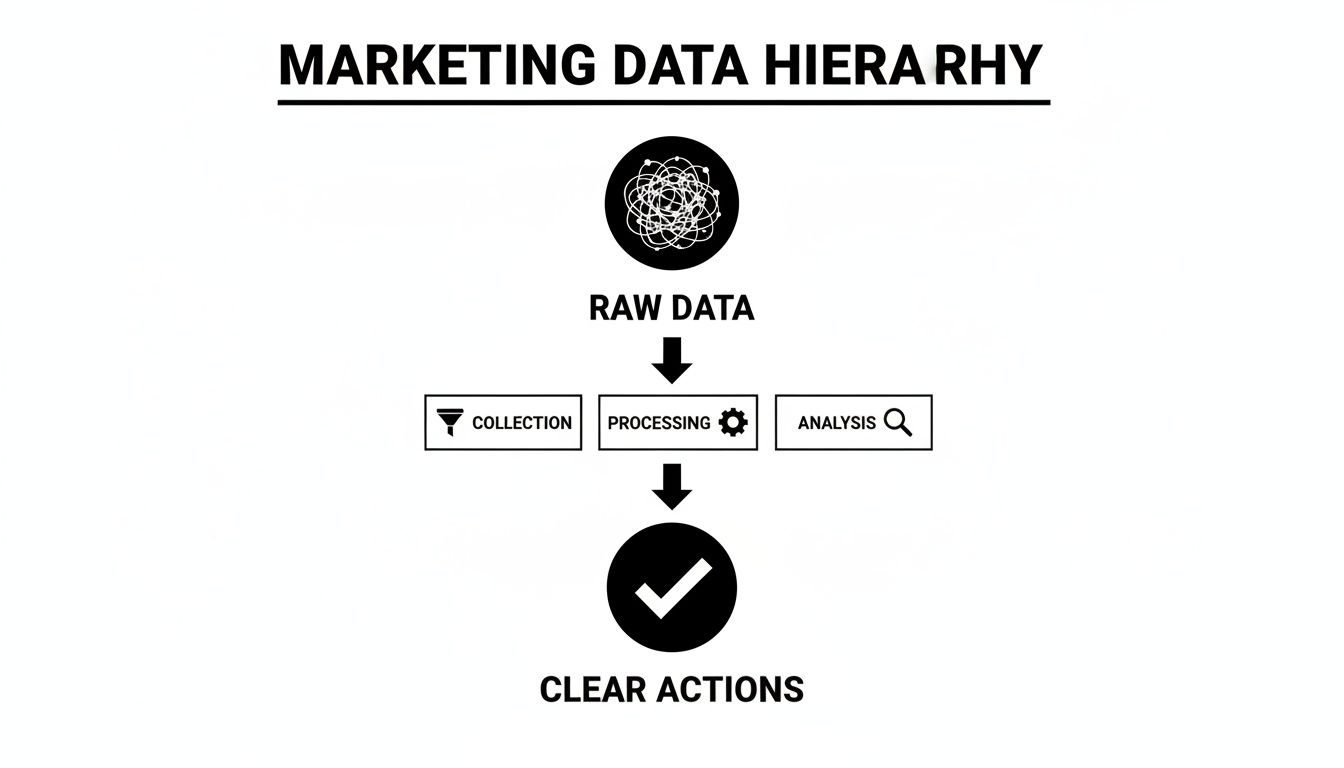
The big takeaway here is that data is only useful when it points to a specific next step. You need to move from just looking at numbers to actually doing something with them.
H3: The Core Performance Metrics
Let's start with the basics. These are your "results" metrics—the numbers that directly tell you if your ad spend is making you money.
Return on Ad Spend (ROAS): This is the king of all metrics. For every dollar you put in, how many did you get back? A low ROAS is a blaring alarm that something’s off—it could be the ad creative, the offer, or the audience you're targeting.
Cost per Result (CPR) / Cost per Acquisition (CPA): This tells you exactly what you’re paying for a specific outcome, like a sale or a lead. Watching your CPR is the best way to know if you're getting more or less efficient over time.
Click-Through Rate (CTR): This one measures how many people who see your ad bother to click it. While not a direct profitability metric, a strong CTR is a fantastic sign that your creative and copy are hitting the mark with your audience.
These metrics answer the big question: "Is this campaign working?" But they don't tell you why. For that, you need to look at the next layer of data.
H3: The Campaign Health Metrics
I call these the "predictive" metrics. They’re the early-warning signs that give you a heads-up about future trouble. Watching them lets you step in and fix things before they start draining your budget. Think of them as the ‘why’ behind your performance numbers.
A sudden drop in ROAS is a lagging indicator—the problem has already happened. A rising frequency or a high audience saturation rate is a leading indicator—it tells you a problem is just around the corner.
Here are the key health signals I always keep an eye on:
Ad Fatigue: This is what happens when your audience has seen your ad so many times it's just become background noise. You'll spot this when your CTR drops while Frequency (the average number of times someone sees your ad) starts creeping up.
Audience Saturation: You've basically shown your ads to everyone in your target audience who’s going to see them. The tell-tale sign is a plummeting "first-time impression ratio," which means you're running out of fresh eyes.
Performance Volatility: This measures how stable your results are. If your CPA is swinging wildly from day to day, your campaign is on shaky ground and definitely not ready to scale.
To make this distinction clearer, think about it this way: Core Performance Metrics are about results, while Campaign Health Metrics are about sustainability. One tells you if you're winning today; the other tells you if you're set up to keep winning tomorrow.
Here’s a quick comparison:
Core Performance Metrics vs. Campaign Health Metrics
Metric Category | Key Metrics | What It Tells You | Example Action |
|---|---|---|---|
Core Performance | ROAS, CPA, Revenue, Purchases | "Am I getting the results I'm paying for?" | If ROAS is below your target, you might pause a poor-performing ad set. |
Campaign Health | Frequency, Saturation, Volatility, CTR | "Is my campaign stable and set up for future success?" | If Frequency is high and CTR is dropping, it's time to launch fresh creative to combat fatigue. |
Seeing the difference? One is reactive (the result is already in), while the other is proactive (preventing a future bad result).
When you start combining performance metrics with health metrics, your reports and analytics suddenly become a powerful diagnostic tool. Instead of just panicking over a low ROAS, you can pinpoint the root cause—like creative fatigue—and take precise, effective action. This is exactly the kind of detective work that platforms like SpendOwlAI automate, connecting all these dots to give you clear, actionable advice every single day.
Turning Analytics Into Actionable Insights
Raw data from your ad reports is like a pantry full of ingredients but no recipe. You have everything you need, but you're not sure how to put it all together to make a meal. The real magic happens when you can connect a dip in one metric to what your audience is actually thinking and doing. It’s about turning a number on a screen into a simple, actionable question.
Think of it as learning a series of "if-then" statements. Building this interpretive muscle lets you move from observation to action fast, without getting bogged down in endless spreadsheets.

This is precisely where a modern system like SpendOwlAI shines. It doesn't just show you numbers; it presents a diagnosis that points directly to your next move, like swapping out a tired ad.
Building Your Diagnostic Muscle
Let's walk through a few common scenarios you’ll see in your own accounts. Once you understand these patterns, you can start diagnosing issues yourself, turning a confusing dashboard into a clear roadmap.
If your Click-Through Rate (CTR) is dropping while Frequency is rising, then your creative is probably getting stale. Your audience has seen the ad too many times, and it’s become background noise. The next step? Launch some fresh creative.
If your ROAS is high but your first-time impression ratio is tanking, then you’re hitting audience saturation. You've tapped a profitable group, but you're running out of new people to show your ads to. It’s time to start testing new audiences before the campaign dies out.
If your CTR is strong but your conversion rate is low, then the problem isn’t your ad—it’s likely your landing page or the offer itself. The ad did its job and earned the click, but something in the post-click experience is dropping the ball.
This interpretive step is where most marketers lose hours, jumping between spreadsheets and dashboards to connect the dots. The goal is to make this process as fast and accurate as possible.
How AI Augments Your Insights
This diagnostic process is exactly what advanced analytics platforms are built to automate. In fact, the global market for digital marketing analytics is projected to explode from USD 8,996.81 million in 2025 to USD 33,382.58 million by 2031. This growth is fueled by the need for tools that can deliver clear, actionable insights for ads across multiple channels. You can read more on the market’s rapid expansion in this detailed report from Reanin.
A platform like SpendOwlAI automates the "if-then" thinking for you. It analyzes multiple metrics at once to give you a clear diagnosis, not just a data point.
So, instead of just telling you CTR is down, it connects that signal to your rising frequency and flags the root cause: creative fatigue. This saves hours of manual digging and, more importantly, stops you from making knee-jerk decisions that can hurt performance.
Of course, for any of this to work, you need clean data. Make sure your tracking is set up correctly from the start. You can learn more about UTM parameters in our guide to get it right. This approach transforms your reporting from a complex puzzle into a prioritized to-do list.
Common Reporting Mistakes That Waste Your Ad Budget
When it comes to ad analytics, knowing what not to do is often just as important as knowing what to do. So many of the most expensive errors I see come from misreading the data or, even worse, acting on a gut feeling that turns out to be just a statistical blip. These common mistakes can quietly turn a promising campaign into a money pit.
One of the most frequent missteps is over-editing campaigns based on daily noise. An advertiser sees a bad day of ROAS, panics, and immediately starts pausing ad sets or slashing budgets. This kind of knee-jerk reaction constantly disrupts the ad platform's learning phase, which means you never give it a real chance to find its footing and deliver stable, profitable results.
Another classic mistake? Prematurely scaling a "winning" ad. You hit a fantastic ROAS for a solid 24 hours and get excited, so you start pumping more money into it. The next thing you know, performance has completely fallen off a cliff. That initial success was likely a short-term fluke, not a reliable trend, and scaling it just amplified the instability.
Ignoring The Bigger Picture
Tunnel vision is another major pitfall. I often see teams fixate on one metric while completely ignoring the context around it. For instance, they might apply a blanket rule to cut any ad set with a "low ROAS" without first asking what that ad set is actually doing for the business. That ad might be a crucial top-of-funnel touchpoint, bringing in new people who don't buy today but will a week from now.
Cutting an ad based on a single metric is like removing a car's tire because it doesn't directly power the engine. You’re ignoring its essential role in the overall system, and the entire vehicle will grind to a halt.
Similarly, ignoring campaign health metrics is a recipe for disaster down the road. Metrics like audience saturation and creative fatigue are the early warning signs that tell you performance is about to decline. If you aren't watching them, you'll only spot the problem after it's already hurting your bottom line.
The Cost of Poor Analytics
These mistakes are happening in a massive market where the stakes couldn't be higher. The AdTech sector, which powers the reports and analytics behind platforms like Meta and Google, hit USD 986.87 billion in 2025 and is on track to hit a staggering USD 3,227.25 billion by 2034. With digital ads taking up the lion's share of marketing budgets, you simply can't afford to waste money on reactive edits or premature scaling. You can explore the full AdTech market findings to see just how fast this space is growing.
This is exactly why having a system with built-in "guardrails" is so valuable. Instead of just throwing data at you, a tool like SpendOwlAI adds a layer of operational intelligence. It’s designed to stop you from making these specific, costly errors.
It monitors stability: The system flags when a campaign isn't stable enough for you to scale, stopping you from throwing good money after bad.
It diagnoses root causes: Instead of just showing you a low ROAS, it connects that result to an underlying issue like creative fatigue, so you know what you actually need to fix.
It provides context: It helps you see the bigger picture and understand an ad's role in the funnel, so you don't accidentally cut a valuable asset.
By building in these guardrails, you can turn your reports from a source of anxiety and potential mistakes into a system for confident, data-backed decisions.
A Practical Workflow For Daily Ad Management
Turning a mountain of ad data into smart, daily decisions doesn't have to be a grind. Most advertisers get stuck in a chaotic cycle of jumping between ad manager dashboards and messy spreadsheets. But you can replace that stress with a simple, repeatable morning routine.
This isn't about doing more work. It’s about focusing your effort on the few actions that will actually move the needle.

Here's a workflow I've seen work wonders for everyone from busy founders to agency teams juggling dozens of accounts. It’s efficient, easy to defend, and protects your campaigns from the kind of nervous over-editing that kills momentum.
The Five-Step Daily Check-In
A rock-solid daily ad management routine can be boiled down into five simple steps. The whole point is to get you in and out in minutes by focusing your attention only on what truly matters.
Review Prioritized Alerts: Start your day with a ranked list of the most important performance shifts. Don't just open a raw dashboard and start hunting. Look at alerts that have already been filtered for statistical significance.
Investigate the Top Recommendations: Zero in on the top one to three recommendations. Your goal isn't to fix every little fluctuation; it's to tackle the biggest opportunities or threats first.
Inspect the Rationale: Before you click a single button, understand the "why" behind the alert. A great system won't just tell you what happened, but why it matters. For example: “Creative fatigue detected due to a 20% drop in CTR and a 35% rise in frequency.”
Execute with Confidence: Once you’re clear on the diagnosis, make the change. That could mean swapping in fresh creative, reallocating a budget, or pausing a campaign that’s bleeding cash.
Leave the Rest Alone: Honestly, this is the hardest—and most important—step. After you’ve handled the big stuff, stop. Constant tinkering interferes with the ad platform's learning phase and often does more harm than good.
This methodical approach is the complete opposite of making panicked, gut-feel changes based on one bad day. It’s about surgical precision, not frantic activity.
How SpendOwlAI Streamlines This Process
This five-step workflow is the very foundation of an execution system like SpendOwlAI. It automates the noisy, time-sucking parts of sifting through reports and analytics and gives you a clear, actionable to-do list every morning. It connects the dots between all those metrics to give you a diagnosis you can actually trust.
By giving you ranked alerts with logic you can inspect, it provides the confidence to act decisively on the most important issues while safely ignoring the background noise. This turns your daily ad management from a reactive chore into a strategic, data-backed discipline.
To see just how powerful this shift can be, check out our article on how AI-driven marketing insights are reshaping strategy. You'll see how this approach gives you a massive advantage in the long run.
2. Your Ad Analytics Questions Answered
Even with a solid plan, you're bound to run into specific questions when you start digging into your ad performance data. Let's tackle some of the most common ones we hear from e-commerce operators about using reports and analytics to their full potential.
How Often Should I Check My Ad Analytics?
Instead of getting sucked into the black hole of constant dashboard refreshing, aim for one focused check-in per day. This isn't about ignoring your ads; it's about being smart with your time.
The real goal is to review prioritized alerts or significant trend changes, not the tiny daily ups and downs that just create statistical noise. This disciplined approach stops you from making knee-jerk reactions that can derail your campaign's crucial learning phase. You'll learn to act on real signals, not random movements.
What's More Important: ROAS or CTR?
This is a classic question, and the answer is simple: they tell two different, equally important stories. They aren’t competing for your attention; they work together to give you the full picture.
ROAS (Return on Ad Spend) is your main performance metric. It cuts straight to the point and answers the big question: "Is this ad actually making me money?"
CTR (Click-Through Rate) is a vital health metric. It tells you if your creative and messaging are hitting the mark with your audience, answering: "Is this ad grabbing people's attention?"
Think about a high CTR paired with a low ROAS. That's a powerful diagnostic clue. It often means your ad creative is great, but something is going wrong after the click. The problem might be your landing page, your offer, or even your product pricing.
Think of it this way: CTR tells you if you earned the click. ROAS tells you if you earned the sale. You need both to understand what’s really happening.
How Do I Know if a Change Is Real or Just Noise?
This is one of the trickiest parts of looking at reports. How do you separate a genuine trend from simple daily volatility? A real trend is a sustained change over several days, not a single 24-hour blip.
For example, one bad ROAS day followed by two good days is probably just noise. But if you see a steady decline in ROAS over three to five consecutive days, that's a clear signal that something needs your attention. This is where tools designed to filter out daily noise, like SpendOwlAI, become so valuable. They use statistical models to flag only the trends that truly matter, so you don't have to guess.
Should I Turn Off an Ad Set if Its ROAS Drops?
Not so fast! Acting too quickly is a common and costly mistake. Before you hit the pause button, you need to play detective. First, check the ad set's health metrics.
Is the frequency getting too high? This could mean your audience is tired of seeing the same creative.
Is the audience saturation creeping up? You might be running out of new people to reach.
What's its job in your funnel? Some ad sets naturally have a lower ROAS because they're great at bringing in new top-of-funnel customers who might buy something later.
Making a snap decision based on a single metric often means you're cutting off a valuable part of your marketing engine without even realizing it. Always investigate the "why" before you take action.
To help you keep these concepts straight, here’s a quick-reference table that boils down the key takeaways.
Your Ad Analytics Questions Answered
Question | Answer |
|---|---|
How often should I check my ads? | Once per day, focusing on significant alerts and trends, not minor fluctuations. |
Which is more important, ROAS or CTR? | Both are crucial. ROAS measures profitability, while CTR measures creative effectiveness. Use them together. |
Is a bad day a real problem? | Not always. Look for a sustained trend over 3-5 days. A single bad day is often just statistical noise. |
Should I kill an ad with low ROAS? | Not immediately. Investigate why. Check for creative fatigue, audience saturation, or its role in the funnel first. |
Answering these questions day in and day out is what separates good advertisers from great ones. It’s about building a consistent, data-informed workflow.
Ready to stop guessing and start executing with confidence? SpendOwlAI delivers a ranked list of clear, explainable actions every day, so you can focus on what matters and safely ignore the noise. Try SpendOwlAI with a free 7-day trial and see the difference for yourself.