A Strategist's Guide to Placement in Advertising
In advertising, placement is simply where your ad shows up. But that simple definition hides a massive amount of strategic power.
Think of it as digital real estate. A billboard in a deserted alleyway won't get the same traffic as one in Times Square. The same logic applies online. Your ad's location determines who sees it, what they're doing when they see it, and ultimately, how likely they are to act.
The Strategic Value of Ad Placement
Choosing where your ad runs is one of the most important decisions you'll make in any campaign. It’s not just about getting eyeballs; it’s about getting the right eyeballs in the right context. An ad appearing in the high-intent environment of Google Search results is going to have a completely different impact than the same ad shown to someone casually scrolling through Instagram Stories.
This choice has a direct, measurable effect on your bottom line. Get it right, and you can see a lower cost-per-click (CPC) and a higher click-through rate (CTR). Get it wrong, and you’ll burn through your budget on low-quality traffic that never converts, killing your return on ad spend (ROAS).
To really nail this down, let's look at how placement choices ripple through your most important metrics.
How Ad Placement Directly Impacts Your Key Metrics
This table gives a quick look at the advertising metrics most influenced by your placement decisions, helping you grasp the immediate importance of this strategic choice.
Metric | Impact of Placement | Example |
|---|---|---|
CTR (Click-Through Rate) | Placement context directly influences a user's likelihood to click. High-intent placements like search results typically yield higher CTRs than passive placements like the Audience Network. | An ad for running shoes on a running blog (Display Network) will likely get more clicks than the same ad on a generic news site. |
CPC (Cost-Per-Click) | Competition and inventory dictate cost. Premium, high-traffic spots like the Instagram Feed are more expensive than less-trafficked placements like Facebook Marketplace. | Bidding for the top spot on Google Search for "emergency plumber" will be far more expensive than a placement in the Facebook right-hand column. |
ROAS (Return On Ad Spend) | The ultimate measure of profitability. Placements that reach users closer to a purchase decision (e.g., Google Shopping) tend to produce a higher immediate ROAS. | A retargeting ad on the Display Network shown to a user who abandoned their cart will almost always have a better ROAS than a broad awareness ad in a YouTube pre-roll. |
Ad Fatigue | The same ad seen repeatedly in the same spot gets old fast. Spreading your budget across multiple placements can slow down creative fatigue and keep your message fresh. | If your audience only sees your ad in their Instagram Feed, they'll tune it out much quicker than if they also see it in Stories, Reels, and the Audience Network. |
As you can see, placement isn't just a setting to check off—it’s a central pillar of your campaign's financial performance.
Understanding Placement in Modern Marketing
The importance of placement in advertising has exploded as budgets have shifted online. Today, marketers have to navigate a sprawling ecosystem of choices on platforms like Meta and Google, each offering dozens of potential spots for an ad to run.
The money follows the eyeballs. It’s projected that digital advertising will soak up 68.7% of all global ad investment by 2026. The fastest-growing slices of that pie are retail media, online video, and social media—all areas where placement decisions are absolutely critical. You can dig deeper into these global ad spend trends to see the full picture.
Mastering placements is no longer optional. For any performance marketer serious about growth, it's a fundamental skill.
A great creative in a bad placement will always underperform a good creative in a great placement. Your ad’s environment provides the context that turns a passive viewer into an active customer.
How Placement Shapes Campaign Success
So, what does a smart placement strategy actually do for you? It creates a positive ripple effect that touches every part of your campaign.
Reach More Relevant Audiences: You can align your message with the user's mindset. Someone scrolling their Facebook Feed is in a discovery mode, worlds away from someone actively typing a product name into Google Shopping.
Get a Better Handle on Costs: Not all real estate is priced the same. High-competition placements will cost you more, but sometimes a less obvious, cheaper placement can deliver incredible efficiency if it reaches your niche audience perfectly.
Boost Engagement Rates: Ads that feel like they belong—like a seamless vertical video in Instagram Stories—just perform better. They don't scream "interruption," so users are more likely to engage.
Maximize Your Conversion Potential: By matching your placement to where a customer is in their journey, you can hit them with the right message. Use broad, discovery-focused spots for brand awareness and save your direct-response ads for placements where purchase intent is high.
Where to Place Your Ads on Meta and Google
Let's think about Meta and Google as two massive, sprawling cities. Each one has all kinds of different neighborhoods where people hang out. Your ad placement is simply choosing which neighborhood to set up shop in. A flashy boutique on a quiet, residential street has a very different vibe—and a different goal—than a pop-up stall in the middle of a packed commercial square.
To get this right, you have to stop seeing placements as just a checklist of options. The real secret is to see them through the lens of user intent. Is someone actively hunting for a solution to their problem, or are they just casually scrolling to see what's new? Answering that question is everything. It's how you match your message to the moment.
This way of thinking splits placements into two main buckets: Discovery Placements and High-Intent Placements.
Discovery Placements: Finding People Who Don't Know You Yet
This is where you introduce your brand to people who aren’t looking for you. Not yet, anyway. They’re in a passive, relaxed state of mind, scrolling and open to stumbling upon something cool. These spots are gold for building brand awareness and sparking that first bit of interest.
Here are the main families of Discovery Placements:
Social Feeds (Meta): This is the classic town square. People on their Facebook and Instagram Feeds are catching up with friends, family, and topics they follow. To work here, your ad can't feel like an ad. It needs to blend in with compelling visuals and a hook that stops the scroll.
Stories & Reels (Meta): Welcome to the fast-paced, entertainment district. This is all about quick, vertical, full-screen video. If your ad isn't immersive and doesn't grab attention in the first two seconds, it's gone. This is a fantastic spot for showing your product in action.
Video Placements (YouTube & Meta): Think of these as the movie theaters and concert halls of the internet. People are settled in to be entertained or to learn something. Your in-stream ads on a YouTube or Facebook video have to land their punch immediately before that "Skip Ad" button appears.
High-Intent Placements: Capturing People Ready to Buy
On the flip side, High-Intent Placements are where you meet customers who are already on the hunt for what you sell. They're focused, they know what they want, and they're often ready to make a purchase. These placements are your closers, designed to capture existing demand and drive conversions. If you want to really master this, learning how to scale Facebook Ads effectively is a great next step.
The key High-Intent neighborhoods include:
Search Results (Google): This is the holy grail of high-intent. Someone literally types "buy waterproof running shoes" into a search bar. They couldn't be screaming their intent any louder. Your ad showing up at that exact moment is incredibly powerful.
Shopping Placements (Google): This is the digital shopping mall. Users see your product's picture, price, and name right there in the search results. It’s built for quick comparisons and immediate purchase decisions.
Display Network (Contextual & Retargeting): While the Display Network can be used for discovery, it becomes a high-intent powerhouse when you use it for retargeting. Showing an ad for the exact pair of shoes someone just looked at on your site is a classic, and for good reason—it works.
The rise of automation has completely changed how these placement decisions get made. Global spending on programmatic advertising hit $595 billion in 2024 and is projected to clear $800 billion by 2028. While algorithms are choosing most placements now, that doesn't mean you can just set it and forget it. Without a smart strategy and careful oversight, that automation can quickly lead to wasted budget and burned-out audiences. You can dive deeper into these trends with advertising statistics on DesignRush.com.
Understanding the user’s state of mind within each placement is your strategic advantage. It allows you to tailor your creative and messaging to fit the context, turning a simple ad into a relevant and welcomed interaction.
How Placements Influence Performance and Ad Fatigue
Where you choose to run your ads is one of the biggest levers you can pull for campaign performance. It's far more than a simple checkbox in your ad setup; it’s a strategic choice that directly impacts how people see your brand, how much it costs to reach them, and whether they ultimately convert.
Think of it this way: you wouldn't try to sell luxury watches by setting up a kiosk in the middle of a skatepark. The audience's mindset is all wrong. An ad placed in a high-end financial magazine (a smart Display placement) will always crush the same ad shown during a mobile game. The context and user intent are completely different, and that changes everything.
The Connection Between Placement and Key Metrics
Different ad placements are built to deliver different results, and you can't judge them all by the same yardstick. A great click-through rate (CTR) in one spot might be a total waste of money in another. Understanding this is the key to knowing what’s actually working.
For instance, a high CTR from a Facebook Right-Hand Column placement is usually a fantastic signal. Someone had to consciously move their cursor over and click, showing real interest. On the other hand, a sky-high CTR from the Audience Network—which often includes mobile games and utility apps—can be a red flag. It’s notorious for accidental clicks from people just trying to close the ad. If you want to dig deeper into driving meaningful clicks, you can learn more about how to improve your click-through rate.
This flowchart helps visualize how certain placements map to a user's journey, from just discovering a need to actively looking to buy.
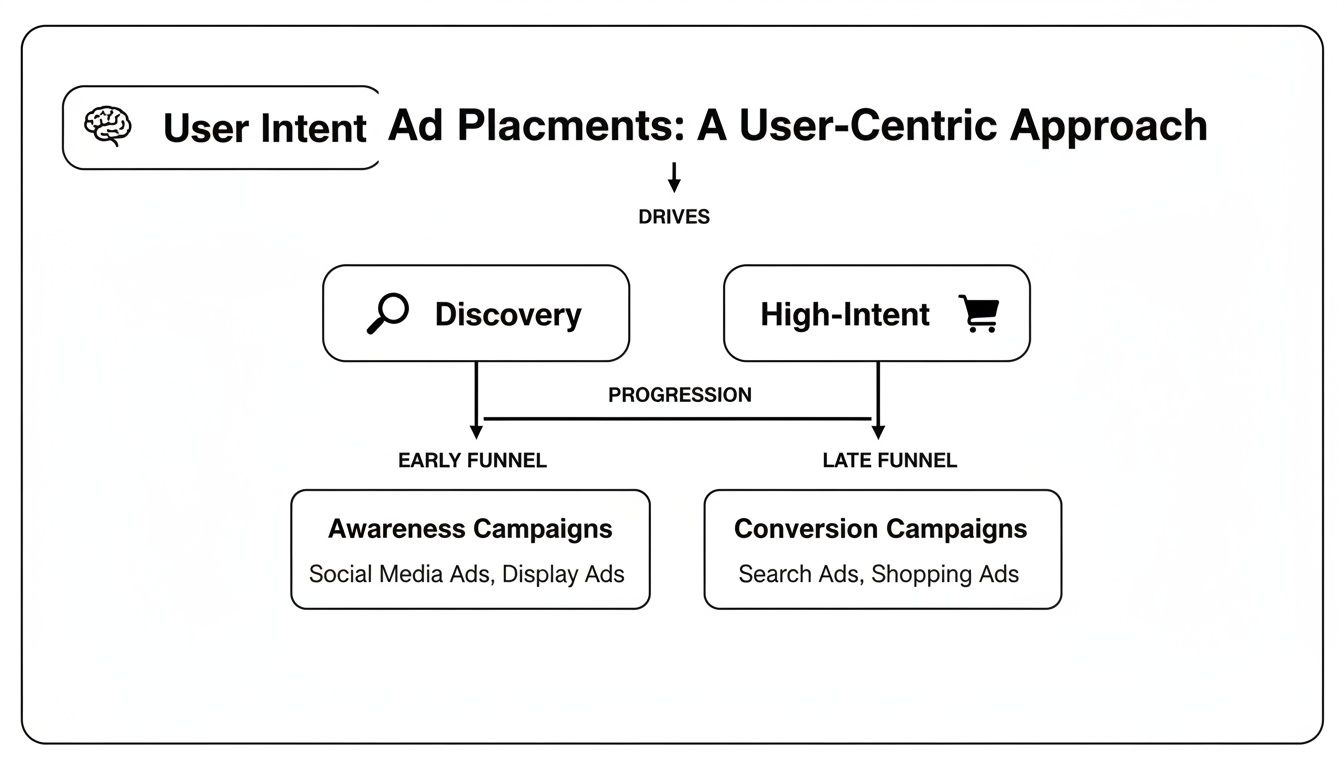
As you can see, 'Discovery' placements are perfect for building awareness at the top of the funnel, while 'High-Intent' placements are designed to capture demand and drive sales.
Why Some Placements Cause Ad Fatigue Faster
Ad fatigue is what happens when your audience sees your creative so many times that they just start tuning it out. Your performance drops, and costs go up. The placement in advertising you choose can either speed this process up or slow it down.
If your audience sees the same ad ten times a day in the exact same spot, they'll become blind to it. A diverse placement strategy creates a more natural and varied experience, keeping your message fresh for much longer.
This is why putting all your eggs in one placement basket is so risky.
High-Frequency Placements: Think Instagram Stories or a top-of-feed video ad. These spots can show your ad to the same user several times in one day. Without fresh creative, performance will tank—fast.
Low-Frequency Placements: A Google Search ad is a great example. It only appears when a user is actively searching for your keywords. Since it's triggered by their immediate intent, fatigue is rarely an issue.
By spreading your budget across a mix of placements, you're not just reaching people in different places; you're reaching them in different mindsets. Someone might see your Facebook Feed ad in the morning, a retargeting banner on a news site at lunch, and a YouTube pre-roll ad in the evening. This approach feels less repetitive, extends the life of your best ads, and ultimately creates a more stable, resilient campaign.
How to Actually Test and Measure Your Placements
Alright, let's get practical. Knowing what placements are is one thing, but figuring out which ones make you money is another. You can't just rely on a gut feeling; you need a solid, repeatable way to test what's working and what’s just eating your budget.
The simplest, most effective starting point is a classic showdown: Automatic Placements versus Manual Placements.
Set up two identical campaigns. For the first, let the platform's algorithm do its thing—think Advantage+ on Meta or letting a Performance Max campaign on Google Ads run free. For the second campaign, you take the wheel and manually select only your handful of highest-intent placements, like Facebook Feed and Google Search.
This head-to-head test gives you an immediate, high-level answer. You'll quickly see if the algorithm's wide-net approach beats your focused, hands-on strategy.
Auditing Your Placement Performance
Once you've let your campaigns run for at least 7-14 days to gather some reliable data, it’s time to roll up your sleeves and do an audit. This means going deeper than the main dashboard and digging into the placement breakdown reports.
Here’s how I approach it:
Segment Everything: In your ads manager, find the report that breaks down performance by placement. Don't just look at "Facebook" or "Google Display Network." Get granular. Compare the Facebook Feed against Stories, the Right-Hand Column, and Marketplace. Each one is its own unique environment.
Focus on Business Metrics: Clicks and CTR are fine, but they don't pay the bills. The numbers that really matter are Conversion Rate, Cost Per Acquisition (CPA), and especially Return On Ad Spend (ROAS). These tell you if a placement is actually driving profitable growth.
Validate with Your Own Data: The ad platform’s data is only part of the puzzle. You need to cross-reference these numbers with your own analytics tool, like Google Analytics. By using proper UTMs for Google Analytics tracking, you can see what users from each placement actually do once they hit your site. Are they bouncing immediately? Or are they engaging and buying?
What Truly Matters (and What Doesn't)
It's so easy to get pulled in by vanity metrics. You might see a huge CTR from an Audience Network placement and think you've struck gold. But if you dig in and see that not a single one of those clicks led to a sale, you realize it's a complete waste of money. The goal isn't just to get cheap clicks; it's to find customers who will actually buy something.
The most dangerous thing a marketer can do is react to daily noise. True performance trends emerge over weeks, not hours. Patience is a strategic advantage that prevents you from making reactive, noise-driven changes that disrupt the algorithm's learning.
Look for clear, sustained trends. If a placement consistently delivers a terrible ROAS over a two-week span, that’s a strong signal to cut it. On the other hand, if a historically great placement has one bad day, just let it be. It's almost certainly just statistical noise. Having the discipline to wait and watch prevents you from over-managing your campaigns and lets the algorithms do their job.
Common Placement Pitfalls and How to Avoid Them
I’ve seen millions of dollars wasted on ad placements over the years, and it almost always comes down to a few common, avoidable mistakes. These aren't rookie errors, either—even experienced teams can get tripped up by trusting automation too much or misreading the story their data is telling.
Think of it like this: avoiding these traps is about building guardrails for your budget. You want to make sure your money is actively working for you, not just leaking out through low-quality inventory. Let’s walk through the biggest mistakes I see and how you can steer clear of them.
Pitfall 1: The "Set-It-and-Forget-It" Mindset with Automation
This is probably the most expensive mistake in the book. It’s easy to turn on automatic placements like Meta’s Advantage+ or Google’s Performance Max and just let them run. While these tools are incredibly smart, they aren't magic. Their primary goal is to find the cheapest impressions to spend your budget, which doesn't always align with your goal of finding high-quality customers.
Left unchecked, this often means your budget gets funneled into a sea of low-intent placements, like mobile game apps and obscure partner websites. Suddenly, you're paying for ads that no one with real purchase intent is actually seeing.
The fix here is simple but requires discipline:
Schedule a weekly placement audit. No excuses. Get into your ad accounts and look at the placement breakdown reports.
Focus on what matters. A high click-through rate is nice, but what’s your Cost Per Acquisition (CPA) or Return On Ad Spend (ROAS) for that placement? That's your source of truth.
Build exclusion lists. Don't be afraid to tell the algorithm where not to spend money. If a specific app, website, or content category is burning through your budget with no results, block it. This forces the system to find better, more relevant inventory.
Pitfall 2: Chasing High CTRs from Low-Quality Traffic
It’s tempting, I get it. You see a placement delivering a sky-high CTR for pennies per click and think you've struck gold. But more often than not, this is a classic trap. Many placements, especially within audience networks and mobile apps, are notorious for generating accidental clicks.
Imagine a user trying to close an ad to get back to their mobile game. They accidentally tap the banner, and poof—you just paid for a click from someone with zero purchase intent. Your top-of-funnel metrics look amazing, but your conversion rate tanks. You're essentially paying for thousands of people to bounce from your site immediately.
A high click-through rate is a vanity metric if it doesn’t lead to conversions. The true value of a placement is measured by its ability to deliver profitable customers, not just cheap clicks.
Pitfall 3: Using One-Size-Fits-All Creative
Running the same ad creative across every single placement is another critical error. That perfect 1:1 square image you designed for the Instagram Feed? It's going to look terrible when it gets awkwardly cropped into a 9:16 vertical space for a Reel or Story.
This creative disconnect is jarring for the user. It instantly screams, "This is an ad that doesn't belong here," which leads to lower engagement, weaker performance, and wasted impressions. Every placement has its own vibe and user expectations.
Here’s how to get it right:
Customize your assets. Use the platform's built-in tools to assign specific creative to specific placements. Upload a vertical video for Stories, a polished square image for the Feed, and so on.
Design for the environment. Your goal is to make your ad feel native to the placement. A raw, user-generated-style video might crush it on Reels, while a high-production carousel ad performs better in the main Facebook Feed.
Be strategic with your resources. If you can't create custom assets for every single placement, don't worry. Focus your energy on the placements that receive the most spend and have the biggest impact on your results.
Your Ad Placement Optimization Checklist
Knowing the theory is one thing, but turning that knowledge into profit is what really matters. For that, you need a solid, repeatable process. This checklist will guide you through a continuous optimization loop, helping you fine-tune your placement in advertising strategy and make sure every dollar you spend is working its hardest.
Step 1: Analyze Historical Data
Before you touch a single setting, you have to look back. Jump into your placement reports from the last 30-60 days and get a clear picture of your winners and losers. Don't get distracted by vanity metrics like CTR; focus on the numbers that actually impact your bottom line, like ROAS and CPA.
Action: Find the top 2-3 placements that are bringing in the most profitable conversions. These are your gold mines.
Pro-Tip: Just as important, identify the bottom 2-3 placements that are eating your budget with little or nothing to show for it. These are the first places you'll want to consider cutting.
Step 2: Segment by Device
People interact with ads completely differently on their phones versus their desktops, even in the exact same placement. A click on a Facebook Feed ad from a desktop is often more considered, while a mobile user is probably scrolling quickly on the go.
Action: Take your top placement reports and break them down by device type (Desktop vs. Mobile).
Pro-Tip: This is where you can uncover some real hidden gems. You might find a placement that looks like a total dud on mobile is actually a cash cow on desktop. This lets you make smart bid adjustments instead of just axing the entire placement.
Your goal isn't just to find what works, but where and how it works best. Granular segmentation turns broad assumptions into precise, actionable insights.
Step 3: Align Creative with Placement
Running the same ad creative everywhere is a guaranteed way to waste money. That beautiful square image you designed for your Instagram Feed is going to look cropped, awkward, and totally out of place when it's shoehorned into a vertical Story. That mismatch screams "this ad doesn't belong here" and kills engagement before it even has a chance.
Action: Use the built-in platform tools, like Meta’s Asset Customization, to pair your creative assets with the placements they were actually designed for.
Pro-Tip: Focus your creative efforts where they'll make the biggest splash—your top-spending placements. A perfectly formatted vertical video for Instagram Stories will drive a much better return than tweaking creative for a placement that barely gets any budget.
Step 4: Build Strategic Exclusion Lists
One of the most powerful moves you can make is to proactively tell the ad platforms where not to run your ads. This is crucial for stopping budget from leaking into low-quality digital real estate, like those mobile game apps notorious for accidental clicks or irrelevant websites on the Google Display Network.
Action: Create and consistently update placement exclusion lists in both Google Ads and Meta Ads.
Pro-Tip: A great starting point is to block any specific apps, websites, or content categories that consistently deliver low ROAS or poor conversion rates. This forces the algorithm to stop wasting your money and find better, more valuable inventory for your ads.
Your Top Ad Placement Questions, Answered
Let's tackle some of the most common questions performance marketers run into with ad placements. These are the real-world challenges we see every day, and here are some practical answers to help you navigate them.
Should I Always Use Automatic Placements?
When you're launching a new campaign, starting with automatic placements is almost always a good idea. Think of it as casting a wide net. It gives platforms like Meta and Google the freedom to explore all their available inventory and find pockets of high-performing users you might never have discovered on your own.
The catch? It can also lead to wasted spend. The algorithm's primary goal is often to find the cheapest impressions, which can steer your ads into low-quality spots. We’ve all seen them—those obscure partner sites or mobile game apps that rack up accidental clicks but deliver zero real business value.
The best approach is to start with automation to gather data, but then you have to step in and actively refine. Dig into your placement reports and be ruthless about excluding anything that isn't pulling its weight and delivering a positive return on ad spend (ROAS).
How Often Should I Check My Placement Reports?
It’s so tempting to dive into your reports every morning and start tweaking things. Resist that urge. Fiddling with your campaigns daily often does more harm than good, as it can constantly reset the platform’s crucial learning phase, preventing your ads from ever hitting their stride.
A much better rhythm is a weekly or bi-weekly check-in. This gives you enough time to see real performance trends emerge from the data, rather than just reacting to the small, daily ups and downs that are often just statistical noise. Giving the algorithm this stability is key to letting it do its job effectively.
Why Is My ROAS So Low When My CTR Is High?
Ah, the classic (and incredibly frustrating) high CTR, low ROAS puzzle. If you're seeing this, it's almost certainly a sign that you're getting a lot of low-quality traffic.
Certain placements, especially on the Audience Network or within mobile games, are notorious for generating accidental clicks. Imagine someone trying to close a banner ad to get back to their game—they miss the 'X' and inadvertently click your ad. Your click-through rate (CTR) goes up, but their purchase intent is zero.
This is exactly why you have to look beyond surface-level metrics like CTR. A high click rate is meaningless if those users bounce off your landing page immediately. To get to the bottom of it, you need to analyze your post-click metrics: Conversion Rate, Cost Per Acquisition (CPA), and Average Order Value (AOV). These are the numbers that tell you the true story of a placement's value, helping you separate empty clicks from genuinely interested customers and protect your ROAS.
Instead of getting lost in noisy data, let SpendOwlAI give you clear, daily actions for your Meta and Google ads. We analyze your campaigns for meaningful shifts in performance, creative fatigue, and audience saturation, delivering a ranked to-do list that tells you exactly what to change and what to leave alone. Stop guessing and start executing with confidence by visiting https://spendowlai.com to start your free trial.