A Modern Playbook for New Client Acquisition
Acquiring new clients isn't just about running a few ads and hoping for the best. It's about building a well-oiled machine that consistently brings in paying customers through smart marketing and sales. To really succeed, especially on competitive paid channels like Meta and Google, you need a system that’s built on solid data—connecting the dots between who you're targeting, what you're showing them, and where you're sending them.
Building a Modern System for Client Acquisition
Let's ditch the generic advice and stop making decisions based on gut feelings. Winning at client acquisition today, particularly on crowded platforms, demands a methodical, almost scientific approach. This guide is your playbook for moving beyond reactive, chaotic campaign management and into a predictable, data-backed system that fuels real growth.
We're going to break down the essential pillars of a high-performing acquisition engine. This isn't just about launching ads; it's about deeply understanding the entire client journey, from the very first impression they have of your brand to the moment they decide to buy.
Why You Need a System, Not Just Tactics
The days of boosting a post and crossing your fingers are long gone. A modern framework treats client acquisition as an interconnected system. Think of it like a series of dominoes—each piece has to be perfectly aligned to knock down the next. This means building a cohesive strategy, not just throwing isolated tactics at the wall to see what sticks.
How businesses find clients has completely changed. Most now rely on a mix of social media, search, and paid advertising. For example, social media marketing drives 75% of acquisition efforts for retailers, while paid ads hold a strong 60% share. What does this tell us? No single platform owns the customer journey, which makes having an integrated system absolutely critical.
The Pillars of Predictable Growth
Before we dive into the nitty-gritty, let's lay out the foundational components of a truly effective paid acquisition system. Each pillar represents a critical area you need to master. Getting these right is the difference between guessing and knowing.
Pillar | Core Focus | Why It Matters |
|---|---|---|
Audience Strategy | Defining and reaching your ideal customer segments with precision. | Your message is wasted if it doesn't reach the right people. This is the foundation of efficiency. |
Creative & Copy | Developing ads that grab attention and persuade people to take action. | Even the best targeting fails with bad creative. This is what makes your audience stop and listen. |
Landing Page Optimization | Ensuring the post-click experience is seamless and drives conversions. | You've paid for the click; this is where you convert that interest into a tangible lead or sale. |
Budget & Bid Strategy | Allocating your ad spend intelligently to maximize your return on investment. | Smart spending ensures you're not just getting clicks, but profitable customers. |
Tracking & Attribution | Accurately measuring what’s working and what isn’t. | Without clean data, you're flying blind. This is how you make informed decisions. |
Testing & Iteration | Continuously experimenting to improve performance over time. | What works today might not work tomorrow. Constant testing is the engine of growth. |
Mastering these pillars creates a powerful feedback loop where insights from one area inform and improve all the others, leading to sustainable and scalable growth.
What This Playbook Delivers
This guide is built for the operators in the trenches—the people who need clear, actionable tasks, not just high-level theory. We'll focus on turning performance data into confident decisions. You’ll learn how to build a robust system by zeroing in on:
Pinpoint Audience Targeting: How to move past broad demographics and find high-intent customer segments ready to buy.
High-Impact Ad Creative: The art and science behind visuals and copy that actually stop the scroll and get clicks.
Frictionless Landing Pages: Simple ways to optimize your post-click experience to turn more traffic into leads or sales.
Disciplined Budget Management: Smart techniques for allocating your budget to drive maximum results and eliminate waste.
The real goal here is to move from guessing to knowing. A systematic framework lets you stop second-guessing your campaigns, avoid scaling too soon, and build a truly predictable engine for bringing in new clients.
This structured process makes every dollar accountable and every action purposeful. For anyone looking to go a level deeper, understanding the core principles behind data-driven marketing solutions is a fantastic next step.
Crafting Your Audience and Creative Strategy

Let’s get straight to it: the two most powerful levers you can pull in any paid campaign are who you talk to and what you show them. Nail these, and you're on the path to predictable client acquisition. This is where we move beyond just boosting posts and start building a real engine for growth.
Success isn't about stumbling upon one perfect audience or a single magical ad. It's about building a system. Your audience insights should directly fuel your creative, and the performance of that creative should, in turn, help you refine who you target next. This is the feedback loop that separates the campaigns that fizzle out from the ones that scale.
Defining Your High-Intent Audiences
Forget generic targeting. While broad lookalikes have their place, the real wins come from segmenting users based on their intent and how well they already know you. This is how you make your message feel personal and powerful.
I like to map out audiences in tiers, moving from coldest to warmest. It keeps everything organized and ensures we’re showing the right message at the right time.
Broad & Lookalike Audiences: This is your top-of-funnel, where you find new people. Instead of using a lookalike of all your customers, build one from your top 25% based on lifetime value. On Google Ads, this means focusing on sharp in-market and affinity audiences that mirror the problems you solve.
Engagement Audiences: This group is intrigued but hasn't made it to your site yet. Think about people who watched 75% of your video ad, engaged with your Meta page, or opened a lead form but didn't submit. They're aware of you and just need a little nudge.
Site Visitor Audiences: Now we're talking. These folks have taken the critical step of visiting your landing page. Slice this group up even further. Did they check out your pricing page? Spend more than two minutes on a key service page? These behaviors tell a story.
High-Intent Retargeting Pools: This is your money audience. It’s the cart abandoners, the people who started a checkout, or those who filled out a form but got distracted. This is where you deploy your most direct, offer-driven creative.
This tiered approach stops you from making classic mistakes, like showing a "10% Off Now!" ad to someone who has never even heard of your brand. That just wastes money and confuses everyone.
Developing Creative That Stops the Scroll
Once you know who you're talking to, you have to actually get their attention. Your ad creative isn't just a pretty picture; it's a tool built to do a specific job for a specific audience. The trick is to perfectly match your hook, message, and call-to-action with how aware that audience is of their problem and your solution.
One of the biggest campaign killers is creative fatigue. This is what happens when someone has seen your ad so many times it just becomes background noise. Their eyes glaze over, your click-through rates plummet, and your costs skyrocket. Keep a close eye on your frequency metric. If it’s creeping above 3-4 within a 7-day window for a single ad set, you've got a problem.
Don’t wait for your campaign performance to fall off a cliff. Rising frequency and dipping engagement are the early warning signs. Swapping in fresh creative before your costs spike is the key to maintaining momentum.
To get consistent creative wins, you need a hypothesis-driven approach. Stop throwing random images at the wall to see what sticks. Instead, test specific strategic ideas against each other.
Here’s how that looks in practice:
Test Your Hook: The first three seconds are everything. Pit a question-based hook ("Struggling with X?") against a bold statement ("This is how you solve X for good.").
Test Your Angle: Does your audience respond better to pain or gain? Run an ad focused on a pain point ("Tired of wasting hours on manual reports?") against one that highlights a benefit ("Get your weekends back with automated reporting.").
Test Your Format: Put a polished, high-production video up against a simple, raw clip that looks like it was shot on a phone. You’d be surprised how often the "less professional" ad feels more authentic and crushes it.
When you test methodically like this, you get real answers. You don't just learn what works; you learn why it works. Those insights become your creative playbook, making every future campaign smarter from day one.
Optimizing Your Landing Page and Offer

Getting someone to click your ad is only half the battle. The real work begins the moment a prospect hits your landing page. If that post-click experience is confusing, slow, or doesn't match the ad they just saw, you’re basically just lighting your ad budget on fire. This is where you turn expensive traffic into actual leads.
An optimized landing page isn't just about looking good; it's a machine engineered for one thing: conversion. Every single element, from the headline down to the button color, has to work in harmony to nudge the user toward taking that one specific action you want.
Anatomy of a High-Converting Landing Page
The most common—and costly—mistake I see is businesses sending paid traffic to their generic homepage. A homepage is designed for exploration, with a dozen different paths a visitor can take. A landing page, on the other hand, is built for a single decision.
Think of it like this: a homepage is a department store, but a landing page is a specialized boutique. You walk into the boutique for a very specific reason, and everything inside is designed to help you with that one goal. Your landing page needs to be that focused.
To get there, every high-performing page has a few non-negotiable elements:
Message Match: The headline on your page must echo the promise from your ad. If your ad says "Get a Free Marketing Audit," your headline better say something almost identical, not "Welcome to Our Marketing Services."
A Single, Clear Call-to-Action (CTA): Stop asking people to "Book a Demo," "Download a Guide," and "Follow Us on Social." Pick one goal. Make the button for it big, bold, and impossible to miss.
Frictionless Forms: Only ask for what you absolutely need right now. Every extra field you add is another reason for someone to give up. Often, just a name and email are enough to get the conversation started.
Compelling Social Proof: This is your trust-builder. Sprinkle in client testimonials, snippets from case studies, logos of well-known customers, or industry awards. It lowers the perceived risk for a new client.
The goal is to eliminate all distractions. That means ditching the main navigation menu, the footer links, and anything else that could pull a user away from the one action you want them to take. A focused page creates a focused mind.
The Power of a Flawless Mobile Experience
Let's be clear: optimizing for mobile is no longer optional. A huge chunk of your paid traffic, especially from platforms like Meta, will come from people scrolling on their phones. If your page is slow to load or a pain to navigate on a small screen, you will lose conversions. Guaranteed.
Page speed is everything. Study after study confirms that conversion rates plummet with every extra second a page takes to load. Use a tool like Google's PageSpeed Insights to see where you stand. The usual culprits are massive, uncompressed images or bloated code.
The user experience itself has to be seamless. That means:
Buttons need to be large and easy to tap.
Font sizes have to be readable without any pinching and zooming.
Forms must be simple to complete on a mobile keyboard.
This isn't just a technical checklist; it’s a core part of your new client acquisition strategy. A clunky mobile experience screams "we don't pay attention to detail," which is a terrible first impression. For a much deeper dive, our guide on website conversion optimization breaks down more advanced techniques.
Crafting an Irresistible Offer
Even the most beautiful landing page will fall flat without a compelling offer. The offer is the "why" behind the click. It needs to provide so much obvious value that a prospect would feel foolish for passing it up.
A truly great offer solves a specific, urgent problem for your ideal client. Instead of a bland "Contact Us," try something that delivers immediate value:
A free, customized audit of their current website or ad account.
A limited-time discount exclusively for new clients.
Access to a proprietary tool or resource.
A no-obligation, 15-minute strategy session.
The trick is to frame the offer around their benefit, not yours. It should feel like a generous first step toward a valuable relationship, making it an easy "yes" and setting the stage for a long-term partnership.
Mastering Budgets, Bids, and Attribution
Okay, let's get into the engine room. You can have the best creative and the most optimized landing page in the world, but if your spending strategy is a mess, you're just burning cash. This is where we get into the nuts and bolts of budget allocation, smart bidding, and figuring out what’s actually working.
Nail this part, and you build a profitable, scalable client acquisition machine. Get it wrong, and… well, it’s a fast way to blow through your marketing budget with nothing to show for it.
Think of every dollar you spend not as a cost, but as an investment. You're putting money in with the clear expectation of getting more money out. That single shift in mindset is the foundation of mastering paid channels.
Choosing the Right Bid Strategy for the Job
Both Meta and Google roll out a dizzying number of bidding options, but don't get overwhelmed. You can cut through the noise by asking one simple question: Am I trying to get as many leads as possible for a fixed cost, or am I trying to maximize the total revenue from my sales?
Your answer points you directly to the right strategy.
Here’s how it usually plays out:
When to Use Cost Caps or Target CPA: This is your go-to when you know your numbers inside and out. Say you know a new lead is worth $100 to your business. You can set a target CPA (tCPA) of $50, effectively telling the platform, "Go get me all the conversions you can find, but don't you dare pay more than $50 a pop." It’s a fantastic way to enforce profitability right from the start.
When to Use Value-Based Bidding (ROAS): If you're in e-commerce or sell services at different price points, this is your best friend. Instead of telling the algorithm to get you the most conversions, you tell it to get you the most revenue. This requires feeding conversion value data back to the platform, but it’s worth it. It stops the algorithm from chasing cheap, low-value wins at the expense of bigger, more profitable customers.
One of the biggest rookie mistakes I see is constantly fiddling with the bid strategy. Pick one, set it, and give the platform at least a solid week to figure things out. If you keep changing it, the algorithm stays stuck in the "learning phase," and you'll just be lighting money on fire.
Managing Budgets Without Killing Momentum
Want to know the fastest way to derail a high-performing campaign? Make a drastic, knee-jerk change to its budget. The algorithms that run these ad platforms absolutely hate volatility. A sudden spike or cut in spend can throw them for a loop and completely reset the learning process.
Your North Star for every budget decision has to be your Customer Acquisition Cost (CAC). It’s the single clearest indicator of whether your spend is efficient and sustainable.
Your Customer Acquisition Cost is the ultimate health check for your campaigns. It's calculated by dividing your total ad spend by the number of new customers you actually acquired. This number tells you if you’re making money or losing it on every new client. In today's competitive ad auctions, letting your CAC run wild is a recipe for disaster.
So, how do you scale a winner without causing chaos? Follow the 20% rule.
When you have an ad set or campaign that’s crushing it, only increase its budget by a maximum of 20% every 48 to 72 hours. This slow, steady increase gives the algorithm time to adapt, find new pockets of customers, and maintain its performance without going haywire.
Demystifying Attribution in a Post-iOS World
Finally, we have to talk about attribution. Let's be honest—tracking has gotten a lot harder. But it's not impossible. The key is to be realistic about what the platforms can and cannot see.
The numbers you see inside Meta Ads Manager or Google Ads are valuable, but they are often modeled to fill in the tracking gaps. Treat them as strong directional indicators, not as gospel.
To get a true picture of performance, you have to triangulate your data from a few different sources:
Platform Data: Use this for what it's good at—diagnosing in-platform metrics like click-through rates (CTR) and ad costs (CPM).
Web Analytics: Tools like Google Analytics help you see the bigger picture of the customer journey and how paid channels interact with your other marketing efforts.
Your Business Data: This is your source of truth. How many new clients or sales are actually in your CRM? At the end of the day, that’s the only number that really matters.
By cross-referencing these three sources, you can build a much more accurate and reliable model of what's driving your growth. If you're ready to go even deeper, our guide on choosing the right marketing attribution software can walk you through more advanced solutions.
Remember, the goal isn't perfect, flawless attribution—that's a fantasy. The goal is to have enough confidence in your data to make smart decisions.
Implementing Daily Guardrails for Execution
Winning at paid acquisition doesn't come from a few brilliant, game-changing moves. It’s built in the trenches, day after day, with a disciplined approach to management. This is where you swap out chaotic, reactive decisions for a calm, data-driven system.
The foundation of that system is a set of 'guardrails'—proactive checks and rules you follow to prevent the most common and costly mistakes. These guardrails stop you from meddling with campaigns too often, scaling a hot ad set too fast and blowing it up, or letting creative fatigue quietly tank your returns.
It’s about knowing exactly what to look at, which signals actually matter, and—most importantly—when to step back and let the platform algorithms do their work.
Your Daily Management Cadence
The goal of your daily check-in isn't to make huge, sweeping changes. Think of it as taking the temperature of your accounts. You’re looking for early warning signs and making sure your budget is actually being spent wisely.
Remember, over-managing is just as bad as neglect. Constant tinkering can knock campaigns right back into the learning phase, destroying any stable rhythm you had going. Your daily routine should be a quick, focused review of the core health metrics, scanning for major deviations from the norm, not tiny daily wobbles.
The Art of Knowing When to Do Nothing
One of the hardest skills for any performance marketer to develop is restraint. It's tempting to jump in and "fix" things. But ad platforms like Meta and Google Ads are complex systems that need time and data to find their footing.
The most valuable action you can take on some days is no action at all. If your key metrics are stable and hitting your targets, your job is to protect that stability, not disrupt it by chasing a tiny bit more performance.
Your guardrails should define what "stable" actually means for you. For example, you might have a rule that you won't touch an ad set if its CAC is within 15% of its 7-day average. This creates a buffer against normal market volatility and stops you from making emotional decisions based on one bad day's data.
This visual decision tree provides a simple framework for making these calls based on CAC stability.
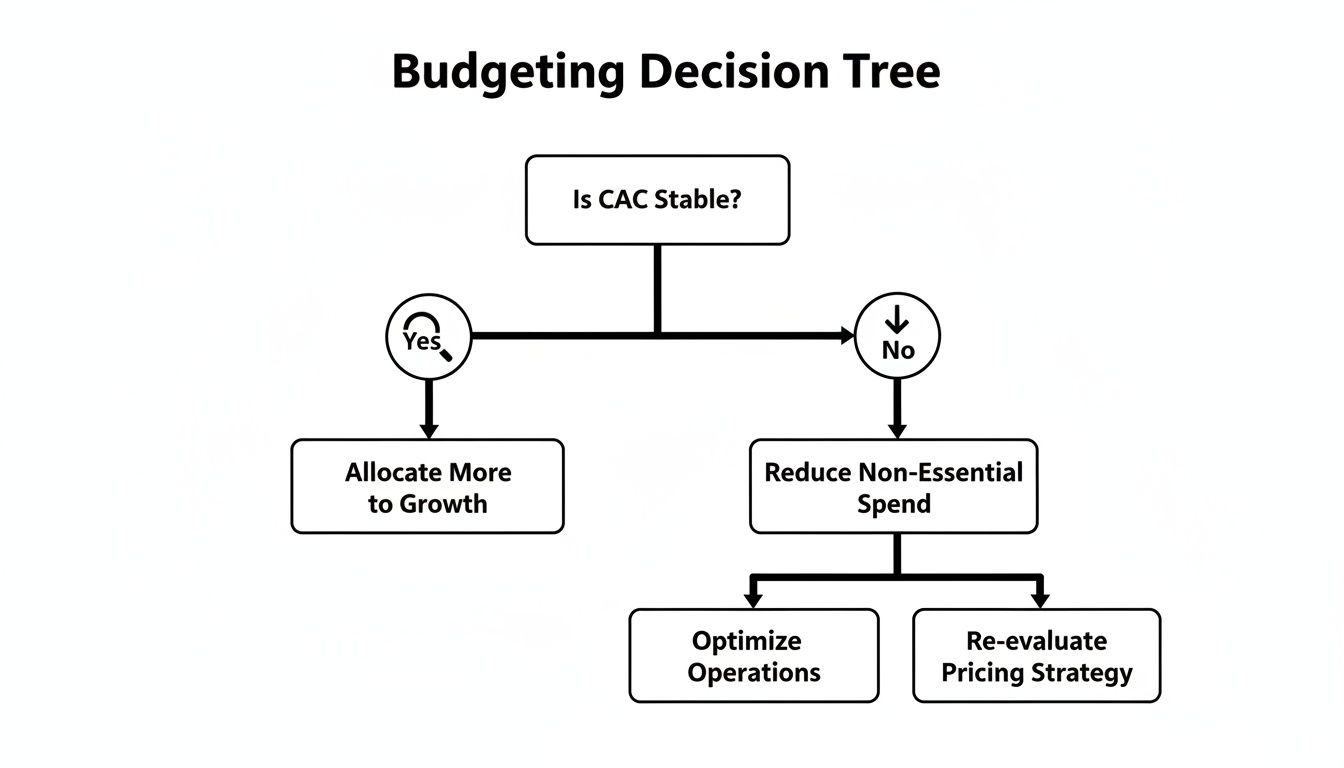
This just reinforces the core idea: if performance is steady, look for smart ways to scale. If it's all over the place, you need to diagnose the "why" before you start throwing money at it or pulling the plug.
It’s also important to remember that while paid ads are a powerful tool, they aren't the only one. Trust and word-of-mouth are still massive growth drivers. In fact, a comprehensive survey of agencies found that referrals from existing clients were the single most effective channel for new client acquisition, beating out even SEO. You can read more about these agency acquisition strategies on Databox.com.
Daily Operator Execution Checklist
To keep your daily check-ins sharp and efficient, a structured checklist is your best friend. It keeps you focused on the metrics that matter and provides clear triggers for action, turning a potentially messy process into a simple routine.
Here’s a practical checklist you can adapt for your own daily management.
Check | Metric to Review | Action Trigger (If...) | Recommended Action |
|---|---|---|---|
Pacing | Daily Spend vs. Budget | Spend is <90% of daily budget | Investigate delivery issues (e.g., ad approvals, audience saturation). |
Primary KPI | Cost Per Result (CPA/CAC) | CPA is >20% above 7-day avg | Pause poor-performing ads/ad sets; analyze for cause (creative, audience, etc.). |
Leading Indicators | CTR & CPC | CTR drops >15% and CPC rises >15% | Potential creative fatigue. Plan to introduce new creative variations soon. |
High Spenders | Top 3-5 Campaigns/Ad Sets | Performance is degrading for 48-72 hrs | Reduce budget by 20% or pause if significantly below target. Reallocate funds. |
Recent Changes | Campaigns/Ad Sets edited in last 72 hrs | Performance is volatile or in "Learning" | Do nothing. Give the algorithm time to stabilize and optimize before intervening again. |
This checklist isn't about finding problems to solve every day. More often than not, it's about confirming that everything is on track, giving you the confidence to let your campaigns run without interference.
Scaling and De-Scaling with Discipline
When you’ve got a winner on your hands, the first instinct is to crank the budget way up and ride the wave. That's a classic mistake. A sudden, massive budget increase can totally shock the algorithm, throw it back into the learning phase, and ruin the very performance you were trying to scale.
Instead, follow a much more disciplined protocol:
Go Slow and Steady: Never increase a campaign or ad set budget by more than 20% in a single 24-hour period. Small, steady steps win this race.
Wait and Watch: After you nudge the budget up, wait at least 48 hours to see how it affects performance before you even think about touching it again.
Keep an Eye on Efficiency: As you scale, watch your CAC like a hawk. If it starts creeping up past your acceptable limit, you’ve likely hit that budget’s efficiency ceiling.
The flip side is just as important. When a campaign's performance tanks and stays down for more than 48-72 hours, you have to act decisively. Don't fall into the "sunk cost" trap and let a failing ad set bleed your budget dry. Cut the spend, turn it off, and reallocate that money to your proven winners or to fund new creative tests. This ruthless discipline is what separates the pros from the amateurs.
Common Questions from the Trenches
Even with the best playbook, paid advertising will always find a way to keep you on your toes. Things change fast. Below are a few of the most common questions I hear from people managing campaigns day-in and day-out, along with some straight-to-the-point answers to help you navigate these bumps in the road.
How Long Should I Test a New Ad Before I Know if It’s Working?
I get it. The urge to call a new ad a "winner" or "loser" after just 24 hours is almost irresistible, but you have to fight it. It's a classic trap. Making a call based on a single day's data is one of the fastest ways to kill a potentially great ad before the algorithm has even had a chance to work its magic.
As a solid rule of thumb, let a new creative run for at least 3-5 days. More importantly, you need to let it gather enough data to be meaningful. I usually look for something in the range of 5,00t to 10,000 impressions before I even start to form an opinion. This gives the platform enough runway to get out of its initial, often volatile, learning phase.
Sure, you can glance at leading indicators like Click-Through Rate (CTR) early on. But the final "keep or kill" decision absolutely has to come from your main goal, whether that's Cost Per Acquisition (CPA) or Return On Ad Spend (ROAS). You simply need enough conversion data to make that call with confidence.
Which Is More Important: Overall ROAS or New Customer ROAS?
This is a fantastic question because it cuts right to the heart of your growth strategy. Both metrics have their place, but for a campaign that's supposed to be acquiring new clients, they tell very different stories.
Here's how I think about it:
Overall ROAS: This is the big picture—the total revenue you got back for every dollar you spent. It lumps together sales from brand-new customers and existing ones who just happened to see your ad.
New Customer ROAS: This is your precision metric. It surgically removes existing customers and shows you the return you’re getting only from first-time buyers.
If your goal is new client acquisition, then New Customer ROAS is your north star. A high overall ROAS can be incredibly deceptive. It might look great in your dashboard, but if it's being propped up by your loyal, existing customers, then your acquisition campaign isn't actually doing its job. It's failing to bring new blood into your business.
A high overall ROAS can easily mask a failing acquisition strategy. Always segment your reporting to isolate the return from truly new customers. This is your source of truth for scalable growth.
My Ad Costs Are Creeping Up. What Should I Do?
Seeing your CPA climb is never a good feeling, but don't panic. It’s usually a signal that one of a few predictable things is happening. Instead of guessing, work through a quick diagnostic checklist.
First, check for creative fatigue. This is the most common culprit by a long shot. Look at the frequency score on your ads. If you see it creeping up while your CTR is trending down, that's the classic sign your audience has seen your ad too many times. They're bored. It’s time to get some fresh creative in there.
Next up is audience saturation. Have you been hitting the same small, niche audience for weeks on end? You might have simply run out of new people to show your ads to. The platform now has to work harder (and charge you more) to find anyone left. Try testing a broader lookalike percentage or expanding into a new interest-based audience to find some fresh inventory.
Finally, don't forget to check your technical setup. Is your attribution window too short? A 1-day click window, for example, could be missing conversions that happen a few days later, which would artificially inflate your reported CPA. Also, take a look at the calendar. Are you running into a big holiday or a major sales event like Black Friday? Sometimes costs rise simply because competition in the ad auction heats up, which is something you need to account for.
Managing the daily grind of paid acquisition requires discipline and a smart system. Instead of getting lost in endless dashboards, what if you had a tool that told you exactly what to prioritize each day? SpendOwlAI gives you a ranked to-do list for your Meta, Google, and Shopify accounts, ordered by impact. It watches for performance shifts and creative fatigue so you can stop wasting money and start executing with confidence. Start your free 7-day trial today and see what you've been missing.