A Marketer's Guide to Multi-Touch Attribution Models
Instead of giving 100% of the credit for a sale to a single ad, multi-touch attribution models spread that credit across the various marketing touchpoints a customer interacts with along their path to purchase. This gives you a much more realistic picture of which channels are actually moving the needle, helping you make smarter calls on where to put your budget. It’s a necessary shift away from simplistic, old-school models to reflect the messy, complex reality of how people buy things today.
Ending the Guesswork with Multi-Touch Attribution
Think about a typical customer journey. Maybe they see your Meta ad on Monday, click a Google search ad on Thursday, and finally pull the trigger after opening an email campaign on Saturday. Who gets the credit? If you only reward that final email, you might mistakenly slash the budget for the Meta and Google ads—the very channels that built awareness and pushed them down the funnel. This is the exact, and often expensive, problem that multi-touch attribution models are built to solve.

Why Last-Click Thinking Is Obsolete
For years, the default in marketing was the last-click model. It’s simple, sure, but also deeply flawed. Imagine giving all the credit for a championship win to the player who scored the final basket, completely ignoring the assists, the defensive plays, and all the teamwork that led to that moment. That's last-click attribution in a nutshell.
This narrow view creates massive blind spots, leading to bad decisions and wasted ad spend. You end up pouring money into bottom-of-funnel channels that close deals while starving the crucial top-of-funnel efforts that introduce your brand to new people in the first place. The rise of multi-touch attribution (MTA) in the mid-2000s was a direct response to this problem, as digital marketing became too complex for such a basic approach. You can find more on the historical importance of marketing attribution on Growify.ai.
Mapping the Entire Customer Journey
Multi-touch attribution looks beyond that final click to map the entire path to conversion. It provides a system for assigning partial credit to each touchpoint, so you can finally see what’s really working. For performance marketers and DTC brands, implementing these models means you can:
Cut wasted ad spend by spotting channels that look busy but don’t actually contribute to conversions.
Allocate budget more intelligently by funneling money into the channels that consistently assist sales, even if they don't land the final punch.
Get a true read on ROI by understanding how different platforms work together to drive growth.
By analyzing the entire sequence of interactions, multi-touch attribution transforms marketing from a guessing game into a data-backed science. It empowers you to understand the why behind your conversions, not just the what.
At the end of the day, getting a handle on these models is non-negotiable for any modern marketer trying to build a sustainable, efficient growth engine.
Breaking Down the 6 Core Attribution Models
Picking an attribution model feels a lot like a sports manager trying to decide who gets the MVP award. Was it the defender who stole the ball and started the play? The midfielder who made the perfect pass? Or the striker who actually kicked the ball into the net?
Each model offers a different lens for assigning credit, and getting to know their logic is the first step toward making smarter marketing decisions. Let's walk through the six main models, from the simplest to the most sophisticated.
H3: The Single-Touch Models: First and Last Interaction
While they aren't technically "multi-touch," the First and Last Interaction models are the classic starting points. They give 100% of the credit to a single touchpoint, but they serve as crucial benchmarks.
First Interaction (The Scout): This model is simple: it gives all the credit to the very first touchpoint a customer ever had with your brand. Think of it as crediting the scout who discovered a star player. It's fantastic for figuring out which channels are best at generating initial awareness and filling the top of your funnel, but it completely ignores everything that happens afterward to nurture that lead.
Last Interaction (The Striker): This is the famous "last-click" model that has dominated marketing for years. It gives all the credit to the final touchpoint right before a conversion. This model is great at highlighting your "closers"—the channels that are most effective at sealing the deal. Its biggest flaw? It undervalues all the earlier marketing efforts that made the final click possible in the first place.
The Linear Model
The Linear model is our first true multi-touch approach. It takes a democratic view of the customer journey, splitting credit equally across every single touchpoint.
If a customer interacts with a Meta ad, a blog post, a Google search ad, and an email before converting, each of those four touchpoints gets exactly 25% of the credit. This model works best for long sales cycles where you feel every interaction played a more or less equal role. Its simplicity is both its strength and its weakness—it acknowledges all touchpoints but assumes they are all equally important, which is rarely the case.
When to Use a Linear Model: This approach shines for campaigns focused on maintaining brand awareness and steady engagement throughout a lengthy consideration phase. It ensures that no part of the customer journey gets overlooked.
The Time Decay Model
The Time Decay model operates on a very intuitive idea: the closer a touchpoint is to the conversion, the more influential it probably was. Credit gets distributed across all interactions, but the amount of credit ramps up exponentially for touchpoints that happen nearer to the sale.
Imagine a journey where a customer saw a display ad 30 days ago, clicked a social media post 7 days ago, and then converted from an email yesterday. The email would get the most credit, the social post would get a moderate amount, and that initial display ad would get the least. This model is perfect for shorter sales cycles or promotional campaigns where recent interactions are much more likely to have a direct impact.
The Position-Based (U-Shaped) Model
The Position-Based model, often called the U-Shaped model, offers a smart compromise. It assigns the most weight to the two moments that arguably matter most in any journey: the first touch (discovery) and the last touch (conversion).
A typical setup gives the first and last interactions 40% of the credit each. The remaining 20% is then spread evenly among all the touchpoints in the middle. This model is a fan favorite because it respects the importance of both opening and closing a deal, making it a great fit for businesses that value both lead generation and conversion-focused activities.
The Algorithmic (Data-Driven) Model
Finally, we have the most advanced option: the Algorithmic, or Data-Driven, model. Instead of following a fixed rule, this model uses machine learning to analyze your unique conversion data and assign credit based on the actual impact of each touchpoint. It looks at both converting and non-converting paths to figure out which interactions truly move the needle.
This approach is easily the most accurate because it’s tailored specifically to your business and customer behavior. It's no surprise that modern algorithmic techniques like Markov chains and machine learning are becoming the gold standard for sophisticated marketing teams.
While these advanced methods are powerful, industry research shows that time decay and custom position models are still the most widely used. This tells us that marketers place a high value on the timing and sequence of touchpoints. You can learn more about the evolution of multi-touch attribution on Strong.io. The biggest hurdle to data-driven attribution? You need a significant volume of conversions for the algorithm to learn and produce reliable results.
Comparing the Most Common Multi-Touch Attribution Models
With so many options, it helps to have a quick reference. This table breaks down each model's core logic, its best use case, and its biggest blind spot.
Attribution Model | How Credit Is Assigned | Best For | Key Weakness |
|---|---|---|---|
Last Interaction | 100% credit to the final touchpoint before conversion. | Short sales cycles; understanding "closer" channels. | Ignores all earlier touchpoints that built awareness and interest. |
First Interaction | 100% credit to the very first touchpoint in the journey. | Top-of-funnel campaigns; measuring initial awareness. | Completely undervalues nurturing and conversion-driving efforts. |
Linear | Credit is divided equally among all touchpoints. | Long consideration phases; maintaining brand engagement. | Assumes all touchpoints have equal impact, which is rarely true. |
Time Decay | Touchpoints closer to the conversion get more credit. | Short-term promotions; B2C sales cycles. | May undervalue early-stage, awareness-building channels. |
Position-Based | 40% to first, 40% to last, 20% to middle touches. | Valuing both brand discovery and final conversion actions. | The 40/20/40 split is arbitrary and may not fit your business. |
Data-Driven | Uses machine learning to assign credit based on impact. | Mature businesses with high conversion volume. | Requires significant data and technical expertise to implement well. |
Think of this table not as a definitive guide, but as a starting point. The best model for you will always depend on your business goals, sales cycle, and the story your data is trying to tell.
Putting Your Attribution Model into Practice
Knowing the theory behind multi-touch attribution is one thing, but actually putting it to work to grow your business is another. This is where we bridge the gap from concept to reality, and it requires the right tools, a clean data foundation, and a clear-eyed view of your options.
Honestly, this is where the real work starts. It’s about turning those abstract models into a living, breathing system that shows you what’s actually moving the needle. And it all begins with your data.
Laying the Foundation with UTM Parameters
Before you can even think about analyzing a customer journey, you have to be able to see it. This is why Urchin Tracking Module (UTM) parameters are completely non-negotiable. Think of them as little digital breadcrumbs you attach to your URLs. They tell your analytics platform precisely where every single visitor came from.
Without a consistent UTM strategy, all your hard work on different Meta campaigns, Google Ads, and email newsletters gets jumbled together. Everything just looks like "direct" or "referral" traffic. This makes your data a mess, and no attribution model on earth can assign credit correctly. Building a disciplined UTM framework is the most important first step you can take. If you want to go deeper, check out our guide on using UTMs effectively for Google Analytics.
Choosing Your Implementation Toolkit
Once your tracking is squared away, you need a system to crunch the numbers. Thankfully, we have a few solid options today, each with its own pros and cons.
Native Analytics Platforms (e.g., Google Analytics 4): For most people, GA4 is the perfect place to start. It’s powerful, accessible, and comes with several attribution models built right in—including a data-driven one for eligible accounts. You can easily switch between models to see how the story changes without spending an extra dime.
Server-Side Tracking: Let's face it: browser privacy settings and ad-blockers are here to stay. Traditional client-side tracking, which relies on a user's browser, is starting to miss a lot of data. Server-side tracking solves this by sending data directly from your server to your analytics platform, giving you a much more reliable and complete picture.
Dedicated Attribution Software: If you’re at a point where you need more firepower, specialized attribution tools are the next step. They offer deeper integrations, more custom modeling, and advanced cross-device tracking that standard analytics just can't match.
The image below does a great job of showing how the basic rules-based models think about the customer journey.
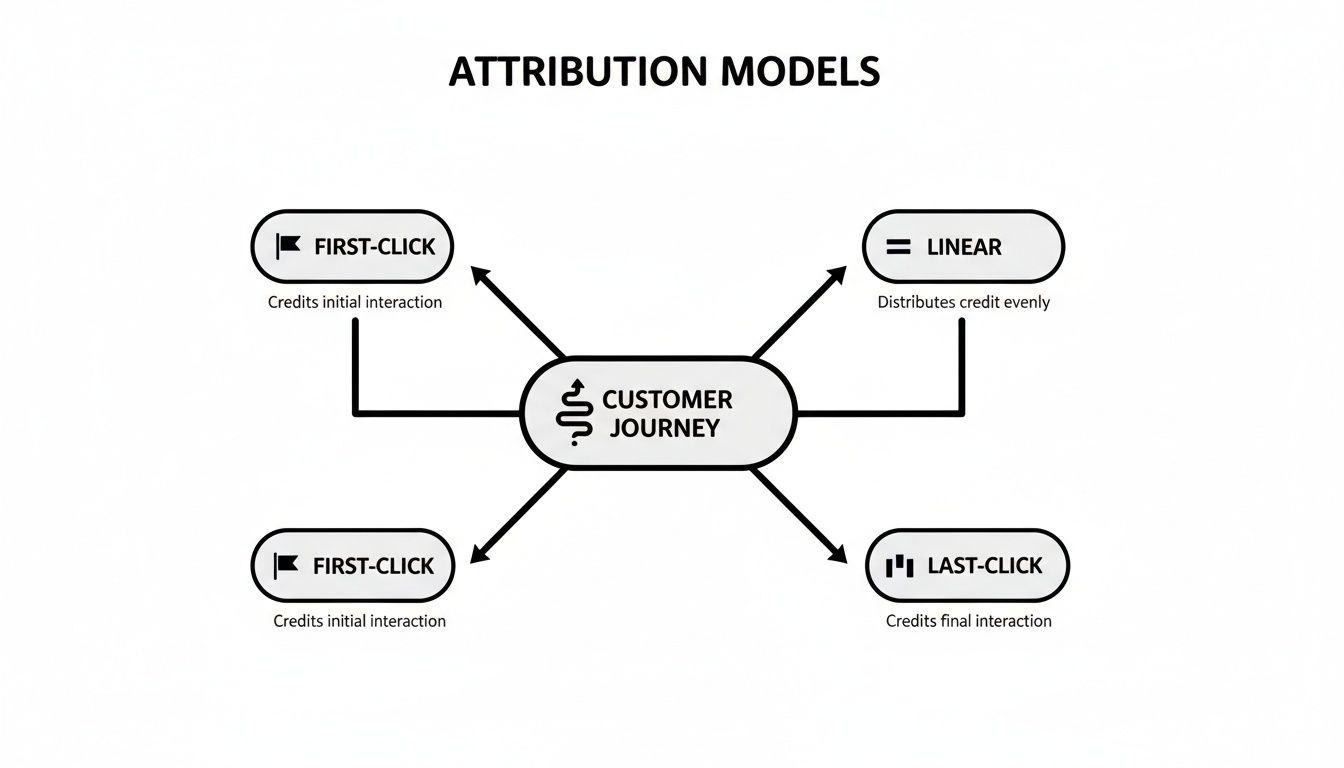
As you can see, First-Click and Last-Click are laser-focused on the very beginning and very end, while a Linear model spreads the love equally across every touchpoint.
Exploring Advanced Attribution Approaches
For businesses with really complex sales cycles or massive datasets, it’s worth looking beyond the standard models. A couple of advanced methods can give you a much wider perspective on what's really driving performance.
One of the big ones is Marketing Mix Modeling (MMM). Instead of obsessing over individual clicks, MMM takes a 30,000-foot view. It uses statistical analysis on big-picture data—like total channel spend, impressions, and sales over time—to find correlations. It’s fantastic for answering high-level questions like, "What was the real ROI of our TV ads last quarter?" and for understanding the impact of offline channels or even economic trends.
The old, rigid attribution models just aren't cutting it anymore. While they offer a simple way to divide up credit, they’re fundamentally blind to how customers actually behave and can't adapt when market dynamics shift.
This is exactly why so many teams are now turning to machine learning. Data-driven attribution is a huge leap forward, as it analyzes actual user-level data and historical conversion patterns to figure out which touchpoints had a genuine impact. These AI-powered models can adapt on the fly, offering a level of nuance and accuracy that the old fixed-rule systems simply can't compete with.
Real-World Scenarios for Attribution Modeling
Theory is one thing, but seeing multi-touch attribution models in action is what really makes the concepts click. Let's walk through a couple of common scenarios that every performance marketer sees, day in and day out. These examples will show you just how dramatically your strategy can shift depending on the model you use.
Sticking with the wrong model isn’t just a reporting mistake—it can trick you into cutting your best-performing campaigns without ever knowing it. Think of these stories as different ways to interpret the same customer journey, where each model crowns a completely different hero.
The Meta Ads to Shopify Journey
Picture a direct-to-consumer brand selling premium skincare. Their customer, Sarah, goes on a week-long journey before finally hitting "buy" on their Shopify store.
Here’s how her journey unfolds:
Monday: Sarah is scrolling through Instagram and sees an engaging video ad showing the product's benefits. It's a classic top-of-funnel play. She watches most of it but keeps scrolling.
Wednesday: She gets retargeted with a carousel ad on Facebook, this time featuring customer testimonials and before-and-after photos. Intrigued, she clicks through to the product page but gets distracted and leaves.
Friday: A final retargeting ad pops up in her Instagram Stories, flashing a "10% Off Your First Order" offer. This one does the trick. She clicks the ad, adds the product to her cart, and completes her $100 purchase.
Now, let's see how different attribution models would divvy up the credit for that $100 sale.
Last-Click Model: The final retargeting ad gets 100% of the credit ($100). From this perspective, the first two ads did absolutely nothing. A marketer relying on this would probably conclude that only discount ads work and slash the budget for awareness-building video content.
Linear Model: All three ads are treated as equals. Each touchpoint gets 33.3% of the credit (about $33.33 each). This model acknowledges the entire funnel but fails to distinguish the unique impact of each interaction.
Position-Based (U-Shaped) Model: The first video ad (the discovery) gets 40% of the credit ($40). The final retargeting ad (the conversion) also gets 40% ($40). The carousel ad in the middle, responsible for nurturing her interest, receives the remaining 20% ($20).
This one example perfectly illustrates the danger of a last-click mindset. You'd be completely blind to the 80% of the journey that made the final sale possible, potentially killing the very campaigns that introduce new customers to your brand in the first place.
The Google Ads B2B Journey
Now, let's switch gears to a B2B software company. A potential lead, David, is hunting for a new project management tool. His journey is more research-heavy and plays out across Google Ads.
Here is David's path:
Day 1: David starts with a broad, non-branded search like "best project management tools for small teams." He clicks a search ad and spends a solid five minutes reading a blog post on the company's website.
Day 5: He searches again, this time for "project management software integrations." He clicks another ad from the same company, landing on a features page.
Day 10: He's nearly convinced. David searches for the company's name directly—a branded search like "[CompanyName] pricing"—clicks the final ad, and signs up for a demo.
So, how would different models value these touchpoints?
First-Click Model: The initial, broad keyword ad gets 100% of the credit. This model champions the top of the funnel, showing you exactly which campaigns are reeling in new prospects.
Time-Decay Model: The final branded search ad gets the lion's share of the credit because it happened right before the conversion. The second ad gets a moderate amount, and the first ad receives the least. This model puts a premium on the interactions that finally pushed the user over the finish line.
Choosing a model isn't just some academic exercise. It has a direct, real-world impact on your budget, your strategy, and your ability to grow. These scenarios prove that without a multi-touch view, you're almost certainly giving credit to the wrong players and making big decisions based on a tiny piece of the story.
How to Choose the Right Attribution Model
Picking the right multi-touch attribution model isn’t about finding one “perfect” answer. It’s more like choosing the right lens to view your customer journey through. The best model for your business depends entirely on what you’re trying to achieve, how long your sales cycle is, and the story you need your data to tell.
There's no one-size-fits-all solution. A model that brings crystal-clear insights to a fast-moving e-commerce brand could completely mislead a B2B company with a six-month sales cycle. The trick is to match the model to your reality.
Start by Defining Your Business Goals
Before you even think about models, ask yourself the most important question: "What are we trying to accomplish?" Your core business objective is the North Star that guides this entire decision. Are you focused on generating brand new leads, or is your main goal to drive those final, decisive clicks that lead to a sale?
For Lead Generation: If your priority is filling the top of your funnel with new prospects, a First-Interaction or Position-Based (U-Shaped) model is your best friend. These models shine a spotlight on the crucial first touchpoints that introduced someone to your brand in the first place.
For Sales and Conversions: If you have a short sales cycle and just need to drive immediate purchases, a Last-Interaction or Time-Decay model makes a ton of sense. They give the most credit to the final interactions that nudged a customer over the finish line.
Picking a model that fights your goals is a recipe for bad decisions. Imagine using a last-click model when your primary goal is brand awareness—you’d end up undervaluing the very channels you need to invest in.
The right attribution model doesn't just measure what happened; it reflects your strategic priorities. It should help you answer your most pressing business questions, not just fill up a dashboard.
Consider Your Sales Cycle Length
How long does it take for a customer to go from "just browsing" to "just bought"? This is another huge piece of the puzzle. A long, research-heavy journey needs a completely different analytical lens than a quick impulse buy.
For a short sales cycle, like you see with many direct-to-consumer products, the most recent touchpoints are usually the most influential. In these cases, a Time-Decay model is a great fit because it correctly gives more weight to the ads and emails a customer saw right before they clicked "buy."
On the other hand, a long sales cycle—common for B2B software or big-ticket items—can involve dozens of touchpoints over weeks or months. For these marathon journeys, a Linear model provides a nice, balanced view by giving every interaction a bit of credit. A Position-Based model is also a strong contender here, as it highlights both the critical moment of discovery and the final push toward conversion.
Assess Your Data and Marketing Maturity
Finally, you have to be honest about your team’s resources and data volume. The most sophisticated model isn't always the most practical one, especially if you’re a smaller team or don't have a massive number of conversions to analyze.
The Data-Driven (Algorithmic) model is the most accurate on paper, but it’s hungry for data. It needs a high volume of conversions to learn effectively, which makes it a poor choice for businesses that only see a handful of sales each day. Trying to run it on thin data will just give you unstable and unreliable results.
For teams just starting out, simpler rules-based models like Linear or Position-Based are often a much smarter choice. They deliver clear, actionable insights without needing a mountain of data. As your business grows and you have more conversion data to work with, you can always graduate to a more advanced approach. You can get a better sense of the options out there by exploring different types of marketing attribution software and seeing what fits your current stage.
Ultimately, the best strategy is often not to lock yourself into a single model. Use different models to answer different questions. A U-shaped model can help you understand the value of your top-of-funnel channels, while a time-decay model can help you optimize your end-of-quarter promotions. Using them together gives you a much richer, more complete picture of what’s actually driving growth.
Turning Attribution Insights into Actionable Growth
All this data is just noise until you do something with it. Picking and setting up a multi-touch attribution model is only half the job. The real payoff happens when you start turning those insights into smarter, faster marketing decisions that actually move the needle. It’s about shifting from looking in the rearview mirror to actively steering your campaigns toward a better future.

The goal here is simple: stop making reactive tweaks based on messy data and start making confident, proactive moves. You want to use your attribution model to get solid answers to the questions that keep you up at night.
Make Confident Budget Decisions
One of the first, most powerful things you can do with multi-touch attribution is allocate your budget with real conviction. Instead of just feeding the beast that got the last click, you can finally see the unsung heroes of your customer's journey—the channels that consistently help conversions along, even if they aren't the ones to score the final goal.
Let's say your data shows that a top-of-funnel YouTube campaign, which looked like a total dud under a last-click model, actually plays a role in 40% of your high-value conversions. That single insight gives you the ammunition to:
Reallocate spend from those over-credited, bottom-funnel channels to the awareness campaigns that are actually filling your pipeline.
Justify sustained investment in channels that nurture leads over time, protecting them from the chopping block when someone demands short-term results.
Refine Creative and Messaging
Good attribution data doesn't just tell you which channels are working; it starts to give you clues as to why. When you trace the most common paths customers take to conversion, you start to see patterns in the types of creative that resonate at different stages.
Your attribution model is a roadmap to your customer’s mindset. It shows you what they needed to see at the beginning, middle, and end of their journey to feel confident enough to buy.
This lets you tailor your messaging with incredible precision. Maybe you find out that educational blog posts are critical for that first touchpoint, but it’s the social proof from case studies that gets people over the hump in the middle of the funnel. With that knowledge, you can align your creative strategy with how your customers actually behave. For more on this, our guide can help you better define marketing ROI and connect it to these kinds of strategic decisions.
Ultimately, multi-touch attribution transforms your marketing from a collection of isolated tactics into a cohesive, intelligent system. Every action you take is backed by a clear understanding of how it impacts the entire customer journey, from first glance to final sale.
A Few Common Questions About Attribution
As you start digging into multi-touch attribution, a few practical questions always seem to pop up. Let's tackle some of the most common ones to help clear things up.
What's the Real Difference Between Single-Touch and Multi-Touch?
It all comes down to how you give credit. A single-touch model, like the classic last-click, is a winner-takes-all approach. It gives 100% of the credit to one single interaction, usually the very last click before a purchase.
Multi-touch attribution models, on the other hand, share the credit. They recognize that a customer’s journey is rarely a straight line. Instead of just one winner, credit gets distributed across several touchpoints, giving you a much richer picture of what actually influenced the sale.
How Does This Work with Big Platforms Like Meta and Google Ads?
MTA connects the dots between platforms. Using tracking tools like UTM parameters and analytics integrations, you can follow a user's path as they jump from one place to another—maybe they first see your ad on Meta, then later search and click a Google Ad, and finally convert.
This is where the magic happens. Instead of looking at your Meta performance in one silo and your Google performance in another, you see how they work together. You get the full story of how your channels team up to drive results.
By stitching together interactions from various sources, multi-touch attribution gives you a unified narrative of the customer path, turning fragmented data points into a coherent story of what truly influences a purchase decision.
Should I Always Use a Data-Driven Model?
Not necessarily. While data-driven models are often hailed as the most accurate, they have one big catch: they need a lot of conversion data to work properly. Without enough data to learn from, their insights can be shaky.
If you're a business with a lower number of conversions or a really short sales cycle, a simpler rules-based model might be a better fit. Something like the Position-Based or Time-Decay model can give you stable, actionable insights you can trust, without needing massive data volumes.
Ready to stop guessing and start executing? SpendOwlAI delivers a daily, ranked list of exactly what to change in your ad accounts—from budgets to creatives—backed by transparent rationale. Move from noisy data to clear, profitable actions. Start your free 7-day trial and see what needs your attention today.