Boost ROI: Your Marketing Efficiency Ratio Guide
You open Google Ads and see one account improving. You open Meta and see another slipping. Platform dashboards tell different stories, your team has touched budgets three times this week, and finance still asks the only question that matters: are we spending efficiently, or just staying busy?
That tension is where most performance teams live. The problem is not a lack of data. It is too much channel-level data without a clear operating constraint for the business as a whole.
Marketing efficiency ratio solves that. Not because it replaces ROAS, CAC, or contribution analysis, but because it gives operators a blended reality check. When used well, it becomes more than a monthly reporting line. It becomes a daily guardrail that stops teams from wasting money on reactive changes, false positives, and local optimization that hurts the wider system.
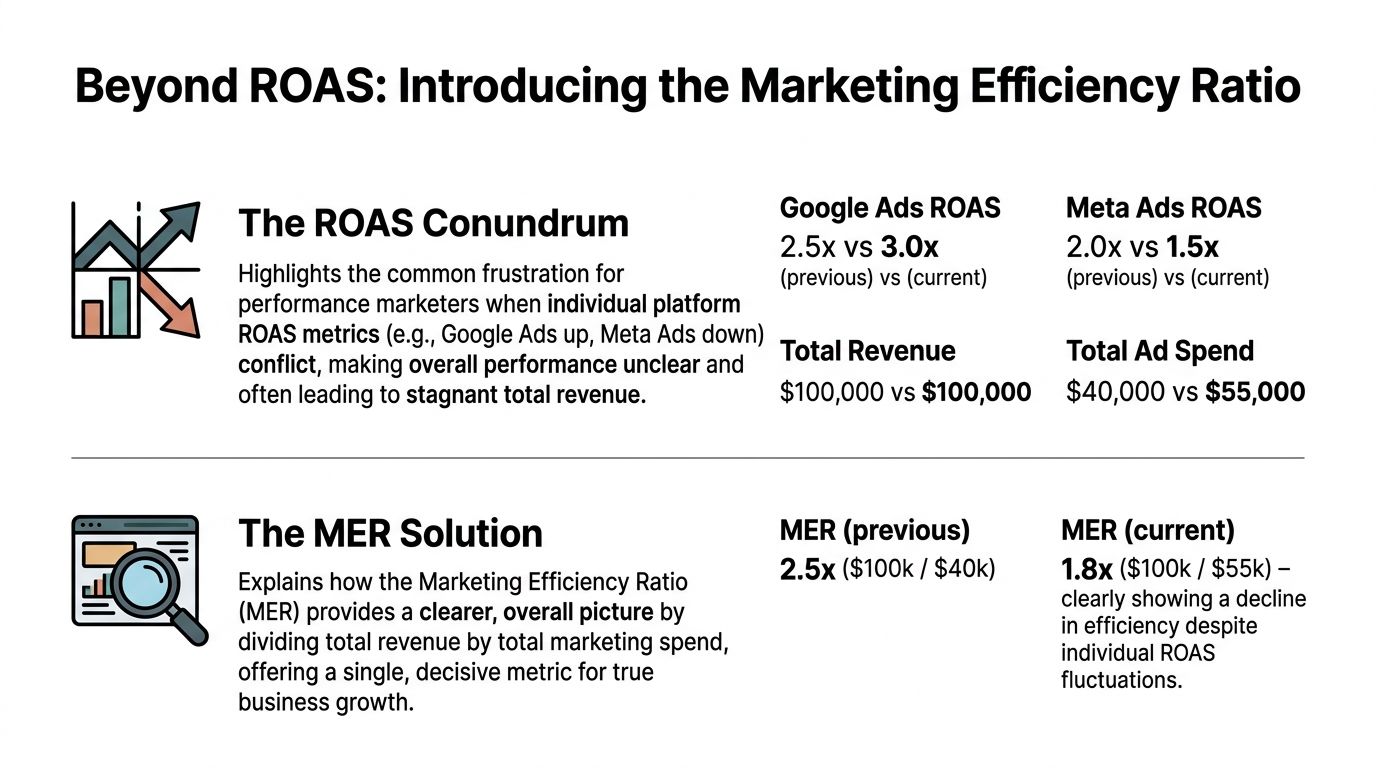
Beyond ROAS Introducing the Marketing Efficiency Ratio
Many teams first feel the need for MER when their dashboard gets noisy.
Google looks efficient. Meta looks messy. Branded search is carrying more than it should. Revenue is not collapsing, but it is not responding to spend the way it should either. In that situation, channel-specific ROAS can push a team toward the wrong conclusion because each platform is grading its own homework.
The marketing efficiency ratio, or MER, gives you a top-down answer. It is calculated as Total Revenue ÷ Total Marketing Spend. That simplicity is why it matters. It does not ask which click got credit. It asks whether the business got enough revenue for what it spent.
What MER tells leadership that ROAS cannot
ROAS is tactical. It helps a media buyer decide whether a campaign, ad set, or audience deserves more budget. If you need a refresher on channel-level efficiency, this explanation of https://spendowlai.com/blog/article/what-is-roas-in-digital-marketing is useful.
MER answers a different question. According to Northbeam’s explanation of marketing efficiency ratio and ROAS, the metric represents a fundamental shift in how businesses measure marketing performance at an organizational level because it provides a blended, executive-level view of overall marketing effectiveness. The same source gives a clean example: a company spending $100,000 on marketing and generating $500,000 in total revenue has an MER of 5.0, meaning $5 in revenue for every $1 spent.
That is why finance teams like MER. It speaks the language of allocation, not ad manager trivia.
A useful way to think about it
ROAS is a microscope. MER is the windshield.
You still need the microscope. You cannot run Meta, Google, YouTube, email, affiliate, and creative testing from a single blended number. But if you drive only by microscope, you will crash into wasted spend.
A few practical differences matter:
ROAS is channel-specific: It helps you optimize inside a platform.
MER is blended: It reflects the combined effect of paid, organic, referral, and brand activity.
ROAS is execution-level: Buyers use it to tune bids, budgets, and creatives.
MER is business-level: Leaders use it to judge whether total spend is sustainable.
Tip: If a channel is winning in-platform while total efficiency is deteriorating, trust the blended number first, then diagnose the cause.
How teams should calculate it
The formula is simple. The discipline is not.
Use the same revenue definition and the same spend definition each time. If your team changes what counts as revenue or excludes parts of marketing spend when performance gets uncomfortable, the metric stops being useful.
A clean operating habit looks like this:
Pick one reporting window: Daily monitoring can help operators, but trend judgment needs consistency.
Define marketing spend clearly: Include the spend categories your team agrees represent marketing investment.
Track the number over time: The point is not one isolated MER value. The point is whether your actions improve or degrade it.
Marketing efficiency ratio's power appears when it changes how your team behaves. A team with MER as a north star stops celebrating isolated wins that do not improve total business efficiency.
Decoding Your MER Benchmarks and Context
A raw MER number means very little without context.
A team can hit a ratio that looks healthy on paper and still make poor decisions because margins are thin, growth goals are aggressive, or the customer mix has shifted. The benchmark is a starting point, not a verdict.

What counts as healthy
According to OWOX’s MER benchmark breakdown, a healthy MER typically stands at 3.0 or higher. The same source notes that larger companies with revenue above $500 million achieved MER above 10, while smaller brands ranged between 2.4 and 5.1. It also notes that some mature businesses aim for 5.0 or higher, while startups may accept a lower ratio while prioritizing growth.
That range matters because operators often ask for a universal target when what they really need is a business model discussion.
Why the same MER can mean different things
A venture-backed brand trying to buy market share can live with a lower short-term ratio than a mature, cash-conscious operator. An ecommerce business with tighter product economics usually needs more efficiency than a business with more room in the margin structure.
If you want a more disciplined way to think about how Key Performance Indicators (KPIs) are measured, use that framework before setting any MER target. Teams get into trouble when they inherit a benchmark from another brand without matching it to their own margin profile, sales cycle, and growth objective.
The same goes for ROI framing. This guide on https://spendowlai.com/blog/article/define-marketing-roi can help if your team mixes up profitability language and efficiency language in planning meetings.
Context questions worth asking
Do not ask only, “Is our MER good?”
Ask these instead:
Context question | Why it matters |
|---|---|
Is the business in growth mode or efficiency mode? | Acceptable MER changes with growth goals. |
What do product margins allow? | A blended ratio can look fine while profit stays weak. |
How much revenue comes from returning customers? | Repeat demand can mask weak acquisition efficiency. |
Which SKUs are carrying the ratio? | Blended averages can hide product-level waste. |
Segment the ratio before you trust it
The blended number is useful. The segmented view is where operators find influence.
Look at MER through a few lenses:
By channel mix: Not to replace ROAS, but to see whether one part of the mix is dragging blended efficiency down.
By new versus returning customer behavior: A strong total ratio can hide an acquisition engine that is too expensive.
By SKU or product family: Some products can absorb more spend than others.
By season or promotion period: Efficiency during discounts may not reflect baseline health.
Key takeaway: A benchmark only becomes actionable when you can explain why your business should hit that number and which part of the business is preventing it.
The mistake is treating MER as a grade. Use it as a prompt. If it sits below your target, do not jump straight to cuts or scale. First identify whether the issue comes from channel mix, customer mix, product mix, or a planning assumption that no longer holds.
Four Common MER Traps That Waste Your Marketing Budget
MER is powerful because it simplifies the picture. It is dangerous for the same reason.
One blended number can hide bad economics, timing issues, and structural weaknesses. Operators need to know where MER can mislead them before they use it to make cuts, push scale, or defend performance.
Margin blindness
A respectable MER can still support an unprofitable business.
This shows up most often in DTC. According to HubSpot’s marketing efficiency ratio guide, DTC brands may require an MER of 5.0 for profitability because of product cost structure. That means a ratio that looks strong in a meeting can still fail to support the actual economics of the catalog.
If a low-margin SKU is carrying paid volume, blended efficiency may flatter performance that should not be scaled.
Ask:
Which products can support this spend level
Are promotions making the ratio look healthier than the margin line
Would this MER still be acceptable without repeat purchases
Attribution lag
MER can look weak before revenue fully catches up.
This is common during launches, seasonal spikes, or any model where customers need time to convert. Teams that judge efficiency too early often cut spend right before the return shows up, then spend the next cycle trying to recover lost momentum.
A useful operator habit is to compare early signals against a stable reporting cadence instead of reacting to the first dip.
New versus returning customer fallacy
Blended revenue can hide a fragile acquisition engine.
If returning customers, email, subscriptions, or branded demand are carrying results, total MER may stay stable while paid prospecting deteriorates unnoticed. Leadership sees one healthy number. The acquisition team inherits a future problem.
Separate the questions:
Is the business efficient overall?
Is new customer acquisition efficient enough to sustain growth?
Those are not the same thing.
Channel cannibalization
Teams often overreact to one channel’s high ROAS and starve the rest of the system.
HubSpot notes a critical pitfall here: if one channel has a 10.0 ROAS and another has a 1.0 ROAS, focusing only on the high-ROAS channel can shrink the business because ROAS optimizes micro performance while MER captures total business efficiency. A channel with a weaker direct return may still support branded search, email capture, or later conversion behavior that benefits the whole mix.
Practical test: Before cutting a weak-looking channel, ask whether its removal would reduce total revenue more than it saves in spend.
The best MER users stay skeptical. They do not worship the blended number. They use it to surface better questions about margins, timing, customer mix, and cross-channel interaction.
A Practical Framework to Systematically Improve MER
Improving marketing efficiency ratio is rarely about one heroic optimization. It usually comes from a calmer operating system.
Teams improve MER when they allocate budget with discipline, address fatigue before it spreads, and stop making edits that satisfy anxiety more than performance.

Reallocate with intent
Do not start by asking where you can spend more. Start by asking what deserves protection.
Some campaigns create efficient revenue. Others consume budget while adding noise. The operator’s job is to move spend toward durable efficiency, not chase whichever ad account had a good afternoon.
A practical review looks like this:
Compare blended efficiency against target
Identify the channels, audiences, or product groups pulling the ratio down
Reallocate gradually rather than forcing uniform cuts or blanket scale
Watch whether the blended number improves after the shift
That last step matters. A local improvement inside one platform is not enough if total efficiency gets worse.
For teams interested in the broader discipline of building a powerful return on your marketing spend, the useful takeaway is that better return usually comes from system design, not endless account tinkering.
Fix creative and audience decay before it becomes expensive
Many MER problems start long before the blended number visibly drops.
Creative fatigue, audience saturation, and offer mismatch often show up first as softer engagement, unstable delivery, or rising costs that look temporary. Teams miss them because platform-level ROAS stays acceptable until the decay is more advanced.
Watch for patterns such as:
Creative fatigue: Performance weakens across ads that have already carried too much delivery.
Audience saturation: The same buyers see the same message too often.
Offer mismatch: The ad still gets attention, but the product page or price point does not convert that attention well.
These are not reasons to panic-edit. They are reasons to diagnose carefully and act where the signal is clear.
Build guardrails around action
The biggest operational shift is this: explicit restraint.
According to Common Thread Collective’s analysis of MER in ecommerce, reactive, high-frequency optimization typically degrades MER because teams increase spend without proportional revenue gains. The same source argues that the right response is not uniform budget increases, but diagnosing underperforming segments and using guardrails to distinguish signal from noise.
That means your process needs rules for when not to act.
Tip: If your team cannot explain why a change matters beyond “performance looked off yesterday,” the default should be restraint.
Useful guardrails include:
Edit frequency limits: Too many changes reset learning and make signal harder to read.
Volatility checks: One unstable day should not trigger structural changes.
Cost trend review: Rising costs without supporting revenue movement deserve attention.
Fatigue review: Refresh creatives because evidence supports it, not because the calendar says so.
A short explainer on the operating mindset is worth watching here:
The discipline is simple to describe and hard to practice. Good operators do less, but they do it with better reasons. That is how MER improves sustainably.
How SpendOwlAI Operationalizes MER Daily
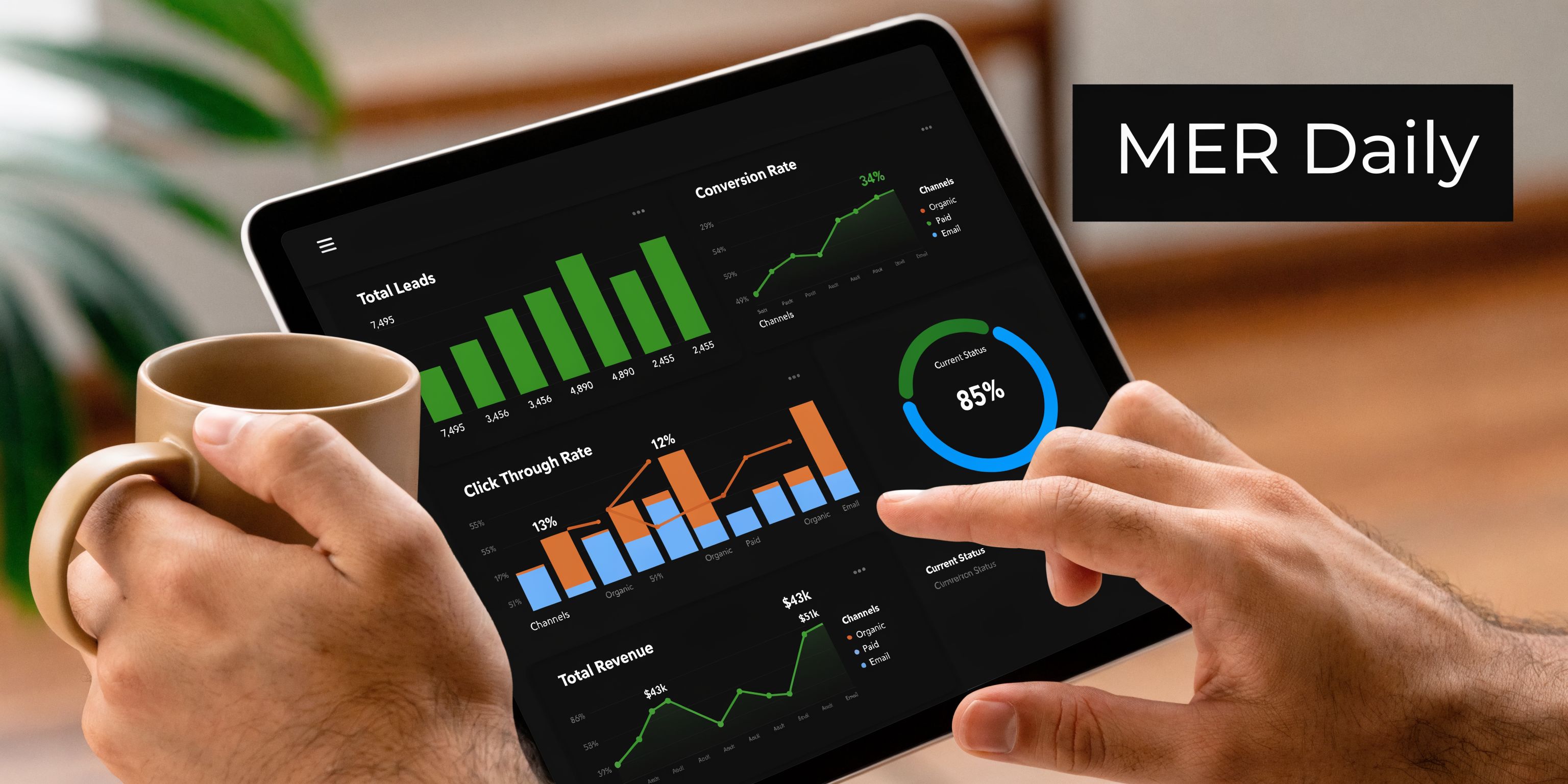
Most articles stop at calculation, benchmarks, and theory. Teams need something else. They need a way to turn marketing efficiency ratio into a daily operating constraint across Meta, Google, and Shopify without drowning in dashboards.
That is where operator tooling matters.
Why a static dashboard is not enough
A dashboard can tell you MER moved. It usually cannot tell you what deserves action first, what should be left alone, and which changes will likely hurt more than help.
That gap gets wider when one person manages several accounts or an agency manages several brands. The bottleneck stops being reporting. It becomes prioritization.
A daily system needs to answer questions like these:
Which account needs intervention today
Which campaign is underperforming in a way that matters to blended efficiency
Is this a real shift or just volatility
Will editing this now improve MER, or just satisfy the urge to act
Where operator-specific signals change the game
This is the area most MER guidance misses.
According to Cometly’s discussion of MER and operational signals, a major gap in MER coverage is its integration with operator metrics such as learning stability and volatility. The same source states that AI-driven platforms are seeing a 25% MER uplift from volatility monitoring, and that ad auctions grew 18% more turbulent post-iOS. More important than the headline numbers is the operational point: tying MER to SKU-level signals, fatigue detection, risk flags, and ranked impact lists turns it from a static snapshot into a daily execution tool.
That is the practical shift. MER becomes useful when it is connected to the causes of waste, not just the outcome.
What daily operationalization looks like
A workable system should not flood operators with alerts. It should narrow attention.
Instead of handing a team a spreadsheet and a target, the system should produce a ranked queue:
Budget actions with rationale
Creative risks before fatigue becomes expensive
Audience issues that suggest saturation rather than random fluctuation
Warnings when edit frequency is becoming the problem
That approach aligns well with how teams work. Media buyers and growth leads do not need another abstract score. They need explainable recommendations they can inspect and defend.
For a deeper look at this operating model, https://spendowlai.com/blog/article/ai-driven-marketing-insights covers how AI-driven analysis becomes more useful when it is tied to practical decisions rather than black-box automation.
Explicit restraint is the significant advantage
The strongest MER systems do not just find optimization opportunities. They stop bad optimization.
That matters because many teams lose efficiency through over-management. Someone sees a weak morning in Meta, trims a budget. Another sees branded search soften, pushes spend elsewhere. A third swaps creative because CTR drifted. Each change feels responsible. Together they create instability.
A tool built around MER should therefore do two things at once:
What it should surface | Why it matters |
|---|---|
High-impact fixes | Operators need to know where action is likely to improve efficiency. |
Risk flags against over-editing | Operators also need protection from noise-driven changes. |
Key takeaway: The goal is not maximum activity. The goal is better judgment about where intervention improves blended efficiency and where restraint protects it.
For agencies, this becomes even more valuable. Multi-account visibility helps teams avoid spending all day inside whichever client is loudest. For Shopify operators, SKU-level context matters because a healthy account-level MER can still hide waste in individual products. For founders, ranked action lists make the metric usable without turning them into full-time analysts.
Used this way, marketing efficiency ratio stops being a reporting metric reviewed after the damage is done. It becomes a daily filter for what to change, what to monitor, and what to leave untouched.
From Metric to Mindset The Future of Efficient Growth
The best use of marketing efficiency ratio has very little to do with spreadsheets.
It changes how a team behaves under pressure. Instead of reacting to every platform swing, operators use a blended efficiency guardrail to decide whether a change is warranted at all. That single shift cuts a surprising amount of waste.
The practical pattern is straightforward:
What strong teams do differently
They keep ROAS in its place: Useful for local optimization, not a substitute for business-level judgment.
They interpret MER in context: Benchmarks only matter when matched to margins, stage, and customer mix.
They challenge the number: Blended efficiency can hide margin issues, acquisition weakness, and channel interaction.
They practice restraint: Fewer edits, better reasons, cleaner signal.
The tactical questions that matter most
If MER drops, do not rush into broad cuts. Diagnose where the drag sits.
If MER looks healthy, do not assume the account is healthy. Check whether returning customer demand or a narrow product set is doing all the work.
If you manage daily performance, your job is not making the most changes. It is protecting the business from bad changes while acting decisively on the few that matter.
Final takeaway: Efficient growth comes from clarity, not motion. Teams win when they can separate meaningful shifts from platform noise and manage spend accordingly.
Marketing Efficiency Ratio FAQs
Question | Answer |
|---|---|
What is marketing efficiency ratio in simple terms | It is the total revenue generated divided by total marketing spend over the same period. It gives a blended view of how efficiently marketing converts spend into revenue. |
Is MER better than ROAS | Neither is better in every situation. ROAS helps optimize campaigns and channels. MER helps judge whether total marketing investment is sustainable for the business. |
What is a good MER | It depends on margins, growth stage, and business model. Common benchmarks place a healthy MER at 3.0 or higher, but context matters more than copying a target from another company. |
Should I use MER every day | You can monitor it daily as an operating guardrail, especially if your team manages active spend across multiple platforms. But you should interpret it with a consistent reporting cadence so short-term noise does not drive bad decisions. |
Can a strong MER still hide problems | Yes. A blended ratio can mask weak acquisition efficiency, low-margin product mix, delayed conversion behavior, or overreliance on returning customers. |
How do I improve MER without hurting growth | Focus on reducing wasted spend, diagnosing underperforming segments, managing fatigue and saturation, and avoiding reactive edits. The goal is better allocation and cleaner decisions, not indiscriminate cuts. |
What does explicit restraint mean in practice | It means setting clear rules for when not to change budgets, audiences, or creatives. If the movement is likely noise rather than a meaningful shift, you hold steady and preserve signal quality. |
If your team wants to turn MER from a lagging KPI into a daily decision system, SpendOwlAI is built for that job. It helps operators managing Meta, Google, and Shopify cut through noisy performance data, prioritize the highest-impact actions, and avoid the over-editing that gradually erodes efficiency.