How to calculate cpc: A Simple Guide to Ad Spend Savings
At its core, calculating your Cost Per Click (CPC) is refreshingly simple. You just take your total ad spend and divide it by the total number of clicks you got. This fundamental formula is your starting point for figuring out just how efficient your paid ad campaigns really are.
How To Calculate CPC: The Basic Formula
Before we get into the weeds with platform-specific quirks or more advanced calculations, you need to have this basic formula down cold. Mastering it gives you a clean, straightforward way to look at your campaign performance.
For any performance marketer, this is the bedrock metric. It cuts right to the chase and answers the most important question about your ad budget: "What am I actually paying every time someone clicks my ad?"
A Quick Worked Example
Let's put this into a real-world scenario. Imagine a new e-commerce store is running a campaign on Google Ads.
They put $500 into the campaign, and it brings in 1,000 clicks to their website. The calculation is simple:
$500 (Total Ad Spend) ÷ 1,000 (Total Clicks) = $0.50 CPC
In this case, the store paid exactly 50 cents for every single click. This basic math—cost divided by clicks—is the universal standard, whether you're advertising on Google, Meta, or anywhere else. For a deeper dive into how different networks handle this, check out this insightful guide on dreamdata.io.
CPC Calculation at a Glance
To make sure we're on the same page, here are the two core pieces of information you'll always need to find your CPC.
Component | Definition | Example Value |
|---|---|---|
Total Ad Spend | The total amount of money spent on a specific ad or campaign. |
|
Total Clicks | The total number of clicks the ad or campaign received. |
|
With these two numbers, you can calculate the CPC for any campaign, ad set, or individual ad.
Why Does This Simple Number Matter So Much?
This single metric gives you an instant read on your campaign's cost-efficiency. While other numbers like conversion rate or ROAS tell you more about profitability, CPC is your first clue. It’s the diagnostic tool that tells you if you're overpaying for attention.
Expert Tip: A low CPC isn't the holy grail. A high-intent click that costs $2.00 but leads to a sale is infinitely better than a cheap, non-converting click for $0.20. It’s all about context and balancing cost against the quality of the traffic you're buying.
Ultimately, knowing how to calculate your CPC is the first real step toward making smarter, data-driven decisions. It’s how you start optimizing your budget for real results.
How CPC Works in Google Ads and Meta
The basic CPC formula is the same everywhere, but getting your hands on the Total Cost and Total Clicks means digging into the specific ad platform you're using. Both Google Ads and Meta Ads give you this data, but the real trick is understanding the story the numbers are telling.
In your Google Ads dashboard, you'll find what you need right in the main "Campaigns" view. Just make sure your columns are set to show "Cost" and "Clicks" for the time period you're analyzing. Over in Meta’s Ads Manager, it works much the same way—the default view usually has "Amount Spent" (your cost) and "Link Clicks" ready to go.
Max CPC vs. Actual CPC: What You Really Pay
This is a big one. It's easy to get your bid confused with your final cost, but they are two very different things.
When you set a Max CPC, you're just telling the platform the absolute most you’re willing to spend for one click. But thanks to the way ad auctions work, your Actual CPC—what you actually get charged—is almost always lower.
You only have to pay a single cent more than the bidder right behind you. So, if you bid $3.00 but the next highest competitor only bids $1.85, you'll probably end up paying around $1.86, not your full $3.00. Mastering this concept is key to helping you improve Google Ads performance because it allows you to bid competitively without just throwing money away.
Key Takeaway: Think of your Max CPC as a price ceiling, not a fixed price. Your Actual CPC is what reflects the reality of the auction, and it's the number you should always use for your performance calculations.
Why Your CPCs Are So Different Across Platforms
Let's look at a real-world example. Imagine you’re running two very different campaigns: a Google Search campaign for "emergency plumber" and a Meta campaign to get the word out about a new clothing brand.
Google Search Campaign: The CPC here could easily be $15.00, maybe even more. Why? The user's intent is sky-high. They have a pipe bursting and need a plumber right now. You’re paying a premium to get in front of someone actively looking to solve an urgent, expensive problem.
Meta Awareness Campaign: On the other hand, your CPC here might be just $0.45. You’re catching people as they scroll through their social feeds. Their intent to buy is low, so the cost to grab their attention with a click is way cheaper.
This huge difference shows why just knowing your CPC isn't enough. You have to interpret it based on the platform, the audience's mindset, and what you’re trying to achieve with your campaign before you can make smart decisions.
Moving Beyond Basic CPC Calculations
A single, campaign-level CPC often hides the real story behind your ad spend. To make genuinely smart budget decisions, you need to slice and dice your data, looking at performance through a more focused lens. This is where we move beyond the simple average and into calculations that provide truly actionable insights.
This means breaking down your overall performance into smaller, more meaningful parts. Instead of just looking at the total cost and total clicks for an entire campaign, we can dig into performance by specific ad groups, devices, or even geographic locations. This level of detail is exactly what you need to spot which parts of your campaign are pulling their weight and which are just burning cash.
This whole process, from setting your maximum bid to what you actually end up paying, is driven by the ad auction.
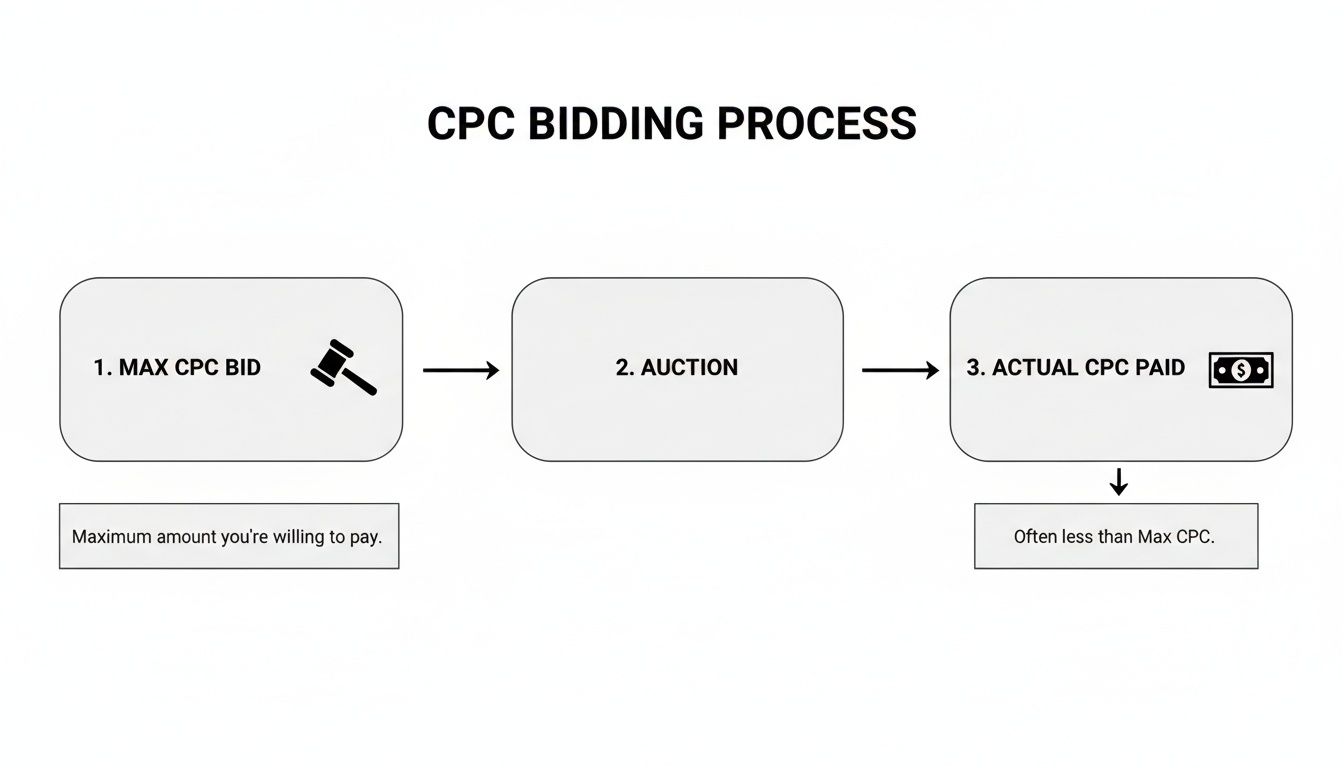
As you can see, your Max CPC is just a ceiling. The auction itself determines the lower, actual CPC you get charged.
Calculating a Weighted CPC
A simple average of your CPCs can be dangerously deceptive. Let's say one ad group spends $900 for 900 clicks ($1.00 CPC) and another spends just $100 for 200 clicks ($0.50 CPC). A simple average of the two CPCs is $0.75. But that's just plain wrong because it completely ignores the massive difference in spend.
A weighted CPC gives you the true picture by factoring in the volume and cost from each segment. The formula is beautifully simple:
(Total Cost of All Segments) / (Total Clicks of All Segments)
Using our example: ($900 + $100) / (900 + 200) = $1,000 / 1,100 = $0.91. The real, weighted CPC is much closer to $1.00 because that’s where the vast majority of the budget went.
This table clearly illustrates how a simple average can skew your perception of performance.
Weighted vs. Simple CPC Calculation
Ad Group | Total Cost | Total Clicks | Simple CPC (Incorrect) | Weighted CPC (Correct) |
|---|---|---|---|---|
Ad Group A | $900 | 900 | $1.00 | $0.91 |
Ad Group B | $100 | 200 | $0.50 | $0.91 |
Total/Average | $1,000 | 1,100 | $0.75 | $0.91 |
The simple average of $0.75 makes performance look better than it is, while the weighted average of $0.91 accurately reflects where the money was spent.
Expert Tip: Always use a weighted average when you're combining CPCs from different segments with uneven spending. It prevents a low-spend, low-CPC ad group from giving you a false sense of security about your overall campaign efficiency.
Creating an Adjusted CPC for Segments
You can apply the same logic to compare performance across different audience segments. A classic and highly effective approach is to calculate an adjusted CPC for mobile versus desktop traffic. From experience, I've often found that desktop clicks are more expensive but convert at a much higher rate.
This knowledge is pure gold. It allows you to set device-specific bid adjustments, strategically pushing more budget toward the higher-performing segment. This is also a fantastic way to start thinking about your cost per acquisition, as you begin to connect the cost of a click to an actual business result.
This kind of strategic thinking is also vital when setting goals. For instance, if you have a budget of $1,000 and need to generate 500 clicks, your target CPC is $2.00. Combining this goal-oriented approach with the knowledge that improving factors like ad relevance and Quality Score can lower your CPC by 20-40% is how you build a seriously efficient advertising strategy.
Using Your CPC Data to Forecast and Benchmark
Figuring out your CPC is great, but that's just the starting line. The real magic happens when you use that number to make smarter decisions about your budget and strategy for the months ahead. It’s the difference between just reporting on the past and actually shaping your future performance.
One of the biggest mistakes I see people make is grabbing a generic "industry average" CPC and using it for their planning. Your own historical data is infinitely more valuable and will give you a much clearer picture.
Digging into your own past campaign costs is the only way to get benchmarks and forecasts that mean anything. Smart marketing teams have moved away from broad industry standards and now focus on what their own data is telling them. By slicing up your CPC analysis by platform, audience, and even time of year, you start to see the real trends that drive your click costs. This is the core of a solid ad cost per click analysis.
Setting Realistic Performance Benchmarks
Forget asking, "What's a good CPC?" Instead, start asking, "What was our CPC last month, or last quarter?" That's your true north.
To find the most useful patterns, you need to segment your historical performance. Look at your data through different lenses:
By Campaign Type: Are you paying more for clicks on top-of-funnel prospecting campaigns compared to your warmer retargeting audiences? (You probably are, and that's okay!)
By Audience: How do costs vary between your lookalike audiences and your core interest-based segments?
By Seasonality: Does your CPC go through the roof during Black Friday or other key holidays?
Breaking it down this way shows you the actual cost of reaching specific customers at specific times.
A savvy ecommerce brand knows its CPC doubles every Q4. Instead of panicking when costs rise, they proactively build that 100% increase into their holiday budget. They're not just reacting; they're strategically planning for a predictable seasonal shift.
Forecasting Future Ad Spend
Once you have a solid benchmark based on your own history, forecasting becomes much more reliable. If you know that a particular type of campaign consistently delivers a CPC of $1.50, you can start predicting your budget needs with real confidence.
Let's say your goal for next quarter is to drive 10,000 new visitors to your website from that campaign. The math is straightforward: 10,000 clicks x $1.50 CPC = $15,000.
This simple forecast is incredibly powerful. It grounds your marketing goals in financial reality, making it much easier to have productive conversations with your finance team. Of course, the next step is connecting that spend to profit, and for that, understanding your break-even ROAS is crucial.
Common CPC Mistakes That Are Costing You Money

Knowing how to calculate CPC is one thing. Knowing how to avoid the common traps that drain your ad spend is another thing entirely. I’ve seen countless marketers make costly, yet preventable, errors that inflate their costs and hide what’s really going on with their campaign performance.
One of the biggest mix-ups is treating your maximum bid as your actual CPC. They are not the same. Your max bid is just what you're willing to pay in the ad auction; your actual CPC is what you actually pay, and it's almost always lower. If you base your analysis on your bids, you're working with flawed data from the start.
Another classic mistake? Forgetting about Quality Score. On platforms like Google Ads, a high Quality Score is your ticket to a lower CPC. If you're not constantly tweaking your ad relevance and improving the landing page experience, you're basically telling the platform you're okay with overpaying for every click.
You're Ignoring How Your Segments Perform
If you're only looking at a single, campaign-wide CPC, you're flying blind. This "blended" average is dangerous because it masks the real story happening underneath. For example, a campaign might have a decent-looking $0.50 CPC, but that could be hiding a fantastic ad set getting cheap clicks and a terrible one burning cash at $5.00 a pop. Without breaking it down, you'd never know.
You have to dig deeper. At a minimum, I always analyze these segments:
Device: How does your mobile CPC stack up against desktop? The answer might surprise you.
Audience: Are you paying a premium for clicks from a brand-new prospecting audience versus your warm retargeting list?
Placement: Is the Facebook News Feed cheaper than Instagram Stories for your ads? Costs can vary wildly.
The ultimate mistake is chasing a low CPC for its own sake. I once saw a team get excited because they slashed their CPC by 50%. The problem? Their return on ad spend (ROAS) completely tanked. Those cheap clicks were from a low-quality audience that never converted, turning their "savings" into a massive net loss.
Always remember that CPC doesn't exist in a vacuum. A higher CPC that brings in high-quality, profitable customers will always beat a rock-bottom CPC that delivers nothing but empty clicks.
Questions We Hear All the Time About CPC
Once you get the hang of the basic CPC formula, the real-world questions start popping up. Let's tackle a few of the most common ones I hear from fellow marketers.
"A lower CPC is always better, right?"
Not necessarily. It's a classic rookie mistake to chase the lowest CPC possible, but this can actually torpedo your profitability.
Think about it: a $5.00 click from someone ready to buy, who ends up making a $200 purchase, is infinitely better than 100 clicks at $0.05 from tire-kickers who never convert. The real goal isn't cheap clicks; it's profitable ones.
My Two Cents: Don't get fixated on a low CPC. Instead, focus on finding your most profitable CPC. This often means paying a bit more for a click that has a much higher chance of turning into a customer.
"How much does my ad quality really impact my CPC?"
Massively. Platforms like Google Ads live and die by their Quality Score, and for good reason. A high Quality Score is like getting a discount on every single click.
If your ad perfectly matches what someone is searching for and your landing page is a great experience, Google rewards you. You can end up paying less for a top ad spot than a competitor with a clunky ad and a higher bid. Seriously, improving your ad creative and landing page is one of the most direct ways to lower what you pay.
"Can I just figure out the CPC for my whole campaign?"
Absolutely, and it’s a great starting point. Just take the total cost of the campaign and divide it by the total clicks it brought in. This gives you a bird's-eye view of your performance.
But don't stop there. A campaign-level CPC is an average, and averages can be deceiving. A great ad group could be propping up a terrible one, and you’d never know. Use the overall campaign CPC to get your bearings, then immediately drill down into your ad groups and keywords to see what’s really going on.
Stop wasting time on noisy data and start making smarter decisions. SpendOwlAI delivers a clear, ranked list of daily actions to optimize your ad spend, complete with transparent rationale. Start your free 7-day trial today and see what needs your attention.