How to Calculate Cost Per Acquisition A Founder's Guide
At its core, calculating your cost per acquisition is pretty straightforward. You just divide your Total Marketing & Sales Spend by the Total New Customers Acquired. But mastering this simple formula is what separates a good marketing engine from a great one, turning raw data into strategic, profitable growth.
Why Mastering Your CPA Is a Non-Negotiable Skill

Knowing the basic formula is just the start. With ad costs constantly climbing and competition getting fiercer by the day, your Cost Per Acquisition (CPA) isn't just another metric to glance at—it’s the pulse of your business's health. For anyone running a business or a marketing team, a deep, practical understanding of CPA is absolutely critical for staying in the black.
This isn't about passively watching numbers on a dashboard. It's about grabbing an active lever you can pull to drive real, sustainable growth. Once you truly get a handle on how to calculate your cost per acquisition, you turn a simple metric into a powerful strategic tool.
The Rising Tide of Acquisition Costs
The challenge today is steeper than it's ever been. Customer acquisition costs have jumped a staggering 60% over the last five years, a reality hitting marketers hard in both B2B and B2C.
Think about it this way: if you're a direct-to-consumer founder running a Shopify store, a Meta campaign that used to bring in a customer for $40 a few years ago might now cost closer to $64. For a product with a lower average order value, that increase can wipe out your profit margin completely. You can find more insights on these rising marketing costs on GenesysGrowth.com.
A high CPA isn't just a marketing problem; it's a business problem. It impacts your cash flow, profitability, and ability to scale. Ignoring it is like trying to navigate a ship without a compass.
Turning CPA into a Growth Lever
When you nail down your CPA tracking, you unlock some serious advantages. The metric shifts from being a backward-looking report card to a forward-looking tool for making smart decisions.
A precise grasp of your CPA helps you:
Allocate Budgets Intelligently: You can confidently pump more money into the channels delivering profitable customers and pull back from the ones that are just burning cash.
Improve Marketing Efficiency: A high CPA on a specific campaign is a red flag. It tells you exactly where to look for problems—whether it’s the creative, the targeting, or the landing page—so you can optimize effectively.
Set Realistic Growth Goals: Your CPA is the key to figuring out how much you can actually afford to spend to hit your revenue targets. This makes financial planning far more predictable.
Validate Your Business Model: The ultimate test of a sustainable business is a healthy relationship between your CPA and Customer Lifetime Value (LTV). It's the proof that you've built something that can last.
The Real Cost: A More Honest CPA Formula (with Examples)

Relying on the CPA reported in your ad platform is a classic rookie mistake. Sure, Meta Ads or Google Ads will show you a "cost per purchase," but that number is dangerously incomplete. It conveniently ignores all the other money you had to spend to get that customer, which can give you a false sense of security and lead you to scale unprofitable campaigns.
To get a number you can actually trust, you need to think bigger. The real formula looks something like this:
CPA = (Total Marketing & Sales Costs) / New Customers Acquired
This approach forces you to account for your entire investment, giving you a much clearer picture of your actual profitability.
Breaking Down the Full Cost
So, what goes into "Total Marketing & Sales Costs"? It's everything you spend to get someone to click that "buy" button. Too many founders just look at ad spend, but the hidden costs can pile up and seriously inflate your real CPA.
Your total costs should include a few key things:
Ad Spend: This one's the most obvious. It's the money you pay directly to platforms like Meta, Google, TikTok, and so on.
Creative Costs: Did you hire a designer, copywriter, or video editor? Pay for user-generated content? All of that gets bundled in here.
Agency or Freelancer Fees: If you're paying an agency a retainer or a freelancer for their help, that's a direct cost of acquisition.
Software Costs: Don't forget about your tech stack. Subscriptions for landing page builders, analytics tools, or email marketing platforms all count.
I’ve seen it time and time again: by overlooking these extra costs, businesses can underestimate their true CPA by 20-40% or even more. That gap is often the silent killer, explaining why a campaign that looks profitable on paper is actually losing the company money.
A Practical Shopify Store Example
Let's walk through a real-world scenario. Imagine your direct-to-consumer Shopify store had the following expenses last month and brought in 100 brand-new customers:
Meta & Google Ad Spend: $5,000
Creative Production: $500 (for a fresh batch of video ads)
Agency Retainer: $1,500
Marketing Software: $250 (for analytics and a landing page tool)
First, let's tally up the total marketing investment.
$5,000 (Ad Spend) + $500 (Creative) + $1,500 (Agency) + $250 (Software) = $7,250 Total Cost
Now, we just divide that total by the number of new customers.
$7,250 / 100 New Customers = $72.50
So, your true CPA is $72.50.
Your ad platforms, however, would likely report a CPA of $50 ($5,000 ad spend / 100 customers). That’s a $22.50 blind spot per customer. This is the kind of insight that stops you from pouring more money into a leaky bucket. Getting this calculation right ensures your decisions are grounded in reality, not just vanity metrics from an ad dashboard.
Calculating CPA Across Different Marketing Channels
Relying on a single, blended CPA is like trying to navigate a ship with a broken compass. It averages out your best and worst performers, completely masking which channels are the true engines of your growth and which are just money pits. To make smart, informed decisions, you have to get granular and calculate a specific cost per acquisition for each channel you're using.
This kind of segmented view is absolutely critical for effective budget allocation. The truth is, the way you calculate CPA for a Meta Ads campaign is fundamentally different from how you'd approach an influencer program. Each channel has its own unique ecosystem of costs, and you need to account for all of them to get a truly accurate picture.
Detailing Costs for Specific Channels
So, how does this work in practice? A channel-specific CPA isn't just about taking the ad spend and dividing it by the conversions reported in that platform's dashboard. You need to dig deeper and tally up all the associated expenses.
Here are a few real-world examples to show you what I mean:
Google Ads CPA: This calculation needs to include your total ad spend, of course. But you also have to factor in a portion of your agency or freelancer fees if someone is managing the account for you. And don't forget any software costs for bid management or specialized reporting tools.
Influencer Marketing CPA: This one can get a bit more complex. You need to sum up all the creator fees, the cost of goods for any gifted products (often called product seeding), all the shipping expenses, and the cost of any platform you use to manage your influencer relationships.
Content Marketing/SEO CPA: For organic channels, the costs are different but just as real. You’d tally up the salaries of your content team, fees for any freelance writers you use, and the subscription costs for essential SEO tools like Ahrefs or Semrush.
Isolating these costs is how you move beyond vanity metrics and get to the true, fully-loaded cost of acquiring a customer through each specific effort. This level of clarity is what gives you the confidence to double down on what’s actually working. For a deeper dive on getting your tracking right, check out our guide on how to get started with UTMs for Google Analytics.
Putting Channel-Specific CPA into Practice
Let's walk through a quick scenario. Imagine you're running two campaigns. Your Google Ads campaign spent $5,000 and brought in 100 customers, giving it a simple, platform-reported CPA of $50. At the same time, an influencer campaign cost $3,000 in fees and product costs and generated 50 sales, for an apparent CPA of $60.
On the surface, Google Ads looks like the clear winner.
But hold on. What if you pay an agency $1,500 a month, and half of their time is spent on your Google account? That adds $750 to your Google costs, pushing the true CPA up to $57.50. Suddenly, that influencer campaign looks a lot more competitive, doesn't it?
This granular approach prevents you from cutting a channel that seems expensive on the surface but is actually highly efficient when all costs are considered. It’s the difference between reactive budget cuts and strategic, profitable investment.
This level of detail can also uncover crucial regional differences. In ecommerce, the average CAC can swing wildly depending on location. For instance, US brands often see 15-25% higher acquisition costs on the West Coast compared to the Midwest, a difference driven largely by intense ad competition. A similar trend exists in Europe, where Germany's CPA can be as much as 30% higher than Spain's, influenced by local economic factors and stricter data regulations. You can find more regional CAC benchmarks at LoyaltyLion.
Ultimately, calculating CPA by channel empowers you to invest your marketing budget with precision. It ensures every single dollar is working as hard as it possibly can to grow your business profitably.
Going Deeper With Advanced CPA Calculations
Once you've got a handle on calculating your cost per acquisition channel by channel, it's time to dig deeper. The basic numbers give you a starting point, but the real strategic advantage comes from understanding the nuances behind each customer's journey. This is where you start investing smarter, not just harder.
The single biggest lever you can pull here is your marketing attribution model. How you choose to assign credit for a conversion dramatically changes the cost—and perceived value—of each touchpoint. Getting this right is the key to unlocking a truly accurate CPA.
The Impact of Attribution Models
Most ad platforms, by default, will show you a last-click attribution model. It's simple: the very last ad a customer clicked before buying gets 100% of the credit. While easy to understand, this model is often deeply misleading and can lead you straight into making poor budget decisions.
Think about a typical customer journey. They might see an engaging ad on TikTok that first plants the seed. A week later, a retargeting ad on Meta reminds them about your brand. Finally, they search on Google, click a Shopping ad, and make the purchase.
With last-click attribution, Google gets all the glory. It looks like your star player. But this view completely ignores the crucial work TikTok and Meta did to build awareness and keep your brand top-of-mind. If you pull the plug on those "underperforming" channels, you might find your "rockstar" Google campaign suddenly starts to falter.
This is why you have to look beyond the default and explore different models using tools like marketing attribution software. Each model tells a different part of the story:
First-Touch: Gives all the credit to the very first channel that brought a visitor to you.
Linear: Splits the credit evenly across every touchpoint along the way.
Time-Decay: Assigns more credit to the touchpoints that happened closer to the final sale.
The table below shows just how drastically your CPA can change depending on which model you use, even with the exact same campaign data.
How Attribution Models Impact Your CPA
Channel | First-Touch CPA | Last-Touch CPA | Multi-Touch CPA |
|---|---|---|---|
Meta | $45 | $120 | $65 |
$90 | $50 | $70 | |
TikTok | $30 | $150 | $55 |
Notice how a channel like TikTok can look amazing for discovery (First-Touch) but terrible for closing (Last-Touch). A multi-touch model often gives you a more balanced and realistic view of each channel's true contribution.
Choosing the right attribution model isn’t about finding one "perfect" answer. It's about aligning your measurement with your business goals. A last-click model might be fine for a quick, direct-response sale, but a multi-touch model is essential for understanding the full-funnel impact of your marketing.
The concept map below breaks down how various channels feed into a single, blended CPA. This is the starting point for seeing the bigger picture before you drill down into attribution.
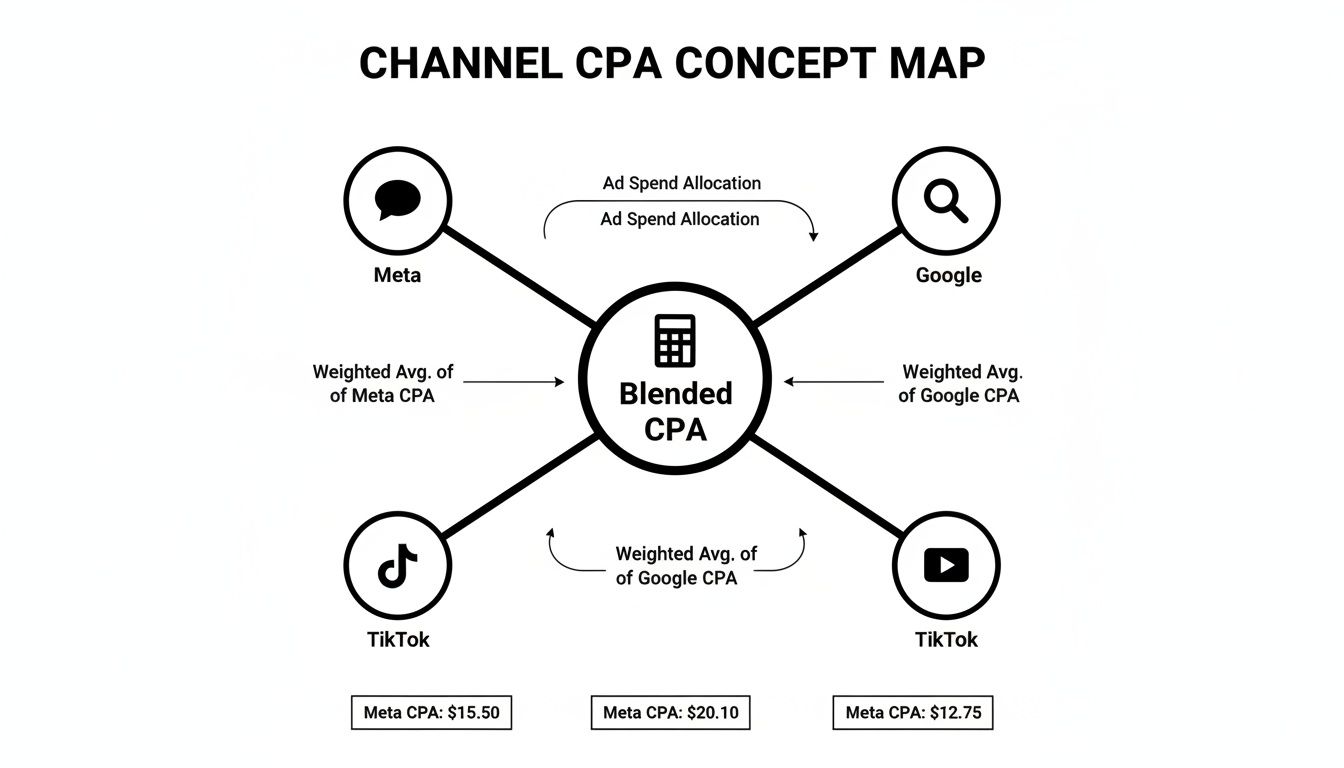
This visual really drives home that your total CPA is just an average. To truly optimize, you have to understand the role each individual channel plays.
Connecting CPA to Customer Lifetime Value
Ultimately, the goal isn't just to get customers for cheap; it's to acquire valuable customers who stick around. This is where Customer Lifetime Value (LTV) enters the conversation. LTV is the total revenue you can reasonably expect from a single customer over their entire relationship with your business.
Pairing LTV with your CPA analysis is a total game-changer.
Let's say one of your channels has a high CPA of $80. On its own, that might seem alarming. But if you discover that customers acquired from that channel have an average LTV of $400, it's an incredibly profitable investment.
On the flip side, another channel might boast a low CPA of just $20, which looks fantastic on a spreadsheet. But if those customers only ever make one small $30 purchase and disappear, you're not building a sustainable business.
A healthy LTV to CPA ratio is widely considered to be 3:1 or better. For every dollar you spend to get a customer, you should be making at least three dollars back over their lifetime. This simple ratio shifts your focus from short-term cost-cutting to long-term, profitable growth.
Common CPA Mistakes That Drain Your Budget

Knowing how to calculate your CPA is a huge step, but the real test is acting on that number wisely. It's incredibly easy to fall into a few common traps that drain your budget and lead to flawed decisions. Sidestep these pitfalls, and you'll be on your way to building a much more resilient and profitable marketing machine.
One of the most frequent errors I see is marketers forgetting to track all the associated costs. As we’ve covered, your true CPA isn't just ad spend divided by conversions. It’s a bigger picture that has to include creative production, agency fees, and software subscriptions. Ignoring these "hidden" expenses gives you a dangerously optimistic CPA and can mask serious unprofitability.
Reacting to Short-Term Noise
Another major mistake? Making knee-jerk decisions based on short-term CPA swings. It’s tempting to panic when your cost per acquisition spikes for a day or two, but this volatility is often just statistical noise, not a real performance shift.
Ad platforms need time to optimize, and daily results can be swayed by countless factors outside your control—like a competitor suddenly upping their bids or even the day of the week. Shutting off a campaign that looks expensive after only 48 hours can kill a potentially great campaign before it ever hits its stride.
The most disciplined marketers learn to distinguish between a temporary fluctuation and a sustained trend. Give your campaigns enough time and data to mature before making significant strategic changes.
Ignoring Conversion Delays
Attribution windows and conversion delays are another area where marketers get tripped up all the time. A customer might click your ad on Tuesday but not actually buy until Friday. If you’re pulling a report on Wednesday morning, that conversion won't be counted yet, making your CPA look artificially high.
This lag is especially common for higher-ticket items with longer consideration periods. You have to understand your typical customer journey and set expectations accordingly.
To avoid this, I always recommend focusing your analysis on longer timeframes:
Weekly Analysis: Perfect for making tactical adjustments to campaigns.
Monthly Reviews: Use this for bigger strategic decisions, like reallocating your budget between channels.
Quarterly Planning: Look at quarterly CPA trends to inform your high-level growth strategy and forecasting.
Misinterpreting Platform-Reported Data
Finally, a critical error is trusting the ad platform's data without question. Platforms like Meta and Google are designed to show you positive results—it keeps you spending. Their default last-click attribution models are overly simplistic, giving all the credit to the final touchpoint while ignoring the channels that introduced the customer to your brand in the first place.
This can lead you to undervalue crucial top-of-funnel efforts that are essential for building brand awareness. The solution is to use a more holistic measurement approach, bringing data into a central analytics tool where you can apply a more sophisticated attribution model. This gives you a much clearer picture of how all your channels work together to drive growth.
For more on getting customers to convert once they land on your site, check out our guide on website conversion optimization.
Common CPA Questions Answered
Once you start digging into cost per acquisition, a few questions always pop up. It's one thing to know the formula, but it's another to apply it effectively in the real world. Let's clear up some of the most common sticking points I see with marketers.
What Is a Good Cost Per Acquisition?
This is the million-dollar question, and the honest answer is: it depends entirely on your business. There’s no universal "good" CPA. The real benchmark is your Customer Lifetime Value (LTV).
A solid rule of thumb is to aim for an LTV to CPA ratio of at least 3:1. In simple terms, for every dollar you spend to get a customer, you should be making at least three dollars back from them over time.
So, if your average customer's LTV is $150, you'll want to keep your CPA under $50. A business with high-profit margins, like a SaaS company, might feel comfortable with a 2:1 ratio to grow faster. On the other hand, a low-margin e-commerce store might need a tighter 4:1 ratio just to stay profitable.
How Often Should I Calculate My CPA?
This really comes down to what you're trying to do. If you're running active ad campaigns, you should be checking in on your CPA daily or at least weekly. This lets you catch problems fast—like an ad that suddenly stops performing or a bug in your landing page—and fix them before they drain your budget.
But when it comes to the big picture, you need to zoom out.
Don't make major strategic decisions based on a single day's data. Daily numbers can be noisy. Base your budget shifts and channel planning on monthly or quarterly CPA trends. Use daily checks for tactics, but monthly reviews for strategy.
Reacting too quickly to normal ups and downs is a classic mistake. You might end up killing a campaign right before it was about to find its groove.
What Is the Difference Between CPA and CAC?
People often use these terms interchangeably, but they measure different things. The easiest way to remember the difference is to think about scope.
Cost Per Acquisition (CPA) is a very specific, tactical metric. It’s tied to the cost of a single action—a sale, a lead, a sign-up, you name it. It's perfect for judging the performance of a specific ad or campaign.
Customer Acquisition Cost (CAC) is a much broader, business-level metric. It rolls up all your sales and marketing costs—salaries, software, overhead, everything—to find the total cost of landing one new paying customer.
So, CPA tells you how efficiently a campaign is driving an action. CAC tells you the fully-loaded cost of growing your customer base.
Ready to stop guessing and start executing? SpendOwlAI translates your complex ad data into a simple, prioritized list of daily actions. Get clear guidance on what to change, what to scale, and what to leave alone, so you can improve your CPA with confidence. Start your free 7-day trial today.