How Long Should a TikTok Ad Be for Best Results in 2026
Let's get straight to it. While TikTok gives you up to 60 seconds for an ad, the numbers don't lie: the sweet spot for grabbing attention and getting results is a tight 9 to 15 seconds.
Think of it like a movie trailer. Its only job is to get you hooked fast, not to lay out the entire plot. On a platform where the first three seconds determine whether someone keeps watching or swipes away, that kind of brevity is your most powerful tool.
The 9 to 15 Second Sweet Spot for TikTok Ads
Figuring out how long a TikTok ad should be isn't just about hitting a specific time. It’s about matching your creative to the lightning-fast pace of the platform. An ad that feels even a few seconds too long is dead on arrival—skipped before your real message ever has a chance to land.
This 9 to 15-second window has become the benchmark for a good reason. It’s just long enough to tell a compelling mini-story but short enough to hold a user's notoriously fleeting attention.
This tight timeframe also instills a kind of creative discipline. You’re forced to capture interest, show your value, and push to a call-to-action in one rapid, seamless flow. There’s simply no room for the slow, meandering brand intros that might fly on other platforms.
Why Brevity Wins on TikTok
At its core, the TikTok experience is driven by the "For You Page"—an endless, algorithm-fueled stream of short, addictive content. Your ad has to compete head-to-head with a creator’s latest viral dance or a hilarious skit. If it looks and feels like a stuffy, traditional ad, users will swipe past it without a second thought.
This is exactly where the 9 to 15-second format proves its worth.
Higher Completion Rates: It's simple math. Shorter ads are far more likely to be watched all the way through, which sends strong positive signals to the TikTok algorithm.
Beats Scroll Fatigue: People jump on TikTok for quick hits of entertainment. A concise ad respects that behavior and feels less like a jarring interruption.
Forces a Clearer Message: When you only have seconds, you have to get right to the point. This eliminates fluff and leads to a much stronger, more direct message.
This chart breaks down how different ad lengths tend to perform, visually confirming why that 9 to 15-second range is so effective.
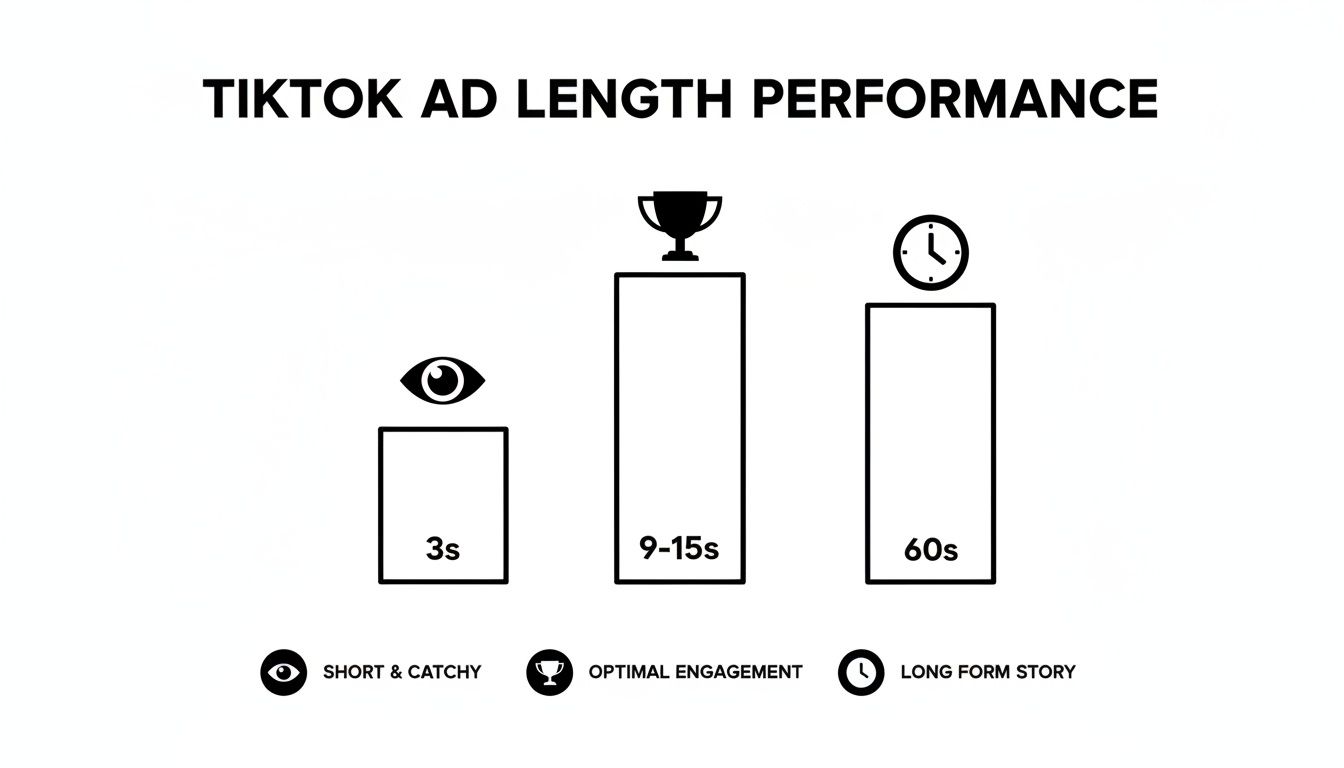
As you can see, super-short ads might grab a glance, but they often don't have enough time for a meaningful call-to-action. On the other end, longer ads suffer a massive drop-off in viewership.
This sweet spot isn't just a theory; it comes from countless real-world tests. In-feed ads—TikTok's highest-engagement format—consistently perform best when they hook viewers instantly and don't overstay their welcome.
Data from TikTok’s own creative guides backs this up, showing that an incredible 71% of an ad's success is decided in the first three seconds. It’s hard proof that a short, punchy approach is the only way to win against the constant threat of the next swipe, especially with users opening the app hundreds of times a month. You can dig deeper into this by checking out the latest TikTok ad guides for the creator economy.
Matching Ad Length to Your Campaign Goal
While the 9 to 15-second window is a fantastic rule of thumb, it's not the whole story. The real answer to "how long should my TikTok ad be?" always comes back to one thing: your campaign goal.
Think of it this way: you wouldn't use the same pitch to ask for a quick sale as you would to build a long-term relationship. It’s the same on TikTok. A short, punchy ad meant to drive immediate clicks is a completely different beast than a mini-story designed to make people remember your brand. Get this wrong, and you'll burn through your budget fast.
Tailoring Length for Direct Response Goals
When your campaign is all about direct response—getting traffic, leads, or sales—every single second is prime real estate. Your only mission is to get someone to act right now. Speed and clarity are everything.
For these campaigns, that 9 to 15-second sweet spot is where you want to live. It gives you just enough time to land a powerful hook, show off your product's value, and drive it home with a clear call-to-action like "Shop Now."
Straying much longer than that for a conversion campaign usually means you'll see a big drop-off in viewers and a higher cost for every action you get. If your bottom line is tied to immediate results, keep it short and sharp. This directly impacts your efficiency, and if you want to dig deeper into the numbers, we have a whole guide on cost per acquisition.
Adjusting Length for Awareness and Consideration
Now, if your goal is Brand Awareness or Consideration, you’ve got a bit more breathing room. Here, the objective isn't an instant click; it’s about making an impression, telling a story, or teaching your audience something cool.
For these top-of-funnel goals, you can start testing slightly longer formats, often in the 15 to 25-second range. That extra time lets you add more narrative and help your brand feel more human and less transactional.
A longer video works really well for:
Storytelling: Unfolding a quick story that creates an emotional connection.
Product Demos: Showing a more in-depth "how-to" or unboxing that builds real trust.
Building Community: Featuring user-generated content (UGC) to create a sense of belonging.
But a word of caution: even with more time, you still have to play by TikTok's rules. The ad needs to feel native to the platform, offer value upfront, and keep the pace moving. A boring 25-second ad is just as bad as a boring 60-second one. The key is always to align the ad's length with its purpose.
Anatomy of a High-Performing TikTok Ad
Knowing the right ad length is a great start, but it's not the whole story. A 15-second ad can fall completely flat if the content inside doesn't work. The best TikTok ads aren’t just short; they’re incredibly efficient. They pack a full narrative into a tight, three-part structure that respects the viewer's notoriously short attention span.
Think of it like telling a great joke—it needs a solid setup, a clear punchline, and a call for a reaction. On TikTok, that structure translates perfectly to the Hook, the Story, and the Call-to-Action (CTA). Nailing this flow is how you make an ad that feels native to the platform, not like a jarring commercial that begs for an instant swipe.
Act 1: The Hook (0–3 Seconds)
You have three seconds. That's it. Three seconds to stop someone from scrolling right past your ad. This isn't the moment for a gentle logo reveal or a slow, cinematic pan. Your hook has to be a showstopper that immediately grabs attention, either by posing a question, highlighting a problem, or showing off a jaw-dropping result.
The entire goal here is to create a pattern interrupt. Your audience is in a trance, swiping through an endless feed of similar content. Your ad has to be the one thing that looks and sounds different enough to break that trance.
A few hooks that almost always work:
A bold, controversial claim: "You've been cleaning your sneakers all wrong."
An unexpected visual: Someone casually dropping a brand-new iPhone into a bucket of water (to sell a waterproof case, of course).
A super-relatable problem: A quick shot of someone wrestling with a hopelessly tangled mess of charging cables.
Your hook has to be fast, visually arresting, and tie directly into the solution you're about to present.
Act 2: The Story (4–12 Seconds)
Okay, you’ve earned their attention. Now you have a precious few seconds to tell your story. And by story, I don’t mean a complex narrative. This is all about a rapid-fire demonstration of value. In this short window, you connect the problem from your hook to the solution your product offers.
The golden rule here is to show, don't just tell. If your hook was a filthy sneaker, this is where you show your product making it look brand new in seconds. If the hook was the tangled cable mess, the story is a satisfying shot of a sleek, organized charging station.
The most effective "story" sections on TikTok feel raw and real. Think fast cuts, user-generated content (UGC) clips, and simple text overlays that deliver information quickly. This approach makes your ad feel more like a helpful tip from a friend and less like a polished corporate broadcast.
Act 3: The Call to Action (13–15 Seconds)
This is the final push. After hooking the viewer and proving your product's value, you have to give them a crystal-clear, simple, and urgent next step. Ambiguity is your worst enemy. Don't just say, "check us out"; tell them exactly what to do next.
Combine a verbal CTA ("Tap the link to get yours!") with bold on-screen text and TikTok’s built-in CTA button (like "Shop Now" or "Learn More"). This creates a powerful prompt that hits on multiple senses and makes clicking the link feel like the natural conclusion. Getting this final step right is absolutely critical for turning views into clicks and can dramatically improve your click-through rate.
How User Behavior Shaped TikTok Ad Lengths
To really get why shorter is better on TikTok, you have to look at how the users themselves built the rulebook. TikTok didn't just wake up one day and decide short ads were the way to go; the audience’s behavior forced the platform—and advertisers—to adapt. This entire evolution from a quirky dance app to a global advertising machine was all about one thing: attention.
Think of the early "For You Page" as a quiet neighborhood. Seeing an ad was a bit of a novelty. But as TikTok’s popularity exploded, that quiet street turned into Times Square on New Year's Eve. All of a sudden, your ad wasn't just up against a few other brands. It was fighting for a sliver of attention against millions of other creators, trends, and inside jokes.
The Rise of the Split-Second Judgment
This flood of content completely changed how people watch videos on the platform. With a practically endless stream of new content just a swipe away, our attention spans naturally got shorter. We all became incredibly good at deciding if a video is worth our time within the first second.
This behavior directly trained the TikTok algorithm. Videos that landed an immediate hook—a laugh, a question, a "whoa" moment—got rewarded with more reach. Anything that felt slow, boring, or too much like a traditional TV commercial got swiped away into oblivion, telling the algorithm to bury it.
This isn't just a fleeting trend; it's baked into the platform's DNA. Time and time again, we see that shorter ads drive higher engagement—more full video views, more shares—which the algorithm sees as a sign of quality. That, in turn, often leads to lower ad costs and makes it easier to scale your campaigns.
Following the Data (and the Money)
The platform’s insane growth tells the rest of the story. As TikTok’s ad revenue skyrocketed from $2 billion in 2020 to a projected $43.96 billion by 2026, the competition got incredibly fierce. That's a nearly 2,100% surge, and it flooded the feed with ads, forcing marketers to get sharp or get ignored.
The data made it crystal clear. In-feed ads that run between 9-15 seconds consistently hit the sweet spot for click-through rates and cost-per-mille (CPM) in most major markets. You can dig deeper into this explosive growth and its strategic impact by checking out these insights on TikTok ad spending.
All this market pressure cemented the need for tight, punchy creative. The question of how long a TikTok ad should be stopped being a simple creative choice. It became a strategic necessity, driven entirely by user behavior and cutthroat competition.
A Practical Framework for Testing Ad Lengths
Alright, we've talked a lot about best practices, but theory only gets you so far. While the data often points to that 9 to 15-second sweet spot, the only person who can truly answer how long your TikTok ad should be is you—by testing it.
The secret is to stop throwing random videos at the wall to see what sticks. A disciplined testing framework is what separates the pros from the amateurs. The goal is to isolate one single variable: the ad's length. This means you need to create a few different versions of the exact same core concept, just edited to different durations. This is how you get clean data and scale your winners with real confidence.
Setting Up Your A/B Length Test
First things first, you'll want to create three distinct variations from one core creative idea. This gives you enough data to spot a clear pattern without spreading your budget too thin across a dozen different tests.
Here’s a great place to start your experiment:
The Short Cut (9 seconds): Think of this as your rapid-fire, scroll-stopping version. It needs a killer hook, a lightning-fast value prop, and an immediate CTA. No fluff.
The Standard Cut (15 seconds): This is your baseline, hitting the upper end of that recommended sweet spot. It gives you a bit more breathing room for storytelling while still keeping things tight and punchy.
The Story Cut (25 seconds): This is your "long-form" test. It’s perfect for seeing if a more detailed narrative or a deeper product demo can hook your audience, especially for top-of-funnel goals.
By running these three ads at the same time, you can directly compare how a few extra seconds impacts how people watch, engage, and—most importantly—buy.
The biggest mistake I see marketers make is testing completely different video concepts against each other and calling it a length test. That’s not an A/B test; it's a creative test. A true length test uses the same footage, same hook, and same offer, with only the timing and pacing adjusted.
Key Metrics to Monitor for a Clear Winner
Once your ads are live, it’s easy to get lost in the daily ups and downs. Ignore the noise. You need to focus on a few key metrics that will tell you the real story of what’s working.
Here’s what I always look at to find the winner:
3-Second View Rate: This is your first checkpoint. It tells you which hook is doing the best job of stopping the scroll. If this number is low, your hook is broken, and nothing else matters.
Video Completion Rate: Are people actually sticking around to watch the whole thing? A high completion rate is a massive signal to the TikTok algorithm that you've made something good, which can lead to cheaper CPMs.
Return on Ad Spend (ROAS): At the end of the day, this is what pays the bills. Which ad is actually turning your investment into revenue? Don't let a "viral" video fool you if it isn't driving sales.
Looking at these metrics together gives you the full picture. For an even more precise read on what happens after the click, you can dig deeper by using UTM parameters for better analytics. This kind of data-backed process is how you stop guessing and start knowing.
Common TikTok Ad Length Mistakes to Avoid

Finding the perfect ad length is only half the battle. The other half is knowing what not to do, and I've seen countless brands waste serious ad spend by falling into the same few traps. Getting your video duration right means steering clear of these common, costly mistakes.
One of the biggest missteps is what I call the "TV Commercial Transplant." This is when a brand takes a polished, perfectly produced 30-second spot—something that works great on TV or even YouTube—and just drops it onto TikTok. It almost never works.
Why? Because it completely ignores what makes TikTok feel like TikTok. An ad that looks and feels like a traditional commercial sticks out like a sore thumb on the "For You Page," and users will swipe away in a heartbeat.
Sacrificing Clarity for Brevity
But the opposite mistake is just as common. In a frantic race to create the shortest ad possible, some marketers cut so much that the message becomes totally incoherent.
Chopping an ad down to six or seven seconds might feel efficient, but if the viewer is left scratching their head about what your product even does, then the ad has failed. The goal is to find the sweet spot that balances speed with actual comprehension.
Your ad must be long enough to land a clear message and call-to-action. If a user watches your ad and is left thinking, "What was that for?" you've cut too much. Brevity is a tool, not the end goal itself.
Another classic error is poor sound design. TikTok is a sound-on platform, plain and simple. Trending audio and voiceovers are the lifeblood of the app. An ad with jarring audio, or worse, one that makes no sense without sound, is a complete waste of money.
Finally, be sure to sidestep these other common blunders:
One-Size-Fits-All Placements: Using the same 15-second video for your in-feed ads, Stories, and Pangle placements without tweaking it for each format’s unique feel.
Scaling on a Gut Feeling: Throwing more budget behind an ad just because it "feels right." Without structured A/B testing to back it up, you're just guessing.
By keeping these pitfalls in mind, you can build a smarter, more resilient ad strategy that’s guided by real data, not just assumptions.
Your Top TikTok Ad Length Questions, Answered
Alright, so you’ve got the core principles down. But when it's time to actually build your campaigns, the real-world questions start to surface. Let’s get into the nitty-gritty and answer some of the most common questions I hear from performance marketers.
Does the Ideal Ad Length Change for TikTok Stories?
Yes, absolutely. For In-Feed ads, that 9 to 15-second window is your sweet spot. But for TikTok Stories, you need to think even shorter, aiming for the 7 to 10-second range.
Think about the user experience here. People are in a rapid-fire "tap, tap, tap" mode when watching Stories. Your ad is sandwiched between their friends' content, so it has to feel just as quick and native. If you don't land your message almost instantly, they've already swiped past you. The core principle is still speed, but the context demands you be even more concise.
How Many Ad Lengths Should I Test at Once?
This is a great question. You want clear, statistically significant results, but you don't want to spread your budget so thin that the data becomes meaningless. My rule of thumb? Stick to testing 2-3 length variations of the same creative concept at a time.
A test I run all the time pits three versions against each other, and it works wonders:
A super quick 9-second cut
Your standard 15-second version
A slightly longer 25-second edit
This simple setup gives you clean, undeniable data on which duration actually moves the needle for your key metrics, whether that's ROAS or CPA. You'll find a clear winner to scale without muddying the waters with too many variables.
Can a Longer Ad Ever Actually Work on TikTok?
It’s rare for cold prospecting, but yes, a longer ad (30+ seconds) can work wonders in very specific scenarios. The key is using it for retargeting a warm, high-intent audience that already knows who you are.
For example, a 30-45 second ad can be perfect for someone who abandoned a cart or spent a lot of time on your product pages. They already have the context and interest, so they're much more willing to watch a detailed product demo or connect with a deeper brand story.
Just be careful. Always treat these longer ads as the exception, not the rule for your top-of-funnel campaigns. The creative has to be magnetic from the first frame to the last to hold their attention for that long.
Are you tired of guessing which ad lengths, creatives, and audiences are actually working? SpendOwlAI delivers a daily ranked list of exactly what to change in your ad accounts, turning noisy data into clear actions. Stop wondering and start executing with confidence by trying our free 7-day trial.