Mastering google cost per impression: A Quick, Actionable Guide
When you run ads on platforms like the Google Display Network or YouTube, you'll often come across a pricing model called cost per impression (CPM). In simple terms, this is the price you agree to pay for every one thousand times your ad is shown to a user.
Instead of paying only when someone clicks, you're paying for the visibility itself. This makes it a go-to metric for campaigns where the main goal is getting your brand name and message out there.
What Is Google Cost Per Impression
Think of the CPM model like renting a billboard on a busy highway. Your goal isn't necessarily to make every driver pull over and visit your store that instant. The real objective is to have thousands of people see your brand, building recognition and familiarity as they go about their day.
That’s the essence of Cost Per Mille (CPM), where "mille" is the Latin word for a thousand. You're not buying a direct action like a click; you're buying eyeballs. You pay a set price for every 1,000 times your ad appears on a screen, making it a perfect fit for top-of-funnel marketing where getting noticed is what counts.
Why Impressions Matter for Your Brand
For direct-to-consumer brands and Shopify stores, building a memorable brand is just as crucial as chasing that next sale. CPM bidding gives you a predictable way to do just that. It's the ideal approach for campaigns meant to:
Introduce a new product: You can get your latest launch in front of a huge, relevant audience almost overnight.
Enter a new market: When you're the new kid on the block, CPM helps build brand awareness from scratch in a new city or country.
Stay top-of-mind: Use it for remarketing to keep your brand visible to people who've already checked out your site, gently nudging them back.
The real power of CPM lies in its focus on reach and frequency. By optimizing for impressions, you make sure your brand message is consistently seen by potential customers, which is fundamental for building the trust that leads to future sales.
Ultimately, paying for impressions is an investment in your brand's future. It carves out your space in the market, ensuring that when a potential customer is finally ready to make a purchase, your name is one of the first that comes to mind.
For the operators in the trenches managing daily ad spend, keeping an eye on CPM provides a clear signal of how efficiently they're capturing audience attention. This is where a tool like SpendOwlAI can be invaluable, as it automatically flags significant shifts in impression costs, helping you make smarter, faster decisions about where your budget should go.
Choosing Between CPM, CPC, and CPA Bidding
Deciding whether to pay for views (CPM), clicks (CPC), or actions (CPA) is one of the most fundamental strategic calls you'll make in Google Ads. Each model has its place, and the real trick is knowing when to use each one to build a powerful advertising funnel. This isn't about finding a single "best" model—it’s about matching your bidding strategy to your campaign's specific job.
I like to think of it this way: a CPM campaign is your Super Bowl commercial. The goal is pure, unadulterated visibility, getting your brand in front of as many eyeballs as possible. A CPC campaign is more like a direct mail flyer with a great coupon; it's built to grab someone's interest and get them to walk through your digital front door. And a CPA campaign? That's your commission-only salesperson who only gets paid when they actually make a sale.
Matching Your Bidding to Your Funnel Stage
The sharpest advertisers I've seen don't just pick one and stick with it. They use a blended approach, mapping each bidding model to a specific stage of the customer journey. This keeps you from expecting a brand awareness campaign to drive sales, which is a classic recipe for frustration.
Here’s how that looks in practice:
Top-of-Funnel (Awareness): When you're just trying to get your name out there, launch a new product, or stay on people's minds, CPM is your best friend. You're paying for guaranteed impressions, so you know your message is getting seen by a wide audience for a predictable cost.
Mid-Funnel (Consideration): Once people have a sense of who you are, you need to pull them in closer. This is where CPC shines. You only pay when someone is interested enough to actually click your ad, which is perfect for driving traffic to your site and getting them to browse your products.
Bottom-of-Funnel (Conversion): For the campaigns that need to deliver the goods—sales, leads, sign-ups—CPA is the undisputed champ. You set a target cost per acquisition, and Google's algorithm goes to work finding the people most likely to convert. Your ad spend is tied directly to real business outcomes.
By aligning your bidding strategy with the marketing funnel, you create a cohesive system. CPM builds the audience, CPC filters for interest, and CPA closes the deal. This layered approach maximizes the efficiency of your ad budget at every step.
A Practical Example for Shopify Stores
Let's picture a Shopify store launching a new line of sustainable activewear. A savvy media buyer would use all three models at once, just in different campaigns with different goals.
They might run a big YouTube and Display campaign using CPM bidding to get the brand in front of fitness enthusiasts and eco-conscious consumers. Meanwhile, they'd have a Google Search campaign running on CPC bidding, targeting specific keywords like "sustainable yoga pants" to catch people who are actively shopping. To really dig into that, you can check out our in-depth guide on the cost per click formula and its applications.
And for the final push? They would set up a remarketing campaign using CPA bidding. This targets people who’ve already visited the site but left without buying, optimizing bids specifically to hit a target cost per sale. This complete strategy lets them build their brand, capture existing demand, and efficiently turn curious visitors into loyal customers.
How Google Calculates Your Impression Costs
Behind every ad you see on Google, there’s a real-time auction happening at lightning speed. Your cost per impression isn't a set price; it's the result of a dynamic bidding war. To figure out who wins and how much they pay, Google’s system juggles several factors at once.
It’s less like a typical auction where the highest bidder simply wins. Think of it more like an art auction where the auctioneer considers not just the size of the bid, but also the bidder's reputation and how much the audience is likely to appreciate their art. In Google's world, that translates to a mix of your bid and your ad's overall quality.
The Role of Ad Rank and Quality Score
The two key players in this process are Ad Rank and Quality Score. Your Ad Rank is what determines your ad's position on the page, and funnily enough, a higher rank can often lead to a lower actual cost per impression. It’s calculated by multiplying your maximum bid by your Quality Score.
So, what’s a Quality Score? It's Google’s rating of how relevant and well-made your ads, keywords, and landing pages are. A high score signals to Google that your ad is a great fit for the user's search, which can earn you better placements without having to outbid everyone.
The image below gives you a good visual of how different bidding strategies—whether they’re focused on awareness, clicks, or sales—map to the bigger advertising funnel.
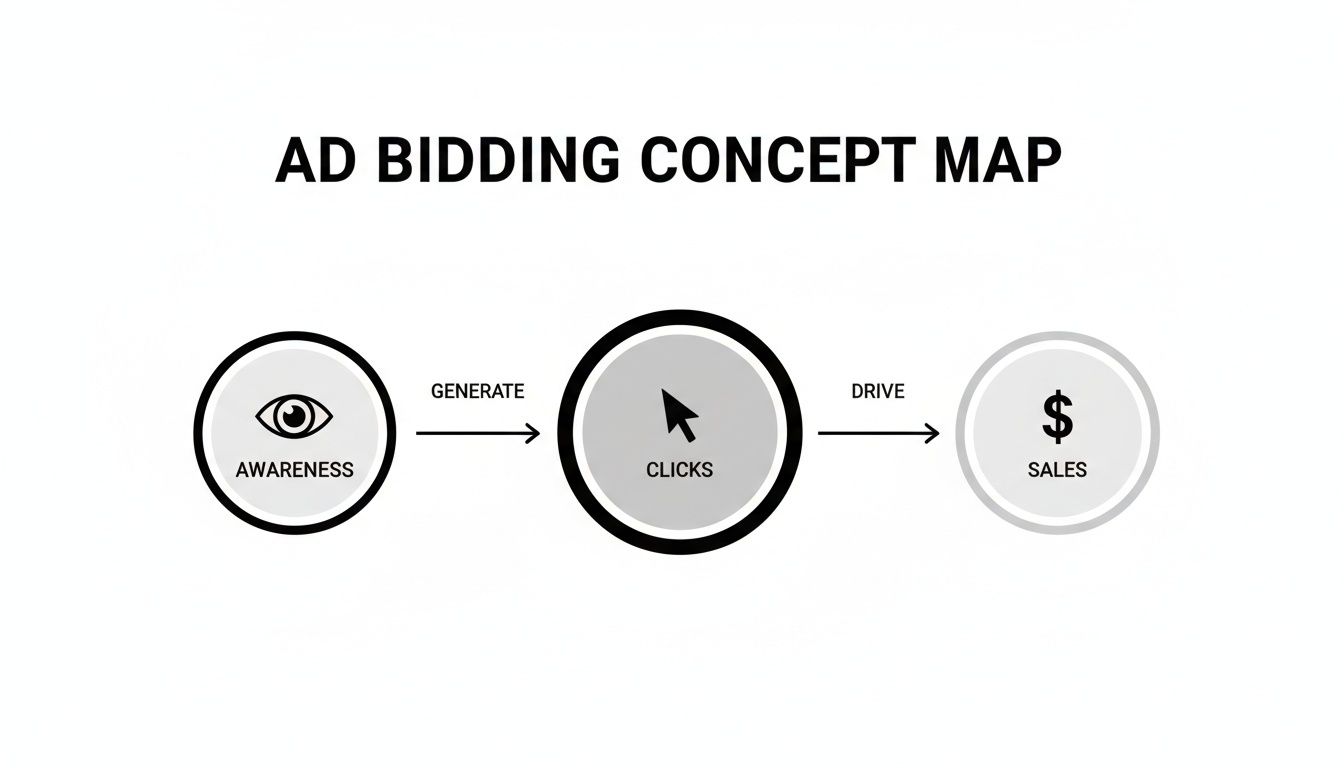
As you can see, CPM is really an "awareness" play. It lives at the top of the funnel, designed to get eyeballs on your brand before you start worrying about driving clicks or sales.
Viewable CPM (vCPM): The Metric That Actually Matters
Here’s the thing: not all impressions are created equal. An impression is worthless if a user never actually had a chance to see your ad. That’s why Google shifted its focus to viewable CPM (vCPM), a model where you only pay when your ad is officially considered "viewable."
What does "viewable" mean? For a display ad, at least 50% of its pixels need to be on-screen for at least one continuous second. For video ads, the bar is a little higher at two continuous seconds. This simple change ensures you're paying for genuine visibility, not for an ad that was stuck at the bottom of a page someone never scrolled to.
When you're digging into your performance data, always zero in on vCPM. It’s the true measure of your cost for grabbing attention and the most honest reflection of what your ad budget is buying you.
The cost for these viewable impressions can swing wildly depending on where you run your ads. For example, the Google Display Network often has some of the most affordable impression costs you can find. The average CPM for a standard Display Ad can be $1 or less. Compare that to a YouTube video ad, which commands a much higher average CPM of $3.53. This difference really underscores why picking the right network for your awareness goals is so important for keeping your budget in check. You can dig into more of these Google Ads statistics and trends to get a feel for the broader ad environment.
Finding this data in your own account is easy. Just head to your Google Ads dashboard, click on "Columns," then "Modify columns," and add "Viewable CPM" and "Viewable impressions" to your reports. This quick tweak gives you the clarity you need to see exactly where your money is going and how effectively you're capturing attention.
What to Expect: Decoding Typical Cost Per Impression Benchmarks
Before you can set a realistic budget for your Google Ads campaigns, you need a ballpark idea of what you’ll actually pay for impressions. The truth is, there's no magic number for a "good" Google cost per impression. What you'll pay can swing wildly depending on who you're targeting, where your ads show up, and the industry you're in.
Think of it like buying real estate. A small plot of land in rural Kansas will cost a fraction of a similar-sized lot in downtown Manhattan. It all comes down to location, demand, and the perceived value of who's there. In the digital ad world, a generic display ad shown to a broad audience might only cost you $2-$3 per thousand impressions. But a highly targeted YouTube video ad aimed at affluent homeowners in a specific city? That could easily run you over $10.
What Pushes Your CPM Higher?
So, what's behind these big price swings? It really boils down to supply and demand. The more competitive and valuable the audience, the more you'll have to bid to get your ad in front of them. Premium "digital real estate" simply commands a higher price.
Here are the main things that drive up your impression costs:
Audience Targeting: The more specific you get, the more you pay. When you start layering demographics, interests, and in-market segments, you're creating a high-value audience that everyone wants to reach. That competition inflates the CPM.
Ad Format and Placement: Video ads on YouTube are just more engaging (and thus more expensive) than a standard banner ad on the Google Display Network. Similarly, an ad placement on a major site like Forbes or The New York Times is going to cost more than one on a small, niche blog.
Industry and Seasonality: Costs ebb and flow with industry competition. A direct-to-consumer brand running ads during the Black Friday chaos will face way higher CPMs than a B2B software company advertising in a sleepy July.
A higher CPM isn't automatically a bad thing. It often means you're reaching a more valuable, more competitive audience. The real question is whether that higher cost leads to better performance and a stronger return on your investment.
Benchmarks to Steer Your Strategy
As targeting has gotten more precise, the link between audience quality and CPM has become much stronger. We're seeing this play out in the data—opting for premium audiences and placements consistently pushes CPMs into the $10 to $30 range, sometimes even higher. Compare that to the standard $3-$10 you might see on the broader Display Network.
This price difference is part of how Google's auction works. The platform rewards advertisers who dial in their targeting and maintain a good performance history with better impression costs over time. Industry trends show this clearly, too. For instance, B2C sectors like retail typically see CPMs in the $5-$15 range. For a deeper dive, you can find additional insights on Google advertising costs that explore these trends further.
Ultimately, you should use these benchmarks as a starting point, not a strict rulebook. Your own historical data is always the best guide. This is where a tool like SpendOwlAI becomes incredibly useful for operators managing daily ad spend. It can flag meaningful shifts in your impression costs, helping you figure out if a rising CPM is just a sign of tougher competition or a signal that you need to refine your targeting to get more efficient. It helps you move beyond generic numbers and optimize based on what’s actually happening in your accounts right now.
Proven Strategies to Lower Your CPM
Knowing what drives your Google cost per impression is one thing, but actually getting it down without torpedoing your visibility is another game entirely. The real goal isn't just to find cheap impressions. It's to secure efficient ones that land in front of the right people. This takes a hands-on approach that blends sharp targeting, great creative, and a bit of discipline.
Think of it like fishing. You could just toss a huge, expensive net into the middle of the ocean and hope you catch something good. Or, you could use a smaller, more specialized net right where you know your target fish are swimming. That second method isn't just cheaper—it’s way more effective. For Google Ads, this means getting surgical with your strategy instead of just casting a wide net.
Refine and Sharpen Your Audience Targeting
The biggest lever you can pull to lower your CPM is simply who you show your ads to. The more advertisers are competing for an audience, the more you're going to pay. The trick is to find those undervalued or less crowded segments that still fit your ideal customer profile perfectly.
Start by digging into your performance data. Look for specific demographics, in-market segments, or affinity audiences that give you solid engagement at a lower cost. Instead of targeting a massive category like "Fitness Enthusiasts," you might discover that "Outdoor Adventure Seekers" who are also interested in "Sustainable Products" is a much more cost-effective niche for your brand.
Layer Your Audiences: Don't just pick one. Combine demographic data with specific interests and behaviors to build a much more precise targeting profile. This helps you sidestep the bidding wars for those huge, generic segments.
Utilize Exclusions: Be aggressive about excluding audiences that you know won't convert. This stops you from wasting money and keeps your budget focused on people who are actually interested.
Test Lookalike Audiences: Build lookalike audiences from your best customers. Google's algorithm is surprisingly good at finding users with similar traits, often uncovering pockets of potential customers you would've never thought to target.
By constantly testing and tweaking your audience segments, you stop overpaying for crowded digital real estate and start discovering hidden gems. This optimization process is the foundation of making your ad budget work smarter, not just harder.
Boost Your Quality Score with Better Creative
Google actively rewards advertisers who create a good experience for users. It’s a simple trade-off: a higher Quality Score tells Google your ad is relevant and engaging, which can earn you better placements and a lower CPM. Your ad creative is where this all starts.
Boring, generic ads get scrolled past. When that happens, your relevance score tanks and your costs climb. The only way to fight this is to test, test, and test some more.
A/B Test Everything: Run controlled tests on your headlines, descriptions, images, and videos. Find out what message actually connects with people and which visuals make them stop scrolling.
Match Creative to Audience: You can't show the same ad to everyone. A 22-year-old student and a 45-year-old professional might fall into the same broad audience, but they'll respond to completely different creative approaches.
Focus on a Clear Value Proposition: You have a split second to get someone's attention. Your ad has to instantly communicate why they should care. What problem are you solving for them? What makes your product the one they need?
Remember, cost and performance can vary wildly across Google's different networks. For instance, the average cost-per-click on the Search Network can be pretty steep, while Display Network CPCs average a much more palatable $0.60. The catch is that Search usually delivers much higher conversion and click-through rates. To see how this plays out across different sectors, you can find more data on Google Ads benchmarks and performance. This just goes to show how important it is to tailor your creative for the specific network you're on.
Manage Ad Frequency to Avoid Fatigue
Showing the same ad to the same person twenty times is the fastest way to annoy your audience and watch your CPM skyrocket. This is called ad fatigue. When users get so used to seeing your ad that they become blind to it, engagement plummets, and that signals to Google that your ad is no longer relevant.
You can prevent this by setting frequency caps on your campaigns. A good place to start is limiting impressions to around three to five per user, per week. This keeps your brand top-of-mind without becoming an irritant. If you're running into this issue, we offer more tips in our guide on how to improve Google Ads performance. By putting these strategies into action, you can take real control over your Google cost per impression and make every dollar you spend count.
When to Build Your Strategy Around CPM
Understanding the nuts and bolts of Google cost per impression is one thing. Knowing precisely when to build a campaign around it is what separates a good media buyer from a great one. CPM bidding isn't a one-size-fits-all solution; it’s a specific tool for a specific job. It truly shines when your main goal is to get your brand in front of as many eyeballs as possible for a predictable price.
Think of it as the opening act for your entire marketing funnel. A CPM-first approach is ideal for campaigns where broad reach and awareness are the name of the game, not immediate clicks or sales. It's about planting the seeds of brand recognition that will bloom later on.
Scenarios Built for CPM Bidding
While every brand’s journey is unique, certain situations are practically tailor-made for a CPM strategy. This model is all about saturating a target market with your message, making your brand a familiar, trusted name.
Here are a few prime situations where a CPM approach makes a ton of sense:
Launching a New Product or Brand: When you're the new kid on the block, the first job is just getting on people's radar. CPM lets you cast a wide net and announce your arrival to a huge, relevant audience.
Breaking into a New Geographic Market: Expanding to a new city or country where nobody knows you? CPM is perfect for building that crucial, foundational awareness from scratch.
Running Top-of-Funnel Campaigns: For ads designed to simply educate, entertain, or inspire—without pushing for a direct action—CPM ensures your content gets seen. You won't get penalized for a low click-through rate because clicks aren't the point.
Remarketing to Stay Top-of-Mind: You can use a CPM strategy to gently keep your brand in front of people who've already visited your site. It’s a great way to reinforce your message and build trust over time.
A CPM bidding strategy is your go-to when you need to answer the question, "How can I get my message in front of the most relevant people for the lowest possible cost?" It prioritizes visibility above all else.
Measuring the True Impact
You can't measure the success of a CPM campaign with clicks or direct sales. That’s just not what it’s built for. Instead, you have to look at metrics that show brand lift and audience engagement. Keep an eye on things like view-through conversions, spikes in branded search volume, and post-impression engagement to see the real value you're creating.
While CPM campaigns might not deliver the instant gratification of a conversion-focused effort, they are a critical investment in your brand’s long-term health. They fill the top of your funnel, which makes every click and conversion that happens later more likely. This is a massive difference from strategies laser-focused on a bottom-funnel metric like cost per acquisition, where the goal is tied directly to ringing the cash register.
Common Questions About CPM
When you're in the weeds of managing Google Ads, a few practical questions about cost per impression always seem to pop up. Let's tackle some of the most frequent ones I hear from other advertisers.
What Is a Good CPM on Google Ads?
Honestly, a “good” CPM is a moving target. It really depends on your industry, where you're placing your ads, and what you’re trying to achieve.
Think of it this way: on the Google Display Network, seeing a CPM under $3 is generally a pretty solid result. But if you’re running YouTube ads, where you're capturing more focused attention, that number might look more like $3 to $10. The real key isn't to fixate on a single magic number, but to benchmark against your own industry and focus on whether the impressions you're buying are actually making an impact.
Does a High CPM Mean My Ads Are Performing Poorly?
Not always. A high Google cost per impression can actually be a good sign—it might mean you're competing for a really valuable, high-intent audience that your competitors also want. Reaching the right people often costs a bit more.
Of course, it could also point to a problem, like your audience being tired of seeing the same ad over and over. That's why you can't look at CPM in a vacuum. You have to pair it with other vital signs like viewability, engagement rates, and any brand lift data to get the full story.
Can I Use CPM Bidding for Search Campaigns?
That’s a definite no. CPM bidding is off the table for Google Search ads.
Search campaigns are all about capturing someone's intent the moment they type in a query, making Cost Per Click (CPC) the only model that makes sense there. You pay when they act. CPM is built for a different job: getting your brand seen. That's why it's reserved for Display and YouTube campaigns, where the main goal is to build awareness and visibility.
Ready to turn noisy ad data into clear, daily actions? SpendOwlAI analyzes your campaigns to surface the most impactful opportunities and risks, helping you optimize your Google cost per impression with confidence. Start your free 7-day trial today at https://spendowlai.com.