Unlock cost per click formula to optimize ad spend and boost ROI
The cost per click formula is about as straightforward as it gets: you take your total ad spend and divide it by the total number of clicks the ad generated. That’s it. This simple math gives you the exact price you paid for every single visitor who landed on your site from that ad.
Decoding The Cost Per Click Formula
Think of your ad budget like a gumball machine. If you put $100 in (your total cost) and get 200 gumballs out (your total clicks), then each gumball cost you $0.50. The cost per click formula operates on the same principle, boiling down campaign data into one clean, understandable metric. It's the absolute baseline for figuring out how efficiently your paid ads are running on platforms like Google Ads or Meta.
This single number is the bedrock of performance marketing. It tells you exactly what it costs to get one potential customer to take that first step. This was a massive shift in the history of advertising—we went from paying for potential views (impressions) to paying only when someone took a tangible action (a click). Suddenly, marketers had direct control over their spending and a clear way to measure performance.
From Eyeballs To Actions
The cost per click formula has been the backbone of digital advertising since the early 2000s. Its roots go back to pioneers like GoTo.com, which first rolled out the pay-per-click model. Google AdWords (now Google Ads) later perfected this into the auction-based powerhouse we all know today.
This change was monumental. It moved us away from flat-fee advertising to a dynamic system where performance, relevance, and competition set the price. If you want to dive deeper, you can see how this plays out by exploring different campaign performance metrics.
Why This Simple Formula Matters
Getting a handle on this basic calculation is the first real step toward mastering your ad spend. Without it, you’re flying blind. You have no idea if your campaigns are a bargain or just a money pit.
To make this even clearer, let's break down the two main ingredients and the final result.
Core CPC Formula Components at a Glance
Component | Definition | Example |
|---|---|---|
Total Cost of Clicks | The total amount of money you spent on a campaign or ad group over a specific period. | You spent $500 on your Google Ads campaign last month. |
Total Clicks | The total number of times users clicked on your ad during that same period. | Your ad received 1,000 clicks last month. |
Cost Per Click (CPC) | The average amount you paid for a single click on your ad. | $500 / 1,000 clicks = $0.50 CPC |
This table shows just how simple the inputs are. You just need your total spend and your total clicks to find your CPC.
By mastering this foundational concept, you can start digging into the more advanced strategies needed to optimize your campaigns, cut out wasted spend, and actually grow your business. This simple division is your starting line.
Calculating CPC With Practical Walkthroughs
Theory is great, but putting it into practice is how you actually get a handle on your ad spend. The good news is that using the cost per click formula is pretty simple once you know where to find the numbers. Let's walk through the exact steps with a real-world scenario.
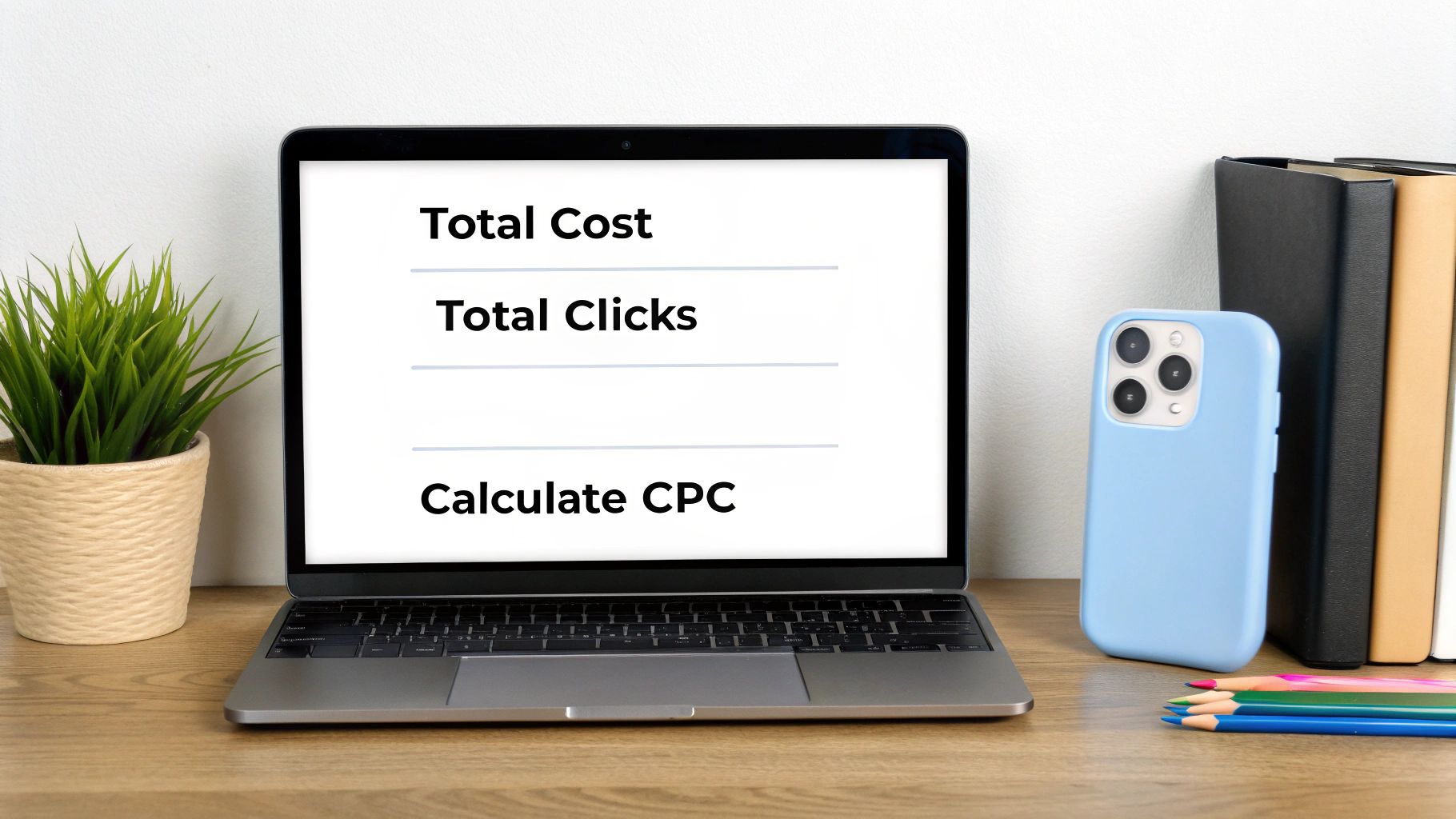
Let’s say you run an e-commerce brand called "CaseCrafters," selling custom phone cases. Last month, you launched a campaign on Google Ads to push your new line of eco-friendly cases.
Here’s exactly how you'd figure out the CPC for that campaign.
A Step-by-Step Google Ads Example
First things first, you need to grab two key metrics from your Google Ads dashboard. You can usually find them right on the main "Campaigns" overview page once you've set the date range you want to look at.
Find the Total Cost: Look for the column labeled "Cost." This tells you the total amount you spent on that campaign during the time frame you selected. Let's imagine CaseCrafters spent $750.
Find the Total Clicks: Next, find the column labeled "Clicks." This is simply the number of times people clicked on your ads. For our example, your campaign got 1,500 clicks.
Apply the Formula: Now for the easy part. Just divide the total cost by the total clicks.
$750 (Total Cost) / 1,500 (Total Clicks) = $0.50 CPC
And there you have it. This means that, on average, you paid exactly 50 cents every time someone clicked your ad and landed on your website. This one number gives you a solid baseline to judge how the campaign is performing.
Applying the Formula to Meta Ads
The process for Meta Ads (that's Facebook and Instagram) is almost identical, though you might see slightly different names for the metrics. Just hop into your Ads Manager dashboard and select the campaign you want to analyze.
You'll find a column usually called "Amount Spent" and another for "Link Clicks" (or a similar click-related metric, depending on your campaign goal). The math is exactly the same.
Key Takeaway: The cost per click formula—Total Cost ÷ Total Clicks—is the same everywhere. The only thing that changes is where you find the "Cost" and "Clicks" data inside each platform's ad manager.
Tracking CPC in a Simple Spreadsheet
To really get a feel for your performance, you can't just calculate CPC once and call it a day. Tracking it over time in a basic spreadsheet can give you some powerful insights into how your campaigns are trending.
Just create columns for the date, campaign name, total cost, total clicks, and a final column with the formula to calculate CPC for you.
By logging this data every week, you'll start to see patterns emerge. For instance, you might notice the CPC for a certain campaign is slowly creeping up, which could be a sign of ad fatigue or more competition jumping in. Having this historical data lets you make smart, proactive decisions instead of just reacting when things go wrong.
For anyone using a platform like SpendOwlAI, this kind of granular tracking is done for you, sending alerts when there are big shifts in CPC so you can jump on it right away.
Ever looked at your ad account on a Tuesday and then again on a Thursday, only to see your Cost-Per-Click has completely changed? That's not a glitch—it's just how the paid advertising auction works. Your CPC is a living number, constantly pushed and pulled by a few powerful forces.
Think of it like trying to get a front-row parking spot at a huge concert. The price isn't set in stone. It all depends on how many other people want that same spot (your competition), what time you show up (timing and seasonality), and even who runs the parking lot (the ad platform). Digital ad auctions are a lot like that.
The Role of Quality and Relevance
One of the biggest levers on your CPC is how much the platform likes your ad. Seriously. It’s not always about who has the deepest pockets. Both Google and Meta actively reward advertisers who create a genuinely good experience for users.
A higher Quality Score doesn’t just mean better ad placements; it can lead to a 50% discount on your CPC. Platforms reward relevance because it keeps users happy and engaged, which is good for their business and yours.
On Google Ads, this is all wrapped up in your Quality Score. It’s a rating that considers your ad's expected click-through rate, how relevant it is to the keyword, and the user experience on your landing page. A high score signals to Google that your ad is a perfect fit for the search, and they'll thank you with a lower CPC.
Meta has its own version called Ad Relevance Diagnostics. This system grades your ad's quality, engagement, and conversion rates against other ads chasing the same eyeballs. The more relevant your ad, the more Meta will favor it, often at a much lower cost to you.
Competition and Seasonality
It’s a simple supply and demand game. Your CPC is directly linked to how many other advertisers are fighting for the same audience's attention. If a new competitor with a massive budget suddenly jumps into your market, you can bet your costs will climb as they start driving up auction prices.
Seasonality is another huge factor. The most classic example is the holiday shopping frenzy from Black Friday through Christmas, where retail CPCs can easily double or even triple. But smaller trends have an impact, too. Think about fitness-related CPCs spiking in January or travel costs getting more expensive right before summer vacation season.
Targeting and Placement Choices
The decisions you make in your campaign setup have a direct line to your costs. Your CPC will absolutely shift based on:
Audience Targeting: The more specific and valuable your audience, the more you'll likely pay to reach them. Targeting a broad audience of "people interested in shoes" will have a very different CPC than a niche group of "marathon runners who recently purchased high-end running gear."
Keyword Match Types: On Google, your keyword strategy is key. Broader keywords can sometimes bring in cheaper clicks, but they're often far less relevant. For a deeper dive, check out our guide on broad match vs. phrase match.
Ad Placements: A click from an ad in the Instagram Feed will cost something different than one from Facebook Stories or the Audience Network. Certain placements are simply more competitive—and valuable—which the CPC will always reflect.
Getting a handle on these variables is the first step to truly managing your ad spend. Instead of getting spooked by daily CPC swings, you can start to see the "why" behind them and make smarter, more strategic moves. For a tool like SpendOwlAI, tracking these shifts is at the core of what it does, offering daily insights so you can adapt intelligently instead of making reactive, gut-based decisions.
Connecting CPC to Profitability and ROAS
A low Cost Per Click might feel like a win, but it’s a classic vanity metric if those cheap clicks never turn into paying customers. The real power of the cost per click formula isn't just about measuring campaign efficiency—it’s about directly connecting your ad spend to your bottom line.
This shift in thinking moves the conversation from, "How cheap are my clicks?" to a much smarter question: "How much can I afford to pay for a click and still be profitable?"
This is where you start working backward from your core business goals. Instead of just taking whatever CPC the ad auction throws at you, you can define your absolute spending ceiling. It all boils down to a simple, powerful calculation that links what you pay for a click to what you earn from a customer.
Maximum CPC = Target CPA x Conversion Rate
Think of this formula as the strategic bridge between what you pay for traffic and what that traffic is actually worth to your business.
Calculating Your Maximum Sustainable CPC
Let's walk through a real-world example. Imagine you run an e-commerce brand with a target Cost Per Acquisition (CPA) of $50. You know from your analytics that your product page converts visitors into customers at a rate of 2% (or 0.02).
Plugging these numbers into the formula gives you a clear break-even point:
Max CPC = $50 (Target CPA) x 0.02 (Conversion Rate)
Max CPC = $1.00
The result is crystal clear: you cannot afford to pay more than $1.00 per click if you want to hit your acquisition target. Any CPC above that threshold means you are actively losing money on every new customer, putting you on a direct path to unprofitability.
This calculation is your guardrail, preventing you from overspending on traffic that doesn't support your financial goals. Of course, getting this right depends on accurate data. A critical piece of that puzzle is understanding how to use UTM parameters for Google Analytics to attribute every conversion correctly.
This simple diagram breaks down the main forces that will push your actual CPC up or down in the ad auction.
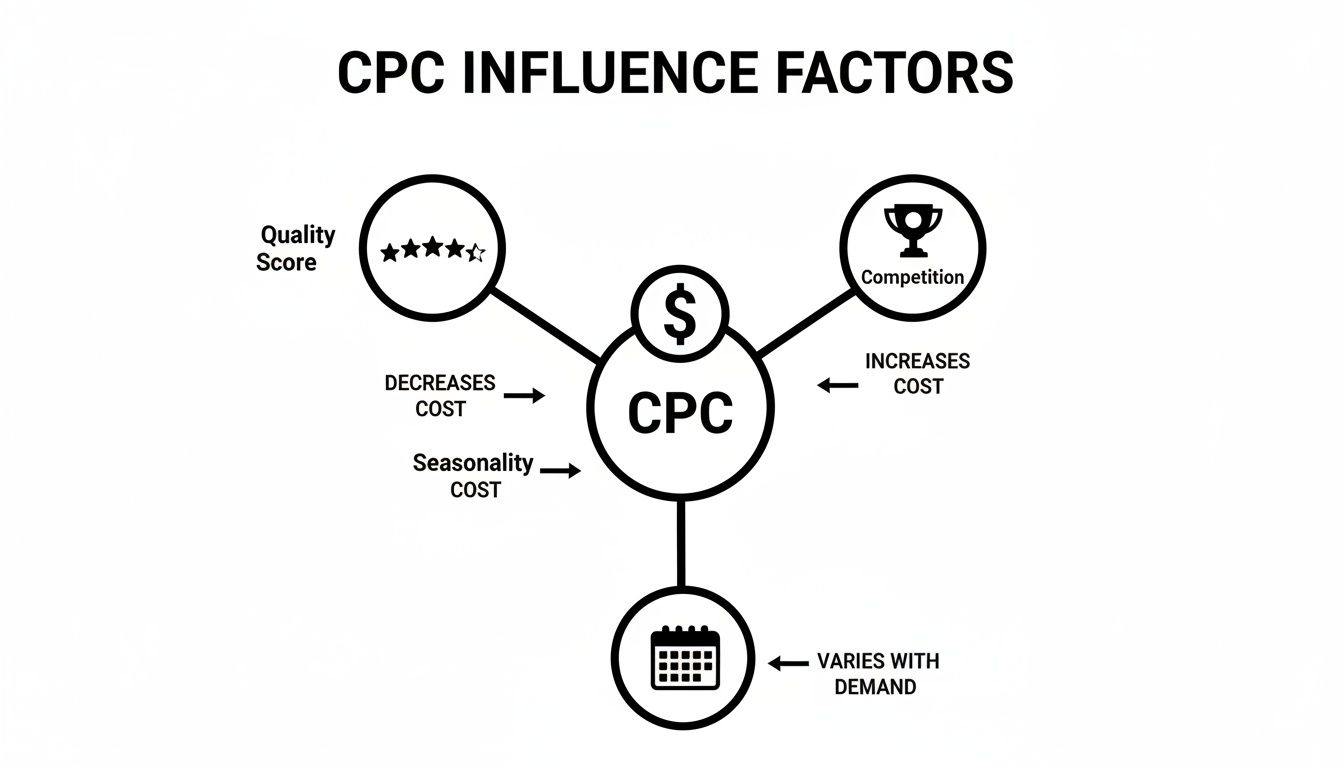
As you can see, your final CPC is a mix of market competition, ad relevance (your Quality Score), and timing (seasonality). To stay profitable, you have to manage all three to keep your bids below that $1.00 maximum we just calculated.
For experienced performance marketers, this logic goes even deeper. Many will back-calculate from Customer Lifetime Value (CLV) instead of a single sale, which often justifies paying a higher CPC upfront because they know the long-term payoff is there. This kind of strategic thinking is essential, especially since market dynamics are always changing.
Actionable Strategies to Lower Your CPC
Knowing the cost-per-click formula is one thing, but actually getting your CPC down is where the real work begins. Lowering your CPC makes your entire ad budget work harder, giving you more chances to find new customers without spending more money.
The secret is to focus on the specific levers each ad platform gives you to improve ad relevance and efficiency. Think of it this way: a lower CPC is your reward for making the platform (and its users) happy.
It also helps to see how all the metrics are connected. A less common but incredibly useful version of the cost per click formula is CPC = (CPM / 1000) / (CTR / 100). This ties your cost for impressions directly to how often people actually click.
This relationship explains why even a 1% lift in your click-through rate (CTR) on a campaign with a $10 CPM can slash your CPC in half, from $1.00 down to $0.50. That’s a game-changer. Plus, high-relevance ads often see their CPCs cut by as much as 50% just because they perform better.
Fine-Tuning Your Google Ads Campaigns
When it comes to Google Ads, your north star is the Quality Score. This is Google's rating of your ad's overall quality and relevance, and a higher score directly translates to a lower CPC. It's that simple.
To improve your Quality Score, you need to zero in on three things:
Ad Copy Relevance: Your headlines and descriptions need to be a mirror image of the keywords you're bidding on. If someone searches for "blue running shoes," your ad copy better be talking about blue running shoes, not just "footwear" in general.
Landing Page Experience: The user’s journey doesn’t stop at the click. The landing page has to deliver exactly what the ad promised. It should also load fast and be a breeze to navigate.
Negative Keywords: This is just smart budget defense. Consistently add negative keywords to stop your ads from showing up for irrelevant searches that eat up your budget with worthless clicks.
Mastering Your Costs on Meta Ads
The game is a bit different on platforms like Facebook and Instagram. Meta’s auction isn't about matching keywords; it’s about grabbing someone's attention in a busy, scrolling feed. Here, your creative and audience targeting are what really move the needle on CPC.
Key Insight: On visual-first platforms like Meta, your creative has to stop the scroll. High engagement—likes, shares, comments—tells the algorithm your ad is good stuff, and you’ll often be rewarded with lower costs to show it.
Here’s where to focus your energy:
Creative Excellence: Your ad needs to be impossible to ignore. Use high-quality images, snappy videos, and a call-to-action that’s crystal clear. Your CTR is a great health metric here. If it's low, your creative probably isn't cutting it. For more on this, check out our guide on how to improve your click-through rate.
Audience A/B Testing: Never assume you know which audience is cheapest. You should always be testing different interest groups, lookalike audiences, and demographic slices to uncover pockets of users who click for less.
Combat Ad Fatigue: People get tired of seeing the same ad over and over. When that happens, performance drops and your CPC climbs. Keep a close eye on your ad frequency and have fresh creative ready to swap in before engagement starts to tank.
CPC Reduction Tactics Google Ads vs Meta Ads
While the goal of lowering CPC is the same, how you get there varies quite a bit between Google and Meta. The table below breaks down the key tactics and how they apply to each platform.
Tactic | How it works on Google Ads | How it works on Meta Ads |
|---|---|---|
Improve Relevance | Focus on Quality Score. Match keywords, ad copy, and landing pages tightly. | Focus on engagement. Creative must be thumb-stopping and relevant to the target audience's interests. |
Refine Targeting | Use negative keywords to exclude irrelevant search queries. Focus on specific keyword match types. | A/B test audiences. Experiment with lookalikes, interests, and demographics to find lower-cost segments. |
Enhance Creative | Write compelling ad copy with strong CTAs. Use ad extensions to add more information and take up more space. | Test different ad formats (video, carousel, image). Refresh creative regularly to fight ad fatigue. |
Optimize Bidding | Use Smart Bidding strategies like Target CPA or Maximize Conversions, which can optimize for lower-cost clicks that lead to actions. | Set bid caps or cost caps to control spending, but be mindful of delivery. Let the algorithm optimize for engagement first. |
Landing Page | Ensure a fast, mobile-friendly landing page experience that directly reflects the ad's promise. A poor page hurts your Quality Score. | The landing page must deliver on the ad's visual promise and provide a seamless path to conversion. High bounce rates can signal poor relevance. |
As you can see, Google is a game of precision and intent-matching, while Meta is a game of attention and audience discovery. Master the levers for each, and you'll be well on your way to a more efficient ad spend.
Common Mistakes To Avoid With CPC
It's surprisingly easy to misread your CPC data and make some expensive mistakes. When you get it wrong, this helpful diagnostic metric can quickly become a source of total confusion. I've seen it happen time and time again: marketers get tunnel vision on CPC, completely ignoring the metrics that actually matter to the business.
Focusing Only on a Low CPC
The most common trap is chasing a low CPC at all costs, without a second thought for conversion rates or actual profit. A $0.25 CPC might look fantastic on a report, but if you need 500 of those clicks to make a single sale, your Cost Per Acquisition (CPA) is a painful $125.
On the other hand, you might have a campaign with a $2.00 CPC that feels a bit steep. But if that campaign converts one out of every 20 clicks, your CPA is a much healthier $40. It’s not about getting the cheapest click; it’s about getting the most valuable one.
Comparing Apples To Oranges
Another classic blunder is comparing CPCs across campaigns that have totally different goals. Think about it: a top-of-funnel brand awareness campaign is built to get cheap, broad reach. Its CPC should be much lower than a bottom-of-funnel campaign targeting people who are actively searching for your product and are ready to buy.
Judging both by the same CPC benchmark is a true apples-to-oranges comparison. Each campaign plays a different role in your strategy, and you have to evaluate its CPC in that specific context. A "high" CPC on a retargeting ad could be wildly profitable, while a "low" CPC on a prospecting campaign might just be burning cash.
Reacting To Statistical Noise
Finally, I see so many marketers make knee-jerk reactions to short-term CPC spikes. A sudden jump in costs can be alarming, I get it. But it's critical to tell the difference between normal day-to-day market fluctuations—just statistical noise—and a real performance problem that needs your attention.
Don't let daily volatility dictate your strategy. Before you go slashing budgets or rebuilding campaigns, zoom out. Look at your CPC trends over a longer window, like 7 or 14 days, to see if that spike was just a temporary blip or a sustained issue that needs a real fix.
Steering clear of these common pitfalls will help you keep a cool head and make data-driven decisions. This is where tools like SpendOwlAI can be a huge help, as they are designed to monitor performance volatility and give you clear signals on when it's time to act versus when it's best to let the algorithms do their thing.
Frequently Asked Questions
When you're in the trenches with paid ads, a few questions about CPC come up again and again. Let's get you some straight answers.
What Is a Good CPC for My Industry?
This is probably the number one question I hear, but it's not always the right one to ask. You can find benchmarks everywhere—apparel might see CPCs under $0.50, while a keyword in finance could easily cost you over $3.75. But honestly, a "good" CPC is simply one that makes your business money.
The better question is: "What CPC can I afford while still hitting my ROAS goals?" Think about it. A $5.00 CPC is a bargain if it leads to a $500 sale. On the flip side, a $0.20 CPC is a total waste if those clicks never turn into customers. Your perfect CPC is always tied to your own profitability, not a generic industry number.
How Does My Bidding Strategy Affect CPC?
Your bidding strategy is one of the main levers you can pull to influence your CPC. If you're using manual bidding, you're in the driver's seat, setting the absolute maximum you're willing to pay for any single click. It gives you ultimate control but demands a lot of hands-on attention.
Then you have automated bidding strategies, like Target CPA or Maximize Conversions on Google Ads. These let the platform's algorithm do the heavy lifting, adjusting your bids on the fly. The system is designed to hunt for clicks that are most likely to convert, often at a lower cost than you might find yourself. You give up some of that fine-tuned control, but you gain a ton of efficiency. What’s right for you really depends on your goals and how much time you can spend in the account.
Why Did My CPC Suddenly Increase?
Waking up to a sudden CPC spike is never fun, and it's rarely just one thing. It's usually a perfect storm of factors messing with the ad auction. Here are the usual suspects:
New Competition: A new player just entered the auction with deep pockets, instantly driving up the price for everyone.
Seasonality: Think holidays, Black Friday, or even just a change in weather. When demand surges, so does the competition and your costs.
Ad Fatigue: People are getting tired of seeing your ad. Engagement drops, your quality score takes a hit, and the platforms start charging you more to show it.
Algorithm Changes: Ad platforms are always tinkering behind the scenes. A small update can cause big, and often temporary, ripples in your CPC.
Can I Get a CPC of Zero Dollars?
In paid advertising? No, that's not really how it works. A click that you pay for will, by definition, always have a cost.
But you absolutely can get free clicks from your organic efforts, like a well-ranked blog post (SEO) or a viral social media update. The goal with your ads isn't to chase a $0 CPC. It's to use the cost per click formula to make sure every single dollar you spend is working hard to bring you a positive return.
Stop guessing what's driving your performance. SpendOwlAI delivers a prioritized daily list of actions, turning noisy ad data into clear, impact-ranked recommendations you can trust. Start your free 7-day trial and execute with confidence.