Broad Match vs Phrase Match A Modern Guide for Google Ads
The real difference between Broad Match and Phrase Match boils down to a simple trade-off: Broad Match casts a wide net to find new customers using AI, while Phrase Match gives you more direct control over who sees your ads. But with how much Google Ads has evolved, that distinction isn't as clear-cut as it used to be. The choice is now less about technical settings and more about a fundamental strategy: how much trust do you put in Google's AI versus your own manual control?
The Strategic Choice Between Broad Match and Phrase Match
Picking between Broad Match and Phrase Match used to be a simple, technical decision. Not anymore. Today, it’s one of the most important strategic calls you can make, directly impacting your campaign performance. The old playbooks are obsolete because Google's AI has completely changed how both match types work, blurring the lines that once separated them.
This shift forces performance marketers into a tough spot. Do you stick with the perceived safety and predictability of Phrase Match, or do you embrace the scalable, AI-powered potential of Broad Match? This debate isn't just about keyword targeting anymore; it’s about aligning your entire match type strategy with modern bidding algorithms to get the best results.
Redefining Control and Performance
For years, experienced advertisers held onto Phrase Match for its promise of precision. But Google has slowly expanded what it considers a "close variant," which has seriously watered down that control. Phrase Match now often triggers ads for searches that feel more like Broad Match territory, but without giving you the full benefit of Broad Match's sophisticated signals.
The new reality is that true control in Google Ads comes from feeding the AI, not fencing it in. High-quality conversion data, smart bidding strategies, and a well-maintained negative keyword list are what empower Broad Match to outperform more restrictive match types.
When you pair Broad Match with a Smart Bidding strategy like tCPA or tROAS, the algorithm gets access to a whole different level of data that Phrase Match just doesn't use.
This includes signals like:
A user's recent search history and browsing patterns
The actual content and context of your landing pages
Other keywords within your ad group to better understand intent
This richer data set helps the algorithm find high-intent users you would have otherwise missed. While individual click costs might fluctuate more, this approach often leads to a much better return on ad spend (ROAS) and a lower cost per acquisition (CPA) in the long run.
Quick Comparison Broad Match vs Phrase Match
Before we dive deeper, here's a quick look at the core differences to set the stage. This table gives you a high-level summary of what to expect from each.
Attribute | Broad Match | Phrase Match |
|---|---|---|
Primary Goal | Maximize reach and discover new queries | Balance reach with keyword relevance |
Control Level | Low (relies on AI and bidding) | Medium (keywords must appear in order) |
Ideal Use Case | Scaling mature campaigns with strong data | New campaigns or brand term protection |
AI Dependency | High (requires Smart Bidding) | Moderate (works with manual or Smart Bidding) |
Data Signals | Uses a wide range of signals | Primarily relies on the keyword itself |
Think of this as your starting point. The right choice depends entirely on your campaign's goals, maturity, and the quality of your conversion data.
Understanding the Financial Impact of Match Types
Choosing between broad and phrase match is much more than a simple targeting decision—it’s a core financial strategy that directly shapes your campaign’s profitability. Just looking at the cost-per-click (CPC) is a recipe for disaster. To get the full picture, you have to dig into how each match type influences your entire funnel, from the first click to the final sale.
The Google Ads auction isn't what it used to be. It’s a fast-moving, dynamic marketplace where yesterday’s assumptions about cost-efficiency are dead wrong. Clinging to old beliefs about which match type is "cheaper" will burn through your budget and leave growth opportunities on the table.
The Growing Cost of Phrase Match
Lately, one of the biggest trends we've seen is the skyrocketing cost of Phrase Match, especially when you compare it to Broad Match. Recent data shows Phrase Match CPCs are climbing at a much faster rate, signaling a major shift in how the platform values these targeting methods.
Between June 2023 and June 2025, Broad Match CPCs went up by 29%. In that same period, Phrase Match CPCs shot up by an eye-watering 43%. This growing price gap is forcing savvy advertisers to rethink their heavy reliance on Phrase Match, particularly as Google keeps pushing the AI-powered capabilities of Broad Match. You can read more about this CPC trend and what it means over at Search Engine Land.
This isn't a coincidence. It's a clear signal from Google. They are actively rewarding advertisers who embrace Broad Match paired with Smart Bidding by giving them a leg up in the auction.
Budget Leakage and Inefficient Spend
Relying too heavily on increasingly expensive Phrase Match keywords often causes what I call budget leakage. This is when your ad spend is consistently eaten up by high-cost clicks that fail to deliver a proportional return on ad spend (ROAS).
The real problem isn't just a higher CPC. It's that you're paying a premium for a level of control that Google has steadily eroded. With Phrase Match now covering so many "close variants," you're often paying more for traffic that's becoming just as unpredictable as Broad Match once was.
This inefficiency becomes a massive roadblock when you're trying to scale. If your budget is locked into overpriced Phrase Match keywords, you have nothing left to invest in the wider net of Broad Match, which could be out there finding new, high-converting customer segments at a much lower cost-per-acquisition (CPA).
A Practical Scenario: ROAS vs. CPC
Let’s say you’re running a campaign for "performance marketing software." A head-to-head comparison might look something like this:
Phrase Match Keyword:
"performance marketing software"Average CPC: $12.50
Conversion Rate: 5%
Cost-Per-Acquisition (CPA): $250
Broad Match Keyword:
performance marketing softwareAverage CPC: $9.00
Conversion Rate: 4%
Cost-Per-Acquisition (CPA): $225
At first glance, the higher conversion rate on Phrase Match looks like a clear winner. But when you run the numbers, the real story emerges. The Broad Match keyword, even with a slightly lower conversion rate, delivers a 10% lower CPA.
This example gets to the heart of the matter: cost efficiency isn't about the cheapest click. It’s about the entire conversion journey. A higher CPC is fine—if it leads to a better ROAS or a lower CPA. Your ultimate goal is profitability, and more often than not, Broad Match combined with Google's smart bidding is the most direct path to getting there at scale. When you move past simple CPCs, you can start making strategic decisions that actually align with your financial goals.
Rethinking Control in an AI-Powered Bidding World
For years, we all clung to Phrase Match. The logic was simple and solid: it gave us control. We believed that by restricting our ads to queries with a specific phrase, we could weed out junk traffic and keep our targeting laser-focused. That thinking is now a relic, and it's actively costing you money.
The very meaning of "control" in Google Ads has changed. It’s no longer about manually building fences around your keywords. Today, real control comes from strategically guiding Google's powerful AI. You’re not the pilot anymore; you’re the flight planner, giving the machine a clear destination and letting it find the most efficient route.
The Dilution of Phrase Match Precision
The main reason the old playbook is obsolete is that Phrase Match just doesn't work the way it used to. Google has steadily expanded what it considers a close match variant, blurring the lines between match types to the point where Phrase Match often behaves a lot like Broad Match.
It used to be a reliable middle ground. Phrase Match triggered ads only when someone searched for your exact phrase or something incredibly close, in the right order. But with the constant inclusion of more "close" variants, the traffic quality has been diluted, creating a huge overlap with Broad Match. This erodes its entire original purpose, a topic seoteric.com has covered in detail.
What does this mean for your campaigns? You're likely paying a premium for a level of precision that simply doesn't exist anymore. You're using a tool designed for a bygone era of manual bidding, and you're leaving a massive amount of performance on the table because of it.
Why Legacy Structures Are Inefficient
This shift has rendered old-school account structures, like Single Keyword Ad Groups (SKAGs), almost completely useless. SKAGs were built on the premise of perfect message match—one keyword, one ad group. But when a Phrase Match keyword like "women's running shoes" can trigger an ad for a search like running sneakers for ladies, the granular control SKAGs promised evaporates.
Trying to maintain a structure like that today is a recipe for frustration. It leads to:
Wasted Management Time: You spend countless hours building and managing thousands of ad groups that provide zero real performance benefit.
Fragmented Data: Performance data gets spread so thin that Google's AI can never gather enough conversion signals to learn and optimize effectively.
Internal Competition: You end up with multiple ad groups bidding against each other for the same search queries, driving up your own costs and making analysis a nightmare.
Instead of trying to force control through these outdated structures, the best advertisers now consolidate keywords into tightly-themed ad groups. This approach feeds Smart Bidding a concentrated stream of data, allowing it to learn much faster and make smarter decisions.
True control in modern Google Ads isn’t about restricting keywords. It’s about providing the highest quality inputs—clean conversion data, a robust negative keyword list, and strategic budget management—to empower the AI to find your ideal customers.
Redefining Control as Strategic Guidance
In this AI-first world, control is all about strategic guidance, not manual restriction. Your role has evolved from an operator pulling levers to a strategist feeding a powerful machine. The better the information you feed it, the better the results it produces.
Your focus needs to shift away from obsessing over individual keyword matches. Your real tools for control are now at a much higher level:
High-Quality Conversion Data: This is everything. Ensuring your conversion tracking is accurate and measures true business value (like revenue, not just form fills) is the single most important input for Smart Bidding.
Robust Negative Keyword Lists: This is how you teach the algorithm what you don't want. Proactively blocking irrelevant queries sharpens its targeting over time.
Strategic Budget Management: Setting clear budgets and performance targets (like a target CPA or target ROAS) gives the algorithm the guardrails it needs to operate effectively.
When you focus on these inputs, you give Broad Match and Smart Bidding the power to explore the entire landscape of user intent. It will find valuable, high-intent customers you would have never discovered with a restrictive Phrase Match strategy.
A Nuanced Look at Cost and Performance
When it comes to Broad Match versus Phrase Match, the conversation often gets stuck on a single, misleading metric: Cost-Per-Click (CPC). It's a classic mistake. Advertisers see a higher CPC with Broad Match and instinctively label it as too expensive or inefficient. But this overlooks the real drivers of profitability and misunderstands how modern Google Ads actually works.
True cost efficiency isn’t about chasing the cheapest click. It’s about securing the lowest Cost-Per-Acquisition (CPA) and the highest Return On Ad Spend (ROAS). Honestly, a higher CPC is perfectly fine—I'd even say it's often desirable—if it brings in better conversions and boosts your bottom line. And that's exactly what Broad Match, when paired with Smart Bidding, is built to do.
Looking Beyond Surface-Level CPCs
Here's where Broad Match really shines: it taps into a much richer set of data signals. When you let Smart Bidding do its job, the algorithm isn't just looking at your keyword. It's analyzing a whole spectrum of contextual cues that other match types simply can't access.
These signals include things like:
User Search History: What has this person looked for before?
Landing Page Content: What's the specific offer and context on your page?
User Location and Demographics: Where are they, and what do we know about them?
Ad Group Context: What other keywords are in this ad group that can inform the user's overall intent?
This 360-degree view allows Smart Bidding to make incredibly intelligent decisions. It can predict the likelihood of a conversion with far greater accuracy, which means it knows when to bid aggressively for a high-intent user and when to pull back on a long-shot search. Phrase Match, by its very design, is working with a more limited playbook, focusing mostly on the keyword itself.
How Broader Reach Can Actually Lead to Lower CPAs
The old assumption that higher CPCs automatically mean higher CPAs is often just plain wrong. While some analyses show Broad Match CPCs can be around 40% higher than the account average, that number is deceptive. Broad Match covers every single search that Phrase and Exact do, plus thousands more. Comparing their CPCs directly is an apples-to-oranges game. You can find more practical takes on this in these insights on eightohtwo.com.
The key is realizing that Google's machine learning is actively filtering this expanded reach. It sifts through that huge pool of potential queries to prioritize traffic most likely to convert, often delivering a more efficient cost-per-conversion than the "safer" feeling Phrase Match.
Think of it this way. Phrase Match is like fishing in a small, well-known pond. Broad Match is like using a high-tech sonar to scan the entire lake, pinpointing the biggest schools of fish before you even cast a line. Sure, you might spend a bit more on fuel (a higher CPC), but your overall catch (conversions) is far more efficient. In many cases, this translates directly to a lower CPA. Plus, that broader reach feeds your campaigns more conversion data, which helps you learn and improve even faster. You can find related strategies in our guide on how to improve click-through rate.
A Practical Example of Holistic Profitability
Let's bring this to life with a real-world scenario for an e-commerce store selling premium coffee beans.
Metric | Phrase Match Campaign | Broad Match Campaign |
|---|---|---|
Keyword | "gourmet coffee beans" | gourmet coffee beans |
Average CPC | $2.10 | $2.80 |
Clicks | 500 | 500 |
Ad Spend | $1,050 | $1,400 |
Conversions | 25 | 45 |
Conversion Rate | 5.0% | 9.0% |
CPA | $42.00 | $31.11 |
In this table, the Broad Match campaign has a 33% higher CPC. An advertiser fixated on click cost alone would probably panic. But by using those deeper signals, Google found users searching for high-intent queries like single origin Ethiopian coffee online or best whole bean espresso for home—searches that led to a dramatically higher conversion rate.
The end result? A CPA that's 26% lower for the Broad Match campaign. This is a perfect illustration of why focusing on CPC is shortsighted. The real win comes from evaluating performance through the lens of total profitability.
The Performance Marketer's Playbook for Match Types
Theory is one thing, but execution is everything. Knowing the difference between Broad and Phrase Match is only half the battle. What really separates stalled campaigns from scalable growth is knowing precisely when and how to use each one. This playbook gives you practical, scenario-based frameworks to make the right call.
Your match type choice isn't a "set it and forget it" decision. It's a dynamic strategy that has to evolve with your campaign's maturity, data volume, and performance goals. The approach you take for a new product launch is completely different from what a mature, high-converting campaign needs.
Playbook 1: The New Campaign Launch
When you're launching a new campaign, you're working with a major handicap: no conversion data. Unleashing Broad Match right away is a recipe for burning cash because Google's AI has nothing to work with.
In this early stage, Phrase Match is your best friend. Think of it as your primary research tool. It lets you gather high-quality, relevant search query data without casting the net too wide and hoping for the best.
Your Action Plan:
Primary Match Type: Start with Phrase Match for your core, high-intent keywords. This gives you a solid balance of discovery and control.
Bidding Strategy: Kick things off with Maximize Conversions or a conservative Target CPA (tCPA). The name of the game is accumulating conversion data efficiently.
Negative Keywords: Get aggressive. Check your search query report daily for the first two weeks. Add any irrelevant terms as negative exact or negative phrase keywords to tighten your targeting fast.
This whole initial phase is about building a solid foundation of performance data. Once you have a steady stream of at least 30-50 conversions per month, you've earned the right to start testing Broad Match.
Playbook 2: Scaling a Mature E-commerce Campaign
For a mature campaign with a solid history of conversions, sticking only to Phrase Match is like driving with the handbrake on. You're just leaving money on the table. This is where Broad Match, paired with value-based bidding, becomes your primary engine for growth.
This strategy is incredibly effective for scaling revenue and finding new pockets of customers. If you're looking for scaling ideas beyond Google, check out our guide on how to scale Facebook ads.
Your Action Plan:
Primary Match Type: Transition your top-performing ad groups to Broad Match. The best way to do this is with a campaign experiment, which ensures you get a clean A/B test against your existing Phrase Match setup.
Bidding Strategy: Switch to Target ROAS (tROAS). This tells Google's AI to hunt for not just any conversion, but the most profitable ones—a critical instruction when you're giving it the wider reach of Broad Match.
Budget Considerations: Make sure you allocate enough budget for the experiment to run freely. A constrained budget will choke the algorithm, preventing it from properly exploring and learning.
The goal here is to trust the machine. By feeding it rich, historical conversion data and a clear ROAS target, you empower Broad Match to find users with high purchase intent that your Phrase Match keywords would never have reached.
This decision tree visualizes how to think about match types based on key financial metrics like CPC and ROAS.
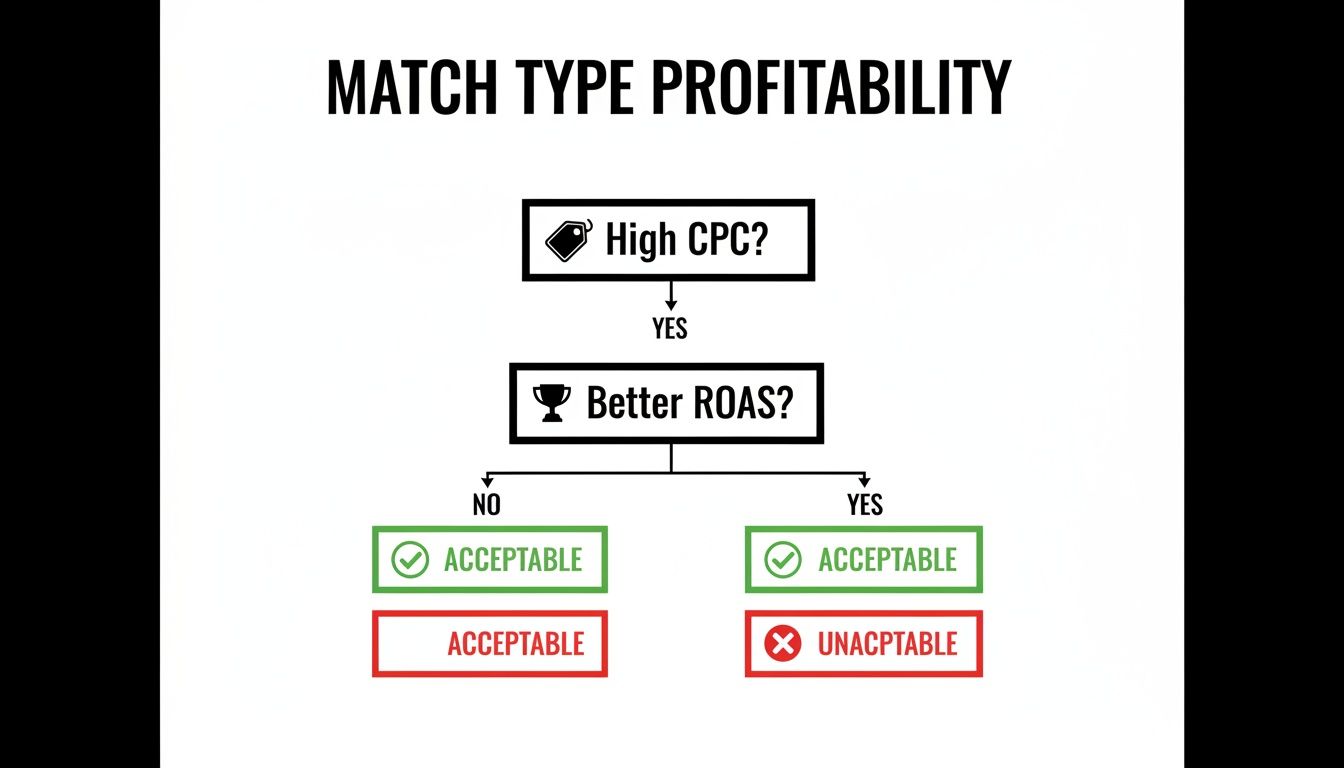
The main takeaway? A higher CPC is perfectly acceptable if it ultimately delivers a better ROAS, which is often exactly what happens when you scale successfully with Broad Match.
Match Type Decision Framework for E-commerce
To make this even more practical, here's a simple framework to guide your match type selection based on common e-commerce goals. This table breaks down the best starting point for different campaign objectives.
Campaign Goal | Recommended Primary Match Type | Bidding Strategy | Key Consideration |
|---|---|---|---|
New Product Launch (Data Collection) | Phrase Match | Maximize Conversions or tCPA | Focus on gathering clean, relevant conversion data quickly. |
Profitability at Scale | Broad Match | Target ROAS (tROAS) | Requires sufficient historical data to guide the algorithm effectively. |
Brand Defense & Top-of-Page Dominance | Phrase Match / Exact Match | Target Impression Share | Goal is maximum visibility and message control, not discovery. |
Lead Generation (Quality over Quantity) | Phrase Match | Maximize Conversion Value (w/ offline data) or tCPA | Filters out less relevant queries to focus spend on high-intent leads. |
This isn't about picking one match type and sticking with it forever. The best advertisers mix and match based on the specific job they need to get done, constantly testing and adapting as their accounts mature.
Playbook 3: Brand Protection and High-Control Scenarios
Even in a world where Broad Match is king for scaling, Phrase Match still holds a vital role in high-control situations. The most obvious example is for your brand campaigns, where the main goal is to defend your brand name and control the user experience.
Using Broad Match on your brand terms is risky. You could easily show up for irrelevant searches that happen to include your brand name, which dilutes your message and wastes money.
Your Action Plan:
Primary Match Type: Use Phrase Match and Exact Match exclusively for your branded keywords. No exceptions.
Bidding Strategy: A Target Impression Share strategy is usually perfect here. It ensures you dominate the top of the search results for your own brand.
Negative Keywords: Proactively add negatives for terms like "reviews," "jobs," or "login" to filter out non-commercial traffic. This makes sure your budget is spent only on users looking to buy.
By applying these situational playbooks, you can move past the generic "broad vs. phrase" debate. Instead, you'll be making smart, data-driven decisions that align your match type strategy with your specific campaign goals—whether you're in a discovery phase, scaling for profit, or protecting your brand.
Frequently Asked Questions About Match Types
Even with a solid plan, the choice between Broad Match and Phrase Match always sparks a few questions. Let's tackle some of the most common ones I hear from advertisers to help you fine-tune your approach and sidestep those classic, costly mistakes.
Should I Stop Using Phrase Match Entirely?
Absolutely not. It's a common misconception that Broad Match with Smart Bidding makes Phrase Match obsolete. Think of it as having different tools for different jobs.
Phrase Match is still your go-to for new campaigns where you have zero conversion history. It lets you establish a performance baseline and get a clean read on the core search terms people are using. It’s also invaluable for brand campaigns, giving you the tight control needed to protect your brand name from irrelevant associations.
The goal isn't to eliminate tools from your toolbox; it's to know when to use them. Let Broad Match do the heavy lifting for mature performance campaigns, but keep Phrase Match in your back pocket for research, brand defense, and those surgical, high-intent initiatives.
How Many Negative Keywords Are Needed for Broad Match?
There’s no magic number here. What matters is having a proactive, ongoing negative keyword strategy—it's completely non-negotiable if you want Broad Match to work.
Kick things off with a foundational list of obvious no-gos for your business, like ‘free,’ ‘jobs,’ or ‘reviews.’ But the real work starts after launch. You need to live in your search query report weekly, especially for the first month of a new Broad Match campaign.
As you feed the algorithm negatives and it learns from your conversion data, you'll find yourself adding fewer keywords over time. But the process never truly stops. Continuous refinement is the name of the game.
The real test of a Broad Match campaign isn't how it launches, but how it's refined. Your negative keyword list is the primary tool you have to teach the algorithm what not to target, sharpening its focus over time.
Can I Test Broad Match vs. Phrase Match in the Same Ad Group?
I strongly advise against this. It’s a classic mistake that creates a mess of your data. When you put both match types in the same ad group, you force your own keywords to bid against each other. This internal competition completely skews your performance metrics, making it impossible to know which match type is actually driving results.
The right way to do this is with a controlled experiment. Use the campaign experiments feature in Google Ads or, if you prefer, set up two identical campaigns—same ads, same landing pages, same budget, different match types. Let the test run until you hit statistical significance. That's how you get a clean, data-driven answer.
For more deep dives on testing and optimization, feel free to explore the strategies on our SpendOwlAI PPC and marketing blog. This will help ensure your conclusions are based on clean data, not internal auction noise.
Ready to replace guesswork with data-backed guidance? SpendOwlAI delivers clear, daily actions to optimize your ad spend and improve performance. Start your free 7-day trial and execute with confidence at https://spendowlai.com.