A Guide to FB Ads Automation in 2026
Think of Facebook ads automation as the software and AI that manage, optimize, and scale your campaigns for you, handling the tedious work with little to no manual input. It’s no longer just a nice-to-have tool; it's become a core part of any competitive advertiser's playbook.
The New Era of FB Ads Automation
Let's be real: trying to manage Facebook ads manually today is like showing up to a high-speed stock exchange and trying to trade by shouting. Everyone else is using sophisticated algorithms, and you're just... not. This shift isn't about being lazy; it’s a necessary adaptation to a platform that has become incredibly complex and crowded.
With ad costs always on the rise and a tidal wave of data to sort through, the old hands-on approach just can't keep up. Simple "if-then" rules are giving way to advanced AI, with Meta’s own Advantage+ suite leading the charge. This evolution is fundamentally changing what it means to be a media buyer.
Your Role as a Strategic Co-Pilot
Don't mistake automation for a replacement. It’s your co-pilot. Its job is to take the overwhelming noise of campaign data—all the clicks, impressions, and conversions—and turn it into clear signals you can actually use. This frees you up to make smarter, faster decisions.
The numbers don't lie. By 2025, an estimated 82% of Facebook advertisers had already adopted Meta's Advantage+ automation. We're seeing campaigns using AI-powered bidding achieve a 27% higher ROAS on average, while cutting CPAs by as much as 30%. In the US market alone, where Facebook's ad revenue soared past $32.55 billion in 2024, using automation is simply the cost of entry.
To really get ahead, you need to understand how these tools think. Resources like A Guide to AI for Ads Dominating in 2026 are great for digging into how artificial intelligence is rewriting the rules of the game. Your focus shifts from tweaking bids to crafting killer creative and making big-picture strategic calls based on the insights your AI co-pilot serves up.
Key Takeaway: The whole point of modern ads automation isn't to make the marketer obsolete. It’s to elevate you from a button-pusher to a strategic director, letting technology handle the execution while you steer the ship.
To see this shift in action, let's compare the old way of doing things with the new automated approach. The table below breaks down the fundamental differences in how you operate.
Comparing Manual vs Automated Ad Management
Aspect | Manual Management (The Old Way) | Automated Management (The New Way) |
|---|---|---|
Effort | Constant monitoring and daily tweaks | Strategic oversight with automated execution |
Decision Speed | Slow, based on periodic report analysis | Real-time, based on live performance data |
Bidding | Manual bid adjustments based on gut feel | Algorithmic bidding optimized for your goal |
Budgeting | Rigid, requires manual reallocation | Fluid, budget flows to top performers |
Scaling | Difficult and prone to human error | Efficient and data-driven |
As you can see, automation doesn't just save time—it enables a smarter, more responsive way to manage your ad spend. It's about moving from reacting to reports to proactively guiding a system that optimizes itself.
When people talk about Facebook ads automation, they’re rarely talking about the same thing. It's a broad term that covers everything from simple safety-net rules to fully autonomous systems. Think of it like a spectrum of control and intelligence—knowing where a tool falls on that spectrum is the key to picking the right one for your accounts.
To get a real handle on it, I find it helpful to break automation down into four distinct levels. Each one builds on the last, offering more power but also changing how you, the operator, interact with your campaigns.
Level 1: Basic “If-This-Then-That” Rules
This is the ground floor of automation, and it’s built right into the Meta Ads Manager. At its core, this level is all about setting up simple “if this happens, then do that” commands based on the metrics you care about.
You're essentially telling the system what to do when a certain threshold is crossed. For instance, you could create a rule to:
Pause an ad set if its Return on Ad Spend (ROAS) dips below 2.0 for more than three days.
Boost the budget by 15% on any ad set that brings in over 10 purchases in a single day.
Shoot you a notification if your Cost Per Click (CPC) suddenly jumps above $3.
These basic rules are fantastic for getting started. They act as a 24/7 monitor, catching major performance swings and preventing catastrophic overspending. They're your first line of defense, but they’re purely reactive. They can’t understand nuance or see the bigger strategic picture; they just follow the simple orders you give them.
Level 2: Advanced, Custom-Coded Scripts
The next step up involves custom scripts. These are beefed-up instructions that let you create far more complex, multi-layered logic than basic rules allow. While Meta’s own platform has some scripting capabilities, this level is usually where third-party tools or an in-house developer come into play.
Let's say you have a winning ad set you want to scale. A simple rule might scale it too soon or in the wrong conditions. An advanced script, however, could be programmed to check multiple boxes at once: "Increase the budget by 20%, but only if the ROAS is above 3.5, the ad set has generated more than 50 purchases, and the ad frequency is still below 4."
This kind of layered thinking allows for incredibly sophisticated management, especially when you're juggling hundreds of ads. The catch? You either need to know how to code these scripts yourself or have a developer on standby. This technical barrier keeps them out of reach for a lot of marketing teams.
Level 3: Meta's "Black Box" AI
This is where we get into true machine learning, best represented by Meta's own Advantage+ suite. Here, you stop defining the rules and instead give the algorithm a goal. You hand over your budget, your creative, and your objective (like maximizing purchase value), and the AI handles the rest.
This is what many advertisers call a "black box." You know the inputs and you see the outputs, but you have no visibility into the thousands of micro-decisions the AI is making to connect the two. It's finding the audience, setting the bids, and allocating the budget all on its own.
Advantage+ can be incredibly powerful, as it processes more real-time signals than any human ever could. But that lack of transparency is a huge hurdle. When performance suddenly tanks or skyrockets, you’re often left guessing why. For operators who need to report on results and make strategic decisions, flying blind is a major problem.
Your high-level strategy should always be the driver, with automation acting as the engine that turns your goals into real, measurable results.
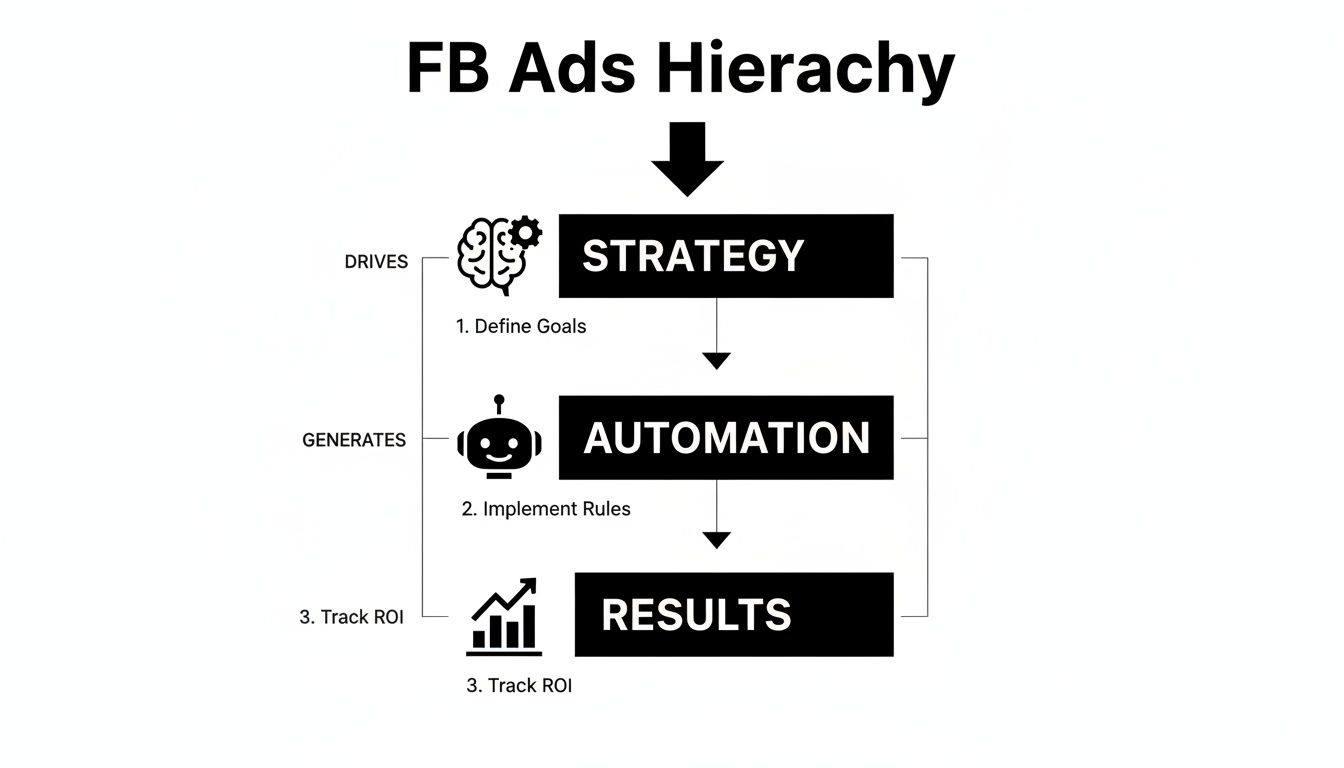
As the visual shows, automation isn't a replacement for strategy—it's the tool that executes it.
Level 4: Autonomous Execution Systems
Finally, we reach the most advanced level of automation available today. Autonomous execution systems, like SpendOwlAI, are designed to give you the best of both worlds: powerful machine learning analysis combined with the transparency and control that skilled operators need.
The game-changing difference here is that these systems don't just act on your behalf in a black box. Instead, they deliver ranked, explainable recommendations.
You get a clear, prioritized to-do list for your ad accounts. The system might suggest pausing a specific creative because it’s showing clear signs of fatigue, shifting budget away from a saturated audience, or scaling an ad set that’s demonstrating strong, statistically significant performance. Each suggestion comes with the "why" attached.
This approach gives you:
AI-Powered Analysis: The system does the heavy lifting, poring over all the data to spot opportunities and risks you might have missed.
Human-in-the-Loop Control: You’re still the pilot. You get to review the recommendations, understand the logic, and then confidently pull the trigger on the ones that make sense for your strategy.
The impact is massive. Effective fb ads automation can easily save you over 10 hours a week in manual account busywork. That efficiency is more critical than ever, with CPMs having surged 89% between 2020 and 2025. And with Meta rolling out 83 platform changes in 2025 alone, having an intelligent system to help you navigate that constant volatility is a huge advantage. As detailed in these insights on Facebook ad automation, this top-tier automation lets you make decisive moves, all backed by data you can actually see and trust.
Knowing When to Trust the Machine
The biggest question we face as media buyers isn't just about building the perfect campaign. It's about knowing when to let fb ads automation fly the plane and when to grab the controls ourselves.
Think of it like being a pilot. For those long, monotonous stretches of a flight, the autopilot is a lifesaver. It maintains altitude and direction with a precision that a human just can't sustain for hours on end. This is your automation at work—a tireless co-pilot that excels at the tactical, number-crunching jobs that would otherwise burn you out. It’s built for the relentless, split-second adjustments needed to win in today’s ad auctions.
The Autopilot’s Job: Tactical Execution
Think of automation as your system for flawless tactical execution. It’s the part of your team that never sleeps, never gets tired, and processes data at a scale no human ever could. This is where you absolutely should trust the machine.
Here are the key tasks best left to your automation:
Continuous Bid Adjustments: An algorithm can analyze billions of signals in real time to find the perfect bid for every single impression. This is a job a human simply cannot do effectively.
Real-Time Budget Allocation: Using features like Campaign Budget Optimization (CBO), automation can fluidly shift your budget toward the best-performing ad sets and creatives, squeezing maximum value out of every dollar.
Pausing Underperforming Ads: A good automation system uses statistical confidence to identify and pause ads that are definitively wasting money. This frees up your budget for the winners far faster than manual checks.
By handing over these tactical duties, you pull yourself out of the weeds. You’re no longer reacting to every minor dip and spike in the data. Instead, you get to step up into the role that automation can't—and shouldn't—ever replace: the strategic pilot.
The Pilot’s Job: Strategic Direction
While the autopilot handles the flight, the pilot is always in command of the destination. You provide the strategic vision that guides the entire operation. Automation is a powerful tool, but it's just that—a tool. It has no idea what your business goals are or what’s happening in your market.
Your most important job as a marketer is to provide the "why." The machine can figure out the "how" with incredible efficiency, but only you can set the big-picture goals and make the critical judgment calls that lead to real growth.
Your human insight is irreplaceable in these areas:
Setting the Destination: You decide if the goal is hitting a specific ROAS target, driving down Cost Per Acquisition (CPA), or just getting as many leads as possible. Automation will optimize for whatever goal you set, so choosing the right one is everything.
Interpreting Creative Fatigue: An algorithm can spot a declining CTR, but it can’t tell you why an ad is burning out. You’re the one who can look at the creative, understand the message, and decide if it’s time for a new angle or a completely fresh concept.
Understanding Market Context: Automation doesn't know about the flash sale you're running next week, a new competitor who just launched, or a sudden shift in customer mood. You provide this crucial context to make sense of performance data.
Making Strategic Pivots: If market conditions change or a campaign just isn't hitting its high-level goals, you’re the one who makes the call to change course. Maybe you need to test a new audience or adjust the offer. The machine might also struggle with the initial chaos of the Facebook ads learning phase, where your strategic patience is key.
Ultimately, successful fb ads automation is a partnership. It's about letting the machine handle the high-frequency tactics so you can focus on the high-impact strategic decisions. Trust the autopilot to fly the plane, but never forget that you’re the pilot who sets the course and knows exactly where you’re going.
Setting Guardrails for Safe Automation
Powerful Facebook ads automation is like handing the keys to a high-performance race car to a brand-new driver. Without guardrails, things can go off the track, and fast. Letting sophisticated algorithms run free without safety nets is a surefire way to burn through your budget, destabilize performance, and create more problems than you started with.
This is where guardrails come in. Think of them not as rigid rules that suffocate your automation, but as intelligent safety nets. They help you shift from frantically fixing problems after the fact to proactively preventing them in the first place. By setting clear boundaries, you make sure your automation is always working for you, not against you.

Protect the Learning Phase at All Costs
Your first and most important guardrail is one that protects the learning phase. Every time you make a significant edit to an ad set—whether it's changing the budget, swapping creative, or tweaking the targeting—you risk sending it right back to square one. When ad sets are constantly resetting, the algorithm never gets enough data to truly optimize, leaving you with volatile and unpredictable results.
A stability guardrail keeps an eye on how often your campaigns are being reset. It alerts you when frequent, small edits are actually doing more harm than good. This stops you (or your automation) from making knee-jerk changes based on noise, which just disrupts the algorithm's mission to find your best customers. As we explain in our guide on the Meta Conversions API, feeding the platform better data can also lead to a much smoother learning process.
Put a Cap on How Often You Make Edits
This goes hand-in-hand with learning phase stability. It's incredibly tempting to jump in and tweak a campaign based on just a few hours of data, but that’s a classic rookie mistake. An edit frequency cap acts as a much-needed brake, preventing your automation—or your own itchy trigger finger—from making too many changes too quickly.
This type of guardrail ensures that your decisions are driven by statistically significant trends, not random daily blips. For example, you could set a rule that prevents budget changes of more than 20% within any 24-hour period. This simple constraint forces patience and lets performance trends actually develop before you act.
While AI-driven creative automation allowed advertisers to produce 45% more ad variations by 2025, that power can backfire. As you can see from these Facebook ad statistics, a sudden 30% budget hike can easily cause a stable CPA to balloon to $65. This is why tools that provide inspectable, ranked actions are so critical—they let you make changes with data-backed confidence and avoid these costly mistakes.
Keep an Eye on Performance Volatility
Even with stable campaigns, performance can sometimes swing wildly. A volatility monitor acts as an early warning system for your most important metrics. It tracks things like your CPA, ROAS, and CTR over time, flagging any sudden, dramatic shifts that fall outside your normal performance window.
Let's say your average CPA is a steady $30. A volatility guardrail could alert you the moment it jumps to $50 and stays there. This gives you a chance to dig in and find the root cause—maybe a broken link, a tracking error, or a competitor's new campaign—before the problem drains a huge chunk of your budget.
Watch Out for Audience Saturation
Showing the same ads to the same people over and over again is a guaranteed way to kill your performance. We call this audience saturation, and it's most easily measured by the frequency metric—the average number of times someone has seen your ad. A saturation guardrail keeps a close watch on this number for you.
When frequency starts creeping up (a good rule of thumb is to investigate anything above 3-5 in a seven-day period), the guardrail should trigger an alert. This is your signal to take action:
Introduce fresh creative to liven up your message.
Expand your targeting to find new pockets of customers.
Rotate in a different offer to re-engage a tired audience.
Spot Creative Fatigue Before It's Too Late
Finally, remember that even your best-performing ads lose their magic over time. This is creative fatigue. You'll notice the once-stellar CTR starting to drop as the CPC begins to climb. A fatigue detection system automatically monitors this performance decay on an ad-by-ad basis.
This guardrail looks beyond a single metric and focuses on the trendline. It can flag a creative that has seen a consistent 20% drop in CTR over the past week, telling you it’s time for a swap. This proactive approach keeps your ad account fresh and effective, ensuring your Facebook ads automation engine is always fueled with high-performing creative.
Common Automation Pitfalls and How to Avoid Them
Let's be honest: Facebook Ads automation can feel like a magic bullet. But I've seen even the most sophisticated tools go completely off the rails when managed with the wrong mindset. The dream is to set it and forget it, but one wrong move can turn a promising account into a money pit with performance charts that look like a heart attack.
Knowing where the landmines are is half the battle. If you can sidestep these common mistakes, you’ll build an advertising engine that's not just efficient, but genuinely resilient.
The Daily Data Panic Attack
The most common trap I see is operators reacting to daily noise. You log in, see a bad 24 hours, and your stomach drops. The impulse is to immediately start pausing ads or gutting budgets. Don't do it.
This kind of knee-jerk reaction is poison to the algorithm. Every time you make a drastic change, you're essentially resetting the learning phase, robbing the system of the very data it needs to find stable performance. You end up chasing statistical blips instead of capitalizing on real trends.
The Trap of Premature Scaling
Here's another classic mistake: scaling too fast, too soon. Picture a DTC skincare brand. They launch a fresh ad, and on day one, it pulls in five sales. Excitement takes over, and they immediately double the budget, thinking they've struck gold.
But those five sales weren't a trend; they were just a lucky break. The bigger budget forces the ad in front of a wider, less qualified audience, and the ROAS plummets. By day three, that "winner" is burning cash. They fell for a false positive because they didn't wait for real proof.
Key Insight: Smart scaling decisions are built on trends, not single data points. The game isn't about reacting to every daily peak and valley. It's about identifying a sustained upward climb and confidently putting more fuel behind it.
A good automation platform—or just a patient media buyer—would wait for a more meaningful signal, like 50+ conversions over a 7-day window, before hitting the accelerator.
Running Blind Without Business Context
Automation is brilliant at crunching numbers and hitting the targets you set. What it can't do is understand your business. It's completely blind to the real-world context outside of Ads Manager.
For instance, an automation tool might see a product flying off the shelves and logically decide to pour more budget into its ads. The numbers look great! But what if you only have 50 units of that product left in stock?
The tool, just doing its job, will happily burn through ad spend promoting something that's about to sell out. You're left with angry customers, backorder nightmares, and wasted ad dollars. This is where a human is absolutely essential. You have to layer in those real-world guardrails.
Inventory Levels: Make sure your system can pause or down-weight ads for products that are running low on stock.
Profit Margins: Prioritize scaling ads for your high-margin heroes, even if a low-margin item has a slightly better ROAS.
Upcoming Promotions: Your automation needs to know about planned sales so it can align its strategy accordingly.
To help you keep these issues top of mind, I've put together a quick checklist. Use it to spot and fix these common problems before they do any real damage to your account.
FB Ads Automation Pitfall Checklist
This table summarizes the most frequent mistakes we see operators make and, more importantly, how to get back on track.
Common Pitfall | What It Looks Like | The Solution |
|---|---|---|
Over-Editing | Panicked daily changes to budgets or creative based on short-term data (e.g., last 24 hours). | Enforce a rule to only make changes after 3-7 days of consistent data. Limit budget changes to a max of 20% at a time. |
Premature Scaling | Doubling down on an ad set's budget after just one good day of performance. | Wait for statistical significance (e.g., 50+ conversions) before scaling. Use a tiered approach (e.g., increase budget by 20% every 3 days of sustained performance). |
Context Blindness | Automation aggressively promotes an ad for a product that is nearly out of stock or has low margins. | Integrate inventory data with your ad platform. Create rules that automatically pause campaigns for low-stock SKUs and prioritize high-margin products. |
Metric Fixation | Obsessing over a single metric like ROAS while ignoring early warning signs like rising CPMs or falling CTR. | Adopt a holistic view. Monitor leading indicators like creative fatigue and audience saturation to get ahead of performance drops, not just react to them. |
Think of this as your pre-flight check before letting automation take the controls.
Ultimately, avoiding these pitfalls means changing your role. You have to evolve from a reactive button-pusher into a strategic overseer. When you combine the raw power of fb ads automation with your own market knowledge and a patient, data-first approach, you get a system that’s not just efficient but truly intelligent.
Your Daily Performance Marketing Workflow

Alright, let's bring this down to earth. What does a day in the life actually look like when you have a smart fb ads automation system working for you? The goal is to shift from being a reactive firefighter to a proactive strategist.
Instead of getting sucked into the vortex of Ads Manager every morning, you get to follow a clear, focused process. It’s not about doing more; it’s about making fewer, better decisions that save you time and prevent costly slip-ups.
Step 1: The Morning Review
Your day starts not with a chaotic dashboard dive, but with a prioritized to-do list served up by your automation tool. This isn't just a data dump. It's your morning briefing, a ranked set of actions ordered by what will make the biggest impact on your bottom line.
For instance, your system might give you a simple, three-point plan:
Top Priority: Ad Set X has a killer ROAS over the last 72 hours. Let’s scale it by 15%.
Second Priority: Creative Y is losing steam. Its CTR has dropped 30% week-over-week. Time to pause it.
Third Priority: Audience Z is starting to show signs of saturation. Keep an eye on it.
Right away, you know exactly where to focus your energy for the biggest wins.
Step 2: Inspect and Validate
Now you move from the "what" to the "why." Before you blindly follow any suggestion, you dig in and verify the data yourself. A great automation system is transparent, showing you the exact numbers and trends that led to its recommendation.
This is where your expertise really shines. You're not just a button-pusher; you're the final sign-off. You're there to add human context, confirming the logic aligns with your big-picture strategy or an upcoming sale the machine doesn't know about.
If you’re thinking about how to build this into your own routine, platforms like lunabloomai's ad automation app are designed around this very principle of structured, human-in-the-loop review.
Step 3: Confident Execution
Once you've given the green light, you can execute the changes with total confidence. You're not just hoping it works; you're making a calculated move backed by data.
Whether you're increasing a budget, retiring a tired ad, or testing a fresh audience, you're doing it because you understand the rationale. For those looking to get more aggressive with growth, our guide on how to scale Facebook ads digs deeper into making these kinds of high-impact decisions.
Step 4: The Guardrail Check
Lastly, you do a quick health check on the whole account. Your automation's guardrail system should give you a fast "all-clear" or flag any potential trouble spots, like campaigns stuck in the learning phase or ad frequency creeping up across the board.
This final check-in ensures everything is running smoothly, giving you the peace of mind to step away from the numbers and focus on what really matters: creative strategy, long-term planning, and your next big win.
A Few Lingering Questions About Ad Automation
Alright, we've covered a lot of ground. But even after all the theory, I know a few practical questions are probably rattling around in your head. Let's tackle the big ones I hear from media buyers all the time.
Can FB Ads Automation Actually Replace a Marketing Manager?
Not a chance. Think of automation as your tireless, number-crunching assistant, but you're still the one calling the shots.
Automation is brilliant at handling the high-volume, repetitive tasks that would drive a human crazy—tweaking bids every hour, shifting tiny budget amounts between ad sets, and catching performance dips at 3 AM. It handles the tactical grunt work with a speed and precision we just can't match.
But a human manager? That's where strategy lives. You're the one who understands the brand's voice, spots a new creative angle that's resonating with customers, and interprets the bigger market trends. The absolute best results happen when a smart operator works with powerful automation, not against it.
How Much Data Do I Need Before Turning On Automation?
This is a critical question. There's no single "magic number," but you absolutely need enough data to separate real trends from random noise.
A good rule of thumb is to let a campaign get its sea legs first. Wait for it to exit the learning phase, which usually requires around 50 conversions and a solid 3-7 days of runtime.
If you jump the gun and automate too early, you're just asking the system to make big decisions based on a tiny, unreliable data set. That's how you end up killing a potential winner before it ever had a fair shot.
Key Insight: The whole point of automation is to act on reliable signals, not early volatility. A little patience up front pays huge dividends later.
How Is a Third-Party Tool Different from Meta's Advantage+?
The difference really comes down to two words: transparency and control.
Meta's native Advantage+ is essentially a "black box." You give it an objective and a budget, and it goes to work. It can be very effective, but you're often left scratching your head, wondering why it made certain decisions or why performance suddenly changed.
A smart third-party tool, on the other hand, is like an intelligence layer. It sits on top of your ad account, analyzes all the same data, but then presents you with a clear, ranked list of suggested actions. Crucially, it shows you the why behind each recommendation. This gives you the insight to approve or reject actions with full confidence, keeping you in the driver's seat.
Ready to stop guessing and start executing with data-backed guidance? SpendOwlAI gives you clear, ranked actions for your ad accounts, complete with transparent rationale. Start your free 7-day trial and bring confidence to your daily workflow.