A Strategic Guide to the Facebook Ads Learning Phase
Ever launched a new Facebook ad campaign and watched your results swing wildly for the first few days? That's the learning phase in action. Think of it as Meta's AI going to school—it's the initial training period where the algorithm figures out the best way to deliver your ads.
This crucial first stage involves a lot of trial and error. The system tests your ads on different people, in different places, at different times, all to find the sweet spot that leads to conversions. This can feel a bit chaotic, but it's the necessary groundwork for achieving long-term, stable performance.
What Is the Facebook Ads Learning Phase?
The Facebook ads learning phase is the period that kicks off right after you create a new ad set or make a significant change to an existing one. During this time, Meta's delivery system is in full-on exploration mode. It's collecting data and learning who is most likely to respond to your ad and take the action you want, whether that's a purchase, a lead form submission, or something else.
I like to compare it to a new delivery driver learning their route in a big city. On day one, they'll probably try a few different roads, get stuck in traffic, and maybe even take a wrong turn or two. Their delivery times will be all over the place. But after a week of learning the traffic patterns and shortcuts, they become incredibly efficient, hitting their destinations faster every time. Meta's algorithm is doing the exact same thing with your campaign.

Why This Phase Is So Important
This isn't just random spending; it's a strategic investment in your campaign's future. When an ad set successfully pushes through the learning phase, the payoff is huge and shows up directly in your results.
A healthy learning process gives you:
More Stable Performance: Once the algorithm figures out what works, your key metrics—like Cost Per Acquisition (CPA)—will stop bouncing around and become much more predictable.
Improved Budget Efficiency: The system gets smart. It stops wasting your money on audiences or placements that aren't performing and doubles down on what drives the best return.
Confident Scaling: With stable, predictable performance, you can finally start increasing your budget with confidence, knowing you have a solid foundation for growth.
The real challenge for us advertisers is feeding our ad sets enough data to get them out of this phase. Getting stuck just burns cash and delivers the exact kind of inconsistent results we all want to avoid.
The magic number is 50. The goal is to get roughly 50 optimization events (like purchases or leads) within about a week. This gives the algorithm enough data to graduate from uncertain exploration to confident, stable delivery. Hitting that threshold is the key to unlocking consistent performance.
The Consequences of an Incomplete Learning Phase
What happens when an ad set doesn't get those 50 events? It gets stamped with a "Learning Limited" status. This means the algorithm never built up enough confidence to truly optimize your ad delivery. Your ads will still spend money, but their performance will likely be choppy, inefficient, and unpredictable.
This is a massive point of frustration for so many advertisers, but it's almost always preventable. By understanding the mechanics of the Facebook ads learning phase, you can structure your campaigns for success right from the start.
This foundational knowledge is a must-have for anyone serious about mastering Meta's platform. For a deeper dive into more advanced campaign management strategies, you can find more insights on the SpendOwlAI blog. Nailing this part of the process is your first real step toward building more profitable and resilient campaigns.
Why 50 Conversions Is Your Magic Number
If there’s one number you need to burn into your brain when running Meta ads, it’s 50. This isn't some arbitrary figure Meta pulled out of thin air. It's the key that unlocks stable, predictable performance for your ad sets, getting them out of the volatile "learning phase."
Think of the algorithm like a new hire trying to learn who your best customers are. If you only give it a few examples (conversions) to work with, it's just guessing. It needs a solid base of evidence to start recognizing patterns and confidently finding more people like your existing buyers.
That’s where the magic number comes in. Meta’s delivery system needs about 50 optimization events (purchases, leads, whatever your goal is) within a 7-day window for a single ad set. Once it gets that much data, it graduates from just exploring to actually executing with precision. Experienced advertisers know this is the tipping point where you often see Cost Per Acquisition (CPA) start to settle down and those wild daily performance swings begin to fade. For a deeper dive into the mechanics, you can read more about the Facebook learning phase on bestever.ai.
Hitting this 50-conversion threshold is what separates the campaigns that scale from the ones that just burn cash.
Do You Have the Budget to Exit the Learning Phase?
Let's get practical. This 50-conversion rule has a direct impact on your budget. You can actually do some quick back-of-the-napkin math to see if you're even giving your ad set a fighting chance to succeed.
Here's the simple formula:
(Your Target Cost Per Acquisition) x 50 Conversions = Your Minimum 7-Day Budget
If your weekly budget falls short of this number, you're setting yourself up for the dreaded "Learning Limited" status.
Example: An E-commerce Brand
Let's say you sell handcrafted leather wallets, and your target CPA for a purchase is $20.
The Math: $20 CPA x 50 purchases = $1,000
Weekly Budget Needed: Your ad set needs at least $1,000 to spend over a 7-day period.
Daily Budget Needed: That works out to roughly $143 per day.
If you launch this ad set with a $30 daily budget, you’re basically telling the algorithm you don't expect it to find enough customers. It will struggle to gather data, and you'll likely never see the stable, efficient delivery you're hoping for.
How Underfunded Budgets Keep You in "Learning Limited"
This is, without a doubt, the most common pitfall I see. An insufficient budget starves the algorithm of the data it needs to do its job.
When an ad set is underfunded, this is what's happening behind the scenes:
A Trickle of Data: Instead of a steady stream of conversions, you get maybe one or two a day, if you're lucky.
No Clear Patterns: With so few data points, the algorithm can't connect the dots. It has no idea if your best customers are 30-year-old men on Instagram Reels or 55-year-old women on Facebook Marketplace. The signal is just too weak.
Stuck in Limbo: The ad set gets flagged as Learning Limited, which is Meta's way of telling you it's flying blind. Your CPAs will be all over the place, and performance will feel completely random.
The Bottom Line: Your budget isn't just about how much you can afford. It's a strategic tool. You're far better off funding one ad set properly than spreading a small budget too thinly across several.
By aiming for that 50-conversion goal, you’re not just hoping for the best—you’re intentionally setting up your campaigns to work with the algorithm. You're giving it the fuel it needs to find your customers, and that's how you win.
How to Diagnose Your Campaign's Learning Status
Alright, you get why hitting that magic number of 50 conversions is the goal. But how do you actually know where you stand? The good news is that Meta gives you a clear window into what's happening under the hood, right inside Ads Manager.
Learning to read these signals is what separates a proactive media buyer from one who’s always reacting to bad performance. It’s all about checking your campaign’s pulse.
Your go-to diagnostic tool is the Delivery column. This little column, found at the ad set level, is basically Meta's real-time report card on your campaign's health. It tells you exactly what the algorithm is thinking and doing.
Finding and Reading the Delivery Column
This is super simple. Just pop over to the ad sets tab in your Ads Manager and find the "Delivery" column. If you don't see it, just customize your columns to add it. This is where you'll see a few key statuses that tell the story of your ad set's journey through the learning phase.
The two main statuses you need to care about are:
Learning: This is totally normal. It means your ad set is live and actively gathering the data it needs to figure things out. Seeing this isn't a bad thing at all—it means the process is working as intended.
Learning Limited: This is your warning light. It’s Meta’s way of saying, "Hey, I'm struggling to get enough conversions to learn properly." Your ads are still running, but the algorithm is telling you that performance will probably be choppy, unstable, and more expensive than it should be.
"Learning Limited" isn't a death sentence for your ad set, but it's a clear signal that the algorithm is flying blind. Think of it as an invitation to play detective, figure out what's wrong—usually budget, audience size, or conversion volume—and fix it.
A Quick Diagnostic Checklist for "Learning Limited"
When you spot that "Learning Limited" status, don't hit the panic button. Instead, treat it as a trigger to investigate. The decision tree below from Meta visualizes the simple logic the system uses—if you don't hit 50 conversions in about a week, you're going to get stuck.
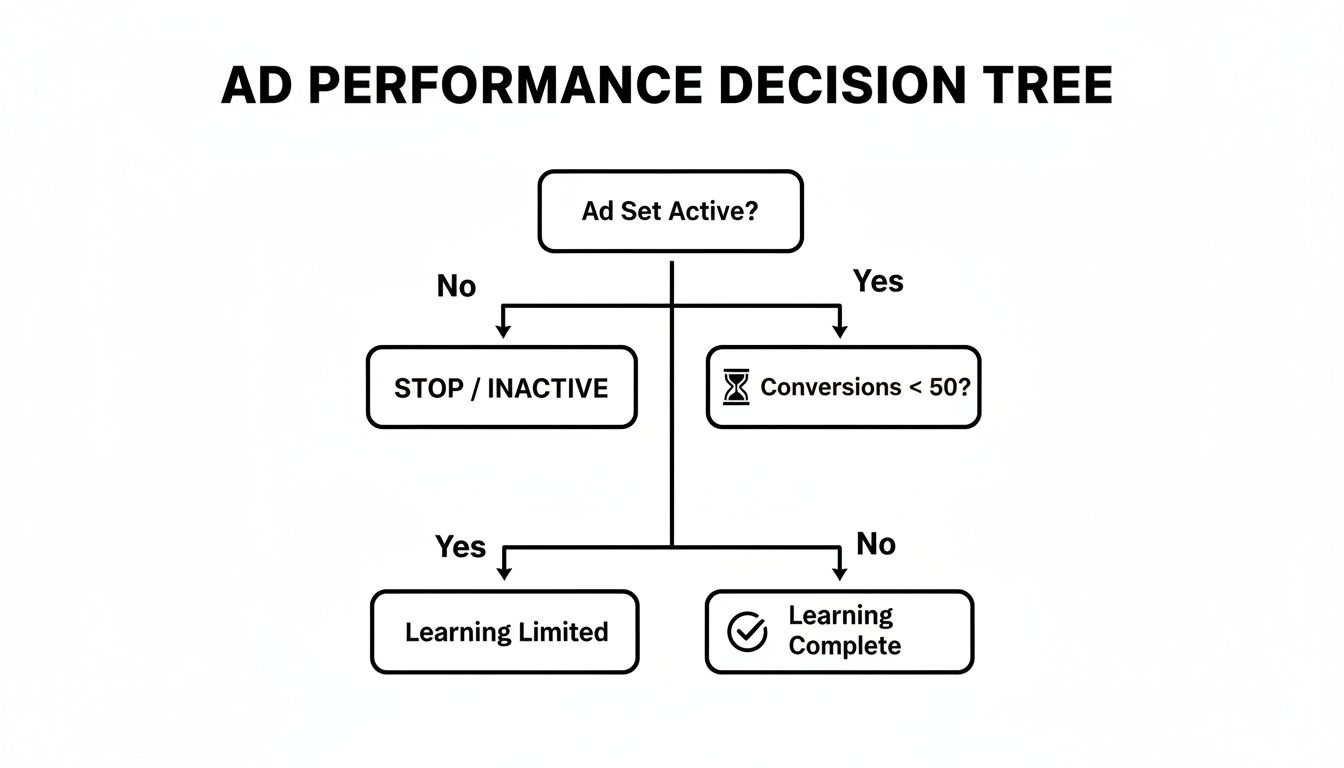
This visual makes it crystal clear: failing to reach that 50-conversion threshold is the direct path to "Learning Limited."
So, start by asking yourself these three questions:
Is My Budget Too Low? This is the most common culprit, hands down. If your daily budget can't realistically buy 50 conversions within a week at your typical cost-per-acquisition (CPA), you're setting the ad set up to fail. The fix? Either increase the budget or, better yet, consolidate your budget into fewer ad sets.
Is My Audience Too Niche? A super-small, highly-targeted audience can starve the algorithm. Even with a healthy budget, you might not have a big enough pool of people to find enough converters. The fix here is to broaden your targeting—try a larger lookalike percentage, loosen up your interest targeting, or expand your demographics.
Is My Conversion Event Too Rare? Are you optimizing for a "Purchase" event that only happens a few times a day? The algorithm might not get enough data fast enough. A smart workaround is to temporarily optimize for an event that happens more often, like "Add to Cart" or "Initiate Checkout," to feed the system the volume it needs.
Interpreting Learning Phase Statuses in Meta Ads Manager
To help you quickly diagnose what's going on, here’s a breakdown of the key delivery statuses you'll encounter and what they really mean for your campaigns.
Delivery Status | What It Means | Common Cause | Recommended Action |
|---|---|---|---|
Learning | The ad set is active and gathering the data needed to stabilize performance. Performance may fluctuate. | A new ad set has just been launched or a significant edit was made. | Let it run. Avoid making any significant edits that would reset the learning process. |
Active | The ad set has successfully exited the learning phase. Performance should now be stable. | The ad set generated at least 50 conversions without a significant edit. | Monitor performance and scale budgets gradually if results are strong. |
Learning Limited | The ad set is not getting enough conversions to exit the learning phase, leading to inefficient spending and unstable performance. | Budget is too low, audience is too small, or the conversion event is too infrequent. | Diagnose the root cause using the checklist above. Increase budget, broaden the audience, or change the optimization event. |
Not Delivering | Your ads are not being shown to anyone. | Approval issues, ad set is turned off, or there are billing problems with the account. | Check for ad disapprovals, ensure the campaign/ad set/ad is active, and verify your payment method. |
By walking through this simple diagnostic process, you can move from just seeing a status to truly understanding why it's happening. This is how you make smart, strategic adjustments that get your campaigns out of the learning rut and back to driving efficient results.
Common Mistakes That Trap Your Ad Sets in Learning
Getting through the Facebook ads learning phase isn’t about some secret growth hack. More often than not, it’s about getting out of your own way. Too many advertisers accidentally trap their own campaigns in a frustrating cycle of instability, leaving them scratching their heads about why their results are all over the place.
The real culprit is almost always a lack of patience, which triggers impulsive, knee-jerk changes. It’s tempting to dive in and “fix” a campaign that isn’t printing money on day two, but that’s the very behavior that prevents the algorithm from ever finding its footing. The first step to breaking this expensive cycle is understanding the common pitfalls.
The Number One Mistake: Trigger-Happy Editing
The single most destructive habit that keeps ad sets in a perpetual state of learning is making frequent, significant edits.
Think of the algorithm as a student cramming for a final exam. Every time you make a major change to a live ad set, it’s like yanking the textbook out of their hands and shoving a new one in their face. All their hard-earned progress is gone. They have to start studying from page one all over again.
This constant resetting is exhausting for the algorithm and incredibly expensive for you. Meta’s system needs a stable, consistent environment to gather those 50 conversions and find predictable patterns. When you keep changing the rules of the game, it never gets the steady data stream it needs to work its magic.
So, what counts as a “significant edit” that can throw your campaign back to square one?
Budget Changes: Any sudden, large jump or cut in the ad set budget—typically more than 20-30% at once—can shock the system and trigger a reset.
Targeting Adjustments: Altering your audience by adding or removing interests, tweaking demographic parameters, or swapping out lookalike audiences forces the algorithm to re-learn who it's looking for.
Creative Swaps: Adding new images or videos, or even making big changes to your ad copy, is a major edit that requires a full learning reset.
Changing the Optimization Goal: Switching your objective from, say, "Add to Cart" to "Purchase" completely changes the finish line and restarts the entire process.
Meta is very clear about this: frequent edits delay stabilization. Each major change forces the system to re-explore the endless combinations of audiences, placements, and creatives. As seasoned advertisers at Matchnode's blog about Facebook ad strategy will tell you, it's far smarter to consolidate ad sets, giving each one enough budget density to power through learning quickly.
The Problem of Budget Fragmentation
Another classic misstep is spreading your budget too thin across too many ad sets. It’s the advertising equivalent of trying to water a giant garden with a tiny watering can—nothing gets enough to thrive. An advertiser might have a total budget of $100 per day, but they split it among five different ad sets, giving each a measly $20.
While it feels like a good way to test different audiences, this approach virtually guarantees that none of them will ever make it out of the learning phase.
Let’s go back to our simple math. If your target CPA is $25, you need 50 conversions to exit learning.
Calculation: $25 CPA x 50 Conversions = $1,250 needed within 7 days. Daily Budget Required: ~$178 per day.
With just a $20 daily budget, that ad set is mathematically doomed. It is physically incapable of generating the data volume required for optimization. The result? All five ad sets get stuck in "Learning Limited," burning cash without ever hitting stable, efficient performance.
Key Takeaway: You are far better off properly funding one or two ad sets than underfunding five. Consolidation is your friend. By combining those tiny budgets into a single, well-funded ad set, you give the algorithm a fighting chance to succeed.
Forgetting the Power of Great Creative
Finally, a surprisingly common oversight is launching campaigns with weak, uninspired creative. Let's be blunt: no amount of budget or audience wizardry can save an ad that people just scroll past.
If your creative fails to grab attention and get the click, your conversion volume will stay stubbornly low, no matter how hard the algorithm works.
Low engagement and a poor click-through rate starve the algorithm of the data it needs to learn, dragging out the learning phase indefinitely. Strong creative isn’t just a nice-to-have; it's the fuel that powers the entire optimization engine. If you need a refresher, check out our guide on how to improve click-through rate.
By avoiding these three critical mistakes—impulsive editing, budget fragmentation, and weak creative—you create an environment where Meta's algorithm can do its job, exit the Facebook ads learning phase quickly, and finally deliver the stable, profitable results you’re looking for.
Actionable Strategies to Get Out of the Learning Phase—Fast

Knowing what keeps your ad sets stuck in the Facebook ads learning phase is half the battle. Now, let’s get into the practical, forward-thinking strategies that will push you through it as quickly and painlessly as possible. The trick isn't to make random, panicked changes but to use a structured approach that gives the algorithm exactly what it needs to find its footing.
Our goal isn't just to exit learning; it's to build campaigns that are engineered for stability right from the start. These tactics are all about speeding up data collection, which helps the system find predictable patterns and deliver consistent results much, much faster.
H3: Pool Your Budget for Maximum Impact
One of the quickest ways to fix a "Learning Limited" status is to stop spreading your budget too thin. Seriously. If you’re running five different ad sets with $20/day each, you've essentially given the algorithm five tiny, underfunded projects. None of them have enough juice to hit that magic 50-conversion mark.
Instead, pool that budget. Combine those five ad sets into a single, powerful one with a $100/day budget. This simple move concentrates your spending power, massively increasing the chances of hitting your daily conversion goals for that one ad set. It’s the most direct way to feed the algorithm the data it’s hungry for.
H3: Keep Your Campaign Structure Simple
Complexity is the enemy of fast learning. A sprawling campaign with a dozen ad sets and tons of ads creates way too many variables for the algorithm to test efficiently. You want to simplify things to speed up the process.
A clean, focused setup might look something like this:
1 Campaign: Focused on a single, clear goal (e.g., Purchases).
1-3 Ad Sets: Each targeting a distinct, reasonably broad audience.
3-5 Ads Per Ad Set: Stick to your best-performing creative concepts or angles.
This streamlined approach stops your budget from getting fragmented and ensures every ad set has a clear job and enough money to do it. As a bonus, it also makes it way easier for you to figure out what's working and what isn't without getting lost in a mess of campaigns.
H3: Go Broader With Your Audience to Feed the Algorithm
This might sound backward, but a hyper-specific, niche audience can actually starve the algorithm. If your targeting is too narrow, Meta’s system might struggle to find 50 people to convert within a week, even if you're spending enough. You have to give it some breathing room.
Start with a broader audience—think lookalikes in the 3-5% range or expanded interest targeting. This gives the algorithm a much bigger sandbox to play in. It dramatically increases the odds of finding those little pockets of high-intent users, letting you rack up conversion data at a much faster rate.
Once your ad set is stable and humming along, you can always start to refine and narrow your targeting. But during that critical initial learning phase, a wider net almost always catches more fish, faster. For more on this, check out our guide on how to scale Facebook ads once you’ve built that stable foundation.
H3: Pick the Right Bid Strategy for the Job
Your bid strategy is your instruction manual for Meta on how to spend your money. Choosing the right one can make a huge difference in how quickly you get through the learning phase. The two most common options each have their own pros and cons.
Comparing Bid Strategies
Bid Strategy | Best For | How It Works | Impact on Learning Phase |
|---|---|---|---|
Highest Volume | Speed and getting lots of data. Perfect for getting out of the learning phase as fast as possible. | This tells Meta to get you the most conversions it can for your budget, period. It won't worry about hitting a specific cost goal. | It prioritizes hitting 50 events above everything else—which is exactly what you need. Be prepared for costs to be a bit higher at first. |
Cost Per Result Goal | Control and predictability. Use this when you have a hard CPA you absolutely cannot go over. | You set a target cost per conversion, and Meta will aim for that average. This means it might pass up conversions that are too expensive. | This can really slow down learning if your cost goal is too low or unrealistic, as the system will be overly cautious. |
For most advertisers trying to get out of the learning phase, Highest Volume is the way to go. It’s all about speed and volume, which is your main objective here. Once your campaign is stable and performing well, you can always switch over to a Cost Per Result Goal to dial in your efficiency.
By putting these proven strategies into play—pooling your budget, simplifying your structure, broadening your audiences, and picking the right bid strategy—you create the perfect environment for your campaigns to succeed. You’ll find yourself moving through the Facebook ads learning phase faster, wasting less money, and building a foundation for predictable, scalable growth.
Got Questions? We've Got Answers
Getting to grips with the Facebook ads learning phase always brings up a few common questions. Let's break down the ones we hear most often from advertisers so you can run your campaigns with a bit more confidence.
How Long Does This Learning Thing Actually Take?
There’s no magic number of days. The learning phase isn't on a timer; it’s on a counter. It officially ends when your ad set racks up about 50 optimization events (think purchases, leads, etc.) within a 7-day window.
So, the real-world timeline can be all over the place. A high-budget ad set with a great conversion rate might pop out of learning in just a couple of days. On the other hand, a campaign with a smaller daily budget could take the full week or even longer. Your goal isn't to wait it out—it's to hit that conversion count as fast as possible.
Can an Ad Set Get Thrown Back Into Learning?
Oh, absolutely. Even after an ad set graduates to "Active" status, it can get sent right back to square one. This happens whenever you make what Meta considers a "significant edit."
A significant edit isn't just a tiny tweak. We're talking about changing your creative, overhauling your targeting, switching your optimization event, or making a big budget change (usually more than 20-30% at once). When you do this, you're essentially telling the algorithm to forget everything it learned and start over.
Is "Learning Limited" Really That Bad?
In most cases, yes. Think of "Learning Limited" as a flashing yellow light on your dashboard. It’s a warning that your ad set isn't getting enough data to figure out how to deliver your ads efficiently. This almost always leads to unpredictable performance and higher costs.
Sure, for a tiny, hyper-local campaign, you might be able to live with it. But if you're trying to scale or get the best possible return on your ad spend, you should always treat "Learning Limited" as a problem that needs fixing.
Should I Combine Ad Sets Stuck in Learning Limited?
Yes, this is one of the best moves in your playbook. If you have several ad sets all sputtering in "Learning Limited," consolidating them is a smart strategy. By merging their budgets and audiences into one stronger ad set, you're pooling your resources.
This focuses your spend, which helps that single ad set get more conversions each day. It's often the fastest way to give the algorithm the 50 events it needs to finally exit the learning phase and stabilize.
Tired of manually diagnosing learning phase issues and guessing which changes to make? SpendOwlAI provides clear, daily actions to stabilize performance and prevent wasted spend. Our system monitors learning stability and prescribes guarded actions, telling you what to change—and what to leave alone—for maximum impact. Start your free 7-day trial at SpendOwlAI.
Article created using Outrank