10 Winning Examples of Video Ads That Convert in 2026
Video ads dominate digital platforms, but what separates the ones that convert from the ones that get skipped? The difference isn't just budget or production value; it's a deliberate, repeatable strategy. This guide moves beyond surface-level showcases to provide a deep, operator-focused analysis of 10 proven video ad formats. We will dissect high-performing examples of video ads from Meta, Google, and top-tier Shopify brands, breaking down the specific elements that drive results.
Instead of just showing you ads, we provide a clear framework for understanding them. Each example includes a detailed breakdown of its:
Hook: The first three seconds that stop the scroll.
Creative Elements: The specific visuals, audio, and text overlays used.
Audience Fit: Why this ad resonates with a particular target segment.
Measurable Outcomes: The performance data that proves its effectiveness.
Our goal is to give you more than just inspiration. We'll deliver actionable templates and testing frameworks you can use to replicate this success immediately. For performance marketing managers and DTC founders, the real challenge isn't just creating a good ad; it's building a system for consistent creative performance. It's knowing when an ad is fatiguing, when to rotate creative, and how to scale winning concepts without disrupting stable results. Throughout this analysis, we will show you how to turn these examples into a reliable, data-backed system, helping you move past one-off creative wins and toward predictable growth. This isn't a gallery of cool ads; it's a playbook for building a high-performing video ad machine.
1. Short-Form Performance Ads (15-30 seconds)
Short-form performance ads are vertical videos, typically 15 to 30 seconds long, built for mobile-first platforms like Instagram Reels, TikTok, and YouTube Shorts. Their primary goal is immediate impact. These ads are designed to stop the scroll within the first three seconds by presenting a direct solution to a viewer's problem or showcasing a compelling product benefit.
This format is a cornerstone for direct-to-consumer (DTC) brands that need to test creative concepts quickly and drive conversions. For example, a Glossier Reel might feature a rapid, satisfying application of a new lip gloss, while a Gymshark ad could show a quick before-and-after clip of someone comfortably performing a workout in their gear. The common thread is a singular, powerful message delivered without delay.
Strategic Breakdown & Actionable Takeaways
To make these ads work, focus on a high-volume, rapid-testing methodology. The goal isn't a single perfect ad but a system that identifies winning creative combinations.
Hook (0-3 seconds): Start with a direct question ("Tired of workout gear that rides up?") or a visually arresting product shot. This is your most critical asset.
Creative Elements (3-12 seconds): Use quick cuts, user-generated content (UGC), or a simple product demonstration. Avoid complex narratives; show, don’t just tell.
Call to Action (12-15 seconds): A clear, bold text overlay like "Shop Now" or "Learn More" should appear in the final moments, paired with a verbal cue if possible.
Key Insight: The main purpose of these ads is audience and creative validation. By launching 5-10 variations at once, you can quickly spot which hooks, visuals, and CTAs resonate with your target demographic, allowing you to allocate budget to winners and iterate on successful patterns. This high-volume approach requires diligent tracking of metrics like click-through rate (CTR) to make informed decisions.
Monitor ad performance daily for signs of creative fatigue. If you see CTR or cost-per-view metrics begin to decline, it's time to rotate in fresh creative. Use platform-native editing tools to maintain an authentic, organic feel that blends seamlessly into the feed.
2. Testimonial and User-Generated Content (UGC) Ads
Testimonial and User-Generated Content (UGC) ads feature authentic videos from real customers or creators using products in natural, everyday settings. These ads build trust and relatability by showcasing social proof through unboxing moments, genuine reactions, or before-and-after results. For brands facing ad fatigue, UGC offers a powerful way to refresh creative and reconnect with audiences who are skeptical of polished, corporate messaging.

This format thrives on its lack of studio polish. An Olaplex ad might feature a creator showing their damaged hair before and their healthy hair after using the product, all filmed on a smartphone. Similarly, a MVMT watch ad could be a simple unboxing video from a customer’s perspective. The strength of these examples of video ads comes from their raw, unfiltered feel, which makes the endorsement feel more like a trusted recommendation than a paid promotion.
Strategic Breakdown & Actionable Takeaways
To succeed with UGC, shift from a brand-centric perspective to a customer-centric one. The objective is to facilitate and amplify authentic stories, not to script them.
Hook (0-3 seconds): Open with a relatable problem or a powerful testimonial quote. For instance, a skincare ad could start with a creator saying, "My acne scars are finally fading," paired with a close-up shot.
Creative Elements (3-12 seconds): Show the product in action through the customer's eyes. This could be an unboxing, a "get ready with me" sequence, or a quick demo explaining a specific benefit. The content should feel native to the platform.
Call to Action (12-15 seconds): End with a clear directive. A customer holding the product could say, "You have to try this," immediately followed by a "Shop Now" text overlay.
Key Insight: UGC's primary advantage is its extended lifespan and ability to combat ad fatigue. These ads often resist performance decline 30-40% longer than brand-led creative. Systematize content creation by building a pipeline of 10-20 creators to produce video variations in bulk. This allows you to test different faces, environments, and storytelling styles simultaneously.
Always test UGC alongside your branded ads within the same campaign. This A/B testing approach provides clear data on which format resonates better with specific audience segments. When you notice audience saturation or declining performance on your primary ads, you have a validated library of UGC ready to rotate in, maintaining campaign momentum and efficiency. Remember to secure written usage rights from creators upfront to avoid costly negotiations later.
3. Educational and How-To Tutorial Ads
Educational and how-to tutorial ads are longer-form videos, often running from 30 to 120 seconds, that teach an audience how to use a product or solve a specific problem. Instead of a direct sales pitch, their goal is to build brand equity and trust by positioning the brand as a helpful authority. These ads are excellent for products with a learning curve or higher-consideration purchases where a customer needs more information before committing.
This format excels on platforms that favor longer content, like YouTube and Facebook Watch. For instance, a Notion ad might walk a user through setting up a project management template, while a Native deodorant ad could explain the science behind its natural ingredients. The common element is providing genuine value first, which nurtures a lead and builds brand affinity that pays dividends later. The GoPro ad below is a perfect example of showing, not just telling, what a product makes possible.
Strategic Breakdown & Actionable Takeaways
To succeed with this format, the focus shifts from immediate conversion to audience engagement and brand lift. The goal is to create content so useful that viewers see your brand as an indispensable resource.
Hook (0-5 seconds): Frame a common problem or a desired outcome. For example, "Here's how to organize your entire life in Notion" or "Struggling to get cinematic shots? Try this."
Educational Core (5-90 seconds): Deliver on the promise with a clear, step-by-step tutorial. Use screen recordings for software or close-up shots for physical products. Text overlays and captions are essential, as many viewers watch with the sound off.
Call to Action (90-120 seconds): The CTA is softer. Instead of "Shop Now," try "Learn More," "Get the Template," or "Watch More Tutorials." The goal is to draw them deeper into your brand's ecosystem.
Key Insight: The primary metrics for these ads are not CTR or immediate sales. Instead, focus on watch time and view completion rate. These metrics signal brand lift and audience interest. A high completion rate on a two-minute tutorial indicates a highly qualified audience that is more likely to convert in a future retargeting campaign.
Separate your educational ad campaigns from your direct-response campaigns to avoid misattributing results. Use the performance of these ads to identify warm audiences, then retarget them with short-form, conversion-focused ads. This two-step approach builds trust first and asks for the sale second, leading to a higher customer lifetime value.
4. Carousel and Multi-Product Showcase Ads
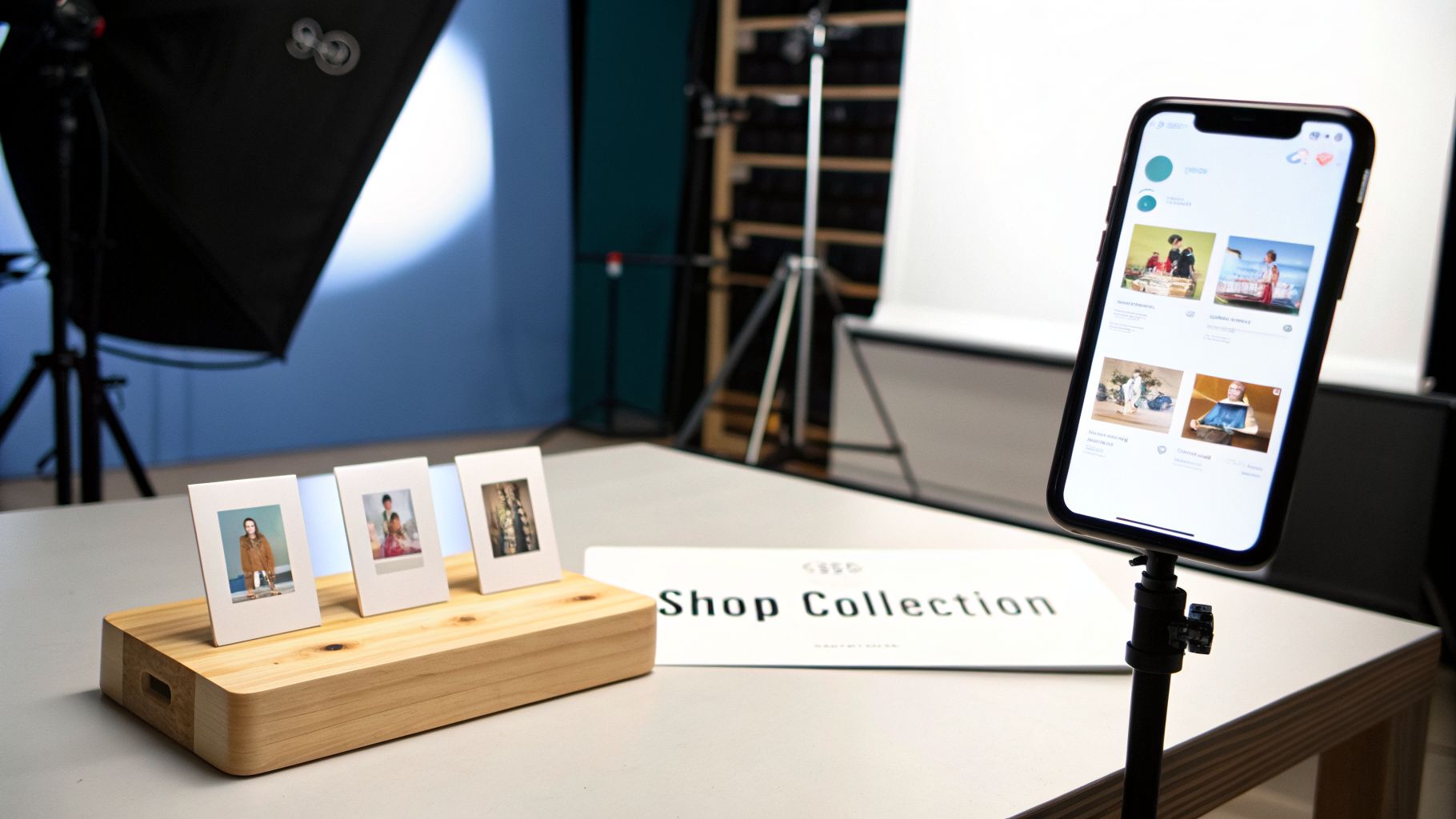
Carousel and multi-product showcase ads combine the interactivity of a gallery with the engagement of video. These formats cycle through 3-10 products or product variations within a single ad unit, letting users swipe through different items or styles. They are especially powerful for e-commerce brands with diverse catalogs, maximizing inventory exposure per ad impression and enabling SKU-level performance tracking.
This format is a staple for Shopify merchants looking to showcase a range of products efficiently. For example, a Lululemon carousel might display a single pair of leggings in multiple colors, while an Etsy seller could feature several distinct, handmade items. The common goal is to offer choice and capture interest from a broader segment of viewers by presenting more of the catalog upfront.
Strategic Breakdown & Actionable Takeaways
Success with carousels hinges on optimizing each card to encourage swiping and discovery. It's less about a single narrative and more about creating a visually cohesive mini-catalog.
First Card (The Hook): This card is your primary hook and determines whether users engage further. Feature your absolute bestseller or the product with the highest historical return on ad spend (ROAS). The video on this card must be compelling enough to stop the scroll and signal that more value lies ahead.
Subsequent Cards (The Inventory): Maintain a consistent visual style, background, and product angle across all cards to create a seamless browsing experience. Use each card to showcase a different product, color, or benefit. Sort cards by popularity or relevance, not just what's new.
Call to Action (Per-Card and Final): Each card should have its own destination URL, directing traffic to a specific product page. The final card can serve as a broader CTA, like "Shop the Collection" or "See All Styles," to capture users who browsed the entire set.
Key Insight: The main goal of a carousel is to turn a single impression into a multi-product discovery session. The most important metric to watch is the swipe-through rate (cards viewed per user). A rate of 2.5 or higher suggests the content is relevant and the first card successfully encouraged exploration. This gives you a much richer data set on what products are generating interest.
Monitor the click-through rate (CTR) of each individual card to identify top performers and underachievers. Allocate the majority of your optimization efforts to the first card, as its performance disproportionately affects the entire ad's effectiveness. Pairing this with SKU-level analytics tools can help you quickly pause underperforming products within the carousel and reallocate budget to winners.
5. Retargeting and Abandoned Cart Video Ads
Retargeting and abandoned cart video ads are targeted campaigns shown to users who have already interacted with your brand but did not convert. These ads use behavioral data to reconnect with warm audiences who visited product pages, added items to their cart, or viewed specific items. The core function is to overcome final purchase hesitation by showing relevant products and creating a sense of urgency through limited-time offers or scarcity messaging.

This tactic is fundamental for e-commerce, especially for Shopify Plus stores optimizing checkout flows and direct-to-consumer brands like Warby Parker. For instance, a furniture retailer might show a short video of the exact sofa a user viewed, while a fashion brand could serve a video ad reminding a shopper about the dress left in their cart, sweetened with a small discount code. These are powerful examples of video ads because they are hyper-relevant to the viewer's recent online behavior.
Strategic Breakdown & Actionable Takeaways
Success with retargeting depends on segmentation and message relevance, not just repetition. Avoid ad fatigue by providing genuine value or a compelling reason to return. A solid strategy to optimize your Facebook ads for retargeting involves careful audience management.
Hook (0-3 seconds): Open with a dynamic product shot of the item the user viewed or a direct question like, "Still thinking it over?" or "Forgot something?" This immediately re-establishes context.
Creative Elements (3-12 seconds): Reinforce the product's value. Show a user testimonial, a different angle of the product, or a quick demonstration of its key benefit. Keep it simple and focused on the specific item.
Call to Action (12-15 seconds): Use a clear, direct CTA that guides the user back to their journey, such as "Return to Cart" or "Claim Your Discount." Display the offer code prominently if one is used.
Key Insight: The main goal of retargeting is efficient conversion at a lower cost. Segment your audiences based on intent-level: cart abandoners are your highest-intent group, followed by product viewers, and then general site visitors. Tailor your message and offer to each segment. A 15% discount might be effective for a cart abandoner, while a simple reminder is enough for a product viewer.
Set strict frequency caps, aiming for no more than 3-4 impressions per user per week to prevent annoying your warm audience. Monitor your cost-per-conversion closely; a well-run retargeting campaign should maintain a cost-per-acquisition that is significantly lower than your cold audience campaigns.
6. Brand Story and Emotional Connection Ads
Brand story ads are longer-form narrative videos, often running 60 to 180 seconds, that focus on building an emotional connection rather than driving an immediate sale. They tell a brand's origin story, highlight its core mission, or showcase its impact on a community. This format is crucial for premium or values-driven brands needing to differentiate themselves from lower-priced, commodity competitors by building lasting brand affinity.
These are not performance ads; they are investments in brand equity. For instance, Patagonia’s films about environmental conservation or TOMS' origin story about its one-for-one shoe donation model create a powerful "why" that transcends product features. Other great examples of video ads using this approach include Warby Parker's narrative on making vision accessible and Ben & Jerry’s videos championing social justice causes. The goal is to make the audience feel like part of a movement, not just a customer.
Strategic Breakdown & Actionable Takeaways
Executing these ads requires a shift in mindset from direct response to brand building. Success is measured over months, not days, and the creative must feel authentic and purposeful.
Hook (0-5 seconds): Open with a powerful emotional statement, a stunning cinematic shot, or a question that introduces the core conflict or mission. For example, "What if a piece of clothing could help save our planet?"
Creative Elements (5-90 seconds): Unfold the narrative. This could be a founder's journey, a customer's success story, or a documentary-style look at the brand's supply chain or social impact. Use high-quality cinematography and a compelling score to maintain engagement.
Call to Action (final 10 seconds): The CTA is softer. Instead of "Shop Now," use "Discover Our Mission," "Join Our Community," or simply fade to the brand logo. The aim is to inspire further exploration, not force a transaction.
Key Insight: Brand story ads are top-of-funnel assets designed for awareness campaigns, not conversion-focused ones. Their ROI is measured in brand lift, audience growth, and delayed conversions (tracked over 7-30 day windows), not immediate ROAS. Reserve this format for campaigns with a significant budget (e.g., $10k+ monthly) to justify the higher production costs.
To maximize reach, repurpose your long-form story. Create 15-30 second clips from the main video to use as teaser ads on platforms like Instagram Reels or as introductory cards in carousel ads. This allows you to introduce the narrative to a wider audience before inviting them to watch the full story.
7. Live Shopping and Interactive Video Ads
Live shopping and interactive video ads merge entertainment with e-commerce, creating a real-time, shoppable experience. These ads allow viewers to purchase products directly within a video stream, effectively combining a product demonstration, a sales pitch, and a transactional opportunity into a single, engaging event. This format is thriving on platforms like TikTok Shop, Instagram Live Shopping, and Amazon Live.
The core concept is to turn passive viewing into active participation. For instance, a beauty brand might host a live tutorial on YouTube Shopping where viewers can click on featured products as they are being used. Similarly, a fashion brand like Fashion Nova could run a live event with creators trying on new arrivals, with clickable product tags appearing on-screen. The format collapses the sales funnel, moving a customer from awareness to purchase in minutes.
Strategic Breakdown & Actionable Takeaways
Success in live shopping is less about perfect production and more about creating an authentic, engaging, and urgent connection with the audience. Your host's personality is often more important than the product features alone.
Hook (Pre-Event Promotion): Build anticipation before going live. Promote the event with short-form videos teasing exclusive deals, special guests, or product bundles available only during the stream.
Creative Elements (During the Live): Cast an engaging host who can entertain and educate. Bundle 3-5 related products into a cohesive theme, as single-product streams tend to underperform. Use clear on-screen graphics for product details, prices, and promo codes; never rely only on verbal information.
Call to Action (Throughout the Stream): Integrate multiple CTAs. Encourage immediate purchases with limited-time offers and create urgency by showing stock levels. Prompt viewers to ask questions and interact in the chat to maintain high engagement.
Key Insight: Treat your first few sessions as experiments. Start with a pre-recorded "shop-along" video to test the format with lower risk. Monitor add-to-cart rates separately from completed purchases. A high add-to-cart rate with low checkout completion can signal friction in the buying process, a critical area for website conversion optimization.
Monitor chat sentiment and engagement metrics in real time. The feedback loop is immediate, allowing you to pivot your presentation based on viewer reactions. This direct interaction is one of the most powerful examples of video ads for building community and driving direct sales simultaneously.
8. Product Comparison and Differentiation Video Ads
Product comparison and differentiation ads are designed to directly address purchase friction by answering the critical question: "Why should I choose your product over the others?" These videos use side-by-side or sequential comparisons to highlight your product's unique advantages against competitors or older versions. This format is especially potent in saturated markets where consumers face decision paralysis.
These ads work by making a direct, evidence-based case for your product's superiority. For instance, an Allbirds video might visually contrast its sustainable wool materials against the synthetic plastics of a traditional shoe, or a Slack ad might show a streamlined, organized workflow next to a chaotic mess of emails and disparate apps. The goal is to make the choice clear and simple for the viewer by framing your product as the obvious solution.
Strategic Breakdown & Actionable Takeaways
Success with comparison ads hinges on framing your product's value positively, not just attacking a competitor. The focus should be on building confidence in your solution by demonstrating its superior outcomes.
Hook (0-3 seconds): Open with the core problem your product solves better than anyone else. A question like "Still juggling five different apps to manage your team?" or a split-screen showing a clear benefit immediately establishes the comparison.
Creative Elements (3-12 seconds): Show, don't just tell. Use split screens, feature callouts, or before-and-after sequences to demonstrate your advantage. For example, show a website being built on your platform in minutes versus a confusing interface on another. Using third-party data or review snippets adds credibility.
Call to Action (12-15 seconds): End with a strong call to action that reinforces the benefit. A CTA like "Experience the Difference" or "Get Your Free Trial" invites the user to validate the comparison for themselves.
Key Insight: The primary purpose of a comparison ad is to overcome specific purchase objections. Instead of directly naming competitors, which can give them free exposure, focus on the "old way" versus the "new way." Frame the conflict as "traditional shoe manufacturing" vs. "our sustainable method" to position your brand as the modern, intelligent choice.
Always test comparison ads against your standard benefit-led creative. Measure the lift in conversion rates and cost per acquisition to confirm that the competitive angle is actually improving performance. Monitor social media comments closely to prepare for any counter-messaging from competitors or industry critics.
9. Behind-the-Scenes and Process Video Ads
Behind-the-scenes (BTS) and process video ads pull back the curtain on your business, showing manufacturing, production, or packing operations. These videos build trust and justify a premium price by making quality tangible. For ethically-minded or artisanal brands, they offer a powerful way to demonstrate craftsmanship, sustainable sourcing, and attention to detail.
This format is especially effective for brands whose value isn't immediately obvious from the final product alone. For instance, Everlane built its brand on manufacturing transparency, showing the factories and people behind its apparel. Similarly, a Patagonia ad might demonstrate its complex garment repair process, reinforcing its commitment to durability and sustainability. The goal is to connect the "how" and "why" behind the product to its final value proposition.
Strategic Breakdown & Actionable Takeaways
Success with process ads hinges on storytelling and authenticity, not a hard sell. These videos are meant to educate and build brand affinity, which then nurtures future conversions.
Hook (0-3 seconds): Open with an intriguing shot of the process, like raw materials being transformed or a unique piece of machinery in action. A text overlay like "Here's How We Make Our Best-Selling Serum" sets clear expectations.
Creative Elements (3-20 seconds): Focus on one specific part of the process. Show close-ups of skilled hands at work, highlight a unique ingredient, or follow a product through a key quality control checkpoint. Narration from a founder or team member adds a personal touch.
Call to Action (20-30 seconds): The CTA should be softer and more educational. Instead of "Shop Now," consider "Discover Our Process" or "See Why Quality Matters," linking to a dedicated landing page that expands on your brand's story.
Key Insight: The primary purpose of these video ads is not immediate return on ad spend (ROAS) but building long-term brand equity and trust. By being transparent, you answer unspoken customer questions about quality, ethics, and price. This builds a moat around your brand that discount-focused competitors cannot easily cross.
Use BTS content for top-of-funnel awareness campaigns and measure success with brand lift studies, audience engagement rates, and landing page views rather than direct sales. This approach creates a more informed and loyal customer base that is willing to invest in your brand, not just purchase a product.
10. Micro-Moment and Contextual Video Ads
Micro-moment and contextual video ads are hyper-targeted, short videos (often 5-15 seconds) made for specific points in a user's journey. They are built around Google's framework of "I-want-to-know," "I-want-to-go," "I-want-to-buy," and "I-want-to-do" moments. The goal is to address immediate user intent at high-friction decision points with a perfectly aligned message.
These are not general awareness ads; they are precision tools. For instance, a local restaurant might run a 6-second YouTube bumper ad showing a delicious pizza to users searching for "pizza near me" on a Friday night. Similarly, DoorDash serves ads about quick delivery when a user shows intent for food delivery. These ads succeed by answering a user's unspoken, context-driven question at the exact moment it's asked.
Strategic Breakdown & Actionable Takeaways
Success with this format depends on aligning your ad creative with specific user signals like search queries, location, or time of day. The strategy is to map your creative assets directly to these intent-based moments.
Hook (0-2 seconds): Immediately reference the user's context. An ad for a hardware store might open with "Need the right tool for the job?" for a user searching "how to fix a leaky faucet."
Creative Elements (2-10 seconds): Show the direct solution. Display the exact tool, the finished project, or the food being delivered. The visuals must match the user’s immediate goal.
Call to Action (10-15 seconds): The CTA must be hyper-specific to the moment. Use "Get Directions" for "I-want-to-go" moments, "Shop Now" for "I-want-to-buy" moments, and "Reserve a Table" for dining queries.
Key Insight: The power of these ads comes from their relevance, not their production value. Focus on creating dozens of creative variations tailored to different user journey segments. Test 8-10 micro-moment variations weekly, as they require constant refreshing to stay effective. Monitor cost-per-conversion by intent type, as a "buy" moment will perform very differently from a "know" moment.
Segment your audiences based on their journey stage (awareness, consideration, decision) and pair ads with contextual signals. This approach turns your advertising from a broadcast into a one-on-one conversation, meeting customers exactly where they are.
Top 10 Video Ad Types Comparison
Ad Type | 🔄 Implementation Complexity | ⚡ Resource Requirements | 📊 Expected Outcomes | Ideal Use Cases | ⭐ Key Advantages |
|---|---|---|---|---|---|
Short-Form Performance Ads (15–30s) | Low–Medium: fast production, high iteration cadence | Low production cost; many creative variants required | Quick CTR upticks and impulse conversions; short lifespan per creative | DTC mobile-first acquisition; rapid creative A/B testing | High CTR and test velocity; cost-efficient for awareness and impulse sales |
Testimonial & UGC Ads | Low–Medium: creator sourcing and rights management needed | Low per-video cost but higher management overhead | Strong engagement and trust; longer resistance to fatigue | Cold audiences, credibility recovery when brand creative fatigues | Authentic social proof; high engagement and low production cost |
Educational / How-To Tutorial Ads | Medium–High: scripting and subject-matter expertise required | Moderate–High production/time; longer edits | Builds authority and consideration; higher view-through rates | Higher-consideration products; customer education and brand lift | Evergreen content that reduces post-purchase confusion and drives consideration |
Carousel & Multi-Product Showcase Ads | Medium: SKU mapping and card sequencing complexity | Moderate asset pool (consistent product photos/video); data feeds | SKU-level performance insights; efficient multi-SKU testing | Shopify/multi-SKU stores seeking product-level ROAS | Tests many SKUs per impression; clear SKU ROAS visibility |
Retargeting & Abandoned Cart Video Ads | Medium: pixel setup and dynamic insertion needed | Low creative variation; strong reliance on data infrastructure | Highest conversion rates; lower CPA vs cold prospecting | Recovering cart abandoners, high-intent warm audiences | High ROI and clear attribution when pixel/audience quality is mature |
Brand Story & Emotional Connection Ads | High: long-form narrative production and organizational alignment | High production budgets and media spend; longer timelines | Brand lift and long-term loyalty; slow direct ROAS realization | Premium or values-driven brands building long-term equity | Deep differentiation and shareable storytelling; drives affinity over time |
Live Shopping & Interactive Video Ads | High: real-time commerce integration and host coordination | High technical/setup and engaging on-camera talent | High engagement and instant purchases; variable conversion completeness | Fashion/beauty, creator-driven commerce, bundle sales | Frictionless in-video checkout and strong organic reach when hosted well |
Product Comparison & Differentiation Ads | Medium: requires factual claims and legal vetting | Moderate research and production to validate claims | Converts evaluators; high CTR in consideration-stage audiences | Competitive or mature categories where shoppers compare options | Directly addresses objections and shortens decision time |
Behind-the-Scenes & Process Video Ads | Medium: facility access and coordination required | Moderate production; operational coordination | Builds trust and justifies premium pricing; long-term impact | Sustainability-focused, craft, or premium brands | Transparency and credibility that support price premium |
Micro-Moment & Contextual Video Ads (5–15s) | High: precise intent/context targeting required | Low per-ad production but heavy targeting/data needs | High intent-driven conversions; limited brand lift | Time/location/search-triggered intent moments (local, urgent buys) | Exceptional intent match and low cost-per-view for decision moments |
From Examples to Execution: Building a System for Sustainable Growth
Throughout this deep dive into powerful examples of video ads, a clear pattern emerges. The most successful campaigns are not accidental hits; they are the result of a deliberate system that matches the right creative format to a specific audience, platform, and business goal. A raw, authentic UGC testimonial ad resonates on a Meta feed for cold audiences, while a polished, educational tutorial captures intent on YouTube's search results.
The central lesson is not to simply replicate the ads we've analyzed. Instead, the goal is to internalize the underlying principles. Success comes from understanding the strategic 'why' behind each ad format, from the hook and pacing of a 15-second performance ad to the emotional arc of a brand story.
Turning Inspiration into a Scalable Process
Moving from inspiration to execution requires a structured approach. It means abandoning reactive, gut-feel decisions and building a methodical process for creative testing, measurement, and iteration. A high-performing ad account is not built on a single "winner" but on a portfolio of diverse ad formats, each serving a distinct purpose across the customer journey.
Key takeaway: Sustainable growth isn't about finding one perfect video ad. It's about building a resilient system for testing, measuring, and rotating a portfolio of ads that work together. This system turns creative ideation into a predictable growth engine.
To get started, don't try to implement all ten formats at once. Choose two or three that align with your immediate goals:
For quick sales and lead generation: Begin with UGC Testimonial Ads and Short-Form Performance Ads. These are built for direct response and can provide rapid feedback on your offers and messaging.
To overcome objections and build trust: Focus on Educational & How-To Ads and Product Comparison Ads. These formats position your brand as an expert and help customers make informed purchasing decisions.
For increasing AOV and customer lifetime value: Prioritize Retargeting & Abandoned Cart Ads alongside Carousel & Multi-Product Showcases to re-engage warm audiences with relevant offers.
Measuring What Matters for Each Ad Format
Once you begin testing, it is critical to measure success using the right metrics for each format. Judging a brand awareness ad by its direct ROAS is as misguided as expecting a direct-response ad to build deep emotional connection.
Establish clear key performance indicators (KPIs) for each ad type. For a brand story, you might track video completion rate and lift in brand recall. For a UGC ad, your primary focus will be on click-through rate (CTR) and cost per acquisition (CPA). This KPI discipline prevents you from prematurely killing an ad that is succeeding at its specific job.
Ultimately, the many examples of video ads we've explored prove that creative strategy is a science. It involves forming a hypothesis, running a clean test, and letting clear data guide your next move. By adopting this systematic mindset, you transform your ad account from a source of anxiety into a reliable engine for business growth. You move from chasing fleeting trends to building a durable competitive advantage.
Tired of guessing which ads to scale, edit, or kill? The system we've described is exactly what SpendOwlAI is built to manage. It analyzes your entire ad account, translates complex performance signals into simple instructions, and tells you precisely what actions to take for sustained growth, taking the guesswork out of executing on all these new video ad ideas. Learn more at SpendOwlAI.