E-commerce Growth Strategy: The 2026 Playbook
Most advice on e-commerce growth strategy is still stuck in a traffic-first mindset. Buy more clicks. Open more channels. Push spend harder. That works up until revenue goes up and cash gets tighter.
For a multi-SKU DTC brand, growth problems aren't caused by a lack of traffic. They're caused by bad distribution of traffic across products. Teams scale spend into a catalog that hasn't been segmented, a feed that isn't carrying useful product intelligence, and campaigns that let the ad platform decide what deserves budget. The platform does decide. It doesn't decide based on your margin.
That gap is where a lot of "growth" gets expensive. A brand can post stronger top-line numbers while funding low-margin products, starving high-contribution SKUs, and teaching the algorithm to chase easy clicks instead of profitable demand. If you run Shopify, sell more than a handful of products, and rely on Meta for acquisition, your growth engine isn't your ad account alone. It's the operating system behind your catalog, your product sets, your audience rules, and your budget discipline.
Your Growth Strategy Is Probably Leaking Money
The default playbook goes like this. Find a creative that works, broaden targeting, raise budgets, and watch revenue climb. The leak starts when nobody asks which SKUs carry profit.
That matters more now because online retail is no longer a niche channel. Global e-commerce sales reached about $6.4 trillion in 2025 and represented roughly 20% of total global retail sales, according to Cross-Border Magazine's 2025 global e-commerce wrap-up. In a market that large, the easy wins get competed away fast. Volume alone stops being a strategy.
More traffic doesn't fix bad economics
If your catalog contains winners, break-even products, low-margin products, and products that don't convert, sending more traffic into one undifferentiated campaign won't fix anything. It amplifies the worst parts of the business.
A lot of teams treat the catalog like one asset. It isn't. It's a portfolio.
Some SKUs should carry acquisition.
Others should only appear in retargeting.
Some are there to increase average order value.
Some should be hidden from paid traffic entirely.
When those jobs aren't defined, the platform defaults to whatever gets engagement and cheap conversion signals fastest. In such situations, brands confuse platform efficiency with business efficiency.
Growth at the account level can hide underperformance at the SKU level.
Revenue growth and profit growth are not the same job
The operational mistake is simple. Teams manage campaigns as if the objective is account-wide ROAS and overall spend efficiency. The job is narrower and harder. Allocate budget to the products that deserve reach, suppress the ones that don't, and refresh that decision continuously.
That requires discipline in three places:
Catalog structure: Products need clear roles in acquisition, retargeting, and retention.
Margin visibility: A strong selling product can still be the wrong product to scale.
Exclusion rules: Products that absorb spend without contributing need to come out quickly.
An e-commerce growth strategy that ignores those three points creates the same pattern. Paid media looks productive. Finance disagrees. The team responds by tweaking creative and audience settings, while the core issue sits inside the product feed.
What usually works instead
The brands that scale cleanly stop asking, "How do we get more traffic?" and start asking better questions:
Which SKUs can afford cold traffic?
Which products should only show after intent is established?
Which products look strong in-platform but weak after margin?
Which items are soaking up budget because the algorithm likes them, not because the business should?
That's the shift. A serious e-commerce growth strategy isn't only about buying demand. It's about directing demand profitably at the product level.
Redefining Success From ROAS to Profit
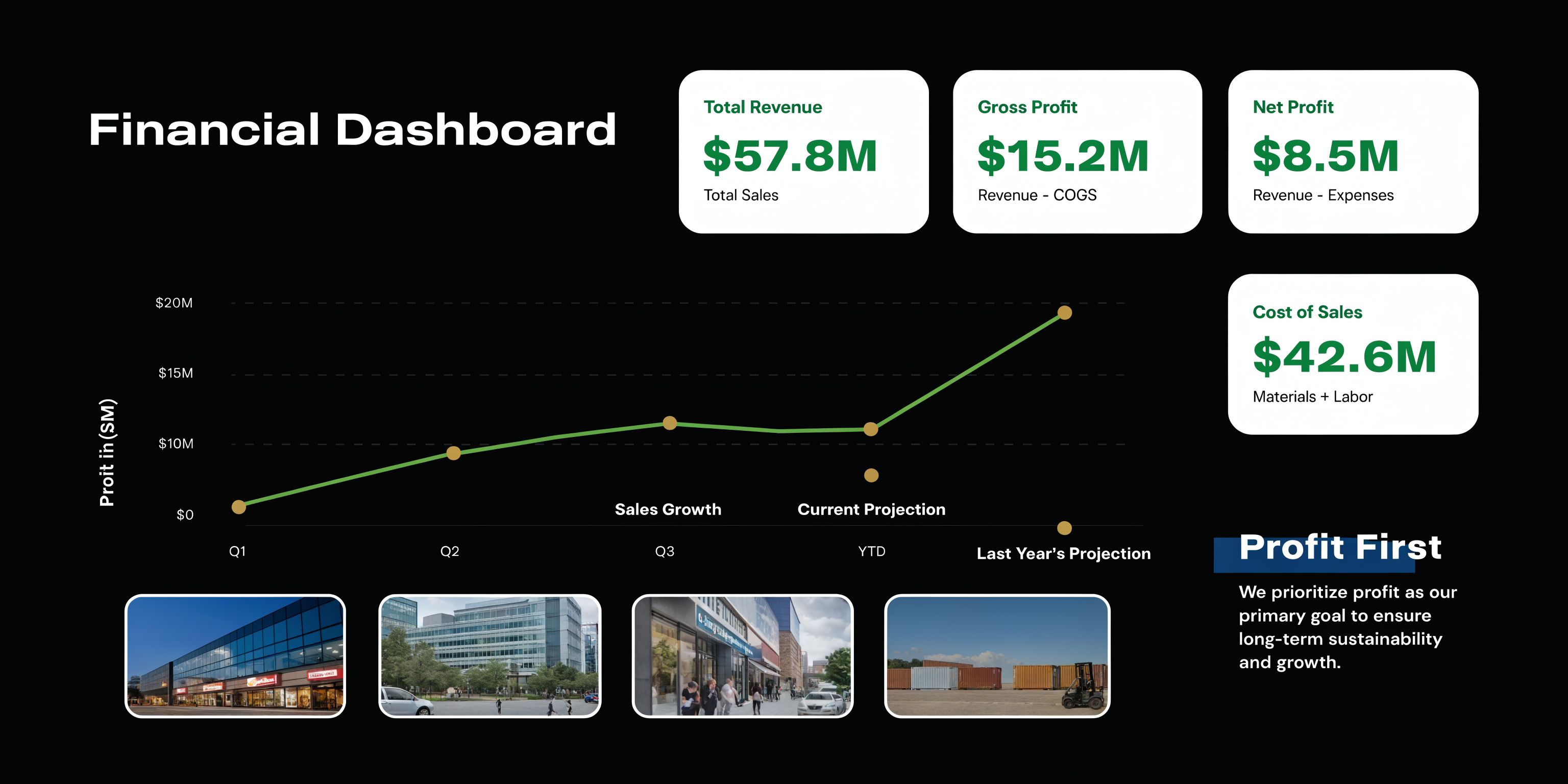
A lot of ad accounts look healthy until you map performance back to margin. At that point, the usual reporting stack falls apart. ROAS tells you whether revenue came back against spend. It doesn't tell you whether the sale was worth chasing.
The more SKUs you carry, the less useful a single blended efficiency metric becomes.
Use the revenue equation as an operating model
The cleanest way to reset how you judge performance is the Ecommerce Equation:
Revenue = traffic × conversion × price × availability
Pattern's write-up on e-commerce growth strategy makes the key point clearly. Brands that optimize across all four variables, rather than chasing just one, report 15% to 22% conversion rate improvements. The same source also frames the risk of over-focusing on traffic while neglecting the rest of the system. See Pattern's explanation of the ecommerce equation and its impact on growth.
For operators, the practical takeaway is straightforward:
Variable | What the growth team controls | Where teams go wrong |
|---|---|---|
Traffic | Prospecting, audience quality, creative reach | They overvalue volume |
Conversion | Retargeting, PDP relevance, offer sequencing | They lump all visitors together |
Price | Margin protection, promotion discipline, product mix | They scale low-contribution SKUs |
Availability | Feed health, inventory sync, in-stock routing | They advertise products they can't support |
Many ad accounts are heavily optimized for only the first row.
ROAS can point you in the wrong direction
A high-ROAS product isn't automatically a scale product. It may be underpriced, overly discounted, expensive to fulfill, or carrying weak contribution after costs. Meanwhile, a lower-ROAS product can be more valuable if its economics are healthier.
That distinction is why mature teams move from ROAS-only reporting toward profit-aware decision making. Some call that POAS. Others monitor contribution margin by SKU, campaign, and customer segment. The label matters less than the behavior.
What matters is this: the budget should follow profitable inventory, not just platform-favored inventory.
Practical rule: If a metric can rise while cash generation gets worse, it cannot be your primary KPI.
A good working dashboard includes:
Contribution margin by SKU: Which products create room to scale.
Profit-aware ad efficiency: Whether spend is buying useful revenue.
SKU concentration: Whether too much budget is being pulled into too few items.
Inventory-adjusted readiness: Whether your likely winners are in stock and feed-approved.
If your team still reports performance as one account-wide ROAS line and one spend line, you're missing the operating detail needed for a real e-commerce growth strategy.
The KPI stack should match business reality
The shift isn't about abandoning growth. It's about building a hierarchy of metrics.
At the top, track business outcomes. Under that, track campaign efficiency. Under that, track product-level diagnostics. That order matters because it prevents the media team from optimizing for a number that finance doesn't trust.
If you're sorting out that distinction internally, this breakdown of ROI vs ROAS is a useful starting point for aligning marketing and finance around the right definitions.
A practical KPI stack looks like this:
Business health first Revenue matters. Profit matters more.
Channel efficiency second Paid social should justify its role without hiding behind blended performance.
SKU-level signals third Here, you catch product mix problems before they become margin problems.
When teams make that switch, campaign decisions get clearer. You stop asking which ad looks cheapest to scale. You start asking which product deserves the next dollar.
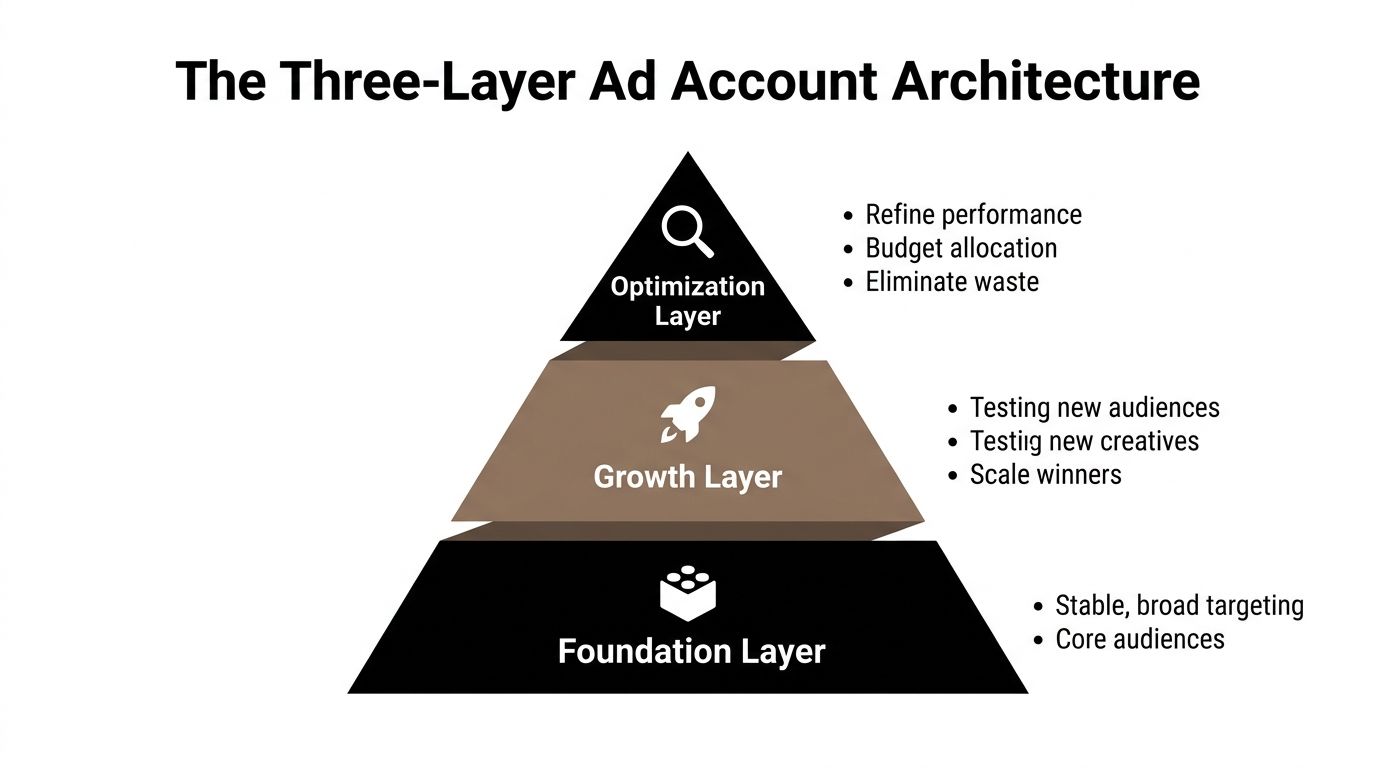
The Three-Layer Ad Account Architecture
Many Meta accounts get messy because every campaign is trying to do every job at once. Prospecting is mixed with remarketing. Broad audiences are fed the full catalog. Existing customers get the same product set as first-time visitors. Then the team wonders why performance is volatile.
A durable e-commerce growth strategy needs separation of roles. The cleanest version is a three-layer architecture.
Start with the structure visually.
Prospecting should sell proven products
Cold traffic is expensive because you're paying to create demand and qualify it at the same time. That's why prospecting shouldn't carry your whole catalog. It should carry your Hero products, or the products you've already seen win with broad audiences.
The budget split many operators use is 50% to 60% for prospecting, based on the campaign architecture outlined in the verified guidance above. This layer exists to bring in new customers with your strongest, clearest offer.
That means:
Keep product sets narrow: Don't let unproven SKUs ride on the back of a winner.
Use broad or Advantage+ style targeting carefully: Broad works better when the catalog itself is curated.
Protect against overlap: If the same item appears in multiple cold campaigns, you create self-competition and muddied learning.
Prospecting is not where you "give every product a chance." That's a merchandising fantasy, not a paid media strategy.
Retargeting should respond to intent, not just existence
Retargeting has a different job. It converts interest that already exists. The audience is smaller, warmer, and more behaviorally distinct.
The verified framework calls for 25% to 30% of budget in retargeting, with segmentation by recency and intent. Someone who viewed a product recently isn't in the same state as someone who added to cart and went inactive. Treating both users the same flattens conversion potential.
Useful retargeting splits include:
Audience type | Best use |
|---|---|
Recent product viewers | Relevance, reminder, low-friction return |
Cart abandoners | Stronger urgency, objection handling |
Checkout initiators | Minimal friction, trust reinforcement |
Category viewers | Broader product set, merchandising logic |
The important part isn't just the audience. It's matching the right products back to that audience.
Later in the cycle, a dynamic ad should show what the shopper viewed, adjacent products, or a tightly related set. It shouldn't dump a random slice of the catalog because the feed lacks structure.
A useful reference for cleaning up this side of the account is this guide on how to scale Facebook ads, especially if your current setup keeps blending new-customer acquisition and remarketing logic.
Here's a short walkthrough that aligns with the architecture:
Retention should monetize the catalog you already sold
Many teams underbuild the third layer. They work hard to acquire the customer, then rely on email alone to drive the second purchase. That leaves paid social underused.
The verified guidance assigns 10% to 15% of budget to cross-sell and retention. Purchase-history logic matters here. One cited example shows that cross-selling to buyers of Product A who haven't bought a complementary Product B can drive a 22% conversion uplift compared with undifferentiated targeting, according to GSM Growth Agency's segmentation example.
This layer works when it is specific. Not generic.
A buyer is easiest to convert when you know what they already own, what they skipped, and what should logically come next.
For retention, build around product relationships:
Complementary use: A routine, bundle extension, or add-on.
Replenishment behavior: Consumables, refills, repeat-need items.
Post-purchase sequencing: Entry product first, premium product next.
The trade-off many teams miss
A three-layer account gives up some simplicity. It takes more feed management, more exclusions, and more reporting discipline. But that's the point. Simplicity at the campaign level creates waste at the business level.
When each layer has one job, budget allocation gets easier, audience overlap drops, and product strategy becomes visible. That's what lets an e-commerce growth strategy scale predictably instead of lurching between short bursts of performance and long stretches of cleanup.
Automating SKU-Level Product Intelligence
Your catalog needs a decision system. Without one, campaign structure doesn't matter much because the wrong products still slip into the wrong places.
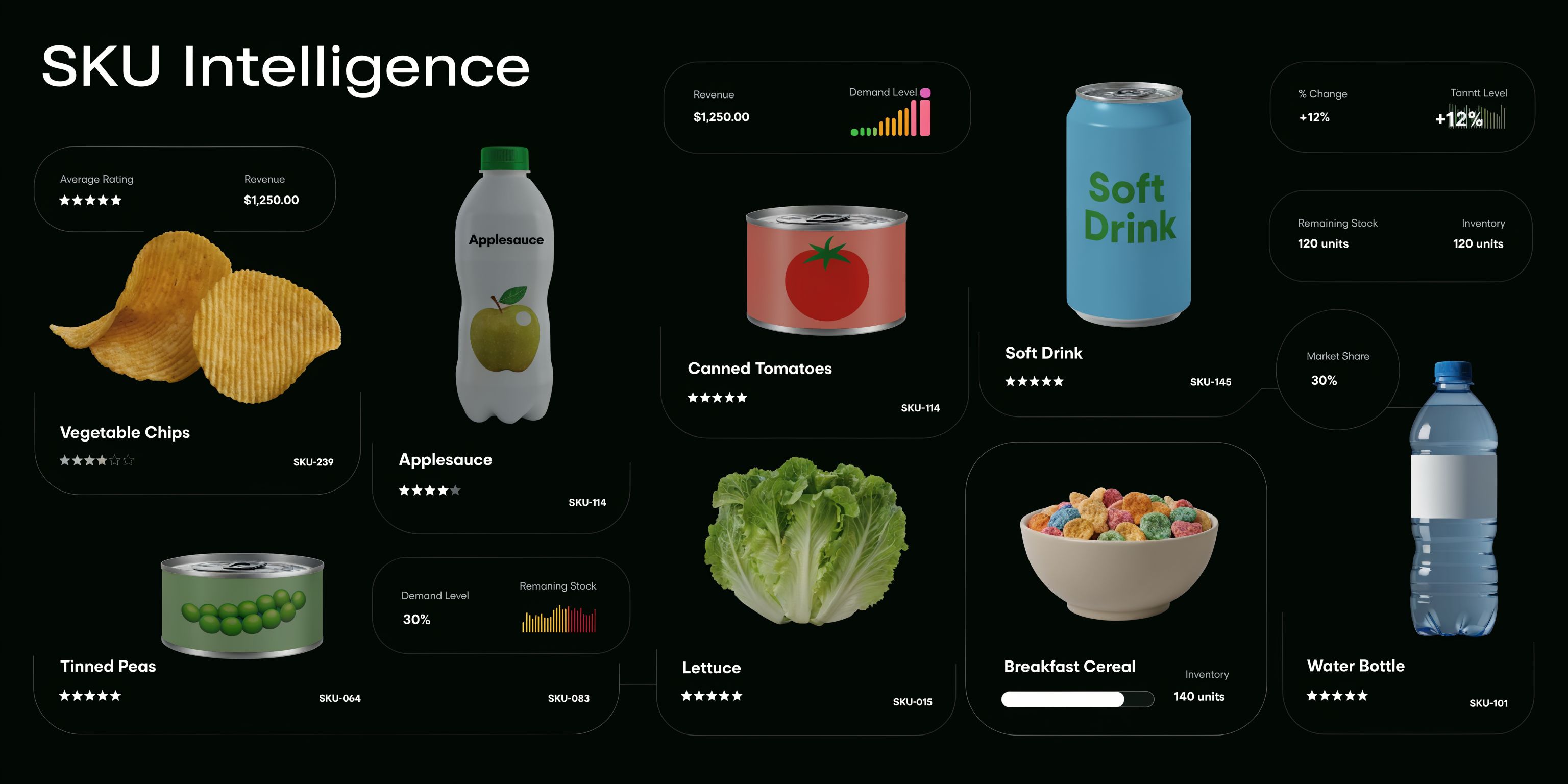
The operational answer is to turn the catalog into a tagged portfolio. Every SKU should have a current role based on performance, margin, and readiness.
The tiering model that helps media buying
For many Shopify brands with more than a small catalog, a five-part model is practical:
Tier | What it means | Where it should show |
|---|---|---|
Heroes | Proven products with stable demand and healthy economics | Prospecting, retargeting |
Potentials | Strong interest signals, weak or incomplete conversion proof | Controlled testing |
New Launches | Products that need forced exposure to gather signal | Isolated launch campaigns |
Long Tail | Niche items with limited but valid demand | Low-budget discovery, retention |
Dead | Products that consume spend without business value | Exclude from paid traffic |
Many brands improve fast here. Not because they found a secret audience, but because they stopped treating every SKU as equally eligible for spend.
Margin data has to sit inside the ad decision
One of the most useful verified points in the source material is also the one many teams ignore operationally. For Shopify brands with more than 20 SKUs, many brands waste up to 90% of ad spend on low-margin products because standard algorithms chase cheap clicks, not profit. The recommended correction is to integrate Shopify margin data into Meta custom labels for dynamic product tiering, as noted in this margin-aware optimization guidance.
That should change how you build the feed.
Don't just tag products by category or season. Tag them by business value.
A practical custom-label system includes:
Performance tier: Hero, Potential, New Launch, Long Tail, Dead
Margin band: High, medium, low
Inventory state: In stock, constrained, do not push
Merchandising role: Acquisition, retargeting, retention
Creative status: Fresh, aging, rotate
Once those labels exist, product sets become much easier to manage. You can build campaigns around combinations that make sense, instead of one broad "all products" bucket.
Automation beats weekly cleanup
Manual tagging breaks as soon as catalog movement speeds up. Prices change. Inventory changes. Creative fatigue appears. A product that was a Hero last month might now be saturated, out of stock, or no longer worth acquisition.
That's why teams increasingly need an intelligence layer between Shopify and Meta. Tools such as SpendOwlAI connect store data with Commerce Manager, scan product-level signals like ROAS, CTR, purchase volume, and margin, and push updated product labels into Meta custom labels automatically. The point isn't reporting. The point is keeping campaign inputs current.
If you're building internal reporting around this process, these examples of data analytics dashboards are useful for deciding what operators should see every day.
Products don't become scale candidates because they're in the feed. They become scale candidates because the business has enough evidence to trust them.
What to automate first
If the current setup is still mostly manual, automate in this order:
Dead product exclusion Remove products that are spending without contributing.
Hero product tagging Protect your cold traffic from catalog sprawl.
Margin-aware labels Give the platform a way to distinguish profitable from merely clickable.
Inventory gating Stop routing paid demand to weak availability.
Creative rotation flags Pair product status with ad freshness.
A key advantage of SKU-level intelligence isn't that it makes the account look organized. It changes where money goes. That's the core of a profit-first e-commerce growth strategy.
Setting Your Operational Cadence and Guardrails
A strong strategy still falls apart if the team runs the account by impulse. Daily reactions create noise. Slow reactions create waste. What works is a cadence with clear thresholds, ownership, and restraint.
That matters more in a mature market. U.S. e-commerce growth slowed to 5.4% in 2025, one of the lowest rates since the Great Recession, according to Digital Commerce 360's U.S. e-commerce sales analysis. In that environment, disciplined execution matters more than broad expansion.

The daily operating rhythm
The daily review should be short and specific. This isn't the time for strategic debate. It's the time to catch breakage, overspend, and obvious misallocation.
A good daily check includes:
Feed health: Are products approved, syncing, and available?
Budget pacing: Are prospecting, retargeting, and retention spending in line with plan?
Product concentration: Is one SKU or a tiny cluster pulling too much spend?
Dead spend: Are any products or creatives consuming budget without meaningful downstream value?
Creative fatigue signals: Is click-through behavior falling on core ads?
Keep this review operational. The question is not "How did we do?" The question is "What needs intervention today?"
The weekly review is where real decisions happen
Weekly review is for changes in direction. During this review, the growth lead, media buyer, and operator should decide what to scale, what to pause, and what to retest.
Use a simple structure.
What to scale
Keep these conditions tight:
Stable product economics: The SKU is still worth pushing after margin and fulfillment reality.
Catalog fit: The product belongs in the layer where it is winning.
Inventory support: The store can absorb more demand without creating service issues.
What to cut
Be faster here than many teams are comfortable with.
Products with spend but no strategic role: Remove them.
Creative that has aged out: Replace or rotate.
Audience segments with vague intent: Consolidate or sharpen the logic.
What to test
Testing should answer one variable at a time. If you change product set, audience, creative, and offer at once, you won't learn anything useful.
A clean weekly test queue includes one item from each area:
Area | Example of a useful test |
|---|---|
Product mix | Swap one Potential SKU into a controlled product set |
Audience logic | Split recent viewers from older site visitors |
Creative format | Change overlay treatment or catalog card presentation |
Offer sequencing | Adjust message intensity by intent stage |
Guardrails that protect profit
Guardrails matter because ad platforms reward action. Operators feel productive when they make changes. That doesn't mean the changes are good.
Operating principle: Fewer decisions, made on better inputs, beat constant optimization.
Some guardrails worth formalizing:
Don't scale because of one good day Short-term spikes come from audience timing, attribution lag, or a single SKU surge.
Don't judge prospecting by the same lens as retention Their jobs are different. Their acceptable economics can be different too.
Don't let creative and product decisions drift apart A strong SKU with stale creative will look weaker than it is. A fresh creative can temporarily flatter a weak product.
Don't wait for the weekly report to remove obvious waste If a product is draining budget and doesn't fit the plan, pull it sooner.
Creative rotation should follow signals, not a calendar
Some teams rotate creative too late. Others rotate too often and reset learning. The better rule is to rotate when the ad's behavior changes in a way that matters.
Watch for patterns like:
Falling click-through on Hero products
Higher spend concentration with weaker downstream quality
Retargeting ads that stop pulling users back efficiently
Catalog cards that blur together across too many products
Creative fatigue isn't only a design problem. It's a merchandising problem. If the same few products carry all exposure for too long, the audience doesn't just tire of the ad. It tires of the product.
Operational cadence fixes that. It keeps the team from overreacting to noise while still moving fast enough to protect budget.
Building Your E-commerce Growth Operations Stack
At a certain catalog size, spreadsheets stop being a management system. They become a delay mechanism. By the time someone exports performance, merges store data, checks feed status, and updates product sets, the account is already working off stale inputs.
A modern e-commerce growth strategy needs a connected stack. Not a bloated one. A connected one.
The core systems that need to talk to each other
For many Shopify brands running Meta seriously, the stack has four parts.
Store data layer
Shopify holds the operational truth for products. Margin inputs, inventory state, product relationships, bundle logic, and purchase history all start here. If that data is incomplete or inconsistent, the rest of the system gets weaker fast.
Advertising delivery layer
Meta Commerce Manager and the ad account are where product sets, dynamic ads, audience logic, and campaign budgets get activated. This layer is powerful, but it only works as well as the product feed and custom labels feeding into it.
Tracking layer
Pixel and CAPI health determine whether the platform can match user behavior back to real events. If purchase, cart, and product-view signals are delayed or inconsistent, optimization degrades. Retargeting quality degrades too.
Intelligence layer
Teams lack this piece. It sits between the store and the ad platform, reads product-level performance, applies rules, updates labels, flags waste, and keeps the catalog segmented in a way the ad platform can act on.
Manual management breaks first in the same places
When teams try to run this with manual workflows, the failure points show up:
Feed issues go unnoticed Disapprovals, sync errors, and out-of-stock products keep spending against bad inputs.
Product sets get stale Last month's Hero products keep absorbing spend long after conditions changed.
Audience and catalog logic drift apart The campaign says one thing. The product feed serves another.
Cross-sell never matures Teams know complementary product paths exist, but nobody operationalizes them consistently.
Exclusions happen too slowly Waste gets spotted in reporting after it has already accumulated.
The more SKUs you carry, the more expensive these delays become.
What the stack should make possible
The goal isn't more dashboards. It's better decisions pushed directly into campaign infrastructure.
A functioning stack should let your team:
Tag products by role and profitability
Build Meta product sets from those tags
Sync purchase history into retention and cross-sell logic
Monitor feed, pixel, and CAPI health continuously
Exclude weak products without waiting for a weekly cleanup
Rotate product exposure as performance changes
That's when the business starts acting like an operator-led brand instead of a brand that's renting its decisions from the ad platform.
The big shift is simple. Growth stops being a media-buying exercise and becomes a systems exercise. That's the level where a multi-SKU brand can scale revenue without losing control of profit.
If your team runs Shopify and Meta with a catalog that’s getting harder to manage, SpendOwlAI is built for that operating gap. It connects Shopify product data with Meta Commerce Manager, auto-tags products into performance tiers, pushes those labels into catalog campaigns, and helps teams manage what products should be shown, to whom, and when to rotate them.