A Practical Guide to E Commerce Automation
Imagine hiring an expert co-pilot for your brand—one who works around the clock, handling all the tedious but necessary tasks, crunching the numbers, and flagging opportunities you might otherwise miss. That’s what e-commerce automation really is. It’s not about replacing your team’s strategic thinking; it’s about giving them superpowers.
What E-Commerce Automation Really Means
At its heart, e-commerce automation is all about using smart software to take over the repetitive, manual jobs required to run an online store. Think of it like creating a detailed playbook that tells different parts of your business what to do and when, without you having to be there every second. This goes way beyond basic "if this, then that" rules, like sending a generic abandoned cart email.
True automation today acts as an intelligent operating system for your entire brand. It links together all your different tools—from Meta Ads to your inventory system—and gets them talking to each other. This creates a connected ecosystem where a dip in stock can automatically adjust your ad spend, or a spike in customer service tickets can trigger a review of a specific product page.
Moving Beyond Basic Task Management
The real magic happens when automation stops being a simple task-doer and starts acting as a strategic advisor. Instead of just following orders, it digs into complex data to give you insights you can actually use. This gets your team out of the weeds of manual data checks and reactive campaign fixes, freeing them up to focus on what really moves the needle: creative strategy and long-term growth.
For example, a basic rule might be to just pause an ad if its return on ad spend (ROAS) drops below 2x. An intelligent automation system, on the other hand, would look at the bigger picture before telling you what to do:
Is this ROAS drop a one-off bad day, or is it a worrying trend?
Are people getting tired of seeing the same ad creative?
Have we shown this ad to our target audience too many times?
By weighing all these factors, the system might suggest refreshing your creative instead of just pulling the plug, preventing you from killing a potentially great ad too early. This jump from blind action to informed advice is what separates good automation from great automation.
This is the daily reality for so many operators—a constant cycle of manual checks and reactive decisions. Let's compare that grind to a more automated, strategic workflow.
Manual Operations vs Automated E-Commerce Workflows
Operational Area | The Manual Grind (The Problem) | The Automated Advantage (The Solution) |
|---|---|---|
Ad Campaign Management | Waking up to find an ad blew through its budget overnight. Manually checking ROAS on dozens of campaigns every few hours. | Automated guardrails pause underperforming ads instantly. Budgets are reallocated to winning campaigns based on real-time performance data. |
Inventory & Fulfillment | A product sells out, but the ads keep running, wasting money and frustrating customers. You only discover the issue after seeing angry comments. | Low stock levels automatically trigger an alert and can pause corresponding ad campaigns, preventing wasted spend and protecting the customer experience. |
Customer Communication | Sending the same generic "You left something in your cart!" email to every single customer, regardless of their purchase history or the products they viewed. | Smart email flows send personalized messages based on customer behavior, like offering a specific discount on the exact product a high-value customer abandoned. |
Reporting & Analysis | Spending hours every Monday pulling data from five different platforms into a spreadsheet just to figure out what worked last week. | A unified dashboard automatically pulls and visualizes key metrics. You get actionable insights delivered to your inbox, ready for your team meeting. |
As you can see, the difference isn't just about saving time. It's about shifting from a reactive, often chaotic process to a proactive, data-driven operation.
An Engine for Profitable Scaling
This ability to make smarter, faster decisions is why the market is exploding. The global e-commerce automation market was valued at USD 10.5 billion in 2024 and is expected to hit USD 28.5 billion by 2032. This growth is fueled by smarter AI and the simple fact that brands need to be more efficient to survive. If you want to dive deeper into the market trends, Future Data Stats offers some great insights.
In the end, automation isn’t just a tech tool; it’s the leverage that modern DTC brands need to scale without breaking the bank. It cuts down on human error, keeps your execution consistent, and gives you the analytical firepower to compete in an incredibly noisy market.
By handing off the repetitive work to machines, you let your human experts focus on what they do best: being creative, thinking big, and building real connections with customers. That’s how you turn data into decisions and decisions into sustainable growth.
The Four Pillars of E‑commerce Automation
Effective e‑commerce automation isn't a single magic button you can press. It's more like a solid foundation for a house, built on four distinct pillars that work together to support real, scalable growth. If you skip a pillar, the whole structure gets wobbly.
By breaking it down into these four core areas, you can stop guessing and start creating a clear roadmap. This helps you figure out where automation will give you the biggest bang for your buck, moving you from random acts of automation to a smart, deliberate system.
The whole point is to let automation handle the repetitive tasks and data crunching, which frees up you and your team to focus on the high-level strategy that actually grows the business.
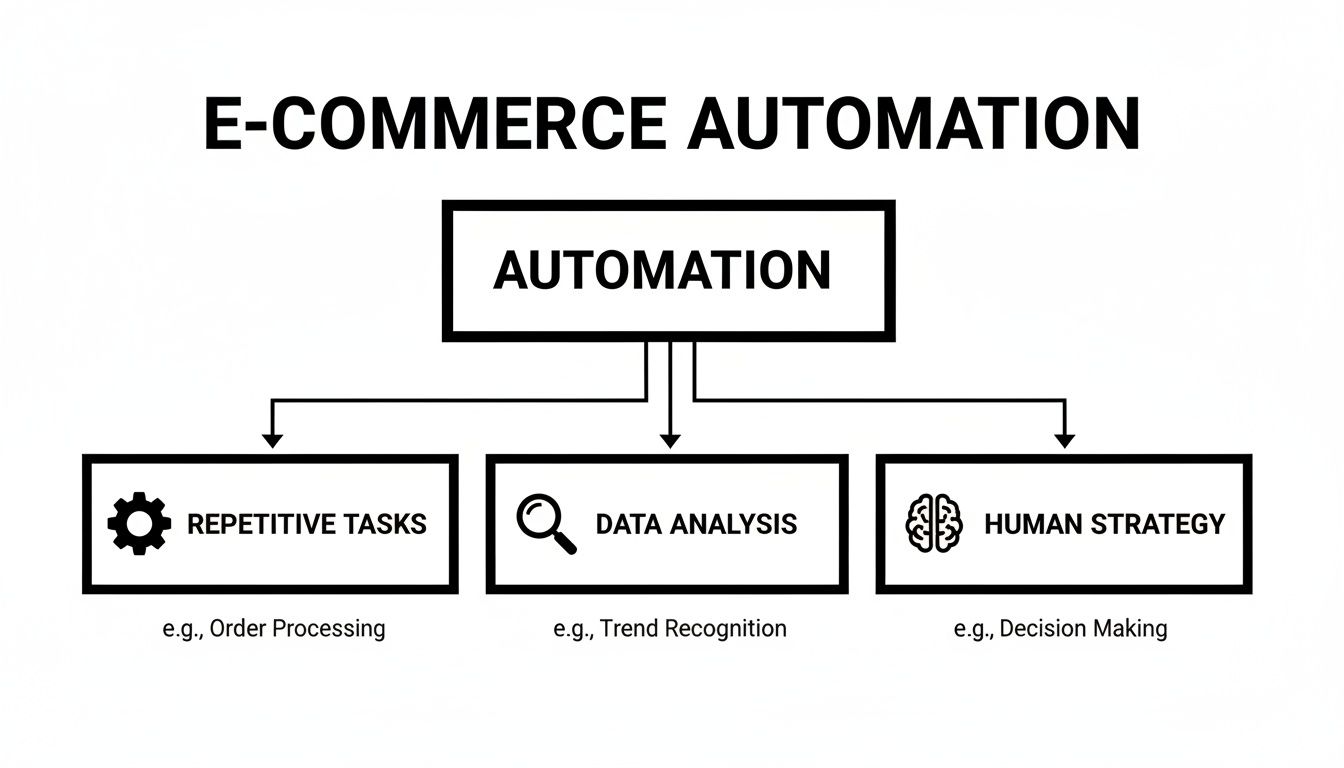
Automation isn’t about replacing people. It’s about elevating them by taking over the manual grunt work that bogs everyone down.
1. Marketing and Ad Execution
This is where most brands dip their toes into automation first, and for good reason. Juggling paid media campaigns is a chaotic mix of budget-watching, creative testing, and endless tweaking. It’s a perfect storm for human error and burnout.
Think of automation here as a vigilant co-pilot for your ad accounts. Instead of you manually checking dozens of campaigns every few hours, an automated system is on guard 24/7. It can spot an ad suffering from creative fatigue long before it torches your budget or suggest shifting spend from a dud ad set to a proven winner.
For example, a tool like SpendOwlAI can monitor your Meta and Google campaigns and serve up prioritized, actionable insights daily. You might get an alert that says, "Ad Set A has held a 3.5x ROAS for 72 hours with low audience saturation. Consider bumping its budget by 15%." Suddenly, you’re making moves based on data, not just gut feelings.
2. Inventory and Fulfillment
So your marketing is firing on all cylinders and sales are pouring in. Awesome! But it’s all for nothing if you don't have the products to ship. This second pillar is the crucial link between your front-end advertising and your back-end operations, ensuring a smooth journey from a customer's click to the package on their doorstep.
This is where automation prevents the classic e-commerce nightmare: spending good money to advertise a product that’s out of stock. A smart system can automatically hit pause on ad campaigns for specific SKUs the second inventory drops below a set level. This simple move instantly stops wasted ad spend and saves you from a flood of angry customer emails.
But it goes deeper than that:
Automated Reorder Points: Systems can trigger new purchase orders with your suppliers when stock gets low, preventing you from running out of your bestsellers during a big sale.
Intelligent Order Routing: If you have multiple warehouses, automation can send an order to the fulfillment center closest to the customer. That means cheaper, faster shipping and happier customers.
By connecting your inventory data directly to your marketing, you build a resilient and efficient loop that protects both your budget and your brand’s reputation.
3. Customer Experience and CRM
The third pillar is all about automating the little interactions that build loyal customers. It’s about delivering personalized, timely messages at a scale that would be completely impossible to manage by hand.
This is where your email and SMS marketing workflows truly come to life. Forget sending one generic "You left something behind!" email. With automation, you can build sophisticated sequences. A loyal customer who abandons a cart worth over $200 could get a completely different, more compelling offer than a first-time visitor who just left a single, low-cost item.
Other key automations in this pillar include:
Personalized Product Recommendations: Sending a follow-up email after a purchase that suggests products that genuinely complement what they just bought.
Smart Chatbot Responses: Programming a chatbot to instantly handle common questions like "Where is my order?", freeing up your human support team for the tricky, high-touch issues.
There's a reason the marketing automation market is projected to hit $20.12 billion by 2034. According to this detailed marketing automation report, businesses see an average return of $5.44 for every dollar spent, and automated campaigns can see click rates up to 332% higher. The numbers speak for themselves.
4. Reporting and Analytics
This final pillar is arguably the most important for making smart, strategic decisions. It automates the painful process of gathering, organizing, and actually understanding your data, so you can stop drowning in spreadsheets and start taking action.
Instead of manually pulling reports from Shopify, Google Analytics, your ad platforms, and everywhere else, an automated system brings it all together into one clean, easy-to-read dashboard. It doesn't just show you numbers; it delivers insights.
Imagine getting a daily email digest that highlights your top-performing products by ROAS, shows you which ad creative is driving the most sales, and flags any weird dips in your site-wide conversion rate. This transforms data from something you look at retroactively into a powerful tool that helps you plan your next move, ensuring your team starts every day focused on what really matters.
Automating Ad Execution with Confidence and Control

Running paid media can often feel like you're trying to fly a plane in a hurricane. You're surrounded by a storm of conflicting data and under constant pressure to deliver results. It's no wonder so many marketers fall into the trap of making reactive, gut-driven decisions that end up doing more harm than good.
This is exactly where smart e-commerce automation steps in to act as your trusted co-pilot, bringing some much-needed calm to the cockpit.
The idea isn’t to hand over the keys to some mysterious "black box" AI and just hope for the best. It's about using technology to get transparent, data-backed recommendations you can actually understand, question, and act on with confidence.
Introducing Automation Guardrails
Think of automation guardrails as a sophisticated safety net for your ad accounts. Their main job is to stop you from making those common, often costly, mistakes we’ve all made. Every performance marketer knows that itch to constantly tweak campaigns, a nervous habit that almost always resets the ad platform's learning phase and tanks performance.
These guardrails are designed to watch for those exact patterns. They keep an eye on how often you're editing campaigns, how volatile your key metrics are, and whether the platform’s learning algorithm is stable. By flagging these risks, they help you pull back on the reins and prevent you from over-editing your way into a slump.
Anyone who has managed campaigns on Meta or Google knows how easy it is to make a small mistake that costs big money. Below is a quick look at some classic blunders and how a good set of automation guardrails can prevent them.
Common Ad Management Mistakes Solved by Automation Guardrails
Common Operator Mistake | The Negative Impact | How Automation Guardrails Help |
|---|---|---|
Reactive Over-Editing | Constantly tweaking bids or budgets based on hourly data resets the ad platform's learning phase, creating instability and poor results. | The system flags excessive edits and advises restraint, allowing campaigns enough time to stabilize and optimize effectively. |
Premature Scaling | Ramping up the budget on a campaign after just one good day, only to see performance collapse as the new spend fails to convert. | Guardrails analyze performance over a sustained period (e.g., 72 hours) and check for audience saturation before recommending a budget increase. |
Ignoring Creative Fatigue | Running the same ad creative for too long, causing performance to slowly decline as your audience tunes it out. | The system monitors frequency and click-through rates, sending an alert when an ad is showing signs of fatigue and needs to be refreshed. |
Context Blindness | Pausing a campaign with a low ROAS without realizing it's a top-of-funnel ad driving valuable new traffic that converts later. | Automation connects ad performance to your overall funnel, helping you understand the true value of each campaign beyond a single metric. |
This shift from just staring at raw data to getting guided actions is a game-changer. It transforms a chaotic process into a structured, repeatable workflow that actually drives results.
Imagine getting a clear, ranked list of actions every morning. Instead of a messy dashboard, the system might highlight one ad set for a budget increase, flag another for creative fatigue, and recommend leaving three others completely untouched to protect their performance. This is automation that builds confidence, not confusion.
From Data Overload to Prioritized Actions
The real magic here is explainability. A good automation platform doesn't just tell you what to do; it shows you why.
Let's say the system suggests you increase the budget on a specific Meta ad set. It won't just be a blind command. It will lay out the evidence in plain English:
Sustained ROAS: "This ad set has held a 3.8x ROAS for the past four days, which is well above your account average."
Low Ad Fatigue: "The creative's frequency is still low, so the audience isn't tired of seeing it yet."
Stable Learning: "This campaign has been out of the learning phase for over a week, so a budget change is unlikely to cause instability."
This kind of transparency is empowering. You’re no longer just following orders from a machine; you’re making a strategic call backed by clear, defensible data. This is especially crucial for agencies and in-house teams who need to justify their decisions to clients or leadership. Of course, none of this works without accurate data, which is why a solid setup using tools like the Meta Conversions API is a non-negotiable foundation.
Ultimately, this type of e-commerce automation helps you execute with precision, cut down on wasted spend, and free up your time to focus on what really matters: strategy, creative, and growing the business. It’s all about making fewer, but much better, decisions every single day.
Streamlining Inventory and Fulfillment Operations

A killer marketing campaign can feel like rocket fuel, but all that momentum means nothing if your back-end operations can't handle the heat. The most brilliant ad strategy will quickly turn into a customer service nightmare if you’re driving sales for products you can't actually ship.
This is where the physical side of e-commerce automation becomes so critical. It’s about moving beyond ad spend to create a well-oiled machine for inventory and fulfillment.
This is the operational pillar where brands either scale successfully or collapse under their own weight. Stockouts kill momentum and send eager buyers straight to your competitors, while overstocking ties up precious capital in products just collecting dust. Automation builds an intelligent supply chain that anticipates these challenges, creating a vital link between your marketing efforts and the reality on your warehouse floor.
Preventing Stockouts and Wasted Ad Spend
Let's be honest: spending money to advertise a product that’s out of stock is one of the most frustrating ways to burn cash. It’s a direct hit to your marketing budget and a surefire way to annoy potential customers. Automation offers a simple, powerful fix.
By connecting your inventory management system directly to your ad platforms, an automated workflow can spring into action the moment stock levels get too low. When a product hits a certain threshold, the system can instantly:
Pause Ad Campaigns: It immediately stops all ads for that specific SKU, preventing any more wasted spend.
Trigger Alerts: A notification is sent straight to your ops team, flagging the low stock so they can act.
Generate Purchase Orders: For fast-moving items, it can even draft a PO to your supplier to get the restocking process started.
This straightforward connection ensures your marketing dollars are always pushing products that customers can actually buy.
Intelligent Order Routing and Fulfillment
As you grow, fulfillment gets complicated. Juggling orders across multiple warehouses or working with a third-party logistics (3PL) partner adds a lot of moving parts. Automation helps untangle this web, making your fulfillment faster and cheaper.
Instead of someone manually assigning orders, an automated system can intelligently route them based on a set of rules you define. A common one is routing an order to the fulfillment center closest to the customer’s shipping address. This single move can dramatically cut down on shipping times and costs, leading to happier customers and healthier margins.
By transforming fulfillment from a manual checklist into an automated decision-making process, you ensure that every order is processed in the most efficient way possible, every single time. That consistency is the key to scaling without a drop in quality.
The Rise of Warehouse Automation
Automation’s impact goes even deeper—right into the warehouse itself. We're seeing a fundamental shift in fulfillment, with projections showing nearly 4.7 million warehouse robots will be installed globally by 2026.
And the results are compelling. Companies embracing this tech are seeing 25-30% reductions in labor costs and are fulfilling orders up to 300% faster, with accuracy rates hitting nearly 99%. You can dig into more of the data on how automation is reshaping warehouses on SellersCommerce.
This isn't just for giants like Amazon anymore. Autonomous mobile robots (AMRs) offer great economics for growing brands, often paying for themselves in under two years. While you may not be ready for a fleet of robots today, this trend highlights the immense leverage automation provides. From simple inventory syncs to advanced robotics, the goal is always the same: building a faster, more accurate, and more resilient supply chain that can truly support your growth.
Your Practical Roadmap for Implementing Automation
Diving into e-commerce automation can feel like trying to boil the ocean. You know you should be doing it, but with a sea of tools and potential workflows, it's easy to get stuck in analysis paralysis. The secret isn't to automate everything at once. A clear, phased roadmap takes the guesswork out of the equation.
The smartest brands don't try to change everything overnight. They pick a single, high-impact problem, prove the value of solving it, and then thoughtfully expand from there. This approach minimizes risk, builds confidence within your team, and guarantees that every layer of automation you add actually makes a difference.
Phase 1: Identify Your Biggest Bottlenecks
Before you even glance at a new software platform, you have to find the pain. Where is your team sinking the most time into repetitive, low-value tasks? The goal here is to pinpoint the friction that’s quietly draining your time, money, and morale.
Take a good, hard look at your daily workflows. A great place to start is anywhere you see people manually shuffling data between systems.
Manual Ad Management: Is someone on your team glued to their screen, tweaking ad budgets every hour and manually pausing underperformers? This is often the lowest-hanging fruit.
Inventory and Ad Syncing: How many times have you wasted ad spend promoting a product that just went out of stock? Trying to keep campaigns updated with real-time inventory levels is a classic—and costly—bottleneck.
Repetitive Reporting: Does someone’s Monday morning disappear into the black hole of pulling numbers from Shopify, Google Ads, and Meta just to build a single spreadsheet? That's a perfect job for a machine.
By focusing on these time-sucks first, you ensure your initial automation project solves a real, expensive problem.
Phase 2: Choose the Right Tools Wisely
Once you know the problem, you can find the right tool. Resist the temptation of shiny all-in-one platforms that promise the world. Instead, find a solution that's genuinely good at solving your specific bottleneck and plays nicely with the tools you already use.
The best automation tools don't operate in a black box. They provide clear, explainable insights that empower your team to make better decisions, not just blindly follow commands. Transparency is more valuable than a long list of features.
Look for solutions that show you their work. For instance, a platform like SpendOwlAI doesn’t just tell you to raise a budget; it shows you the data on ROAS stability and ad fatigue that backs up the recommendation. This builds trust and transforms automation from a simple command-follower into a true strategic partner. A solid grasp of how you measure results is also key. You can sharpen your data analysis skills with our guide to marketing attribution software.
Phase 3: Start Small and Iterate
Now it’s time to get your hands dirty. Pick just one workflow from your list of bottlenecks and automate it. Seriously, just one. Don't try to reinvent your entire operation in a week.
For example, your first project could be setting up a simple automated guardrail that instantly pauses any ad campaign spending money on an out-of-stock product. That’s an easy, high-impact win.
Once it's up and running, measure its impact.
Quantify Time Saved: How many hours did this automation give back to your team each week?
Calculate Money Saved: How much ad spend did you rescue from being wasted?
Gather Team Feedback: Does your team feel less buried in manual work and more focused on strategy?
After you’ve proven the value with this first test, you can confidently move on to the next bottleneck. This simple, iterative cycle—identify, automate, measure, expand—is the most reliable way to build a powerful and effective automation engine for your brand.
Frequently Asked Questions About E-commerce Automation
Even with a solid plan, stepping into e-commerce automation always brings up a few big questions. I hear them from DTC founders and marketing teams all the time. They want to know what this really means for their people, their processes, and, of course, their bottom line.
Let's cut through the noise and tackle the most common concerns head-on.
Will Automation Replace My Marketing Team?
Absolutely not. This is probably the biggest misconception out there. The goal of automation is augmentation, not replacement.
Think of it as giving your talented team a set of power tools. Automation takes over the mind-numbing, repetitive tasks that drain their energy—like manually checking campaign performance every hour or pulling the same reports day after day. This frees them up to focus on the high-impact, strategic work that actually moves the needle.
Instead of being stuck in the weeds, your team can finally spend their time on things like:
Dreaming up breakthrough creative concepts that stop the scroll.
Digging into customer research to understand the why behind the data.
Planning long-term growth initiatives and mapping out the big picture.
Automation turns your team from reactive data-checkers into proactive strategists. It helps them make smarter, faster decisions, which ultimately makes them far more valuable to the business.
How Do I Measure The ROI Of Automation?
Calculating the true ROI of automation goes way beyond just looking at top-line revenue. While better performance is the end game, the most immediate returns often come from new efficiencies and massive cost savings.
To get the full picture, you need to look at a few key areas:
Time Reclaimed: This one is easy to quantify. Start by tracking the hours your team gets back each week now that they're not bogged down in manual tasks. Multiply those hours by their loaded cost, and you've got a hard dollar figure.
Reduced Spend Waste: Measure the direct drop in wasted ad spend. This is the money you save by automatically pausing ads on out-of-stock products or catching underperforming campaigns hours—or even days—sooner than a human ever could.
Core Metric Improvement: Of course, you need to track the lift in your main KPIs. This could be a clear increase in ROAS or a welcome decrease in your cost per acquisition (CPA). If you need a refresher on the fundamentals, we have a detailed guide on what ROAS means in digital marketing.
Error Prevention: Don't forget to estimate the cost of human errors that automation now prevents. What’s the real damage from a budget overrun that goes unnoticed for a weekend? Or running out of stock on your hero product during a flash sale?
When you combine these tangible savings with your performance gains, you can build a rock-solid case for the total return on your investment.
What Is The Biggest Mistake To Avoid When Starting?
The single biggest pitfall I see is trying to automate everything all at once. Brands that attempt to roll out a massive, all-encompassing system from day one almost always get tangled in a complex web that creates more problems than it solves. It’s a fast track to team frustration and a failed project.
The best approach? Start small and be ruthless with your focus. Identify the single biggest pain point in your operations—the one thing that causes the most friction and wastes the most time—and solve that problem first.
For many brands, that might be stopping ad spend on out-of-stock items. For others, it’s the endless cycle of manually tweaking campaign budgets. By automating just that one workflow, you prove the value quickly, build your team’s confidence, and create positive momentum. From there, you can start layering on new automations, one proven use case at a time.
How Is Intelligent Automation Different From Basic Rules?
This is a crucial distinction to make. Basic automation works on simple "if-this-then-that" (IFTTT) logic. It follows a rigid, pre-set command without any context. For example, "if a customer abandons their cart, send them this email in exactly one hour." It's a one-trick pony.
Intelligent automation, on the other hand, is dynamic. It’s often powered by AI and can analyze multiple data points at once to make a more nuanced recommendation or take a more calculated action. It’s less of a task-doer and more of a sophisticated decision-support system.
For example, instead of just pausing an ad when its ROAS dips, an intelligent system might suggest a budget increase by considering:
Has the ROAS been stable and profitable for the last 72 hours?
Is the ad creative showing any signs of fatigue?
Is the target audience nearing saturation?
This ability to weigh multiple factors makes its suggestions far more strategic and reliable. It’s the difference between a simple trigger and a thoughtful co-pilot helping you steer the ship.
Ready to replace noisy dashboards with clear, daily actions? SpendOwlAI provides the prioritized insights and guardrails your team needs to execute with confidence. Stop guessing and start making data-backed decisions. Start your free 7-day trial today.