Mastering Creatives Facebook Ads in 2026
For years, Facebook ad success was all about who you were targeting. We spent countless hours buried in Ads Manager, meticulously tweaking interest layers and building lookalike audiences. That era is over. Today, the single biggest lever you can pull for campaign performance is your creative.
Why Your Creative Is the New Targeting
If you're still obsessing over audience settings, you're fighting yesterday's battle. Meta's advertising algorithm has evolved. It’s a sophisticated AI that now prioritizes engaging content above all else. Your ad's creative isn't just one piece of the puzzle anymore; it is the targeting mechanism.
This fundamental shift means the algorithm actively rewards compelling ads with lower costs, better placements, and access to the very users you want to reach. On the flip side, ads that don't immediately resonate are punished. They just don't get shown, no matter how perfectly you think you've defined your target audience.
This playbook is all about giving you a systematic approach to producing winning Facebook ad creatives, turning what often feels like a guessing game into a reliable driver of profitable growth.
The Algorithm's New Priority
Think of Meta’s system as a massive, real-time content filter. Before your ad even gets a chance to compete in the auction, the algorithm makes a snap judgment about its potential to engage people. Ads with what we call "signal-rich" creative—ones that instantly communicate value and spark a reaction—are fast-tracked to the top.
This is a complete reversal from the old way of doing things. You no longer need to spoon-feed Meta an exact audience profile. Instead, your job is to feed the machine a steady diet of high-quality creative inputs and let its AI do the heavy lifting of finding the right people. It's a far more efficient process, but it also places a much greater demand on your creative production.
The bottom line is that your visuals, hooks, and messaging now dictate campaign performance. A systematic, test-driven approach to creative strategy is the only way to scale profitably today.
In the hyper-competitive ad auction, creative isn't just a nice-to-have; it's the primary factor driving 56% of all auction outcomes. Your visuals and copy literally decide if your ad soars or sinks.
The Most Effective Ad Formats
To get a head start, it's helpful to know which formats are currently delivering the best results. I've put together a quick snapshot based on what we're seeing in the field. This isn't a rigid rulebook, but it's a fantastic starting point for planning your first few creative tests.
Facebook Ad Creative Format Performance Snapshot
Creative Format | Typical CTR Lift | Best Use Case |
|---|---|---|
Short-Form Video (Reels/Stories) | +20-30% | Grabbing attention with fast-paced, authentic content. Perfect for UGC and demos. |
Carousel Ads | +10-15% | Showcasing multiple products, features, or telling a sequential story. |
Static Image (High-Impact) | +5-10% | Communicating a single, powerful message or offer. Great for clear value props. |
User-Generated Content (UGC) | +25-40% | Building instant trust and social proof. Highly effective for top-of-funnel. |
Remember, these are benchmarks. The key is to test these formats with your own offers and audiences to see what truly connects. The best performers often combine formats, like using a powerful UGC video followed by a carousel ad for retargeting.
Adapting Your Strategy for 2026
To win in the current environment, you have to pivot. It’s time to move your focus away from granular audience management and toward building a high-velocity creative pipeline. This means abandoning the idea of a single "hero ad" and instead embracing a more diverse and iterative testing process.
Platform-specific nuances are also critical. For instance, knowing the optimal TikTok ad lengths highlights just how much the small details of creative execution matter. What works on one platform won't necessarily work on another.
A robust creative strategy for Facebook should always include:
A mix of formats: Don't just run static images. Test them against carousels and, most importantly, short-form videos designed for Reels and Stories.
Diverse angles and concepts: Cycle through different types of creative. Think user-generated content (UGC), customer testimonials, product demos, and founder-led stories.
Crystal-clear messaging: Your hook is everything. You have less than three seconds to grab someone's attention and communicate your core value proposition. Be direct and bold.
Building Your Creative Strategy From the Ground Up
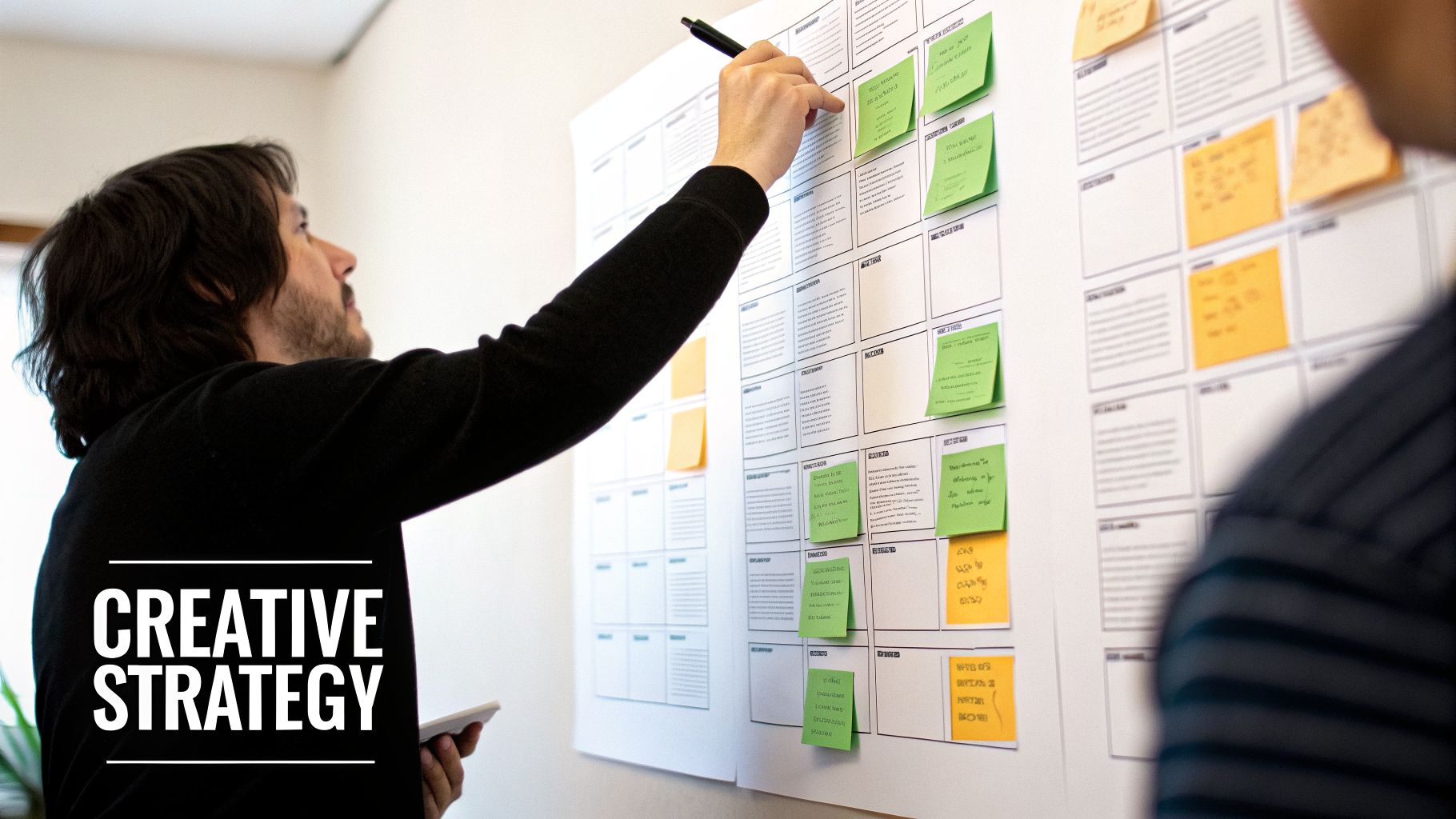
The best creatives for Facebook ads aren't accidents. They’re the result of a deliberate, repeatable system. Think of your ad account less like a lottery and more like a content studio, where you’re consistently producing high-quality assets. This all starts long before you ever touch Ads Manager—it begins with a documented strategy.
Forget about vague brainstorming and hoping for a lucky break. A winning strategy is always built on a “creative hypothesis.” This is just a clear, simple statement about what you think will connect with a specific audience and, most importantly, why. It's not just a cool idea; it’s a testable assumption that links your product directly to a customer's real-world problem.
To get there, you have to move past chasing one-off "hero ads" and start building a high-velocity creative pipeline.
Crafting Your Creative Hypothesis
Every single great ad I've ever launched started with a strong hypothesis. It’s the core idea you're actually testing. To build one yourself, you need to get crystal clear on three things: your product's real value, your customer's deepest pain points, and the emotional hook that ties them together.
A solid creative hypothesis is an informed prediction, not a wild guess. For instance, a skincare brand trying to stand out might hypothesize: "We believe a raw, user-generated video showing a customer's 30-day acne journey will beat our polished studio ad because it delivers authentic social proof that counters our audience's skepticism about "miracle" products."
See how that works? It's specific, you can measure it, and it's tied directly to a business goal. This gives your creative team a sharp brief and gives your ad tests a real purpose. Without it, you’re just making noise.
Mapping Messaging to the Customer Journey
You can't talk to a complete stranger the same way you'd talk to someone who almost bought from you yesterday. It just doesn't work. The most effective creatives for Facebook ads are always tailored to where a person is in their journey with your brand.
Prospecting (Top of Funnel): At this stage, your only job is to stop the scroll and earn a few seconds of attention. You need to lead with broad-appeal hooks that agitate a common problem or offer genuinely helpful content. This is where user-generated content (UGC) absolutely shines because it feels native to the feed and builds trust almost instantly.
Retargeting (Middle/Bottom of Funnel): These folks already know who you are. Now, your creative needs to get them over the finish line. Focus on crushing their objections, showing off more value, and pushing them to act. Testimonials, in-depth product demos, and exclusive offers are your best friends here. Formats like Dynamic Product Ads (DPAs) and carousels are incredibly powerful for this audience.
When you align your creative with the funnel stage, you’re meeting the user exactly where they are. A prospecting ad’s job is to make them realize, "Hey, I have that problem," while a retargeting ad’s job is to make them realize, "Aha, this is the solution."
Building a Practical Ad Creative Calendar
To keep Meta's algorithm happy and avoid your ads going stale, you need a steady rhythm of fresh creative. This is where a simple ad creative calendar becomes your most important operational tool. It's more than a schedule—it’s a production plan that makes sure you're never caught without new assets to test.
Your calendar should track the essentials for every concept you plan to run:
Concept/Hypothesis: The core idea you're testing.
Funnel Stage: Is this for Prospecting or Retargeting?
Format: Video, Static, Carousel, etc.
Hook/Angle: The main message or pain point.
Production Status: Ideation, Scripting, Shooting, Editing, Live.
Performance: A spot to drop in key metrics once it's running.
This simple structure turns your creative process from a last-minute scramble into a proactive system for growth. By planning your work in sprints—say, a batch of three new prospecting videos and two retargeting carousels every two weeks—you establish a powerful rhythm. This approach not only keeps your campaigns fresh but also generates the structured data you need to learn what’s working, a vital component for anyone trying to figure out how to scale Facebook ads effectively. Once you have a well-oiled pipeline, you’ll never run out of ideas to test or winners to scale.
Bringing Your Ad Creatives to Life
Alright, this is where the rubber meets the road. All that planning now gets turned into the actual ads that will make or break your campaigns. Production isn't just about hitting "record" or firing up Canva; it's about building assets that genuinely connect with people and convince them to take action.
The goal is simple: make Facebook ad creatives that stop the scroll and drive real business results.
But before you get to the fun stuff, you have to get the boring stuff right. An incredible creative concept is completely useless if it's cropped, blurry, or just plain broken on someone's phone. Meta’s placements all have their own rules, and playing by them is the first step to winning.
A video that kills it in the Feed might be a total flop in Reels if your hook or call-to-action gets hidden by the UI. Nailing the specs isn't optional—it's foundational.
Nail the Technical Specs
Think of ad specs as the canvas you're painting on. You wouldn't start a painting without knowing the size of your canvas, right? The same goes for ads. Before any filming or designing happens, you need to know the exact dimensions and, more importantly, the safety zones for your main placements.
Here’s a quick rundown of what you need to know for 2026:
Reels & Stories (9:16 Aspect Ratio): This is king. You absolutely must design for a vertical, full-screen experience. The most critical thing here is the "safe zone"—that central part of the screen where you should keep all your text, logos, and CTAs. Anything outside of it risks getting covered by usernames, captions, or buttons.
In-Feed (1:1 or 4:5 Aspect Ratio): Square (1:1) is the universal soldier; it works pretty well everywhere. But I'm a big fan of the 4:5 vertical. It takes up more screen real estate in the feed, pushing competitors out of view. That extra space is a huge advantage.
Carousel (1:1 Aspect Ratio): Keep it simple: every card should be a 1:1 square. This gives users a clean, consistent experience as they swipe through your products or features.
Getting this right from the start saves a ton of headaches later. It means no last-minute re-edits and no wasted ad dollars on assets that look terrible live. This attention to detail applies to all your brand visuals, right down to creating perfect Facebook profile pictures that build trust.
Choose Your Production Style
With your technical blueprints in hand, it’s time to decide what your ads will actually look and feel like. There isn't a single "best" style. The right choice hinges on your brand, who you're talking to, and what you're trying to say. Broadly, you have two main paths: polished studio content or raw, authentic User-Generated Content (UGC).
Polished, studio-shot content signals quality and professionalism. It’s fantastic for crisp product shots, detailed feature demos, and building a premium brand image. The downside? It can scream "AD!" from a mile away, which can be a major turnoff at the top of the funnel where users are wary of being sold to.
On the other hand, UGC is the undisputed champion of top-of-funnel advertising right now. It looks like content from a real person, not a corporation, which instantly builds trust and lowers the barrier to purchase. It’s authentic, it’s relatable, and it just flat-out works.
For most e-commerce brands I work with, the sweet spot is a mix of both. Use scrappy, attention-grabbing UGC to build awareness and social proof, then hit those warm audiences with polished retargeting ads that showcase your product's quality and seal the deal.
How to Source and Direct Great UGC
Sourcing great UGC is way easier than most people think. You don't need to be spending five figures on massive influencers.
First, just look in your own backyard. Check your DMs, your tagged posts, and your customer reviews. You're probably sitting on a goldmine of content you can license for a fraction of the cost of producing it yourself. If you need to be more proactive, try running a small contest or just offering a gift card to customers who share a video of them using your product.
When it comes to directing creators, less is more. The worst thing you can do is hand them a word-for-word script. You'll get a stilted, robotic performance that defeats the whole purpose.
Instead, give them a simple framework:
The Goal: Tell them what the video is for (e.g., "a 15-second TikTok-style ad to grab attention").
Key Talking Points: Give them 2-3 benefits to hit on, but let them say it in their own words.
A Simple 'Ask': Be specific. Instead of "review our product," try "Show us how our product fits into your morning routine."
This light touch guides them to create content that feels genuine and trustworthy. After all, you're paying for their authenticity. Getting this creative component right is a massive lever for media buyers. For a deeper dive into how creative impacts performance, check out our guide on how to improve click-through rate.
How to Run Creative Tests That Actually Give You Answers
Let's be honest: most creative "testing" is just guesswork. We throw a bunch of ads against the wall, hope something works, and rarely understand why. It's time to stop guessing and start building a system that gives you real answers.
Effective testing isn’t random. It’s a structured, almost scientific process designed to isolate what’s working so you can do more of it. This is how you turn your ad account from a source of constant anxiety into a predictable growth engine.
When you get this right, you stop making gut-driven decisions and start building a library of proven hooks, angles, and formats. Every test, win or lose, becomes a valuable lesson that makes your next batch of creatives for Facebook ads that much stronger.
Designing Tests to Isolate One Variable at a Time
This is the biggest mistake I see advertisers make. They launch a new ad with a completely different video, new copy, and a new headline. When performance tanks (or skyrockets), they’ve learned absolutely nothing. Was it the video? The headline? You have no idea.
The key to getting clean, trustworthy data is to isolate one variable at a time.
A perfect place to start is with your opening hook. The first three seconds of your video are everything. You can design a simple, powerful test by keeping the main body of the video and the call-to-action identical, but creating three distinct intros.
Hook 1: A user-generated clip showing the "before" state (the problem you solve).
Hook 2: A bold text-on-screen graphic that calls out the main benefit.
Hook 3: A founder speaking directly to the camera about why they created the product.
By holding everything else constant, you can confidently say the performance difference came from the hook. The winner gives you an invaluable insight into what grabs your audience's attention, and you can apply that learning to your next round of ads. The same logic applies to testing CTAs, copy angles, or visual styles.
A Proven Three-Phase Testing Framework
Top-tier agencies don't test randomly. They use a phased approach to find and scale winning ads without sabotaging their own results or wasting budget. This framework is designed to prevent new, unproven ads from competing unfairly against your established winners, which already have tons of social proof and optimization data.
Phase 1: Pre-Flight Testing In this initial stage, you only test new creatives against other new creatives. The goal here is simple: find the strongest contender from your latest batch of ideas. This gives every new concept a fair shot on an even playing field.
Phase 2: The Challenger Round Once you have a winner from Phase 1, it's time for the real test. Pit your best new creative against your current, top-performing ad (your "control" or "champion"). If the new ad performs as well as or, even better, outperforms the old one, you have a confirmed winner.
Phase 3: Scaling the Winner After an ad has proven its worth, it's ready for the big leagues. You can confidently add it to your main scaling campaigns. It’s also the perfect asset to swap into ad sets that are showing signs of fatigue, breathing new life into your evergreen campaigns.
This structured process stops you from prematurely killing a potentially great ad just because it couldn't immediately beat an old favorite that had weeks of data and social proof on its side.
This flowchart breaks down the entire ad production pipeline. It all starts with the technical specs, which then inform the style, and finally, the tools you'll need to bring it to life.
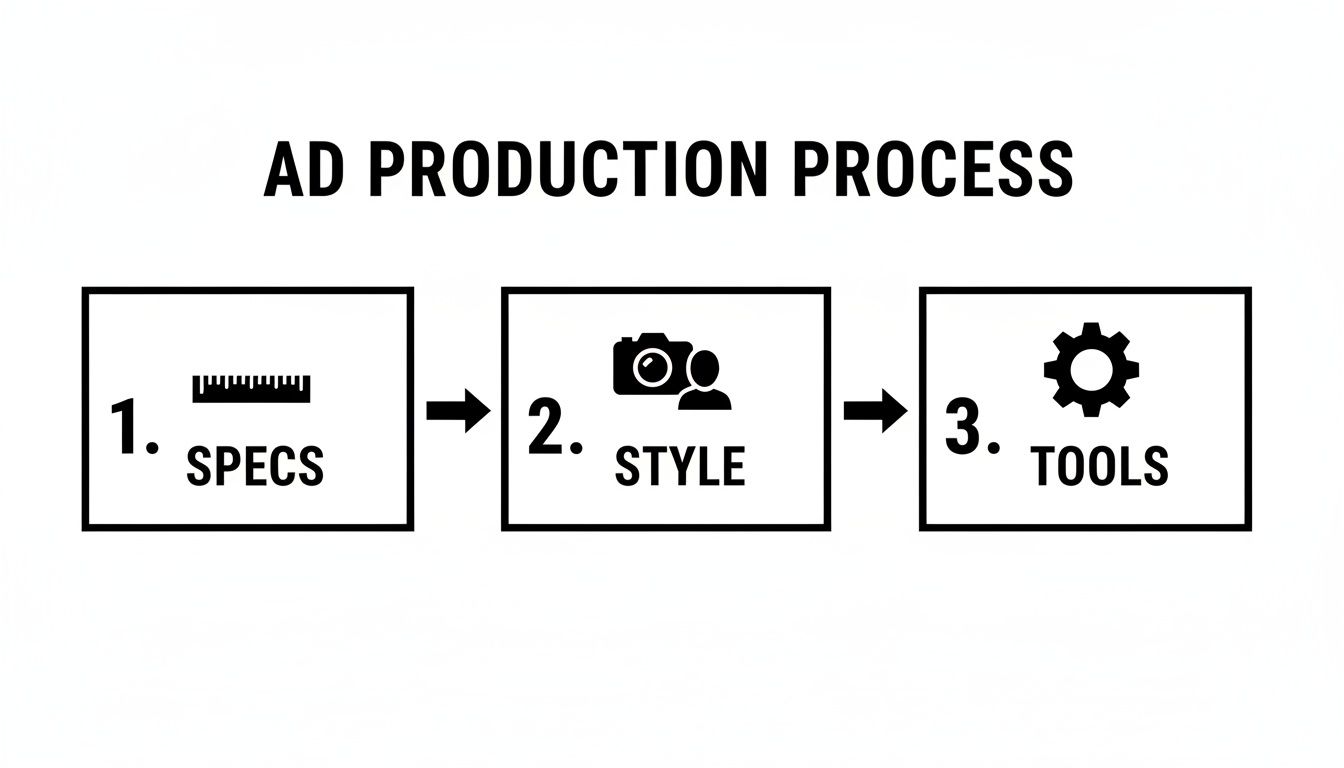
Think of it as a domino effect: getting the specs right from the start makes choosing a style and the right production tools much more straightforward.
How to Structure Your Testing Campaigns
The way you set up your campaigns in Ads Manager directly impacts the quality of your test results. There are a few ways to do it, each with its own trade-offs between cost, speed, and data clarity.
Advantage+ Shopping (ASC): This is the "easy button." You load all your new creatives into a single ASC campaign and let Meta’s algorithm do the work. It’s incredibly efficient for scaling, but it's not ideal for clean testing. The algorithm will quickly favor one creative, starving the others of spend and leaving you with inconclusive data.
CBO Campaign: Using a Campaign Budget Optimization campaign with each creative in its own ad set gives you a bit more control than ASC. However, the CBO algorithm will still aggressively shift the budget to whichever ad set gets early traction, which can cloud your test results.
ABO Campaign: The gold standard for pure testing. An Ad Set Budget Optimization campaign gives you maximum control. You create a separate ad set for each creative you're testing and assign each one a specific, equal daily budget. This is the best way to ensure every ad gets enough spend to exit the dreaded Facebook ads learning phase and give you a clean read on performance.
For most accounts I've worked on, an ABO structure provides the perfect balance of control and speed needed for clear, actionable test results. You can learn more about how to manage this critical period in our guide to the Facebook ads learning phase.
Meta's 2025 algorithm evolution has made creatives the new king of targeting, with AI-driven tools boosting Reels conversions by up to 5%, proving that scroll-stopping content trumps manual audiences. Agencies scaling $28M+ in spend emphasize a three-phase testing model to pick top performers based on CTR and ROAS, while Shopify DTC founders see lead ads convert 20% better with video. Discover more insights about these creative testing trends on Metalla.digital.
Spotting Creative Fatigue Before It Torches Your ROAS

Even your all-time, hall-of-fame ad creative has an expiration date. It's just a fundamental truth of paid media. An ad that starts out crushing it will eventually burn out as your audience grows tired of seeing it. We call this creative fatigue, and it’s the quiet assassin of campaign profitability.
The real skill is spotting the warning signs before your Return on Ad Spend (ROAS) plummets. Too many advertisers just glance at frequency and call it a day, but that metric alone is a trap. A high frequency might be perfectly fine for a warm retargeting audience, but that same number in a top-of-funnel campaign is a massive red flag.
To really get ahead of fatigue, you have to look deeper. It’s about seeing a pattern of decay across a few key metrics, not just knee-jerk reacting to one bad day.
The Real Indicators of Ad Fatigue
Forget gut feelings. The data tells the story. When an ad starts to go stale, the early warning signs almost always pop up in a specific order. It’s a domino effect that will absolutely wreck your performance if you ignore it.
These are the metrics I watch like a hawk every single day:
Slipping Click-Through Rate (CTR): This is your canary in the coal mine. A sustained drop here is the very first signal that your audience has seen your ad, processed it, and is now scrolling right on by. They’ve become blind to it.
Rising Cost Per Click (CPC): It’s simple math. As CTR falls, the algorithm has to serve more impressions to find someone who will click. Naturally, your CPC starts to creep up. You’re now paying more just to get people to your site.
Climbing Cost Per Acquisition (CPA): This is the last and most painful domino to fall. Fewer people are clicking, those clicks are getting more expensive, and inevitably, the cost to actually get a customer skyrockets. This directly attacks your margins.
If you see this three-part decay happening over a 3-5 day period, you’re not looking at normal daily noise. You are witnessing creative fatigue in real-time. It's time to act.
Differentiating Trends from Daily Noise
It’s incredibly easy to panic over one day of bad numbers. Don’t do it. Performance will always have its ups and downs. The key is knowing the difference between random volatility and a genuine downward trend.
A real trend is a sustained slide. For instance, if your CTR drops 10% one day but bounces back the next, it's just noise. But if it drops 5% on Monday, another 3% on Tuesday, and 4% more on Wednesday—you’ve got a problem. That’s a trend, and it’s time to intervene.
Creative fatigue is the silent killer of Facebook ad campaigns, and in 2026, it's hitting harder as the platform churns out 195 billion monthly ad impressions globally. Here's a stat that should concern performance managers: retargeting campaigns can deliver 10x better conversion rates than prospecting, but only if you rotate creatives before fatigue sets in. Data shows this happens faster with AI-generated content saturation, as 85% of DTC brands are pumping out ads, leading to algorithm deprioritization after just a few weeks. Discover more statistics and insights on Facebook ad performance at SQ Magazine.
The Danger of Learning Phase Instability
When you’ve confirmed an ad is fatigued, your gut reaction might be to rush into the ad set and swap it out. Fight that urge. Editing an active ad set, especially one that’s been running well, can throw it right back into the learning phase.
That reset forces Meta’s algorithm to relearn everything from scratch, which often triggers days of wild performance swings. You can take a campaign that just needed a minor creative refresh and send it into a complete nosedive.
A much safer play is to introduce new creative in a more structured way. You can either launch it in a separate testing campaign or, my preferred method, duplicate the existing ad set and swap the creative in the new (copied) one. This preserves all the optimization and data from your original ad set while giving the new creative a clean slate to prove itself.
Patience and a methodical process are what separate the pros from the amateurs. A disciplined approach to monitoring and replacing fatigued creatives for Facebook ads is how you build a machine that scales predictably, not one that’s constantly in a state of panic.
Your Top Facebook Creative Questions, Answered
No matter how airtight your creative strategy is, the same questions always pop up when you're in the trenches managing campaigns. I've heard them all over the years. Here are the most common ones, with straight-to-the-point answers based on what actually works.
How Often Should I Refresh My Ad Creatives?
Forget the rigid two-week rule you might have heard about. That's just a recipe for either killing a winner too soon or letting a dud burn through your budget. Your performance data is the only calendar you need to follow.
For high-spend prospecting campaigns, you can expect creative fatigue to start showing up within 2-4 weeks. But for smaller budgets or retargeting campaigns aimed at a warm audience, a great ad can perform beautifully for much longer.
So, what’s the signal? Watch for the one-two punch: a steady drop in Click-Through Rate (CTR) that’s quickly followed by a rising Cost Per Acquisition (CPA) over a 3-5 day window. When you see that pattern, it's time to swap in a fresh creative. You react to performance decay, not a date on the calendar.
What's Better: UGC or Polished, Professional Content?
For most direct-to-consumer brands in 2026, authentic User-Generated Content (UGC) is your ace in the hole for prospecting. It just works. It looks and feels like a post from a friend, cutting through the noise and skepticism that cold audiences naturally have toward ads.
But don't write off your high-production content. Polished assets are perfect for retargeting. This is where you can really flex your brand's quality, dive deep into product features, or project a premium feel to people who are already familiar with you and considering a purchase.
The real magic happens when you blend them. Hit cold audiences with raw, believable UGC to build that initial trust. Then, follow up with polished, high-quality creatives to showcase value and convince them to buy.
How Many Creatives Should I Test at Once?
This all comes down to your budget. The golden rule is giving the algorithm enough spend to actually learn. As a benchmark, I always aim to give each new creative a budget of at least 2-3 times my target CPA. Anything less, and you're not giving it a fair chance to succeed.
If you're working with a smaller budget, focus your firepower on 3-4 truly different creative concepts. Don't waste money testing a blue button vs. a green one. Test a completely different hook, a new value proposition, or a totally different visual format. You're hunting for big wins, not tiny optimizations.
For those with a bigger war chest, you can run a dedicated testing campaign with 5-10 creatives at a time. This lets you test rapidly, find your breakout hits much faster, and build a library of proven concepts you can scale.
My New Creative Isn't Spending. What's Wrong?
First, take a breath and step away from the "edit" button. Do not touch the ad for at least 72 hours. The algorithm needs time to work its way out of the learning phase, and every little tweak you make just resets the clock and pollutes your data.
If it's still stuck after three days, it's time to play detective. The usual suspects are:
A Tiny Audience: Is your audience so niche that the algorithm is struggling to find people?
A Low Budget or Bid: Are you being outbid in the auction before you even have a chance to compete?
Algorithm Favoritism: This is a big one. Did you launch your new creative in an ad set that already has an old, established winner? Meta's algorithm will almost always funnel spend to the ad with a long history of performance and social proof.
The easiest fix is often the best one: duplicate the campaign and launch the new creative in a completely fresh ad set. This gives it a clean slate, forcing the algorithm to give it a fair shot without playing favorites.
SpendOwlAI is your daily execution system for ad accounts, turning noisy data into clear, prioritized actions. Instead of dashboards, you get a ranked list of what to do today—from budget shifts to creative swaps—backed by transparent rationale. See what needs your attention and what to leave alone. Start your free 7-day trial and execute with confidence.