CPA for Ecommerce: Boost ROI & Cut Costs
You check Meta in the morning and CPA looks ugly. By lunch, Google looks fine. Shopify says revenue is holding, but not in the same way the ad platforms report it. Someone on the team wants to kill a campaign. Someone else wants to raise budget on the only ad set that had a good day.
That is normal in ecommerce.
The mistake is treating CPA for ecommerce like a single scoreboard number. It is not. It is an operating metric that sits inside attribution, inventory, contribution margin, repeat purchase behavior, and platform volatility. If you use it loosely, you will make expensive edits for the wrong reasons. If you use it well, it becomes one of the clearest controls you have over profitable growth.
What CPA Really Means in Ecommerce
At the simplest level, CPA is cost per acquisition. You spend money, you get conversions, and you divide one by the other.
That definition is useful, but only for about five minutes.
One metric, several realities
In ecommerce, CPA changes depending on where you read it. Meta Ads Manager shows one version. Google Ads shows another. Shopify shows what got purchased in your store. Those numbers can all be directionally useful and still disagree on the same day.
A simple way to think about it is fuel efficiency in a car. Highway mileage, city mileage, and what your dashboard estimates on a steep hill are all related, but they are not the same measurement. CPA works the same way.
Three things usually create the confusion:
Channel context: Prospecting on paid social usually behaves differently from branded search because buyer intent is different.
Measurement tool: Each platform uses its own attribution rules and reporting logic.
Time window: A conversion reported today may have started with a click or view from earlier.
If a teammate asks, “What’s our CPA?” the right response is usually, “Which one?”
What each system tells you
Meta and Google are media platforms. Their job is to show you how their delivery systems believe they influenced conversion behavior.
Shopify is your commerce system. Its value is that it reflects actual store orders, customer behavior, refunds, and product mix.
That is why platform CPA is best used for in-platform optimization, while store-level analysis is better for business reality.
Tip: Use platform CPA to decide what to test inside a platform. Use store and finance data to decide whether the acquisition was worth it.
If your team needs a cleaner grounding in the base metric, this explainer on what is cost per conversion is a solid refresher because it frames the metric in plain operating terms instead of treating it like a black-box ad number.
Why ecommerce makes CPA harder than lead gen
Lead gen teams can often stop at “did we get the lead?” Ecommerce teams cannot. You still have to ask whether the order was profitable after product cost, fees, shipping pressure, discounting, and returns.
That is why smart operators do not chase the lowest visible CPA. They chase the CPA that holds up when the order hits the P&L.
How to Calculate Your True Ecommerce CPA
Platform CPA is a starting point. It is not the number you should run the business on.
The useful version of cpa for ecommerce includes customer type and product economics. If you skip those, you can scale campaigns that look efficient in the ad account and still damage margin.
Start with two CPA views
You need at least two versions on the same dashboard or weekly review.
Blended CPA Total ad spend divided by total acquired orders or customers across channels. This tells you overall acquisition efficiency.
New customer CPA Ad spend aimed at acquisition divided by new customers acquired. This tells you what growth costs.
Blended CPA is good for executive visibility. New customer CPA is better for growth decisions, especially if returning customers buy through email, search, or direct traffic after the first purchase.
Add product economics or you are guessing
A conversion is not automatically a good acquisition.
CPAs who work with ecommerce brands implement SKU-level COGS computation using methods like FIFO or weighted average cost because inventory mismanagement can distort gross margins by 10-20% according to this ecommerce CPA explanation. That matters because ad platforms optimize toward conversion volume, not toward your real margin by SKU.
If one product has strong click-through and cheap conversions but weak margin, the platform may keep sending you more of the wrong customers to the wrong product.
A better working formula
A practical version looks like this:
Platform CPA = ad spend / reported conversions
Store CPA = ad spend / store-attributed acquisitions
Contribution margin per acquisition = revenue per order - COGS - variable fulfillment and channel costs - ad cost
That third line is where weak decisions get exposed.
If contribution margin per acquisition is thin or negative, the ad account can still look “healthy” while the business gets worse. This happens often when discounting, shipping costs, and low-margin SKUs creep in unnoticed.
Use attribution software to reconcile the gap
You do not need perfect attribution. You do need consistent attribution.
A good workflow is to compare platform CPA, Shopify performance, and your finance view on a repeating cadence. If you are trying to tighten that reconciliation process, this guide to marketing attribution software is useful for sorting out where platform reporting ends and business-level attribution begins.
For quick checks during planning or review, a simple CPA calculator can help standardize the math across the team. The point is not the calculator itself. The point is forcing everyone to use the same formula before they argue about performance.
Key takeaway: The right CPA for decision-making is not the cheapest one in-platform. It is the one that survives COGS, fees, and customer mix.
Benchmarks How to Know if Your CPA Is Good
Many teams ask the wrong benchmark question. They ask, “Is this CPA good?” as if there is one number that applies to every brand, channel, and catalog.
There is not.
The only benchmark that matters first
A good CPA is one your business model can support.
For ecommerce brands, a common benchmark is to target Customer Lifetime Value at 3x Customer Acquisition Cost, and a healthy net profit is typically in the 10-20% range. Specialized ecommerce CPAs also help businesses boost net margins by 5-10% by tracking these operating metrics, according to Meru Accounting’s overview of ecommerce accountant economics.
That benchmark matters because it forces context into the conversation. A subscription brand can often tolerate a higher first-order CPA than a single-purchase brand. A high-AOV product can carry a different acquisition profile than a low-AOV impulse item.
Channel benchmarks are not interchangeable
A branded search campaign and a cold social campaign should not be judged by the same standard.
Here is the practical lens:
Channel type | Typical expectation |
|---|---|
High-intent search | Lower CPA, less room to scale, stronger immediate conversion intent |
Paid social prospecting | Higher CPA, broader reach, more dependent on creative and landing page quality |
Retargeting | Usually more efficient, but easy to over-credit if attribution is loose |
Email or owned channels | Often strongest efficiency, but dependent on prior acquisition quality |
This is why copying an account-wide target CPA into every campaign usually creates bad edits. The campaign objective and buyer intent are different.
Build internal benchmarks, not fantasy averages
The best benchmark stack is internal:
By channel: Meta prospecting, Google non-brand, brand search, retargeting
By customer type: new versus returning
By product family: strong-margin SKUs versus thin-margin SKUs
By seasonality: promo periods versus steady-state periods
If the team cannot answer those four cuts quickly, your benchmark is too blunt to guide execution.
A final filter helps. Compare CPA to what the business needs, not what the platform says is possible. If you need help pressure-testing that threshold, a break-even ROAS calculator is useful because it anchors media decisions to economics rather than vanity efficiency.
The Five Levers That Control Your CPA
When CPA moves, teams often blame the wrong thing. They blame the platform, or “the algorithm,” when the problem is usually one of a handful of controllable levers.
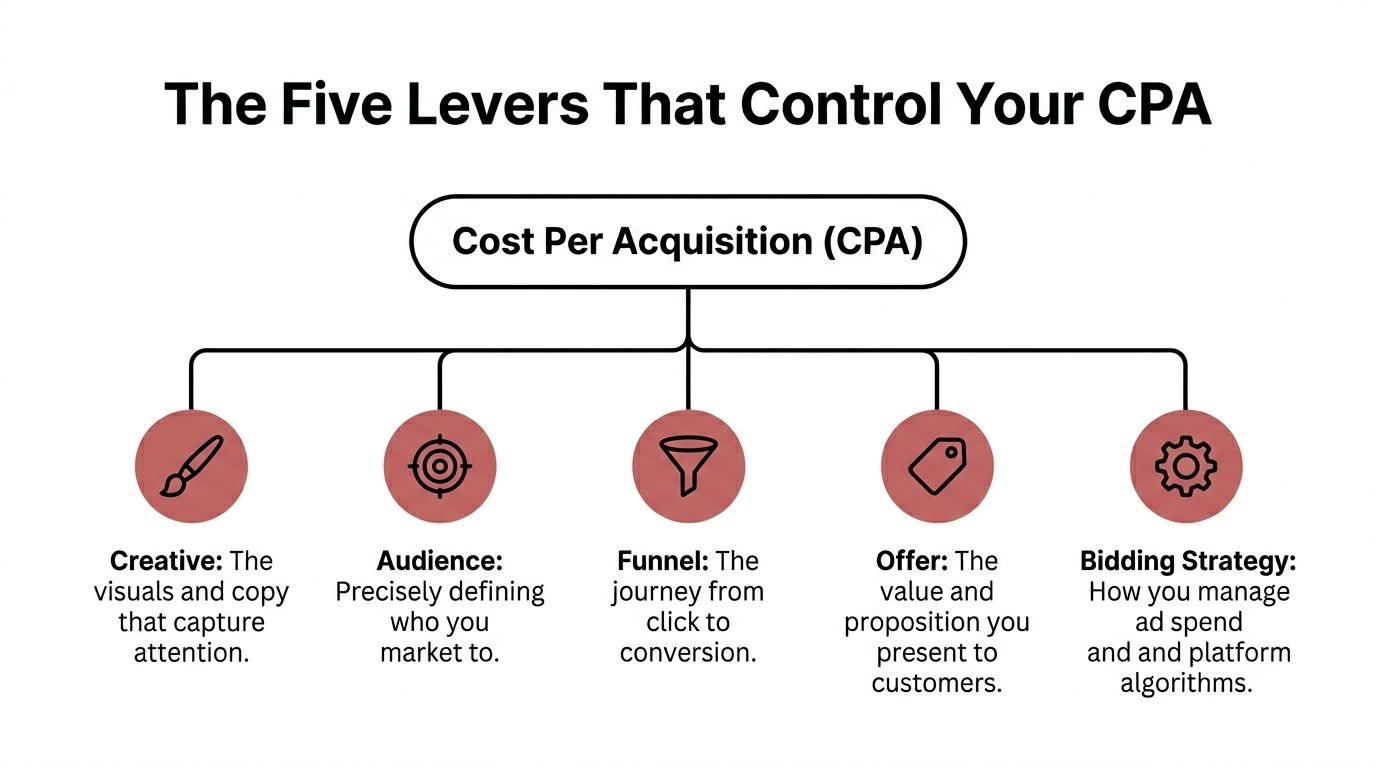
Creative changes the cost of attention
Creative is usually the first lever to check on paid social.
If the ad does not stop the scroll, everything after that gets more expensive. Weak hooks, repetitive visuals, and copy that explains instead of selling can push CPA up before the landing page ever gets a chance.
Good creative does not just look nice. It pre-qualifies the click. It tells the right buyer why this product matters now.
Audience decides who gets the message
Audience quality shapes the kind of traffic you buy.
Overly narrow targeting can choke delivery. Overly broad targeting can attract low-intent clicks if the creative is vague. The right balance depends on how well the ad itself filters for fit.
This is one reason operators should evaluate audience and creative together instead of in isolation.
Funnel determines whether intent survives the click
A strong ad can still produce weak CPA if the product page, cart flow, or mobile experience leaks conversion intent.
Check the basics:
Page-message match: The landing page should continue the promise made in the ad.
Offer clarity: Price, shipping, returns, and product benefits should be easy to see.
Mobile friction: Slow pages, cluttered galleries, and awkward checkout steps raise acquisition cost fast.
Work on-site matters as much as in-platform work. Teams often neglect this because changing ads feels faster than fixing pages. If your site is the bottleneck, website conversion optimization usually moves CPA more reliably than another round of micro-edits in the ad account.
Offer and pricing shape conversion efficiency
Sometimes the campaign is fine and the offer is weak.
A poor bundle, unclear value proposition, or discount structure that attracts low-quality buyers can inflate CPA and then create margin problems after the sale. Operators often confuse “more conversions” with “better acquisition.” Those are not the same thing.
Bidding and measurement decide what the platform learns
Even with strong creative, audience, and funnel alignment, poor bidding logic or sloppy measurement can produce unstable CPA.
And margin pressure is not just a media issue. The sales tax environment got more complex after South Dakota v. Wayfair, which established economic nexus and pushed ecommerce sellers into compliance obligations in up to 45 states, with penalties averaging $1,000-$10,000 per violation according to CRI Advisors’ ecommerce accounting analysis. When compliance costs squeeze margin, every wasted acquisition gets more painful.
That is why disciplined CPA management matters. It is not about making prettier dashboard numbers. It is about protecting real dollars in a business with tightening operational costs.
A Prioritized Framework to Lower Your CPA
Many teams lower CPA slowly because they fix things in the wrong order.
They start with structural changes when a messaging problem is sitting in plain view. Or they rebuild landing pages before they have proved the traffic is worth saving. Better results usually come from sequencing the work by speed, confidence, and likely impact.
Start with fast tests that do not disrupt the account
The first moves should be low-risk and easy to isolate.
Refresh hooks and first-frame creative: Keep the offer the same. Change the opening angle, visual pattern interrupt, or headline.
Tighten ad-to-page match: If the ad sells one use case, land traffic on the product page section that proves that use case.
Trim obvious waste: Pull back on placements, keywords, or audiences that consistently bring low-intent traffic.
These changes are fast because they do not require rebuilding your measurement stack or redesigning the site.
Then test audience and offer changes
Once the message is stronger, move one level deeper.
A practical sequence looks like this:
Audience simplification Duplicate the best-performing setup and remove one layer of targeting complexity. Many accounts carry old audience logic long after the platform has changed.
Offer framing Test bundles, product comparison language, or value framing that helps buyers justify the purchase without relying on constant discounting.
Product mix control Check whether the campaign is driving demand to SKUs that convert easily but leave weak margin behind.
This is also a good point to review creative and landing page alignment as a pair rather than as separate tasks.
A short walkthrough can help if the team needs a visual reset on how to think about CPA optimization in practice:
Save major rebuilds for proven bottlenecks
Big changes have a place. They just should not be your first move.
Redesigning product pages, changing account structures, or rebuilding feed logic can help when the evidence is clear. They are the right call when the problem is repeated and structural, not when the account just had a messy two-day stretch.
Tip: If a smaller test can answer the same question, run the smaller test first.
A disciplined operator asks, “What is the cheapest experiment that can prove or disprove this hypothesis?” That mindset keeps your team from confusing activity with progress.
Guardrails When to Stop Editing and Let Platforms Work
One of the most expensive habits in paid media is reacting to every wobble in CPA.
Teams see a bad day, make a change, see another bad day, make two more changes, then spend the week trying to understand which edit caused the result. That is not optimization. That is contamination.
Volatility is real, but so is self-inflicted damage
Recent platform changes, including Google’s Performance Max updates and Meta’s Advantage+ saturation flags, have increased CPA variability for Shopify sellers. Reports also show 25-35% of ad spend is wasted from over-editing during these volatile periods, according to eCom CPA’s analysis of monthly accounting and operational guardrails.
That matters because not every movement is signal. Some of it is normal delivery fluctuation. Some of it is attribution lag. Some of it is the platform exploring.
If you interrupt that process constantly, you teach the system less and your team learns less.
Practical guardrails for daily operators
Use guardrails that reduce impulsive edits.
Separate monitoring from intervention: Review performance daily, but do not force a daily change.
Group edits into windows: If you need to adjust budgets, creative, or targeting, batch changes instead of touching the campaign repeatedly.
Judge patterns, not isolated outcomes: One ugly day is not the same thing as a confirmed decline.
Protect active tests: Do not change targeting, bids, and creative at the same time if you still want a readable result.
Escalate only when multiple signals agree: Rising CPA alone is weaker evidence than rising CPA paired with weaker conversion rate and fatigue signals.
These rules sound simple, but many teams break them under pressure.
What not to do
A few behaviors almost always create noise:
Bad habit | Why it hurts |
|---|---|
Editing budgets too often | Delivery becomes harder to interpret |
Killing creatives immediately | You miss late-emerging winners |
Making multiple variable changes at once | You lose causal clarity |
Chasing platform CPA without store context | You optimize reporting, not business performance |
Key takeaway: Restraint is an optimization skill. Some of the best CPA improvements come from stopping unnecessary edits, not adding more of them.
Good operators still move fast. They just move with thresholds, not with panic.
From Reactive Tweaks to Disciplined Growth
Strong CPA management is less about finding one magic tactic and more about running the account with discipline.
First, define the metric correctly. Then calculate the version that includes business reality, not just platform reporting. Judge it against your own economics. Diagnose the true lever before you touch the account. Act in a sequence that keeps learning intact. And when volatility shows up, resist the urge to turn every fluctuation into a decision.
That is the fundamental shift in cpa for ecommerce. The metric stops being a number you stare at and becomes a system you operate.
The teams that improve most are rarely the teams making the most edits. They are the teams with clearer thresholds, better SKU awareness, stronger attribution discipline, and enough restraint to tell signal from noise.
If your current workflow feels reactive, that is fixable. Tighten the math. Narrow the questions. Make fewer, better changes. Then give those changes room to prove themselves.
SpendOwlAI helps ecommerce teams turn noisy Meta, Google, and Shopify performance into clear daily actions. Instead of more dashboards or black-box automation, it gives you ranked recommendations, explainable rationale, and guardrails that help you avoid waste from reactive edits. If you want a calmer, more disciplined way to manage acquisition, start with the free SpendOwlAI trial.