What Is ICP in Marketing and How Does It Drive Growth
In marketing, your Ideal Customer Profile (ICP) isn't just another buzzword—it’s the blueprint for the perfect company you should be selling to. Forget individual buyers for a moment. The ICP is all about the account that gets the most out of your product and, in turn, provides the most value back to your business.
What Is an Ideal Customer Profile and Why Does It Matter
Think of marketing like fishing. You could just cast a massive net into the ocean and hope you catch something good. That's the "spray and pray" method, and it’s exhausting and inefficient.
An ICP, on the other hand, is like a high-tech fish-finder. It pinpoints the exact location of a school of high-value tuna, telling you precisely where to focus your time, energy, and budget to land the customers that matter most.
Without a sharp ICP, marketing and sales teams are flying blind. They waste money chasing leads that never convert or, even worse, sign up customers who are a poor fit, get frustrated, and churn. A well-defined profile is a strategic filter, making sure every ad dollar, blog post, and sales call is aimed at prospects with the highest possible potential.
From Aspiration to Data-Driven Certainty
When you first launch a business, your ICP is usually a guess—a well-informed hypothesis about who you think your best customer will be. But as you start closing deals and collecting real-world data on sales cycles, customer lifetime value (LTV), and renewal rates, that guess needs to evolve into a data-backed certainty. You stop assuming and start knowing.
This shift from gut feeling to hard data is what separates good from great. In fact, high-performing sales teams are 2.3 times more likely to use a structured ICP. With buyers now using over 10 different touchpoints before ever speaking to a sales rep, a clear profile is essential to guide them effectively. The results speak for themselves: teams with a strong ICP have reported 68% improved win rates.
The Core Components of a Strong ICP
So, what goes into building one of these profiles? A truly powerful ICP is built on specific, quantifiable attributes. It’s a concrete checklist that helps you spot your perfect-fit companies out in the wild.
Here's a quick guide to the essential data points you'll need to define your ICP.
Quick Guide to ICP Core Components
Component Type | Description | Example for a B2B SaaS Company |
|---|---|---|
Firmographics | The basic, objective facts about a company. | Mid-market tech companies (100-500 employees), headquartered in North America, with $20M-$100M in annual revenue. |
Technographics | The technology stack a company uses. | Uses Salesforce for CRM, Slack for communication, and is currently using a competing project management tool. |
Behavioral Data | How the company acts and makes decisions. | Has a defined annual budget for software, buying decisions involve the Head of Operations, triggered by rapid team growth. |
Pain Points | The specific, urgent problems your product solves. | Struggles with project visibility across departments, misses deadlines due to poor collaboration, and can't accurately track team capacity. |
These components are the building blocks of a focused growth strategy. By moving past broad marketing, you lay the foundation for highly effective customer segmentation and targeting. To go deeper, check out our deep dive into why segmentation is important for growth. Understanding your ICP is the first step toward building a more precise, efficient, and scalable business.
Building Your Ideal Customer Profile From Scratch
This is where the rubber meets the road. Building your Ideal Customer Profile (ICP) is how you stop guessing and start operating from a place of data-backed confidence. You're moving from who you think your best customers are to knowing exactly who they are.
The whole point is to create a rock-solid blueprint. This isn't just for the marketing team; it's a guide for your sales, product, and customer service departments to attract, convert, and keep more of the customers you actually want.
Think of yourself as a detective. Your best customers have left a trail of clues, and your job is to gather them from different sources to assemble a complete picture. You just need to know where to look.
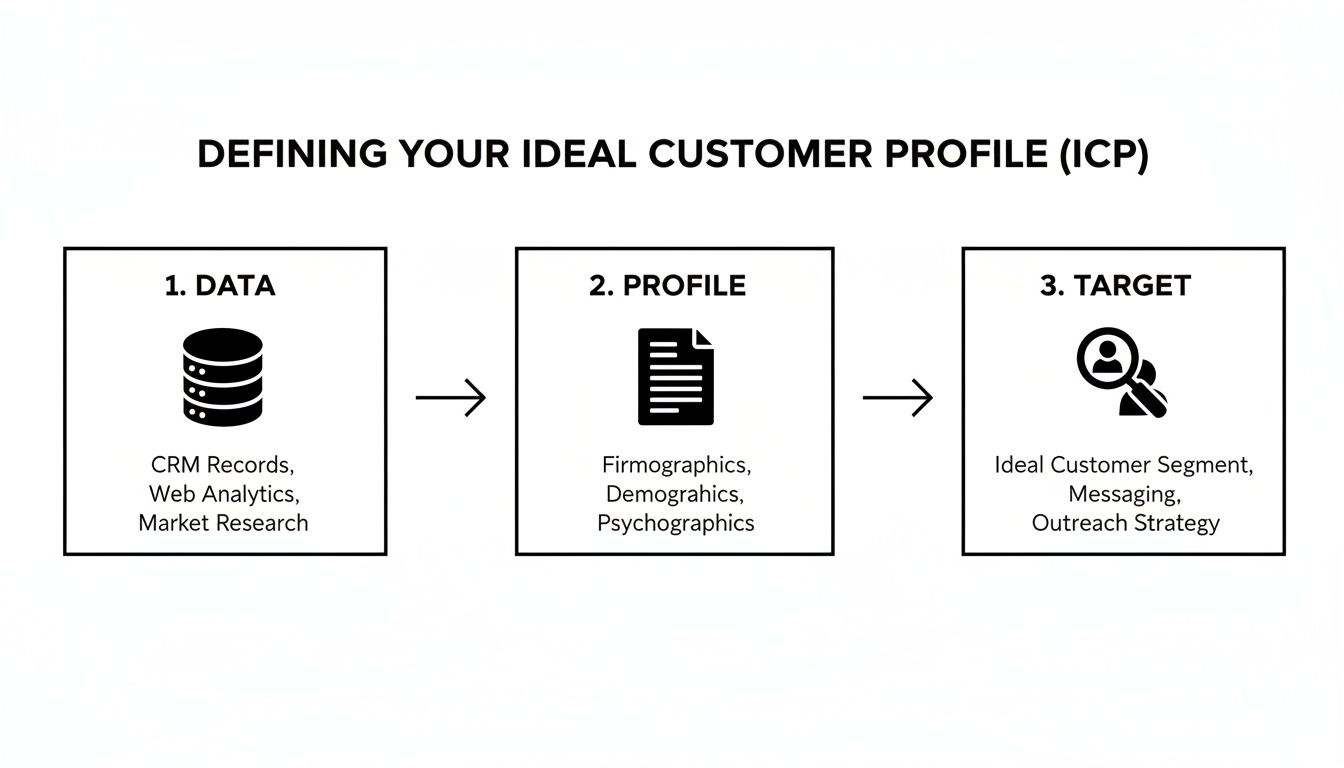
The process is straightforward: start with solid data collection before you even think about drafting a profile. Garbage in, garbage out.
Uncovering Your Best Customers with Data
A strong ICP is built on a foundation of hard data, not gut feelings. But here's the catch: data quality is a massive hurdle for most companies. In fact, a staggering 77% of organizations admit their data quality is average or worse, which can completely derail marketing efforts.
If you’re managing ad spend on platforms like Meta or Google, feeding them bad data is like setting money on fire. Clean inputs from your CRM, analytics, and customer interviews are non-negotiable for building an effective ICP. You can learn more about the impact of data quality on marketing trends at AlmohMedia.com.
Your first step is to identify your "champions"—the customers who get the most value from your product and are a joy to work with.
1. Mine Your CRM and Financial Data Your CRM is a goldmine waiting to be excavated. Pull a list of your top 10-20 customers based on cold, hard business metrics.
High Lifetime Value (LTV): Who has spent the most money with you over their entire relationship?
Low Churn/High Retention: Which accounts have stuck around the longest with minimal fuss?
Expansion Revenue: Who has upgraded their plan, bought add-ons, or expanded their usage?
Short Sales Cycles: Which customers went from lead to closed-won in record time?
These accounts are the model. They represent your most successful and profitable relationships, and they’re the ones you want to replicate.
2. Analyze Product Analytics Next, dig into how these top-tier customers actually use your product. Engagement data shows you what they value and how deeply your solution is woven into their daily work.
High Feature Adoption: Are they using the key features you know lead to success?
Frequent Logins: Do they show consistent daily or weekly activity?
Low Support Tickets: Are they self-sufficient, or are they constantly needing help?
This behavioral data adds another layer to your profile, showing you what a healthy, successful customer does.
Adding the Human Element Through Interviews
Quantitative data tells you what your best customers look like. But qualitative interviews tell you why they're your best customers. Talking to them directly uncovers the goals, frustrations, and motivations that numbers can never show you.
Set up brief 20-30 minute calls with a handful of your champions. Ask open-ended questions to get to the heart of their story.
Key Takeaway: An ICP built only on company stats is one-dimensional. The magic happens when you combine firmographics (what they are), behavioral data (what they do), and interview insights (why they care). That’s how you build a truly actionable profile.
Here are a few questions to get the conversation flowing:
"Before you found us, what was the biggest headache you were dealing with in your role?"
"What was the specific event that made you realize you needed to find a solution?"
"Can you walk me through how our product fits into your team's typical day?"
"If you had to name one thing, what's the most valuable result you've gotten from using our product?"
These conversations are what turn your ICP from a dry list of attributes into a rich, three-dimensional portrait of the customer you should be obsessed with finding.
Understanding ICP vs. Buyer Persona vs. TAM

In the world of marketing, it’s incredibly easy to get tangled up in acronyms that sound suspiciously similar. Three of the most common culprits are the Ideal Customer Profile (ICP), the Buyer Persona, and the Total Addressable Market (TAM).
Getting these straight isn't just about sounding smart in meetings. It’s about building a growth strategy that actually works—one that doesn't waste time or money chasing the wrong people.
Let’s try a simple fishing analogy. Your Total Addressable Market (TAM) is the entire ocean. It’s every single fish, of every kind, everywhere. It represents the maximum possible demand for what you sell, assuming you could magically reach everyone.
Your Ideal Customer Profile (ICP) is much more focused. It’s not just any fish; it’s a specific type of fish you’re perfectly equipped to catch—the ones that are most valuable and easiest to land. Think of it as knowing that your boat, bait, and gear are designed specifically for catching schools of big, profitable tuna in a particular region.
And the Buyer Persona? That’s the specific person you need to convince to bite your hook. In the B2B world, this isn't the company; it's the marketing director or the head of engineering—the actual human being who makes the buying decision at that perfect-fit company.
ICP Defines the "What" and the Persona Defines the "Who"
The real difference comes down to what each one describes. An ICP is all about the company (the "what"), while a Buyer Persona is about the people inside it (the "who").
Ideal Customer Profile (ICP): This zeroes in on the perfect account or business. It uses firmographic data like company size, industry, and revenue, plus other signals like the technology they use or their current growth stage. It answers the question, "What kind of company is the perfect fit for us?"
Buyer Persona: This focuses on the individual decision-makers and influencers working at those ideal companies. It gets into demographics (age, job title), psychographics (goals, pain points, motivations), and how they like to communicate. This answers the question, "Who are we actually talking to?"
For example, your ICP might be: “US-based SaaS companies with 100-500 employees using Salesforce as their CRM.”
Your Buyer Persona, on the other hand, would be someone like "Marketing Molly," a 35-year-old manager at one of those companies who is completely swamped with manual reporting and desperately needs a tool to prove her team's ROI.
How They All Work Together
These concepts aren't at odds with each other. They form a strategic funnel, guiding you from the broadest market view down to a single, specific person. You can't create a truly effective Buyer Persona if you haven't first figured out your ICP.
Key Takeaway: Your TAM shows you the size of the entire pond. Your ICP tells you which part of the pond holds your best fish. Your Buyer Persona helps you choose the right lure to get those fish on the line.
This alignment is crucial for anyone running paid ad campaigns. Your ICP should guide your big-picture targeting on platforms like Google Ads, helping you focus on the right industries or company sizes. Your Buyer Persona, in contrast, directly shapes the ad creative and copy for your Meta campaigns, making sure your message hits home with the person you’re trying to reach.
This table breaks down the key distinctions to help you keep these concepts clear.
ICP vs. Buyer Persona vs. TAM: A Clear Comparison
Concept | Focus | Scope | Primary Use Case |
|---|---|---|---|
Total Addressable Market (TAM) | The entire market demand | Very broad (e.g., all e-commerce stores) | Sizing market opportunity for investors and long-term strategy. |
Ideal Customer Profile (ICP) | The perfect company | Specific (e.g., Shopify stores with >$1M revenue) | Aligning sales and marketing on high-value accounts; ABM targeting. |
Buyer Persona | The individual decision-maker | Individual (e.g., the founder or marketing lead) | Crafting targeted ad copy, content marketing, and sales outreach. |
Ultimately, understanding what an ICP is in marketing—and how it’s different from a persona and TAM—gives your entire team a shared playbook. It connects your high-level strategy to your day-to-day execution, turning that vast, intimidating market potential into focused, profitable growth.
Putting Your ICP to Work in Paid Advertising
Defining your Ideal Customer Profile is a great start, but it's just a document until you actually use it. The real magic happens when you take that profile and apply it directly to your ad campaigns. This is where theory meets reality, and your ICP becomes the driving force behind every dollar you spend on platforms like Meta and Google.
Think of it as the difference between casting a wide, expensive net and using a high-tech fish finder. An ICP helps you stop wasting money on broad, hopeful targeting and start surgically placing your ads in front of the companies that are most likely to become your best customers. For any team that's serious about scaling efficiently, this shift is everything.
Escaping Broad Targeting on Meta
We’ve all been there—relying on Meta’s broad interest targeting and just hoping the algorithm figures it out. But with a sharp ICP, you can give that algorithm a massive head start. Instead of guessing with vague interests like "small business owners," you can build powerful custom and lookalike audiences based on the real data of your best customers.
Your ICP is essentially the DNA of your ideal customer. You're going to use that DNA to build audiences that are far more potent than anything you can create from scratch.
Create a Custom Audience: Start by uploading a list of your top-tier customers—the best 10-20% you identified when building your ICP. This can be a list of company domains or email contacts. You're literally showing Meta, "This is exactly who we want to find."
Build a High-Fidelity Lookalike Audience: From that custom audience, the next step is to create a 1% Lookalike Audience. This is arguably Meta's most powerful acquisition tool. You're asking the platform to go out and find new people who share the core characteristics of your most valuable, profitable customers.
Layer with Relevant Interests: To make your targeting even sharper, you can layer this high-quality lookalike with specific interests. For example, if your ICP shows that your best customers all use Salesforce, add "Salesforce.com" as an interest layer. Now you're targeting people who look like your best customers and are confirmed to use a key piece of software.
This simple process transforms your advertising from shouting into a void to having a direct conversation with a highly curated group of prospects. For a deeper dive into this strategy, check out our guide on how to effectively scale Facebook ads.
Laser-Focusing Your Google Ads
When it comes to Google Ads, especially with powerful campaign types like Performance Max, a well-defined ICP is your secret weapon. Instead of just bidding on keywords that anyone could be searching for, you use your ICP to build audience signals that guide Google's AI toward the right kind of traffic.
By feeding strong audience signals based on your ICP into your campaigns, you're not just telling Google what people are searching for. You’re telling it who you want to find. This adds a critical layer of business qualification, ensuring your budget is spent on high-value prospects, not just random clicks.
You do this by creating custom segments within Google Ads using the firmographic, technographic, and behavioral data from your ICP.
Example Custom Segment for a B2B SaaS Tool:
People who search for any of these terms:
"project management software for agencies"
"client reporting tools"
"resource planning for creative teams"
AND people who browse websites similar to:
asana.com
monday.com
smartsheet.com (your top competitors)
AND people who use apps similar to:
Slack
Trello
Jira (key tools in your ICP’s tech stack)
This multi-layered signal is incredibly powerful. It tells Google's algorithm to hunt for users who are not only showing intent with their searches but also exhibit the exact digital behaviors and tool preferences of your ideal customer.
Making Your ICP Part of Your Daily Routine
Knowing your ICP is one thing. Making sure your ad spend actually follows it day in and day out is a whole different challenge. This is where your ICP needs to move from a strategic document to an active part of your daily execution, and where modern tools can make a huge difference.
Instead of manually checking performance dashboards and trying to remember if the results align with your ICP, a system like SpendOwlAI can bridge that gap for you. It connects your ICP strategy directly to your daily campaign management.
The system constantly monitors your ads and flags when performance starts to drift away from your ideal customer benchmarks. It checks if the audiences and creatives driving results are still the ones that attract your high-value segments.
If a specific ad set starts bringing in lower-quality leads or its ROAS dips below the baseline set by your best customers, you get a clear signal to investigate. This turns your ICP from a static document into an active guardrail for your ad spend, ensuring every dollar is working to bring in the right kind of customer.
Validating and Refining Your ICP Over Time
Putting together your first Ideal Customer Profile is a huge step forward, but the work doesn’t stop there. An ICP document that just sits on a shelf collecting dust is completely useless. The best profiles are treated as living, breathing hypotheses—not a rigid set of rules—that need to be constantly tested against the reality of your market.
Think of your initial ICP as a well-educated guess. Now it’s time to head into the lab (your ad accounts and CRM) and run some experiments to see if you were right. The whole point is to shift from, "We think these are our best customers," to, "We know these are our best customers because the data proves it." This constant cycle of testing and refining is what keeps your marketing sharp and aimed at real opportunities, not just old assumptions.
Using Data to Test Your Hypothesis
The core idea here is simple: pit the performance of customers who fit your ICP against those who don't. You need to look at the business outcomes that actually move the needle. If your ICP is on the money, the segment of customers who match it should clearly outperform everyone else.
Your ICP starts as an aspiration—a picture of who you want to sell to. It must evolve into a regression—a data-backed model of who your best customers actually are. If you skip this step, you’re just guessing.
To get started, divide your recent leads and new customers into two buckets: "ICP-Fit" and "Non-ICP-Fit." From there, you just need to track how each group behaves.
Key Metrics for ICP Validation
So, what should you be tracking? Look for clear signals in these key performance indicators (KPIs). A well-defined ICP should give you a lift in these areas.
Conversion Rate: Do leads that match your ICP turn into paying customers more often than the others? A big difference here is one of the strongest signs you're on the right track.
Sales Cycle Length: Are your sales reps closing deals with ICP-fit accounts faster? A shorter sales cycle means less friction and a message that’s landing perfectly.
Customer Lifetime Value (LTV): This is the ultimate test. Do your ICP-fit customers spend more over time? Do they stick around longer and buy more from you? A high LTV from this group is gold.
Win Rate: When your sales team gets an ICP-fit prospect on the phone, what's their closing percentage? This directly measures how well your targeting is resonating with the right people.
If you see that your "ICP-Fit" group is falling short in one of these areas, don't panic. That’s not a failure; it’s a gift. It's a data-driven insight telling you exactly which of your initial assumptions was off and where your profile needs a tune-up.
Don't Forget Qualitative Feedback
Numbers tell you what is happening, but they rarely tell you why. For that, you need to talk to your people. Your sales and customer success teams are on the front lines every single day, and their real-world insights are incredibly valuable.
Set up quick, regular check-ins to get their unfiltered feedback. Ask pointed questions like:
"Are the leads we're sending you feeling like a good fit?"
"What are the most common objections you're hearing from our target accounts?"
"Is our messaging missing a key pain point that keeps coming up in conversations?"
This is the feedback that adds color and context to the data. A sales rep might point out that while a certain type of company looks perfect on paper, they never have the budget. That’s a crucial flaw in your ICP that you'd never find in a spreadsheet. It’s this combination of hard data and human insight that turns a decent ICP into a true revenue-generating machine.
From Noise to Clarity: How an ICP Powers Smarter Decisions
Think of your Ideal Customer Profile as less of a marketing document and more of a strategic compass for your entire business. Without one, most companies are simply flying blind. Marketing and sales teams get buried in conflicting metrics, never quite sure which signals are genuine opportunities and which are just expensive noise.
A well-defined ICP cuts through all that. It acts as a filter, helping everyone from marketing and sales to product development zero in on the same target. Suddenly, you have a shared language and a unified goal, making sure every ounce of effort is spent on attracting—and keeping—the customers who get the most value from what you do.
The Before and After Picture
Does this sound familiar? Your marketing team celebrates a flood of cheap leads, but the sales team complains they’re all duds. Meanwhile, your product team is building niche features for demanding, low-profit customers, while your best clients quietly churn because their real needs are being ignored. This is what happens when teams operate in silos, driven by conflicting data and gut feelings.
Now, picture the alternative. With a clear ICP, marketing shifts its focus from lead volume to lead fit. Sales cycles get shorter because reps are talking to the right people from the start. And the product roadmap? It’s directly shaped by the needs of your most valuable customers, which naturally boosts retention and opens up expansion revenue.
An Ideal Customer Profile isn’t just about better marketing; it’s about building a healthier, more aligned business. It ensures that every team is rowing in the same direction, toward the same high-value destination.
This kind of alignment isn't just a feel-good concept; it shows up on the bottom line. You'll see less wasted ad spend, shorter sales cycles, and a higher customer lifetime value. More importantly, it gives your team the confidence to make sharp, decisive moves every single day.
Your Compass for Sustainable Growth
Ultimately, understanding what an ICP is in marketing and putting it to work is about swapping guesswork for informed action. It's the bedrock of sustainable growth, focusing your limited resources—time, money, and talent—squarely on the opportunities that matter most.
It turns a random collection of go-to-market tactics into a single, cohesive system built on real data. For any team serious about building a more resilient and efficient company, defining and using your ICP is the essential first step. If you're looking to build a more focused strategy, you can learn more about these data-driven marketing solutions.
In the chaos of digital advertising, your ICP is the one tool that consistently points you toward profitable, long-term growth.
Frequently Asked Questions About ICP
As you start putting the Ideal Customer Profile to work, a few questions always seem to pop up. Think of this section as a quick cheat sheet for getting past those common sticking points.
My goal here is to help you move from theory to confidently using your ICP every day. Let's clear up some of the usual confusion.
How Often Should I Update My ICP?
Your ICP isn't a "set it and forget it" document. The best way to think of it is as a regular health check for your marketing. A good rule of thumb is to formally review and update your profile every 6 to 12 months.
But don't just wait for the calendar. Certain events should trigger an immediate review. If you see key metrics for your target customers start to slip—things like lower conversion rates or more people churning—that’s a huge red flag. It’s time to see what’s changed. Likewise, big moves like launching a new product or expanding into a new market demand an instant ICP refresh.
Can a Company Have More Than One ICP?
Absolutely. In fact, most successful businesses do. It’s a smart strategy if you sell to different types of customers or have products that solve completely different problems. For instance, a software company might have one ICP for its enterprise clients in the finance world and a totally separate one for tech startups.
The trick is to resist the urge to lump everyone into one "master" profile. When you try to make a single ICP for everyone, it becomes so generic that it's useless. Keep each profile specific, detailed, and laser-focused on one high-value group. That’s how you keep your messaging and targeting sharp.
What Is the Biggest Mistake When Creating an ICP?
The single biggest mistake I see is building a 'fantasy' ICP. This happens when you create a profile based on who you wish your customers were, instead of looking at the data of who they actually are. It's easy to get caught up in dreaming of landing Fortune 500 clients, but if your data clearly shows your best, most loyal customers are mid-sized companies, that's where your attention belongs.
Your ICP starts as an aspiration—a picture of who you want to sell to. It must evolve into a regression—a data-backed model of who your best customers actually are. If you skip this step, you’re just guessing.
Always, always ground your profile in real evidence. The most powerful insights are sitting right there in your own data. Start by analyzing your most profitable, happiest, and most successful customers.
Do I Need an ICP if My Business Is B2C?
Yes, you do! While the term "Ideal Customer Profile" gets thrown around more in B2B circles, the concept behind it is just as crucial for B2C brands. For a direct-to-consumer business, this simply means creating a very detailed ideal customer persona or target audience segment.
You're doing the exact same thing: identifying your most valuable type of customer using hard data. Instead of firmographics like company size, you’ll be focusing on demographics, psychographics, lifestyle choices, and buying habits. The goal is exactly the same—to pour your ad budget and creative energy into the audience that brings in the highest lifetime value.
Tired of guessing which ads are working? SpendOwlAI turns noisy performance data into a clear, ranked list of daily actions. See exactly what to change in your Meta, Google, and Shopify campaigns and why—all backed by transparent rationale. Start your free 7-day trial and execute with confidence at https://spendowlai.com.