What is consumer segmentation: A practical guide (what is consumer segmentation)
At its core, consumer segmentation is the simple act of grouping your customers based on shared characteristics. This could be anything from their age and location to their personal values or how often they buy from you. It’s the fundamental difference between yelling one message to a crowd and having a meaningful conversation with a specific person.
This simple shift turns marketing from a scattergun blast into a precision tool, making sure your message and money are actually hitting the right targets.
Why Consumer Segmentation Matters Now

Think of it this way: imagine a tailor who only sells one-size-fits-all suits. Sure, they might make a few sales, but the vast majority of people would walk away with an outfit that just doesn't fit. Broadcasting a single marketing message to your entire audience is exactly the same—it’s wasteful and rarely gets the job done.
Consumer segmentation is the art of tailoring your marketing to fit different customer groups perfectly. Instead of a single, generic message, you create specific ones that truly connect with distinct groups. With ad costs climbing and competition getting fiercer by the day, this isn't just a "nice-to-have" strategy. It's essential for survival.
Navigating a Divided Consumer Landscape
Today's economic pressures have created a clear split in how people spend their money, making segmentation more critical than ever. Recent data reveals a growing divide: some consumers feel financially secure and ready to spend, while others are holding back.
According to NIQ's 2026 Consumer Outlook, 31% of global consumers now feel their financial situation is thriving or unimpacted, up from 27% in 2024. This points to an expanding segment of confident buyers, which helps explain trends like the +2.1% volume growth in categories like Health & Beauty. You can dig deeper into these trends by reading the full 2026 consumer outlook from NIQ.
When you understand these different financial realities, you can stop guessing and start creating campaigns that speak directly to each group. This data-driven approach is what turns marketing from a cost center into a reliable revenue driver.
By truly understanding who your customers are and what they care about, you can stop wasting ad spend on audiences that will never convert. Instead, you focus your budget on high-potential segments, which leads to more relevant ads, higher conversion rates, and a much better return on ad spend (ROAS).
The Core Benefits for Your Business
When you put a clear segmentation strategy in place, you unlock several powerful advantages that directly impact your bottom line. We cover this in more detail in our guide on why segmentation is important for your marketing efforts.
Here’s what you stand to gain:
Improved Message Relevance: You can craft offers and creatives that solve the specific problems and desires of each segment.
Increased Customer Loyalty: Customers feel seen and understood, which builds a much stronger, more authentic connection to your brand.
Higher Conversion Rates: By showing the right product to the right person at the right time, you make the path to purchase smooth and intuitive.
Optimized Ad Spend: You can finally allocate your budget to the most profitable segments and channels, eliminating waste and making every dollar work harder.
Ultimately, mastering consumer segmentation isn't about working harder—it’s about working smarter. It's about building a genuine understanding of your audience and using that insight to create more meaningful and profitable relationships.
The Four Core Types of Consumer Segmentation

If you want to truly understand your customers, you need a framework for organizing them into meaningful groups. The best way to do this is by layering four core types of segmentation. Think of them as different lenses, each answering a fundamental question about your audience.
When you combine these pillars, you go from a flat, one-dimensional customer list to a rich, 3D profile that can actually drive business decisions.
Let's walk through each one and see how they work in the real world.
1. Demographic Segmentation: The Who
This is almost always the starting point, and for good reason. Demographic segmentation uses objective, statistical data to answer the most basic question: Who is buying from me?
It starts with the basics like age and gender, but the real power comes when you dig a bit deeper. A customer’s income, for instance, gives you a clue about their price sensitivity. Their life stage—like being a new parent versus an empty-nester—is a massive predictor of what they need right now.
Key data points here include:
Age: Are your customers teenagers, young professionals, or retirees?
Gender: Does your product and messaging land differently with men versus women?
Income: Are you selling to value-conscious shoppers or those looking for premium goods?
Occupation: A construction worker has a completely different set of daily needs than a software engineer.
Marital Status: A single person's spending habits look nothing like a family of four's.
Lately, the focus on generation and income has become incredibly sharp. HubSpot's 2026 State of Marketing Report found that 72% of marketers now target Millennials and 36% aim at Gen Z, a clear shift toward digital-first buyers. Data providers like Experian are even creating highly specific audience profiles that combine generation, income, and location to separate groups like "value-seekers" from "premium chasers." You can see more on what 2026 consumer insights mean for marketers at Experian.
2. Psychographic Segmentation: The Why
If demographics tell you who is buying, psychographics explain why they're buying. This is where you group people by their internal motivations: their values, attitudes, beliefs, and lifestyles.
Imagine two customers who look identical on paper. Both are 35-year-old women earning $100,000 a year. But one might be an "eco-conscious minimalist" who researches every brand's sustainability policy. The other could be a "luxury trendsetter" who prioritizes brand prestige and the latest styles. They have the same demographics but completely different motivations, so they need completely different messages.
Psychographic segmentation gets to the heart of the emotional and psychological drivers behind a purchase. It’s what allows you to build a brand people don't just buy from, but truly connect with.
3. Behavioral Segmentation: The How
This is all about action. Behavioral segmentation groups customers based on their direct interactions with your brand, answering the question: How do they engage with my business?
For any e-commerce brand, this is often the most powerful type of segmentation because it's built on tangible data you already own. By analyzing what people do on your site and in their purchase history, you can spot your most valuable customers.
Common behavioral segments include:
Purchase History: Grouping by what they buy, how often, and average order value (AOV).
Brand Loyalty: Separating your ride-or-die VIPs from one-time shoppers.
Product Usage: Finding the heavy users of a specific product category versus those who buy it occasionally.
Cart Abandoners: Targeting high-intent users who just need a little nudge to check out.
Coupon Lovers: Identifying customers who are almost exclusively driven by discounts.
4. Geographic Segmentation: The Where
Finally, where your customers are located matters. Geographic segmentation groups them by their physical location, which influences everything from the products they need to the cultural references that resonate with them. It answers the simple but vital question: Where are they?
This is more than just country or state. You can get much more specific:
Climate: A brand selling parkas will have a very different conversation with customers in Boston than in Miami.
Urbanicity: The needs of someone in a dense city are worlds apart from someone in a rural community.
Cultural Preferences: Marketing campaigns often need to be tweaked to align with local holidays, events, and social norms.
By layering these four types of segmentation, you build a complete and nuanced picture of your audience. This is what enables you to create hyper-relevant experiences that build loyalty and fuel profitable growth.
Unlocking Your Segments With the Right Data
Alright, you know the what—the different types of consumer segmentation. But now for the how. This is the fun part, where you stop just thinking like a marketer and start acting like a data detective, digging for the clues that reveal the hidden groups within your customer base. And your investigation always starts with the most valuable asset you have: your own data.
Think of your e-commerce platform—whether it's Shopify, BigCommerce, or something else—and your analytics tools as a treasure trove of evidence. Every click, every purchase, every abandoned cart is a piece of the puzzle. This is your first-party data, and it’s the foundation of any good segmentation work because it’s a direct, unfiltered log of how real people behave with your brand.
Building Your Data Foundation
Your first job is to gather the raw materials. This data is incredibly powerful because it’s yours alone, reflecting genuine customer history and intent. It’s the most trustworthy source you have.
Start by looking in your own backyard:
Purchase History: What are people actually buying? How often do they come back? What’s their average order value?
Website Behavior: Which product pages get the most views? Where are people navigating on your site, and at what point do they leave?
Email Engagement: Who’s opening your newsletters? Who’s clicking the links and taking you up on your offers?
This internal data gives you a fantastic starting point, but the best detectives know when to bring in outside intelligence. You can flesh out your customer profiles by layering in second-party data (essentially, another company’s first-party data, shared through a partnership) or third-party data (aggregated data from large providers). This helps fill in the blanks on things like broader lifestyle interests or demographics, giving you a much more complete, three-dimensional view of your customer.
From Raw Data to Actionable Insights
Once you've collected all these clues, you need a way to connect the dots. This is where analytical models come into play. They act as your magnifying glass, revealing the subtle patterns and relationships in your data that the naked eye would miss. These models help you move from simply grouping customers to actually predicting what they'll do next.
Two of the most practical and powerful models for any e-commerce brand are RFM Analysis and LTV Modeling.
RFM (Recency, Frequency, Monetary) Analysis is a classic for a reason. It's a surprisingly simple way to quickly sort your customers by scoring each one based on how recently they bought, how often they buy, and how much money they spend.
This method immediately helps you spot your best customers. For example, someone who bought last week (high Recency), has purchased 10 times before (high Frequency), and has spent a lot (high Monetary) is clearly a VIP. On the flip side, a customer who hasn't bought in a year but used to be a frequent shopper is a "Champion at Risk." You know exactly who they are and that they need a personalized campaign to win them back.
Lifetime Value (LTV) Modeling takes this analysis to the next level. Instead of just looking backward, LTV models use your data to predict the total profit you can expect from a customer over their entire relationship with your brand. This changes the questions you ask:
How much can I realistically spend to acquire a new customer and still be profitable?
Which of my customer segments are on track to be the most valuable in the long run?
Are my marketing campaigns attracting high-LTV customers or just one-time discount hunters?
By focusing on LTV, you graduate from chasing short-term sales to building long-term, sustainable profitability. For marketers ready to make smarter, more strategic bets, exploring data-driven marketing solutions is the perfect next step. This forward-looking approach ensures your marketing dollars are invested in the people who will truly grow your business, turning raw data into a reliable roadmap for success.
Putting Your Segmentation Strategy Into Action
Alright, so you’ve mapped out your customer segments. Now what? This is where the rubber meets the road—and where most of the value is actually created. All the data analysis in the world doesn't mean much until you use it to make smarter marketing decisions.
Think of it this way: a spreadsheet full of segments is just a map. Actually acting on those segments is the journey. It’s the difference between knowing who your best customers are and making them feel like VIPs.
A solid, repeatable process is what separates guessing from making calculated moves. The goal is to turn those data-driven insights into real campaigns on platforms like Meta and Google Ads. The entire workflow boils down to a simple, powerful cycle.
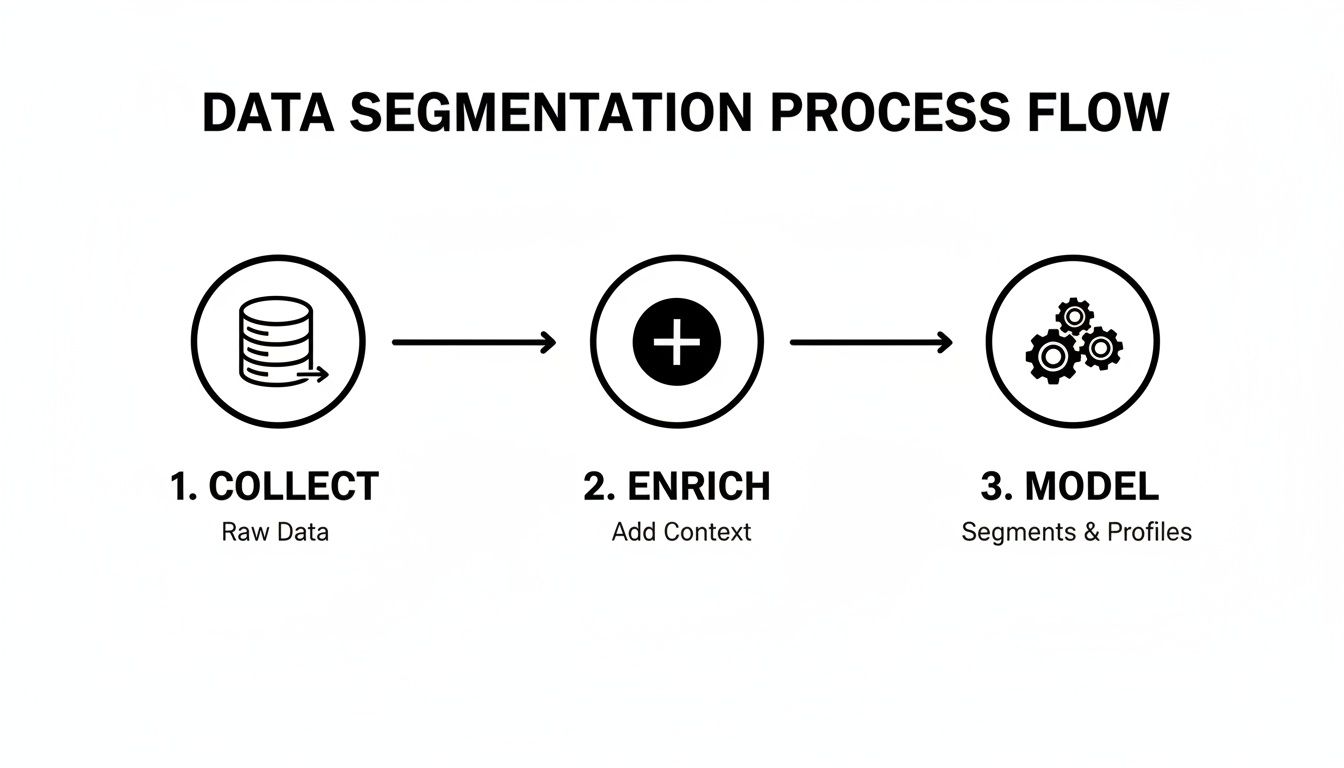
At its core, you’re just collecting your raw customer data, making it smarter by enriching it, and then using models to spot the meaningful patterns that define your segments.
A 5-Step Playbook for Implementation
To really bring this to life, you need a clear game plan. This five-step approach will take you from a high-level goal all the way to launching targeted campaigns.
Start with a Goal: What are you trying to accomplish? Double your repeat purchase rate? Win back customers who are about to churn? A crystal-clear objective, like improving ROAS by 15%, will shape every decision you make.
Pull Your Data Together: This is where you gather your raw materials. Collect your first-party data from your Shopify store, Google Analytics, and CRM. We're talking purchase history, browsing behavior, and email engagement.
Pick the Right Model: Your goal dictates your model. If you’re hunting for your most valuable customers, an RFM (Recency, Frequency, Monetary) model is your best friend. If you’re playing the long game and focused on profitability, LTV (Lifetime Value) modeling is the way to go.
Create Your Segment Personas: Now for the fun part. Give your segments a name and a story. For example, a "VIP Spender" could be anyone with 5+ purchases and an average order value over $150. A "Fading Fan" might be someone who hasn't bought in 90 days but used to be a regular.
Activate Your Segments: Finally, unleash your segments in your marketing channels. This means building custom audiences, tweaking your ad creative, and tailoring your offers to speak directly to each group.
The magic of segmentation isn't in finding the segments; it's in the activation. It’s the difference between knowing who your VIPs are and actually rolling out the red carpet for them with exclusive offers and personalized messages.
Activating Your Segments on Meta and Google Ads
So how does this look in practice? Below is a quick comparison showing how you can use different segments on the two biggest ad platforms to achieve specific goals.
Activating Your Segments on Meta and Google Ads
Customer Segment | Activation Tactic on Meta Ads | Activation Tactic on Google Ads |
|---|---|---|
VIP Customers | Create a Custom Audience. Target them with exclusive early access offers and loyalty rewards to boost retention. | Use as a Customer Match signal in Performance Max to find new customers who look just like your best ones. |
Recent First-Time Buyers | Create a Custom Audience. Run a campaign to drive a second purchase, showcasing complementary products or your loyalty program. | Exclude this audience from "first-time buyer" discount campaigns to avoid showing them irrelevant offers. |
High-Intent Cart Abandoners | Set up a dynamic retargeting campaign (DPA) showing them the exact products they left behind, possibly with a small incentive. | Run a Search or Shopping retargeting campaign (RLSA) for users who added to cart but didn't buy. Bid more aggressively for them. |
Potential Churn | Launch a win-back campaign for users who haven't purchased in 90-120 days. Offer a compelling "we miss you" discount. | Exclude this inactive segment from top-of-funnel campaigns to focus your budget on more engaged users. |
These tactics aren't just theory—they are practical ways to make every ad dollar work harder. Let's break down a couple of these examples.
On Meta Ads (Facebook & Instagram), you can upload your "Recent First-Time Buyers" list to create a Custom Audience. The goal is simple: get that crucial second purchase. You can target them with a campaign showing off products that pair well with what they just bought. Many savvy brands automate this with post-purchase sequences—a strategy we detail in our guide on what a drip campaign is and how it works. At the same time, you'd exclude your VIPs from prospecting campaigns. Why waste money serving "new customer" ads to your most loyal fans?
Over on Google Ads, the logic is similar. You can take that same "VIP Customers" list and use it for Customer Match. By feeding this list into a Performance Max campaign as an audience signal, you’re essentially telling Google, "Go find me more people who look and act exactly like my best customers." Conversely, you’d want to exclude your "Recent First-Time Buyers" from any search campaigns promoting a "10% off your first order" deal. It’s a bad experience for them and a waste of your ad spend.
By taking these specific, deliberate actions, you graduate from spray-and-pray advertising. You start having relevant conversations with the right people at the perfect time, turning your ad budget into a precision tool for growth.
Consumer segmentation is an incredibly powerful tool, but let's be honest—the path from theory to profit is littered with pitfalls. Getting it wrong can waste a ton of time and money. Knowing what these common traps are is the first step to sidestepping them and building a strategy that actually works.
One of the most frequent mistakes is getting way too granular, way too fast. Marketers get excited and slice their audience into a dozen or more tiny micro-segments. It feels precise, but in practice, it’s a nightmare to manage. You end up trying to have twelve different conversations at once and, ultimately, saying nothing meaningful to anyone.
The goal isn't to create the most segments; it's to create the most impactful ones. We've found the sweet spot is usually three to five core groups that represent the biggest opportunities for your brand.
Start there. You can always drill down further once you've mastered creating distinct messaging and offers for these key groups without overwhelming your team.
Ignoring Your Data’s Expiration Date
Another classic error is treating your customer data like it's a fine wine that gets better with age. It's not. It's more like a carton of milk—it has a very real expiration date. A segment you built six months or a year ago might be completely out of touch with reality today.
People's lives change. Their priorities shift. Economic trends come and go. That's why segmentation can't be a "set it and forget it" project. It needs to be a continuous part of how you operate, with regular check-ins to make sure your insights are still sharp.
The Fix: Put a recurring event on your calendar to review your segments every quarter. Are your "VIPs" still buying? Have your "At-Risk Customers" churned for good, or are they showing signs of life? This simple routine keeps your strategy grounded in what’s happening now.
Overlooking Channel-Specific Behavior
Thinking a customer is the same person everywhere they shop is a huge misstep. Shoppers behave differently depending on the channel. We call this channel polarization. The person hunting for a bargain at a dollar store has a completely different mindset than when they’re on your website expecting great service and a premium experience.
If you don't segment by channel, you're just throwing money away. For instance, recent data shows that while 59% of consumers are using quick commerce, that preference isn't universal across all your customer groups. Pushing the same offer everywhere ignores this reality completely.
Smart brands are already adapting. They separate their main list prices from channel-specific digital discounts, aligning their offers with what customers expect in that specific context. You can get a deeper look at how these global trends are shaping pricing strategies by reviewing the full 2026 report from RevenueML.
By steering clear of these common mistakes, you’ll move beyond just talking about segmentation and start actually profiting from it. It's this disciplined, data-informed approach that makes all the difference.
Your Consumer Segmentation Questions Answered
Alright, so you get the "what" and "why" of consumer segmentation. But now comes the tricky part: actually doing it. Moving from a smart idea on a whiteboard to a real-world strategy is where most people get stuck.
Let's walk through the practical questions that always pop up when it's time to get your hands dirty.
How Many Segments Should I Start With?
It's tempting to slice and dice your customer list into a dozen different groups right away. But trust me, that's a classic rookie mistake. You end up with a tangled mess of audiences, a headache trying to create unique messaging for each, and a bad case of analysis paralysis.
The goal isn't to create the most segments; it's to create the most impactful ones. Start small and build momentum.
For just about any e-commerce brand, the sweet spot is three to five core segments to begin. This is manageable, and it forces you to focus on the groups that will actually move the needle. A great place to start is by identifying your biggest opportunities:
Your VIPs or Top Purchasers: These are the loyal fans who are responsible for a huge chunk of your revenue. You need to treat them like gold.
Recent First-Time Buyers: This group is at a critical crossroads. Your job is to turn their first purchase into a second one and build a lasting habit.
At-Risk or Churning Customers: These are the folks who haven't bought in a while. A targeted nudge could be all it takes to bring them back from the brink.
How Often Should I Refresh My Segments?
Customer behavior is a moving target. People's needs change, your competitors launch new products, and last season's trends fade away. If you treat your segmentation work as a one-and-done project, you'll be making decisions based on old news.
Your segments are living, breathing things, not a static report you can file away. A good rhythm is to review and refresh your core segments every quarter. This isn't about starting from scratch every three months. It's a quick health check to ask:
Are the behaviors that define our segments still the same?
Have our "At-Risk" customers officially churned, or are they coming back?
Are our "VIPs" still spending like VIPs?
This regular check-in makes sure your marketing stays grounded in reality, not history.
Can I Do This on a Small Budget?
Yes, absolutely. You don’t need a six-figure analytics platform to get started. The truth is, the most valuable data is the first-party data you already own, and the tools you use every day are more powerful than you think.
Before you look for new software, dive into what you already have. Google Analytics is fantastic for segmenting users by how they found you, what they do on your site, and basic demographics. Your e-commerce platform—whether it's Shopify, BigCommerce, or something else—is a goldmine for purchase history, order value, and product preferences.
By combining these free resources, you have more than enough information to build out your initial 3-5 segments and start making your campaigns smarter.
Ready to put these insights into action without all the guesswork? SpendOwlAI takes your complex data and turns it into a simple daily action plan. It tells you exactly which audiences to target, which ads need a refresh, and where to shift your budget to get the most out of every dollar. Start your free 7-day trial and execute with confidence.