A Guide to Target Cost Per Acquisition
Target Cost Per Acquisition (CPA) isn't just another marketing acronym—it's the absolute maximum you can afford to pay to get a new customer and still make a profit. Think of it as your hard-and-fast budget for each sale you win through advertising. This single number is the financial guardrail that keeps your growth on track.
Why Target CPA Is Your Most Important Metric
It's so easy to get bogged down in metrics like clicks, impressions, and click-through rates. While they have their place, they mostly track activity, not results. A target CPA, on the other hand, cuts right through the noise to answer the one question that truly matters: "Is my ad spend actually making me money?"
Imagine you're planning a cross-country road trip. Your destination is a new customer. Your target CPA is the total amount you've budgeted for gas, food, and lodging to get there. Without that budget, you could easily run out of cash halfway to California. It's the same with advertising—without a firm target CPA, you risk spending way more to acquire a customer than they'll ever be worth to your business.
This kind of financial discipline is more critical than ever. The cost of acquiring customers online has been climbing for years, with one study showing a massive 222% increase over eight years. That trend isn't slowing down, which makes a well-defined target CPA your best defense against burning through your marketing budget. For a deeper look at this trend, you can check out these customer acquisition cost benchmarks for marketing leaders.
The Foundation of Profitable Advertising
At its core, a target CPA strategy connects your daily marketing decisions directly to the financial health of your company. It forces you to look past vanity metrics and focus on what really drives the business forward.
When you have a clear target CPA, you can:
Make Smarter Decisions: It gives you a simple pass/fail grade for every campaign, ad set, and creative. Is the actual CPA below your target? Great, it’s working. Is it above? Time to figure out what’s wrong or turn it off.
Protect Your Profit Margins: By setting a hard ceiling on your acquisition cost, you create a built-in safety net that stops you from accidentally spending away all your profits.
Scale with Confidence: Once you know your numbers, you can pour more money into your winning campaigns, confident that every dollar you spend is fueling sustainable, profitable growth.
To really nail this, you need to be comfortable with a few key financial metrics. These are the building blocks for calculating a target CPA that actually works for your specific business.
Key Metrics for Calculating Target CPA
This table breaks down the core concepts you'll need to understand. Think of it as your cheat sheet for setting a profitable target CPA.
Metric | What It Means | Why It's Critical for CPA |
|---|---|---|
Cost Per Acquisition (CPA) | The actual, measured cost to acquire one customer from a specific ad campaign. | This is the "real-world" number you compare against your target CPA. |
Gross Margin | The profit left over from a sale after subtracting the Cost of Goods Sold (COGS). | This tells you how much money you have available to spend on advertising and still break even. |
Lifetime Value (LTV) | The total profit you expect to earn from a single customer over their entire relationship with your brand. | LTV helps you decide if it's worth paying a higher initial CPA to acquire a valuable long-term customer. |
Getting a handle on these three metrics is the first step. They work together to give you a complete picture of your unit economics, which is exactly what you need to set a target CPA that fuels real growth instead of just empty clicks.
How to Calculate a Realistic Target CPA
Figuring out your target CPA isn't about plucking a number from an industry report. It’s a gut-check on your own business's financials to land on a figure that actually fuels profitable growth. This calculation is the essential bridge connecting your marketing spend to your bottom line.
Think of it this way: your target CPA is the absolute maximum you can afford to pay for a customer and not lose money on their first order. Getting this right means every ad dollar is a smart investment, not just another line item on the expense sheet. The whole process starts with two fundamental pieces of your business puzzle: your gross margin and your customer lifetime value.
The flowchart below shows you exactly how these core metrics come together to build a sustainable target CPA.
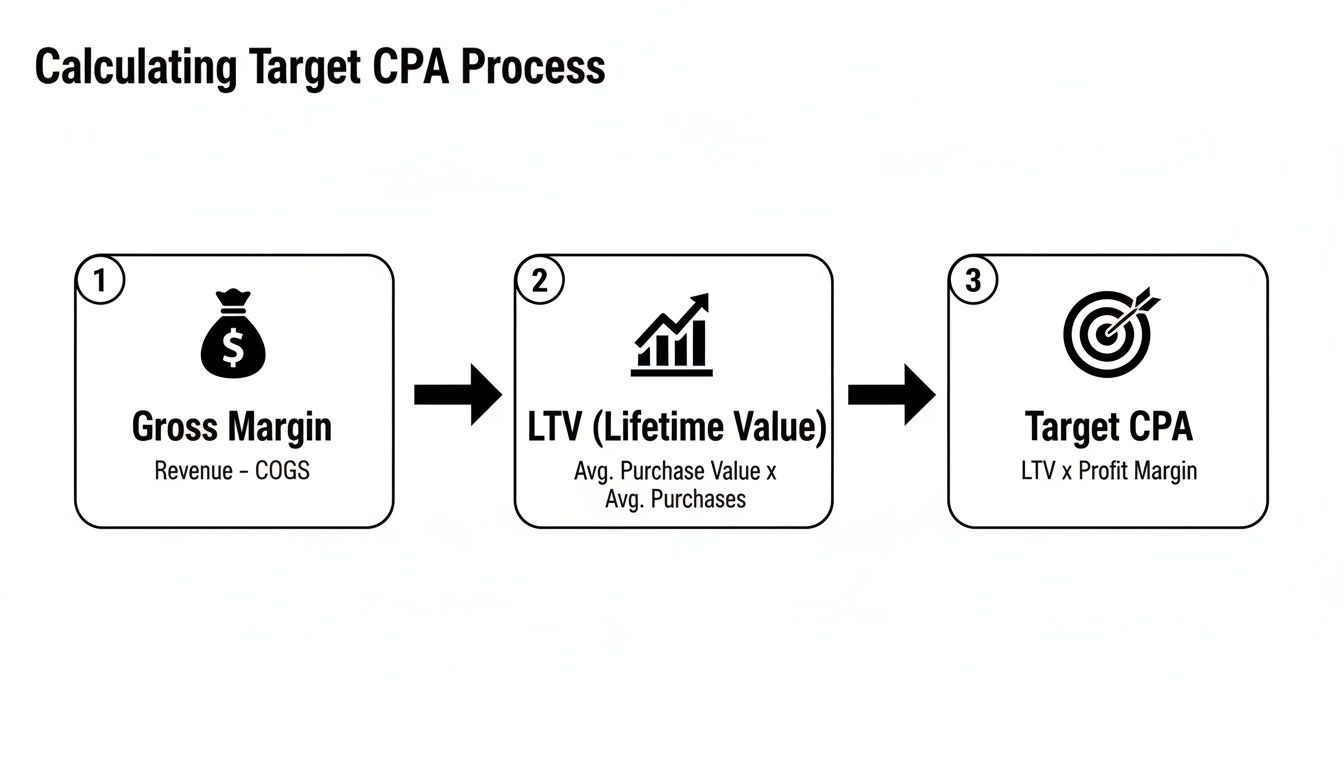
As you can see, a powerful target CPA is built on a rock-solid understanding of both your profit per sale and the long-term value each new customer brings to the table.
The Foundational Formula for Target CPA
First things first, you need to know exactly how much profit you make from a single sale before you even think about ad costs. This is your breakeven point—the absolute ceiling for what you can spend to get a customer.
Let's walk through a real-world example. Imagine a DTC brand that sells high-quality leather bags.
Average Order Value (AOV): On average, a customer spends $200 per order.
Cost of Goods Sold (COGS): It costs the company $70 to make and ship each bag.
Operational Costs: Things like payment processing fees and other variable costs tack on another $10 per order.
Now, let's calculate the gross profit for each order: $200 (AOV) - $70 (COGS) - $10 (Ops) = $120 Gross Profit
This $120 is your breakeven CPA. If you spend precisely $120 to land a customer, you haven't made or lost a dime on that initial transaction. It's a critical baseline, but if you're serious about growth, it's rarely the number you should actually be aiming for. You can dive deeper into this concept in our guide to the break-even ROAS calculator.
Breakeven CPA vs. Growth CPA
Your breakeven CPA is your safety net, but a "growth" CPA is your engine. The goal isn't just to stay afloat; it's to acquire customers profitably. To find your growth-focused target, you have to decide how much of that gross profit you want to pocket.
A common and effective strategy is to reinvest a portion of your gross profit back into advertising to fuel more growth, while banking the rest as net profit. This is how you transform your target CPA from a simple breakeven metric into a strategic lever for scaling your business.
Let’s go back to our leather bag brand. Let's say they want to lock in a healthy 25% net profit margin on every new customer they acquire.
Here’s the simple math for their growth target CPA: $120 (Gross Profit) x (1 - 0.25 Desired Profit Margin) = $90 Target CPA
This tells the brand they can spend up to $90 to acquire a new customer while still hitting their 25% profit goal. That $90 is now the North Star for all their marketing campaigns. Any campaign with a CPA under $90 is driving profit, and anything over it is actively losing money against their target.
When to Adjust Your Target CPA
A single target CPA should never be set in stone. It’s a living number that needs to reflect your current business goals. Your strategy of the moment will dictate just how aggressive—or conservative—you need to be.
For example, consider these different scenarios:
Maximizing Profit: If you have a mature product with strong brand recognition, you might aim for a higher profit margin. This would lead to a lower, more conservative target CPA (like $70).
Rapid Market Capture: When launching a new product, you might be willing to sacrifice some initial profit to grab as much market share as possible. In this case, you could set your target CPA much closer to your breakeven point (say, $115) to drive maximum sales volume.
Inventory Liquidation: Got old stock you need to move? You might even set a target CPA slightly above your breakeven point, knowingly taking a small loss on each sale just to free up cash and warehouse space.
By truly understanding the math behind your numbers, you can set a realistic target CPA with confidence. You'll know it aligns perfectly with your goals, turning your ad spend into a predictable and powerful driver of profitable growth.
Setting Target CPAs Across Different Ad Platforms
One of the most common—and costly—mistakes I see advertisers make is applying a single, universal target CPA across every ad platform. It seems simple, but it’s a recipe for wasted ad spend.
Each channel is its own unique ecosystem. The way people behave, the ad formats they see, and their reason for being there are completely different. A $90 target CPA that fuels profitable growth on Google Search could be a total fantasy for a prospecting campaign on Meta.
Google Ads Demand Capture vs. Meta Ads Demand Generation
The biggest difference between these platforms boils down to a single concept: user intent.
On a platform like Google Ads, you're practicing demand capture. People are actively searching for a solution. They’re typing in keywords that signal they have a problem and are ready to buy. This high-intent traffic naturally leads to higher conversion rates, which can justify a higher CPA.
Meta (Facebook and Instagram) is the opposite. It’s a platform for demand generation. Users are there to scroll, connect with friends, and be entertained. Your ad is an interruption, introducing a product they weren't looking for. The job here is to first grab their attention, then build interest, and finally persuade them to click.
This fundamental difference in user mindset completely changes the game.
Google Ads (Search & Shopping): You can expect higher conversion rates but also higher costs-per-click. You're bidding against competitors for those high-intent eyeballs.
Meta Ads (Facebook & Instagram): You'll likely see lower initial conversion rates. However, the cost to reach a massive audience is often much lower, making it perfect for brand discovery and filling the top of your marketing funnel.
A Quick Comparison: Meta vs. Google
Thinking about how to set your CPA targets on these two giants? It’s not just about the number; it’s about understanding the context of how each platform works.
Here’s a breakdown of the key factors to consider:
Factor | Meta Ads (Facebook/Instagram) | Google Ads (Search/Shopping) |
|---|---|---|
User Intent | Low (Passive Scrolling): Users are discovering, not actively searching. CPAs need to account for this "colder" traffic. | High (Active Searching): Users are looking for a specific product or solution. Can justify a higher CPA. |
Audience Targeting | Broad & Interest-Based: You target based on demographics, interests, and behaviors. | Keyword-Based: You target users based on the exact terms they are searching for. |
Campaign Goal | Demand Generation: Ideal for brand awareness and introducing new products to cold audiences. | Demand Capture: Perfect for closing sales with users who are ready to buy now. |
Typical Funnel Stage | Top-of-Funnel (TOFU): Your goal is often to drive initial interest and website visits. | Bottom-of-Funnel (BOFU): Your goal is to convert high-intent searchers into customers. |
Realistic CPA | Generally lower than search campaigns, especially for retargeting, but higher for pure prospecting. | Generally higher than social campaigns due to intense competition for valuable keywords. |
Ultimately, your strategy can't be one-size-fits-all. A lower CPA on Meta for a top-of-funnel campaign is just as valid as a higher CPA on Google for a bottom-of-funnel branded search campaign. They play different roles in your customer's journey.
Beyond the Platform: Segmenting by Campaign Type
Even within a single platform like Meta or Google, a single CPA target is still too blunt of an instrument. You absolutely have to segment your targets by the type of campaign you're running. The most critical distinction is between prospecting and retargeting.
Prospecting Campaigns: These campaigns target cold audiences—people who have likely never heard of your brand. The goal is purely acquisition. It’s no surprise that the cost to acquire a brand-new customer will be your highest CPA.
Retargeting Campaigns: These campaigns target warm audiences—people who have already visited your site, added a product to their cart, or engaged with a past ad. They know who you are. Because of this familiarity, their conversion rates will be much higher and their CPA will be significantly lower. You can dive deeper into this in our guide on how to optimize your Facebook ads.
Setting distinct CPA goals is not just a best practice; it's a strategic necessity. Your target for a cold prospecting audience on Facebook should be significantly higher than your target for a branded search campaign on Google, where users are literally typing your company's name.
Don't Forget About Industry Benchmarks
Finally, your targets need to be grounded in reality. The economics of your industry play a huge role in what constitutes a "good" CPA.
For example, the legal services industry has the highest average CPA at around $73. That sounds high until you remember that a single client can be worth thousands in revenue, making that acquisition cost a smart investment.
On the other end of the spectrum, pet service companies had a CPA of less than $15 back in 2021. This reflects the lower average order value of services like dog walking or grooming. This pattern holds true everywhere—the jewelry and luxury goods sector boasts the highest average order value at $188, while home goods sit much lower. These AOV differences are a great starting point for understanding why CPAs vary so much.
Optimizing Your CPA at the Product Level
Relying on a single, account-wide target CPA is like trying to navigate a city with a map of the entire country. Sure, it gives you a general sense of direction, but it completely ignores the one-way streets and dead ends that actually determine whether you reach your destination. For any e-commerce store with more than a few products, this kind of blended CPA isn't just vague—it's dangerously misleading.
This broad-strokes approach almost always creates a hidden subsidy. Your most profitable, best-selling products end up propping up the ones that are quietly losing you money. You might be hitting your overall $90 target CPA and think everything is fine. But what if your star leather bag is actually getting a $50 CPA, while a new, low-margin wallet is burning through cash at $150 per sale? Without digging deeper, you'd never know.
The answer is to stop thinking in averages and start optimizing at the product level. By setting a unique target CPA for individual SKUs (Stock Keeping Units) or even tight product groups, you finally connect your ad performance to real-world profitability, one item at a time.
The Problem with a Blended CPA
A blended target CPA forces you to pretend every product has the same profit margin, moves at the same pace, and holds the same strategic value. That’s just not reality. A single, averaged-out target creates massive blind spots that can slowly and silently drain your ad budget.
Here’s why a blended approach just doesn’t cut it:
It Hides the Losers: A fantastic performance from one product line can completely mask the losses from another. This makes your ad account look much healthier on the surface than it truly is.
It Stifles Your Winners: You might hold back on increasing the budget for a campaign that's just "meeting" its blended target, not realizing there’s a wildly profitable product inside that’s ready to scale.
It Disconnects Ads from Business Goals: Your ad strategy ends up operating in a silo, totally detached from inventory realities like needing to clear out old stock or give a new high-margin item an aggressive push.
Shifting to a SKU-level mindset turns your advertising from a blunt instrument into a set of surgical tools. Getting this right starts with a solid grasp of market segmentation. You can get a deeper dive on this in our guide on why segmentation is important for your marketing strategy.
Calculating a Target CPA for Individual SKUs
To figure out a target CPA for each product, you just apply the exact same logic we used for the whole business, but on a much smaller scale. The mission is simple: find the absolute maximum you can pay to acquire a customer for each specific item and still make the profit you need.
Let’s go back to our leather goods brand and look at two very different products.
Example 1: The High-Margin Hero (The "Executive" Briefcase)
Sale Price: $350
COGS & Ops: $120
Gross Profit: $230
Desired Profit Margin: 30% (
$230 * 0.30 = $69)SKU-Specific Target CPA:
$230 - $69 = $161
For this premium briefcase, you can spend up to a whopping $161 to get a customer and still walk away with your 30% profit.
Example 2: The Volume-Driver (The "Everyday" Cardholder)
Sale Price: $60
COGS & Ops: $20
Gross Profit: $40
Desired Profit Margin: 30% (
$40 * 0.30 = $12)SKU-Specific Target CPA:
$40 - $12 = $28
Here, the math is much tighter. Your target CPA for the cardholder is only $28. A single, blended $90 target would make the briefcase wildly profitable but would be a complete financial disaster for the cardholder.
When you set these granular targets, you're essentially giving your ad platforms' algorithms a much smarter set of instructions. Now you can build dedicated campaigns or ad groups for specific SKUs and feed them a goal that actually reflects their true value.
Connecting Granular CPAs to Business Strategy
This product-level focus does more than just make your ad spend more efficient. It builds a vital bridge between your marketing team and other core parts of the business, like merchandising and inventory planning.
Once you have clear, SKU-level performance data, you can make smarter, more integrated decisions.
Inform Your Merchandising: If a high-margin product consistently hits a low CPA, that's a bright green light to feature it more prominently across your site and in your email campaigns.
Guide Promotional Calendars: See a product with a high CPA but also a warehouse full of excess inventory? Now you can strategically run a sale, knowing exactly how a price drop will affect the allowable CPA for that specific item.
Validate Product Launches: When introducing a new product, you can set an initial break-even CPA to drive early sales and gather data, without letting its performance drag down the profitability goals of your proven winners.
At the end of the day, breaking down your target cost per acquisition to the product level is how you build a truly performance-driven marketing operation. It ensures every dollar you spend is a calculated investment, perfectly aligned with the unique financial reality of every single item you sell.
Common Mistakes That Inflate Your CPA
You've done the math and set a perfect target CPA. So why does it feel like your profits are vanishing into thin air? It happens, and it's almost always due to a few common, completely avoidable mistakes. These slip-ups usually come from making gut calls and reacting in the moment instead of sticking to a disciplined, data-first system.
Getting your target CPA strategy right isn't just about picking a number; it's about having the operational backbone to enforce it. Too many advertisers fall into the trap of micromanaging their campaigns, making knee-jerk changes based on one bad day's performance rather than trusting the data over a more meaningful stretch of time.
This is where having guardrails becomes so important. A system like SpendOwlAI helps you distinguish between normal daily swings and a real problem that needs your attention, preventing you from making those costly, emotional decisions.
Let's walk through the most common pitfalls that send your CPA soaring and talk about how to keep your ad spend on a tight, profitable leash.
Mistake 1: Reacting to Daily Performance Dips
This is, without a doubt, the most frequent and destructive habit I see. You log into your ad account, see a high CPA for the day, and your first instinct is to panic—slashing budgets, pausing campaigns, and twisting knobs. This constant, reactive tinkering is a CPA killer. It throws the ad platform's learning algorithm into chaos and never gives it a chance to stabilize.
One day is almost never enough data to make a smart call. A couple of expensive conversions can make your daily average look scary, but the platform will often self-correct if you just give it a 3- to 7-day window.
The Fix: Create a simple rule for yourself: no major changes based on just 24 hours of data. Instead, make your optimization decisions based on a 7-day rolling average. This smooths out the daily bumps and gives you a much clearer, more accurate view of how a campaign is truly performing against your target CPA.
Mistake 2: Scaling Unproven Campaigns Too Soon
We've all been there. You launch a new ad set, and it pulls in a few cheap conversions on day one. The excitement is real. You immediately double or triple the budget, thinking you've struck gold. More often than not, this backfires—hard.
That initial low CPA was likely the algorithm picking off the lowest-hanging fruit. When you suddenly crank up the budget, you force it to look for conversions in broader, less-qualified audiences, which sends your acquisition cost through the roof.
How to Scale with Discipline:
Be Patient: Let a new campaign or ad set run for at least 3-5 days to gather enough solid data before you even think about scaling.
Scale in Steps: Increase your budget gradually. A good rule of thumb is to bump it up by no more than 20-30% every few days, and only if it's consistently hitting your target CPA.
Look for Stability: A campaign is truly ready to scale when it shows consistent performance over time, not just after one lucky day.
Mistake 3: Ignoring Creative and Audience Fatigue
No ad is a winner forever. After a while, your target audience has seen your creative so many times they just tune it out—a phenomenon known as "banner blindness." Your click-through rates dip, conversion rates slide, and your CPA starts to creep upwards. This is creative fatigue.
The same thing happens with your audience. If you keep hitting the same small, niche group for too long, you’ll simply run out of new people to convert. This is audience saturation. Both problems lead to the same result: you're paying more and more for each new customer.
The only way to fight this is to have a system for keeping things fresh.
Watch Your Frequency: Keep a close eye on your ad frequency metric. If that number is climbing while your performance is tanking, it's a huge red flag for fatigue.
Build a Creative Pipeline: You should always have new ad concepts, images, and copy variations in the queue, ready to test. A steady flow of new creative is your best weapon against burnout.
Rotate Your Audiences: Give your saturated audiences a break. Introduce new lookalike audiences or test different interest-based targeting groups to find fresh pockets of customers.
Frequently Asked Questions About Target CPA
Alright, you've got the theory down. You know how to calculate your target CPA, break it down by channel, and even think about it on a product-by-product basis. But when the rubber meets the road, a lot of practical questions pop up.
Let's dig into some of the most common ones that come up when you start putting these strategies to work. Think of this as your field guide to managing your target CPA with confidence.
How Often Should I Adjust My Target CPA?
Think of your target CPA like the thermostat for your business, not the volume knob on a radio. You don't want to be fiddling with it constantly. Big, strategic adjustments should only happen when something fundamental about your business changes.
Maybe you're launching a new product line with totally different margins. Or perhaps the company is shifting its entire focus from aggressive, top-line growth to maximizing bottom-line profitability. Those are the moments for a serious review. For smaller tweaks, looking at it quarterly is usually plenty to stay aligned with your broader goals.
Key Takeaway: Whatever you do, resist the urge to make knee-jerk changes based on one bad day. Ad platform algorithms, especially on Google and Meta, need stable data and consistent goals to learn effectively. Messing with the target too often just confuses them, which can torpedo your campaign's momentum and efficiency.
What Is a Good Target CPA for My Business?
This is the million-dollar question, but the answer is surprisingly simple: there's no such thing as a universal "good" CPA. Chasing some generic industry benchmark is one of the fastest ways to either leave a ton of money on the table or, even worse, run your business into the ground.
A "good" CPA is one that is profitable for you.
It all comes down to your unique numbers. The right target is a figure that lets you acquire a customer and still walk away with a profit after covering your Cost of Goods Sold (COGS) and other variable expenses. For a SaaS company with high margins, a $300 CPA could be fantastic. But for a DTC brand selling low-margin snacks, that same $300 CPA would be an absolute catastrophe.
The best place to start? Calculate your breakeven CPA. From there, set your actual target comfortably below that number. That's how you ensure every single acquisition is actually driving sustainable profit.
What Should I Do If My Campaigns Miss Their Target CPA?
First, don't panic. The absolute worst thing you can do when your campaigns start missing their target is to slam the pause button on everything. Instead, it's time to put on your detective hat and figure out what's really going on.
A rising CPA is almost always a symptom of a deeper problem. Start by checking your campaign fundamentals:
Is the creative stale? Look at your ad frequency. If it's creeping up while your performance is tanking, you've got creative fatigue. It's time for a refresh.
Is the audience tapped out? As you saturate a small audience, costs inevitably rise. You might be running out of high-intent people to convert.
Is something broken? Don't overlook the simple stuff. A slow-loading landing page or a bug in the checkout flow can absolutely destroy your conversion rates and send your CPA into the stratosphere.
Once you've ruled those out, look at channel-specific issues. On Google Ads, you might need to get more aggressive with your negative keywords to weed out irrelevant search traffic. On Meta, it might be time to test a completely new ad format or audience. And finally, ask yourself if the target is even realistic for that specific campaign—a top-of-funnel prospecting campaign will naturally have a higher CPA than a bottom-of-funnel retargeting one.
How Does Target CPA Relate to ROAS?
Target CPA (Cost Per Acquisition) and ROAS (Return On Ad Spend) are two sides of the same profitability coin. They both measure the efficiency of your advertising, just from different perspectives.
Target CPA focuses on the cost to get one specific outcome—a new customer. It's perfect for businesses where the average order value (AOV) is pretty consistent, meaning each new customer is worth roughly the same amount.
ROAS focuses on the total revenue you get back for every dollar you spend. This metric is more helpful for brands with a wide range of product prices, where cart sizes can vary dramatically from one customer to the next.
The best part is they are mathematically linked. You can easily switch between them as long as you know your AOV.
Target CPA = Average Order Value (AOV) / Target ROAS
Let’s say your AOV is $120 and your business needs a 4x ROAS to be profitable. Your target CPA would be $30 ($120 / 4). Understanding how they connect gives you a much more complete and flexible picture of your advertising performance.
A disciplined target CPA strategy requires more than just good math—it demands a system to enforce it. SpendOwlAI provides the operational guardrails to protect your profitability, turning noisy daily data into clear, actionable guidance. It helps you avoid over-editing, premature scaling, and other costly mistakes by clarifying what needs attention and what should be left alone.
Start your free 7-day trial and execute with confidence at SpendOwlAI.