Your Guide to RFM Customer Segments for Smarter Ad Spend
Let's be real for a moment. Trying to make sense of noisy ad data and figure out which audiences to target can feel like you're just throwing money at the wall and hoping something sticks. This is where RFM (Recency, Frequency, Monetary) analysis comes in. It's a surprisingly simple, yet powerful, way to identify who your best customers actually are by turning raw Shopify data into clear, actionable rfm customer segments like 'Champions,' 'At-Risk Customers,' and 'Newcomers.'
Stop Guessing Who Your Best Customers Are
Relying on gut feelings to guide your ad spend just doesn't cut it anymore. To defend your budgets and get the best results, you need a data-driven system. RFM gives you that framework, providing the kind of clarity that most DTC and performance marketing teams are desperately looking for. It's the first step toward building a marketing engine that's more predictable and, ultimately, more profitable.

Why Customer Segmentation Is Critical
The hard truth is that not all customers are created equal. Some people will buy from you once and then vanish forever. Others will become loyal fans who come back time and time again, driving a huge portion of your revenue. If you're sending the same generic marketing message to both groups, you're wasting ad spend and missing major opportunities.
Good segmentation is about moving past one-size-fits-all campaigns. When you understand the unique behaviors of different customer groups, you can tailor your strategies to deliver exactly what they need, right when they need it. We dive deeper into this in our guide on why segmentation is so important for marketers.
RFM analysis sorts customers based on what they do (their purchase behavior), not who they are (demographics). This makes it an incredibly practical tool for driving sales.
From Data Overload to Clear Actions
The whole point of RFM is to cut through the noise. It takes complex purchase histories and boils them down into a handful of easy-to-understand groups. Instead of getting lost in spreadsheets, you can see at a glance who your most valuable customers are and who might need a little nudge to come back.
This clarity helps you make smarter decisions, faster. RFM gives you a lens to look through your customer base and answer critical questions, like:
Who are my absolute best customers that I need to retain at all costs?
Which customers are about to churn and could be won back with the right offer?
Who are my most promising new customers with high potential?
Which segments are most likely to jump on a new product launch?
By organizing your audience into these meaningful rfm customer segments, you can finally stop guessing and start building marketing strategies with real confidence and precision.
How RFM Analysis Actually Works
So, what’s really going on under the hood with RFM? At its core, RFM analysis is a refreshingly simple way to understand your customers by looking at what they do, not just who they are. Forget demographics for a second. This method zeroes in on three specific buying signals to group your customers based on their actual purchase history.
Think of it this way: if your customer base were a group of friends, RFM would help you figure out who your best friends are. It asks three straightforward questions about each relationship:
Recency (R): When did we last talk? A recent purchase means the relationship is warm and they’re actively thinking about your brand.
Frequency (F): How often do we hang out? This reveals loyalty. Someone who buys from you again and again is far more invested than a one-and-done shopper.
Monetary Value (M): How much do they contribute to our friendship? In business terms, how much do they spend? This pinpoints the customers who have the biggest impact on your revenue.
Answering these questions gives you a much clearer, more practical picture of who your most valuable customers truly are.
Here’s a quick breakdown of these three pillars:
The Three Pillars of RFM Analysis
Component | What It Measures | Why It Matters for Marketers |
|---|---|---|
Recency | The time since a customer's last purchase. | This is your best predictor of future engagement. A recent buyer is far more likely to respond to a new offer than someone who hasn't purchased in a year. |
Frequency | The total number of purchases a customer has made over a specific period. | Frequency separates loyal, repeat customers from one-time buyers. High-frequency customers are your brand advocates and the bedrock of stable revenue. |
Monetary | The total amount of money a customer has spent. | This identifies your big spenders. While all customers are important, those with high monetary value have a disproportionate impact on your bottom line. |
By combining these three data points, you get a powerful, multi-dimensional view of each customer's value to your business.
Scoring Your Customers
The next move is to turn this raw data into a simple scoring system. You’ll rank every customer on a scale of 1 to 5 for each of the three pillars: Recency, Frequency, and Monetary value. In this system, 5 is the best score you can get, and 1 is the worst.
Let’s say you run a direct-to-consumer brand selling premium dog food. Here’s how you’d score your customers:
First, pull a list of all your customers along with their last purchase date, total order count, and total lifetime spend.
For Recency, you sort that list from the most recent to the least recent purchasers. Divide them into five equal groups (or quintiles). The top 20% of most recent buyers get a shiny R-score of 5. The next 20% get a 4, and you continue down the line.
For Frequency, you do the exact same thing. Sort by the number of orders, from most to least. The top 20% who order constantly get an F-score of 5, while the bottom 20% (your one-time buyers) get a 1.
For Monetary Value, you guessed it—rinse and repeat. The top 20% of spenders get an M-score of 5.
Once you’re done, every single customer has a three-digit RFM score, like 555 or 123. This is where the magic starts.
From Scores to Segments
A customer with a 555 score is an absolute rockstar. They bought recently, they buy all the time, and they spend a ton. We call these your “Champions.” On the flip side, a 111 customer is pretty much a lost cause—they bought ages ago, only did it once, and spent very little.
By combining these three simple scores, you create a powerful, at-a-glance view of customer loyalty. An RFM score instantly tells you where each customer stands, transforming messy data into clear, actionable instructions for your marketing team.
Let's look at a more nuanced example. Imagine a customer with a 155 score. What does that tell you? They haven't bought in a while (R=1), but they used to buy often (F=5) and spent a lot of money (M=5). This is a classic "Can't Lose" customer. They were one of your best, but they’re slipping away. This score is a flashing red light, signaling that you need to launch a targeted win-back campaign right now.
This is how raw numbers become strategic rfm customer segments that you can actually use to make smarter marketing decisions.
Building Your Core RFM Customer Segments
Okay, so you’ve crunched the numbers and given every customer a score for Recency, Frequency, and Monetary value. Now for the fun part: turning those raw scores into a powerful, actionable strategy. This is where we stop looking at individual data points and start seeing the bigger picture by building RFM customer segments.
Think of yourself as a coach looking at your team. You wouldn't just see 25 individual players; you'd see groups. You have your star players, the reliable veterans, promising rookies, and even a few players who are in a slump. Each group needs a completely different approach, and your RFM segments work the exact same way.
This diagram shows how the three core RFM metrics stack up to form the foundation of your segmentation.
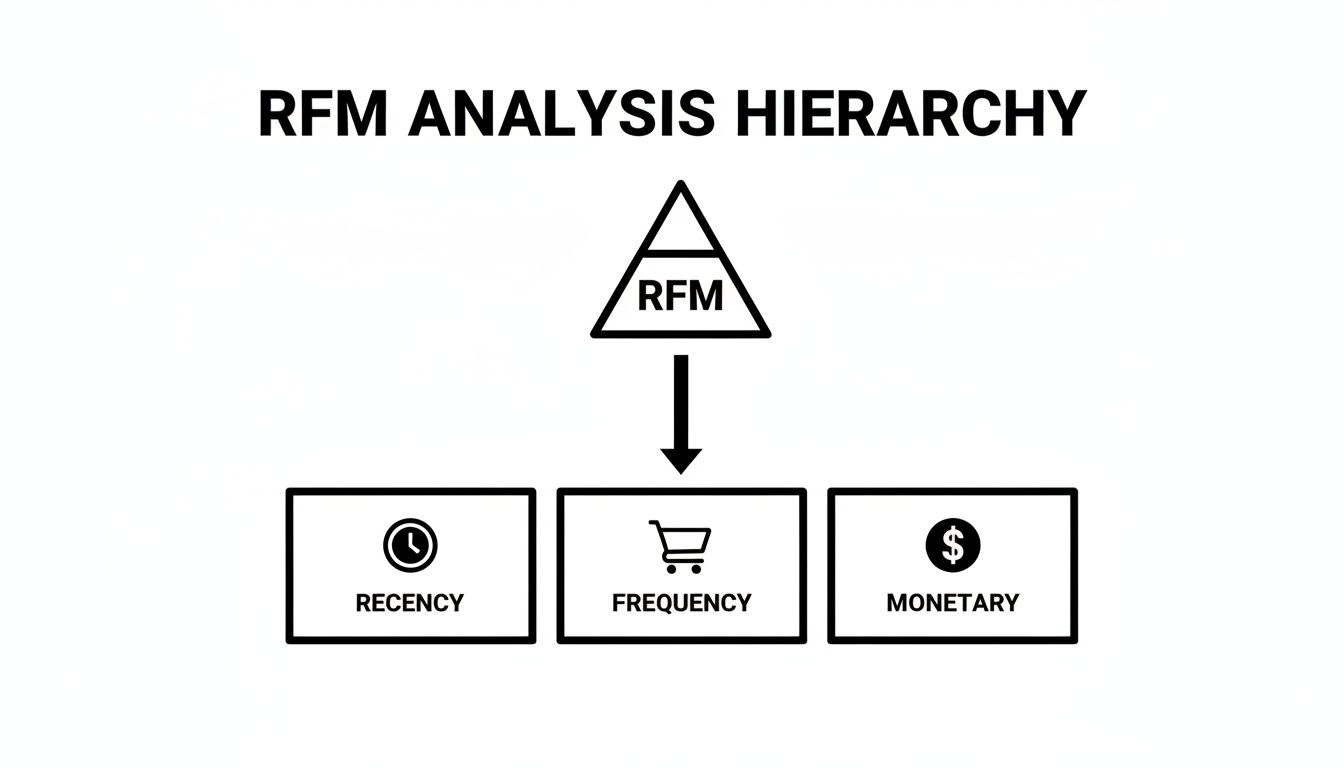
It’s a simple but powerful visual. Each metric gives you a different lens to look through, helping you understand both customer behavior and their overall value to your business.
The Most Common RFM Customer Segments
While you could technically create 125 different segments (5x5x5), that’s not practical for anyone. The real magic happens when you simplify and group these combinations into a handful of core segments. This makes targeting manageable and your strategy crystal clear.
Here are the essential segments every DTC brand should start with.
Champions (Score: 555) These are your absolute best customers. They bought recently, they buy often, and they spend the most. They’re the lifeblood of your business.
Behavior: Think of them as brand advocates who are always excited to try your new products first.
Strategic Value: Protect this group at all costs. Your main job here is to reward them, keep them happy, and inspire them to spread the word.
Loyal Customers (Scores: X5X, where R and M are 3-5) This group loves your brand and comes back again and again. While they might not spend quite as much as Champions in a single order, their consistency makes them incredibly valuable.
Behavior: They are the bedrock of your revenue—the reliable repeat buyers you can count on.
Strategic Value: Focus on nurturing them to become your next Champions. Loyalty programs and smart upsell offers are your best friends here.
Potential Loyalists (Scores: X3-5X, where R is 3-5, F is 1-2) These are newer customers who are showing all the right signs. They've bought recently and have either made a couple of purchases or spent a decent amount. They're on the cusp of becoming long-term fans.
Behavior: They’ve had a good first experience and are warming up to your brand.
Strategic Value: Your mission is simple: get them to make that second or third purchase. A solid onboarding series and personalized follow-ups can work wonders.
This isn’t just theory; it's backed by hard data. A 2023 study of a Brazilian retailer found that its top 20% of customers—a segment they called "Brand Champions"—drove a staggering 40% of total revenue. This elite group had purchased just 7.20 days ago on average and made nearly 11 transactions each. It’s a powerful reminder of how much impact focusing on your best buyers can have.
Segments That Need Your Attention
Beyond celebrating your top-tier customers, RFM is a fantastic early-warning system. It helps you spot customers who are drifting away before they're gone for good. These at-risk segments are where your retention efforts can deliver a huge ROI.
Recognizing at-risk customers is one of the most profitable actions you can take. It’s far cheaper to save a customer who already knows you than to acquire a brand new one.
Here are the critical at-risk groups to watch:
At-Risk Customers (Scores: 1-2, 3-4, 3-4): These were once good customers. They bought frequently and spent well, but it's been a while. They’re valuable, but you’re losing them.
Can’t Lose Them (Scores: 1-2, 5, 5): This is a red alert. These were once your Champions or Loyal Customers—high frequency, high spend—but they've gone completely silent. Finding out why is a top priority.
Hibernating (Scores: 1-2, 1-2, 1-2): These customers have low scores across the board. They made a low-value purchase a long time ago and never came back.
By organizing your customer base into these clear RFM customer segments, you can finally move past generic, one-size-fits-all marketing. You’re now equipped to create highly relevant campaigns that speak directly to what each group has done—and what you want them to do next.
Activating RFM Segments in Your Ad Campaigns
Okay, you’ve done the hard work of crunching the numbers and defining your RFM customer segments. Now comes the fun part: turning that analysis into a real advertising strategy that makes you money. This is where you stop just looking at data and start using it on platforms like Meta and Google to talk to customers in a way that actually resonates.
It’s time to ditch the one-size-fits-all campaigns. We're going to map specific ad tactics to each segment, building a marketing engine that's more efficient, profitable, and predictable. Think of it as sending the right message to the right person at the right time.

Engaging Your High-Value Segments
Your best customers are gold. They deserve the white-glove treatment, not a 10% off coupon. For Champions and Loyal Customers, our goals are retention and getting them to spread the word.
For Your Champions (Score: 555):
Audience Strategy: First, upload this customer list as a custom audience. You can use it for exclusive early access to new drops or VIP-only content. But the real magic? Create a 1-3% lookalike audience from this list. You’re essentially telling the ad platforms, "Go find me more people exactly like these amazing customers."
Creative Angle: Your messaging has to feel exclusive and appreciative. Forget discounts. Try ad copy like, "As one of our best customers, you get first dibs," or "A special preview, just for you." Make them feel seen.
Budget Allocation: You only need a small, consistent budget to nurture this group directly. The real investment here is in fueling your acquisition campaigns with the high-quality lookalikes they generate.
For Your Loyal Customers (Scores: X5X, with high R & M):
These are your reliable, repeat buyers. The goal is to get them to spend a little more and lock in their loyalty for the long haul.
Your marketing to loyal customers should feel like a conversation with a friend. Focus on upselling and cross-selling relevant products, not just pushing discounts.
For instance, if they regularly buy your coffee beans, show them an ad for your new premium espresso machine or a subscription that saves them a trip. The creative should feel like an insider tip, showing that you get them and what they like.
Re-Engaging At-Risk Customers
This is where your retention efforts can pay off big time. These are folks who used to be good customers but have gone quiet. A timely, compelling offer is often all it takes to bring them back.
For At-Risk Customers (Scores: 1-2, 3-4, 3-4):
Audience Strategy: Create a dedicated custom audience for this group. You'll be running a specific win-back campaign just for them.
Creative Angle: Urgency and a strong offer are your best friends here. Use copy like, "We've missed you! Here's 20% off to come back," or "Your favorites are waiting for you." Sometimes showing them new products that have launched since their last visit does the trick.
Budget Allocation: This segment is worth a more aggressive, short-term budget push. You want to reactivate them quickly before they're gone for good. A smart retention play here can dramatically improve your overall Return on Ad Spend (ROAS). You can learn more about how to track this in our complete guide to ROAS in digital marketing.
Nurturing Your New and Promising Customers
For brand-new buyers and those showing early promise (your Potential Loyalists), the entire strategy is about one thing: encouraging that crucial second purchase. This is your window to turn a one-time transaction into a long-term fan.
For New Customers (Scores: High R, Low F):
Welcome Series: Don't just leave them hanging after one purchase. Use a timed ad sequence. The first ad could share awesome user-generated content, the next might highlight your brand's mission, and a final one could offer a small thank-you incentive for their next order.
Product Discovery: They bought one thing, but they probably don't know what else you sell. Show them different product categories or best-sellers they haven't tried yet.
Build Trust: Hit them with ads featuring customer reviews, video testimonials, and trust symbols like your satisfaction guarantee. Reassure them that they made a great choice.
By activating these RFM customer segments with tailored strategies, you’re turning a simple analytics exercise into a powerful system for growth. You're no longer just throwing ad dollars at the wall; you're making smart investments to guide customers on their journey with your brand.
Using RFM Insights for Proactive Ad Management
Building out your RFM customer segments is a huge first step. But the real magic happens when you stop thinking of them as static lists and start using them for proactive, daily ad management. This is where analysis turns into action.
Instead of a one-off report, RFM becomes a living, breathing system for making smarter decisions. The key is to watch how customers move between segments and react to real performance shifts, not just random fluctuations in your data.
This approach keeps you from making common, expensive mistakes. For instance, how do you know if you're over-messaging your 'Champions' and creating ad fatigue? Without a system to track this, you could end up annoying your most valuable customers. Proactive management gives you the guardrails to know when to push and when to pull back, protecting your performance and your budget.
From Static Lists to Dynamic Guardrails
The single biggest mistake marketers make is treating RFM as a "set it and forget it" exercise. But customer behavior is anything but static. A 'Champion' today can easily become an 'At-Risk' customer in 60 days if they're ignored or targeted with the wrong message.
A dynamic approach means you're constantly monitoring these shifts. Think of it less like a snapshot and more like a health monitor for your entire customer base. You’re tracking vital signs over time to spot problems before they become crises.
The goal is to evolve from reactive decision-making ("Why did our ROAS suddenly drop?") to proactive adjustments ("Our 'Potential Loyalist' segment is shrinking; let's boost our nurturing campaign").
This is how you build sustainable growth. You stop just analyzing what happened last month and start influencing what happens next week by responding to customer behavior in near real-time.
Answering Critical Performance Questions
When you manage your ads proactively with RFM insights, you can finally answer the tough questions that keep performance teams up at night. For any DTC brand, the ability to correctly interpret audience signals is a massive competitive advantage.
Here are a few real-world examples of how this works:
Is My Lookalike Audience Saturated? Your lookalike built from 'Champions' was a winner for weeks, but now performance is slipping. By tracking the flow of new customers into your high-value RFM segments, you can see if that audience is still bringing in quality buyers. If not, it's a clear signal to refresh your source list.
Are We Causing Ad Fatigue? You notice a surprising number of customers moving from 'Champions' down to 'At-Risk'. This is a classic sign that your always-on retention ads are getting stale. This insight tells you to pause those ads or swap in fresh creative before you burn out your best people.
Should I Increase My Budget? A top-of-funnel campaign is bringing in tons of new customers. Great! But are they the right customers? By measuring how many of those new buyers actually convert into 'Potential Loyalists', you can confidently decide whether to scale that campaign's budget or not.
Tools built for this, like SpendOwlAI, provide the guardrails needed to turn this data into clear, daily actions. For teams ready to graduate from basic dashboards, exploring AI-driven marketing insights can be a powerful next step. It effectively turns RFM from a simple classification model into an active defense system against wasted ad spend.
Frequently Asked Questions About RFM
As you dig into rfm customer segments, you're bound to have questions. It’s a simple concept on the surface, but a few key details can make or break your results. Let's walk through some of the most common hurdles marketers face so you can get started with confidence.
My aim here is to give you practical, no-fluff answers that will help you put RFM analysis to work and sidestep those early mistakes.
How Often Should I Recalculate My RFM Segments?
The right timing really hinges on your store’s natural sales rhythm. You want to refresh your segments often enough to catch important changes in buying habits, but not so often that it becomes a chore.
For most DTC brands in spaces like fashion or beauty, recalculating your RFM segments every 30 to 90 days is a great starting point. This cadence keeps your audiences from getting stale and makes sure your targeting is based on what customers are actually doing.
But you might need to adjust based on your specific business:
High-Velocity Businesses: If you sell things people buy frequently, like coffee or supplements, a monthly refresh is probably your best bet. Customer behavior changes fast, and you need to keep up.
Longer Purchase Cycles: Selling furniture or expensive electronics? Those purchases are few and far between. A quarterly update is likely all you need.
If you see a sudden, unexplained drop in campaign performance, that’s a huge clue it's time to refresh your segments. It’s like a quick health check for your entire customer file.
Can I Use RFM with a Small Customer Base?
Yes, you absolutely can. In fact, RFM analysis is arguably even more powerful for businesses with smaller customer lists, even if you just have a few hundred. When every customer relationship matters, RFM helps you identify which ones matter most.
Sure, you'll have fewer people in each segment, but the clarity it provides is priceless. Knowing exactly who your 'Champions' are—even if there are only a handful of them—lets you roll out the red carpet and make sure they feel valued.
On the flip side, spotting 'At-Risk' customers early on gives you a chance to step in with a personal email or special offer before they’re gone for good. For small teams, that kind of focus is a game-changer. It ensures your precious time and budget go toward the people who are actually keeping the lights on.
What Is the Biggest Mistake to Avoid with RFM?
The single biggest mistake I see is treating RFM as a one-and-done report. It's so easy to build the segments, feel good about the insights, and then just... stop. The analysis itself has zero value until you act on it.
A segment isn’t just a static label; it's a direct command for your marketing team. If you create an 'At-Risk Customers' segment but never actually run a win-back campaign, you've wasted your time. If you know who your 'Champions' are but keep hitting them with the same generic 20% off ads you show to everyone else, you're not just missing an opportunity—you're actively damaging their loyalty and your margins.
To get real results from RFM, you have to commit to taking action. It means consistently using these segments to refine your audiences, tweak your ad creative, and personalize your offers. That’s how RFM evolves from a boring spreadsheet into a living, breathing system for smarter growth.
Ready to turn these RFM insights into clear, daily actions for your ad accounts? SpendOwlAI provides the guardrails to help you act on meaningful performance shifts, not just data noise. Start your free 7-day trial today and see how much time and ad spend you can save.