The Top 12 PPC Management Software for Agencies in 2026
Managing a growing portfolio of PPC clients quickly exposes the limits of manual workflows and the native ad platform interfaces. As account volume, channel complexity, and client expectations increase, agencies inevitably hit a ceiling. The constant context-switching between accounts, inconsistent reporting, and reactive fire-drills drain your team's resources and create unforced errors that can erode client trust. This guide is built to solve that problem by providing a clear, comparative analysis of the leading PPC management software for agencies.
This isn't another surface-level list. We move beyond marketing copy to dissect each platform through the specific lens of a busy agency. For each tool, you will find:
A practical breakdown of core features, not just a generic list.
Honest pros, cons, and ideal agency use cases.
Direct links and screenshots to give you a feel for the user experience.
Insight into pricing models and implementation considerations.
We will examine tools like SpendOwlAI, Optmyzr, and Search Ads 360, focusing on their ability to handle multi-account dashboards, provide transparent automation, and establish guardrails to prevent costly mistakes. Whether you are a small team outgrowing spreadsheets or a larger firm aiming to standardize your tech stack, this resource provides the detailed insights needed to select the right platform. The goal is to help you systemize your execution, reduce manual overhead, and ultimately deliver superior, scalable results for your clients.
1. SpendOwlAI
SpendOwlAI presents a distinct approach to PPC management software for agencies by replacing conventional dashboards with a daily, prioritized action list. Designed for operators managing Google, Meta, and Shopify ad ecosystems, it moves beyond raw data visualization to deliver concrete, ranked recommendations. Instead of leaving account managers to interpret complex charts, the system generates a clear "what to change today" list covering budgets, creatives, and audiences, ordered by expected performance impact.
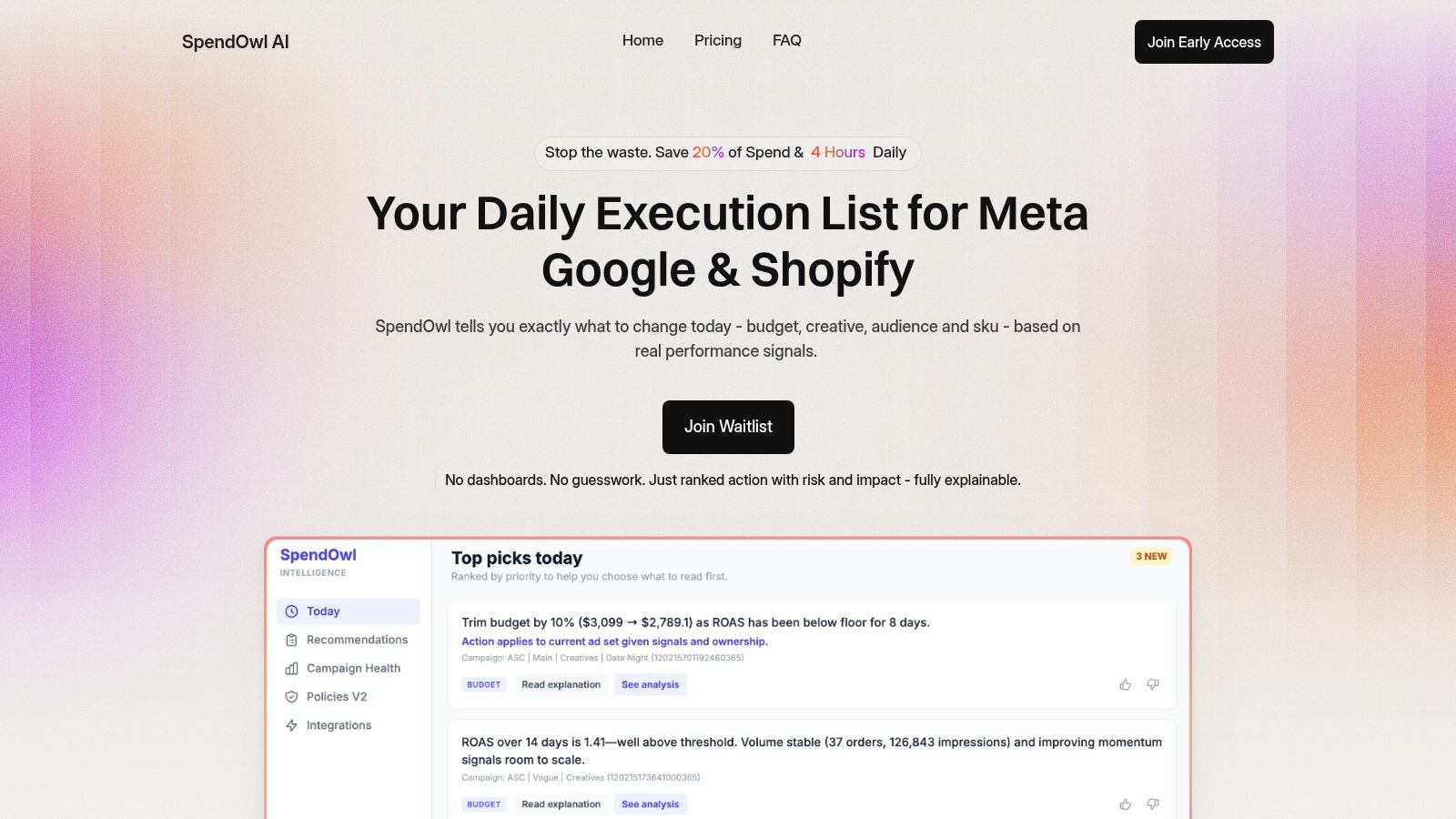
What truly sets it apart is its emphasis on transparent, "white-box" rationale. Every suggestion comes with an explanation, allowing agency staff to understand the 'why' behind a recommendation, which is critical for client communication and defending strategic choices. The platform continuously monitors key metrics like ROAS, CTR, and creative fatigue, but it also tracks operational factors such as edit frequency, learning phase stability, and audience saturation. This combination helps surface meaningful changes while actively preventing common agency pitfalls like over-editing accounts, scaling budgets prematurely, or making decisions without proper context.
Ideal Use Case and Implementation
SpendOwlAI is best suited for performance-focused agencies and in-house teams that need to improve daily execution efficiency and reduce wasted ad spend. It functions as a decision-support system, not a fully automated "black-box" tool. The ideal workflow involves an account manager reviewing the daily ranked list, inspecting the rationale for the top recommendations, and then implementing the changes in the native ad platforms. This keeps the human operator in full control but significantly reduces the time spent on manual analysis and guesswork.
For agencies, the multi-account visibility is a core benefit. It aggregates the most critical actions across an entire client portfolio into a single, unified view. This allows an agency director or team lead to quickly spot which accounts need immediate attention, ensuring no client is overlooked during a busy day. Getting started involves connecting ad accounts, after which the platform begins its analysis. The site offers a free 7-day trial, and access is currently managed through a waitlist for its limited early-access program.
Core Features, Pros & Cons
Feature Analysis | Pros | Cons |
|---|---|---|
Ranked Daily Actions: Delivers a prioritized to-do list based on expected impact across budgets, creative, and audiences. | Action-First Workflow: Drastically cuts down decision friction and the time needed for daily account check-ins. The site claims it can save teams up to four hours daily. | Requires Operator Input: It is not a set-it-and-forget-it autopilot. Teams must still review and execute the recommendations, which might not suit agencies looking for 100% automation. |
Guardrails & Explainability: Provides transparent reasons for each suggestion and flags risks like over-editing or premature scaling. | Reduces Errors: The system helps prevent common but costly mistakes that destabilize ad account performance, preserving campaign learning and improving budget efficiency. | Limited Availability: The platform is in a limited early-access phase with invite-only tiers. Final pricing is not yet public, which can make it difficult for some agencies to budget for adoption. |
Agency-Specific Tools: Offers multi-account visibility, creative fatigue detection, and SKU-level signals for e-commerce clients. | Built for Operators: The feature set directly addresses pain points for teams managing multiple brands, providing insights that go deeper than standard platform metrics. | |
AI-Driven Insights: Analyzes performance trends and operational stability to surface what truly matters. Explore the blog to understand more about its approach to AI-driven marketing insights. | Cuts Through the Noise: Focuses attention on high-impact opportunities rather than overwhelming users with more data dashboards, directly supporting its claim to save 20% of ad spend. |
Website: https://spendowlai.com
2. Optmyzr
Optmyzr is a mature and highly respected PPC management platform designed with the needs of serious practitioners and agencies at its core. It strikes a powerful balance between sophisticated automation and maintaining human control, a key reason it's a go-to tool for teams that need to scale their optimization efforts without losing strategic oversight. The platform provides a system for managing Google Ads and Microsoft Ads, focusing on repeatable workflows and rule-based optimizations.
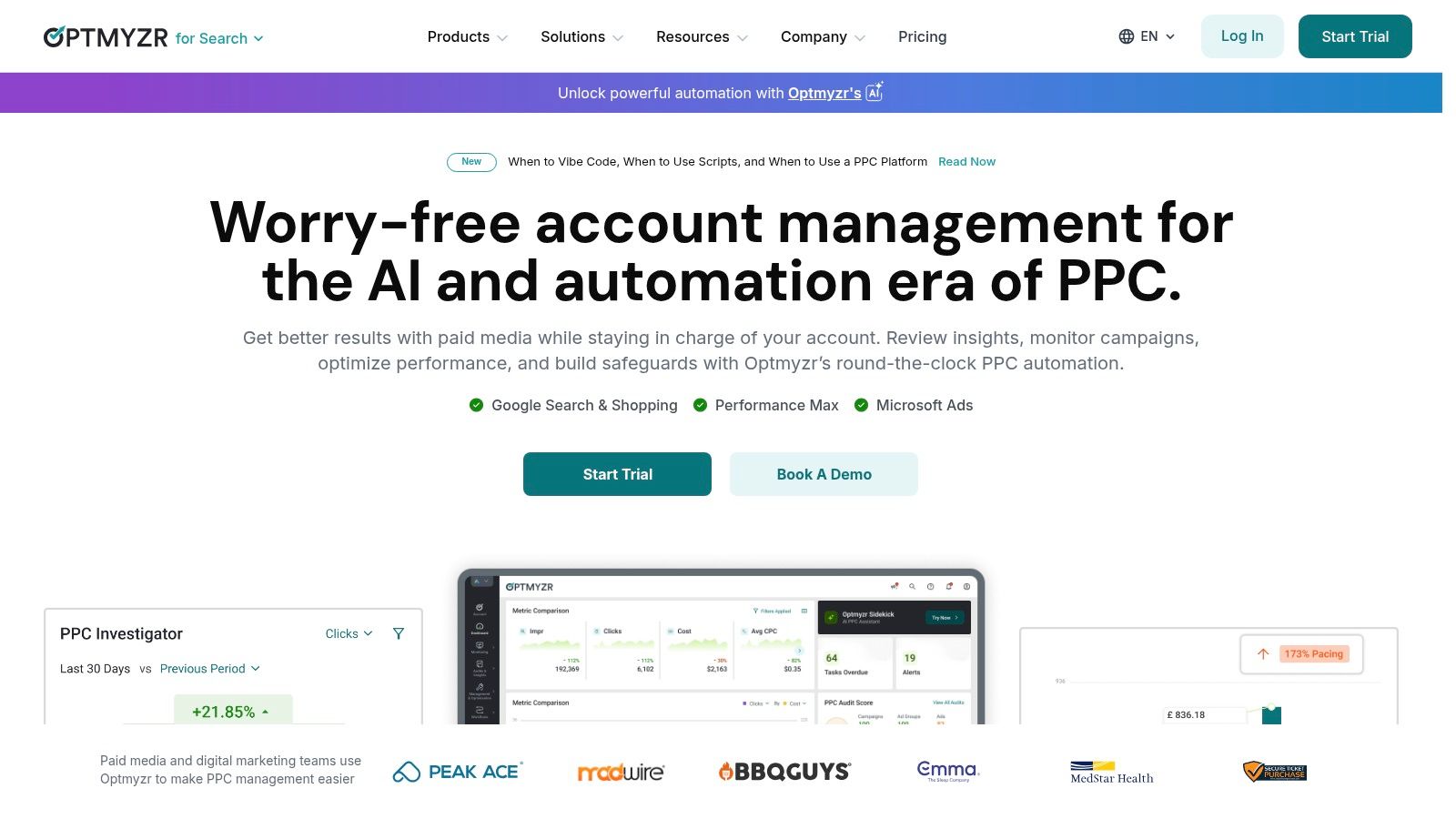
What sets Optmyzr apart is its practitioner-first approach. Instead of a "black box" AI, it provides tools like the Rule Engine and custom alerts that let agencies build their own optimization logic. This makes it an ideal piece of PPC management software for agencies that have established their own best practices and want to apply them consistently across a large portfolio of client accounts. A standout feature is the inventory-driven Campaign Automator, which is exceptionally useful for e-commerce agencies managing clients with large, frequently changing product catalogs.
Key Details & Use Case
Ideal Agency: Mid-to-large agencies or in-house teams managing significant ad spend that need to systematize their optimization processes. It's perfect for teams that distrust fully automated solutions and prefer to build and control their own automation rules.
Pricing: Tiered pricing starts at $416/month (billed annually) for the Core plan, scaling up based on ad spend and feature requirements. Add-ons for Shopping, Social, and Amazon Ads are available at an extra cost.
Unique Feature: The "One-Click Optimizations™" provide data-backed suggestions that still require a manager's approval to implement, reinforcing the human-in-the-loop philosophy.
Pros:
Purpose-built for PPC experts, not just account managers.
Strong toolset for Shopping campaigns and RSA creation.
Reduces reliance on complex, fragile spreadsheets and scripts.
Cons:
Pricing can become a significant expense for agencies with very large ad spend portfolios.
Requires a dedicated effort to learn and fully implement the more advanced tools.
Website: https://www.optmyzr.com/
3. Google Search Ads 360 (SA360)
Google Search Ads 360 (SA360) is Google's own enterprise-grade search management platform, designed for advertisers with immense scale and complexity. It sits within the Google Marketing Platform and provides a centralized hub for managing massive campaigns across multiple search engines, not just Google Ads. Its core purpose is to unify bidding, reporting, and management for organizations that need rigorous governance and deep data integration.
What makes SA360 distinct is its native connection to the broader Google ecosystem, including Analytics 360, Campaign Manager 360, and Display & Video 360. This allows for powerful cross-channel attribution and audience sharing that third-party tools cannot replicate. For agencies managing global brands or complex e-commerce accounts, SA360 provides the architecture for advanced bid strategies based on Floodlight conversions and unified data. It is the premier PPC management software for agencies operating at the highest level of advertising maturity, where having a holistic view is essential to improve Google Ads performance and other channel efforts.
Key Details & Use Case
Ideal Agency: Large, enterprise-focused agencies or global in-house teams managing many brands and eight-figure budgets. It is built for those who require deep integration with the Google Marketing Platform stack and advanced, cross-engine bidding.
Pricing: Custom enterprise pricing. Access is typically bundled with other Google Marketing Platform products and involves a percentage of ad spend, making it significantly more expensive than SMB tools.
Unique Feature: Floodlight conversion tracking allows for deduplicated, cross-channel conversion data to fuel powerful automated bidding and reporting, providing a single source of truth for attribution.
Pros:
Enterprise-grade governance and deep integrations with Google Marketing Platform.
Unmatched capabilities for very large portfolios and advanced, cross-engine workflows.
Unified real-time data and access to Google's most powerful automated bidding models.
Cons:
Pricing structure is prohibitive for all but the largest advertisers.
Requires significant enablement, process discipline, and specialized expertise to realize its full value.
Website: https://marketingplatform.google.com/about/search-ads-360/
4. Skai (formerly Kenshoo)
Skai positions itself as an omnichannel performance advertising platform, extending well beyond just paid search to cover paid social, retail media, and app marketing. It's an enterprise-grade solution used by large global agencies and Fortune 500 brands to unify planning, optimization, and measurement across a complex web of channels. The platform is built for massive scale, providing a single source of truth for advertising data.
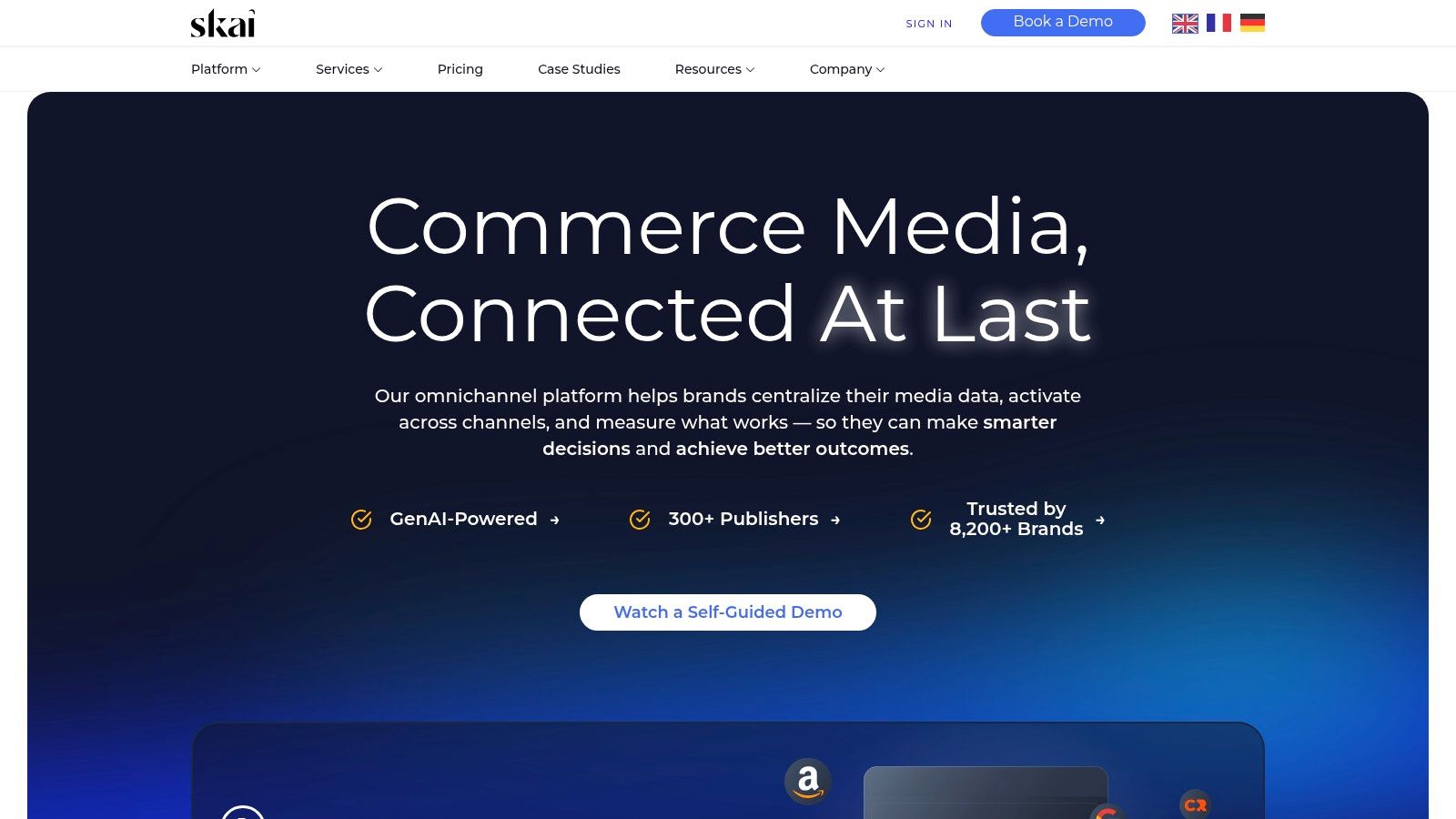
What makes Skai stand out is its deep integration with retail media networks like Amazon, Walmart Connect, and Target, placing it a step above typical search-focused tools. For agencies managing big-box brands with a heavy retail presence, this is a critical differentiator. The platform’s advanced forecasting and budget-pacing tools allow teams to make strategic decisions based on predictive intelligence. This makes it a powerful piece of PPC management software for agencies that need to manage large, multi-channel budgets with strict governance and performance goals.
Key Details & Use Case
Ideal Agency: Large, enterprise-level agencies managing significant multi-channel ad spend for major brands. It is particularly suited for those with a strong focus on retail media in addition to traditional search and social advertising.
Pricing: Custom enterprise pricing. Access typically requires a substantial minimum ad spend, making it inaccessible for smaller agencies or independent contractors.
Unique Feature: The cross-channel budget forecasting and optimization engine allows agencies to plan and allocate spend across search, social, and retail media from a single, unified interface.
Pros:
Exceptional for multi-channel, multi-brand agency environments.
Industry-leading depth in retail media alongside search and social.
Provides robust data governance and decisioning layers for enterprise needs.
Cons:
Pricing model and high minimum spend requirements exclude smaller teams.
Implementation and training represent a significant time and resource investment.
Website: https://skai.io/
5. MarinOne (Marin Software)
MarinOne is a long-standing, enterprise-grade platform built for unifying cross-channel advertising efforts across paid search, social, and retail media. Its primary strength lies in data consolidation, offering agencies a single source of truth for optimization, reporting, and budget management. This makes it a powerful tool for large agencies managing complex, multi-channel strategies for high-spend clients who demand integrated insights.
What distinguishes MarinOne is its capacity to not only manage multiple publishers but also to export unified data directly into an agency's BI tools or data warehouse. This functionality is critical for agencies that perform deep, custom analysis beyond a platform's built-in reports. While some lighter tools focus purely on in-platform actions, MarinOne acts as a central data hub, making it a valuable piece of PPC management software for agencies that prioritize data ownership and bespoke business intelligence.
Key Details & Use Case
Ideal Agency: Large, full-service agencies managing significant, multi-channel ad spend (search, social, retail) that require a robust data integration and reporting solution. It is well-suited for teams that need to feed clean ad data into their own BI systems.
Pricing: Marin offers published starting prices and a 30-day free trial. Agency-specific plans are available, with pricing dependent on ad spend and required features.
Unique Feature: The ability to connect directly to an agency's data warehouse or BI tools for custom reporting and analysis, providing a level of data freedom not common in all platforms.
Pros:
Excellent for unifying data from disparate channels like Google, Meta, and Amazon.
Agency-specific packaging and service options are available.
Transparent starting prices and a generous 30-day free trial.
Cons:
Advanced automation and AI forecasting features are gated behind higher-tier plans.
Can be perceived as more complex to implement compared to newer, more focused tools.
Website: https://www.marinsoftware.com/
6. Smartly.io
Smartly.io is an enterprise-grade platform specializing in creative and media automation, with a strong focus on paid social channels like Meta, TikTok, and Pinterest. It’s designed for large-scale advertisers and agencies that need to fuse creative production directly with media buying to maximize performance. The platform excels at automating workflows across massive paid social portfolios, especially for e-commerce and app install campaigns.
What distinguishes Smartly.io is its tight integration of creative and media execution. Agencies can use it to build dynamic ad templates that pull from product feeds, then test and iterate on creative variations at a scale that's impossible to manage manually. This makes it a formidable piece of PPC management software for agencies focused on performance branding, where creative effectiveness is a primary growth lever. The inclusion of enterprise-level support with clear service-level agreements (SLAs) also provides a layer of governance and reliability that large agency teams require. For teams looking to master campaign growth on these platforms, understanding the fundamentals of how to scale Facebook ads is a critical first step.
Key Details & Use Case
Ideal Agency: Large agencies or enterprise brands managing significant social ad spend ($50k+/month) that need to automate creative production and testing in tandem with media buying.
Pricing: Based on a percentage of ad spend, typically with a required monthly minimum fee. This model makes it more suitable for high-spend accounts.
Unique Feature: The Creative Automation tools allow for building thousands of ad variations from a single template and product feed, enabling hyper-relevant and continuous creative testing.
Pros:
Exceptional creative and media execution loop for performance teams.
Enterprise support model with documented SLAs and dedicated reps.
Powerful automation rules for budget, bidding, and creative management across social channels.
Cons:
Pricing structure can be prohibitive for smaller agencies or clients with lower ad spend.
Can be overly complex for teams that don't need advanced creative automation features.
Website: https://www.smartly.io/
7. Madgicx
Madgicx positions itself as an "eCom Ad Cloud," with a clear focus on automating Meta and Google Ads for direct-to-consumer brands and the agencies that serve them. It provides a suite of tools geared toward rapid creative analysis, audience discovery, and cross-channel bidding automation. This makes it a strong contender for performance agencies that heavily prioritize social commerce and need to iterate quickly on creatives and audiences to drive results.
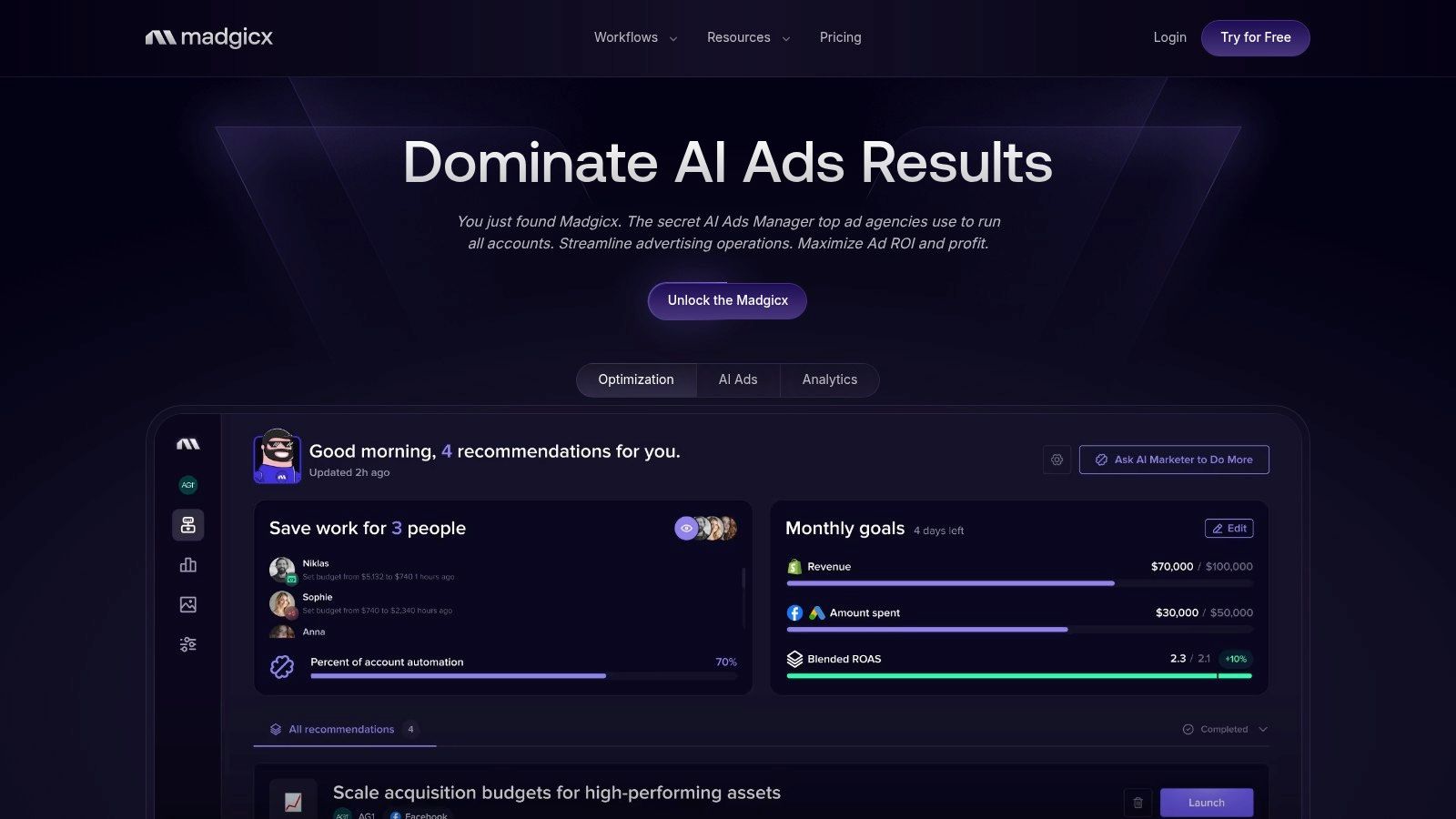
What distinguishes Madgicx is its deep integration with the creative and audience-building aspects of paid social, which are often siloed from traditional bid management tools. Its creative analytics help agencies quickly identify winning ad elements, while the Audience Studio simplifies the process of discovering and launching new targeting segments. This makes it a powerful piece of PPC management software for agencies looking to scale their clients' social ad performance. A notable feature is the Tracking Pro add-on, which offers server-side tracking to improve data accuracy in a post-iOS 14 environment.
Key Details & Use Case
Ideal Agency: E-commerce and DTC-focused agencies that manage a significant portion of their clients' budgets on Meta and Google. It’s a great fit for teams that need to automate creative testing and audience management without building custom scripts.
Pricing: Pricing is based on ad spend, with plans starting around $99/month for up to $3k in spend and scaling from there. The Tracking Pro add-on is an additional cost.
Unique Feature: The Creative Insights and Audience Studio tools provide actionable intelligence on ad performance and targeting that goes beyond standard platform reporting, connecting creative success directly to audience segments.
Pros:
Strong creative and audience utilities built for Meta advertisers.
Quick to onboard and begin automating campaigns.
First-party tracking add-on helps address measurement gaps.
Cons:
Search-specific management tools are less developed than search-first platforms.
Pricing can be dynamic, varying with ad spend and selected add-ons.
Website: https://madgicx.com/
8. Birch (formerly Revealbot)
Birch, which was previously known as Revealbot, is an automation and alerting platform built for agencies managing campaigns across Meta, Google, TikTok, and Snap. Its strength lies in a flexible and powerful rule engine that allows teams to automate routine tasks like pausing underperforming ads, scaling successful ad sets, or adjusting bids based on custom performance metrics. The system is designed to integrate directly into an agency's existing communication workflows.
What makes Birch a notable piece of PPC management software for agencies is its chat-centric approach to alerts. Instead of requiring managers to live inside another dashboard, it sends real-time performance notifications and rule execution updates directly to Slack. This keeps the team informed and allows for quick responses without context switching. The platform also includes useful utilities for building audiences from customer lists and launching new creatives across multiple accounts, which is a major time-saver for busy teams.
Key Details & Use Case
Ideal Agency: Performance marketing agencies that are heavily active on social ad platforms (Meta, TikTok) in addition to Google and need a centralized automation hub. It’s perfect for teams that value real-time, chat-based alerts.
Pricing: Starts at $83/month (billed annually) for up to $10,000 in monthly ad spend. Pricing scales with total ad spend, and teams need to be mindful of potential overage charges. A 14-day free trial is available.
Unique Feature: The deep integration with Slack for real-time alerts and reporting sets it apart. This turns a passive communication tool into an active part of the campaign management process.
Pros:
Strong, flexible automation core that supports major social and search platforms.
Chat-centric alerting system keeps teams agile and informed.
Clear plan options and a free trial for proper evaluation before committing.
Cons:
Pricing is based on total monthly ad spend, so overages need to be monitored.
The best value is realized with moderate-to-high campaign volume where automation can have a significant impact.
Website: https://bir.ch/
9. Adalysis
Adalysis is a performance-focused platform that specializes in deep auditing, rigorous ad testing, and budget management for Google and Microsoft Ads. It's built for agencies and practitioners who prioritize continuous quality assurance and statistical validity in their optimization workflows. The platform acts as an always-on QA layer, constantly scanning accounts for performance deviations, structural issues, and missed opportunities.
What makes Adalysis a critical tool for many is its extensive library of over 100 customizable audit checks. This functionality is invaluable during client onboarding, allowing an agency to quickly diagnose an inherited account's health and demonstrate immediate value. This focus on auditing and data-driven testing makes it an essential piece of PPC management software for agencies that need to enforce best practices and identify hidden issues at scale. Its practical tools, like the n-gram analysis for search queries and the RSA asset manager, directly address time-consuming manual tasks.
Key Details & Use Case
Ideal Agency: Small-to-mid-sized agencies or consultants who need a robust, automated system for account audits and A/B testing without the overhead of enterprise platforms. It is particularly strong for teams that manage many search-heavy accounts.
Pricing: Ad spend-based pricing starts around $99/month for up to $10k in monthly spend, with unlimited users and accounts within the subscription tier. The cost scales with total ad spend under management.
Unique Feature: The Performance Analyzer tool allows for multi-dimensional analysis, helping managers quickly find the root cause of performance changes (e.g., was it a specific device, network, or ad group that caused the drop?).
Pros:
Excellent audit/QA coverage for agency onboarding and routine maintenance.
Practical budget and testing utilities that reduce dependency on spreadsheets.
Unlimited users and accounts per subscription simplifies agency-wide adoption.
Cons:
The user interface is utilitarian and data-heavy, which may be less intuitive for junior team members.
Primarily focused on search engines with limited depth for paid social or other channels.
Website: https://adalysis.com/
10. Opteo
Opteo positions itself as a smart assistant for Google Ads, focusing on delivering clear, actionable daily improvements rather than overwhelming users with data. It’s designed for speed and efficiency, making it an excellent fit for agencies managing a high volume of small-to-medium-sized client accounts. The platform continuously monitors accounts for performance dips, budget pacing issues, and missed opportunities, then presents these findings as simple, guided tasks.
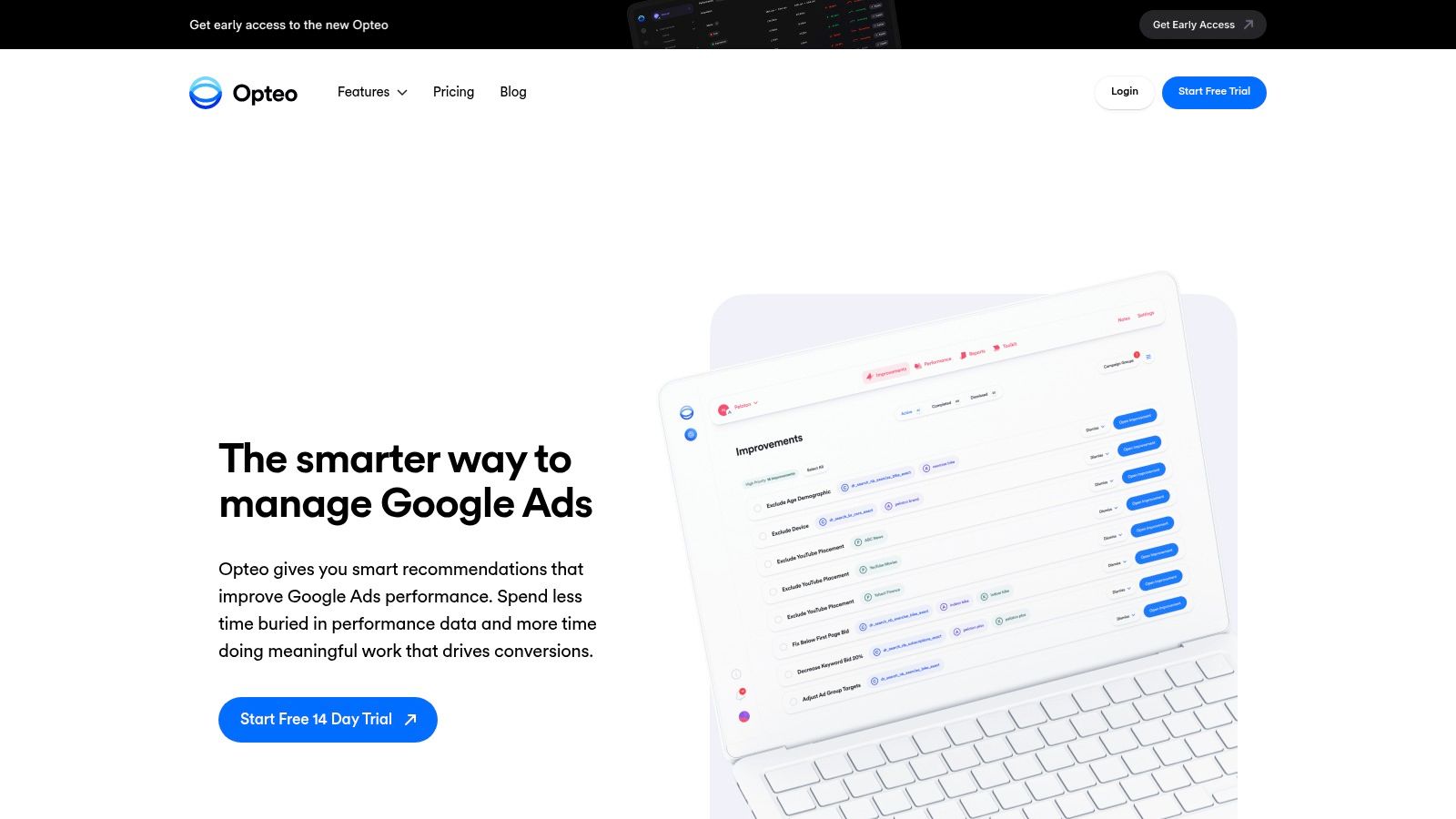
The core strength of Opteo is its simplicity and focus. Instead of providing a complex rule-building engine, it offers a curated list of "Improvements" that a manager can approve or dismiss with a click. This makes it an ideal piece of PPC management software for agencies that need to delegate daily account checks to junior staff or want to enforce a consistent optimization routine across their entire portfolio without extensive training. The emphasis is on quick wins and error prevention, like flagging keyword conflicts or suggesting negative keywords based on poor-performing search terms.
Key Details & Use Case
Ideal Agency: Small-to-mid-sized agencies or freelancers with a large roster of SMB clients primarily on Google Ads. It’s perfect for teams that need a tool for fast, routine optimizations without the complexity of enterprise-level platforms.
Pricing: Transparent, spend-based pricing starts at $99/month for agencies managing up to $50k in monthly ad spend. Tiers scale up, with higher tiers offering faster data refresh cycles.
Unique Feature: The "Improvements" feed acts like a prioritized to-do list, flagging issues and suggesting fixes for everything from ad copy performance to budget management and conversion tracking problems.
Pros:
Extremely user-friendly with a minimal learning curve.
Clear, published pricing makes it easy for smaller agencies to budget.
Excellent for maintaining and incrementally improving many smaller accounts.
Cons:
Primarily focused on Google Ads with limited native support for other channels.
Data refresh frequency is tied to the pricing tier (from 24 hours down to 6 hours).
Website: https://opteo.com/
11. Shape
Shape carves out a specific and crucial niche in the PPC ecosystem by focusing almost exclusively on budget management and pacing. While many platforms include budgeting as a feature, Shape makes it the main event, providing agencies with a powerful system to prevent over- and underspend across Google, Microsoft, Meta, and other ad networks. This laser focus makes it an indispensable tool for account managers juggling numerous clients with strict monthly budgets.
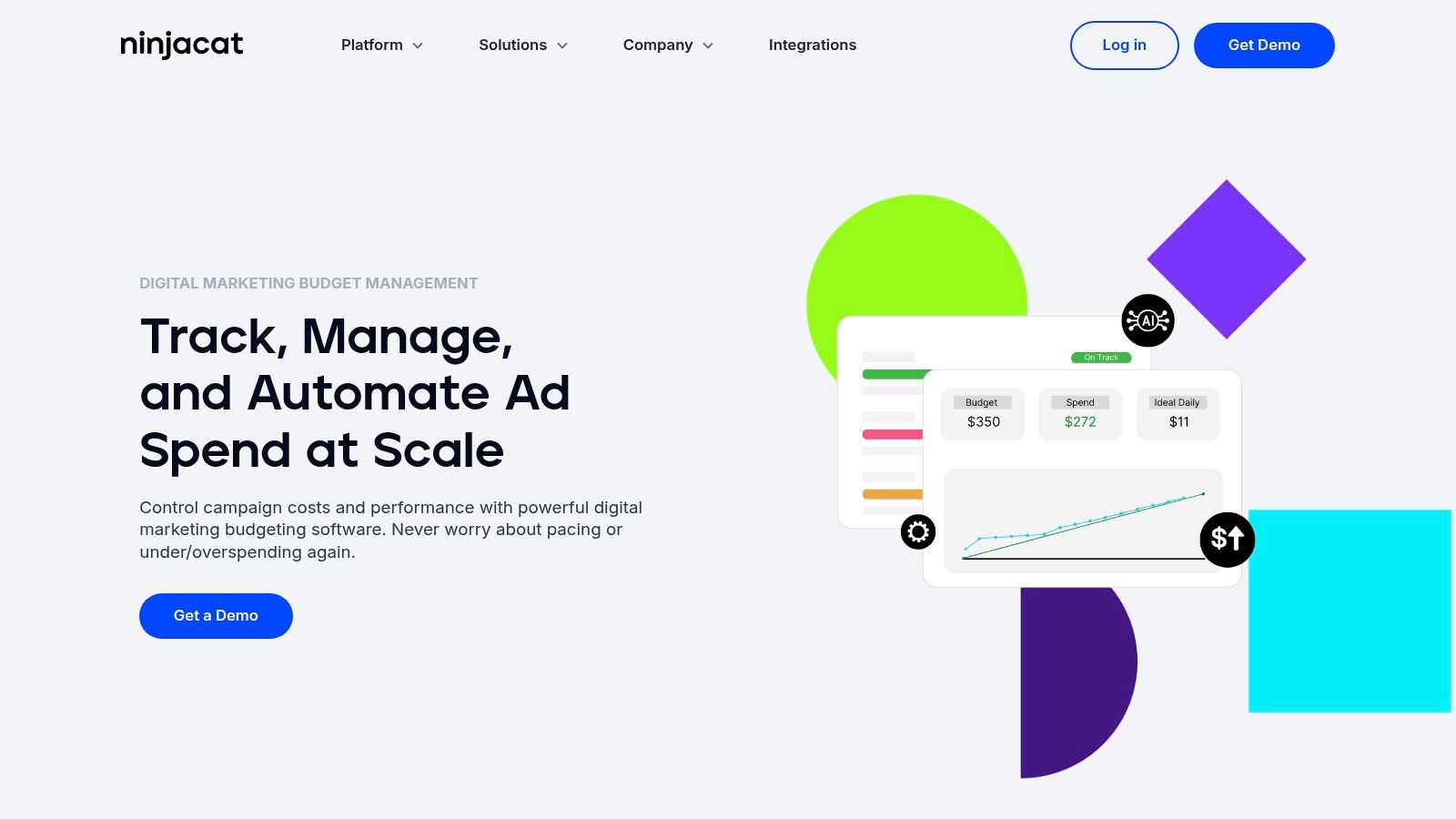
What makes Shape a standout piece of PPC management software for agencies is its ability to standardize budget governance. Its "Budget Pacer" automatically adjusts daily caps based on performance and allows for spend rollovers between periods. For agencies managing dozens of accounts, this removes the need for constant, manual spreadsheet checks. The platform also offers an Advertising Data Infrastructure (ADI), which pipes clean, standardized spend data directly into business intelligence tools like Looker Studio or Tableau for centralized reporting.
Key Details & Use Case
Ideal Agency: Any agency, from small to large, that prioritizes hitting exact client budgets every month. It's especially valuable for teams that need to centralize financial reporting and prove fiscal discipline.
Pricing: Starts with a "Pro" plan for single-brand use. Agency plans with multi-client functionality and the ADI feature are priced based on the number of budget "Shapes" and ad spend, requiring a custom quote.
Unique Feature: The "AutoPilot" rules engine allows for automated pausing of campaigns when budgets are hit or a custom spend threshold is reached, providing a critical safety net against accidental overspend.
Pros:
Purpose-built for budget pacing, which it does exceptionally well.
The ADI simplifies cross-channel financial reporting for BI dashboards.
Automated rules provide a reliable safeguard against budget errors.
Cons:
It's a specialized tool, not an end-to-end optimization platform.
Costs for multi-client use and the ADI feature are separate and can add up.
Website: https://shape.io/
12. TrueClicks
TrueClicks operates as an indispensable quality assurance layer for your Google Ads and Microsoft Ads accounts. Rather than replacing the strategist, it acts as a persistent, automated auditor, constantly scanning for issues that lead to wasted spend and missed opportunities. Its core function is to provide an 'extra pair of eyes' that enforces best practices and monitors account health across your entire client portfolio, ensuring a consistent standard of quality.
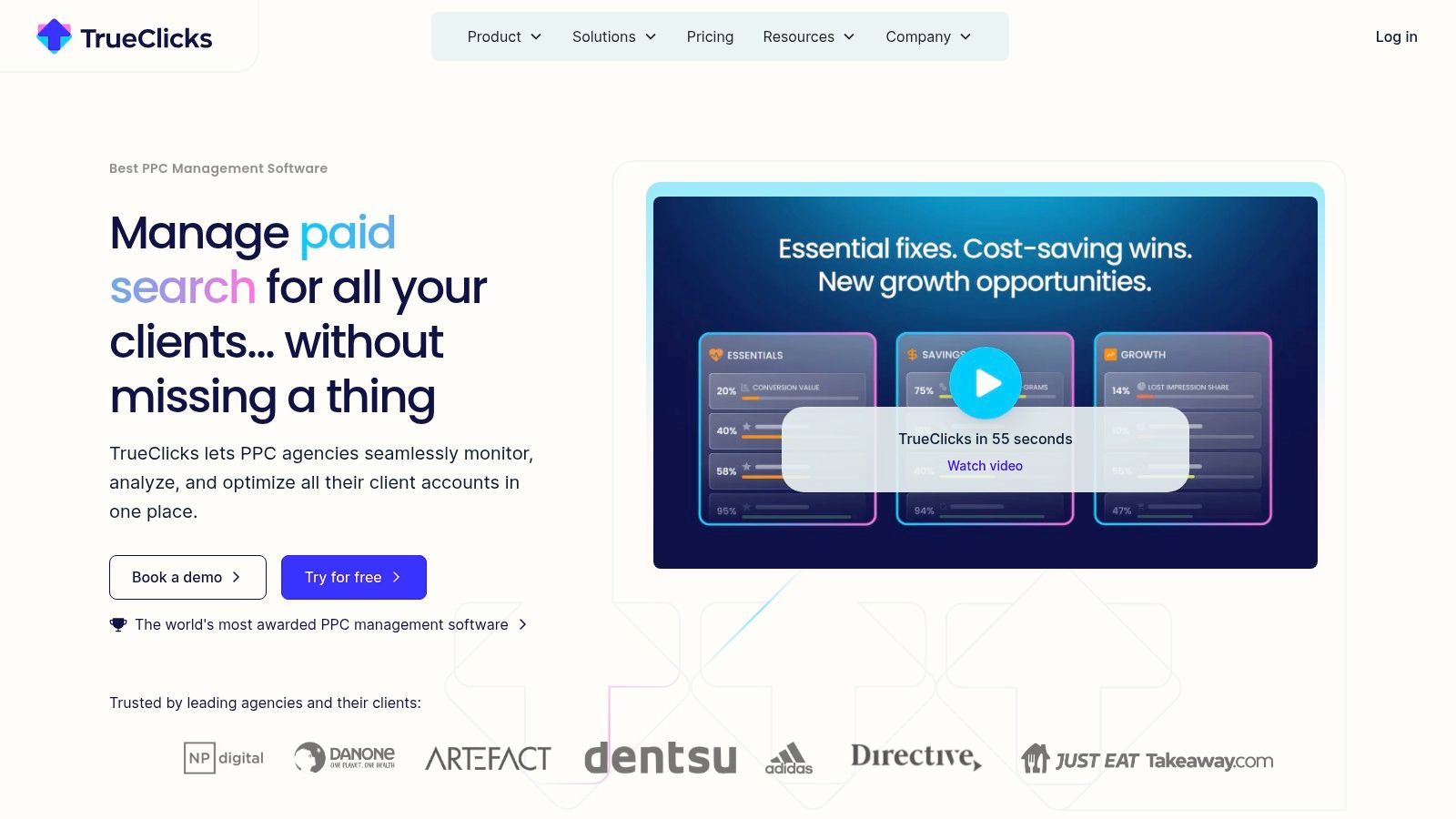
The platform’s strength lies in its 100+ automated checks that cover everything from conversion tracking integrity and budget pacing to ad copy relevance and negative keyword conflicts. This makes it an exceptional piece of PPC management software for agencies focused on operational excellence and standardization. Instead of manually auditing accounts, managers can rely on TrueClicks to surface critical and minor issues, complete with clear instructions for resolution. It helps agencies establish and maintain a high baseline of account quality, which is crucial when onboarding new clients or team members.
Key Details & Use Case
Ideal Agency: Small to enterprise-level agencies that want to standardize account management quality and prevent costly mistakes. It's especially useful for training junior staff and ensuring senior-level best practices are applied everywhere.
Pricing: A generous free plan is available for accounts with up to $50k/month in ad spend. Paid plans use a transparent, spend-based model starting around $83/month for $100k in spend, with unlimited users and accounts.
Unique Feature: The "Health Score" provides an at-a-glance metric for every account, gamifying the optimization process and making it easy for managers to prioritize which accounts need the most immediate attention.
Pros:
Free tier is genuinely useful for small accounts or piloting the tool.
Transparent, spend-based pricing is easy to understand and scale.
Excellent for enforcing quality control and training new team members.
Cons:
Strictly focused on Google and Microsoft Ads; no social media or creative analysis.
More of a monitoring and auditing tool than a full-fledged bid management or campaign creation platform.
Website: https://www.trueclicks.com/
Top 12 PPC Management Tools Comparison
Product | Core focus & features | UX / Quality ★ | Value & Price 💰 | Target 👥 | Unique selling points ✨ |
|---|---|---|---|---|---|
SpendOwlAI 🏆 | Daily ranked “what to change” lists; watches cost, CTR, ROAS, creative fatigue, SKU signals; guardrails | ★★★★☆ | 💰 Free 7‑day trial; tiered scale-based pricing; claims ~20% spend saved & 4h/day regained | 👥 DTC founders, performance managers, agencies | ✨ White‑box, explainable recommendations + risk flags; operator-first decision support |
Optmyzr | Rule engine, workflows, shopping tools, multi‑account reporting | ★★★★☆ | 💰 Pricing scales with spend; strong ROI for PPC teams | 👥 PPC practitioners & agencies | ✨ Inventory‑driven Campaign Automator; robust automation + human control |
Google Search Ads 360 (SA360) | Enterprise search mgmt, bid automation, deep GMP integrations (CM360/DV360/Analytics) | ★★★★★ | 💰 Custom/enterprise pricing; enterprise-grade attribution & governance | 👥 Large enterprises & multi‑brand agencies | ✨ Native Google Marketing Platform integration & governance |
Skai (Kenshoo) | Omnichannel optimization, forecasting, retail media, decisioning layers | ★★★★★ | 💰 Enterprise pricing; built for large ad budgets | 👥 Agencies & multi‑brand advertisers | ✨ Cross‑channel forecasting + strong retail media coverage |
MarinOne (Marin) | Budget pacing, bidding, AI forecasting, BI/data exports | ★★★★☆ | 💰 Published starting prices; 30‑day trial; enterprise tiers for advanced features | 👥 Agencies & mid‑to‑large advertisers | ✨ BI exports, long data retention and agency packaging |
Smartly.io | Creative production + media automation for paid social at scale | ★★★★★ | 💰 % of ad spend pricing with monthly minimums | 👥 Enterprise social advertisers & creative teams | ✨ Scaled creative→media execution loop with SLAs |
Madgicx | Meta & Google automation, creative analytics, audience discovery, Tracking Pro add‑on | ★★★★☆ | 💰 Spend‑based pricing + add‑ons (dynamic) | 👥 DTC agencies and fast‑moving e‑commerce teams | ✨ Rapid onboarding; first‑party tracking add‑on |
Birch (Revealbot) | Flexible automation rules, real‑time alerts, audience builder, creative launches | ★★★★☆ | 💰 Spend‑based pricing; 14‑day free trial | 👥 Agencies managing multi‑platform portfolios | ✨ Highly flexible rules + Slack/Sheets alerting |
Adalysis | Deep audits (100+ checks), ad testing, budget tracking, automated adjustments | ★★★★☆ | 💰 Practical agency pricing; ROI from QA/time saved | 👥 Agencies needing audit, testing & QA | ✨ Extensive audit suite and ad testing utilities |
Opteo | Guided daily Google Ads “Improvements”, budget help, scorecards | ★★★☆☆ | 💰 Clear agency tiers; cost‑effective for SMB portfolios | 👥 Agencies with many small Google Ads accounts | ✨ Lightweight, guided daily optimization with easy onboarding |
Shape | Budget pacer, rollovers, pausing rules, Advertising Data Infrastructure (ADI) | ★★★★☆ | 💰 Paid tiers for ADI and pacing; standardized agency billing | 👥 Agencies needing cross‑client pacing and BI | ✨ Purpose‑built budget pacing + warehouse connectors |
TrueClicks | Always‑on auditing (100+ checks), budget pacing, KPI tracking, integrations | ★★★★☆ | 💰 Free forever up to $50K/mo; transparent spend‑based pricing | 👥 Agencies seeking continuous QA & oversight | ✨ Free tier + continuous audits and Slack/Looker Studio integrations |
Making Your Final Decision: From Tools to a Tech Stack
We've explored a wide array of PPC management software for agencies, from enterprise-grade platforms like Google Search Ads 360 and Skai to more focused, task-specific tools like Adalysis and TrueClicks. The journey through these options reveals a critical truth: there is no single, perfect solution for every agency. The most effective approach isn't about finding one tool to do everything; it's about strategically assembling a tech stack that solves your most pressing operational challenges.
Your agency's ideal setup will depend entirely on its structure, client base, and biggest growth obstacles. A large agency managing eight-figure annual budgets might find the power and multi-channel integration of Skai or MarinOne essential. In contrast, a smaller, performance-focused team might get more value from the direct, actionable recommendations of a tool like Opteo or the powerful rule-based automation within Optmyzr. The key is to shift your perspective from "which software is best?" to "which software best solves my specific problems?"
Charting Your Course: A Needs-First Approach
Before committing to any platform, conduct an internal audit of your agency’s workflows. Where does your team spend the most manual, repetitive time? What are the biggest risks to client performance and retention? An honest assessment of these pain points will act as your compass.
Is daily account management a time sink? If your team is bogged down by routine checks, budget pacing, and identifying small optimization opportunities, a platform like SpendOwlAI could be your core. Its focus on prioritized daily actions and guardrails directly addresses the chaos of managing multiple accounts, freeing up strategists for higher-value work.
Do you need deep, rules-based automation? For agencies that want to build complex, custom "if-then" scenarios across campaigns, Optmyzr and Birch offer robust engines. This is ideal for standardizing processes like ad testing, bid adjustments based on weather data, or pausing low-performing keywords at scale.
Is budget management and reporting the main bottleneck? Tools like Shape and TrueClicks offer a focused solution. Shape excels at budget pacing and forecasting across clients, while TrueClicks provides an essential layer of quality assurance, ensuring accounts adhere to best practices.
Are you managing massive, multi-channel enterprise clients? This is where SA360 and Skai shine. Their ability to manage search, social, and retail media under one roof, coupled with advanced bidding and reporting, is built for complexity and scale that smaller tools can't handle.
From Selection to Implementation
Choosing the right PPC management software for your agency is only the first step. Successful implementation requires a deliberate plan. Start with a pilot program. Select one or two accounts, ideally with an internal champion who is excited to test the new system, and set clear goals. What specific metric do you want to improve? Are you aiming to reduce time spent on reporting by 50%? Or increase return on ad spend by 10% through better bid management?
Document your workflows and be prepared to adapt them. Software doesn't just automate old processes; it creates opportunities for entirely new, more efficient ones. For example, a tool that provides daily ranked actions eliminates the need for manual account "health checks." This allows you to redesign your account manager's day around strategic execution, not discovery.
Ultimately, the goal is to build a system that empowers your team, not just adds another login to their password manager. The right tech stack should create clarity, enforce consistency, and provide the leverage your agency needs to deliver superior client results. It’s an investment in your team’s capacity and your agency’s ability to scale with confidence and control.
Tired of the daily chaos of managing multiple PPC accounts? SpendOwlAI provides a centralized execution system designed for agencies, delivering prioritized daily actions, smart guardrails to prevent costly errors, and clear visibility across your entire client portfolio. Stop searching for problems and start executing solutions by visiting SpendOwlAI to see how you can streamline your agency's operations.