Marketing Cross Channel: marketing cross channel Fundamentals for Growth
Think of your marketing like an orchestra. In a multi-channel world, each instrument plays its own separate tune. The flute plays its melody, the violins have their own, and the drums are off doing a solo. You just hope the audience likes something they hear.
Cross-channel marketing, on the other hand, is the conductor. It brings every instrument together to play the same symphony, creating one powerful, cohesive experience for the listener.
Understanding the Cross-Channel Symphony

At its heart, cross-channel marketing is all about creating a unified and seamless customer journey across every single touchpoint. It’s a strategy built around the customer, not the channel.
Instead of treating your Meta campaigns, Google Ads, and Shopify store as separate battlegrounds, you start seeing them as connected parts of a single, fluid conversation with your customer.
This approach is so much more than just being present on multiple platforms. It's about making those platforms talk to each other. For instance, a customer might see a video ad for your brand on their Meta feed, search for you on Google later that day, and finally buy from your Shopify store a week later. A true cross-channel strategy makes sure the messaging, offers, and overall experience feel consistent and relevant at every single step.
Cross Channel vs. Multi Channel Marketing: What's the Real Difference?
It’s easy to get these two terms mixed up, but the key distinction boils down to one word: integration. Multi-channel marketing simply means you're using various channels to reach customers, but they often operate in total isolation from one another. A cross-channel strategy, however, intentionally connects these channels to create that cohesive symphony we talked about.
To make it crystal clear, here’s a breakdown of the fundamental differences.
Cross Channel vs Multi Channel Marketing Key Differences
Attribute | Multi-Channel Marketing | Cross-Channel Marketing |
|---|---|---|
Strategy | Channel-centric: Each channel is optimized independently to hit its own goals (e.g., best ROAS on Google). | Customer-centric: The entire journey is optimized, understanding how channels influence each other. |
Customer Experience | Fragmented and inconsistent. The customer gets a different message or offer on each platform. | Seamless and consistent. The experience feels like one continuous conversation, no matter the channel. |
Data & Insights | Siloed data. What happens on Meta stays on Meta, making it hard to see the full picture. | Integrated data. Insights from one channel inform actions on another, creating a unified view of the customer. |
Ultimately, the goal of multi-channel is to be everywhere, while the goal of cross-channel is to be everywhere with a purpose.
This integrated approach isn't just a "nice-to-have" anymore; for modern DTC brands, it's essential for sustainable growth. In fact, brands that run integrated campaigns see engagement rates jump by a massive 166% compared to single-channel efforts.
Businesses adopting these strategies also report 24% higher conversion rates, and customers who engage across multiple touchpoints tend to spend up to 10% more online. You can find more data on this in some recent studies about cross-channel performance.
Why This Matters for Your Brand
Adopting a cross-channel mindset is critical. It allows you to build a deeper, more meaningful relationship with your audience by delivering experiences that feel personal and consistent.
A cross-channel approach doesn't just improve marketing metrics; it builds brand equity. When every touchpoint reinforces the same core message, customers develop a level of trust and loyalty that siloed campaigns can never achieve.
This unified view helps you avoid common marketing mistakes, like sending a customer an ad for a product they just bought or overwhelming them with disconnected messages. It shifts your goal from winning on a single platform to winning the entire customer journey, which ultimately leads to higher customer lifetime value and a much stronger, more resilient brand.
How to Build Your Cross-Channel Strategy
Building a great cross-channel strategy isn't about having a massive team or a bottomless budget. It's about being smart and deliberate. You don't need to connect every single platform on day one. The real secret is to start small, get a few things right, and build momentum from there.
Think of it like building with LEGOs. You don't just dump the whole bin on the floor and hope for the best. You start with a solid base—two or three bricks that click together perfectly—and then you build up. We'll apply that same idea here: master the connection between a couple of core channels before you start adding more to the mix.
Establish a Single Source of Truth
Before you can get all your marketing channels to work together, they need to be reading from the same playbook. In marketing, that playbook is your customer data. This makes your first step the most important one: you absolutely must establish a single source of truth (SSoT) for all your customer information.
This just means bringing all your data from places like Shopify, Meta, and Google into one central hub. Without this, each channel is flying blind, working with a different, incomplete picture of the customer. You end up making silly mistakes, like sending a "10% off!" email to someone who just bought that exact item at full price through a Google Ad. It’s a clunky experience that screams "we don't know who you are."
A single source of truth makes sure every channel is on the same page, allowing you to create messaging that’s consistent and actually makes sense to the customer.
Map the Complete Customer Journey
Once your data is in one place, you can finally see the whole picture. Now you can map out what the complete customer journey really looks like. This isn't just about what happened on the last click before a sale. It’s about understanding every single touchpoint someone has with your brand, from the moment they first hear about you all the way to becoming a repeat buyer.
A common path might unfold something like this:
Awareness: A potential customer is scrolling their Meta feed and stumbles upon a compelling video ad for your brand.
Consideration: A week goes by. They remember your brand and head to Google to look for reviews, eventually clicking on one of your search ads.
Conversion: They land on your Shopify store, add a product to their cart... but then life happens, and they get distracted.
Re-engagement: An automated abandoned cart email lands in their inbox, reminding them about the product and maybe offering a little nudge to finish checking out.
Loyalty: After they buy, they get targeted emails showing them products that go well with their first purchase and are invited to join your loyalty program.
Mapping this out shows you which channels are doing what job and, more importantly, where the handoffs between them are happening. You stop thinking in terms of "channel performance" and start thinking about "journey performance."
Set Unified Campaign Goals
When marketing teams work in silos, their goals often clash. The Google Ads manager is chasing ROAS, the Meta ads team is obsessed with CPMs, and the email manager just wants higher open rates. A true cross-channel strategy demands unified campaign goals that get everyone pulling in the same direction.
It's time to look beyond channel-specific metrics and focus on what really moves the needle for the business.
The real point of a cross-channel strategy isn't to make each individual channel look good. It's to optimize the entire customer lifecycle. You'll know you're succeeding when you see higher Customer Lifetime Value (LTV), a lower blended Customer Acquisition Cost (CAC), and more people coming back to buy again.
This shift in thinking forces teams to work together. It’s no longer about one channel "winning." It's about making sure the customer's journey is a success, because that's what drives real, sustainable growth. If you want to dive deeper into this, you need to start by understanding why segmentation is so important in marketing.
Align Messaging Across Platforms
Okay, you've got unified data, a clear journey map, and shared goals. Now for the fun part: aligning your messaging. This is where the magic of cross-channel really comes to life. The message a customer sees should always feel like it's coming from your brand, but it needs to be adapted for the context of each platform.
Here’s how that might play out:
Meta Ad (Top of Funnel): Someone watches 75% of your video ad but doesn't click. You can retarget them with a simple, static image ad that highlights the product's main benefit. It's quick, visual, and perfect for a passive scroll.
Google Ad (Mid Funnel): Later, that same person searches for your product category. They see a search ad with copy that directly answers their question, maybe even mentioning a unique feature they saw in that first video.
Email (Bottom of Funnel): They finally visit your site but abandon their cart. The email they get a few hours later shouldn't be generic—it should show the exact product they were looking at, remind them why it's great, and build a little urgency.
When you align your messaging like this, every interaction feels like part of a single, intelligent conversation that guides the customer smoothly from one step to the next.
Solving the Cross-Channel Attribution Puzzle
So, you’ve got a cross-channel strategy running. That’s great. But it doesn't take long before the big question pops up: how do you know what’s actually working? This is the heart of the attribution puzzle, and frankly, it’s where most brands get stuck. If you can't measure the impact of your efforts, you’re basically just throwing money at a wall and hoping some of it sticks.
At its core, attribution is just the process of giving credit to the marketing touchpoints that lead to a sale. In a simple world where everything happens on one channel, this is a piece of cake. Someone clicks a Google Ad, they buy, and Google gets the credit. But in a real cross-channel environment, the customer's path is way more complicated, often weaving through multiple platforms over days or even weeks.
This map gives you a good way to visualize the flow—from connecting raw data sources to understanding the full customer journey and, ultimately, hitting your business goals.
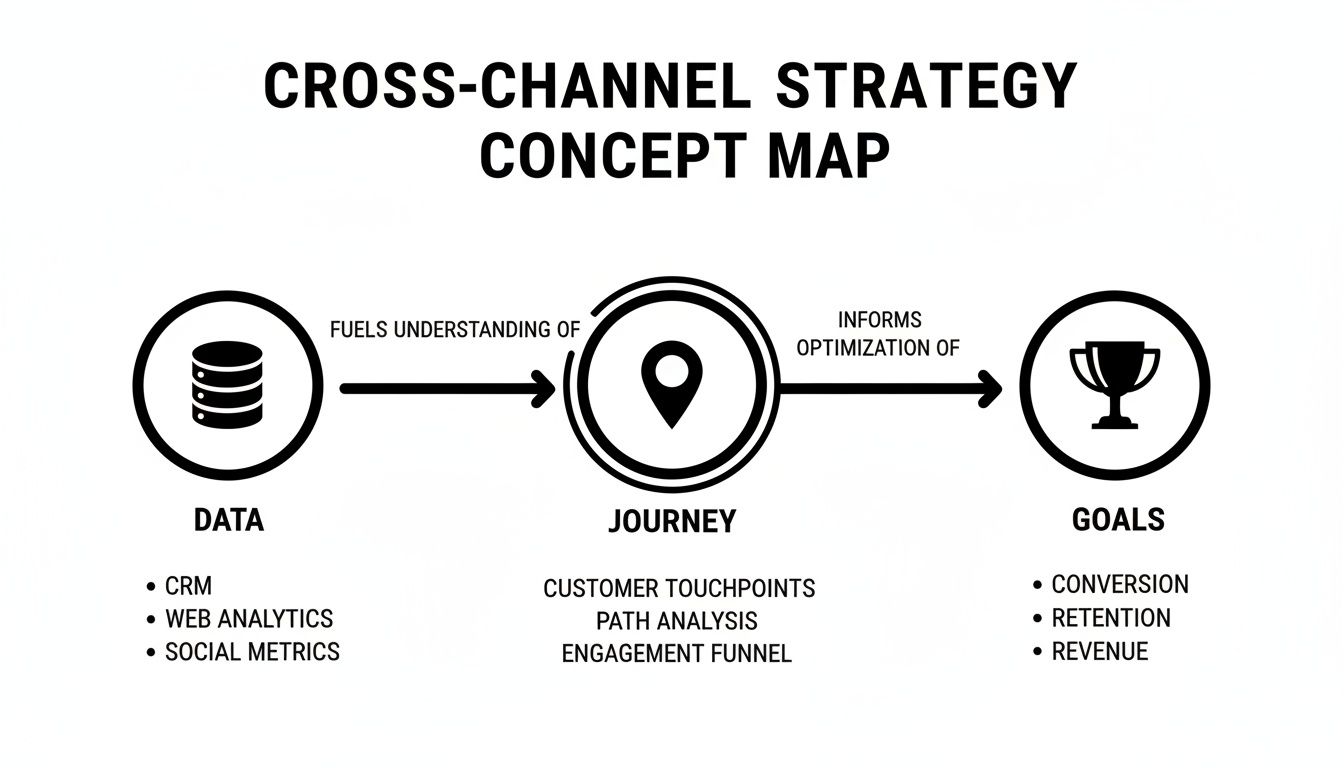
As you can see, a winning strategy is all about connecting the dots. You have to link disparate data to truly see how customers move and measure what's driving you toward your unified objectives.
Understanding Common Attribution Models
To solve this puzzle, marketers rely on "attribution models," which are really just different sets of rules for assigning credit. Think of them as different lenses for looking at the same customer journey. Getting a handle on the most common ones shows you pretty quickly why no single model ever tells the whole story.
Here’s a breakdown of the main players:
First-Touch Attribution: This one gives 100% of the credit to the very first channel a customer ever interacted with. Let's say someone first sees your brand in a Meta video ad, but then buys two weeks later after searching for you on Google. With this model, that initial Meta ad gets all the glory. It’s useful for figuring out what’s driving brand discovery.
Last-Touch Attribution: The complete opposite of first-touch. This model gives 100% of the credit to the final touchpoint right before the purchase. Using the same example, the Google search ad would get all the credit. This is the default setting for most ad platforms, but it has a major blind spot—it ignores every single marketing effort that built awareness and interest along the way.
Linear Attribution: This model tries to be fair by spreading the credit equally across every touchpoint. If a customer saw a Meta ad, clicked a Google ad, and opened an email before buying, each of those three touchpoints gets 33.3% of the credit. It’s more balanced, but it makes the flawed assumption that every interaction is equally valuable, which is almost never the case.
The biggest mistake you can make in cross-channel marketing is putting all your faith in a single attribution model. Last-touch dramatically overvalues closing channels like brand search, while first-touch does the same for top-of-funnel channels. The real truth of what drives growth is always somewhere in the middle.
Why In-Platform Reporting Is So Misleading
This brings us to one of the most common and costly pitfalls: relying solely on the dashboards inside Meta Ads Manager or Google Ads. Each platform defaults to its own version of a last-touch model, and worse, it can only see what happens within its own ecosystem.
This creates a siloed, walled-garden view of performance that is often wildly inaccurate. Meta will happily take credit for a sale if a user interacted with one of its ads, and Google will do the exact same thing. So, when both platforms played a role in the journey, they will both claim 100% of the credit for the very same sale.
This constant double-counting of conversions completely distorts your real Return on Ad Spend (ROAS). You might end up cutting the budget on a Meta campaign that looks like a poor performer, not realizing it’s the main engine driving all the high-intent Google searches that are actually closing your deals. You can dig deeper into solving these issues by exploring different types of marketing attribution software.
Moving Toward a More Holistic View
To get a true picture of performance, you have to break down those walls and stitch the data together. That means pulling everything from Shopify, Google Analytics, Meta, and Google Ads into one unified view. Only then can you see the complete customer journey and begin to understand how your channels actually influence one another.
As brands grow, more sophisticated measurement methods become necessary. One of the most powerful is Media Mix Modeling (MMM). Instead of tracking individual users, MMM uses high-level statistical analysis to measure how different marketing inputs (like spend per channel) affect your key outputs (like total revenue).
MMM helps you answer the big-picture strategic questions, like, "If I bump my Meta budget by 20%, what’s the likely lift in my total Shopify sales?" It’s a powerful approach for allocating your budget based on true impact, helping you move beyond siloed, last-click metrics and toward a real understanding of what your marketing dollars are accomplishing.
Your Daily Cross-Channel Execution Playbook
Strategy is the map, but your daily actions are what actually drive the car. Moving from a high-level plan to the day-to-day grind of managing campaigns requires a clear playbook and a whole lot of discipline. Without one, it's easy to get lost in a reactive cycle of panicked tweaks and gut-feel decisions.
This is where having a structured execution plan becomes your best friend. It gives you the guardrails to stop over-editing, protect your campaigns from statistical noise, and make sure every move you make is deliberate. The goal is to stop chasing daily blips and start making proactive changes that build real, long-term value.
Setting the Right Guardrails
First things first: you need to set some clear rules. These guardrails are your defense against making impulsive changes based on a few weird hours of data. A classic mistake is seeing a temporary dip in ROAS and immediately killing an ad or slashing a budget, which just throws the platform’s learning phase into chaos.
Guardrails force you to tell the difference between a campaign that's truly failing and one that's just going through normal, short-term volatility. This discipline is what separates the pros from the amateurs in cross-channel management.
Build your rules around multi-day trends, not single-day hiccups. For example, a solid guardrail might be: "Don't touch budgets or creative unless a key metric like CPA or ROAS has been off-target for three straight days." This simple rule stops you from making panic-driven edits that reset ad learning and do more harm than good. You can get a much clearer picture of what's working by learning how to use UTM parameters for Google Analytics to keep your data clean.
The Daily, Weekly, and Monthly Cadence
A structured routine keeps you focused on what actually matters. By breaking down your tasks into daily, weekly, and monthly checks, you create a sustainable rhythm for managing a complex marketing cross channel ecosystem.
Daily Checklist (15-30 Minutes)
Think of this as a quick health scan, not a deep-dive analysis. You're just looking for any red flags that could throw your performance off the rails.
Pacing and Delivery: Are all campaigns actually spending their daily budget? A sudden drop could signal an issue with an ad, an audience, or the platform itself.
Critical Metric Scan: Take a quick glance at your main KPI (like CPA or ROAS). Flag any campaigns that are wildly off-target, but don't act just yet—just make a note to investigate later.
Ad Rejections or Errors: Are there any disapproved ads or account warnings? These need your immediate attention.
Weekly Review (1-2 Hours)
Your weekly review is where you connect the dots and make thoughtful adjustments. This is the time to identify the real trends.
Analyze 7-Day Performance Trends: Go back to those campaigns you flagged during your daily checks. Has the poor performance continued all week? Now it's time to dig in and find out why.
Spot Creative Fatigue: Is the Click-Through Rate (CTR) on that rockstar Meta ad starting to slip? That's a classic sign of creative fatigue. A dip here should trigger a plan to launch fresh creative on YouTube and other visual platforms next week.
Cross-Channel Signal Analysis: Did that spike in TikTok traffic last week lead to more people searching for your brand on Google this week? Connecting these signals helps you see how your channels are actually helping each other.
Reallocate Your Budget: Now that you're looking at sustained performance trends (not daily blips), you can confidently shift budget away from underperformers and toward the campaigns that are consistently crushing it.
Monthly Strategy Session (2-4 Hours)
The monthly meeting is for big-picture thinking. It's time to zoom out from the daily metrics and assess your overall strategy.
Review Blended Metrics: How are your blended CAC and ROAS looking? This tells you how your entire marketing ecosystem is performing, no matter what the individual platforms are trying to claim.
Assess Audience Saturation: Check your frequency metrics on platforms like Meta. If people are seeing your ads over and over without a lift in results, it's probably time to test some new audiences.
Plan Your Next Moves: What new channels, campaigns, or creative ideas will you test next month? Use the insights from your weekly reviews to make smarter, data-backed decisions.
This disciplined, holistic approach is quickly becoming the industry standard. The cross-channel advertising software market, valued at USD 9.57 billion in 2024, is expected to explode to USD 31.75 billion by 2033. This growth reflects a massive shift toward smarter strategies that prevent wasted ad spend. The proof is in the pudding: brands using three or more channels are seeing 494% higher order rates than those sticking to just one. You can read more about the growth of cross-channel advertising software on straitsresearch.com.
Winning Cross-Channel Campaigns in Action
Theory and playbooks are great, but nothing beats seeing a killer strategy work in the real world. To make all this concrete, let's break down how a couple of actual Direct-to-Consumer (DTC) brands are nailing their marketing cross channel efforts. These aren't just separate campaigns running in parallel; they’re examples of how to connect different platforms to create an experience that’s way more powerful than the sum of its parts.
Each story here follows the same simple arc: what was the business problem, what was the coordinated cross-channel fix, and what were the hard numbers that proved it worked? Think of these as a blueprint for turning abstract ideas into actual revenue.
The Fashion Brand Mastering the Purchase Journey
A fast-growing online fashion brand had a problem many of us can relate to. They were killing it with top-of-funnel engagement on social media, but their conversion rates just weren't keeping up. People would discover products, get excited, and then... nothing. This left them with a mountain of abandoned carts and a very leaky sales funnel.
Their goal was simple: close the gap between that first "ooh, I like that" moment and the final click to buy. The mission was to boost conversion rates and bring down their blended Customer Acquisition Cost (CAC).
Here’s how they stitched together a seamless three-part customer journey:
Instagram Stories for Discovery: The brand used slick, eye-catching video ads in their Instagram Stories to show off new collections. These ads weren't about a hard sell; they were optimized for engagement, getting viewers to swipe up and browse, capturing that initial spark of interest.
Google Shopping for Intent: They knew that someone who saw a cool jacket on Instagram might later search for it on Google. So, they ran targeted Google Shopping campaigns to make sure their products were right at the top of the search results for those high-intent queries. This let them reconnect with prospects at that make-or-break consideration phase.
Shopify Abandoned Cart Emails for Conversion: If a user added items to their cart but bailed, an automated email sequence from Shopify kicked in. The first email was just a gentle reminder. But the second one, sent 24 hours later, dialed up the urgency with a "low stock" alert or a small free shipping offer to get them over the finish line.
The results from this coordinated effort were fantastic. Within a single quarter, the brand saw a 35% increase in its overall conversion rate and sliced its blended CAC by 20%. By treating each channel as a step in a single conversation, they successfully guided people from casual scroller to happy customer.
The Home Goods Brand Turning Browsers into Buyers
A DTC brand selling high-end home goods was dealing with a long sales cycle. Customers loved the products, but they’d often take weeks, sometimes even months, to finally make a purchase. Their marketing felt disconnected and wasn't doing a good job of nurturing those leads over the long haul.
The objective here was to shorten that sales cycle and bump up Customer Lifetime Value (LTV) by creating a much more cohesive and nurturing experience.
They rolled out a patient, multi-touch strategy:
Meta Lead Ads for Initial Contact: Instead of pushing for a sale right away, they ran lead generation ads on Meta that offered a free design guide. This was a low-friction way to get email addresses from genuinely interested people early in their journey.
Email Nurture Sequence for Education: Once someone signed up, they were dropped into an automated email workflow. These emails weren't just sales pitches. They offered real value—home styling tips, customer stories, and behind-the-scenes looks at product quality—to build trust over several weeks.
Dynamic Retargeting for the Final Nudge: As soon as a lead clicked from an email to view a specific product, they were added to a dynamic retargeting audience on Google and Meta. The ads they saw were hyper-relevant, showing the exact products they’d just looked at, keeping the brand top-of-mind and gently nudging them toward a decision.
By aligning their channels, the brand transformed its marketing from a series of one-off ads into a guided, value-driven journey. This approach acknowledges that not every customer is ready to buy immediately and builds the relationship needed to earn the sale.
The outcome was a huge lift in their key metrics. They saw a 15% reduction in their average sales cycle and, even better, a 25% increase in LTV from the leads they nurtured. It’s a perfect example that a smart cross-channel strategy isn't just about getting the first sale—it's about building a base of loyal, high-value customers for the long run.
Unifying Your Marketing for Sustainable Growth
Trying to get your head around cross-channel marketing can feel like you're herding cats, but the idea behind it is actually pretty simple. It’s all about creating one single, unified conversation with your customer, no matter where they are.
This whole process—from just grasping the concept to actually building a strategy, cracking attribution, and executing it day in and day out—isn't just a "nice-to-have" for ambitious DTC brands anymore. It's the only way to build something that lasts.
The real magic happens when you stop thinking in silos and start creating a cohesive customer experience. It’s the difference between shouting into the void on a dozen different platforms and actually guiding a customer along a smooth, logical path from discovery to purchase. This is how you build real brand equity and drive the kind of results that matter, turning one-time buyers into lifelong fans.
From Noisy Data to Clear Action
Here’s the good news: you don't need a massive team or a bottomless budget to pull this off. Orchestrating a sophisticated, multi-channel strategy is more achievable today than ever before.
The secret isn't more people or a bigger ad spend—it's clarity. It's about knowing how to separate the signal from the noise in your data. Great cross-channel execution is all about turning messy performance metrics into clear, daily actions that actually move the needle.
With the right tools and a disciplined playbook, you can set up guardrails that stop you from making reactive, knee-jerk decisions or burning out your creative team. When you focus on what truly matters—blended metrics, the customer journey, and consistent messaging—even a one-person marketing team can operate with the confidence of a major enterprise.
You’ll shift from making gut-feel decisions to taking data-backed actions, building a resilient marketing engine that delivers consistent growth, day in and day out.
A Few Common Questions About Cross-Channel Marketing
Getting started with a true cross-channel strategy always brings up a few practical questions. Let's tackle some of the most common ones we hear from DTC founders and performance marketing teams.
What’s the Real Difference Between Cross-Channel and Omnichannel?
People often use these terms interchangeably, but there's a key distinction that really matters for DTC brands.
Cross-channel marketing is all about intentionally connecting a few specific channels to create a single, fluid customer journey. Think about guiding a customer from a Meta ad to a branded Google search, and then seamlessly over to your Shopify store to make a purchase. It’s a focused effort on making that particular path as smooth as possible.
Omnichannel is the bigger picture. It’s about creating a totally unified experience across every single touchpoint—your website, physical store, mobile app, customer service calls, you name it. The goal is for the brand to feel like one cohesive entity no matter how a customer interacts with it.
I like to think of it this way: Cross-channel is about building a strong, reliable bridge between a few key islands. Omnichannel is about connecting the entire archipelago. For most brands, mastering that first bridge is the most critical step.
How Many Channels Do I Actually Need for a Cross-Channel Strategy?
You don't need to be everywhere. In fact, trying to be on every platform at once is one of the fastest ways to burn through your budget and your team.
A truly effective marketing cross channel strategy can start with just two platforms working in perfect harmony, like Meta and Google. The magic is in the quality of the integration, not the quantity of the channels.
Focus on mastering the flow of data and messaging between your main acquisition and conversion channels first. Get that right, and you'll have a rock-solid foundation. From there, you can strategically layer in other touchpoints like email, SMS, or even TikTok to make the customer journey even richer. Don't fall into the trap of trying to connect five or six channels from the get-go; it almost always leads to messy execution and data you can't trust.
Can a Small Team Really Pull This Off?
Yes, 100%. A smart cross-channel approach isn't about headcount; it’s about having the right systems and discipline. For smaller teams, the secret is leaning on a structured playbook and setting up clear guardrails. This stops you from making knee-jerk, reactive edits that waste time and muddy your results.
Instead of getting lost in hourly fluctuations, you start looking at multi-day trends. You use tools that highlight meaningful shifts in performance, allowing you to operate with the focus of a much larger team. The game changes from making constant, tiny tweaks to making fewer, more strategic decisions based on a clear, unified view of what's actually working.
SpendOwlAI is the daily execution system built to make this a reality. It cuts through the noise of your ad data and gives you a clear, prioritized list of actions. You get the guardrails and clarity needed to manage your cross-channel strategy with total confidence. Start your free 7-day trial.