Geographics in Marketing for Smarter Ad Spend and Higher ROAS
If you've ever felt like your ad spend is disappearing into a black hole, you might be overlooking one of the most powerful tools in your arsenal: geographics.
At its core, geographics in marketing is all about understanding where your customers are and using that information to make your ads more relevant and effective. This isn't just about picking a country and hitting "go." We're talking about a granular approach that can zero in on specific states, cities, ZIP codes, and even individual neighborhoods.
It’s about meeting people where they live, work, and shop—literally.
What Is Geographics in Marketing and Why It Matters Now

Think of it this way: broad, nationwide targeting is like using a giant, expensive billboard on a highway. Sure, lots of people will see it, but how many of them are actually your ideal customer? It's a gamble.
Geographic marketing, on the other hand, is like putting a perfectly worded flyer right on the community bulletin board where you know your customers hang out. It’s targeted, efficient, and far more likely to get a response. By using location as a strategic lever, you can customize everything—your ad copy, your creative, your offers—to resonate with the unique culture and needs of a specific place.
Your Customers Expect Ads That Understand Them
We're all drowning in ads. To stand out, your message can't feel generic. It needs to feel personal, timely, and genuinely useful. Location-aware advertising is the fastest way to get there.
Boost Relevance Instantly: You wouldn't show an ad for snow shovels to someone in Miami in July. It's a simple concept, but it makes a world of difference.
Stop Wasting Money: Why keep spending on regions that have never shown any interest in what you're selling? Geographic analysis helps you cut the fat and reinvest where it counts.
Drive Higher Engagement: An ad that mentions a local landmark or offers a deal specific to a city just feels more personal. That connection leads directly to better click-through rates (CTR) and more conversions.
The table below breaks down the foundational elements of this approach.
Core Components of Geographic Marketing
Component | What It Means for Your Ads | Practical Application Example |
|---|---|---|
Segmentation | Dividing your audience into groups based on location (country, state, city, ZIP). | A national coffee brand creates separate campaigns for Seattle (emphasizing artisanal roasts) and New York (focusing on quick morning energy). |
Targeting | Actively choosing which geographic segments to show your ads to. | An e-commerce store selling high-end surfboards targets coastal ZIP codes in California, Florida, and Hawaii. |
Localization | Customizing ad creative, copy, and offers to reflect the local culture or environment. | A clothing brand shows ads with raincoats to users in Portland, while users in Los Angeles see ads for shorts and t-shirts. |
Analytics | Measuring performance metrics (ROAS, CPA, CVR) at a geographic level. | A DTC marketer notices CPAs are 30% lower in Texas than in California and decides to shift more budget toward Texan cities. |
By mastering these four components, you transform location from a simple setting into a dynamic tool for growth.
A Market That Can't Be Ignored
This isn't just a niche tactic; it's a massive shift in how businesses approach advertising. In 2023, the global geomarketing market hit a staggering USD 17.77 billion. Even more impressive, it's projected to grow at 23.1% annually through 2030. You can read more about the growth of the geomarketing industry to see just how quickly this is scaling.
This explosion is happening because brands are finally realizing that location-based insights are crucial for getting the most out of platforms like Meta and Google.
For DTC founders and performance marketers, mastering geographics is no longer a "nice-to-have." It’s essential for unlocking efficiency, building a real connection with your customers, and driving the kind of sustainable growth that lasts.
How Geo-Targeting Unlocks Performance on Paid Channels
This is where the rubber meets the road—connecting high-level geographic strategy to the ad platforms you're in every single day, like Meta and Google. Geo-targeting isn't just a filter; it's the tool that turns raw location data into a real competitive advantage. It’s what lets you customize every part of your campaign for maximum local impact.
Instead of blasting one generic ad set across the entire country, you can craft specific messages that actually resonate with distinct regional audiences. This kind of precision is exactly how you unlock higher click-through rates (CTR), drive down your customer acquisition costs (CPA), and ultimately, see a much healthier Return on Ad Spend (ROAS).
Tailoring Your Message to Local Context
Let's say you're a clothing brand. A national campaign might just promote a new line of jackets with one single message. But once you start thinking geographically, you can get so much smarter.
For the Pacific Northwest: Your ad creative could show someone wearing the jacket in a drizzly, Seattle-like setting. The copy? "Stay dry on your commute."
For Southern California: That same jacket could be positioned for cool evenings on the coast, with a headline like, "The perfect layer for sunset."
This isn't just about targeting; it’s about building an instant connection. You're showing customers you actually understand their world, which makes your brand feel way more relevant and trustworthy.
For merchants using Shopify, digging into sales data by location is like a treasure hunt. You might find a small town in Texas has a surprisingly high AOV for one product, revealing an untapped market where you should absolutely double down on ad spend.
Aligning Campaigns with Local Events and Culture
Geo-targeting also lets you tap into real-world events that your competitors are probably missing. Think about the power of running ads in specific areas during local festivals, regional holidays, or even just predictable weather patterns.
A perfectly timed ad for allergy relief in a city with a high pollen count will always beat a generic national campaign. In the same way, promoting team-colored apparel in a specific city during a huge playoff game can produce incredible results. This is the heart of geographics in marketing—using location as a dynamic trigger to be hyper-relevant.
When you focus on these local nuances, you stop just shouting at potential customers and start joining conversations that are already happening in their community. For any marketer trying to get more out of their budget, learning how to scale Facebook ads with this kind of geographic precision is a game-changer. Each localized campaign becomes a mini-experiment, feeding you data that sharpens your broader strategy and helps you move from guesswork to data-driven execution.
A Simple Framework for Geographic Segmentation
Stop guessing where your ad budget should go. Effective geographic segmentation isn't about throwing money at a map; it's about knowing precisely which zip codes and cities will turn your ad spend into profit. Instead of treating your entire market as one giant, faceless blob, this framework helps you prioritize with confidence. And it all starts with the data you already have.
Your own backend is a treasure trove. Dig into platforms like Google Analytics and Shopify to find your top-performing cities, states, and regions. Look for the obvious winners—areas with consistently high conversion rates, killer Return on Ad Spend (ROAS), or impressive Average Order Values (AOV). These are your slam dunks, the very foundation of a smart geo-strategy.
Layering Your Data for Deeper Insights
Once you've pinpointed these high-performance pockets, it's time to add some color to the map. This is where you go beyond just sales numbers and start building a real profile of your customers. By layering demographic and psychographic data onto your geographic insights, you start to understand why people in Austin buy your product, while shoppers in Boston don't. It's a critical step we cover in our guide on why segmentation is important for marketers.
The market for this kind of thinking has exploded. Location-based marketing services shot up from USD 33.4 billion in 2020 to a staggering USD 59.7 billion in 2023. This isn't just a trend; it's a fundamental shift. Brands are using everything from GPS to Wi-Fi signals to create deeply personal experiences that leave generic, one-size-fits-all campaigns in the dust. You can read more about the market's rapid growth to see just how big this has become.
This is all about using location as your starting point to build more relevant ads, offers, and creative.
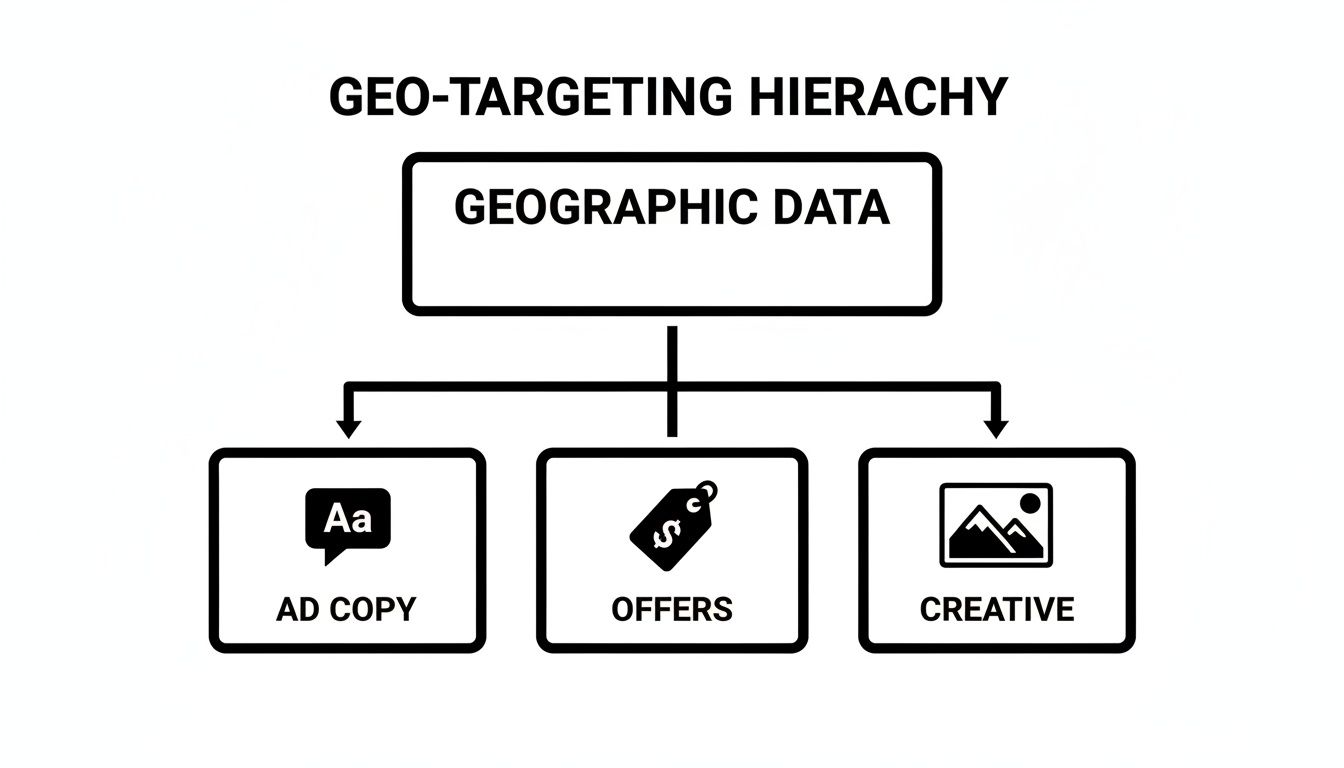
As you can see, a solid understanding of geographic performance is the bedrock of any successful localized campaign. Everything else builds on top of it.
Adopting a Tiered Targeting System
Now that you have this rich, multi-layered view of your market, you can implement a tiered system to guide your budget and creative strategy. This approach is all about organizing your geographic targets into clear priority levels. No more guesswork.
A tiered system forces you to stop treating all locations equally. It’s a data-driven approach that ensures your best markets get the attention and budget they’ve earned, while you intelligently explore new ones.
Here’s a practical framework for tiering your geos, designed to help you allocate resources more effectively and make smarter creative decisions.
Geographic Tiering Framework for Smarter Budgeting
Tier Level | Defining Characteristics | Recommended Budget Strategy | Effective Creative Approach |
|---|---|---|---|
Tier 1: Proven Winners | Consistently high ROAS, conversion rates, and AOV. These are your powerhouse markets. | Allocate the largest budget share here. Focus on maximizing reach and frequency. | Use your best-performing, "greatest hits" creative. Refine messaging, don't reinvent it. |
Tier 2: Growth Opportunities | Shows promise with good engagement or traffic, but conversions aren't yet top-tier. | Dedicate a moderate, controlled budget. Aim to scale efficiently and improve conversion rates. | Test new messaging and offers. Tailor creative to resonate with local nuances. |
Tier 3: Test Markets | New or unexplored regions with little to no historical data. The potential is unknown. | Use a small, fixed "learning" budget. The goal is data collection, not immediate profit. | Experiment broadly. Test bold creative angles and audience hypotheses to find what sticks. |
This tiered system provides a clear roadmap. Your Tier 1 locations are where you double down on what works. Tier 2 is for calculated risks and scaling up. And Tier 3 is your lab for discovering tomorrow's top performers.
Battle-Tested Tactics for Your Geographic Campaigns

Alright, moving from a tiered strategy to actually launching campaigns is where the rubber meets the road. This is where you turn all those geographic insights into real-world results. Let's get our hands dirty and talk about specific, actionable tactics you can use today.
The single most powerful lever you can pull? Creative customization. This is all about making your ads feel like they were made just for the person seeing them. It’s a simple idea, but it has a massive impact on how people connect with your brand and, ultimately, your conversion rates.
Customize Creative for Local Resonance
Think of your ad creative as your first handshake. By localizing it, you create an instant connection that a generic, national campaign simply can’t match. It tells customers you understand their world and aren't just another faceless corporation.
Here are a few easy ways to start:
Use Local Landmarks: Running ads in Chicago? Try an image with the city skyline in the background. It feels familiar and immediately grabs the attention of a local.
Reference Regional Language: Weave local slang or well-known phrases into your ad copy. A campaign targeting Texas might work better with a "y'all," while one for Philadelphia could mention a "hoagie."
Showcase Local Pride: If you're advertising in a city with a die-hard sports fan base, try incorporating their team colors into your creative during a big game week.
This kind of detail builds instant rapport and makes your brand feel like a neighbor, not an advertiser.
Implement Dynamic Budgeting and Testing
Your budget should never be set in stone. A core part of smart geographic marketing is shifting your spend based on what the real-time performance data is telling you. If your Cost Per Acquisition (CPA) in California is double what it is in Florida, your budget allocation needs to reflect that.
Smart geographic management isn't about setting a budget and forgetting it. It's about being nimble—feeding the winners, starving the losers, and constantly testing new ground to find your next high-performance pocket.
Run targeted A/B tests to see what really moves the needle. Instead of a generic "Free Shipping" offer, pit it against a version like "Free Shipping to New York." You’ll often find the more specific, personalized offer wins out with a much higher click-through and conversion rate.
Leverage Advanced Geo-Targeting Techniques
Today’s ad platforms go way beyond just targeting a city or state. You can get incredibly precise.
Geofencing, for instance, lets you draw a virtual boundary around a specific location—think a music festival, a trade conference, or even a competitor’s store. This tactic is a huge reason the location-based advertising market hit USD 81.7 billion in 2022. You can dig deeper into the dominance of geofencing in marketing to see just how fast it's growing.
Another go-to tool is radius targeting. If you have a brick-and-mortar store or are running a local event, you can target everyone within a specific mile radius. This ensures your ad spend is hyper-focused on people who can actually walk through your door. These are the tactics that take your campaigns from high-level theory to decisive, results-driven action.
How to Measure Success and Avoid Costly Mistakes
Launching geo-targeted campaigns is only half the battle. To truly succeed, you need to know what’s working, what isn’t, and—most importantly—when to leave things alone. Knowing your numbers is crucial, but knowing when not to act is what separates good marketers from great ones.
Success in geographic marketing isn't about reinventing your metrics. It's about applying a location-based filter to the KPIs you already live and breathe. Instead of just looking at your overall Return on Ad Spend (ROAS), you need to be analyzing ROAS by state or even ROAS by city.
The same goes for your Customer Acquisition Cost (CPA) and Conversion Rate (CVR). This granular view is where the magic happens, revealing which areas are your true profit engines and which ones are just draining your budget.
The Danger of Over-Editing Your Campaigns
One of the biggest mistakes I see marketers make is reacting to every tiny fluctuation in performance. Think of it like a gardener who keeps pulling up a plant to check if the roots are growing. All you're doing is disrupting the natural process.
Ad platforms like Meta and Google have a crucial "learning phase" where their algorithms figure out the best way to deliver your ads. When you make constant, reactive changes—like shutting down a state after one bad day—you keep resetting that process. You kill your momentum and never give the algorithm a chance to actually find its groove. This is the dangerous pitfall of over-editing.
Over-editing is a silent campaign killer. It’s born from good intentions but fueled by statistical noise. Resisting the urge to react to short-term data blips is essential for long-term, stable performance.
Establishing Guardrails to Guide Your Decisions
So, how do you tell the difference between a real performance signal that requires action and random noise you should ignore? You need to establish intelligent guardrails. These are simply rules and systems that prevent you from making impulsive, data-driven mistakes.
Instead of reacting to a daily dip, a proper guardrail system looks for sustained trends over a statistically significant period. It helps you answer critical questions like:
Is this dip a real problem? Has CPA in Texas been trending up for seven consecutive days, or is this just a two-day blip?
Is this spike an opportunity? Has the conversion rate in Chicago genuinely improved, or did one unusually large order skew the data for the week?
By setting these guardrails, you create a framework for confident, data-backed decisions. This approach ensures you only step in when absolutely necessary, allowing your campaigns to mature and the platform algorithms to do their jobs effectively.
It's a critical discipline for anyone trying to understand the nuances of marketing attribution software and how different channels contribute to performance over time. This mindset turns frantic daily check-ins into calm, strategic oversight, protecting both your ad spend and your sanity.
Turning Geographic Insights Into Automated Action
Trying to manually sift through all your geographic data is a surefire way to miss key opportunities and burn yourself out. The real magic happens when you can put your geo-strategy on autopilot, letting technology do the heavy lifting while you stay in control. This is the leap from staring at dashboards to making decisive, automated moves.
Today’s performance marketing platforms can pull in all your data from channels like Meta, Google, and Shopify. They’re built to automatically find and flag important geographic signals that would otherwise stay buried in a mountain of data.
From Raw Data to Ranked Actions
Think about getting an alert that your ROAS suddenly nose-dived by 15% in California. Or maybe you get a ping that some small city in Texas is suddenly showing a huge spike in click-through rates. Instead of you having to hunt for these clues, they're served up to you on a silver platter.
This technology boils down all that complex geographic analysis into a simple, prioritized list of things you should actually do.
Budget Adjustments: Get straightforward recommendations like, "Increase budget in Austin by 20%; ROAS is consistently high."
Performance Pauses: See proactive warnings such as, "Pause ads in Miami; CPAs are climbing while conversion rates are dropping."
Creative Swaps: Pinpoint where local creative is getting stale long before it completely tanks your budget.
This whole approach replaces gut feelings and tedious spreadsheet analysis with clear, data-backed guidance you can act on with confidence.
The goal is to turn geographic analysis from a quarterly research project into a set of simple, daily actions. By automating signal detection, you can focus your energy on strategic execution rather than data discovery.
Identifying Saturation and Fatigue at a Local Level
One of the toughest nuts to crack with geographics in marketing is figuring out when a local audience has just seen your ads too many times. Your national campaign's frequency numbers can be totally misleading. They often hide pockets of serious ad fatigue happening in specific cities or states.
More advanced systems keep a close eye on these local signals. They can tell you when creative fatigue is setting in for Chicago, or when you’ve hit the point of diminishing returns in Florida. This allows you to make incredibly precise adjustments—like swapping creative in one area or pulling back spend in another—without messing up what's working everywhere else.
It's all about making your entire geographic strategy smarter, faster, and way more effective.
Common Questions About Geographics in Marketing
When you start digging into a geographic strategy, a lot of questions pop up. Let's tackle a few of the most common ones we hear from performance marketers and DTC founders.
How Granular Should My Geo-Targeting Get?
It really comes down to two things: your budget and how much data you have. When you're just starting out, think bigger. Targeting at the state or major metropolitan area level is your best bet. It’s tempting to jump right into specific ZIP codes, but hold off until your data shows clear, consistent performance differences that actually justify that kind of narrow focus.
Spreading a small budget thin across dozens of tiny geo-segments is a classic way to get messy, inconclusive data and burn through cash. Start wide, let the data show you the winners, and only then should you start zooming in.
Can Geo-Targeting Actually Hurt My Campaigns?
You bet it can, especially if you get it wrong. The two biggest pitfalls are constantly tweaking your campaigns and cutting off promising locations too early.
Every time you react to a small, short-term dip in the data, you disrupt the ad platform's learning algorithm and kill your momentum. On the flip side, writing off a whole state because it had a slow week is an equally expensive mistake.
The secret is to use guardrails. Think of these as predefined rules you set for yourself. They stop you from making knee-jerk decisions based on statistical noise and ensure you only act when you see a genuine performance signal.
My Product Sells Everywhere. How Should I Target It?
Even for products with national appeal, a tiered approach almost always works best. First, keep a broad, national campaign running. This is your foundation—it builds baseline awareness and, more importantly, gathers a ton of data.
Next, dive into that data to pinpoint your top 5-10 geographic hot spots. These are the cities or states that are consistently outperforming everywhere else. Spin up separate, higher-budget campaigns aimed directly at these proven winners. This tiered strategy lets you pump your ad spend into the areas with the highest ROAS, all without giving up your national presence.
Stop guessing and start executing with confidence. SpendOwlAI turns noisy geographic data into clear, ranked actions, helping you make smarter budget and creative decisions every day. Explore how it works and start your free trial.