7 Great Example of Business to Business E Commerce Platforms for 2026
Business-to-business e-commerce has moved far beyond simple online catalogs. Today’s leading platforms are focused ecosystems built to solve specific operational problems, from procurement and inventory control to wholesale growth and advertising efficiency. They merge technology with deep industry knowledge to simplify purchasing, manage spending, and generate real ROI. This article offers a blueprint for success by analyzing a diverse set of real-world examples.
You will find a detailed breakdown for each example of business to business e commerce on our list. We will explore its business model, the strategic issues it addresses, and the specific tactics you can apply to your own operations. This listicle is designed to give you a clear view of how the best B2B e-commerce companies build their competitive advantage. Each entry includes screenshots and direct links for your reference.
We will look at everything from massive industrial suppliers like Grainger and Uline to specialized platforms like Faire, the wholesale marketplace for retailers. We'll also examine SaaS-enabled commerce through the lens of SpendOwlAI, which gives operators data-backed actions to optimize ad spend. Whether you are a manufacturer, distributor, or DTC founder, the analysis will provide metrics to watch and actionable advice for performance teams. This guide dissects what makes these platforms effective, giving you a clear playbook for your own B2B endeavors.
1. SpendOwlAI
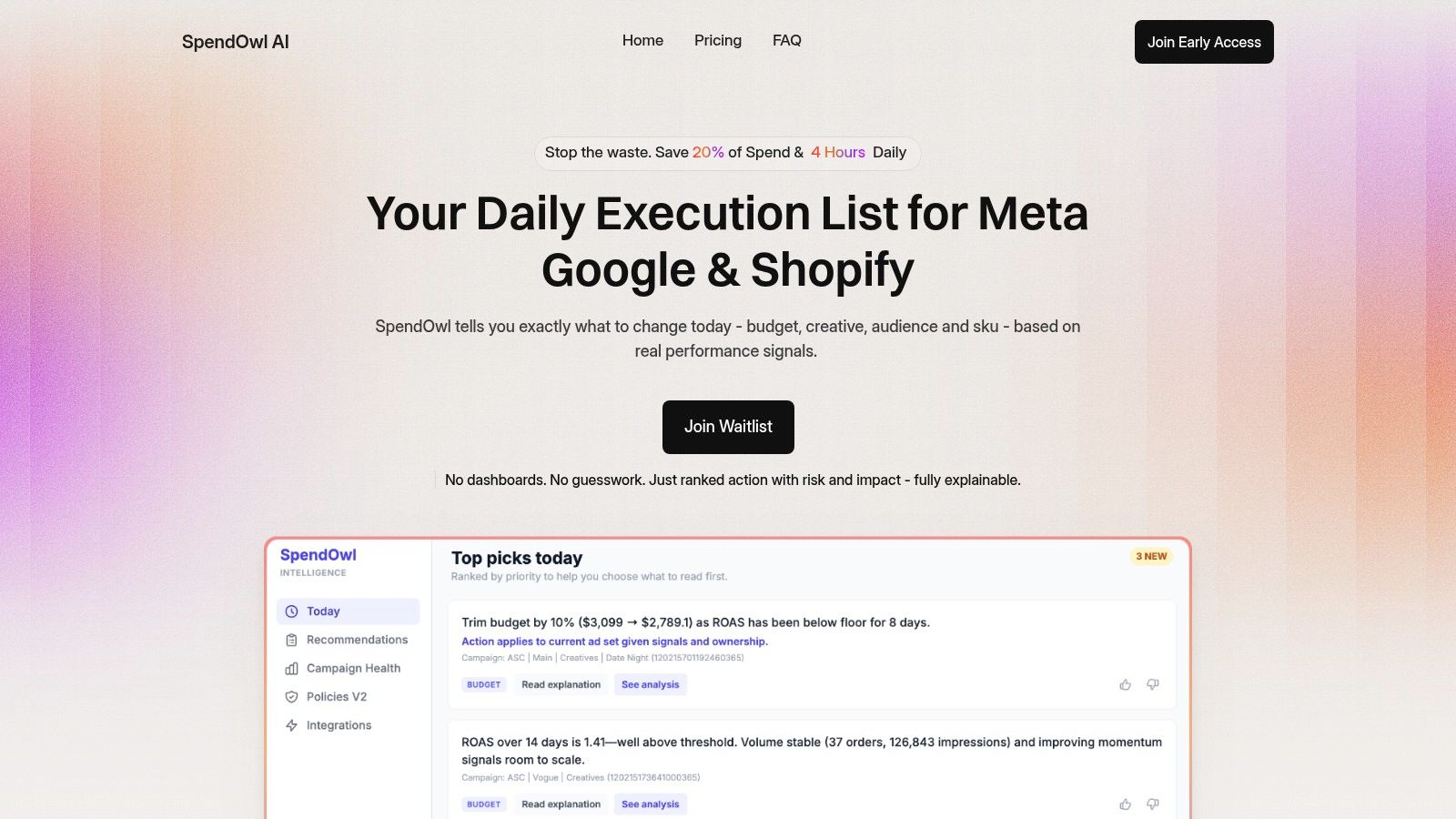
SpendOwlAI presents a compelling example of business to business e commerce within the SaaS (Software-as-a-Service) sector, specifically targeting the pain points of modern digital advertising teams. Instead of offering a generic dashboard or a black-box automation tool, the platform functions as a daily execution system. It provides performance marketing teams with a prioritized, explainable to-do list for managing Meta, Google, and Shopify ad campaigns.
The platform is designed around a core operator problem: translating noisy, complex ad performance data into clear, confident daily actions. SpendOwlAI analyzes signals like cost, CTR, ROAS, delivery, creative fatigue, and audience saturation to generate its recommendations. This approach prevents common but costly errors such as over-editing campaigns, scaling budgets prematurely, or applying blanket optimizations that ignore crucial context. It’s a B2B e-commerce model where the product is a decision-support workflow, sold directly to businesses that rely on digital advertising for growth.
Why SpendOwlAI Stands Out
SpendOwlAI’s primary differentiator is its "white-box" philosophy. Every recommendation, whether it's to adjust a budget, swap a creative, or pause an audience, is paired with the underlying data and logic. This transparency allows operators to inspect, question, and ultimately trust the suggestions. It empowers the marketing team, rather than attempting to replace them with opaque automation.
Strategic Insight: The platform's value isn't just in what it tells you to do, but also in what it tells you to leave alone. By explicitly advising restraint when data is inconclusive, it builds operator discipline and prevents counterproductive tinkering that can destabilize ad account performance.
This focus on explainability directly addresses a major source of friction in the B2B SaaS space for marketing tools, where teams are often hesitant to cede control to algorithms they don't understand.
Key Features & Analysis
SpendOwlAI’s feature set is built for action, not just analysis. It’s a system for daily execution.
Feature | Analysis & Use Case |
|---|---|
Ranked Daily To-Do List | Actions are ordered by potential impact, enabling teams to focus their limited time on the most important changes. This is ideal for small teams or solo founders wearing multiple hats. |
Explainable Recommendations | Every suggestion is backed by data. This is crucial for agency-client communication and internal reporting, as marketers can defend their optimization decisions with clear logic. |
Built-in Guardrails | The system flags high-risk changes before they are made. For example, it might warn a user against scaling a new ad set too quickly, preventing wasted spend and protecting ROAS. |
SKU-Level & Multi-Account View | For e-commerce brands and agencies, the ability to connect ad performance directly to product (SKU) performance is critical. Multi-account visibility streamlines workflows for agencies managing multiple client accounts. |
Practical Takeaways for Teams
For founders and performance teams evaluating SpendOwlAI, the approach is straightforward.
For Performance Marketers: Use the platform as your daily starting point. Before diving into Ads Manager, review the ranked to-do list to structure your day around high-impact tasks and avoid getting lost in data. The platform’s insights on AI-driven marketing trends can further inform your strategic approach.
For Agencies: Leverage the multi-account dashboard to standardize your team's optimization process. The white-box explanations are perfect for client reports, showing exactly why certain actions were taken to improve campaign performance.
For Founders: The promise of saving 20% of ad spend and 4 hours daily is a tangible ROI. The free trial offers a no-risk way to validate this claim and see if the guided workflow can improve your team’s efficiency and ad results.
Access and Pricing
SpendOwlAI is currently in a limited, early-access phase, with some tiers being invite-only. This controlled rollout suggests a focus on gathering user feedback and ensuring product quality before a wider public launch. Pricing is tiered based on scale and feature complexity (Starter, Operator, Agency/Enterprise), though final pricing is not yet public. Interested businesses can sign up for a free 7-day trial without a credit card, which lowers the barrier to entry significantly. While its current availability is constrained, its unique position as an explainable execution system makes it a noteworthy example of B2B e-commerce innovation in the marketing technology space.
Website: https://spendowlai.com
2. Amazon Business
Amazon Business represents a powerful example of business to business e commerce by applying its world-class B2C infrastructure to the specific needs of organizational procurement. It operates as a B2B marketplace where businesses of all sizes, from solo entrepreneurs to global enterprises, can purchase supplies. The platform layers critical business-centric features over Amazon’s massive consumer catalog, creating a one-stop shop for everything from office supplies to industrial equipment. Access is straightforward: a free business account unlocks business-only pricing and the ability to set up multi-user accounts.
What sets Amazon Business apart is its deep integration of procurement controls and financial management tools. The platform isn't just a place to buy things; it's a system for managing organizational spending. This is where it moves beyond a simple B2B retail site and becomes a strategic procurement tool.
Strategic Insight: Amazon Business’s core strength is its ability to centralize a fragmented purchasing process. It allows companies to consolidate dozens or even hundreds of vendors into a single account with unified invoicing, approval workflows, and spending analytics, dramatically reducing administrative overhead.
Analysis: Key Features and Strategic Value
Amazon Business’s feature set is designed to address common B2B purchasing pain points like rogue spending, lack of visibility, and inefficient payment processes.
Buying Policies & Approvals: The "Guided Buying" feature (available with Business Prime) allows administrators to flag preferred products or suppliers and restrict certain purchasing categories. Approval workflows can be configured to require manager sign-off for purchases over a specified threshold.
Spend Visibility & Analytics: The platform provides detailed dashboards and reports on company-wide spending. This data helps procurement managers identify savings opportunities and track budget compliance across different departments or locations.
Flexible Payment Options: Beyond standard credit cards, Amazon offers "Pay by Invoice" with net 30, 45, or even 60-day terms for qualified businesses. This is a significant advantage for managing cash flow.
Business-Only Pricing: Users gain access to exclusive pricing and quantity discounts. For high-volume orders, the "Request a Quote" feature allows for direct negotiation with sellers.
Actionable Takeaways for B2B Teams
Implement Guided Buying to Control Spend: If you struggle with employees buying non-compliant or overpriced items, use Guided Buying policies. Tag preferred SKUs (e.g., a specific brand of printer toner) and restrict categories (e.g., high-end electronics) to steer purchasers toward cost-effective, standardized options.
Consolidate Invoicing for Administrative Efficiency: Transition smaller, recurring purchases from various suppliers to Amazon Business. This centralizes invoicing and payment through a single vendor account, saving significant time for your accounts payable team.
Use Analytics to Inform Vendor Negotiations: Regularly review the Spend Visibility dashboard to understand your purchasing volume for specific product categories. Use this data as leverage when negotiating bulk pricing directly with sellers on or off the platform. Your documented spend is a powerful negotiation tool.
This approach of integrating user controls directly into the purchasing path is a masterclass in B2B user experience. For those looking to improve their own e-commerce platforms, studying how to guide user behavior is critical for website conversion optimization.
Website: https://business.amazon.com
3. Grainger
Grainger provides a classic example of business to business e commerce rooted in a traditional industrial supply model. It is a leading B2B distributor of Maintenance, Repair, and Operating (MRO) products, serving sectors like manufacturing, healthcare, and government. The platform translates its extensive physical catalog and deep industry expertise into a powerful digital channel where professionals can procure everything from safety equipment to HVAC components. Accessing the platform is free, but the full value is unlocked through a business account, which provides negotiated pricing and access to specialized services.
What makes Grainger stand out is how it blends a massive, fast-fulfillment e-commerce experience with hands-on inventory management services. It’s not just a website to order parts; it's a partner in operational continuity, helping businesses manage their on-site stock and prevent costly downtime. This fusion of digital convenience and physical logistics is a hallmark of a mature B2B e-commerce strategy.
Strategic Insight: Grainger’s core advantage is its position as an operational backbone for its customers. By integrating its e-commerce platform with on-site inventory solutions like KeepStock, it embeds itself directly into a company’s workflow, moving beyond a transactional relationship to become a critical component of supply chain management.
Analysis: Key Features and Strategic Value
Grainger's digital tools are designed to solve the practical, on-the-ground challenges of industrial procurement, such as managing consumables, ensuring compliance, and integrating with existing financial systems.
eProcurement & PunchOut Integration: Grainger allows its catalog to be directly integrated into a customer’s existing procurement software (like SAP Ariba or Coupa). This “punchout” capability lets employees shop on a familiar Grainger interface while all purchasing data flows back into their company's ERP for centralized control and approval.
KeepStock Inventory Management: This is a suite of services ranging from customer-managed inventory software to on-site vending machines and vendor-managed storerooms. It automates reordering for critical supplies like gloves or fasteners, reducing stockouts and administrative work.
Real-Time Availability & Rapid Fulfillment: The website displays real-time stock information for local branches and distribution centers. With a massive network, Grainger offers same-day or next-day delivery on hundreds of thousands of items, a critical service when a machine breakdown is costing a company money.
Deep Technical Information: Product pages are rich with detailed specifications, schematics, and compliance documents. This technical depth is essential for engineers and maintenance professionals who need to ensure they are ordering the exact right part.
Actionable Takeaways for B2B Teams
Integrate with Procurement Systems for Full Control: If your organization uses an eProcurement system, use Grainger’s punchout functionality. This enforces your company's buying rules and approval workflows automatically, preventing off-contract spending and simplifying the purchasing process for your team.
Automate Consumable Reordering with Inventory Programs: Identify high-use, critical consumables (e.g., PPE, cleaning supplies, basic fasteners). Work with a Grainger representative to implement a KeepStock solution, even a simple one, to automate replenishment and free up staff from manual inventory counts and reorders.
Use Local Branch Availability for Urgent Needs: For emergency repairs, use the website to check real-time stock at your nearest Grainger branch for same-day pickup. Training your maintenance team to use this feature can dramatically reduce operational downtime compared to waiting for standard shipping.
The strategy of connecting online purchases to physical inventory and financial systems highlights the importance of an omnichannel approach. Understanding which digital touchpoints lead to these high-value integrations is crucial, and is an area where marketing attribution software can provide deep clarity.
Website: https://www.grainger.com
4. Fastenal
Fastenal provides a classic example of business to business e commerce by perfectly blending a robust digital platform with an extensive physical footprint. It serves the industrial and construction sectors as a primary distributor of MRO (maintenance, repair, and operations) supplies. The website, Fastenal.com, acts as a powerful front-end to a network of over 3,200 local branches, allowing businesses to manage complex procurement needs with both online efficiency and local support. Access is granted through a business account, which unlocks custom pricing, order history, and account management tools.
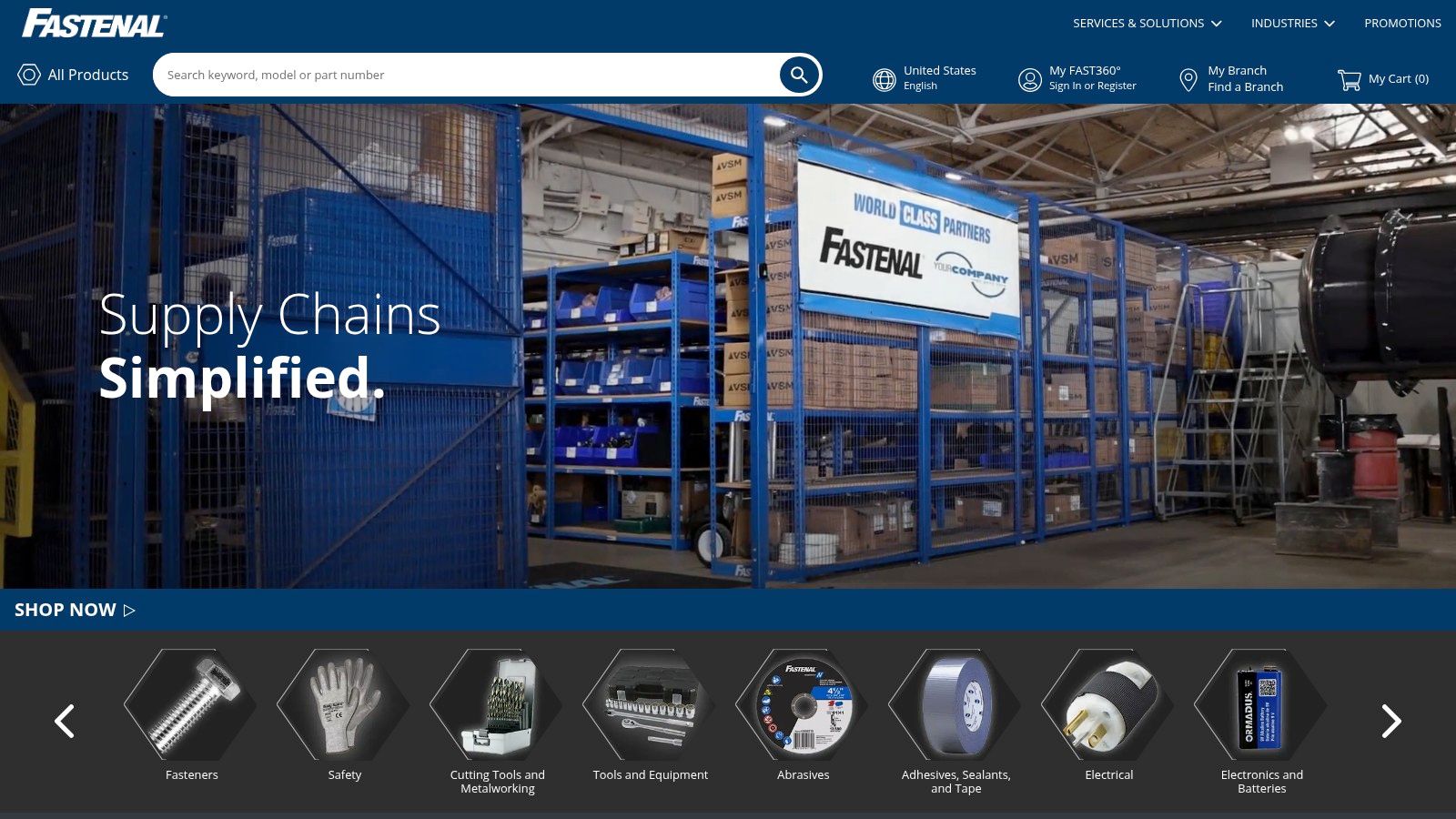
What makes Fastenal a standout is its "phygital" (physical + digital) model. The platform is not just an online catalog; it's an operational tool designed for job sites and factory floors. This integration of local inventory, in-person service, and digital ordering creates a deeply practical procurement ecosystem for trades and manufacturing.
Strategic Insight: Fastenal's success hinges on its ability to solve the "last mile" problem in industrial supply. By connecting its e-commerce site directly to local branch inventory and personnel, it offers a level of service and speed that purely online marketplaces cannot match for urgent, job-critical needs.
Analysis: Key Features and Strategic Value
Fastenal’s digital tools are purpose-built to reduce friction in the recurring, high-frequency purchasing cycles common in industrial settings.
Account-Specific Pricing & Controls: Logged-in users see their negotiated contract pricing directly on product pages. Administrators can set up detailed user permissions, controlling who can order what and establishing spending limits to prevent unauthorized purchases.
Replenishment & Reordering Tools: The platform offers eQuotes and customizable order templates, making it simple to re-purchase frequently used sets of items for specific jobs or locations. This saves significant time for purchasers who manage repetitive orders.
SmartScan & Mobile Ordering: A key feature is the ability to use a mobile app or dedicated scanner to scan bin labels on a factory floor or in a work truck. This automatically adds items to an online cart for quick replenishment, connecting physical inventory management directly to the digital purchasing system.
Local Inventory & Fulfillment: The website displays product availability at the user's local branch. This allows a purchaser to place an order online for immediate pickup or rapid local delivery, a critical advantage when a part is needed to prevent operational downtime.
Actionable Takeaways for B2B Teams
Use Order Templates for Project-Based Buying: If you manage multiple job sites or projects, create a unique order template for each one. This standardizes the materials list, ensures consistency, and allows for one-click reordering as supplies run low.
Implement User Permissions for Field Teams: Grant limited ordering access to supervisors or field personnel. Configure their accounts to only allow purchases from pre-approved product lists or below a certain dollar threshold, maintaining control while empowering them to acquire necessary supplies quickly.
Integrate Physical Bin Management with Digital Reordering: For MRO supplies, use Fastenal’s bin stocking program with SmartScan labels. This turns your physical storeroom into a direct extension of their e-commerce platform, automating the replenishment process and minimizing stockouts of critical parts.
Website: https://www.fastenal.com
5. Uline
Uline is a prime example of business to business e commerce built on the pillars of massive selection and operational speed. It is a direct-to-business supplier specializing in shipping, packaging, industrial, and janitorial supplies. The platform serves businesses that rely on the prompt and predictable delivery of operational essentials, from a small Etsy shop needing shipping boxes to a large factory requiring pallet jacks and safety equipment. Access is direct and requires no special account; businesses can simply order online or via their famously thick catalog.
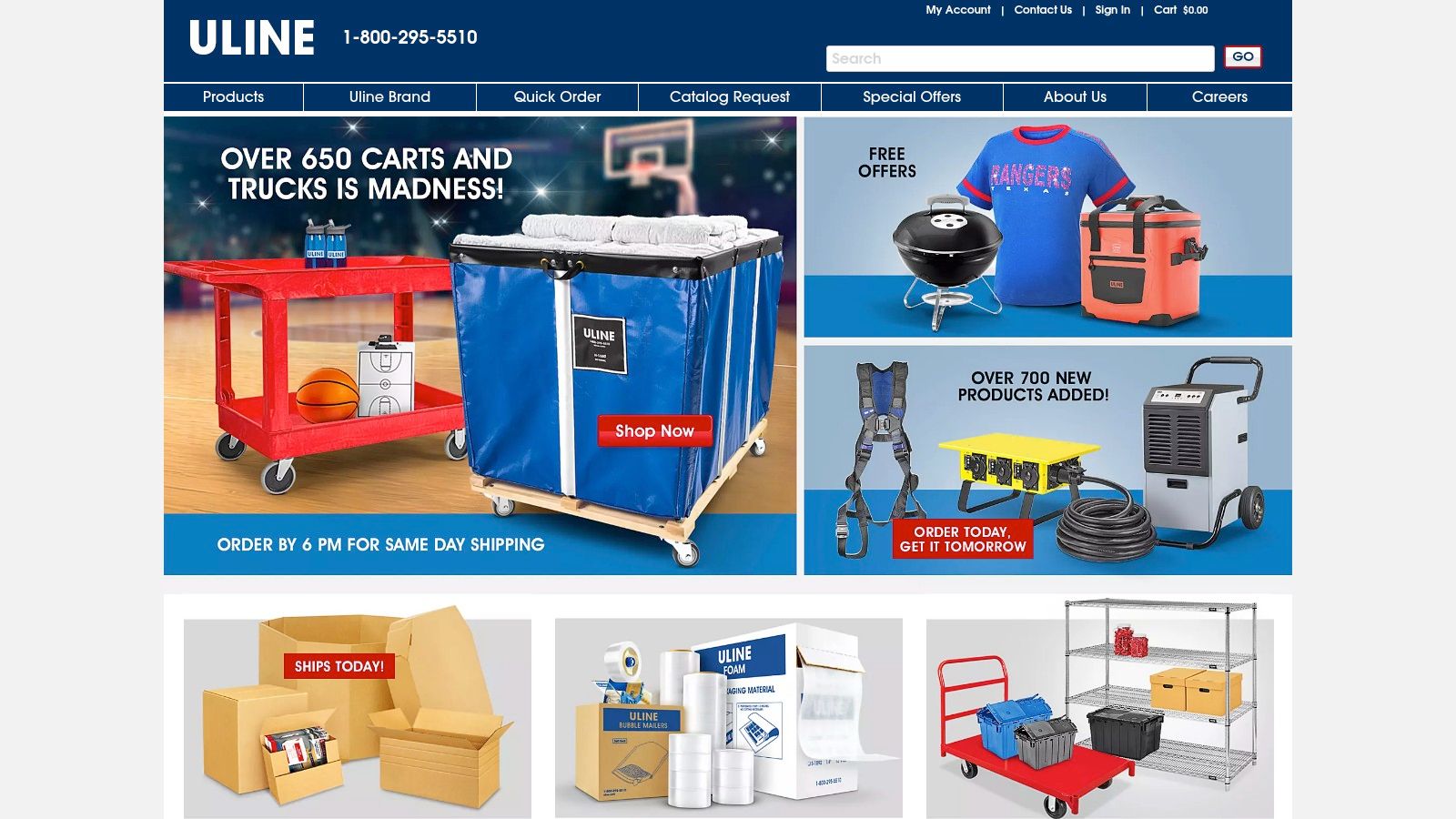
What distinguishes Uline is its unwavering focus on fulfillment velocity. The entire business model is engineered around its network of massive distribution centers, enabling it to offer same-day shipping on a huge catalog of in-stock items. This moves Uline beyond being a simple supplier to becoming a critical partner in its customers' supply chain reliability.
Strategic Insight: Uline's competitive advantage is not price, but predictability. By promising and consistently delivering next-day or two-day shipping on essential operational goods, it allows businesses to run leaner inventories and avoid stockouts of critical supplies like boxes, tape, or labels.
Analysis: Key Features and Strategic Value
Uline’s digital platform is a no-frills, function-first experience designed to get customers from product need to order confirmation as quickly as possible. Its value is rooted in logistical excellence rather than complex software features.
Logistical Speed: The core promise is same-day shipping for orders placed by 6:00 p.m. local branch time. This rapid fulfillment from regional hubs often results in next-business-day delivery, a significant benefit for businesses needing to respond to unexpected demand.
Deep, In-Stock Catalog: Uline boasts an extensive inventory of over 41,000 products. The key is that these items are in-stock and ready to ship, which contrasts with marketplace models where availability can be inconsistent.
Straightforward Ordering: The website offers a simple, account-based ordering process with clear order history, quick re-ordering, and transparent tracking. This efficiency is mirrored in its will-call pickup option for businesses located near a distribution center.
Net 30 Terms: For established businesses, Uline offers Net 30 payment terms upon credit approval, which helps with cash flow management for routine operational purchases.
Actionable Takeaways for B2B Teams
Use as an Emergency Backstop for Critical Supplies: Identify your most critical operational consumables (e.g., specific mailer sizes, thermal labels). If your primary, lower-cost supplier has a stockout or shipping delay, use Uline to procure a small-to-medium quantity to bridge the gap and prevent an operational shutdown.
Test New Packaging with Low Minimums: When considering new packaging, order small quantities of various options from Uline to test in-house before committing to a large, custom order from a manufacturer. The speed of delivery allows for rapid prototyping and decision-making.
Factor in Total Landed Cost: Uline's item prices may appear higher than some competitors, but their shipping can be very fast. When evaluating a purchase, always calculate the "landed cost" (product price + shipping + handling) and weigh it against the financial impact of waiting longer for a shipment from a cheaper vendor. For urgent needs, the higher total cost at Uline can be justified.
Website: https://www.uline.com
6. MSC Industrial Supply (MSC Direct)
MSC Industrial Supply provides an excellent example of business to business e commerce tailored for the industrial sector, particularly in metalworking and maintenance, repair, and operations (MRO). It serves as a digital-first distributor where skilled trades professionals, procurement managers, and shop floor supervisors can acquire everything from carbide end mills to safety gloves. The platform extends beyond a simple product catalog by incorporating procurement-grade controls and integrations directly into the buying experience. Access is free, with advanced features becoming more powerful when linked to MSC's broader eProcurement solutions.
What distinguishes MSC is its focus on solving shop-floor and operational purchasing challenges. The platform is engineered to integrate with a company's existing workflows, whether through its mobile app for on-the-spot reordering or through complex ERP system connections. This makes it a crucial tool for maintaining operational continuity and controlling spend at the point of use.
Strategic Insight: MSC Direct’s strength lies in its ability to embed procurement logic directly into the industrial environment. By connecting physical inventory needs on the factory floor with digital purchasing controls, it reduces manual data entry, prevents stockouts, and enforces budget compliance in real-time.
Analysis: Key Features and Strategic Value
MSC Direct’s feature set is built to address the specific pain points of industrial procurement, such as inefficient reordering, lack of budget oversight, and the high administrative cost of processing many small purchase orders.
ControlPoint Mobile App: This tool allows team members to use a smartphone to scan barcodes on bins or equipment. This action instantly populates a cart with the correct item, enabling fast, accurate reordering directly from the shop floor and minimizing downtime.
eProcurement Integrations: MSC offers a full suite of integration options, including punchout catalogs for systems like Ariba or Coupa, hosted catalogs, and EDI/XML for automated order processing. This eliminates double entry and ensures data flows seamlessly into a company's financial systems.
PO Control & Order Approvals: Administrators can set up budget limits and approval hierarchies. The system can enforce purchase order requirements and allow managers to approve or deny orders before they are placed, providing critical oversight on departmental spending.
Deep MRO & Metalworking Assortment: Unlike generalist marketplaces, MSC offers deep technical expertise and a vast selection of specialized products, complete with detailed specifications and fast shipping options critical for industrial operations.
Actionable Takeaways for B2B Teams
Implement Barcode Reordering for Critical Supplies: For frequently used consumables in a production or maintenance setting, use the ControlPoint app. Create and place barcode labels on storage bins. This empowers floor staff to reorder supplies instantly without leaving their workstation or needing to manually look up part numbers.
Use Punchout Catalogs to Centralize Procurement: If your company uses an eProcurement system (like Jaggaer or SAP Ariba), connect MSC as a punchout supplier. This funnels all MRO spending through your primary system, enforcing your company’s negotiated pricing and approval rules automatically.
Set Up PO Controls to Manage Departmental Budgets: Assign specific PO numbers or budget codes to different teams or projects within the MSC platform. Use the order approval feature to require manager sign-off for any purchase exceeding a preset value, preventing budget overruns before they happen.
Website: https://www.mscdirect.com
7. Faire
Faire is a curated wholesale marketplace that provides a brilliant example of business to business e commerce by focusing on the unique relationship between independent brands and local retailers. It serves as a discovery engine, connecting artisanal product creators with small boutiques and shops looking for unique inventory. The platform’s core value is reducing the financial risk and logistical complexity that traditionally plague the wholesale process for both sides of the transaction. Access is free for retailers, who apply for an account to begin purchasing.
What makes Faire so effective is its deep understanding of the cash flow and inventory challenges faced by small businesses. It has built its entire model around de-risking the wholesale buying experience, allowing retailers to test new products with minimal upfront investment while ensuring brands get paid promptly and can manage their production pipeline.
Strategic Insight: Faire’s genius lies in absorbing the risk for the retailer. By offering free returns on opening orders and net 60-day payment terms, it removes the two biggest barriers preventing a small shop from trying a new, unproven brand. This policy directly fuels product discovery and sales velocity across the entire marketplace.
Analysis: Key Features and Strategic Value
Faire’s features are specifically designed to foster trust and facilitate transactions between two distinct sets of small business users: makers and retailers.
Risk-Free Trial for Retailers: The "Free Returns" policy on a retailer's first order from any new brand is a cornerstone feature. It allows a shop to stock a product, see how it sells for 60 days, and return what doesn't move, effectively making the initial buy a no-risk consignment.
Net 60 Payment Terms: Eligible retailers do not have to pay for their orders for 60 days, a massive cash flow advantage that allows them to sell products before paying for them. Faire pays the brand upfront (minus commission) and takes on the credit risk.
Streamlined Brand Operations: For brands, Faire simplifies the entire wholesale process. It manages order intake, payment processing, and even offers reimbursements for shipping labels to standardize fulfillment. This allows creators to focus on their products instead of administrative tasks.
Commission Structure: Faire's model is performance-based. Brands pay a 15% commission on new customer orders sourced through the marketplace. If a brand brings an existing wholesale account onto the platform ("Faire Direct"), the commission is 0%, encouraging brands to centralize all their wholesale business.
Actionable Takeaways for B2B Teams
De-Risk the Initial Purchase for New Customers: If you are a B2B supplier, consider how you can lower the barrier to entry for a first-time buyer. A Faire-style model could involve offering a smaller, low-risk trial package, extended payment terms on a first order, or a satisfaction guarantee with easy returns to build initial trust.
Absorb Logistical Complexity for Your Customers: Faire simplifies shipping for its brands. Evaluate your own checkout and fulfillment process. Can you offer flat-rate shipping, integrate label printing, or provide clearer tracking information to make the post-purchase experience seamless for your business customers?
Create a "Bring Your Own Customer" Incentive: Use Faire’s 0% commission on "Faire Direct" links as inspiration. If you sell through a marketplace or distributors, create a program that rewards partners for bringing their existing business onto your primary platform, allowing you to own the relationship while they benefit from your system's efficiency.
Website: https://www.faire.com
Top 7 B2B E-Commerce Providers Compared
Solution | Implementation complexity 🔄 | Resource requirements ⚡ | Expected outcomes ⭐ / 📊 | Ideal use cases 💡 | Key advantages ⭐ |
|---|---|---|---|---|---|
SpendOwlAI | Medium — requires integrations with Meta/Google/Shopify and operator workflow setup | Low–Medium — subscription tiers; connective setup; operator time to action | Decision-quality gains; vendor claims ~20% spend reduction and ~4 hrs/day saved; ranked daily actions 📊 | DTC founders, performance marketers, agencies needing explainable daily ad actions | Explainable, white‑box recommendations, ranked impact actions, guardrails, SKU & multi‑account visibility |
Amazon Business | Low — account creation and optional Business Prime enablement | Low — free account; paid Business Prime for advanced features | Consolidated procurement, spend visibility and approval workflows; improved payment terms 📊 | Centralized procurement across SMBs to enterprises | Huge catalog, approval workflows, consolidated invoicing, member perks |
Grainger | Low–Medium — account and optional contract setup for advanced programs | Medium — negotiated contracts for best terms; integration for eProc | Reliable fulfillment and inventory programs that reduce stockouts and downtime 📊 | Government, education, healthcare, manufacturing needing MRO reliability | Deep industrial assortment, KeepStock programs, eProc/punchout support |
Fastenal | Low–Medium — account setup plus coordination with local branches | Medium — account pricing, branch interactions, possible contracts | Improved local replenishment and controlled repeat purchasing; branch support 📊 | Multi‑site maintenance and job‑based ordering teams | Blend of local branch inventory and online tools; eQuotes, templates, SmartScan |
Uline | Low — straightforward ordering and account options | Low–Medium — shipping/handling costs; may require account for tracking | Fast, predictable same/next‑day fulfillment for operational essentials 📊 | Warehousing and operations teams needing predictable delivery | Wide in‑stock SKU coverage, rapid regional fulfillment, clear shipping terms |
MSC Industrial Supply | Medium–High — integration with ERP/eProc and procurement controls | Medium–High — advanced tools, mobile apps, and integration work | Strong procurement controls, reduced double entry, efficient shop‑floor reorders 📊 | Procurement teams and metalworking/MRO operations requiring controls | Procurement‑grade controls, barcode/mobile replenishment, punchout/EDI options |
Faire | Low — marketplace onboarding for retailers; brand onboarding selective | Low–Medium — retailers may access net‑60; brands pay commission on orders | Low‑risk retail discovery, simplified wholesale operations, delayed payment options 📊 | Independent retailers seeking discovery and brands wanting wholesale channels | Net‑60 terms (eligible), free returns on opening orders, curated indie retail focus |
From Insight to Impact: Building Your B2B E-Commerce Playbook
The journey through these distinct examples of business to business e-commerce reveals a powerful, unifying theme. True success is not about simply putting a product catalog online; it's about deeply understanding and solving the operational pains of your business customers. Each leader we've examined, from industrial giants like Grainger to wholesale marketplaces like Faire, has built their digital presence around this core principle.
They have moved past the transactional nature of a simple sale and created indispensable tools that integrate into their customers' daily workflows. This is the new standard. Your B2B e-commerce platform should not just be a place to buy, but a place to manage, plan, and optimize.
Synthesizing the Core Strategies
Reflecting on the examples provided, from Amazon Business’s procurement simplification to MSC Direct’s technical support, several key strategies emerge as universally effective. These are the building blocks for a resilient and customer-centric B2B digital operation.
Solve a Workflow Problem, Not Just a Product Need: Uline’s promise of immediate shipping solves the urgent need for operational continuity. Faire's 60-day payment terms and free returns solve the cash flow and inventory risk for independent retailers. Ask yourself: what is the biggest operational headache my customer faces, and how can my digital platform become the remedy?
Embed Value-Added Services: A simple product listing is not enough. The most effective platforms layer services on top of their catalogs. Think of Grainger's KeepStock inventory management or Fastenal's vending solutions. These services create stickiness and make your platform a core part of the customer's business infrastructure.
Data and Analytics as a Product: The most forward-thinking B2B companies provide their customers with data. This could be spend analytics, budget tracking, or efficiency metrics. For businesses using tools like SpendOwlAI, the ability to see clear, actionable performance data on ad spend transforms a marketing cost center into a strategic growth driver. When your platform helps your customers get smarter, you become a partner, not just a supplier.
Your Actionable Next Steps: From Analysis to Implementation
Moving from inspiration to execution requires a structured approach. The examples in this article provide a rich source of ideas, but applying them to your own business is what truly matters. Here is a practical roadmap to get you started.
Conduct a "Job-to-be-Done" Customer Analysis: Forget what you sell for a moment and focus on what your customer is trying to accomplish. Interview your best clients. What are their biggest time sinks? Where do procurement bottlenecks occur? What reporting do they wish they had?
Map Friction Points to Digital Solutions: Once you've identified their pains, brainstorm specific digital features that could solve them. If customers struggle with multi-person purchasing decisions, a tool for approval workflows is a clear solution. If they constantly reorder the same items, a subscription or reorder list function is essential.
Prioritize Based on Impact and Effort: You cannot build everything at once. Score your potential features on two axes: the level of impact they will have on your customer's business and the effort required for your team to build and maintain them. Start with high-impact, low-to-medium-effort features to gain momentum.
Instrument for Success: Before you launch any new feature, define how you will measure its success. This goes beyond revenue. Track metrics like adoption rate, time saved per customer (which can be surveyed), reduction in support tickets, and increased order frequency. These KPIs prove the ROI of your platform to both your customers and your internal stakeholders.
Choosing the right approach means honestly assessing your business model and customer base. A manufacturer's direct-to-buyer site has different needs than a multi-vendor marketplace. Yet, the underlying goal remains consistent: make your customer’s job easier, and you will become their preferred partner. The most powerful example of business to business e commerce is the one that becomes an extension of its customer's own team.
For performance and growth teams looking to apply these principles to their marketing, the challenge is often translating complex ad data into clear, strategic actions. Just as a great B2B platform simplifies procurement, SpendOwlAI simplifies performance marketing by providing actionable, SKU-level insights and guardrails. See how our AI-driven tool can help you stop wasting ad spend and focus on what truly drives growth by visiting SpendOwlAI today.