Unlocking Growth with E Commerce Advertisement
An effective e-commerce advertisement is the lifeblood of any online brand. In a crowded digital marketplace, advertising is what connects your store to the people who want what you're selling. Without it, even the most fantastic shop is just a needle in a haystack. This guide is your map for building those connections.
The High-Stakes World of E-Commerce Advertisement

Welcome to the fast-paced, high-stakes game of e-commerce advertising. For any growing brand, a smart ad strategy isn't just a marketing task—it's a core part of your business. It's the difference between hoping people show up and building a reliable system that brings in predictable revenue.
This guide will walk you through everything, from the basic principles to the daily grind of running campaigns. We'll tackle the main challenge every performance marketer faces: how to turn mountains of data from platforms like Meta and Google into clear, confident decisions. The goal here is to stop just spending money on ads and start making smart investments that deliver real returns.
Navigating a Trillion-Dollar Marketplace
The sheer size of the digital ad world shows why a sharp strategy is so critical. Global digital ad spend is set to blow past $1.02 trillion in 2026, accounting for over 65% of all media spending. As you can see from these digital marketing statistics from New Media, this massive market means e-commerce brands are fighting for every single click, with retail leading the charge in ad investment.
For founders and marketers in the trenches, this means higher costs and a lot more noise. Winning means cutting through that clutter to find profit without getting buried in spreadsheets.
This is where tools built for this reality, like SpendOwlAI, come into play. Trying to manually juggle budgets across different platforms while keeping an eye on Click-Through Rate (CTR), Return on Ad Spend (ROAS), and ad fatigue is a recipe for disaster. Without a clear, systematic approach, you're just guessing with your budget.
Core Components of a Winning Strategy
A winning ad strategy isn't about finding one magic bullet. It's about building a solid system that balances several moving parts. Throughout this guide, we'll dig into how to:
Choose the Right Channels: Figure out when to use Google to capture existing demand and when to use Meta to create it.
Develop High-Impact Creative: Learn the right way to test ad creative without confusing the platform's algorithm.
Master Bids and Budgets: Shift from reacting to performance to proactively managing your budget with clear rules.
Track What Matters: Focus on the metrics that truly show the health of your business, like Customer Acquisition Cost (CAC) and ROAS.
By the end, you'll have a clear roadmap to turn your ad spend from a necessary evil into your most powerful growth engine, giving you the confidence to execute your strategy day in and day out.
Key E-Commerce Advertising Platforms at a Glance
Choosing where to spend your ad budget is one of the first and most important decisions you'll make. Each platform has its own strengths and is better suited for different goals. Here's a quick rundown of the major players.
Platform | Primary Strength | Best For | Average E-commerce ROAS |
|---|---|---|---|
Meta (Facebook/Instagram) | Demand Generation | Building brand awareness, finding new customers, and retargeting interested shoppers with visual-first ads. | 3.05x |
Google Ads | Demand Capture | Reaching customers with high purchase intent through search, shopping, and YouTube ads. | 4.49x |
TikTok Ads | Viral Reach & Engagement | Capturing the attention of younger demographics with authentic, short-form video content that feels native to the platform. | 2.50x |
Pinterest Ads | Product Discovery | Targeting users in the planning and discovery phase of their shopping journey, especially in visual-heavy niches like home decor and fashion. | 3.10x |
While the ROAS numbers provide a helpful benchmark, remember that your actual results will depend entirely on your industry, product, and execution. The key is to start with the platforms that align most closely with your immediate business goals—whether that's capturing ready-to-buy customers on Google or building a new audience on Meta.
Choosing Your Channels on Meta and Google
When you're mapping out your e-commerce advertising strategy, Meta and Google are the two giants you simply can't ignore. Think of them as two sides of the same coin—both are essential for growth, but they play fundamentally different roles. Figuring out where to put your ad dollars all starts with understanding how each platform fits into your customer's journey.
It helps to think of Google as a very efficient librarian. It's the go-to place for customers who already have something on their mind. They're actively searching for a specific product, a fix for a problem, or even your brand by name. Your job is to be the answer they find waiting for them. We call this demand capture.
Meta, on the other hand (which covers Facebook and Instagram), is more like a lively social gathering or a beautifully designed magazine. People aren't there with a shopping list. They’re scrolling, catching up with friends, and stumbling upon new things. Your ads slide into their feed, introducing your brand to people who didn't even know they were looking for you. This is demand generation.
Google Ads for High-Intent Customers
There's no better place to capture existing demand than Google. When someone types "best running shoes for flat feet" into that search bar, their need is clear and their intent to buy is high. You just need to be there in that exact moment.
Search advertising is still the heavyweight champion for e-commerce. Global spending is on track to hit a staggering $352 billion in 2025 and is expected to stay on top through 2026. This is where you find high-intent traffic, which is why Google Shopping campaigns can pull in a median Return on Ad Spend (ROAS) of 2.95x for e-commerce brands. Yes, Customer Acquisition Costs (CAC) can feel steep, sometimes ranging from $30 to $120, but the potential for a huge return makes it a non-negotiable part of any growth plan. You can dive deeper into these trends with the 2026 global overview report on DataReportal.
For e-commerce, you'll mainly be working with these campaign types on Google:
Search Campaigns: The classic text ads you see at the top of the search results. These are perfect for targeting specific, long-tail keywords and catching users with very clear needs.
Shopping Campaigns: The visual, product-focused ads that display an image, title, price, and your store name. They are incredibly effective for retail because they are so engaging.
Performance Max (PMax): Google's all-in-one campaign type that uses AI to push your ads across all its channels, including YouTube, Display, and Gmail. It's incredibly powerful but demands a careful, strategic setup to work well.
A well-managed Google Ads account keeps these campaign types separate to give you better control. A common pro-level move is to run a PMax campaign for your best-selling products while using Standard Shopping to give a boost to specific, lower-performing items. This hybrid approach gives you the best of both worlds: volume and precision.
Meta Ads for Building Audiences and Discovery
If Google is about finding customers, Meta is about creating them. Its algorithm is incredibly sophisticated at spotting users who look and act just like your best customers and then putting your ads right in front of them. This is how you scale a brand beyond the limits of what people are already searching for.
The campaign structure on Meta is also layered, but its purpose is different. It’s all about testing audiences and creative to see what clicks.
Campaign: This is your top-level goal. Are you after Sales, Leads, or Traffic? You'll likely have separate campaigns for prospecting (finding new customers) and retargeting (bringing back people who have already visited your site).
Ad Set: This is where you get specific about your audience, budget, and where your ads will show up. You can run multiple ad sets in one campaign to test different audiences—for example, one for a lookalike audience and another for a broad, interest-based group.
Ad: This is the creative itself—the actual image, video, and copy people see. You should always be testing a few different ad variations within each ad set to find out what truly resonates with that particular audience.
A classic setup is a "Prospecting" campaign with three ad sets, each targeting a unique audience. Then, within each of those ad sets, you might run three to five different creatives. This structure gives you a systematic way to discover which audiences and messages are your true winners. For more ideas on effective campaign organization, you can also explore our guide on how to improve Google Ads performance and apply some of those structural principles.
By getting a handle on the unique strengths of both Google and Meta, you can build a powerful, end-to-end e-commerce advertisement funnel. You'll use Meta to introduce your brand to a massive audience and then use Google to be there when those new fans are finally ready to buy.
Developing High-Impact Creatives and Audiences

If campaign structure is the engine of your advertising, then creative and audiences are the high-octane fuel and the GPS guiding you to your destination. You absolutely need both. The most successful e commerce advertisement campaigns aren’t built on luck; they’re built on a system for getting the right message in front of the right people.
Let’s break down how you can stop guessing and start building a repeatable process for both creative development and audience targeting.
Crafting a Systematic Creative Strategy
Too many advertisers test creative by just throwing random images and copy at the wall, hoping something sticks. This approach doesn't just waste money; it actively confuses the platform's algorithm and leaves you with no real learnings.
There's a much smarter way: the creative matrix.
Think of a simple grid. The rows are your "hooks"—the first line of your ad copy designed to grab attention. The columns are your visuals, like different product images or user-generated videos. By testing combinations of these hooks and visuals in a single ad set, you create a structured experiment.
This method allows you to isolate what’s actually working. Is a question-based hook outperforming a benefit-driven one? Do polished studio shots work better than raw iPhone photos? The matrix gives you clear, actionable answers instead of a jumbled mess of data.
Another vital concept is ad scent. It’s the invisible but crucial thread connecting your ad to your landing page. If someone clicks an ad for a blue sweater, they had better land on a page where that exact blue sweater is the first thing they see.
A broken ad scent is one of the quickest ways to absolutely tank your conversion rate. It creates a jarring, confusing experience for the customer. When the message is consistent from the ad all the way to checkout, the path to purchase feels natural and trustworthy.
Demystifying Audience Targeting
Your brilliant creative is worthless if the wrong people see it. In e-commerce, we generally think about audiences in three distinct stages of their journey with your brand.
Prospecting: This is your top-of-funnel work, reaching out to find brand-new customers who have probably never heard of you before.
Retargeting: Here, the goal is to bring back people who have already shown some interest. They might have visited your site, added a product to their cart, or liked a social media post.
Retention: This stage is all about marketing to your existing customers to drive repeat purchases and build that long-term loyalty that every brand craves.
You can't talk to a loyal customer the same way you’d talk to a complete stranger. Each of these stages demands a totally different message and targeting approach.
Building and Managing Your Audiences
On platforms like Meta, your prospecting powerhouse is the lookalike audience. This is where the platform analyzes your own data—like a list of past buyers—to build a massive new audience of people who share similar behaviors and traits. A 1% lookalike audience is your sharpest tool here, as it includes users who most closely resemble your best customers.
Over on Google, you can use in-market segments to find people actively shopping for products in your category or affinity audiences to target users based on their broader interests. These are fantastic for capturing high-intent shoppers.
But be warned: no audience works forever. One of the biggest hurdles in e-commerce advertisement is audience saturation. This is what happens when the same group of people has seen your ads so many times they just tune them out. Your performance drops, and your costs start to creep up.
To catch saturation early, you need to be watching a few key metrics:
Frequency: The average number of times someone in your audience has seen your ad. Once you see this number climb above 3-4, it's a yellow flag.
Click-Through Rate (CTR): A falling CTR is often the canary in the coal mine for ad fatigue. People are seeing your ad but just aren't bothering to click anymore. For a deeper look at this, check out our guide on how to improve click-through rate.
Cost Per Acquisition (CAC): If your CAC is rising and you haven't changed anything else, your audience might be tapped out.
When you spot these signs, it's your cue to either refresh your creative or start testing a completely new audience. Proactive management like this is what keeps campaigns profitable and prevents you from burning cash on ads that have lost their punch.
Managing Your Bids, Budgets, and Key Metrics
This is where your e-commerce ad strategy stops being theoretical and starts becoming profitable. Getting a handle on your bids and budgets is what separates the campaigns that just burn cash from the ones that deliver a predictable, healthy return. It’s all about steering your ad accounts with precision, not just flooring the accelerator and hoping you end up somewhere good.
Think of your budget as the fuel in your advertising engine and your bid strategy as the person behind the wheel. You need both working together to get where you're going without running out of gas or crashing. One of the biggest mistakes we see is making frantic, knee-jerk changes based on one bad day—a habit that almost always sabotages your long-term success.
Choosing the Right Bid Strategy
Ad platforms like Meta and Google give you a few ways to manage your bids, and knowing when to grab the wheel yourself versus letting the machine drive is a core skill for any serious advertiser.
Manual Bidding puts you in direct control. You get to set the maximum price you’re willing to pay for a click or a customer. A classic example is setting a Cost Cap, where you tell the platform, "I refuse to pay more than $25 to acquire a customer."
When to Use It: This is your go-to when you have extremely strict cost targets, you're launching something brand new with zero data, or you need to keep a tight lid on spending. It’s your financial safety net.
Automated Bidding, on the other hand, lets the platform’s algorithm do the heavy lifting. It adjusts your bids in real-time to hit a specific goal you've set. The most popular choice here is Target ROAS (Return on Ad Spend), where you essentially say, "For every $1 I spend, I expect to get $4 back in revenue."
When to Use It: Automation shines once a campaign has collected enough conversion data—usually around 30-50 conversions in a 30-day period. The algorithm uses that history to predict who is most likely to buy and bids more aggressively for them, often outperforming what a human could do manually.
Understanding Key Performance Indicators
Your metrics are the vital signs of your advertising health. Just looking at one number is like a doctor only checking your temperature—it doesn't give you the full picture. To really know what’s going on, you have to look at how these numbers influence each other.
Let’s think of it as a full health checkup for your campaigns. Each KPI tells you something different, and together they create a complete diagnosis.
Essential E-Commerce Advertising KPIs Explained
This table breaks down the most important metrics, what they measure, and the actionable questions they help you answer.
KPI | What It Measures | Key Question It Answers | Good Benchmark Range |
|---|---|---|---|
Click-Through Rate (CTR) | The percentage of people who click your ad after seeing it. | Is my ad creative and copy compelling enough to grab attention? | 1-3% is typical, but varies by industry. |
Cost Per Click (CPC) | The average amount you pay every time someone clicks your ad. | How much is it costing me to drive traffic to my site? | Highly variable; can be <$1 or >$10. |
Customer Acquisition Cost (CAC) | The total ad spend required to get one new customer. | Is my advertising affordable and sustainable for the business? | Must be lower than your Customer Lifetime Value (LTV). |
Return on Ad Spend (ROAS) | The total revenue generated for every dollar spent on ads. | Is my ad spend directly translating into profitable sales? | 2:1 is break-even, 4:1+ is generally considered strong. |
Looking at these metrics together helps you connect the dots and find the root cause of a problem, not just the symptom.
Click-Through Rate (CTR): This is your ad’s "first impression" score. A high CTR tells you the creative is hitting the mark. A low one means you're getting scrolled past.
Cost Per Click (CPC): This is the direct cost of getting a single person to your website. If your CPC is climbing while your CTR is falling, that’s a huge red flag that your ads are getting stale.
Customer Acquisition Cost (CAC): This is the bottom line—your total cost to land one paying customer. A low CAC is great, but not if you're only acquiring a handful of customers a month.
Return on Ad Spend (ROAS): This measures how much revenue you get back for every dollar you put in. While a high ROAS feels good, chasing it exclusively can be a trap. An insanely high ROAS might just mean you’re targeting a tiny, hyper-loyal audience and leaving massive growth opportunities on the table. For a more detailed breakdown, our guide on what ROAS means in digital marketing is a great resource.
The best advertisers don't obsess over a single KPI. They see the chain reaction. A falling CTR leads to a higher CPC. A higher CPC inflates your CAC. A bloated CAC crushes your ROAS. Understanding this flow lets you fix the real problem—which is often the ad creative—instead of just chasing symptoms.
Here’s the rewritten section, designed to sound completely human-written and natural.
How to Avoid Costly Advertising Pitfalls
When it comes to e-commerce advertising, success isn't always about finding a magic bullet. More often, it's about knowing which traps to avoid. I've seen countless promising campaigns crash and burn, not because of a bad product or weak creative, but because they fell for a few predictable, expensive mistakes. These pitfalls drain your budget, kill your momentum, and leave you scratching your head.
Let's walk through the three big ones that can derail your ad efforts: the constant need to tinker with your campaigns, scaling your budget too aggressively, and completely exhausting your audience. Understanding how to spot and sidestep these will keep you on a path to patient, data-driven profitability.
The Dangers of Over-Editing
The first pitfall is what I call "nervous tinkering," or over-editing. It’s that impulse to jump in and change a bid, tweak a headline, or swap an audience the moment you see one bad day of performance. It feels productive, but it's one of a most destructive things you can do, especially on platforms like Meta and Google.
These ad platforms run on machine learning, and they need time to figure things out. This is called the "learning phase." For several days, the algorithm is busy testing the waters, trying to pinpoint who in your audience is most likely to actually buy something.
Every significant edit you make resets this learning phase. Think of it like a scientist trying to run an experiment while someone keeps changing the variables. The algorithm never gets the stable data it needs to find a winning formula, so your performance remains volatile and inefficient.
You have to give your campaigns room to breathe. As a rule of thumb, wait at least 72 hours after launching or making a big change before you even start to judge performance. This discipline is what separates the pros from the panicked—it stops you from overreacting to normal daily swings and lets the algorithm do its job.
Resisting the Urge of Premature Scaling
The second major trap is premature scaling. This is what happens when a campaign has a great first day—maybe an amazing ROAS out of the gate—and you immediately dump a ton of money into it, expecting to multiply your results. Instead, performance almost always collapses.
Here's why: A new campaign's initial success often comes from finding the "low-hanging fruit." It’s found a small pocket of incredibly eager buyers who convert easily, which gives you an artificially high ROAS.
When you crank the budget, you force the algorithm to look for customers way beyond that initial hot pocket, and it has to do it too quickly. It starts showing ads to less interested people, your costs shoot up, and your ROAS nosedives. Real, sustainable growth is built on stability, not a one-day hot streak.
Stick to these guardrails to scale smartly:
Wait for Stable Data: Don't make decisions based on one or two days of results. You need a baseline. Wait until you have at least 50-100 conversions over a week or more.
Scale Incrementally: Increase your budget slowly and steadily. A 20% budget increase every 3-4 days is a safe bet. It gives the campaign time to adjust without sending the algorithm into shock.
Recognizing and Combating Audience Fatigue
Finally, there’s audience fatigue, also known as saturation. This is the inevitable point where your target audience has seen your ads so many times that they just tune them out. Your once-effective creative is now just background noise.
The warning signs are obvious if you know what to look for:
Rising Frequency: The average number of times one person has seen your ad keeps climbing. For a prospecting campaign, once you see this number pass 4-5, you're in the danger zone.
Falling Click-Through Rate (CTR): People see the ad, but they aren't clicking anymore. Their interest has waned.
Increasing Cost Per Acquisition (CAC): It’s suddenly costing you more to get a customer, even though you haven't changed anything else.
When you spot these trends, it's time to take action. You can either swap in fresh ad creative to re-engage the same audience or start testing entirely new audiences to find a fresh pool of potential buyers. The trick is to monitor for fatigue proactively so you can make a change before your performance completely flatlines.
Turning Theory Into a Daily Advertising Routine
Knowing the principles of e-commerce advertising is great, but putting them to work every single day without getting lost in a sea of dashboards is a completely different challenge. The real job isn’t just to watch metrics go up and down; it’s to turn that data into smart, profitable moves. This is where a repeatable daily workflow comes in—it’s your filter for all the noise, helping you zero in on what actually demands your attention.
Instead of feeling like you're drowning in data, you can start your day with a clear, prioritized to-do list. This is what a structured approach, often guided by tools like SpendOwlAI, feels like. It helps turn a mountain of performance data into a simple, ranked list of recommendations, getting you out of "analysis paralysis" and into action.
From Data Overload to Clear Actions
A truly effective daily routine isn't about compulsively checking every metric across all your ad accounts. It’s about having a system that automatically spots significant changes and, more importantly, tells you why they matter. This system should be tracking the big stuff—your costs, CTR, and ROAS—but also the health of your campaigns, like whether an ad is stuck in the learning phase or if an audience is getting tired of seeing your ads.
For example, a weak alert might just tell you that your ROAS dropped. A smart system connects the dots for you. It might show you that ROAS fell because your cost per acquisition (CAC) shot up in one specific ad set, which happened because the click-through rate plummeted on a creative that's gone stale.
The magic happens when that diagnosis becomes a specific, data-backed recommendation. Instead of a vague warning, you get a clear instruction: "Pause Ad #123 in the 'Summer Sale' ad set due to audience fatigue and move its budget to Ad #456, which has a rising CTR."
This gives you a clear reason behind every decision. You can make a change with confidence because you know exactly what the problem is, what to adjust, and—just as crucial—what to leave alone so you don't mess with the platform's algorithm.
The visual below shows some of the most common reactive mistakes that a structured workflow can help you avoid.
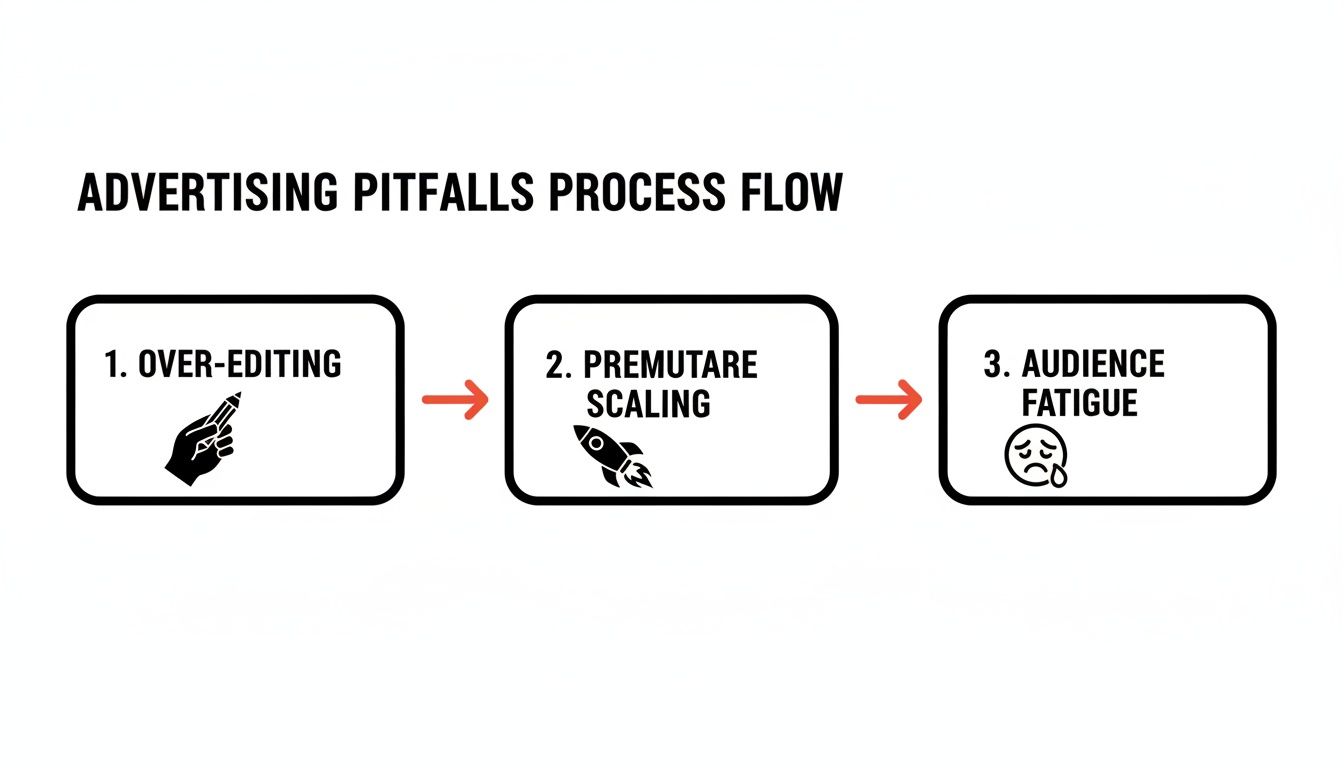
As you can see, one bad habit often starts a domino effect, leading to wasted ad spend and tanking performance.
A Repeatable Daily Execution System
So, what does this actually look like day-to-day? It boils down to a simple, three-step check-in that should take you minutes, not hours, and keeps you focused on the tasks that will have the biggest impact.
Review Ranked Opportunities: Start your day by looking at a prioritized list of actions. The most urgent issues, or biggest opportunities, should be right at the top, ordered by their potential impact on your budget and performance.
Inspect the Rationale: Before you act, look at the "why." A good system will show you the exact data that triggered the alert—like a 40% drop in CTR over the last three days—so you can feel confident in the suggestion.
Execute or Snooze: With all the context, you can make the change right then and there. Or, you can decide to "snooze" the recommendation and keep an eye on it for another day. This puts you in the driver's seat, using AI-driven insights as a trusted advisor, not a blind command.
This disciplined process creates the guardrails you need to sidestep common traps, like meddling with your campaigns too much or trying to scale an ad before it's actually ready. By building a daily execution system for your e commerce advertisement efforts, you stop reacting to problems and start proactively managing your accounts, ensuring every dollar you spend is working as hard as it can to grow your business.
A Few Common Questions About E-commerce Ads
Even with a great plan, running e-commerce ads can feel like you're constantly trying to hit a moving target. To clear up some of the usual confusion, I've rounded up the questions I hear most from operators and marketers who are deep in the weeds every day.
How Much Should I Spend on Ads When I'm Just Starting Out?
There isn’t a single magic number here. The smartest way to think about it is to work backward from your product's price and, more importantly, its profit margin.
A solid benchmark to start with is a 2:1 Return on Ad Spend (ROAS). This simply means for every $1 you put into ads, you get $2 back in revenue. For most brands, that’s enough to cover the cost of the product and shipping, putting you right at break-even. Once you start getting good data and seeing what works, you can start pushing for a healthier 3:1 or 4:1 ROAS.
Don't feel pressured to dump your entire budget into the first week. Start small with something like $20-$50 per day. This gives you room to test and learn without lighting your money on fire.
How Long Should I Let an Ad Run Before Killing It?
This is where so many new advertisers shoot themselves in the foot. Being too quick on the trigger and pausing an ad after a couple of bad days is one of the costliest mistakes you can make. Platforms like Meta and Google have a "learning phase" where their algorithms are actively trying to find your ideal customer. You have to give them time to work.
As a rule of thumb, let any new ad run for at least 72 hours before you even think about judging its performance. For an even clearer picture, wait until an ad has served at least 1,000 impressions. This gives the platform enough data to work with and tells you whether the ad is truly bombing or just having an off day.
What's Actually a Good ROAS for E-commerce?
While you'll hear different benchmarks thrown around, a 4:1 ROAS (making $4 for every $1 spent) is widely considered a strong target for most e-commerce stores. But honestly, context is king.
A 2:1 ROAS might be perfectly fine—even great—if your main goal is just to acquire new customers at your break-even point.
On the flip side, seeing a 10:1 ROAS from a retargeting campaign sounds amazing, but it could be a red flag that you're only advertising to a tiny group of existing fans and missing out on real growth.
Your "good" ROAS always comes back to your specific profit margins and what you’re trying to achieve. The goal is to know your numbers inside and out so you can set different, realistic targets for different campaigns, like prospecting versus retargeting.
Feeling buried in spreadsheets and confusing campaign data? SpendOwlAI translates all that noise into a simple, prioritized to-do list. You can stop guessing what to fix and start making changes that actually move the needle.
See exactly what your campaigns need today with our free 7-day trial at https://spendowlai.com.