Dropshipping with Facebook Ads Your 2026 Playbook
When you pair dropshipping with Facebook Ads, you're essentially pouring high-octane fuel on your ecommerce engine. It’s a powerful combination that lets you tap into Meta's massive user base and sophisticated targeting tools to drive purchase-ready traffic straight to your product pages. This is how you rapidly test, optimize, and scale.
Why Facebook Ads Still Win for Dropshipping in 2026
Let's get straight to the point: is running ads for dropshipping on Facebook still a viable strategy? Yes, absolutely—but the game has evolved. Gone are the days of throwing a bunch of products at the wall to see what sticks. Success in 2026 requires a smarter, data-first mindset.
Despite all the talk about rising ad costs and fierce competition, Meta’s platform is still the go-to for serious dropshippers. The reason is simple: unmatched audience data. No other platform comes close to its ability to pinpoint and reach specific customer profiles with such surgical precision.
The Shift from Brute Force to Brains
The old-school approach of brute-force testing dozens of products is a fast way to burn cash. The modern playbook is all about intelligent campaign structures and, more importantly, knowing how to read the signals your data is giving you. It's less about wild guessing and more about making calculated moves.
To thrive in today's advertising environment, you need to master a few key areas:
Precision Targeting: Go beyond broad interests. Your focus should be on layering behaviors, creating lookalike audiences from your best customers, and using retargeting to bring people back.
Thumb-Stopping Creative: Your ads can't look like ads. They need to feel native to the feed and grab attention in the first three seconds.
Data-Driven Decisions: You have to know which metrics actually matter for profitability and when to act. Just as crucial is knowing when to sit on your hands and let the algorithm do its work.
The single biggest mistake I see sellers make is panicking over noisy data. A dip in ROAS for a few hours doesn’t automatically mean you should kill an ad set. The real skill is learning to tell the difference between a real problem and normal daily fluctuations. That's the secret to long-term profitability.
For a deeper look into building winning campaigns, this guide on dropshipping with Facebook Ads is a great resource.
The Power of Paid Amplification
Organic reach on platforms like TikTok and Instagram has its place, but if you're looking for speed and control, nothing beats a well-executed paid ad campaign. Here’s a quick comparison of the core differences in speed, scale, and control when using paid Facebook ads versus relying on organic social media traffic for dropshipping.
Facebook Ads vs Organic Traffic at a Glance
Metric | Facebook Ads | Organic Traffic (e.g., TikTok, Instagram) |
|---|---|---|
Speed to Traffic | Immediate. Traffic starts as soon as ads are approved. | Slow and unpredictable. Can take weeks or months to gain traction. |
Scalability | High. Directly scalable by increasing the ad budget. | Low. Scaling is difficult and often relies on viral luck. |
Targeting | Hyper-specific. Target by demographics, interests, and behavior. | Very broad. You're targeting anyone who stumbles upon your content. |
Control | Full control over budget, audience, placement, and creative. | Minimal control. You're at the mercy of the platform's algorithm. |
Measurement | Detailed analytics on performance, ROI, and customer journey. | Basic metrics like views and likes; hard to track direct sales. |
The table makes it clear: when you want to grow fast, paid ads are the most reliable tool in your arsenal. The potential here is massive. We've seen a Shopify store pull in $563,000 in sales in just 30 days, all driven by a smart paid ad strategy. While that's an outlier, data consistently shows that the average dropshipper using Facebook Ads brings in about $5,000 per month—nearly 10 times more than those relying solely on free traffic.
This is where smart tools come into play, helping you translate a mountain of complex performance data into simple, daily actions. They act as a safety net, preventing costly errors and giving you a sharp competitive edge. To get a better handle on effective targeting, check out our guide on why segmentation is important in marketing. With the right strategy and tools, building a resilient, profitable dropshipping business is more achievable than ever.
Building Your Foundation Before You Spend a Dollar
I see it all the time. Someone gets excited about dropshipping, finds a product, and immediately throws money at Facebook ads, hoping for a magic money machine. A week later, their budget is torched, and they have zero sales to show for it.
Here’s the hard truth: ads only amplify what you already have. A killer ad campaign can't fix a bad product, a weak offer, or a clunky website. Success in dropshipping with Facebook ads is won or lost before you ever open Ads Manager. Get this foundation right, and your ad dollars will actually turn into profit, not just expensive clicks.
Picking Products Built for Visual Ads
The biggest mistake new dropshippers make is chasing the latest flashy gadget they saw on TikTok. The real, sustainable winners aren't "wow factor" products; they're problem-solvers.
Your product needs to make someone stop scrolling and think, "I need that." It has to lend itself to a visual story on a platform like Facebook or Instagram.
Think about it. A portable blender is just a piece of plastic and metal. But an ad showing someone making a fresh smoothie at their desk after a grueling morning of meetings? That’s not a blender; it’s a solution for an unhealthy, rushed lifestyle. A specialized pet grooming glove isn't just a brush; it's the end of wrestling with your cat and finding hair on every black shirt you own.
These products have a high perceived value because they solve a real, often annoying, problem. That's what gets people to click and, more importantly, to buy.
My rule of thumb: Find a product that solves a nagging problem for a passionate community. Whether it's for gardeners, knitters, or new parents, these groups are full of people looking for an easier way to do what they love.
Crafting an Irresistible Offer
Your product isn't the offer. The product is the "what"; the offer is the "how" and "why now." It's the entire package you present that makes a customer feel like they’d be crazy to pass it up.
From day one, you should be thinking about how to increase your Average Order Value (AOV). Selling single units is a tough way to make a living. Instead, build an offer they can't refuse.
Build Smart Bundles: Don't just offer a "3-Pack." Nobody needs three of the exact same thing right away. Instead, create a "Complete Solution" kit. If you're selling a premium car wax, bundle it with two microfiber towels and an applicator pad. That’s a real solution.
Create Tiered Choices: Give people options that make them feel smart. Offer a "Basic" version (the product), a "Deluxe" version (the product + a popular accessory), and a "Ultimate" bundle (everything in Deluxe plus another complementary item). Most people will pick the middle option.
Reverse the Risk: A "30-Day Money-Back Guarantee" is table stakes. It's expected. Go further. A "Love It or It's Free" guarantee or a "60-Day No-Hassle Return" policy shows you have immense confidence in your product and instantly builds trust.
Your job is to make the value so obvious that the price feels like an afterthought. You're not selling a thing; you're selling a risk-free, complete solution to their problem.
Your Conversion-Ready Shopify Store
So you've got a great product and a killer offer. The customer clicks. Now what? Your Shopify store is where the sale is won or lost. A slow, amateurish, or confusing store will kill your conversions faster than anything else.
Think of your store as the final handshake. It has to be firm and confident.
Here are the non-negotiables your store absolutely must have:
Blazing Speed: In 2026, anything over 3 seconds to load is a failure. Test your site speed on mobile. Every millisecond you shave off is potential revenue saved.
Bulletproof Product Pages: This is your sales pitch. Use high-quality photos and, if possible, short video clips showing the product in use. Your copy should be all about the customer's transformation—the benefits, not just a list of features. And sprinkle it liberally with social proof. Customer reviews with photos are absolute gold.
Zero-Friction Checkout: Make it stupidly simple to give you money. The fewer fields and clicks, the better. Offer express payment options like Shop Pay, PayPal, and Google Pay right at the top. Don't make them hunt for it.
Finally, for anyone serious about using Facebook ads, your data tracking has to be flawless from the get-go. This means setting up your Meta Pixel and Conversions API correctly. This isn't optional; it's the nervous system of your entire advertising operation. If that sounds intimidating, taking some time to understand the Meta Conversions API is one of the smartest investments you can make early on.
Building Your First Campaign: The Blueprint for Success
Alright, you've got a killer product and your store looks sharp. Now for the moment of truth: heading into Meta's Ads Manager. This is where a lot of people get lost, but getting your campaign structure right from day one is the difference between burning cash and building a real business.
When you first create a campaign, Meta asks for your objective. Let me make this simple for you: always, always choose Sales.
I see so many beginners get tempted by the lower costs of 'Traffic' or 'Engagement' campaigns. It feels cheaper, but it’s a trap. You're telling the algorithm to find you people who are great at clicking links and liking posts, not people who actually buy things. Selecting Sales (what we used to call 'Conversions') trains the algorithm on the one thing that matters—finding users with a proven history of pulling out their credit cards.
CBO vs. ABO: The Eternal Budget Debate
Next, you have to decide how to manage your budget: Campaign Budget Optimization (CBO) or Ad Set Budgets (ABO). Your choice here dictates how you test.
Campaign Budget Optimization (CBO): You give Meta one single budget for the whole campaign. Its algorithm then decides which of your ad sets get the most money based on performance. It's built for efficiency.
Ad Set Budget (ABO): You set a specific daily budget for each ad set. This gives you direct, manual control over spending for each audience you’re testing.
For testing a new product, I start with ABO every single time. Why? Because it guarantees every audience gets a fair chance. With CBO, the algorithm can sometimes jump the gun, pouring all the money into one ad set that gets an early lucky sale, while starving others that might have become winners with a little more time. ABO keeps the test clean.
CBO is a fantastic tool, but its time comes later—when you’ve found your winning audiences and you’re ready to let the algorithm scale your winners to the moon.
How to Structure Your Audience Tests
Finding that first pocket of profitable customers is everything. To do this, I build my initial campaigns around testing distinct audience hypotheses. It’s not about guessing; it’s about strategically asking the market what it wants.
I set up one testing campaign with several ad sets. Each ad set targets a completely different group of people. Let's say we're selling a slick, portable espresso maker. Here’s how I’d structure it:
Example Test Campaign: Portable Espresso Maker
Ad Set 1 (Competitor Fans): Go after people who already buy from established, higher-end coffee brands. They appreciate quality and might be looking for a portable alternative.
Interests: Nespresso AND Keurig AND Breville
Ad Set 2 (The Outdoorsy Type): Target people whose hobbies scream "I need coffee on the go!"
Interests: Hiking AND Camping AND Frequent Travelers
Ad Set 3 (The Coffee Snobs): Aim for the true enthusiasts who live and breathe coffee culture.
Interests: Specialty coffee AND Barista AND Coffee beans
Ad Set 4 (The Wildcard - Broad): This one is my secret weapon. Target a wide demographic (like Males 25-55 in the US) but with zero interest targeting. Seriously. This lets your ad creative do the heavy lifting and allows Meta’s powerful algorithm to find customers you never would have thought of.
Pay close attention to the "AND" logic, which you create by layering interests. Targeting people who like "Hiking" or "Camping" is way too broad. But targeting people who like "Hiking" AND "Camping" finds you a much more dedicated outdoor enthusiast who is the perfect customer for a portable product.
Think of each ad set as a question you're asking the market. "Do outdoor lovers want my product?" "Will Nespresso fans switch?" The data you get back is the answer, telling you exactly where to focus your money.
It’s no secret that dropshipping’s growth is tied to Facebook. Even as the ad space gets more competitive, an incredible 78% of all sales from social media happen right here. The global dropshipping market is on a rocket ship, projected to hit $445.5 billion in 2025 and a staggering $1,253 billion by 2030. That growth is fueled by platforms like Meta. It’s why we’re all here, even though ad costs have jumped 47% since 2023. This is where the buyers are—over 60% of US shoppers admit Facebook has directly influenced a purchase. If you want a deeper dive, there's a full report on the 2025 Facebook ads outlook that breaks it all down.
Your first campaign isn't about getting rich overnight. It's about gathering clean, actionable data. By isolating your audiences into separate ad sets (and running the same ads in each one), you can see with total clarity which message resonates with which group. This methodical approach is the bedrock of profitable scaling.
Creating Ad Creatives That Actually Convert
You can have the most perfectly-built campaign and laser-focused audience targeting, but none of it matters if your creative is weak. When it comes to dropshipping with Meta ads, your creative is the single biggest lever you can pull. It’s what stops the scroll, earns the click, and ultimately decides if you're profitable.
Forget the generic advice you’ve heard a hundred times to just "use more video." What you really need to know is which types of videos and images actually work in a feed crowded with content.
Honestly, a polished, corporate-style ad is often the fastest way to get ignored. We've all seen them, and we scroll right past because they scream "I'm an ad!" from a mile away. The trick is to create something that feels native to the feed—more like a post from a friend and less like a slick production from a huge brand. This is how you build instant trust and lower a viewer’s natural skepticism.
The Three Creative Styles That Drive Sales
After years in the trenches, I’ve found that almost all of my winning ads fall into one of three buckets. They each have a different angle, but they all share one common thread: authenticity. They just don't feel like they're trying too hard to sell you something.
Raw, UGC-Style Content: User-generated content (or even better, content that just looks like it) is absolute gold. It acts as powerful social proof by showing real people using and loving your product. It feels genuine, which is a massive advantage. You don’t need a fancy camera; a modern smartphone is all it takes to create these high-impact videos.
Clear Problem/Solution Demos: This is the workhorse of dropshipping creative. The formula is beautifully simple: show a frustrating problem, introduce your product as the hero, and then demonstrate exactly how it solves that problem. It’s direct, easy to understand, and incredibly effective for any product that serves a clear purpose.
Story-Driven Videos: This style is all about creating an emotional connection. Instead of just showing off the product, you tell a relatable story where the product helps someone achieve a transformation. This is how you stop selling an item and start selling a lifestyle.
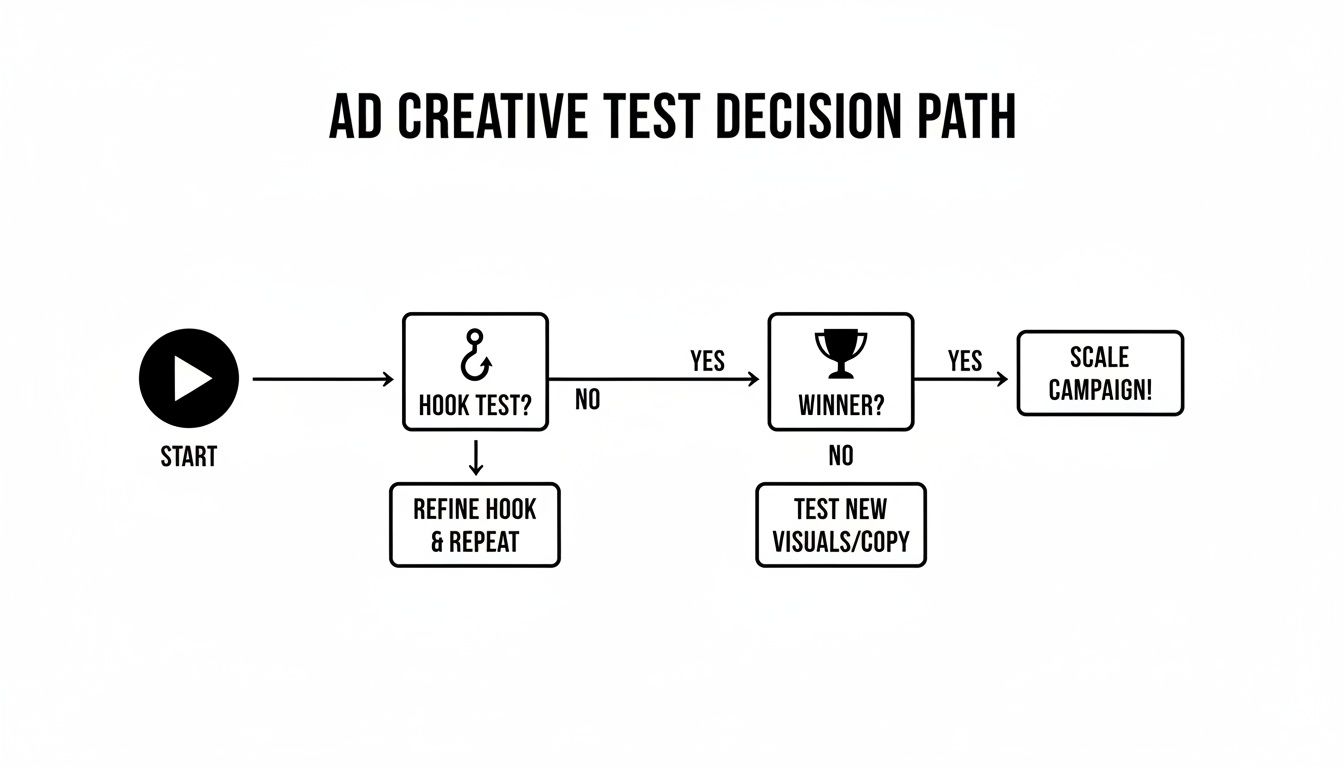
Remember, the first three seconds are everything. Your 'hook'—that opening shot or line—is what determines if someone stops scrolling or glides right past. I always test at least three different hooks for every single new creative concept I launch.
Writing Ad Copy That Sells
Your visuals grab their attention; your ad copy is what convinces them to act. The best copy doesn't just ramble on about features. It speaks directly to your customer's biggest pain points and deepest desires.
One of the most effective and dead-simple frameworks for this is PAS (Problem, Agitate, Solve).
Problem: Call out the specific problem your audience is dealing with. For instance, "Tired of your phone dying right when you need it most?"
Agitate: Pour a little salt in the wound. Remind them how frustrating that problem really is. "Nothing's worse than being stranded with a dead battery and no way to call for a ride home."
Solve: Position your product as the obvious solution. "That's why our pocket-sized power bank is a total lifesaver. It delivers two full charges and fits right on your keychain, so you’re never left powerless again."
This simple three-step flow works because it follows the customer's own train of thought, guiding them from a place of frustration to a clear, simple solution.
A Systematic Approach to Creative Testing
Running ads without a solid testing plan is like flying blind—you’re just burning money. You need a system to find winners quickly without wasting your budget. My entire method revolves around isolating one variable at a time.
I always start by testing 3-5 completely different creative concepts (like a UGC video vs. a demo video vs. an image slideshow) against my best audience. I give them about 48-72 hours to run. In this first phase, I'm not obsessed with Return On Ad Spend (ROAS). I'm hunting for leading indicators.
So, what are those indicators?
High Click-Through Rate (CTR): A high CTR is the clearest signal that your creative is grabbing attention and resonating with people. If your CTR is low, you have a fundamental problem. Improving this metric is key, and if you're struggling, you can learn more about how to improve click-through rates here.
Low Cost Per Click (CPC): When people are genuinely interested and click your ad, the platform often rewards you with a lower CPC. It's another strong sign that your creative is hitting the mark.
High Outbound Clicks: This tells you people aren't just clicking to expand your ad copy; they are actively trying to leave Facebook to get to your website. This is a huge buying signal.
Once I find a creative that has a strong CTR and a low CPC, I know I've got a potential winner on my hands. Only then do I move on to the next phase: testing different hooks, headlines, or calls-to-action on that winning concept. This methodical process stops you from wasting money and helps you find a scalable ad much, much faster.
How to Test Optimize and Scale Like a Pro
Hitting "publish" on your ads is just the starting point. The real game of dropshipping with Facebook ads starts now. This is where you transform a flood of data into a predictable, money-making machine through a disciplined process of testing, learning, and scaling.
Success isn't about getting obsessed with one metric like Return On Ad Spend (ROAS). It's about understanding the whole story the data is telling you. Many dropshippers fail because they fixate on a single number and miss the bigger picture.
Your First 72 Hours: Reading the Initial Data
Those first 3-5 days are strictly for data collection. I can't stress this enough: your goal isn't immediate profit, it's to find signs of life. You have to fight the urge to make frantic changes after just a few hours. That's the single biggest profit-killer I see new advertisers make.
Just let your ABO test campaign run with its dedicated ad set budgets. After about 72 hours, you’ll have a clear enough picture to make your first smart decisions.
Here's what I'm looking for:
Cost Per Purchase (CPA): Is it near or below your break-even point? If an ad set is getting sales within your target, it’s a keeper for now.
Click-Through Rate (CTR): Anything above 1.5% is a great sign. It tells me the creative is doing its job and grabbing attention. If CPA is high but your CTR is strong, the problem probably isn't the ad—it's likely your landing page or offer.
Cost Per Click (CPC): Low CPCs, ideally under $1.50, show that Meta finds your ad highly relevant to the audience. You're getting clicks without breaking the bank.
A low ROAS in the first few days doesn't always mean you should kill an ad. I've kept ad sets with a 1.5x ROAS running because they had a great CPA and a high CTR. Those are the green shoots that can grow into profitable performers with a little more time and data.
This flowchart maps out the decision-making process for your creative tests, starting from launch and moving through optimization.
Ad Performance Decision Matrix
Use this simplified guide to make smart decisions based on key ad metrics during your initial testing phase.
Scenario | Key Metrics | Recommended Action |
|---|---|---|
Clear Winner | Good CPA, High CTR (>1.5%), Low CPC | Keep running. This is a candidate for a scaling campaign. |
Good Ad, Bad Page | High CPA, High CTR (>1.5%) | Keep the creative. Review your landing page and offer for issues. |
Wrong Audience | High CPA, Low CTR (<1%), High CPC | Kill the ad set. The ad isn't resonating with this audience. |
Maybe Pile | Moderate CPA, OK CTR (~1%) | Let it run a bit longer. If performance doesn't improve, kill it. |
This matrix isn't foolproof, but it provides a solid framework for interpreting the early signals your campaigns are giving you.
Consolidating Winners and Optimizing
Once that initial test is done, it's time to consolidate your wins. Identify the best-performing ad sets—the ones with that magic blend of CPA, CTR, and actual purchases—and graduate them to a new campaign.
This new campaign should use Campaign Budget Optimization (CBO). By putting your proven ads and audiences under a single CBO budget, you let Meta's algorithm automatically shift your money to the top performers in real time. This is how you start building real efficiency as you scale.
Of course, even the best ads can't save a broken store. Make sure you've plugged all the leaks in your sales funnel by following a comprehensive Conversion Rate Optimization Checklist for Shopify. An optimized store is critical for turning those expensive clicks into profit.
Safe vs. Aggressive Scaling Strategies
With a profitable CBO campaign humming along, your next move is to scale. There are two primary paths you can take: vertical and horizontal.
Vertical Scaling (The Safe Route)
This is the most straightforward method: you simply increase the budget on your winning CBO campaign.
My Rule of Thumb: Increase the daily budget by no more than 20% every 48-72 hours.
Why it works: Small, slow increases keep the algorithm stable and prevent it from going back into the volatile "learning phase." It's the slow-and-steady-wins-the-race approach to growing spend while protecting your profit margins.
Horizontal Scaling (The Aggressive Expansion)
Here, you duplicate your winning ad sets to find new pockets of customers. It's about broadening your reach quickly.
Target New Lookalike Audiences: Build lookalikes from different data, like people who initiated checkout or your top 25% video viewers.
Stack Your Interests: Combine your winning interests into larger "super audiences" to give the algorithm more room to run.
Go International: Duplicate your winning campaign and start targeting new countries with similar demographics to your best market.
Ultimately, successful scaling comes down to having a system. Instead of making emotional, gut-based decisions, you're following a clear process driven by data. This is where a tool like SpendOwlAI can be a game-changer. It cuts through the noise of performance data and gives you clear, prioritized actions—telling you exactly when to scale, when to tweak, and when to just let things run. This discipline is what separates the pros from the rest.
Common Questions About Dropshipping with Facebook Ads
Once you're in the trenches running ads, you'll find the same questions and nagging uncertainties tend to pop up again and again. It's totally normal to hit a wall or second-guess your numbers. Let's tackle some of the most common questions I hear from dropshippers trying to make Facebook ads work.
How Much Budget Do I Really Need to Start?
Let's cut right to the chase: you need a proper testing budget. I tell everyone to set aside a minimum of $500 to $1,000 before they even think about launching their first ad. Think of this as your data-gathering fund, not instant profit.
A solid starting point is to budget $10–$20 per day for each ad set you're testing. The whole point of this early phase is to find a winning combination of creative and audience. If you spend any less, you’re basically flying blind and might kill an ad just before it starts to show its true potential.
What Is a Good ROAS for Dropshipping?
The only honest answer here is: it depends entirely on your product's profit margin. A "good" Return On Ad Spend (ROAS) for one store could be a disaster for another.
As a general rule of thumb, hitting a 3.0x ROAS or higher is a great place to be. For most dropshipping products, that means you're comfortably in the green. But if you're selling something with massive margins, you could be profitable even at a 2.0x ROAS. It all comes down to your own math.
In the very beginning, don't get hung up on hitting 3.0x right away. I'm often looking for a 1.5x to 2.0x ROAS during testing, as long as my other numbers look healthy. A high Click-Through Rate (CTR) and a low Cost Per Purchase (CPA) are green lights telling me the campaign has legs and is worth optimizing.
Why Are My Facebook Ads Not Getting Sales?
You're getting a ton of clicks, but your Shopify sales notification is silent. It's one of the most frustrating problems to have, but the issue is rarely just the ad itself. Before you start tweaking your campaign, you need to play detective and figure out where your funnel is leaking.
If you have a high CTR but no sales, the problem is almost always happening after the click. Take a hard look at your landing page. Is it trustworthy? Does it load quickly on mobile? Is the price what they expected?
On the other hand, if your CTR is painfully low, that’s a clear signal that your ad creative isn't resonating or your targeting is off. Use the data to isolate the problem instead of just throwing money at a broken campaign.
How Do I Avoid Getting My Facebook Ad Account Banned?
Getting your ad account shut down is a nightmare that can halt your business overnight. The only way to protect yourself is to be proactive and obsessively follow Facebook's Advertising Policies.
Here are the non-negotiable rules I live by:
No Wild Claims: Don't promise your product will change someone's life in 30 seconds. Steer clear of exaggerated "before and after" pictures—they're a huge red flag for Meta's review bots.
Check the Prohibited List: Seriously, double- and triple-check that what you're selling isn't on the restricted or prohibited products list.
Be a Real Business: Your store needs to look legitimate. That means having an easy-to-find privacy policy, contact info, and clear shipping and return policies.
Warm Up New Accounts: Don't just open a new ad account and immediately launch a conversion campaign. Start slow. Run a simple page likes or engagement campaign for a few days first to build some trust with the platform.
Stop Panic Editing: Making a dozen changes to your campaign in an hour looks suspicious and can trigger an automatic account review. Be patient and methodical.
SpendOwlAI cuts through the noise of your ad performance data and gives you a clear, prioritized list of what to do each day. It acts as a set of expert guardrails, helping you make smarter decisions, avoid costly mistakes, and execute your strategy with confidence. Start your free 7-day trial.